

Saved Bookmarks
This section includes 7 InterviewSolutions, each offering curated multiple-choice questions to sharpen your Current Affairs knowledge and support exam preparation. Choose a topic below to get started.
| 1. |
During electrolysis of H_(2)O , the molar ratio of H_(2) and O_(2) formed is |
|
Answer» ` 2 : 1` `THEREFORE` The ratio of `H_(2)` to `O_(2)` `1 : 0.5therefore 2 : 1` |
|
| 2. |
Draw the diagram showing micelle formation by the following detergent. CH_(3)(CH_(2))_(10)CH_(2)Osbar(O_(3))Na |
|
Answer» Solution :Sodium lauryl sulphate `CH_(2)(CH_(2))_(10)CH_(2)OSO_(3)^(-)overset(+)(N)a` is an example of anionic detergent. when added to water, it DISSOCIATES as follows `CH_(3)-(CH_(2))_(10)-CH_(2)OSO_(3)^(-)overset(+)(N)aoverset(+H_(2)O)rarrCH_(3)-(CH_(2))_(10)CH_(2)-OSO_(3)^(-)+overset(+)(N)a` These anions are PRESENT on the surface with their `-OSO_(3)^(-)` groups in water and hydrocarbon part staying away from it and remain at the surface. At higher concentration, these anions are pulled into the bulk of the solution and form an aggregate of spherical SHAPE with their hydrocabonpart pointing towards the centre and `OSO_(3)^(-)` part outwards on the surface of the SPHERE. An aggregatethus formed is KNOWN as micelle. 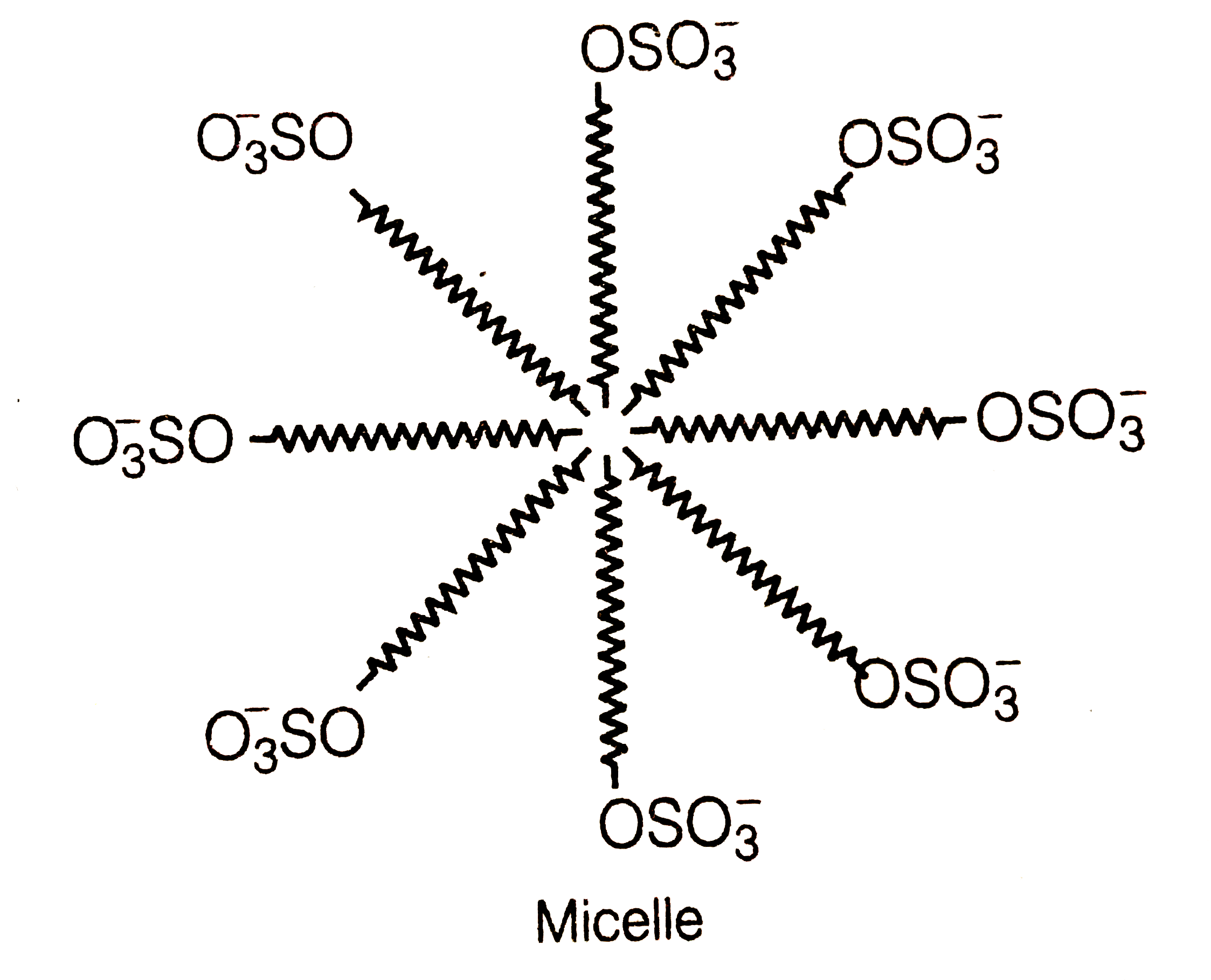
|
|
| 3. |
During electrolysis of fused NaOH |
|
Answer» `H_2` is LIBERATED at CATHODE |
|
| 4. |
Draw the diagram showing micelle formation by the following detergent. CH_3(CH_2)_10CH_2OSO_3^(-)overset+Na |
Answer» SOLUTION :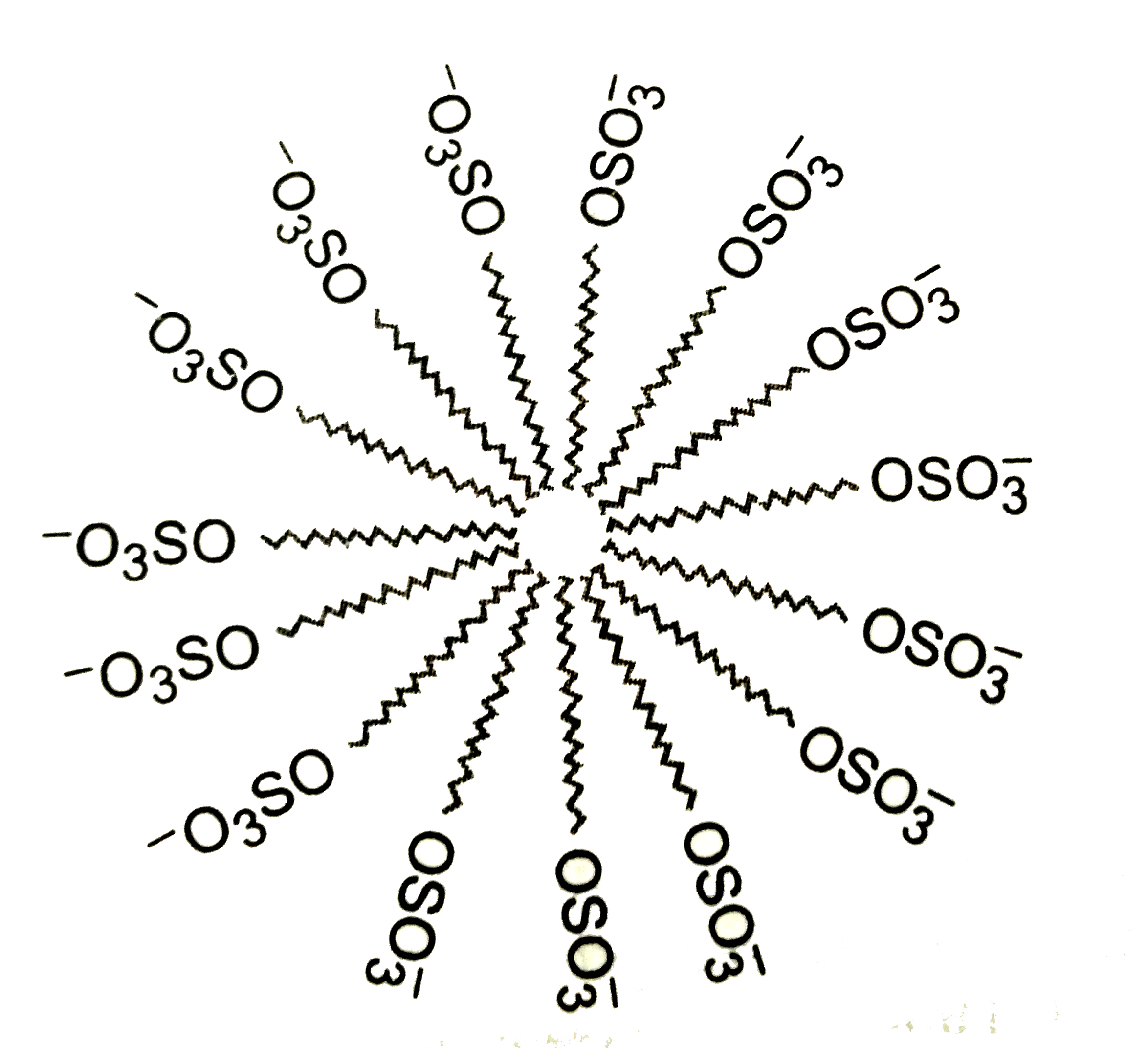
|
|
| 5. |
During electrolysis of fused CaH_2,H_2 is liberated at : |
|
Answer» Anode |
|
| 6. |
During electrolysis of fused aluminium chloride 0.9gm of aluminium was deposited on the cathode. Thevolume of chlorine liberated at the anode will be |
|
Answer» 2.24 litres |
|
| 7. |
During electrolysis of dilute aqueous CuSO_(4) solution by inert electrode, the pH of solution is. . . |
|
Answer» Decreases |
|
| 8. |
During electrolysis of aqueous solution of Na_2SO_4 using graphite electrode ......... |
|
Answer» CONCENTRATION of `Na_2SO_4` DECREASES. |
|
| 9. |
During electrolysis of aqueous NaOH,4gof O_2 gas is liberated at NTP at anode, H_2 gas liberated cathode is |
|
Answer» 2.8 LITRES |
|
| 10. |
During electrolysis of aqueous solution of a salt pH in the space near one of the electrodes is increased. Which of the following salt solution was electrolysed? |
| Answer» Answer :A | |
| 11. |
During electrolysis of an aqueous solution of sodium sulphate, 2.4 L of oxygen at STP was liberated at anode. The volume of hydrogen at STP, liberated at cathode would be |
|
Answer» 1.2 L |
|
| 12. |
Draw the cis, trans isomers for the following and designate them as E or Z. |
|
Answer» `HOH_(2)C-CH=CHCH_(2)CH_(3)` |
|
| 13. |
During electrolysis of a solution of AgNO_(3) , 9650 coulombs of charge pass through the electroplating bath, the mass of silver deposited on the cathode will be |
|
Answer» 1.08g |
|
| 14. |
Draw the bond line structures of the following compounds whose IUPAC names are given as under: (a) 4-Methylpent-1-ene (b) Hex-1-yne (c) 2,3-Dimethylbut-2-ene (d) 3-Isbutylhept-1-ene (e) 3-Ethyl-5-Methylhex-1-ene (f) Penta-1,4-diyne (g) Pent-1-en-4-yne (h)trans-1,3-Dichlorocyclopentane (i) 3,4-Dipropylhepta-1,3,5-triene (j) 4,4-Dimethylpentanal (k) Ethyl-2-cyanopropanoate (l) N-Methylpropan-1-amine. (m) N-Ethyl-N-methyl-2-aminopropane (n) Pentanalimine (o) N-N-Dimethylbutanamide (p) 4-Phenylbutanal (q) 3-Ethenylpenta-1,3-diene (r) 4-Hydroxy-4-methyl-2-pentanone (s) 2,6 -Dimethylhepta-2,5-dienoic acid (t) 1-Cyclopropyl-3-methylpent-1-ene (u) 2,2,6,6-Tetramethyloctane (v) 3-Cyclobutyblut-1-ene (w) 5,6-Dimethylcyclohex-2-en-1-one (x) 3-Ethyl-4-methylhex-4-en-2-one (y) 3- phenylprop-2-en-1-oic-acid (z) 1,1,1,-Trichloro-2,2-diphenylethane. |
|
Answer» |
|
| 15. |
During electrolysis of an aqueous solution of Cu^(2+) sulphate , 0.635 g of copper was deposited at cathode. The amount electricity consumed in coulomb is : |
|
Answer» 1930 |
|
| 16. |
Draw tge structuresof (i) D - Gluceose (ii) D - fructose . |
Answer» SOLUTION :
|
|
| 17. |
During electrolysis of a NaCI a part of the reaction is Na^+ +e^- rarrNa This cannot be termed as : |
|
Answer» Oxidation |
|
| 18. |
During electrolysis of 1 litre of aq. CuSO_4 , the P^(H) of the solution is changed from 5.0 to 4.3 . Then the number of faradays consumed in the process is (x xx 10^(-4)) , here , (x + y) = ? |
|
Answer» ` 2F overset("PASSED ") to 2` moles of `H^(oplus)` `Q to n xx 4 xx 10^(-5) , n = (Q xx 2)/(2F) = 4 xx 10^(-5) , Q = 4 xx 10^(-5) xxF` ` Q = x xx 10^(-4) xx F , (x + y) = (4+5) = 9` |
|
| 19. |
Draw structures of the following derivatives. (i) The ethylene ketal of hexan-3-one (ii) The methyl hemiacetal of formaldehyde |
Answer» SOLUTION :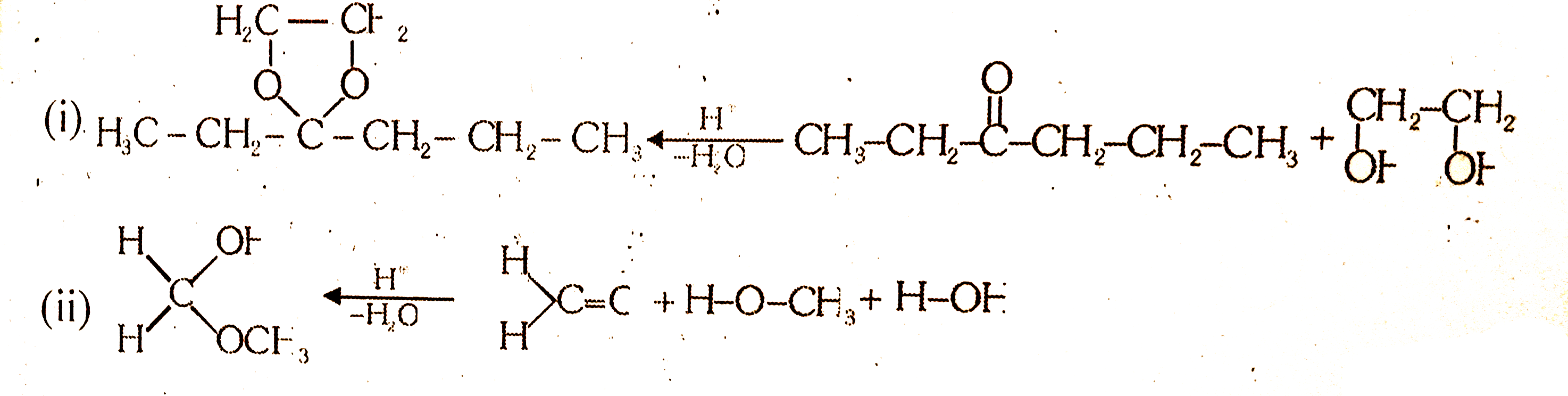
|
|
| 20. |
During electro-osmosis of Fe(OH)_(3) sol : |
|
Answer» sol particles MOVE towards anode Here, the medium is NEGATIVELY CHARGED. |
|
| 21. |
During electrolysis of a concentrated aqueous solution of NaCl , what is the product at anode ? |
|
Answer» `Na` |
|
| 22. |
Draw structures of the following derivatives: (i) The 2,4-dinitrophenylhydrazone of benzaldehye. (ii) Cyclopropanone oxime. (iii) Acetaldehydedimethyl acetal, (vI0 The methyl hemiacetal of formaldehyde. (v) The ethylene ketal of hexan-3-one. |
Answer» SOLUTION :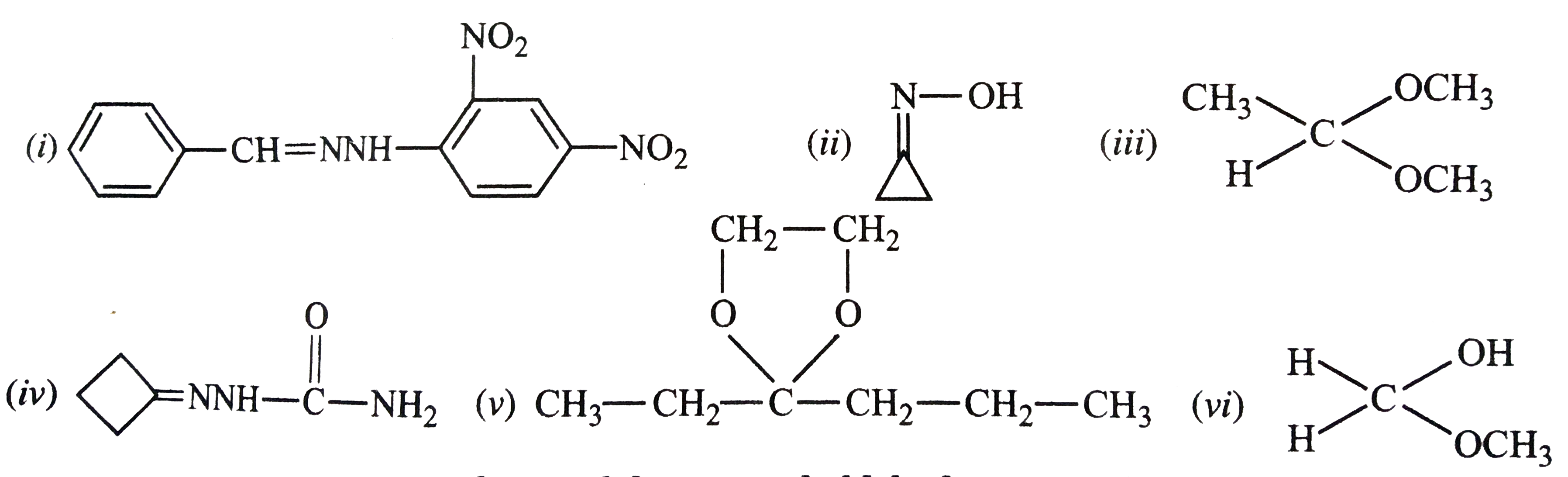 . .
|
|
| 23. |
During electrolysis, 2A current is passed through an electrolytic solution for 965 S. The number of moles of electrons passed will be |
|
Answer» 0.02 |
|
| 24. |
Draw structures of the following derivatives: (i) The 2,4-dinitrophenylhydrazone of benzaldehyde |
Answer» SOLUTION :STRUCTURES of COMPOUNDS (i) to (VI) are GIVEN below: 
|
|
| 25. |
During discharging of lead-storage acid battery following reaction takes place : Pb(s) +PbO_(2)(s)+2H_(2)SO_(4)rarr 2PbSO_(4)(s)+2H_(2)O If 2.5 amp of current is drawn for 965 minutes, H_(2)SO_(4) consumed is : |
|
Answer» `0.75 ` MOL |
|
| 26. |
During dischare of a lead storage battery the denisty of suphuric acid fell form 1.3 to 1.15 gm/ml sulphuric acid of denisity 1.3 gm/ml is 40 % H_(2)SO_(4) by wt and that of denisty 1.15 gm/ml is 20% by wt the battery hold amp hours for which the battery must have been used Pb+SO_(4)^(-2)rarrPbSO_(4)+2e^(-)(discharging) PbO_(2)+4H^(+)+SO_(4)^(2-)+2erarrPnSO_(4)+2H_(2)O (discharging) |
|
Answer» 265.04 AH |
|
| 27. |
Draw structures of geometrical isomers of [Fe(NH_(3))_(2)(CN)_(4)]^(-). |
Answer» SOLUTION :
|
|
| 28. |
During distillation of coal tar. Anthrace ins mainly present |
|
Answer» LIGHT oil |
|
| 29. |
During discharging of Lead storage cell, the reaction taking place at cathode is represented by : |
|
Answer» `PB to Pb^(+2)+2e^(-)` |
|
| 30. |
During discharging of lead storage battery, which of the following is/are true? |
|
Answer» `GH_2SO_4` is PRODUCED |
|
| 31. |
Draw structures of each of the following compounds : (ii) (S)-2-bromohexane. |
Answer» SOLUTION :
|
|
| 32. |
During discharge of Dry cell , the gas liberated at the cathode is : |
|
Answer» `H_(2)` ` 2NH_(4)^(+) + 2e^(-) to 2 NH_(3) + H_(2)` |
|
| 33. |
During detection of P we get canary yellow ppt on addition of ammonium molybdate. The number of element in sp^(3) hybridisation from 15^(th) group is ______________. |
|
Answer» |
|
| 34. |
Draw structures of each of the following compounds : (i) (R)-2-butanol. |
Answer» SOLUTION :
|
|
| 35. |
During diazo coupling, the following group is retained |
|
Answer» `-N=N-` |
|
| 36. |
During depression of freezing point in a solution , the following are in equilibrium |
|
Answer» Liquid SOLVENT, SOLID solute |
|
| 37. |
Draw structure Sulphury chloride (SO_(2)Cl_(2)) |
| Answer» | |
| 38. |
During depression of freezing point in a solution the following are in equilibrium |
|
Answer» LIQUID SOLVENT, SOLID solvent |
|
| 39. |
Draw structure Trithionate ion (S_(3)O_(6)^(2-)) |
| Answer» | |
| 40. |
During the depression in freezing point experiment, an equilibrium is established between the molecules of |
|
Answer» LIQUID SOLVENT, SOLID solvent |
|
| 41. |
During depression of freezing point in a solution, the following are in equilibrium: |
|
Answer» LIQUID SOLVENT and SOLID solvent |
|
| 42. |
Draw structure Thionyl chloride (SOCl_(2)) |
| Answer» | |
| 43. |
During dehydrohalogenation of 2-iodopropane which of the following carbocation is likely to be formed as an intermediate |
|
Answer» `CH_(3)CH_(2)CH_(2)^(+)` |
|
| 44. |
During dehydrohalogenation of 2-bromobutane the major product is |
|
Answer» 1-butane `CH_(3)CHBrCH_(2)CH_(3)+KOH OVERSET(alc) to H_(2)O+KBr+CH_(3)CH=CHCH_(3)` |
|
| 45. |
Draw structure sodium dihydrogen pyrophosphate |
| Answer» | |
| 46. |
During dehydration of alcohols to alkenes by heating with conc. H_(2)SO_(4) the initiation step is |
|
Answer» Protonation of alcohol molecule `C_(2)H_(5)OH + H^(+) underset(" of alcohol")OVERSET("Protonation")to underset("Protonated alcohol")(C_(2)H_(5)-underset(H)underset(darr)overset(o+)O-H)` |
|
| 47. |
During dehydration of alcohols to alkenes by heating with Conc. H_2SO_4, the initiation step is ……………. . |
|
Answer» PROTONATION of alcohol |
|
| 48. |
Draw structure Sodium hydrogen phosphate |
| Answer» | |
| 49. |
During the dehydration of alcohols to alkenes by heating with conc. H_(2)SO_(4), the initiating step is : |
|
Answer» PROTONATION of alcoholmolecule |
|
| 50. |
Draw structure SiO_(2) |
| Answer» | |