

Saved Bookmarks
This section includes 7 InterviewSolutions, each offering curated multiple-choice questions to sharpen your Current Affairs knowledge and support exam preparation. Choose a topic below to get started.
| 1. |
Do you know produce certain amines? What are they called and what is the fucntion of these amines? |
| Answer» Solution :Plants produce MANY biologically active AINES called alkaloids. Plants synthesize alkaloids to protect them from being EATEN by insect and other ANIMALS. | |
| 2. |
Draw the structures of [Co(NH_(3))_(6)]^(3+), [Ni(CN)_(4)]^(2-) and [Ni(CO)_(4)]. Write shapes of the complexes and hybridisation of atomic orbitals of the transition metal in each case. |
Answer» SOLUTION :
|
|
| 3. |
Draw the structures of [Co(NH_(3))_(6)]^(3+) [Ni(CN)_(4)]^(2-) and [Ni(CO)_(4)] Write the hybridization of atomic orbitals of the transition metal in each case. |
Answer» SOLUTION :Hybridization of `Co^(+3)` is `DSP^(2)` shape is octahedral 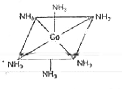 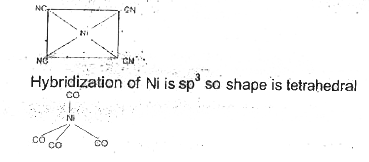
|
|
| 4. |
Draw the structures of all the eight structural isomers that have the molecular formula C_(5)H_(11)Br. Name each isomer according to IUPAC system and classify them as primary, secondary or tertiary bromides. |
Answer» Solution :  The structural ISOMERS can be both CHAIN as well as POSITION isomers. |
|
| 5. |
Do you agree with the statement that in hep and ccp structures, there is no difference in the arrangement of atoms? Explain. |
|
Answer» SOLUTION :The statement is not CORRECT. `{:("HCP" ,"CCP"),("AB AB AB......","ABC ABC ABC......"):}` |
|
| 6. |
Draw the structures of all the eight structural isomers that have the molecular formula C_(5)H_(11)Br . Name each isomer according to IUPAC system and classify them as primary, secondary and tertiary bromide. |
|
Answer» SOLUTION :EIGHT isomers having molecular formula are LISTED below. Their IUPAC names are given against them. `1^(@) ` for primary `2^(@) ` for secondary `3^(@) ` for tertiary `CH_(3)CH_(2)CH_(2)CH_(2)CH_(2)Br"1-Bromopentane " (1^(@))` `CH_(3)CH_(2)CH_(2)CH(Br) CH_(3) "2-Bromopentane " (2^(@))` `CH_(3)CH_(2)CH(Br)CH_(2)CH_(3) "3-Bromopentane " (2^(@))` `(CH_(3))_(2)CHCH_(2)CH_(2)Br "1-Bromo -3-methylbutane " (1^(@))` `(CH_(3))_(2)CHCHBrCH_(3) "2-Bromo-3-methylbutane " (2^(@))` `(CH_(3))_(2)CBrCH_(2)CH_(3) "2-Bromo -2-methylbutane " (3^(@))` `CH_(3)CH_(2)CH(CH_(3))CH_(2)Br "1-Bromo -2- methylbutane " (1^(@))` `(CH_(3))_(3)C CH_(2)Br "1-Bromo -2, 2-dimethylpropane " (1^(@))` |
|
| 7. |
Draw the structures of all the eight structural isomers that have the molecular formula C_(5)H_(11)Br. Name each isomer according to IUPAC system and classify them as primary, secondary or tertiary bromide. |
Answer» Solution :The POSSIBLE structural ISOMERS of `C_(5)H_(11)Br` and their respective IUPAC names are as follows :
|
|
| 8. |
Do we call metal carbonyls as organometallics ? Why or why not ? |
| Answer» SOLUTION :YES, metal carbonyls are CALLED organometallics because C ATOM of CO is linked to the metal atom. In fact, the metal-carbon bonds have both `sigma` and `pi` character. | |
| 9. |
Dotransitionelements formcomplexco-ordinatecompounds ? |
|
Answer» Solution :(i)Transitionelementhave atendencyto formcoordinationcompoundswitha speciesthat has anabilityto donatean electronpair toforma CO- ordinatecovalentbond. (ii)Transitionmetallonsare smallhighlychargedadn theyhavevacantlow energyorbitalstoacceptan electronpairdonatedby othergroups. Due totheseproperties transitionmetalsformlargenumber of complexes. (iii)Examples `[FE (CN)_(6)]^(4-) , [ Co (NH_(3))_(6)] ^(3+) . etc` |
|
| 10. |
Do the vital functions of the body such as digeston get affected during fever ? Explain your answer. |
| Answer» Solution :YES VITAL FUNCTIONS of the body are affected during fever. This is because biological reactions taking place in our body are CATALYSED by enzymes. These enzymes show maximum activity in the temperature range `298-310K.` During fever, when temperature rise above 310 K, enzymatic activity becomes less. | |
| 11. |
Do the vital functions of the body such as digestion get affected during fever ? Explain your answer. |
| Answer» Solution :VITAL functions of the BODY such as digestion are CARRIED by the enzymes and the enzymatic ACTIVITY takes PLACE in the temperature range of 298 310 K. Under the conditions of fever, the body temperature is outside this range, therefore, the vital functions get affected. | |
| 12. |
Do the non - metallic character exhibited by the halogens have any relation to ionization enthalpy? |
| Answer» SOLUTION :HIGHER is the ionization enthalpy higher the NON - METALLIC CHARACTER . | |
| 13. |
Do the following conversions in not more than two steps. (i) Benzoic acid to Benzalolehyde (ii) Propanone to propene. |
|
Answer» SOLUTION :(i) `C_(6)COOHoverset(SOCI_2)to C_(6)COCIoverset("POL"-BaSO_4)underset(H_2)to C_(6)H_(5)CHO`. (ii) `CH_(3)COCH_(3)overset(NaBH_4)toCH_(3)underset(OH)underset(|)CHCH_(3)overset("Conc.H_2SO_4)toCH_(3)CH=CH_(2)`. |
|
| 14. |
Do the following conversions: (i) Methyl bromide to acetone. (ii) Benzyl chloride to 2-phenylacetic acid. |
|
Answer» Solution :(i) Methyl bromide to acetone: `CH_(3)Br +Mg underset("ether")overset("Dry")(to)CH_(3)MgBr+CH_(3)CHOoverset(H_(3)O^(+))(to)CH_(3)-underset(CH_(3))underset(|)(CH)-Ohunderset(573K)overset(Cu)(to)CH_(3)COCH_(3)` (II) Benzyl chloride to 2-pheyl ACETIC acid: `C_(6)H_(5)CH_(2)Cl+KCNtoC_(6)H_(5)CH_(2)CNoverset(H_(3)O^(+))(to)C_(6)H_(5)CH_(2)COOH` |
|
| 15. |
Do the following conversions in not more than two steps: a. Propene to Acetone b. Propanoic acid to 2-hydroxypropanoic acid. |
|
Answer» SOLUTION :Propene to Acetone: <BR> `underset("Propene")(CH_(3)CH)=CH_(2)underset(H^(+))overset(H_(2)O)(to)CH_(3)-overset(OH)overset(+)(CH)-CH_(3)underset(CrO_(3))overset([O])(to)CH_(3)-underset("Acetone")overset(O)overset(||)(C)-CH_(3)` b. Propanoic ACID to 2-hyroxypropanoic acid: `underset("Propanoic acid")(CH_(3)CH_(2)COOH)overset(Br_(2)//"Red"P)(to)overset(Br)overset(|)(CH_(3)COOH)overset(Aq.KOH)(to)underset(3-"HYDROXY propanoic acid")(CH_(3)-overset(OH)overset(|)(CH)-COOH)` |
|
| 16. |
Do the following conversions : (i) Toluene to benzyl alcohol (ii) Ethanol to but - 2 - yne (iii) Ethanol to propane nitrile (iv) Propane to propan-1-ol (v) Ethyl chloride to propanoic acid. |
Answer» Solution :(i)  (ii) `underset("Ethanol")(C_(2)H_(5)-OH) OVERSET(P//I_(2), triangle)to C_(2)H_(5)I underset(Delta)overset(KOH(alc))to CH_(2)=CH_(2) overset(Br_(2), CCl_4)to underset(Br)underset(|)(CH_(2))-underset(Br)underset(CH_(2))` (iii) `underset("Ethanol")(C_(2)H_(5)-OH) overset(P//I_(2), triangle)to C_(2)H_(5)-I underset(H_(2)O)overset(KCN, OH^(-))to underset("Propane nitrile")(C_(2)H_(5)-CN)` (IV) `underset("Propane")(CH_(3)CH=CH_(2)) overset("HBr/Perioxide")to CH_(3)CH_(2) CH_(2) Br overset("Aq KOH")to underset("Propan-1-ol")(CH_(3)CH_(2)CH_(2)OH)` (v) `underset("Ethyl CHLORIDE") (C_(2)H_(5)-Cl) overset(KCN, E_(1)OH, H_(2)O)to C_(2)H_(5)-CN overset(H^(+), H_(2)O)to underset("Propanoic acid") (CH_(3)CH_(2)OOH)` |
|
| 17. |
Do the following conversions : (i) Methyl bromide to acetone (ii) Benzyl chloride to 2-phenylacetic acid. |
|
Answer» Solution :(i) `CH_(3) Br + Mg overset "Dry Ether"rightarrow CH_(3)MGBR` (ii) `C_(6)H_(5) CH_(2)CI + KCN overset"-KCI"C_(6)H_(5)CH_(2)CH` `C_(6)H_(5)CH_(2)CH + 2H_(2)O overset"H^(+)`"rightarrow underset("2-phenylacetic ACID")(C_(6)H_(5)CH_(2)CHOO+NH_(4)^(+))` |
|
| 18. |
Do the following conversion is not more than two steps (i) Benzoic acid to benzaldehyde (ii) Ethylbenzene to benzoic acid. |
|
Answer» |
|
| 19. |
Do classification of polymers based on source. |
|
Answer» Solution :There are three sub categories based on source classification. (a) Natural polymers : These polymers are found in plants and ANIMALS. EXAMPLES are proteins, CELLULOSE, starch, some resins and rubber. (b) Semi-synthetic polymers : Cellulose derivatives as cellulose acetate (rayon) and cellulose nitrate, etc. are the usual examples of this sub category. (c) Synthetic polymers : A variety of synthetic polymers as plastic (polythene), synthetic fibres (nylon-6,6) and synthetic rubbers (Buna-S) are examples of man-made polymers extensively USED in daily LIFE as well as in industry. |
|
| 20. |
DNA undergoes .................but ....................usually does not. |
| Answer» SOLUTION :REPLICATION , RNA | |
| 21. |
DNA multiplication is called ……… . |
|
Answer» TRANSCRIPTION |
|
| 22. |
DNA molecule consists of units of: |
|
Answer» Base-sugar |
|
| 23. |
DNA has deoxyribose and base and third compound is : |
|
Answer» PHOSPHATE group |
|
| 24. |
DNA finger printing is useful for A) Identifying the criminals B) Determining the paternity of individual C) Identifying the dead bodies |
|
Answer» A,B |
|
| 25. |
DNA dictates synthesis of : |
|
Answer» PROTEINS |
|
| 26. |
DNA contains the sugar |
|
Answer» Deoxyribose |
|
| 27. |
DNA and RNA contain four bases each. Which of the following bases is not present in RNA ? |
|
Answer» Adeine |
|
| 28. |
DNA consist of |
|
Answer» `BETA` D-RIBOSE SUGAR |
|
| 29. |
DNA and RNA contain four bases each. Which of the following bases is not present in RNA? |
|
Answer» ADENINE |
|
| 30. |
DNA and RNA contain four bases each. Which of the following bases in not present in RNA ? |
|
Answer» Adenine Thymine is PRESENT in DNA |
|
| 31. |
DNA and RNA contain four bases each. Which of the following bases in not present in RNA? |
|
Answer» Adenine |
|
| 32. |
DNA and RNA are chiral molecules due to the presence of |
|
Answer» CHIRAL bases |
|
| 34. |
DMG is x-valen and y-dentate ligand. Taking x and y as numbers, find (x+y) |
|
Answer» |
|
| 35. |
dm^(3) of water contains 90 g of glucose. The mole fraction of glucose in the solution is |
|
Answer» 0.33 Moles of GLUCOSE `="Mass"/"Molar mass"=90/180=0.5` Mole fraction of glucose `= 0.5/(0.5 + 55.56)=0.5/56.06` |
|
| 36. |
Divalent Manganese is more stable due to |
|
Answer» `3D^(4)` CONFIGURATION |
|
| 37. |
Orthophosphoric acid has the formula: |
|
Answer» `H_2S_2O_6` |
|
| 38. |
Disymmetrical object is one which image |
|
Answer» Superimposable on its MIRROR IMAGE |
|
| 39. |
Disulphuric acid is |
|
Answer» `H_(2)S_(2)O_(6)` |
|
| 40. |
Distribution of molecules with velocity is represented by the curve. Point A in the curve shifts to the higher value of velocity if |
|
Answer» T is increased |
|
| 41. |
Distingusih between 1^(@), 2^(@), and 3^(@) amines by HNO_(2) acid test. |
|
Answer» Solution :`1^(@)` gives `N_(2)` GAS. `2^(@)` gives yellow oily compound. `3^(@)`FORM water soluble SALTS. `CH_(3)CH_(2)NH_(2) + HNO_(2) rightarrow C_(2)H_(5)OH + N_(2)+ H_(2)O` `R_(2)NH+ HNO_(2) rightarrow R_(2)N-N=O+H_(2)O` `(CH_(3)CH_(2))_(3)N+HNO_(2) rightarrow [(CH_(3)CH_(2))_(3) NH]NO_(2)^(-)` soluble in water. |
|
| 42. |
What is difference between calcination and roasting ? |
|
Answer» Solution :Calcination : Calcination is a process of heating the concentrated ore below its melting POINT with limited supply of AIR , or in the absence of air. ROASTING : the concentrated ore is oxidised with limited OXYGEN . HOWEVER the sulphide ore is oxidised with excess oxygen by roasting process. |
|
| 43. |
Distinguishing reagent between silver and lead salt is |
|
Answer» `H_(2)S` gas |
|
| 44. |
Distinguishing reagent between silver and lead salts is |
|
Answer» `H_(2)S` gas |
|
| 45. |
Distinguish tetrahedral and octahedral voids. |
Answer» SOLUTION :
|
|
| 46. |
Distinguish glucose from fructose. |
Answer» SOLUTION :
|
|
| 47. |
Distinguish clearly between the meanings of E_(cell)=0 and E_(cell)^@=0 |
| Answer» Solution :`E_(cell)=0` means that the CONCENTRATION RATIO is the Nernst equation for the cell REDUCES the `E_(cell)^@` value to zero while `E_(cell)^@=0` INDICATES a concentration cell. | |
| 48. |
Distinguish between1- Propanol and 2-Methyl-2-Methyl-2-propanol by suitable chemical test. |
|
Answer» |
|
| 49. |
Distinguish chemically between the following: i. (a) Cyclohexane, (b) Cyclohexane, (c) Benzene ii. (a) Benzene, (b ) Naphthalene iii. (a) Anthrance and (b ) Phenanthrene. |
Answer» Solution :i. Add `Br_(2)//CCl_(4)` to each of the three LIQUIDS. <BR> 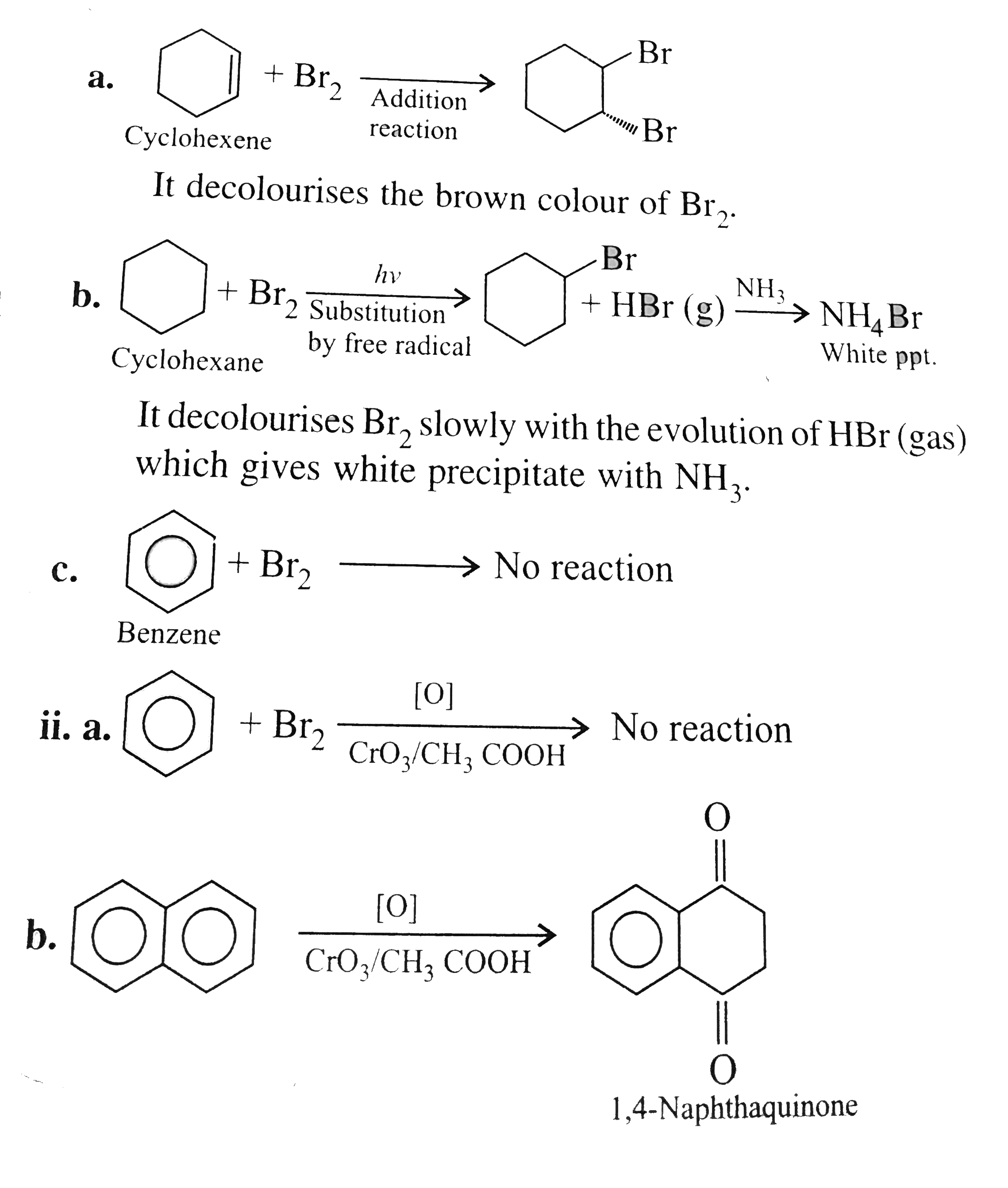 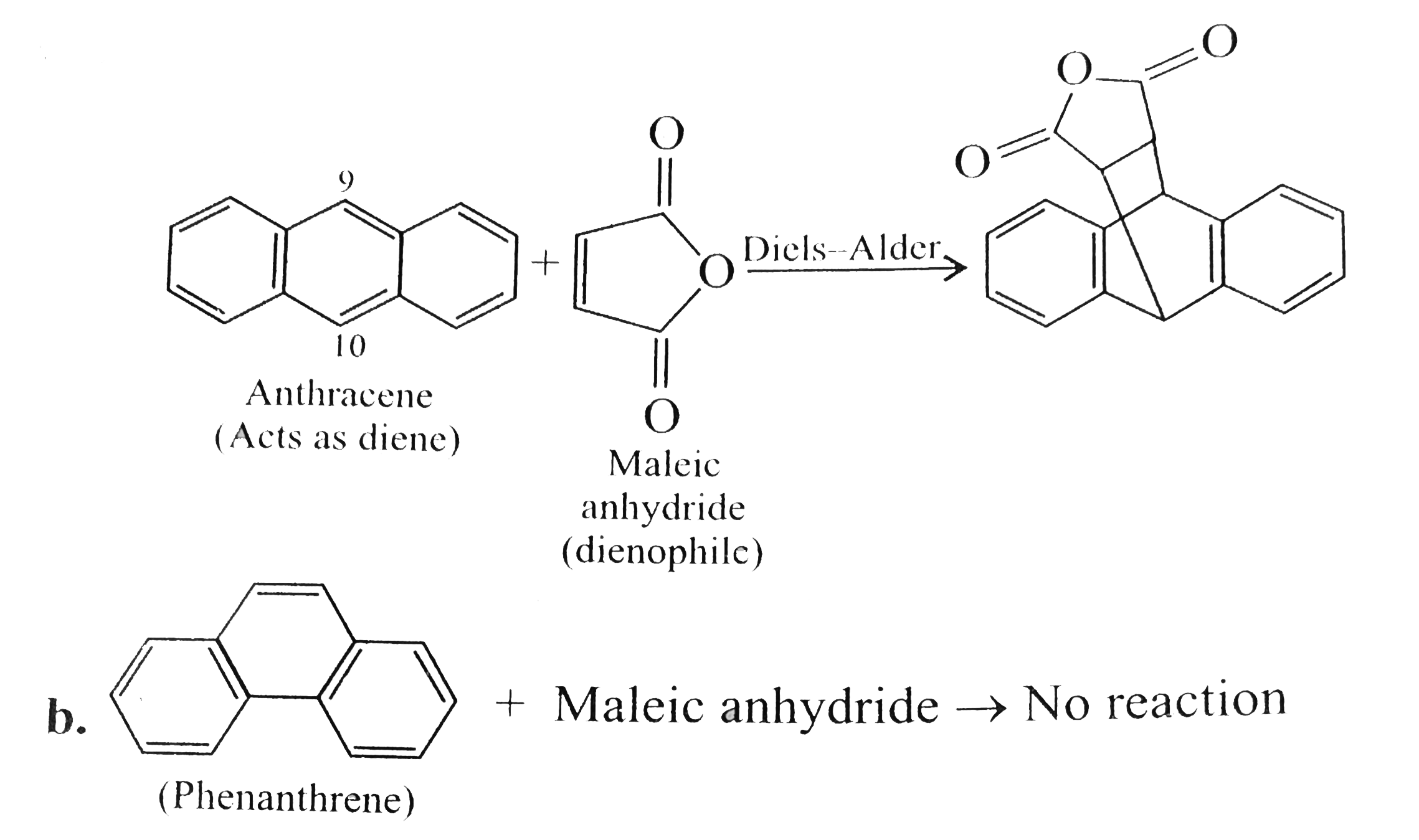
|
|
| 50. |
Distinguish between thermosetting and thermoplastic polymers with examples. |
|
Answer» Solution :THERMOSETTING POLYMERS of not BECOME soft on heating. Example: Bakelite THERMOPLASTIC polymers are those plastics which become soft heating and can be remouled agin and again. Example: POLYTHENE |
|