

Saved Bookmarks
This section includes 7 InterviewSolutions, each offering curated multiple-choice questions to sharpen your Current Affairs knowledge and support exam preparation. Choose a topic below to get started.
| 1. |
Discuss the main purpose of vulcanization of rubber. |
| Answer» Solution :Natural rubber becomes soft at high temperature `(gt 335 K)` and brittle at LOW temperatures `(lt 283 K)` and shows high water absorption CAPACITY. It is soluble in non-polar solvents and is non- resistant to attack by oxidizing agents. To improve upon these physical properties, a PROCESS of vulcanization is carried out. | |
| 2. |
Discussthe lowry-Bronsted concept of acids and bases. |
|
Answer» Solution :According to lowry-bronsted concept, an acid is defined as a substance that has a tendency to donate a proton to another substance the base is a substance that has a tendency to ACCEPT a proton from other substance. When hydrogen chloride is dissolved in water, it donates a proton to the LATER. Thus, HCl behaves as an acid and `H_2O` is base. the proton transfer from the acid to base can be represented as `HCl+H_2O leftrightarrow H_3O^(+)+CL^-` When ammonia is dissolved in water, it acceptsa proton from water. In this case,ammonia `(NH_3)` acts as a base and `H_2O` is acid. The reaction is represented as `H_2O+NH_3 leftrightarrow NH_4^(+)+ OH^-` Let us consider the reverse reaction in the following equilibrium. `HCl+H_2O leftrightarrow H_3O^+ +Cl^-` `H_3O^+` donates a proton to `Cl^-` to form HCl i.e., the products also behave as acid and base. In general, Lowry-Bronsted (acid-base) reaction in represented as `Acid_1+Base_2 leftrightarrow Acid_2+ Base_1` The species that remains after the DONATION of a proton is a base `(Base_1)` and is called the CONJUGATE base of the bronsted acid `(Acid_1)`. In other words , chemical species that differ only by a proton are called conjugate acid-base pairs. 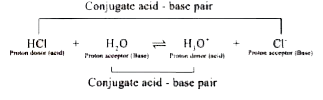 `HCl and Cl^-, H_2O and H_3O^+` are two conjugate acid-base pairs i.e., `Cl^-` is the conjugate base of the acid HCl (or) HCl is conjugate acidof `Cl^-`. SImilarity `H_3O^+` is the conjugate acid of `H_2O`. Limitations of lowry- Bronsted theory: Substance like `BF_3,AlCl_3` etc that do not donate protons are known to behave as ACIDS. |
|
| 3. |
Discuss the Lowery - Bronsted concept of acids and bases. |
|
Answer» Solution :Lowry - Bronsted Theory (Proton Theory) : According to Lowry - Bronsted concept , an acid is defined asa substance that has a tendency to donate a proton to another substance and base is a substance that has a tendency to accept a proton form other substance. In other WORDS, an acid is a proton donor and a base is a proton acceptor. When hydrogen chloride is dissolved in water, it donates a proton to the later. Thus, HCI BEHAVES as an acid and `H_2 O` is base. The proton transfer from the acid to base can be represented as `HCI+H_2 O hArr H_2 O^+ CI^-` When ammonia is dissolved in water, it accepts a proton from water. In this case, ammonia `(NH_3)` acts as a base and `H_2 O` is acid. The reaction is represented as `H_2 O+NH_3 hArr NH_4^(+)+OH^-` Let us consider the REVERSE reaction in the following equilibrium `underset(underset(("acid"))("Proton donar"))(HCI)+underset(underset(("base"))("Proton acceptor"))(H_2O)underset(underset(("acid"))("Proton donar"))( hArrH_3O^+)+underset(underset(("base"))("Proton acceptor"))(CI^-)` `H_3O^+` donates a proton to `CI^-` to form `HCI` i.e., the products also behave as acid base. In general, Lowry - Bronsted (acid - base) reactionis represented as `"Acid"_1+"Base"_2 hArr "Acid"_2+"Base"_1` The SPECIES that remains after the donation of a proton is a base `("Base"_1)` and is called the conjugate base of the Bronsted acid `("Acid"_2)`. In other words, chemical species that DIFFER only by a proton are called conjugate acid - base pairs. |
|
| 4. |
Discuss the magnetic properties of transition elements |
|
Answer» Solution :In presence of magnetic field, two types of magnetic behaviour is observed for transition elements (i) Paramagnetism (ii) Diamagnetism. PARAMAGNETIC substances are attracted by magnetic field while diamagnetic substances are repelled by the magnetic field. Ferromagnetism is extreme form of paramagnetism where substance is very strongly attracted by the magnetic field. The paramagnetism arises from the presence of unpaired electrons in (n-1) d-orbitals each such ELECTRON having a magnetic MOMENT assoicated with its SPIN as well as orbital motion. For most of the transition elements, the orbital contribution is not of much significance. The magnetic moment expresses the paramagnetic behaviour of transition metal ions and is calculated by using "spin -pnlu" formula `mu = sqrt(n(n +2))BM` where, n= number of unpaired electrons in (n-1) d -orbitals `mu`= Magnetic moment in Bohr Magneton (BM)  The magnetic moment increases with the increase in number of unpaired electrons. If the magnetic mometn is ZERO, the substance is diamagnetic and is repelled by magnetic field. |
|
| 5. |
Discuss the general characteristics of Group-15 elements with reference to their electronic configuration, oxidation state, atomic size, ionisation enthalpy and electronegativity. |
|
Answer» Solution :(i) ELECTRONIC configuration : General electronic configuration is nsz np3. These elements have five electrons in valance shell. (ii)OXIDATION states : The common oxidation states of Group-15 elements are (-3), (+3) and (+5). The stability of elements in (+5) oxidation state decreases down the group DUE to inert pair effect. The phosphorus disproportionates in all intermediate states from (-3) to (+5) while nitrogen disproportionates in (+3) oxidation state. (iii)Atomic size : Down the group, the atomic radii of these elements increases. However, there is small increase in radii from As to Bi due to presence of completely filled d- or f-orbitals. (IV) Ionisation enthalpy : As compared to group-14 and group-16 elements, group-15 elements have high values of ionisation enthalpies due to half filled valance orbitals. Down the group, ionisation enthalpy decreases but difference in ionisation enthalpies of heavier members is not so significant. |
|
| 6. |
Discuss the general chemical properties of carboxylic acids. |
|
Answer» Solution :Chemical properties of carboxylic acids. Carboxylic acids give the following reactions : (A) Reactions due to replaceable hydrogen 1. Acidic character. Carboxylic acids ionise in water to give hydrogen ion (`H^(+)`) which are responsible for their acidic character.  2. Action with alkalies and carbonates. Carboxylic acids neutralise alkalies forming salts and decompose carbonates (or bicarbonates) evolving carbon dioxide with effervescence. `underset("Acetic acid")(CH_(3)COOH)+NaOH to underset("Sodium acetate")(CH_(3)COONa)+H_(2)O` `underset("Acetic acid")(2CH_(3)COOH)+Na_(2)CO_(3) to 2CH_(3)COONa+CO_(2)+H_(2)O` 3. Action with metals. Carboxylic acids react with strongly electropositive metals such as Na, Mg, Ca, Zn, ETC. liberating hydrogen gas. `2CH_(3)COOH+2Na to underset("Sodium acetate")(2CH_(3)COONa)+H_(2)` `2CH_(3)COOH+Zn to (CH_(3)COO)_(2)Z +H_(2)`  (B) Reactions due to -OH group of carboxylic acids 4. Action with phosphorus halides. Carboxylic acids react with phosphorus trichloride or phosphorus pentachloride to give acid chlorides as : `3CH_(3)COOH+PCl_(3) to underset("Acetyl chloride")(3CH_(3)COCl)+H_(3)PO_(3)` `CH_(3)COOH+PCl_(5) to underset("Acetyl chloride")(CH_(3)COCl)+POCl_(3)+HCl` 5. Action with thionyl chloride. Carboxylic acids react with thionyl chloride to form acid halides. `CH_(3)COOH +SOCl_(2) to underset("Acetyl chloride")(CH_(3)COCl) +SO_(2) + HCI` 6. Esterification. Carboxylic acids react with alcohols in the presence of an acid catalyst (conc. `H_(2)SO_(4)`) to form esters  7. Formation of anhydrides. Carboxylic acids on treatment with strong dehydrating agents such as phosphorus pentaoxide form acid anhydrides by the elimination of water molecule as:  (C) Reactions due to carboxylic group 8. DECARBOXYLATION. Carboxylic acids get decarboxylated.i.e. lose carbon dioxide when their sodium salts are heated with soda lime (NaOH + CaO). The condition of decarboxylation of carboxylic acids also depend upon their structures. `CH_(3)-overset(O)overset(||)C-ONa + NaOH overset("HEAT")to CH_(4) + Na_(2)CO_(3)` When two carboxylic groups are attached to the same carbon atom, decarboxylation takes place simply on heating.  Alkali METAL salts of carboxylic acids undergo decarboxylation by electrolysis. This method is known as Kolbe.s electrolysis. `3CH_(3)COOH to 2CH_(3)COO^(-)+2K^(+)` At anode: `2CH_(3)COO^(-) underset("Unstable")(2CH_(3)COO) to underset("Ethane")(CH_(3)-CH_(3))+2CO_(2)` At cathode: `2K^(+) overset(+2e)to 2K overset(H_(2)O)to 2KOH + H_(2) uarr` 9. Reduction. Carboxylic acids on .reduction with lithium aluminium hydride (`LiAIH_(4)`) in ether are reduced to alcohols. `LiAIH_(4)` is a mild reducing agent. `RCOOH overset(LiAIH_(4))to underset("alcohol")(RCH_(2)OH)` `underset("Acetic acid ")(CH_(3)COOH)+4[H] underset("ether")overset(LiAIH_(4))to underset("Ethyl alcohol")(CH_(3)CH_(2)OH)+H_(2)O` However, carboxylic acids on drastic reduction with concentrated hydriodic acid and red phosphorus under high pressure yield hydrocarbons as: `CH_(3)COOH + 6HI overset("Red P")to underset("Ethane")(CH_(3)CH_(3)) + 2H_(2)O + 3I_(2)` 10. Ring substitution in aromatic acids. Carboxyl group in benzoic acid is an electron withdrawing group and therefore, it is meta directing group. Some common electrophilic substitution reactions of benzoic acid are : 
|
|
| 7. |
Discuss the generalcharacteristicof the 3dseriesof thetransitionelementswith specialreference to their (i)Atomicsize (ii)Enthalpies of atomisation |
|
Answer» SOLUTION :(i) Atomicsize : The atomicsize in 3dtransitionseriesdecrease from Sc to Mnand then`Fe , CO, Ni` have almostsameatomicsize while copperhas bigersize. It isbacausenumberof unpairedelectronsin d- orbitalsincreasesin thebeginingtillMn. Thereforeeffectivenuclearchargeincreases henceatomicsizedecreasethenpairingof electrons ind- orbitalstakesplace,so the ATOMIC sizeremainsthe sameand finallyit increasedue torepulsionbetweenpairedelectron in d-orbitalswhichleadsto decrease inneffectivenuclearcharge . (ii) THEYHAVE highenthalpyof atomisationdue to strongmetallic bondsadn additionalcovalentbondingdue to thepresenceof unpairedelectronsin d- orbitals |
|
| 8. |
Discuss the formation of coloured compounds by transition metals. |
|
Answer» Solution :(1) The colour is due to the presence of one or more unpaired electrons in (N - 1) d-orbital. The transition metals have incompletely filled (n-1) d-orbitals. (2) The energy required to promote one or more electrons within the d-orbitals involving d-d TRANSITIONS is very low. (3) The energy CHANGES for d-d transitions lie in visible region ofelectromagnetic radiation. (4) Therefore transition METAL ions absorb the radiation in the visible region and APPEAR coloured. (5) Colour of ions of d-block elements depends on the number of unpaired electrons in (n – 1) d-orbital. The ions having equal number of unpaired electrons have similar colour. (6) The colour of metal ions is complementary to the colour of the radiation absorbed. |
|
| 9. |
Discuss the following reactions : (i) HVZ reaction. (ii) Decarboxylation reaction. |
|
Answer» Solution :(i) HVZ reaction. The reaction of an aliphalic carboxylic acid containing `alpha`-H-atoms with `Cl_(2) // Br_(2)` in the presence of a small amount of P to give `alpha`-HALO acid is called HVZ reaction. e.g., `CH_(3)COOH underset(-HCl)overset(P, Cl_(2))to underset(Cl)underset(|)CH_(2)-COOH underset(-HCl)overset(Cl_(2), P)to CHCl_(2)-COOH-HCl underset(-HCl)overset(Cl_(2), PC Cl_(3))to -COOH` (ii) Decarboxylation reaction. The process of REMOVAL of `CO_(2)` from a carboxylic acid is called decarboxylation reaction e.g., `CH_(3)COONa+NaOH^(-) underset(Delta)overset(CaO)to CH_(4)+Na_(2)CO_(3)` |
|
| 10. |
Discuss the following reactions of aldehydes and ketones : (a) Oxidation (b) Reduction. |
|
Answer» Solution :(a) Oxidation reactions of aldehydes and ketones. Aldehydes can be easily oxidised to carboxylic acids on treatment with common oxidising agents like `KMnO_(4)` and `K_(2)Cr_(2)O_(7)`. The carboxylic acids formed contain the same number of carbon atoms as the aldehyde. `R-CHO overset((O))to RCOOH` e.g. `CH_(3)CHO overset((O))to underset("Ethanoic acid")(CH_(3)COOH)` Ketones are not easily oxidised. However, under drastic conditions, cleavage of carbon-carbon bond takes place giving a mixture of carboxylic acids having lesser number of carbon atoms than the original ketones. For examples,  or `underset(("Cleavage of" C_(1)-C_(2) "bond"))(RCOOH+R.CH_(2)COOH)` or `underset(("Cleavage of" C_(2)-C_(1) "bond"))(RCH_(2)COOH+R.COOH)` or `underset(("Cleavage of" C_(1)-C_(2) "bond"))(RCOOH+R.CH_(2)COOH)` or `underset(("Cleavage of" C_(2)-C_(1) "bond"))(RCH_(2)COOH+R.COOH)` The oxidation reactions are very important and can be used to distinguish aldehydes from ketones by the following reagents : (i) Tollen.s reagent. It is ammoniacal silver nitrate solution. When HEATED with Tollen.s reagent, aldehydes reduce silver ions to metallic silver and a bright silver mirror is produced on the inner side of the test tube. `underset("Acetaldehyde")(CH_(3)CHO) + underset("Tollen.s reagent")(2[Ag(NH_(3))_(2)]^(+)) + 3OH^(-) to CH_(3)COO^(-) + underset("Silver mirror")(2 Ag)+ 4NH_(3)+ 2H_(2)O` Ketones, however, do not give this test. (ii) Fehling.s solution. Fehling solution is alkaline copper (II) ions complexed with sodium potassium tartarate. When an aldehyde is heated with Fehling solution, a red precipitate of cuprous oxide (`Cu_(2)O`) is formed. `underset("Aldehyde")(R-overset(O)overset(||)C-H)+2Cu^(2+)+5OH^(-) to RCOO^(-) + underset("(Red ppt.) ")(Cu_(2)O)+ 3H_(2)O` e.g. `underset("Acetaldehyde")(CH_(3) -overset(O)overset(||)C-H) + 2Cu^(2+) + 5OH ^(-) to CH_(3)COO^(-)+ underset("(Red ppt.) ")(Cu_(2)O) + 3H_(2)O` Ketones do not give this test. (b) Reduction. Aldehydes are reduced to primary alcohols and ketones to SECONDARY alcohols by catalytic hydrogenation or with nascent HYDROGEN or with reducing agents such as lithium aluminium hydride (`LiAlH_(4)`). For example, `underset("Acetaldehyde")(CH_(3)CHO) overset(LiAlH_(4))to underset("Ethyl alcohol" (1^(@))(CH_(3)CH_(2)OH)` `underset("Acetone")(CH_(3)COCH_(3))+H_(2) overset(LiAlH_(4))to underset("Isopropyl alcohol" (2^(@))(CH_(3)CHOHCH_(3))` Aldehydes and ketones are reduced to corresponding hydrocarbons by treatment with zinc amalgam and hydrochloric acid. This reaction is known as Clemmensen reduction. For example 
|
|
| 11. |
Discuss the effect of pressure and temperature on the adsorption of gases on solids. |
|
Answer» SOLUTION :Effect of PRESSURE : Adsorption is a reversible process and it increases with the increase in pressure. Effect of temperature : Adsorption is an exothermic reaction. So, ACCORDING to LeChatelier.s PRINCIPLE adsorption decreases with the increase in temperature. |
|
| 12. |
Discuss the electrochemical theory of rusting. |
|
Answer» Solution :The rusting of iron can be explained on the basis of electrochemical theory which involves oxidation and reduction reaction. ACCORDING to this theory, it is believed that non-uniform surface of metal or impurities present in iron behaves like small electric cells (called CORROSION couples) in the presence of water containing dissolved oxygen or carbon dioxide. A film of moisture with dissolved `CO_(2)` acts as electrolytic solution covering the metal surface at various places. In these small electrolytic cells, pure ion acts as anode while cathodes are impure portions. The overall rusting involves the following steps : Oxidation occurs at the anodes of each electrochemical cell. Therefore, at each anode iron is oxidised to `Fe^(2+)` ions. At anode `Fe(s)toFe^(2+)(aq)+2e^(-)""......(i)` hus, the metal atoms in the lattice pass into the solution as ions, leaving electrons on the metal itself. These electrons move towards the cathode region through the metal. At the cathode of each cell, the electrons are taken up by hydrogen ions (reduction takes place). The `H^(+)` ions are obtained either from water or from acidic substances in water : `H_(2)OhArrH^(+)+OH^(-)""......(II)` or `CO_(2)+H_(2)OtoH^(+)HCO_(3)^(-)""......(iii)` At cathode : `H^(+)+e^(-)toH""......(iv)` The hydrogen atoms on the iron surface reduce dissolved oxygen. `4H+O_(2)to2H_(2)O""......(v)` Therefore, the overall reaction at cathode of different electrochemical cells may be WRITTEN as `4H^(+)(aq)+O_(2)(g)+4e^(-)to2H_(2)O(l)""......(vi)` The overall redox reaction may be written by multiplying reaction at anode, Eq. (i) by 2 and adding reaction at cathode Eq. (iv) to equalise number of electrons lost and gained, i.e., Oxidation half reaction `Fe(s)toFe^(2+)(aq)+2e]xx2` Reduction half reaction `4H^(+)(aq)+O_(2)(g)+4e^(-)to2H_(2)O(l)` Overall cell reaction `2Fe^(2+)+4H^(+)(aq)+O_(2)(g)to2Fe^(2+)(aq)+2H_(2)O(l)` The ferrous ions are oxidized further by atmospheric oxygen to `Fe^(2+)` (as `Fe_(2)O_(3)` and form rust `4Fe^(2+)+O_(2)(g)+4H_(2)Oto2Fe_(2)O_(3)+8H^(+)` and `underset("Rust")(Fe_(2)O_(3)+xH_(2)O)to2Fe_(2)O_(3).xH_(2)O` The `H^(+)` ions PRODUCED above are also used for reaction (iv). `4Fe^(2+)+O_(2)+4H_(2)Oto2Fe_(2)O_(3)+8H^(+)(aq)` `Fe_(2)O_(3)+xH_(2)OtoFe_(2)O_(3).xH_(2)O` 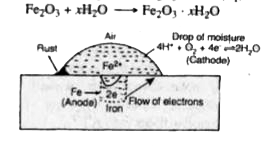
|
|
| 13. |
Discuss the effect of E.W.G on the acidic strength of phenols. |
|
Answer» Solution :Electron withdrawing group [E.W.G] stablises the phenate ion by dispersing the negative charge on it. So E.W.G are more effective in inclosing the ACIDIC strength at the para POSITIOIN relative to ortho position. However, their EFFECT at the meta position is very LITTLE. So we have acidic strength of nitro phenol. p-nitro phenol > o-nitro phenol>m-nitrophenol>Phenol |
|
| 14. |
Definethe mordernperiodic law .Discusstheconstructionof thelongformof theperiodictable. |
|
Answer» Solution :The important characteristic property of an element is found to be its 'atomic number' and not atomic weight. Accordingly, the periodic law was modified- "The physical and chemical properties of the elements are perioidic functions of their atomic number". Later on it was found that while deciding the properties of an element, its electronic configuration plays a found that while deciding th properties of an element, its electronic configuration plays a very important role. So Bohr constructed the long form of the periodic table, based on the electronic configurations of the elements. The periodic law can be stated as "The physical and chemical properties of the elements are periodic functions of their electronic configuration". Salient features: (1) This table is prepared based on a fundamental property "atomic number". (2) This table can be easily STUDIED, remembered are reproduced. (3) Similarities, DIFFERENCE are trends in properties are more clearly reflected in this table. (4) Vertical columns are known as groups and horizontal ROWS are called periods. (5) There are seven periods in this table. The first period consistsof two elements only. Second and third periods contain 8 elements each. Fourth and fifth periods contain 18 eleements each. Sixth period consists of 32 elements. Seventh period is an incompleteperiod and consists of 19 elements. (6) There are eighteen groups in this table. They are designated IA, IIB, IIIC, IVB, VB, VIB, VIIB, VIII, IB,IIB, IIIA, IVA, VA, VIA, VIIA, 0(American Convention of naming). (7) The element in IA , IIA, IIIA, IVA, VA, VIA, and VIIA are known as representative elements or normals elements. (8) The elements in IB, IIB, IIIB, IVB, VB, VIB, VIIB and VIII are called Transition elements. (9) Zero group elements are placed at the extreame right of the table. These are called inert gases or noble gases. They possess stable `ns^(2)np^(2)` configuration. (10) Short periods are broken and long periods are extended to accommodate transition elements. (11) Lanthanides and actinides are placed separately at the bottom of the periodic table. (12) Based on the entrance of differentiatingelectron, the table is divided into four blocks. They are s-block, p-block, d-block and f-block. In the elements of s-block, differentiating ELECTRON enters into s-orbital. Similarly in the elements of p-block, d-block and f-block, the differentiating electron enters into p,d and f-orbitals respectively. (13) Based on complete and incomplete electron shells and chemical properties, the elements are classified into four types. They are 1) Type I (Inert gas elements) 2) Type II (Representative elements) 3) Type III (Transition elements 4) Type IV (Inner transition elements). (14) All the elements in a group possess similar properties, because they possess the same valence electron configuration. |
|
| 15. |
Discuss the Commerical method to prepare Nitric acid. |
|
Answer» Solution :Nitric ACID prepared in large scales using Ostwald.s process. In this method ammonia from Haber.s process is mixed about 10 times of AIR. This MIXTURE is preheated and passed into the catalyst chamber where they come in contactwith platinum gauze. The temperature rises to about 1275 K and metallic gauze brings about the rapid catalytic oxidation of ammonia resulting in the formation of `NO`, which then oxidised to nitrogen dioxide. `4NH_(3)+5O_(2)rarr 4NO+6H_(2)O+120kJ` `2NO+O_(2)rarr 2NO_(2)` The nitrogen dioxide produced in passed through a series of adsorption TOWERS. It reacts with water to give nitric acid. Nitric acid formed is bleached by blowing air. `6NO_(2)+3H_(2)Orarr 4HNO_(3)+2NO+H_(2)O` |
|
| 16. |
Explain the commercial method of preparation of nitric acid. (or) How nitric acid is prepared by Ostwald's process. |
|
Answer» Solution :Nitric acid prepared in LARGE scales using Ostwald’s process. In this method ammonia from Haber’s process is mixed about 10 times of air. This mixture is preheated and passed into the catalyst chamber where they come in contact with platinum gauze. The temperature rises to about 1275 K and the metallic gauze brings about the rapid catalytic oxidation of ammonia resulting in the formation of NO, which then oxidised to nitrogen DIOXIDE. `4NH_(3) + 5O_(2) to 4NO + 6H_(2)O + 120 kJ` `2NO + O_(2) to 2NO_(2)` The nitrogen dioxide produced is passed through a series of adsorption towers. It reacts with water to give nitric acid. Nitric acid FORMED is bleached by blowing air. `6NO_(2) + 3H_(2)O to 4HNO_(3) + H_(2)O` |
|
| 17. |
Discuss the cleansing action of soaps and detergents. |
|
Answer» Solution :(a) The cleansing action of soaps and detergents FOLLOWS the same principle. Soaps and detergents consists of two parts : (b) A non-POLAR part which consists of long CHAIN hydrocarbon part. It is called non-polar tail. This part is insoluble in water but soluble in oil and grease. This also called water repelling or hydrophobic part.  (ii) An ionic part which consists of carboxylate ion (in case of soaps) or sulphonates or sulphates (in case of detergents). This is called polar head. It is soluble in water but insoluble in oil and grease. The ionic part is called water repelling or hydrophillic part. Therefore, soaps and detergents consists of a large hydrocarbon tail with a negatively charged head. The hydrocarbon tail is hydrophobic (water repelling) and negatively charged head is hydrophillic (water attracting). The dirt in the cloth is due to the presence of dustparticles in fat or grease which stick to the cloth. When a soap or detergent is dissolved in water , the molecules gather together as clusters called micelles. When the dirty cloth is dipped come in contact with each other. The non-polar tails of the soap begin to dissolve in non-polar oil or grease, while the polar head part remains directed in water as shown in figure. As more and more soap particles is surrounded by a number of negatively charged ends. SInce the similar charges repel each other, the oil or grease droplets break off into small globules of oil. These are still surrounded by the negatively charged polar heads of the soap molecules. This prevents the small globules from coming together to form bigger particles (aggregates). The rubbing by hands or mechanical stirring also help to break the grease particles. In this manner, the grease particles can be completely broken up and it forms EMULSION of grease or oil contained in dirt and water. As a result , the cloth gets FREE from dirt and the droplets are washed away with water. 
|
|
| 18. |
Discuss in detail about the classification of elements by Mendeleeff. |
|
Answer» Solution :The periodic classification of elements based on 'atomic weights' was done by Lothar Meyeer (Germany) and Mendeleev (Russia), Independently. Mandeleev's periodic law: "The physical and chemical properties of elements and their compounds are a periodic function of their atomic weights". Mendeleev arranged the then KNOWN 65 elements in a periodic table. He did not BLINDLY follow the atomic weight but gave more importance to their chemical properties in arranging them in the table. Explanation of the periodic law: When the elements are arranged in the INCREASING order of their atomic weights, elements with similar properties appear again and again, at regular intervals, just like the days, weeks, months, seasons, etc. repeat at regular intervals of time. This is called periodicity of properties. Mendeleev's Table: Mendeleev introduced a periodic table containing the then known 65 elements. In this table, while arranging the elements, he gave importance not only to their atomic weights, but also to their physical and chemical properties. This table was defective in some respects. Then he introduced another table, after rectifying the defects of that table. It is called, 'Short form of periodic table'. He named the horizontal rows as 'periods' and the vertical columns, as 'GROUPS' . It has in all 9 groups, I to VIII and a '0' group. The first 7 groups were divided into A and B sub groups. There are 7 periods in the table. The VIII group contains three triads, namely, (Fe, Co, Ni), (Ru, Rh, Pd) and (Os, lr,Pt). Merits of Mendeleev's table: (1) Actually it formed the basis for the development of other modern periodic tables. (2) Mendeleev left some vacant spaces in his periodic table, for the then unknown elements. But he predicted the properties of those elements. Later on, when these elements were discovered, they exactly fitted into those vacant PLACES having properties, predicted by Mendeleev. Ex: Eka-boron (scandium), Eka-silicon (germanium), Eka-aluminium(gallium) etc. (3) '0' group elements were not known at the time of Mendeleev. Later when they were discovered, they found a proper place in that table under '0' group of elements. Similarly, ther radioactive elements. (4) In case of these pairsof elements Tellurium-Iodine, Argon-Potassium and Cobalt-Nickel, there is a reversal of the trend. The first element has higher atomic weight than the second one. These are called, anomalous pairs. However, based on their atomic number, and chemical properties, this arrangement proved quite justified. Drawbacks of Mendeleev's periodic table: (1) Dissimilar elements were placed in the same group. Ex: The coinage metals Cu, Ag and Au are placed along with the alkali metals K,Rb,Cs etc. in the 1 group. The only common property among them is that they are all univalent (valency = 1). (2) The 14 are rare earths having differents atomic weights are kept in the same place. (3) Hydrogen could not be given a proper place, as it resembles both alkali metals and halogens in its properties. |
|
| 19. |
Discuss the classification ofamines. |
|
Answer» SOLUTION :Amines are alkyl or aryl DERIVATIVES of ammonia `(NH_(3))` . Amines are classified in following THREE classes (i) Primary amine `(1^(@))` : These amines are the ammonia derivatives in which one hydrogen ATOM has been replaced by alkyl or aryl group. `e.g CH_(3)-NH_(2), C_(6)H_(5)NH_(2)` . (ii) Seconduy Amine `(2^(@))` : These are the ammonia derivatives in which two H-atoms have bttn replaced by alkyl or aryl group. `e.g. (CH_(3))_(2) NH, (C_(6)H_(5))_(2)NH.` (iii) Tertiary Amine `(3^(@))` : These are the amines which are obtained by replacing all the three H-atom of ammonia by alkyl or aryl group. `e.g. (CH_(3))_(3)N, (C_(6)H_(5))_(3)N`. |
|
| 20. |
Discussthechemistryofthefollowingreagentsintherefiningofmetals.(i) COand(ii)I_ 2 |
| Answer» SOLUTION :(i) Mondprocess, (II) VAN Arkel METHOD. | |
| 21. |
Discuss the catalytic properties of transition elements |
|
Answer» Solution :The transition elements and their compounds (mainly oxides) are known for their catalystic properties. This is because of their ability to adopt multiple oxidation states. In a first transition SERIES, elements such as Fe, Ni, Mn, Co etc. utilizes their 3d and 4s electrons for bonding with the reactant molecules on their surface. As a result, the concentration of the reactants increases on the surface on these elements and bonds in the reactant molecule gets weak, there by DECREASING activation energy of the reaction. As, transition elements can change their oxidation states, they becomes more effective as catalyst. Ex : Fe(III) catalyses the reaction between iodide and persulphate ions. `2I^(-) + S_(2)O_(8)^(2-) RARR I_(2) + 2SO_(4)^(2-)` The catalytic ACTION of `Fe^(3+)` can be shown as: `2Fe^(3+) + 2I^(-) rarr I_(2) + 2Fe^(2+)` `2Fe^(2+) + S_(2)O_(4)^(2-) + 2Fe^(3+)` Other examples include `V_(2)O_(5)` in contact process, Fe in Haber.s process, Ni in Hydrogenation of fats, `TiCl_(4)` in polymerisation etc. Thus, the catalytic properties of transition element is because of presence of vacant d-orbitals, tendency to exists in VARIABLE oxidtion states and ability to form a complexes. |
|
| 22. |
Discuss the bonding in the coordiantion entity [CO(Nh_(3))_(6)]^(3+) on the basis of valence bond theory . Also , comment on the geometyr and spin of the given entity . |
|
Answer» Solution :bonding in `[CO(NH_(3))_(6)]^(3+)` `d^(2)sP^(3)` HYBRIDISATION TAKES place in this case . ELECTRONIC configuration in Co III ion 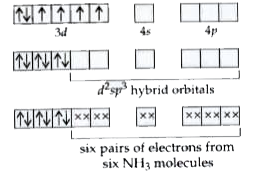 `d^(2)sp^(3)`hybridised orbitals Formation of `[Co(NH_(3))_(6)]6(3)` Geometry : Octahedral Spin : Diamagnetic ( No unpaired electrons ) |
|
| 23. |
Discuss the application of the Ellingham diagram: |
|
Answer» Solution :Ellingham diagram helps us to select a suitable reducing AGENT and appropriate temprature range for reduction.The reduction of a metal oxide to its metal can be considered as a competition between the element used for reduction and the metal so combine with oxygen.If the metal Oxide is more stable ,than oxygen remains with the metal and if the element used for reduction is more stable,then the oxygen from the meral oxygen from the metal oxide combines with elelmetns used for the reduction . from the Ellingham diagram ,we can infer the relative stability of different metal oxides at a given temprature. 1.Ellingham diagram for the formation of `Ag_(2)O` and HgO is at upper part of diagram and their decomposition temperatures are 600 and 700 K respectively.It indicates that these oxides are undtable at moderate temperature and will DECOMPOSE on heating even in the absence of a reducing agent. 2.Ellingham diagram is used to predict thermodynamic feasibility of reduction of oxides of one metal by another metal.Any metal can reduce the oxides of other METALS that are located ABOVEIT in the diagram .For example,in the Ellingham diagram ,for the formation of chromium oxide lies above that of the aluminium ,meaning that `Al_(2)O_(3)` is more stable than `Cr_(2)O_(3)` .Hence aluminium can be used as a reducing agent for the reduction of chromic oxide.However ,it cannot be used to reduce the oxides of magnesium and calcium which occupy lower position than aluminium oxide. 3.The carbon line of metal oxides and hence it can reduce all those metal oxides at sufficiently high temprature .Let us analyse the thermodynamically the formation of FeO and CO intresects around 1000 K.Below this temprature the carbon line lies above the iron line which indicates that FeO is more stable than CO and hence at this temprature range,the reduction is not thermodynamically feasible.However ,above 1000 K carbon line lies below the iron line and hence ,we can use coke as reducing agent above this temrature.The following free energy calculation also confirm that the reduction is thermodynamically favoured from the Elligham Diagram at 1500K, `2Fe_(s)+O_(2)to2FeO_((g))``DeltaG_(1)=-350 KJ mol^(-1)`.................(5) `2C_(s)+O_(2(g))to2CO(g)``DeltaG_(2)=-480 KJ mol^(-1)`..........(6) Reverse the reaction (2) and (3) `2FeO_(s)+2Cto2Fe(1,s)+2CO_(g)``DeltaG_(3)=-130KJ mol^(-1)`...........(8) The standard free energy change for the reduction of one mole of FeO is ,`DeltaG_(3)//2=-65KJ mol^(-1)` |
|
| 24. |
Discuss the anomalous behaviour of nitrogen. |
|
Answer» Solution :The anomalous behaviour of nitrogen is due to : (i) Small size (ii) High electronegativity (iii) High ionization enthalpy (iv) Absence of d-orbital Nitrogen exists as a diatomic (`N_2`) gaseous molecules while other ELEMENTS are solids. Nitrogen has UNIQUE ability to form `ppi - ppi`multiple bonds with itself and with small sized high electronegative elements such as oxygen and carbon. The heavier elements of this group donot form `ppi-ppi`bondings as their atomic orbitals are so large and diffuse that they cannot have effective orver lapping. HENCE `N_2` exists as gas and has very high bond enthalpy. While other elements form single bonds as P-P, As-As and Sb-Sb while BISMUTH has pure METALLIC bonds. Catenation tendency is weaker in nitrogen as N-N bond is weaker because of strong interelectronic repulsions. Hence N-N bond is weaker than P-P bond. Phosphorus catenates maximum in group-15. Nitrogen cannot expand its covalency beyond 4 because of absence of d-orbitals in outermost shell. Hence, it cannot form pentavalent compounds while other elements form a pentavalent compounds. Ex. : `PCl_(15)` . Nitrogen cannot form dn-pn bonds like other elements of group-15. For example `R_3 P = O` or `R_3 P = CH_2` (R = alkyl group). Heavier elements also forms `dpi-dpi` bonding with transition elements when their compounds like `P(C_2H5)3` and `As(C_2H_5)_3` act as a ligand. This is not observed for nitrogen. Trihalides of nitrogen except NF3 are unstable while trihalides of rest of the elements are stable. Oxides of nitrogen are monomeric but the oxides of other elements are dimeric. |
|
| 25. |
Discuss the anomalous behaviour of oxygen. |
| Answer» Solution :(i) Oxygen EXISTS as DIATOMIC molecules whereas other elements are polyatomic. (II) Oxygen is gas whereas other members are solids at room temperature. (iii) Max. O.S. of O is +2 whereas other members show max. O.S. of +6. (IV) Oxygen is paramagnetic whereas other elements are diamagnetic. | |
| 26. |
Discuss Swart's reaction. |
|
Answer» SOLUTION :This reaction INVOLVES the CONVERSION of allyl chloride or bromide. with alkyl fluoride. e.g `C_(2)H_(5)Cl+ AgF to C_(2)H_(5)F+ AgCl` |
|
| 27. |
Discuss social relevance of this branch of chemistry. |
| Answer» Solution :It is a very IMPORTANT branch discussing the IMPACT of VARIOUS chemical PHENOMENAS on living being and make the human resources aware of the dangers CAUSED by their activities. | |
| 28. |
Discuss similarities and dissimilarities in properties of lanthanoids and actinoids. |
|
Answer» Solution :Points of similarities: Both SHOWS oxidation state of (+3) Both shows contraction in ionic size in tripositive state along the series Both exhibit paramagnetism Both are electropositive and REACTIVE Both form COLOURED ions Points of dissimilarities: The dissimilarities in a properties of lanthanoids and actinoids is because of (i) Less binding energy of 5f electrons as compared to 4f electrons. (ii) Poorer shielding effect of 5f electrons as compared to 4f electrons. Actinoid shows large number of oxidation states (upto +7) while lanthanoids show maximum oxidation state of (+4) All actinoides are radioactive, while in lanthanoids only PROMETHIUM is radioactive Outer electrons in actinoids are easily available for bonding Oxo-anions of actinoids are KNOWN Ex: `UO_(2)^(2+)` while lanthanoid donot form oxoanions Actinoids react with non-metals at moderate temperatures while lanthanoid reacts at high temperatures. |
|
| 29. |
Discuss reactivity of group-15 elements with metals. |
| Answer» SOLUTION :All the elements REACT with metals to FORM their BINARY compounds exhibiting (-3) oxidation state such as `Ca_3N_2` (calcium nitride), `Ca_3P_2` (calcium phosphide), `Na_3As` (sodium arsenide) `Zn_3Sb_2` (Zinc antimonide) and `Mg_3Bi_2` (MAGNESIUM bismuthide). | |
| 30. |
Discuss properties of : (i) Xenon-fluoride compounds (ii) Xenon-oxygen compounds |
|
Answer» Solution :(i) Xenon-fluoride compounds : Physical PROPERTIES : `XeF_2, XeF_4` and `XeF_6` are colourless crystalline SOLIDS and sublime readily at 298 K. The structures of `XeF_2, XeF_4` and `XeF_6` are linear, square planar and distorted OCTAHEDRAL respectively and can be DEDUCED from VSEPR theory. 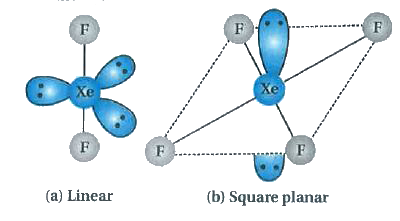 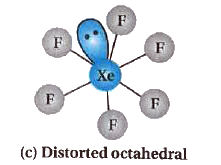 Chemical properties : Xenon fluorides readily hydrolyse even by traces of water. For example :` XeF_2` hydrolyse to give Xe, HF and `O_(2)` `2XeF_2(s) + 2H_2O(l)to2Xe(g) + 4HF(aq) + O_2(g)` Xenon fluorides react with fluoride ion acceptors to form cationic species and fluoride ion DONORS to form fluoroanions. `XeF_(2) + PF_(5) to [XeF]^(+) + [PF_(6)]^(-)`, `XeF_(4) + SbF_(5) to [XeF_(3)]^(+)[SbF_(6)]^(-)` `XeF_(6) + MF to M^(+)[XeF_(2)]^(-)`, (M=Na, K, Rb or Cs) (ii) Xenon-oxygen compounds : `XeO_3` is colourless explosive solid and has a pyramidal molecular structure. 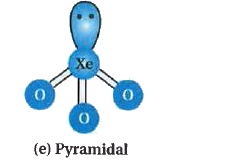 `XeOF_4` is colourless volatile liquid and has square pyramidal molecular structure. 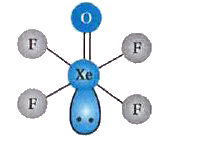
|
|
| 31. |
Discuss physical properties of lanthanoids. |
|
Answer» Solution :All lanthanoids are silvery white soft metals and TARNISH rapidly in air The hardness increases with increase in atomic number. Samarium is steel hard. The melting POINTS range between `1000-1200`K . However, samarium melts at 1623K They show luster and are good conductors of heat and electricity Density and other properties change smoothyl except for Eu and Yband OCCASIONALLY for Sm and TM. Lanthanoids are paramagnetic except `La^(3+), Ce^(4+), YB^(4+), Yb^(2+) and Lu^(3+)` etc |
|
| 32. |
Discuss physical properties and chemical properties of noble gases. |
|
Answer» SOLUTION :(i) Physical Properties : All noble gases are MONOATOMIC. They are COLOURLESS, odourless and tasteless. Noble gases are sparingly soluble in water. They have very low melting and boiling points because the only type of interatomic interaction in these elements is weak dispersion FORCES. Helium has the lowest boiling point (4.2 K) of any known substance. It has an unusual property of diffusing through most commonly used laboratory materials such as rubber, glass or plastics. (ii) Chemical Properties : The noble gases in general are least reactive (inert). This is due to following reasons : (i) Except helium (`Is^2`), the noble gases have completely filled (`ns^2 np^6`) valence shell. (ii) They have high ionisation enthalpy and high positive electron gain enthalpy. Neil Bartlett, first observed the reaction of noble gas. He first prepared a red compound `O_(2)^(+)[PtF_(6)]^(-)` . He realised that the first ionisation enthalpy of molecular oxygen (1175 kJ `mol^(-1)`) and that of xenon (1170 kj `mol^(-1)`) is almost identical. He made efforts and prepare same type of red coloured compound of Xe i.e., `Xe^(+)[PtF_(6)]^(-)`by mixing `PtF^6` and Xe. Later , many compounds of xenon with fluorine and oxygen have been synthesized. The compounds of krypton are fewer. Only the difluoride (`KrF_2`) has been studied in detail. Compounds of radon have not been isolated but only identified (`RnF_2`) by radiotracer TECHNIQUE. No true compounds of Ar, Ne or He are yet known. |
|
| 33. |
Discuss physical properties of halogens. |
|
Answer» Solution :(i) Physical State : At room temperature, fluorine and chlorine are gases, bromine is LIQUID while iodine is a solid. This is due to increase in MAGNITUDE of Van-dar-Waal.s forces down the group with the increase in molecular SIZE. (ii) Atomicity: All the halogens except At and Ts are diatomic. (iii) Colour : Halogens are coloured. The colour of halogens is due to the fact that their molecules absorb light in the visible region. This LEAD to the excitation of outer electrons to higher energy:  (iv)Solubility : Fluorine and chlorine REACTS with water while bromine and iodine are sparingly soluble in water but soluble in organic solvents such as chloroform, carbon tetrachloride, carbon disulphide and hydrocarbons to give coloured solutions. (v) Melting and boiling points : Moving down the group, the boiling points and melting points of the halogens increases due to increase in magnitude of intermolecular forces. |
|
| 34. |
Discuss physical and chemical properties of sulphuric acid. |
|
Answer» Solution :i) Physical properties : Sulphuric acid is a colourless, dense, oily liquid with a specific gravity of 1.84 at 298 K. The FREEZING point is 283K and boiling point is 61 IK. It dissolves in water with evolution of large quantity of heat. Hence, while diluting an acid, the acid must be added to water and not water to an acid with a constant stirring. (ii) Chemical properties : The chemical reactions of sulphuric acid are as a result of the following characteristics : (a) Low volatility (b) Strong acidic character (c) Strong affinity for water (d) Ability to act as an oxidising agent In aqueous medium, sulphuric acid ionises in two steps. `H_(2)SO_(4)(aq) + H_(2)O(l) to H_(3)O_(aq)^(+) + HSO_(4)^(-) (aq), Ka_(1)`=very large `(Ka_(1) gt 10)` `HSO_(aq)^(-) + H_(2)O(l) to H_(3)O_(aq)^(+) + SO_(4)^(2-) (aq), Ka_(2) =1.2 xx 10^(-2)` The larger value of `Ka_1(Ka_1 gt 10`) means that `H_2SO_4` is largely dissociated into `H^+` and `HSO_4`. Greater the value of dissociation constant `(K_a)`the stronger is the acid. The acid forms two series of SALTS : Normal salts such as sodium sulphate, copper sulphate etc. and acid sulphates (e.g., sodium hydrogen sulphate). Sulphuric acid, because of its low volatility can be used to manufacture more volatile acids from their corresponding salts. `2MX + H_(2)SO_(4) to 2HX + M_(2)SO_(4)(X =F, Cl, NO_(3))` (M = Metal) Concentrated sulphuric acid is a strong dehydrating agent. Many wet gases can be dried by passing them through sulphuric acid, provided the gases do not react with the acid. Sulphuric acid removes water from organic compounds, it is evident by its charring action on carbohydrates. `C_(12)H_(22)O_(11) overset(H_(2)SO_(4)) to 11H_(2)O + 12C` Hot concentrated sulphuric acid is moderately strong oxidising agent. In this respect, it is intermediate between phosphoric and nitric acids. Both metals and non-metals are oxidized by concentrated sulphuric acid, which is REDUCED to `SO_2`. `Cu + underset("conc") (2H_(2)SO_(4)) to CuSO_(4) + SO_(2) + 2H_(2)O` `C + underset("conc")(2H_(2)SO_(4)) to CO_(2) + 2SO_(2) + 2H_(2)O` |
|
| 35. |
Discuss physical and chemical properties of nitric acid. |
|
Answer» Solution :Physical Properties : In a gaseous state, `HNO_(3)`exists as a planar molecule. It is a colourless liquid (f.p. 231.4 K and b.p. 355.6 K). Laboratory grade nitric acid contains 68% of the `HNO_(3)` by mass and has specific GRAVITY of 1.504. 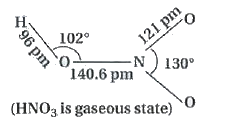 Chemical properties : In aqueous solution, nitric acid behaves as a strong acid GIVING hydronium and nitrate ions. `HNO_(3)(aq) + H_(2)O(l) to H_(3)O_(aq)^(+) + NO_(3)^(-) (aq)` CONCENTRATED nitric acid is a strong oxidizing agent and attacks most of the metals such as gold and platinum. The products of oxidation depend upon the concentration of the acid, temperature and nature of the material undergoing oxidation. `3Cu + 8HNO_(3)("dilute")to 3Cu(NO_(3))_(2) + 2NO + 4H_(2)O` `Cu + 4HNO_(3) ("conc") to Cu(NO_(3))_(2) + 2NO_(2) + 2H_(2)O` Zinc reacts with dilute nitric acid to give `N_(2)O`and with concentrated acid to give `NO_(2)` `Zn+ 4HNO_(3)("conc") to Zn(NO_(3))_(2) + 2NO_(2) + 2H_(2)O` Some metals such as Cr, Al etc. do not dissolve in concentrated nitric acid because of the formation of a passive film of oxide on the surface. Concentrated nitric acid ALSO oxidizes non-metals and their compounds. Iodine is oxidized to iodic acid, carbon to carbon dioxide, sulphur to `H_2SO_(4)` and phosphorus to phosphoric acid. `I_(2) + 10HNO_(3) to 2HIO_(3) + 10NO_(2) + 4H_(2)O` `C + 4HNO_(3) to CO_(2) + 2H_(2)O + 4NO_(2)` `S_(8) + 48HNO_(3) to 8H_(2)SO_(4) + 48NO_(2) + 16H_(2)O` `P_(4) + 20HNO_(3) to 4H_(3)PO_(4) + 20NO_(2) + 4H_(2)O` |
|
| 36. |
Discuss in brief sulphonation and nitration of phenol. |
Answer» Solution :Sulphoration: It is done by cons `H_(2)SO_(4)` to get ortho and PARA hydroxy benzene sulphonic ACID. 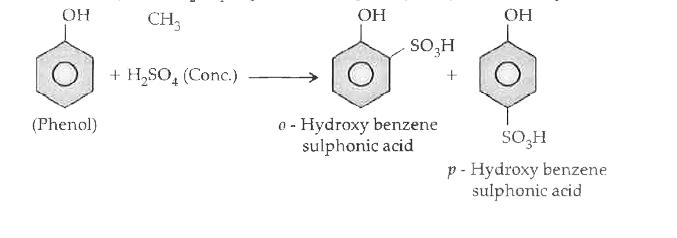 Nitration: Phenol can be NITRATED with dilute nitric at law TEMPERATURE (293K) to give orthio and para nitro phenol. 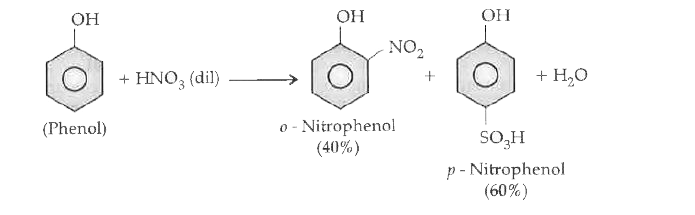
|
|
| 37. |
Discuss important effects of hormones in our body to control the biological activities. |
|
Answer» |
|
| 38. |
Discuss Haloform reaction . |
Answer» Solution :This reaction is given by ACETALDEHYDE or methyl ketones and is known as haloform reaction.For EXAMPLE when acetaldehyde reacts with sodium hypoiodite a YELLOW PRECIPITATE of iodoform is obtained. 
|
|
| 39. |
Discuss construction and uses of conductivity cell. |
|
Answer» Solution :* It is an instrument to measure the IONIC conductivity/resistivity of electrolytic solution. * It is available in several designs and two simple ones are shown in the following diagram.  * CONSTRUCTION : Basicaly, it consists of two platinum electrodes coated with platinum black (finely divided metallic Pt is deposited on the electrodes electrochemically). * These have area of cross SECTION equal to .A. and are separated by DISTANCE .l.. * THEREFORE, solution confined between these electrodes is a column of length l and area of cross section A. * Uses : By using conductivity cell conductivity and resistivity of unknown solution can be measured. |
|
| 40. |
Discuss chemical properties of potassium permanganate |
|
Answer» Solution :Decomposition of POTASSIUM permanganate at 513K gives GREEN coloured potassium manganate. `2KMnO_(4) rarr K_(2)MnO_(4) + MnO_(2) + O_(2)` Acidified permanganate solution is a good oxidizing agent. It oxidizes Fe(II) to Fe(III), `NO_(2)^(-) " to " NO_(30^(-)` and iodides to iodine. The half reactions of the reductants are: (i) `underset(underset(COO^(-))(5|))(C )OO^(-) rarr 10CO_(2) + 10e^(-)` (ii) `5Fe^(2+) rarr 5Fe^(3+) + 5e^(-)` (iii) `5NO_(2)^(-) + 5H_(2)O rarr 5NO_(3)^(-) + 10H^(+) + 10e^(-)` (iv) `10I^(-) rarr 5I_(2) + 10e^(-)` In acidic medium, the hydronium ion concentration plays an important role in kinetics of the REDOX reaction `MnO_(4)^(-) + e^(-) rarr MnO_(4)^(2-) {E^(@)= +0.56V]` `MnO_(4)^(-) + 4H^(+) + 3e^(-) rarr MnO_(2) + 2H_(2)O {E^(@) = +1.69V]` `MnO_(4)^(-) + 8H^(+) + 5e^(-) rarr Mn^(2+) + 4H_(2)O [E^(@) = +1.52V]` Permanganate at `[H^(+)] =1`, should oxidize water but in practise the reaction is extremely slow UNLESS temperature is raised OR Mn(II)ions are present |
|
| 41. |
Discuss Browinan movement. |
| Answer» | |
| 42. |
Discuss brifly the nature of bonding in metal carbonyls. |
|
Answer» SOLUTION :(b)Bonding in metal carbonyls (i) In metal carbonyls , the bondbetweenmetal ATOM and thecarbonyl ligandconsistsof twocomponents (ii) The firstcomponent is an ELECTRON pairdonation from the carbonatom of carbonylligandinto a vacant - d- orbital of centralmetalatom . (iii)The electron pairdonation forms` M overset( sigma " bond")larr CO` sigma bond. The sigmabondformation inceases the electron densityin metal d orbitals and makesthe metalelectron rich. (v)In ORDERTO compensatefor this increased electron densty,a filledmetal d-orbitalinteractswith the empty ` pi`orbital on thecarbonyl ligandand transfersthe added electrondensity back to the ligand. (vi) Thissecond component is called ` pi-` backbonding, Thus in metalcarbonyls , electron densitymovesfromligandto metal throughsigma bondingand from metal to ligandthrough pi bonding , this synergic effect accountsfor strongthis synergic effect accounts for strong` M larr CO`bond in metal carbonyls. (vii) Thisphenomenon is shown diagrammaticallyas FOLLOWS 
|
|
| 43. |
Discuss briefly the nature in metal carbonyls. |
|
Answer» Solution :`(i)` In metal carbonyls, the bond between metal atom and the carbonyl ligand consists of two COMPONENTS. `(ii)` The first component is an electron pair donation from the CARBON atom of carbonyl ligand into a vacant `d`-orbital of central metal atom. This electron pair donation forms `M overset(sigma bond)(larr) CO` sigma bond. `(iii)` This sigma bond formation INCREASES the electron density in metal `d`-orbital and makes the metal electron rich. `(iv)` In order to compensate for this increased electron density, a filled metal `d`-orbital interacts with the empty `pi^(*)` orbital on the carbonyl ligand and transfers the added electron density back to the ligand. This second component is called `pi-`back bonding. `(v)` Thus in metal carbonyls, electron density MOVES from ligand to metal through sigma bonding and from metal to ligand through pi bonding this synergic effect accounts for strong `M larr CO` bond in metal carbonyls. This phenomenon is shown diagrammatically as follows. 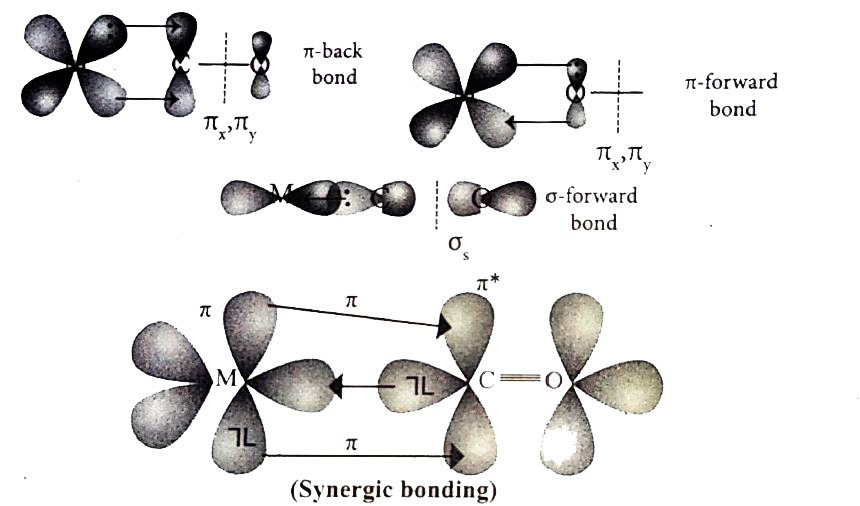
|
|
| 44. |
Discuss briefly giving an example in each case the role of co-ordination compounds in. (i) Biological systems (ii) Medicinal chemistry (iii) Analytical Chemistry |
|
Answer» SOLUTION :(i) Role of co-ordination compounds in biological systems. (a) Haemoglobin, the oxygen carrier in blood, is a complex of `Fe^(2+)`with porphyrin. (b) The pigment chlorophyll in plants, responsible for PHOTOSYNTHESIS, is a complex of `Mg^(2+)` with porphyrin. (c)Vitamin `B_(12)` (cyanocobalamine) the antipernicious anaemia factor, is a complex of cobalt. (ii) Role of co-ordination compounds in medicinal chemistry (a) the platinum complex cis-`[Pt(NH_3)_2 Cl_2]` (cis-platin) is used in the treatment of cancer. (b) EDTA complex of calcium is used in the treatment of lead poisoning. Ca-EDTA is a weak complex , when it is administered, calcium in the complex is replaced by the lead present in the BODY and is eliminated in the urine. (c) The excess of copper and iron present in animal system are REMOVED by the chelating ligands D-penicillamine and desferroxime B via the formation of complexes. (iii) Role of co-ordination compounds in analytical chemistry : Complex formation is frequently encountered in qualitative and quantitative chemical ANALYSIS. |
|
| 45. |
Discuss briefly Frenkel defects in ionic crystals. |
|
Answer» Solution :When imperfections or defects in a crystal are caused by a departure from the periodic arrangement in the vicinity of an ATOM or a group of atoms, the imperfections are called POINT defects. The imperfections are caused either by missing or dislocations of a. constitutent particle to a position meant for another particle or shifting to an interstitial position. Point defects are of two common TYPES : 1. Schottky defects 2. Frenkel defects. 1. Schottky defects. This defect arises if some of the atoms or ions are missing from their normal lattice sites. The lattice sites which are unoccupied are called latrice vacancies or holes. Since the crystal is to remain electrically neutral, equal NUMBER of cations and anions are missing. The ideal AB crystal is shown in Fig. The existence of two holes, one due to a missing cation and the other due to a missing anion, is shown in Fig. Schottky defect is more common in strongly ionic compounds having a high coordination number. 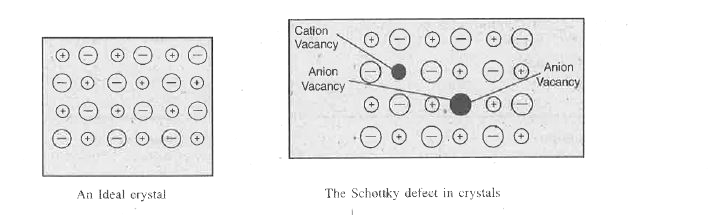 For example, NaCl and CsCl ionic solids have Schottky defects. Because of the presence of vacancies in crystals, its density is markedly lowered. 2. Frenkel defects. This defect arises when an ION is missing from its own position and occupies an interstitial site. The existence of one hole due to a missing cation its proper position and occupying an interstitial position is shown in Fig. In this case also, the crystal remains electrically neutral. Frenkel defects generally occur in 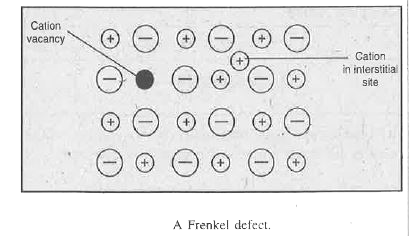 compounds in which anions are much larger than the cations and the co-ordination number is low. These defects can be found in silver halides because of the small size in the `Ag^(+)` ion. |
|
| 46. |
Discuss bilological and industrial importance of osmosis. |
|
Answer» SOLUTION :Biological IMPORTANCE of OSMOSIS. INDUSTRIAL importance of osmosis. Besides these, REVERSE osmosis is used for desalination of water. |
|
| 47. |
Discuss anomalous behaviour of fluorine. |
|
Answer» Solution :Fluorine shows anomalous behaviour due to : (i) Small size (ii) High ionisation enthalpy (iii) Absence of d-orbitals in valance shell (IV) High positive electrode potential Fluorine shows (-1) oxidation state only while other elements show (+1), (+3) (+5) and (+7) oxidation states. HF is liquid due to H-bonding while HCl, HBr and HI are gaseous in state. Fluorine does not FORM poly fluorides, FOREXAMPLE : `F_3` is not known. This is due to absence of d-orbitals in valance shell.Fluorine forms only one oxoacid (HOF) while other halogens form number of OXOACIDS. The maximum covalency of fluorine is one due to absence of d-orbital in valance shell while other halogens show covalence of 7. Hydrofluoric ACID is a dibasic acid (`H_2F_2`) while other hydrohalic acids are monobasic. `F_2` is highly reactive due to low bond (F - F) dissociation enthalpy. Fluorine forms hexafluoride (`SF_6`) while other halogens do not form hexahalides with sulphur. |
|
| 48. |
Discuss about the order of electron affinity of halogen elements. |
|
Answer» SOLUTION :The ORDER of ELECTRON AFFINITY is `ClgtFgtBrgtI` |
|
| 49. |
Discuss about the hydrolysis of salt of weak acid and weak base and derive pH value of the solution. |
|
Answer» Solution :(i) Consider the hydrolysis of ammonium acetate `CH_3COOH_(4(aq)) to CH_3COO^(-) (aq) +NH_4^(+) (aq)` (ii) In that CASE both the cation `(NH_4^(+)) and (CH_3COO^-)` anion have the tendency to REACT with water `CH_3COO^(-)+H_2O leftrightarrowCH_3COOH+Oh^-` `NH_4^(+)+H_2O leftrightarrowNH_4OH+H^+` (iii) the nature of the solution depends on the strength of acid (or) base i.e., if `K_a gt K_b` then the solution is ACIDIC and`pH lt 7` if `K_a lt K_b` then the solution is BASIC and pH and `pH gt 7`. IF `K_a =K_b`then the solution is neutral. (iv) the RELATION between the dissociation constant `K_a,K_b` and hydrolysis constant is given by the following expression. (v) ph of the solution `pH=7+1/2 pK_a-1/2 pK_b` |
|
| 50. |
Discuss about the nature of carbonyl group. |
Answer» SOLUTION :
|
|