

Saved Bookmarks
This section includes 7 InterviewSolutions, each offering curated multiple-choice questions to sharpen your Current Affairs knowledge and support exam preparation. Choose a topic below to get started.
| 1. |
Derive Nernst equation for calculating E_(cell) of Nernst equation and write the effect on E_(cell) when there is change in concentration of Zn^(2+) and Cu^(2+). |
|
Answer» Solution :In DANIELL cell, the electrode POTENTIAL for any given concentration of `Cu^(2+) and Zn^(2+)` ions, its REACTION: * For Anode `Cu^(2+)|Cu`: `E_((Cu^(2+)|Cu))=E_((Cu^(2+)|Cu))^(Theta)-(RT)/(2F)ln(1)/([Cu_((aq))^(2+)])` * For Cathode `Zn^(2+)|Zn`: `E_((Zn^(2+)|Zn))=E_((Zn^(2+)|Zn))^(Theta)-(RT)/(2F)ln(1)/([Zn_((aq))^(2+)])` * Cell potential `E_(cell)=(E_("cathode")-E_("anode"))` `therefore E_(cell)=(E_((Cu^(2+)|Cu))-E_((Zn^(2+)|Zn)))` `therefore E_(cell)=(E_((Cu^(2+)|Cu))^(Theta)-(RT)/(2F)ln(1)/([Cu_((aq))^(2+)]))-(E_((Zn^(2+)|Zn))^(Theta)+(RT)/(2F)ln(1)/([Zn^(2+)]))` `therfore E_(cell)=(E_((Cu^(2+)|Cu))^(Theta)-E_((Zn^(2+)|Zn))^(Theta))-(RT)/(2F)(ln(1)/([Cu_((aq))^(2+)])-ln(1)/([Zn_((aq))^(2+)]))` `therefore E_(cell)=E_(cell)^(Theta)-(RT)/(2F)ln([Zn_((aq))^(2+)])/([Cu_((aq))^(2+)])` (Above formula is for `E_(cell)` of Daniell cell potential) * In above EQUATION if `ln=2.303log_(10)` `E_(cell)=E_(cell)^(Theta)-(2.303RT)/(2F)"log"_(10)([Zn_((aq))^(2+)])/([Cu_((aq))^(2+)])` In the above equation if `R=8.314JK^(-1)mol^(-1)`, `T=298K and F=96487" C "mol^(-1) and (RT)/(F)=0.0591` So cell potential for the Daniell cell, `E_(cell)=E_(cell)^(Theta)-(0.0591)/(2)"log"_(10)([Zn_((aq))^(2+)])/([Cu_((aq))^(2+)])` * It can be seen that `E_(cell)` depends on the concentration of both `Cu^(2+) and Zn^(2+)` ions. it incrases with the increase in the concentration of `Cu^(2+)` ions and decrease in the concentration of `Zn^(2+)` ions. |
|
| 2. |
Derive integrated rate law for a zero order reaction A rarr Product . |
|
Answer» Solution :A reaction in which the rate in independent of the concentration of the reactant over a wide RANGE of concentrations is called as zaro order REACTIONS are RARE . Let us consider the FOLLOWING hypothetical zero order reaction. `""Ararr` Product The rate law can be written as, `(-d[A])/(dt)=k(1)implies-d[A]=kdt` Integrate the above equation between the limits of `[A]_0` at zero and [A] at some later time .t. `-int_([A_0])^([A])d[A]=kint_(0)^(t)dt` `-([A])_([A_0])^([A])=k(t)_0^t` `[[A]-[A_0]]=kt` `k=([A_0]-[A])/t` |
|
| 3. |
Derive an integrated rate for first order reaction. |
|
Answer» Solution :CONSIDER Ist order reaction `R rarr P` `"Rate "=(-d[R])/(DT)=k[R]^(1)` `(d[R])/([R])=-k.dt` `int(d[R])/([R])=-k int dt` `ln [R]=-KT+I` I is integral CONSTANT when `t=0[R]=[R]_(0)` `ln[R]_(0)=-k(0)+I` `THEREFORE I =ln[R]_(0)` `ln[R]=-kt+ln[R]_(0)` `kt=ln[R]_(0)-ln[R]` `KT=(2.303)/(t)log""([R]_(0))/([R])` |
|
| 4. |
Derive integrated rate equation for rate constant for a first order reaction. |
|
Answer» SOLUTION :`R to P` Rate`=-(d[R])/(dt)=k[R] or (d[R])/([R])=-kdt` Integrating this equation In [R]`=-kt+I ""…(i)` where I is constant of integration. When `t=0, R=[R]_(0)`, where `[R]_(0)` is initial concentration. The equation (i) can be written as `"In [R]_(0)= -k xx 0+I` or `"In [R]_(0)=I` Substituting the value of I in equation (i) `"In [R]"= -kt +"In [R]"_(0) or -kt = "In [R]" -"In [R]"_(0)` or `k=(1)/(t)"In"([R]_(0))/([R]) or k-(2.303)/(t)"log"([R]_(0))/([R])` |
|
| 5. |
Derive Henderson - Hassel Balch equation. |
|
Answer» Solution :(i) The concentration of hydronium ion in an ACIDIC buffer solution depends on the RATIO of the concentration of the weak acid to the concentration of its conjugate base present in the solution i.e, `[H_3O^+]=K_a(["acid"]_(aq))/(["base"]_(aq))` The weak acid is dissociated only to a small extent. Moreover, due to common ion effect the dissociation is further suppressed and hence the equilibrium concentration of the acid is nearly equal to the initial concentrationof the unionised acid. Similarly, the concentration of the conjugate base is nearly equal to the initial concentration of the added SALT. `[H_3O^+]=K_a(["acid"])/(["salt"])` (iii) Here [acid] and [salt] represent the initial concentration of the acid and salt, respectively used to prepare to buffer solution Taking logarithm on both sides of the equation `LOG[H_3O^+]=logK_a+log.(["acid"])/(["salt"])` reverse the sign on both sides `-log[H_3O^+]=-logK_a-log.(["acid"])/(["salt"])` We know that `pH=-log[H_3O^+] and pK_a=-log K_a` `rArr pH=pK_a-log.(["acid"])/(["salt"])` `rArr pH=pK_a+log.(["acid"])/(["salt"])` Similarly for a basic buffer, `pOH=pK_a+log.({"salt"])/(["base"])` |
|
| 6. |
Derive half life t_((1)/(2))of first order reaction. |
|
Answer» Solution :For a first ORDER reaction,rate constant (k) is given by following equation . `k=(2.303)/(t)` log `([R]_(0))/([R])`…..(b) In this equation `t_((t)/(2))` =HALF life time. An initial t=0 time,the concentration of reactant =`[R]_(0)` After `t_((1)/(2))` time,the concentration of Reactant =[R] `(1)/(2)` (initial case)=`(1)/(2)[R]_(0)` PUT `t=t((1)/(2))` and [R]=`([R]_(0))/(2)` in equation (b), `k=(2.303)/(t_((1)/(2)))` log `([R]_(0))/(([R]_(0))/(2))` `thereforek=(2.303)/(t_((1)/(2)))` log 2.0 `THEREFORE k=(2.303)/(t_((1)/(2)))xx0.3010` `therefore k=(0.693)/(t_(1)/(2))` and `t_((1)/(2))=(0.693)/(k)`=half life of first order reaction Derivation:It can be seen that for a first order reaction. half life periof is constant It is independent of initial concentration of the reacting species. The half life `t_((1)/(2))` of a first order equation is really calculated from the rate constant & vice versa. For zero order reaction `t_((1)/(2))prop[R]_(0)` and for first order reaction `t_((1)/(2))` is independent of `[R]_(0)` |
|
| 7. |
Derive expression to calculate emf (reduction) of the following half cells at 25^@C Hg_2Cl_2 (s), Cl^(-)|Hg |
|
Answer» Solution :`1/2Hg_2 Cl_2(s)+E leftrightarrow HG(L)+CL^(-)` (reduction) `E_(Hg_2Cl_2Cl^-)=E_(Hg_2Cl_2)^@ -0.0591/1 log""([Hg][Cl^-])/([Hg_2Cl_2])` `=E_(Hg_2Cl_2)^@ -0.0591 log[Cl^-]` |
|
| 8. |
Derive expression to calculate emf (reduction) of the following half cells at 25^@C H^+||H_2(Pt) (1 atm) |
|
Answer» Solution :We have the NERNST equation for aA+bB `leftrightarrow -cC+dD` `E=E^@-(2.303 RT)/(NF) log""{([C]^c [D]^d)/([A]^d [B]^b)}` Substituting `R=8.314 JK^-1 mol^-1` F=96500 COULOMBS and `T=25+273=298K`, we get `E=E^@- .0.0591/n log""{([C]^c [D]^d)/([A]^a [B]^b)}` For the electrode `H^+|H_2(pt)` the half cell reaction is `H^+ + e leftrightarrow 1/2 H_2(g)` (reduction) (1 atm) `therefore E_(H^+) H_2=E_(H^+, H_2)^@-0.0591/2log""([H_2]^(1/2))/([H^+])` `=0-0.0591log""1/([H^+]) (E_(H^+,H_2)^@=0` volt) `=0.0591 log[H^+]` |
|
| 9. |
Derive expression to calculate emf (reduction) of the following half cells at 25^@C Fe^(3+)|Fe^(2+) (Pt) |
|
Answer» SOLUTION :`Fe^(3+)+E LEFTRIGHTARROW Fe^(2+)` (reduction) `E_(Fe^(3+),Fe^(2+))=E_(Fe^(3+),Fe^2+)^@-0.0591/1 log ""([Fe^(2+)])/([Fe^(3+)])` `E_(Fe^(3+),Fe^(2+))=E_(Fe^(3+),Fe^2+)^@ +0.0591 log""([Fe^(2+)])/([Fe^(3+)])` |
|
| 10. |
Derive expression to calculate emf (reduction) of the following half cells at 25^@C Cu^(2+)|Cu(s) |
|
Answer» SOLUTION :`Cu^(2+)+2E leftrightarrow Cu(s)` (REDUCTION) `E_(Cu^(2+),Cu)=E_(Cu^(2+),Cu)-0.0591/2 LOG""([Cu])/([Cu^(2+)])` `=E_(Cu^(2+),Cu) +0.0591/2 log[Cu^(2+)]` |
|
| 11. |
Derive expression to calculate emf (reduction) of the following half cells at 25^@C Cl_2 (g)|2Cl^(-) (Pt) (1 atm) |
|
Answer» SOLUTION :`1/2Cl_2(G)+e leftrightarrow CL^-` (reduction) (1 atm) `E_(Cl_2,Cl^-)=E_(cl_2,Cl^-)^@ -0.0591/1 LOG""([Cl^-])/([Cl]^(1/2))` `=E_(Cl_2,Cl^-)^@-0.0591 log [Cl^-]` |
|
| 12. |
Derive expression to calculate emf (reduction) of the following half cells at 25^@C AgCl(s),Cl^(-)|Ag |
|
Answer» SOLUTION :`AgCl(s)+e^(-) leftrightarrow Ag(s)+CL^(-) ` (REDUCTION) `E_(AgCl,Cl^-)=E_(AgClCl^-)^@- 0.0591/1 LOG"" ([Ag][Cl^-])/([AgCl])` `=E_(AgCl,Cl^-)^@ -0.0591 log[Cl^-]` For Ag and AgCl, both being solids `[Ag]=[AgCl]=1` |
|
| 13. |
Derive the integrated rate equation for rate constant of a zero reaction. |
|
Answer» Solution :Consider a zero order reaction. `R to P` `(-d[R])/(dt) = K[R]^(1)` Where k is velovity constant of a first order reaction. `(-d[R])/([R]) = -k.dt` Inegrating the EQUATION `int(d[R])/([R]) = -intk.dt` In `[R] = -kt +1 ""...(1)` I si constant of integration WHen t = 0 [R] ` = [R]_(0)` Where `[R]_(0)` is initial concentration of the reaction In `[R]_(0) = - k xx 0 +1` `I = "In" [R]_(0)` Substituing I value in equation (1) In `[R] = -kt + "In" [R]_(0)` kt = In `[R]_(0) = "In" [R]` `k = (2.303)/(t) LOG""([R]_(0))/([R])` |
|
| 14. |
Derive an expression for the hydrolysis constant for the hydrolysis of salt of weak acid and weak base. |
|
Answer» Solution :Let us consider the hydrolysis of AMMONIUM acetate. `CH_3COONH_(4(aq)) to CH_3 COO_((aq))^-+NH_(4(aq))^-+NH_(4(aq))^+` In this case, both the cation `(NH_4^+)` and anion `(CH_3 COO^3-)` have the tendency to react with WATER `CH_3 COO^-hArrCH_3 COOH+OH^-` `NH_4^(+)+H_2O hArr NH_4 OH+H^+` The natural of the solution DEPENDS on the strength of acid (or) base i.e., if `K_a gt K_b`,then the solution is acidic and `pH lt 7`, If `K_a lt K_b`, then the solution is basic and `pH gt 7`, if`K_a=K_b`, then the solution is neutral The relation between the dissociation constant `(K_a, K_b)` and the hydrolysis constant is given be the following expression. `K_a.K_b.K_h.=K_w` pH of the solution pH of the solution can be calculated using the following expression, `pH=7+(1)/(2)pK_(1)-(1)/(2)pK_(b)` |
|
| 15. |
Derive an expression to calculate time required for completion of zero order reaction. |
| Answer» SOLUTION :`t_(100%)=([A]_(0))/(K)` | |
| 16. |
Derive an expression for the hydrolysis constant and degree of hydrolysis of salty ofstrong acid and weak base. |
|
Answer» Solution :Hydrolysis of salt of strong acid and weak base : Let us consider the reactions between a strong acid, HCI, and a weak base, `NH_4OH`, to produce a salt, `NH_4CI`, and water `HCI_((aq))+NH_4OH_((aq)) hArr NH_4 CI_((aq))+H_2 O (I)` `NH_4 CI_((aq)) to NH_(4)^(+)+CI_((aq))^(-)` `NH_4^+`is a strong conjugate acid of the weak base `NH_4OH` and it has a tendency to react with `OH^-` from water to produce unionised `NH_4OH` shown below. `NH_(4(aq))^(+)+H_2O(I) hArr NH_4OH_((aq))+H_((aq)^+` There is no such tendency shown by `CI^-` and THEREFORE `[H^+] gt [OH^-]`, the solution is acidic and the PH is less than 7. As discussed in the salt hydrolysis of strong base and weak acid. In this case also, we can establish a relationship between the `K_(h) and K_(b)` as `k_(h).K_(b)=K_(w)` Let us calculate the `K_(h)` value in terms of degree of hydrolysis (h) and the concentration of salt `K_(h)=h^2 C and [H^+]=sqrt(K_(h).C)` `[H^+]=sqrt((K_w)/(K_b).C)` `pH=-log[H^+]` `=-log((K_w.C)/(K_b))^(1/2)` `=-(1)/(2)logK_w-(1)/(2)logC+(1)/(2)logK_(b)` `pH=7-(1)/(2)pK_(b)-(1)/(2)logC.` |
|
| 17. |
Derive an expression for the hydrolysis constant and degree of hydrolysis of salt of strong acid and weak base. |
|
Answer» Solution :LET US consider the reactions between a strong acid, HCl and a weak BASE, `NH_4OH` to produce a salt, `NH_4Cl` and water `HCl(aq)+NH_4OH(aq) leftrightarrowNH_4Cl(aq)+H_2O(l)` `NH_4Cl(aq)toNH_4^+ +Cl^(-) (aq)` `NH_4^+` is a strong conjugate acid of the weak base `NH_4OH` and it has a tendency to react with `OH^(-)` from water to produce unionised `NH_4OH` shown below. `NH_4^(+) (aq)+H_2O(l) leftrightarrow NH_4OH(aq)+H^+ (aq)` There is no such tendency shown by `Cl^-` and therefore `[H^+] gt [OH^-]`, the solution is acidic and the pH is less than 7. As discussed in the salt hydrolysis is strong base and weak acid . In this case also,we can establish a relationship between the `K_h and K_b` as `K_h.K_b=K_w` Let us calculate the `K_h` value in TERM of degree of hydrolysis (h) and the concentration of salt `K_h=h^2Cand[H^+]=sqrt(k_h.C)` `[H^+]=sqrt(K_w/K_b.C)` `pH=-LOG[H^+]=-log(K_w/K_b.C)^(1/2)` `=-1/2logK_w-1/2logC+1/2logK_b` `pH=7-1/2 pK_b-1/2 log C` |
|
| 18. |
State Ostwald’s dilution law. |
|
Answer» Solution :The dissociation of acetic ACID can be represented as `CH_3COOH HARR H^+ +CH_3 COO^-` The dissociation constant of acetic acids is `k_(a)=([H^+][CH_3 COO^(-)])/([CH_3 COOH])""…(1)`  Substituting the equilibrium concentration in equation (1) `k_(a)=((alpha C)(alpha C))/((1-alpha)C)` `k_(a)=(alpha^2 C)/(1-alpha)""...(2)` We know that WEAK acid dissociates only to a very small extent compared to ONE `alpha` is so small and HENCE in the denominator `(1-alpha) ~=1`. The above expression (2) now becomes. `k_(a)=alpha^2 C` `rArr alpha^2 =(K_(a))/(C ) ` `alpha=sqrt((K_a)/(C ))` |
|
| 19. |
Derive an expression for Ostwaid's dilution law. |
|
Answer» Solution :Ostwaid dilution law: It relates the dissocation constant of the WEAK ACID `(K_a)` with its degree of dissociation (a) and the concentration ( c). Considering a weak acid, the dissociation of ACETIC acid can be represented as `CH_3COOH LEFTRIGHTARROW CH_3COO^(-)+H^+` The dissociation constant of acetic acid is `K_a=([H^+][CH_3COO^-])/([CH_3COOH])` 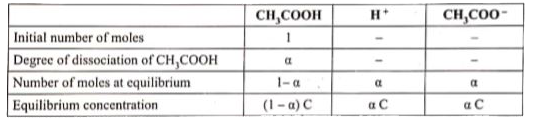 Substituting the equilibrium concentration in equation `K_a=((aC)(aC))/((1-a)C)impliesK_a=(a^2C^2)/((1-a)C)` `K_a=(a^2C)/((1-a))`.....(1) We know that weak acid dissociates only to a very small compared to one a is so small `therefore` equation (1) becomes `K_a=a^2C` `a^2=K_a/C implies a=sqrt(K_a/C)`....(2) Similarly for a weak base, `K_b=a^2C` `a=sqrt(K_b/C)` The concentration of `H^+` can be calculated using the `K_a` value as below `[H^+]=ac` `a=([H^+])/C` Substituting a value in equation (2) `([H^+])/C=sqrt(K_a/C)to[H^+]=sqrt(K_a/C).C` `[H^+]=sqrt((K_a.C^2)/C)implies[H^+]=sqrt(K_a.C)` For a weak base `[OH^-]=sqrt(K_b.C)` |
|
| 20. |
Derive an equation for solution which shows relation between total pressure and mole fraction of volatile solute and volatile solvent and explain it by plotting graph. |
|
Answer» Solution :Suppose in a binary meaning volatile solution component 1 and component 2 is present. Their mole fraction is `X_(1)` and `X_(2)` and their vapour pressure is `p_(1)` and `p_(2)` respective. According to the Raoult.s law, a solution of volatile liquids, the PARTIAL vapour pressure of each component of the solution is directl proportional to its mole fraction present in solution. Thus, for componnent 1 , `p_(1)prop X_(1)` and `p_(1)=p_(1)^(0). X_(1)` where `p_(1)` is the vapour pressure of pure component 1 at the same temperature. Similarly, for component 2, `p_(2) prop X_(2)`and`p_(2)=p_(2)^(0).X_(2)`, where `p_(2)^(0)` represents the vapour pressure of the pure component 2. According to Dalton.s law of partial pressures, the total pressure (total p) over the solution phase in the container will be the sum of the partial pressures of the components of the solution. `p_("total")=p_(1)+p_(2)` `p_("total")=p_(1)^(0).x_(1)+p_(2)^(0).x_(2)` `=(1-x_(2))p_(1)^(0)+x_(2)p_(2)^(0)` `p_("total")=p_(1)^(0)+x_(2)(p_(2)^(0)-p_(1)^(0))` Following conclusions can be drawn from equation : (i) Total vapour pressure over the solution can be related to the mole fraction of any one component. (ii) Total vapour pressure over the solution VARIES linearly with the mole fraction of component 2. (iii)Depending on the vapour pressures of the pure components 1 and 2, total vapour pressure over the solution decreases or increases with the increase of the mole fraction of component 1. A plot of `p_(1)` or `p_(2)` versus the mole fractions `X_(1)` and `X_(2)` for a solution given a linear plot as shown in figure. 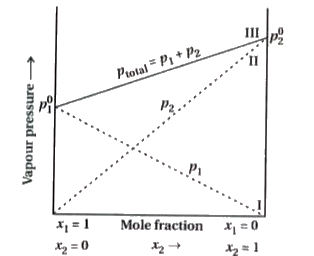 These lines (I and II) pass through the points for which `X_(1)` and `X_(2)` are EQUAL to unity. Similarly the plot (line III) of `p_("total")` versus `X_(2)` is also linear. The minimum value of `p_("total")` is `p_(1)^(0)` and the maximum value is `p_(2)^(0)`, assuming that component 1 is less volatile than component 2, i.e., `p_(1)^(0)lt p_(2)^(0)`. The COMPOSITION of vapour phase in equilibrium with the solution is determined by the partial presures of the components. If `Y_(1)` and `Y_(2)` are the mole fractions of the components 1 and 2 respectively in the vapour phase than, using Dalton.s law of partial pressures: `p_(1)=Y_(1)p_("total")` and `p_(2)=Y_(2)p_("total")` So, in general `p_(i)=Y_(i)p_("total")` |
|
| 21. |
Derive an equation for equilibrium constant K_(c) of any galvanic cell (Redox reaction) and also give its uses. |
|
Answer» Solution :* According to the active mass rule when any redox reaction attains equilibrium then, * At equilibrium both electrode potential becomes zero, `E_(CELL)=0.0V` and so its nernst equation will be as follows: `0.0=E_(cell)=E_(cell)^(Theta)-(0.059)/(n)logQ` `therefore E_(cell)^(Theta)-(0.059)/(n)logK_(C)""(logQ=logK_(C))` `therefore logK_(C)=(nxxE^(Theta))/(0.059)` `therefore K_(C)="Antilog "(n E^(Theta))/(0.059)` Where, n= number of electrons differ in the reaction `E^(Theta)=`standard reduction potential of redox reaction `=E_("cathode")^(Theta)-E_("anode")^(Theta)` * Uses : (i) equilibrium CONSTANT can be calculated by MEASURING potential. (ii) value of `K_(C)` gives account of reaction. if `K_(C)` value is hihgh then FORWARD reaction will be more and so more product will be obtained. |
|
| 22. |
Derive a relationship between K_b,T_b and DeltaH_(vap) for a liquid. |
|
Answer» Solution :Let us consider a PURE liquid. At its boiling point, `T_b` , its VAPOUR pressure `P^@` WOULD be equal to the external pressure. `:.P^@=P_(ext) ` at temperature `T_b`. Now let us consider a non -volatile solute dissolved in the liquid. When the solution reaches temperature `T_b`, the vapour pressure of the SYSTEM, would be less than the external pressure. When the solution is heated further and it reaches its boiling `T_b^**`, the vapour pressure of the solution would be equal to `P_(ext)` which is equal to the `P^@` of the pure liquid at its boiling point. Since vapour pressure of a system are the `K_P`’s for the respective equilibrium, In `K_(PT_2)/K_(PT_1)=(DeltaH)/R[1/T_1-1/T_2]` In `P^@/P=(DeltaH_(vap))/R[1/T_b-1/T_b^**]=(DeltaH_(vap))/R[(DeltaT_b)/(T_bT_b^**)]` Assuming the solution to be highly dilute, `T_b^**` would be very close to `T_b`. `:. InP^@/P=(DeltaH_(vap))/R[(DeltaT_b)/(T_b^(2))]` `-InP^@/P=(DeltaH_(vap))/R[(DeltaT_b)/(T_b^(2))]` `-In[1-((P^@-P)/P^@)]=(DeltaH_(vap))/R[(DeltaT_b)/(T_b^(2))]` `-In[1-X_(solute)]=(DeltaH_(vap))/R[(DeltaT_b)/(T_b^(2))]` Since `X_(solute)` is very small, we can make the approximation that in (1 - x) = - x (when x is very small).`:.X_(solute)=(DeltaH_(vap))/R[(DeltaT_b)/(T_b^(2))]` or`n/(n+N)=(DeltaH_(vap))/R[(DeltaT_b)/(T_b^(2))]` Ignoring n in comparison to N in the denominator `n/N=(DeltaH_(vap))/R[(DeltaT_b)/(T_b^(2))]` `n/(W_(solvent)/(M_(solvent)))=(DeltaH_(vap))/R[(DeltaT_b)/(T_b^(2))]`or `n/(W_(solvent))=(DeltaH_(vap))/(M_(solvent)R)[(DeltaT_b)/(T_b^(2))]` Multiplying by 1000 on both the sides, we get `n/(W_(solvent))xx1000=(DeltaH_(vap))/(M_(solvent)R)[(DeltaT_b)/(T_b^(2))]`xx1000 `m=(DeltaH_(vap))/(M_(solvent)R)[(K_bm)/(T_b^(2))]`xx1000 `K_b=(RT_b^(2)M_(solvent))/(1000DeltaH_(vap))`Similarly, `K_"f"=(RT_b^(2)M_(solvent))/(1000DeltaH_("fus"))` |
|
| 23. |
Derive an expression for Nernst equation. |
|
Answer» Solution :NERNST equation : Nernst equation is the one which relates the cell potential and the concentration of the SPECIES involved in an electrochemical reaction. Let us consider an electrochemical cell for which the overall redox reaction is, `""xA+xB iff1C+mD` The reaction quotient Q for the above reaction is given below `Q=([C]^(l)[D]^(m))/([A]^(x)[B]^(y)) "...(1)"` We have already learnt that, `DeltaG=DeltaG+RTInQ"...(2)"` The Gibbs free energy can be related to the cell emf as follows [`therefore` equation (1) and (2)] `DeltaG=-nFE_("cell"), DeltaG^(@)=-nFE_("cell")^(@)` SUBSITUTE these values and Q from (1) in the equation (2) `(2) rArr -nFE_("cell")=-nFE_("cell")^(@)+RTln""([C]^(l)[D]^(m))/([A]^(x)[B]^(y)]"..(3)"` Divide the whole equation (3) by (-nF) `(4) rArr E_("cell")=E_("cell")-(RT)/(nF)ln""([C]^(l)[D]^(m))/([A]^(x)[B]^(y))` (or) `E_("cell")=E_("cell")-(2.303RT)/(nF)log""([C]^(l)[D]^(m))/([A]^(x)[B]^(y))"...(4)"` The above equation (4) is called the Nernst equation At `25^(@)C` (298K), the above equation (4) becomes, `E_(cell)=E_(cell)^(@)-(2.303 times 8.314 times 298)/(n(96500))log""([C]^(l)[D]^(m))/([A]^(x)[B]^(y))` `E_(cell)=E_(cell)^(@)-(0.0591)/(n)log""([C]^(l)[D]^(m))/([A]^(x)[B]^(y))"...(5)"` |
|
| 24. |
Derive a relationship between dissociation constant K_(a) and molar conductivity wedge_(m). |
|
Answer» Solution :According to Ostwald dilution Law, `""K_(a)=(alpha^(2)C)/((1-alpha))"...(1)"` SUBSTITUTE a VALUE in the above expression (1) `""K_(a)=(wedge_(m)^(2)C)/(wedge_(m)^(2)(1-wedge_(m)/(wedge_(m)^(@))))` `""K_(a)=(wedge_(m)^(2)C)/(wedge_(m)^(2)(wedge_(m)^(@)-wedge_(m))/wedge_(m)^(@))` `RARR K_(a)=(wedge_(m)^(2)C)/(wedge_(m)^(@)(wedge_(m)^(@)-wedge_(m)))`. |
|
| 25. |
Derive a relation showing reversible work of expansion from volume V_(1) to V_(2) by ‘n’ moles of a real gas obeying van der Waals’ equation at temperature T where volume occupied by molecules may be taken as negligible in comparison to total volume of gas. |
|
Answer» |
|
| 26. |
Derive a relation between t_(1//2) and temperature for an n^(th) order reaction where n gt 2? |
|
Answer» Solution :`lnk=lnA-(E_(a))/(RT)` (ARRHENIUS equation) ………………….`(i)` `t_(1//2)=((2^(n-1)-1))/(K(n-1)a_(0)^(n-1))`……………….`(II)` `ln(t_(1//2))=ln.(2^(n-1)-1)/((n-1)a_(0)^(n-1))-lnk` ……………….`(iii)` From the Eqs. `(i)` and `(iii)` `ln(t_(1//2))=ln.(2^(n-1)-1)/((n-1)a_(0)^(n-1))-lnA+(E_(a))/(RT)` `impliesln(t_(1//2))=lnA.+(E_(a))/(RT)` where `A.=(2^(n-1)-1)/((n-1)a_(0)^(n-1)xxA)` That is `t_(1//2)` decreases with increases in temperture. A PLOT of `t_(1//2)` vs `(1)/(T)` GIVES a straight line with slope `E_(a)`. |
|
| 27. |
Derive a relation DeltaH = DeltaU + DeltanRT . Derive a relationq_(p) = q_(v) + DeltanRT |
|
Answer» Solution :Consider a reaction in which `n_(1)` moles of gaseous REACTANT in initial state change to `n_(2)` moles of gaseous product in the final state. Let `H_(1),U_(1),P_(1),V_(1) and H_(2),U_(2),P_(2),V_(2)` represententhalpies, internal energies, pressures and volumes in the initial and final statesrespectively then, `underset(H_(1),U_(1),P_(1),V_(1))(n_(1) A_((g))) overset(T) to underset(H_(2),U_(2),P_(2),V_(2))(n_(2)B_((omega)))` The heat of reaction is given by ENTHALPY change `DeltaH` as, `DeltaH = H_(2) - H` By definition, H = U + PV `therefore H_(1) = U_(1) +P_(1)V_(1) and H_(2) = U_(2)P_(2)V_(1)` `therefore DeltaH = (U_(2) +P_(2)V_(2)) - (U_(1) +P_(1)V_(1))` ` =(U_(2) - U_(1)) +(P_(2)V_(2) - P_(1)V_(1))` Now `DeltaU = U_(2) - U_(1)` SincePV = nRT . For initial state `P_(1)V_(1) = n_(1)RT` For final state ,`P_(2)V_(2) = n_(2)RT` `therefore P_(2)V_(2) =n_(2)RT-n_(2)RT` `=(n_(2) - n_(1)) RT` `= DeltanRT` Where `Deltan = [{:("Number of MOLE"),("of gaseous products"):}]-[{:("Number of moles of"),("gaseous reactants"):}]` `therefore DeltaH = DeltaU + DeltanRT` If `q_(p)` and `q_(v)` are the the heats INVOLVED in the reaction at constantpressure and constant volume respectively, then since `q_(p)= DeltaH` and`q_(v) = DeltaU` `thereforeq_(p) = q_(v) = DeltanRT` |
|
| 28. |
Derive a relation between DeltaG^(@) and equilibrium constant K, for the reaction- aA + bB hArr cC + dD |
|
Answer» Solution : Consider FOLLOWING reversible reaction, `aA + bB hArr CC + DD` The reaction quotient Q is, `Q = ([C]^(c) xx[D]^(d))/([A]_(e)^(a) xx [B]^(b))` The free energy change dG for the reaction is `DELTAG = DeltaG^(@)RT` in Q Where `DeltaG^(@)` is the standard free energy change. At equilibrium `Q = ([C]_(e)^(c) xx[D]_(e)^(d))/([A]_(e)^(a) xx [B]_(e)^(b)) = k` `therefore DeltaG = DeltaG^(@) +RT` in K `because` at equilibrium `DeltaG` = 0 `therefore 0 = DeltaG^(@) +RT` in K `therefore DeltaG^(@) = - RT` in K `therefore DeltaG^(@) = - 2 .303RTlog_(10) k`. |
|
| 29. |
Derive a mathematical expression for the work done on the surrounding when a gas that has the equation of state PV=nRT-(n^(2)a)/V expands reversibly from V_(i)" to "V_(f) at constant temperature. |
| Answer» SOLUTION :`w=-nRTl nV_(f)/V_(i)-N^(2)a(1/V_(f)-1/V_(i))` | |
| 30. |
Derivea formulato calculate the normalityof an acid of sp. Gr 'd' containingx % by weght . The eq. wt of the acidis E . |
|
Answer» SOLUTION :100 G of the acid solution CONTAINS x g of the acid or `100/d `mL of the acid solution contains `x/E` EQ. of the acid…(Eqn .4i) or `100/d ` mL solution contains `x/E xx 1000`m.e of the acid ….(Eqn .3) Normality of acid= `(m.e)/("volume in mL")` ` = x/E xx 1000 xx d/100` ` :. " normality " = (10 xx x xx d)/E` |
|
| 31. |
Derive a formula for the volume of water V_(2) which must be added to V_(1) mL of concentrated solution of molarity M_(1) to give a solution of molarity M_(2) . |
| Answer» SOLUTION :`[V_(2)=(V_(1)(M_(1)-M_(2)))/(M_(2))] ` | |
| 32. |
Depression of freezing point of which of the following solutions does represent the cryoscopic constant of water ? |
|
Answer» 6% by mass of urea in AQUEOUS solution |
|
| 33. |
Deprotonation will occur from the following positions: |
| Answer» ANSWER :A::D | |
| 34. |
Depression of freezing point of which of the following solutions does represent the cryoscopic constant of water? |
|
Answer» `6%` by mass of urea in aqueous solution Molality of glucose solution in `(3)=(9xx1000)/((59-9)xx180)=1` |
|
| 35. |
Depression in freezing point of 1.10-molal solution of HF is 0.201^(@)C. Calculate percentage degree of dissoviation of HF (K_(f)=1.856 K kg mol^(-1)). |
|
Answer» `i=((0.201K))/((1.86" K kg MOL"^(-1))(0.10"mol kg"^(-1)))=1.0806.` `"Degree of dissociation of HF "(ALPHA)=(i-1)/(n-1)=(1.0806-1)/(2-1)` =0.0806 = 8.06 %. |
|
| 36. |
Depression in freezing point of 0.01 m aqueous acetic acid solution is found to be 0.0246 K. One molal urea solution freezes at -1.86^(@)C. Assuming molarity equal to molality, pH of acetic acid solution is |
|
Answer» 2 `K_(f)=1.86^(@)C//m` For acetic acid, `DeltaT_(f)=iK_(f)m` `0.2046=ixx1.86xx0.01 or I = 1.1` `{:(,CH_(3)COOH,hArr,CH_(3)COO^(-),+,H^(+)),("Initial","C mol L"^(-1),,,,),("After disso.",C-CALPHA,,Calpha,,Calpha","):}` `"Total "=C+C alpha=C(1+alpha)` `therefore""i=(C(1+alpha))/(C)=1+alpha or alpha=i-1=0.1` `[H^(+)]=Calpha=(0.01)(0.1)=10^(-3M` Hence, `pH=3` |
|
| 37. |
Depression in freezing point of 0.01 molal aqueous HCOOH solution is 0.02046. one molal aqueous urea solution freezes at -1.86^(@)C, assuming molality equal to molari ty, pH of HCOOH solution is : |
|
Answer» 2 |
|
| 38. |
Depression in freezing of 0.10 molal solution of HF is -0.201^(@)C. Calculate the percentage degree of dissociation of HF. (K_(f)="1.86 K kg mol"^(-1)). |
|
Answer» `{:(HF,hArr,H^(+),+,F^(-),),("1 mol",,"0",,"0",),(1-alpha,,alpha,,alpha",", "TOTAL "=1+alpha.." HENCE, i"=1+alpha"or"alpha=i-1=0.0806=8.06%):}` |
|
| 39. |
Depression , Hair loss muscle pain are dueto the deficiencyof vitamin ……. |
|
Answer» A |
|
| 40. |
Depressing agents used to separate ZnS from PbS is …….. |
| Answer» ANSWER :A | |
| 41. |
Depletion of ozone occurs as :2O_3 to 3O_2 Step 1: O_3 overset(K_c)(iff) O_2 (O) (fast) Step 2: O_3 + (O) overset(K_c)(iff) 2O_2 (slow)What is the order of the reaction |
| Answer» ANSWER :A | |
| 42. |
Depletion of ozone layer causes : |
|
Answer» BLOOD cancer |
|
| 43. |
Depict the galvanic cell in which the reaction Zn_((S))+Ag_((aq))^(+)to Zn_((aq))^(2+)+2Ag_((S)) takes place. Further show: (i) Which of the electrode is negatively charged? (ii) The carriers of the current in the cell. (iii) Individual reaction at each electrode. |
Answer» Solution : * The GALVANIC cell in which the given reaction takes place is depicted as: `Zn_((S))|Zn_((aq))^(2+)|Ag_((aq))^(+)|Ag_((S))` (i) Zn electrode (anode) is negatively charged. (II) Ions are carriers of current in the cell and in the external circuit current will flow from silver to zinc. (iii) The reaction taking place at the anode is given by, `Zn_((S))to Zn_((aq))^(2+)+2e^(-)` * The reaction taking place at the cathode is given by, `Ag_((aq))^(+)+e^(-) to Ag_((S))` * On POSITIVE cathode of Ag, the `Ag^(+)` ions of solution will reduce by obtaining electron and particles of Ag will DEPOSITED on Ag electrode. `Ag_((aq))^(+)+e^(-) to Ag_((s))`. . . . (Reduction) `E_(Cr^(+)|Cr)^(Theta)=-0.74V,E_(Cd^(2+)|Cd)^(Theta)=-0.40V` `E_(Ag^(+)|Ag)^(Theta)=-0.80V,E_(FE^(3+)|Fe^(2+))^(Theta)=0.77V` |
|
| 44. |
Depict the galvanic cell in which the reaction Zn(s)+2Ag^(+)(aq)toZn^(2+)(aq)+2Ag(s) takes place. Further, show (i) which of the electrodes is negatively charged? (ii) the carriers of the current in the cell. (iii) Individual reaction at each electrode. |
|
Answer» Solution :The set-up will be similar to that. The CELL will be represented as: `Zn(s)|Zn^(2+)(aq)||Ag^(+)(aq)|Ag(s)` (i) Anode, i.e.,z inc electrode will be negatively charged. (ii) The CURRENT will flow from silver to COPPER in the external circuit. (iii) At anode: `Zn(s)TOZN^(2+)(aq)+2e^(-)` At CATHODE: `Ag^(+)(aq)+etoAg` |
|
| 45. |
Depict the galvanic cell in which the reaction Zn(s) +2Ag^(+)(aq) to Zn^(2+)(aq)+2Ag(s) takes place. Further indicate what are the carriers of current inside and outside the cell. State the reaction are each electrode. |
|
Answer» SOLUTION :`ZN(s)|Zn^(2+)(aq)||AG^(+)(aq)|Ag(s)` (a) Zn electrode (ANODE) |
|
| 46. |
Depict the galvanic cell in which the reaction : Zn (s) + 2Ag^+ (aq)toZn^(2+) (aq) + 2Ag (s) takes place. Further, show :(i) Which of the electrodes is negatively charged ? (ii) The carriers of the current in the cell. (iii) Individual reaction at each electrode. |
|
Answer» Solution :The cell may be depicted as: `Zn (s) | Zn^(2+) (AQ) || Ag^+ (aq) | Ag (s)` (i) ANODE i.e., zinc ELECTRODE is negatively CHARGED. (ii) The current is carried by the ions inside the cell and by electrons outside the cell. (iii) At Anode: `Zn (s) toZn^(2+) (aq) + 2e^(-)` At cathode : `Ag^(+) (aq) +e^(-) to Ag (s) ` |
|
| 47. |
Depict the galvanic cell in which the cell reaction is Cu+2Ag^(+)to2Ag+Cu^(2+). |
| Answer» SOLUTION :`Cu|Cu^(2+)||AG^(+)|Ag`. | |
| 48. |
Depict the galvanic cell in which the cell reaction is Cu + 2Ag^(+) to2Ag + Cu^(2+) |
| Answer» SOLUTION :`CU | Cu^(2+) || AG^(+) | Ag` | |
| 49. |
Depending uponthe reducingagent , the reductionof nitro paraffinsmaygives. 1.1^(0)amine2. 2^(0) - amine 3. 3^(0)amine 4 .N - alkylhydroxgylamine |
| Answer» ANSWER :D | |
| 50. |
Depict the galvanic cell in which the cell reaction is : Cu+2Ag^(+) to 2Ag +Cu^(2+). |
| Answer» Solution :* In SYMBOLIC REPRESENTATION of galvanic CELL, oxidation half reaction should be written on the left SIDE and reduction half reaction on right side. In above reaction, oxidation of Cu and reduction of `Ag^(+)` is observed. Two vertical line of salt BRIDGE placing between these two half cell give complete representation of cell which is given as : `Cu|Cu^(2+)||Ag^(+)|Ag` | |