

Saved Bookmarks
This section includes 7 InterviewSolutions, each offering curated multiple-choice questions to sharpen your Current Affairs knowledge and support exam preparation. Choose a topic below to get started.
| 1. |
Depending upon concentration , phenol can be used both as an _______as well as a _______ |
|
Answer» |
|
| 2. |
Deoxyribonucleic acid (DNA) consists of the following units: |
|
Answer» Peptides |
|
| 3. |
Deoxyadenylic acid, deoxyguanylic acid, deoxythymidylic acid & deoxycytidylic acid are |
|
Answer» Necleotides of DNA |
|
| 4. |
Deoxyribonucleic acid (DNA) is a polymer of units called: |
|
Answer» Sugars |
|
| 5. |
Dental amalgam is composed of: |
|
Answer» Hg+Ag + Cd+Au+Fe |
|
| 6. |
Density order of alpha, beta, gamma forms in Sulphur |
|
Answer» `alpha gt BETA gt gamma` |
|
| 7. |
Density order of alpha, beta , gamma forms in Sulphur |
|
Answer» `ALPHA GT BETA gt gamma` |
|
| 8. |
Density of water at room tempearture is 1.0g cm^(-3). How many molecules are there in one drop of water if its volume is 0.1 cm^(3)? |
|
Answer» No. of moles `=(0.1)/(18)`: No. of MOLECUELS `=6.02xx10^(23)xx(0.1)/(18)`. |
|
| 9. |
Density of solution prepared by dissolving 120 gm urea in 1000 gm water is 1.15 gm/mL then find out molarity of solution is ……. |
|
Answer» 0.50 M |
|
| 10. |
Density of solid is given by |
|
Answer» `d=(zM)/(a^(3)N_(A)` |
|
| 11. |
Density of nitrogen gas prepared from air is slightly greater than that of nitrogen prepared by chemical reaction from a compound of nitrogen due to the presence of |
|
Answer» argon |
|
| 12. |
Density of silver metal is 10.8 g c c^(-1), A 20 xx 10 cm thin iron foil is totally immersed in aqueous silver nitrate. Making it as cathode, electrolysis is done using a current strength of 1930 amp for a period of 100 sec. Calculate the thickness of silver metal electroplated on each face of iron foil. |
|
Answer» Solution :Quantity of ELECTRICITY (Q) = it = `1930 xx 100 = 193000` coul. Amount of silver depsited using `193000 coul = (193000 xx 108)/(96500) = 216g` Amount of silvre DEPOSITED on each face of the iron foil = 108 g Volume of silver electroplated on each face of the iron foil = `w/d = (108)/(10.8) = 10 cc` The volume is given as, `v = (l + b) xx t, ` if (t) is the thickness and `(l xx b)` is AREA. thickness of silver electroplated = `("Volume")/("area") = 10/(20 xx 10) = 0.05 cm = 0.5 mm.` |
|
| 13. |
Density of nitrogen gas prepared from air is slightly greater than that of nitrogen prepared by chemical reaction from a compound ofnitrogen because aerial nitrogen contains |
|
Answer» `CO_2` |
|
| 14. |
Density of methane at 250^@ C and 6 atm pressure is ( R = 0.821 atm) : |
|
Answer» 2.236 g/L |
|
| 15. |
Density of ionic substance is unchanged in Frenkel defect, but the conductivity of ionic crystalline solid increases. Comment. |
|
Answer» Solution :In Frenkel defect the cations missing at lattice points APPEAR at interstitial SITES. The total number of ions is conserved and hence density is constant. HOWEVER conductivity increases because of the lattice VACANCY and interstitial OCCUPANCY of the ions in the lattice of the crystal. |
|
| 16. |
Density of ideal gas of molecular mass 32 u at 1.2 atm pressure and 327 °C is |
|
Answer» `0.072 GL^- 1` |
|
| 17. |
Density of ether is |
|
Answer» HIGHER than water |
|
| 18. |
Density of ammonia is 0.77 g/litre at NTP. Its vapour density is : |
|
Answer» 8.65 |
|
| 19. |
Density of carbon monoxide is maximum at |
|
Answer» 2 atm and 600K By using this RELATION, density is MAXIMUM at 4 atm and 500K. |
|
| 20. |
Density of a unit cell is given by |
|
Answer» `d=(N_(A))/(ZMA^(3))` |
|
| 21. |
Density of a crystal is given by : |
|
Answer» `(a^(3)xxM)/(zxxN_(0))` |
|
| 22. |
Density of 2.05 M solution of acetic acid in water is 1.02g//mL. The molality of same solutionis: |
|
Answer» 1.14 m Mass of solution=`Vxxd` =`(1000mL) XX (1.02 g mol^(-1))` =1020 g `"Mass os SOLVENT"= 1020-123=897 g.` `"Molality (m)"=((2.05 mol))/((0.897 KG))` `=2.28 mol kg^(-1)=2.28 m` |
|
| 23. |
Density of a 2.05 M solution of acetic acid in water is 1.02 g/ml. The molarity of the solution is : |
|
Answer» 3.28 mol `kg^(-1)` `=1.02xx1000=1020` G Mass of solute in solution `=2.05xx60=123g` Mass of solvent in solution `=1020-123=897` g Molality `=(2.05xx1000)/(897)=2.28 "mol kg"^(-1)`. |
|
| 24. |
Density of 2M NaCI solution is 1.25 g/cc.The molality of the solution is : |
|
Answer» 2.79 molal MOLAR mass of NaCI =58.5 G/mol Mass of 3 moles of NaCI=`(58.5 g mol)XX(3 mol)=1.074 kg` `"Molality of solution"=("No.of moles of NaCI")/("Mass of solvent in kg")` `=((3mol))/((1.074 kg))=2.79 mol kg^(-1)=2.79 molal` |
|
| 25. |
Density , malleability and ductility in coinage metals increase in the order : |
|
Answer» CU , AG , AU |
|
| 26. |
Densities of transition metals are: |
|
Answer» Low |
|
| 27. |
Denatured spirit is mainly used as a |
|
Answer» good fuel |
|
| 28. |
Densest transition element is : |
|
Answer» Fe |
|
| 29. |
Denatured spirit in mainly used as a |
|
Answer» Goodfuel |
|
| 30. |
Denatured spirit is mainly used as a : |
|
Answer» GOOD fuel |
|
| 31. |
Denatured alcohol is |
|
Answer» ethanol + METHANOL Rectified spirit `rightarrow` 95% alcohol + 5% water. |
|
| 32. |
Denatured alcohol is : |
|
Answer» Recified spirit |
|
| 33. |
Denaturation of proteins leads to loss of its biological activity by |
|
Answer» FORMATION of amino ACIDS |
|
| 34. |
Denaturation of protein leads to loss of its biological activity by |
|
Answer» FORMATION of amino acids |
|
| 35. |
Denaturation of protein |
|
Answer» DISRUPTS the `1 ^(@)` and `2^(@)` structure of proteins |
|
| 36. |
Denaturation of alcohol is the |
|
Answer» mixing of `CuSO_(4)` (a FOUL SMELLING solid) and pyridine (to GIVE the colour) to make the commercial alcohol unfit for drinking |
|
| 37. |
Denaturation of ethyl alcohol is made by adding |
|
Answer» methanol only |
|
| 38. |
Denaturation involves converstion of ...............proteins to ...........proteins. |
| Answer» SOLUTION :globuular, FIBROUS | |
| 39. |
Demineraisled H_(2)O is obtained when |
|
Answer» WATER is passed through `R-SO_(3)`H resin |
|
| 40. |
Denaturation does not involve |
|
Answer» BREAKING up of H-bonding in proteins |
|
| 43. |
DeltaU^(@) for combustion of methane is -X kJ mol^(-1). The value of DeltaH^(@) is |
|
Answer» `=DeltaU^(@)` `Deltan_(g)=(n_(p)-n_(R))=1-3=-2` `DeltaH^(@)=DeltaU^(@)+Deltan_(g)RT=-X-2RT` Hence, `DeltaH^(@) lt Delta U^(@)` |
|
| 44. |
DeltaU equal to |
|
Answer» Isobaric WORK Now, `DeltaU=Q+Wimplies DeltaU=W` |
|
| 45. |
Delta_tG° for the following reactionI_2(s) + H_2S(g) rarr 2HI(g) + S(s) at 298 K is, given that Delta_IG°HI(g) = 1.8 kJ mol^-1. Delta_IG°H_2S(g) = 33.8 kJ mol^-1. |
| Answer» ANSWER :C | |
| 46. |
Delta_(r)H^(Theta) of Cyclohexene (l) and benzene at 25^(@)C is -156 and + 46kJ mol^(-1), respectively. Delta_("hydrogenation")H^(Theta) of cyclohexene (l) at 25^(@)C is -119 kJ mol^(-1) Resonance energy of benzene is found to be -38x kJ mol^(-1). Find the value of x |
|
Answer» This SHOWS that the generation of ONE (C=C) bond in cyclohexene requires 119 kJ `mol^(-1)` of enthalpy. To calculate RE resonance energy. 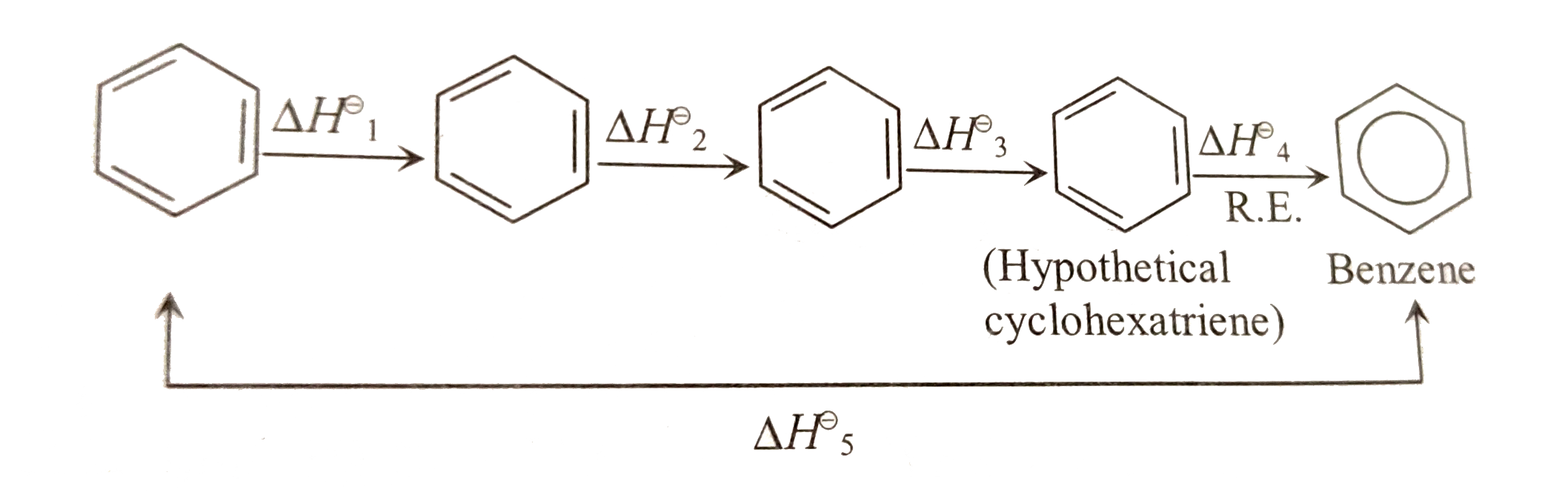 `DeltaH_(1)^(Theta)=DeltaH_(2)^(Theta)=DeltaH_(3)^(Theta)=119 kJ mol^(-1), DeltaH_(4)^(Theta)=RE` `DeltaH_(5)^(Theta)=Delta_(f)H^(Theta)"(benzene)"-Delta_(f)H^(Theta)"(Cyclohexene)"` `=46-(-156)=205kJ mol^(-1)""therefore" From Hess' LAW"` `DeltaH_(4)^(Theta)=DeltaH_(5)^(Theta)-(DeltaH_(1)^(Theta)+DeltaH_(2)^(Theta)+DeltaH_(3)^(Theta))` `=205-3xx119=-152 kJ mol^(-1)""therefore-38x=-152` x=4. |
|
| 47. |
Delta_(r) H of which of the following reactions is zero ? |
|
Answer» `H_(2) (G) + 2 H^(+) (g) + 2E^(-)` |
|
| 48. |
DeltaH_("vap")=30kJ//"mol"andDeltaS_("vap")=75J"mol"^(-1)K^(-1). Find the temperature of the vapour at 1 atm. |
|
Answer» 400 K |
|
| 49. |
Deltan, the change in the number of moles for the reactin, C_(12)H_(22)O_(11(s))+12O_(2(g))hArr12CO_(2(g))+11H_(2)O_((1))at 25^(@)C is |
|
Answer» 0 `Deltan=12-12=0` |
|
| 50. |
DeltaH_(f)^(@) " for "H_(2)O_(2) and H_(2)O are -188 kJ/mole and -286 kJ/mole. What will be the enthalpy change of the reaction 2H_(2)O_(2)(l)rarr2H_(2)O(l)+O_(2)(g) |
|
Answer» `-196` kJ/mole `H_(2)+(1)/(2)O_(2)rarrH_(2)O_(2)" " DeltaH_(f)^(@)=-286 kJ//"mole...(II)"` eq. (i) - eq. (ii) `xx2` gives the required result. |
|