Saved Bookmarks
This section includes 7 InterviewSolutions, each offering curated multiple-choice questions to sharpen your Current Affairs knowledge and support exam preparation. Choose a topic below to get started.
| 1. |
DeltaH_(f)^(o) ("cyclohexane")=-300u DeltaH_(f)^(o) ("cyclohecene")=-100u DeltaH_(f)^(o)("benzene")=200u Where u is an arbitrary unit of enthalpy. If -X("in u") is the resonance energy of benzene, then find (X)/(100) |
Answer» 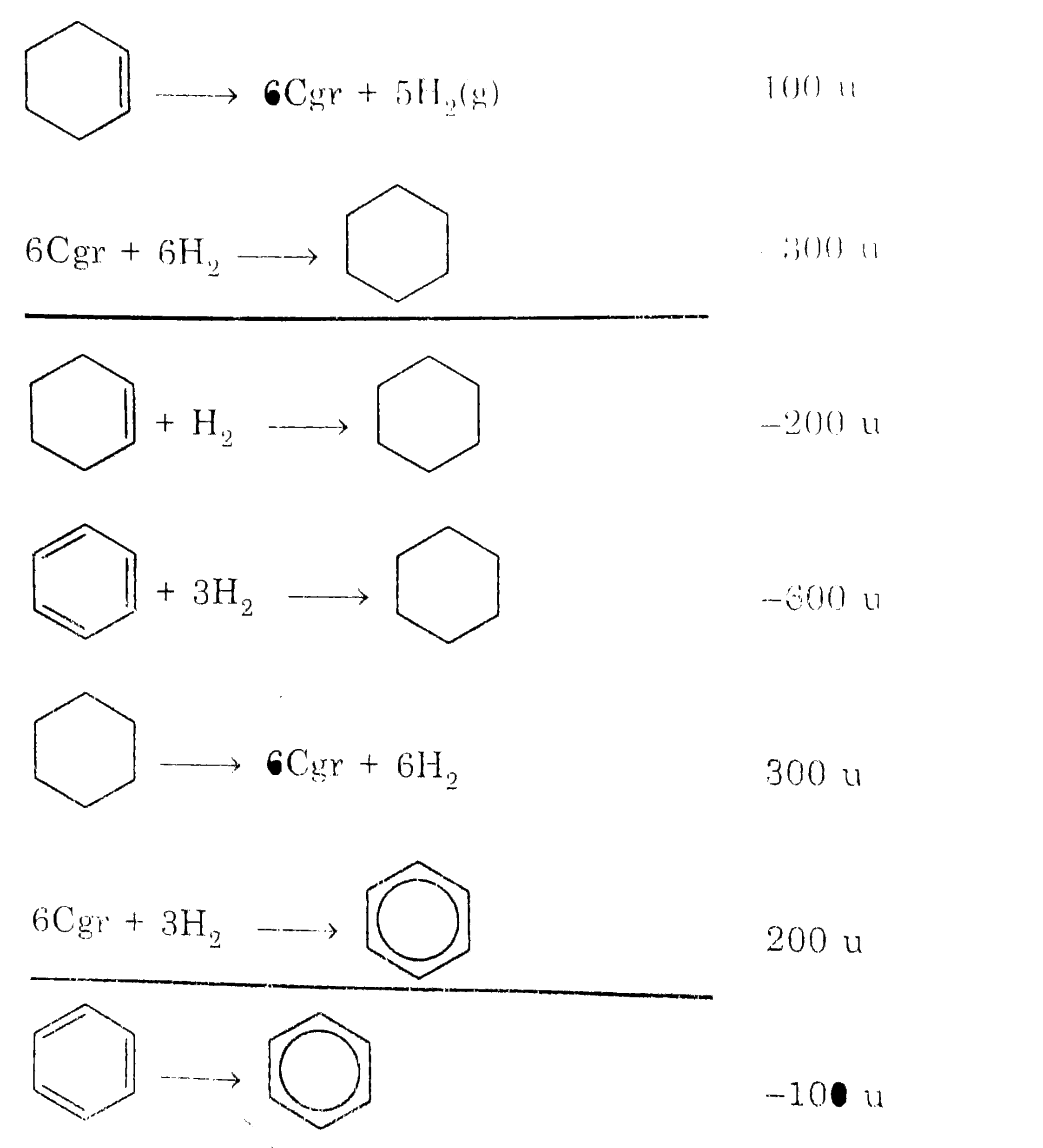
|
|
| 2. |
DeltaH_(f)^@ (298K) of methanol is given by the chemical equation, |
|
Answer» `CH_(4)(g)+(1)/(2)O_(2)(g) to CH_(3)OH(g)` `C("graphite")+(1)/(2)O_(2)(g)+2H_(2)(g) to CH_(3)OH(l)` |
|
| 3. |
DeltaH_(f)^(@) (298 K) of methanol is given by the chemical equation |
|
Answer» `CH_(4)(g)+1//2O_(2)(g)rarrCH_(3)OH(g)` |
|
| 4. |
(DeltaH-DeltaU) for the formation of carbon monoxide (CO) from its elements at 298 K is - (R=8.314JK^(-1)mol^(-1)) |
|
Answer» `1238.78Jmol^(-1)` |
|
| 5. |
(DeltaH - DeltaU) for the formation of carbon monoxide (CO) from its elements at 298 K is (R = 8.314 JK^(-1) mol^(-1)) |
|
Answer» `-1238.78 J MOL^(-1)` `{:(DeltaH=DeltaU+Deltan_(g)RT),((DeltaH-DeltaU)=Deltan_(g)RT):}}DELTAN=1-(1)/(2)implies+(1)/(2)` `=+(1)/(2)xx8.314xx298=+1238.78 J mol^(-1)`. |
|
| 6. |
DeltaH and DeltaS for a reaction are +30.558 kJ mol^(-1) and 0.066 kJ mol^(-1) at 1 atm pressure . The temperature at which free energy is equal to zero and the nature of the reaction below this temperature are : |
|
Answer» 483 K , SPONTANEOUS |
|
| 7. |
DeltaG^(@)(HI,g)-=+1.7kJ. What is the equilibrium constnt at 25^(@)C"for"2 HI_((g))hArrH_(2(g))+I_(2(g)) |
|
Answer» SOLUTION :`DELTAG^(@)=-2.303xx8.314xxx10^(-3)xx298logK_(p)` `1.7=-2.303xx8.314xx10^(-3)xx298xxlog K_(p)` `K_(p)=0.5` |
|
| 8. |
DeltaG^o for the reaction X + Y hArr Z IS -4.606 kcal. The equilibrium constant for the reaction at 227^Ocis: |
|
Answer» 100 |
|
| 9. |
DeltaG^(@) versus T plot the Ellingham 's diagram slopes downward for the reaction |
|
Answer» `C+(1)/(2)O_(2)TOCO` |
|
| 10. |
DeltaG^(@) vs T plot in the Ellingham's diagram slopes downwards for the reactions |
|
Answer» `Mg+(1)/(2)O_(2)rarrMgO` 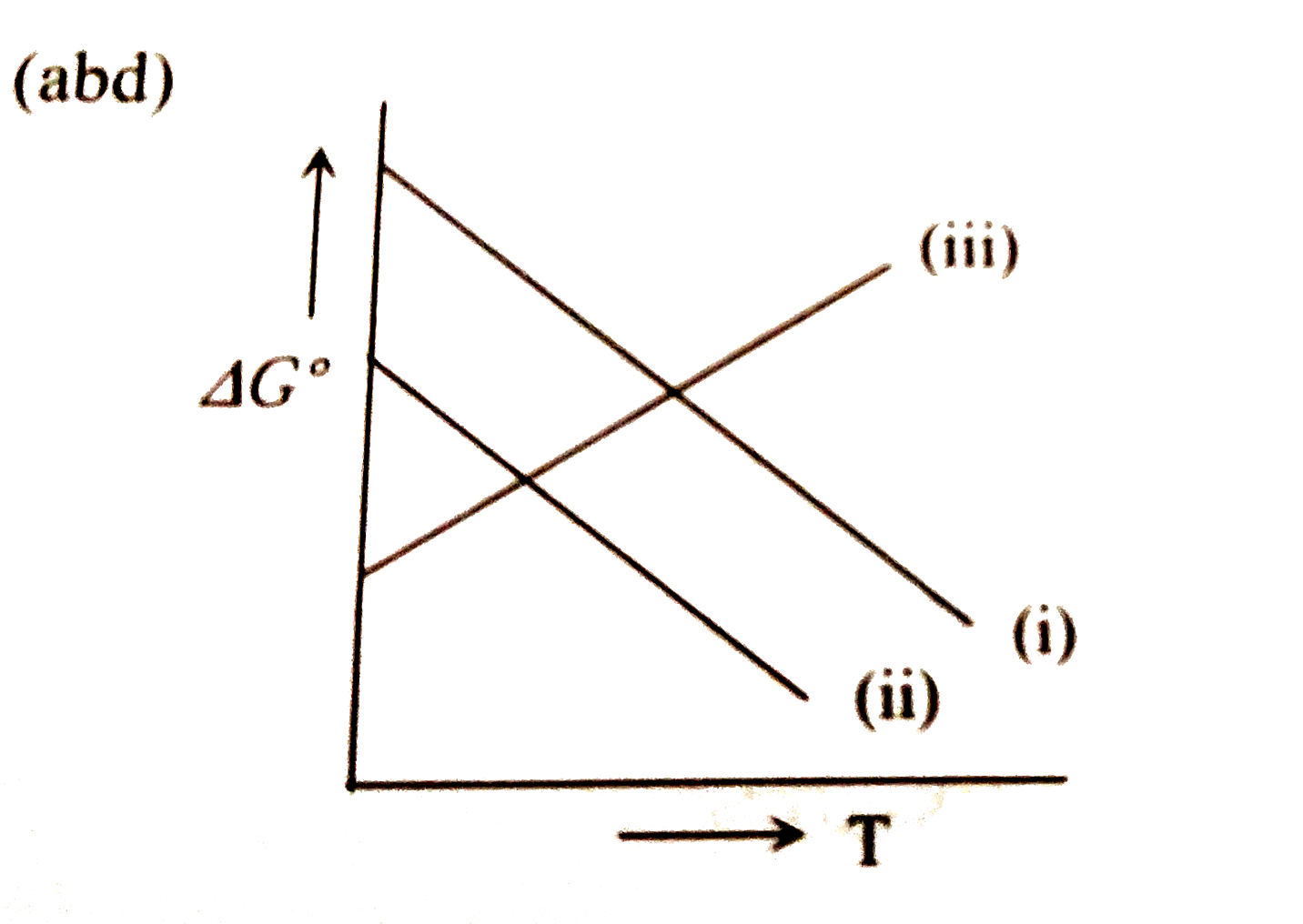 Reaction (i) : `M_((s))+(1)/(2)O_(2(g))rarrMO_((s))" (where M represents METAL)"` Reaction (ii) :`CO_((g))+(1)/(2)O_(2(g))rarrCO_(2(g))` Reaction (iii) :`C_((s))+(1)/(2)O_(2(g))rarrCO_((g))` `DeltaG^(@)` vs T PLOT in the Ellingham's diagram SLOPES DOWNWARDS for the reaction (i) and reaction (ii). For reaction (iii), `DeltaG^(@)` vs T plot in Ellingham's diagram slopes upwards. |
|
| 11. |
DeltaG in Ag_(2)Orarr2Ag+1//2O_(2)at a certain temperature is -10kJ/mole. Pick the correct statement |
|
Answer» `Ag_(2)O` decomposes to AG and `O_(2)` |
|
| 12. |
DeltaG, in process of melting of ice at -15^(@)C,is |
|
Answer» `DeltaG=-ve` |
|
| 13. |
DeltaG^(@) for the reaction X+Y Z is - 4.606 kcal. The value of equilibrium constant of the reaction at 227^(@)C is (R=2.0 cal. Mol^(-1)k^(-1)) |
|
Answer» 100 `-4.606=-2.303xx0.002xx500log K` logK=2, K=100` |
|
| 14. |
DeltaG^(@) for the reaction X+Y hArr Z " is " -4.606 kcal. The equilibrium constant for the reaction at 227^(@)C is |
|
Answer» 100 `-4.606xx10^(3)= -2.303xx2xx50 log K_(e )` `THEREFORE K_(e )=100` |
|
| 15. |
DeltaG for the reaction (4)/(3)Al+O_(2)to(2)/(3)Al_(2)O_(3) is -772kJ mol^(-1) of O_(2). Calculate the minimum EMF in volts requird to carry out and electrolysis of Al_(2)O_(3) |
|
Answer» Solution :`AltoAl^(3+)+3E^(-)` `(4)/(3)MOL" of "Al=(4)/(3)xx3mol" "E^(-)=4mol" "e^(-)` n=4 `DeltaG=-nFE` `-772xx1000J=-4xx96500xxE""thereforeE=(772xx1000)/(4xx96500)=2.0V` |
|
| 16. |
DeltaG = DeltaH-TdeltaS and DeltaG = DeltaH+ T[(d(DeltaG))/(dT)]" then " ((dE_("cell"))/(dT)) is |
|
Answer» <P>`(DeltaS)/(nF)` |
|
| 17. |
Delta_(f)U^(@) of formation of CH_(4)(g) at certain temperature is - 393 kJ mol^(-1). The value of Delta_(f)H^(@) |
|
Answer» ZERO For the reaction, `C(s) + 2H_(2)(g) rarr CH_(4)(g)` :. `Delta n_(g) = 1 - 2 = - 1` :. `Delta_(f) H^(@) = Delta_(f) U^(@) - 1 RT` or `Delta_(f) U^(@) = Delta_(f) H^(@) + RT` or `Delta_(f) H^(@) lt Delta_(f) U^(@)` |
|
| 18. |
Delta_(f)U^(ө) for the formation of CH_(4)(g) at certain temperature is -393 kJ mol^(-1). The value of Delta_(f)H^(ө) is |
|
Answer» zero `Deltan_(g)=(n_(p)-n_(r))=1-3=-2` `Delta_(f)H^(ө)=Delta_(f)U^(ө)+Deltan_(g)RT` `Deltan_(g)=2Delta_(f)H^(ө) lt Delta_(f) U^(ө)` |
|
| 19. |
Delta_(f)G^(@) at 500 K for substance 'S' in liquid state and gaseous state are +100.7 kcal mol^(-1) and +103 kcal mol^(-1) respectively. Vapour pressure of liquid 'S' at 500 K is approximately equal to (R=2 cal k^(-1) mol^(-1)) |
|
Answer» <P>`10` ATM |
|
| 20. |
Delta_(f)U^(-) of formation of CH_(4) (g) at certain temperature is -393 kJ mol ^(-1) . The value of Delta_(f)H^(-) |
|
Answer» ZERO |
|
| 21. |
Delta_(f) H^(theta) of CO_(2)(g), CO(g), N_(2)O(g) and NO_(2)(g) are respectively -393, -110.81 and 34 ("in "kJ mol^(-1)) at 27^(@)C. Delta H (in kJ) for the reaction : 2NO_(2)(g) + 3CO(g) rarr N_(2)O(g) + 3CO_(3)(g) is |
|
Answer» 836 `= 81 + 3 (-393) - (2 xx 34 + 3 (-110))` `= - 836 kJ MOL^(-1)` |
|
| 23. |
DeltaE^(@) of combustion of isobutylene is - X kJ mol^(-1). The value of DeltaH^(@) is |
|
Answer» `=DeltaE^(@)` `Deltan_(g)=4-6=-2` (i.e., NEGATIVE) we know that `DeltaH=DeltaE+Deltan_(g)RT` `=DeltaE-(Deltan_(g))RT (because Deltan_(g)=-ve)thereforeDeltaH lt DeltaE`. |
|
| 24. |
(Delta U - Delta H) for the formation of carbon monoxide (CO) from its elements of 298 K is (R = 8.314 JK^(-1) mol^(-1)) |
|
Answer» `1238.78 J mol^(-1)` `Delta H = Delta U + Delta n_(g) RT` `(Delta H - Delta U) = (1)/(2) xx 8.314 xx 298` `= 1238.75 J mol^(-1)`. |
|
| 26. |
Delta S_("surr") for an exothermic reaction is |
|
Answer» always positive |
|
| 27. |
Delta S^(0) will be highest for the reaction |
|
Answer» `N_(2)(g) + O_(2)(g) rarr 2NO (g)` |
|
| 28. |
Delta is formed by the combination of |
|
Answer» COLLOIDAL waters of RIVER and SEA. |
|
| 29. |
Delta H_(f) (H_(2)O) = X, Heat of neutralisation of CH_(3)COOH and NaOH will be |
|
Answer» LESS than 2X |
|
| 30. |
Delta H (vap) for water is 40.7 kJ mol^(-1). The entropy of vaporisation of water is : |
|
Answer» `- 40.7 kJ mol^(-1) K^(-1)` `= 109 JK^(-1) mol^(-1)` |
|
| 31. |
Delta H for transition of carbon in the diamond form to carbon in the graphite form is -453.5 cal. This suggests that : |
|
Answer» GRAPHITE is CHEMICALLY DIFFERENT from DIAMOND In exothermic reactions products are more stable than reactans, so graphite is more stable than diamond. |
|
| 32. |
Delta H for the reaction, SO_(2) (g) + (1)/(2) O_(2)(g) hArr SO_(3)(g) " " Delta H = -98.3kJ If the enthalpy of formation of SO_(3)(g) is -395.4kJ, then enthalpy of formation of SO_(2)(g) is: |
|
Answer» `-297.1kJ` `-98.3 = -395.4 - [Delta_(f) H(SO_(2)) + 0]` or `Delta_(f)H(SO_(2)) = -395.4 + 98.3 = -297.1 kJ` |
|
| 33. |
Delta G^(0) value for the formation of A_(2)O and B_(2)O are - 827 kJ and - 540 kJ. Which one of them is more stable ? |
| Answer» SOLUTION :`A_(2) O` | |
| 34. |
Delta G^(@) vs T plot in the Ellingham's diagram slopes downward the reaction |
|
Answer» `Mg + (1)/(2)O_(2) rarr MgO` |
|
| 35. |
DeltaG^@ vs T plot in the Ellingham's diagram slopes downward for the reaction |
|
Answer» `Mg+(1)/(2)O_(2)to MgO` 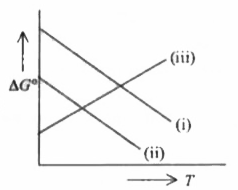 Reaction (i) : `M_((s))+(1)/(2)O_(2(g))rarr MO_((s))`(where M represents metal) Reaction (ii): `CO_((g))+(1)/(2)O_(2(g))rarr CO_(2(g))` Reaction (III) : `C_((s))+(1)/(2)O_(2(g))` `Delta G^(@) vs` T PLOT in the Ellingham's diagram slopes downwards for the reaction (i) and reaction (ii).For reaction (iii), `Delta G^(@)vs` T plot in Ellingham's diagram slopes upwards. |
|
| 36. |
Delta G^(@)vs T plot in theEllingham's diagram slopes downward for thereaction |
|
Answer» ` Mg +(1)/(2) O_2toMg O ` ` C + 1//2O_ 2toCO`,the` Delta S `INCREASES. Therefore,as thetemperatureincreases ` T Delta S `increases andhence `Delta G(Delta H -T Delta S) `decreases. Inother WORDS,the SLOPE ofthecurveforformation of CO decreases. However, FORALL otheroxides, itincreases. |
|
| 37. |
Delta G^(@) vs T plot in the Ellingham's diagram slopes downward for the reaction |
|
Answer» `MG+(1)/(2)O_(2) to MgO` |
|
| 38. |
Delta G^(@) for the reaction Ag_((aq))^(+)+1/2H_(2(g))rarrH_((aq))^(+)+Ag_((s)), where standardpotential for silver half cell reaction in 0.8 V, will be |
|
Answer» `-77.2` KJ |
|
| 39. |
Delta G = Delta H -T Delta S was given by |
|
Answer» Faraday |
|
| 40. |
Delta at the rivers are formed due to .... |
|
Answer» peptisation |
|
| 41. |
Deionised water is produced by |
|
Answer» Calgon process |
|
| 42. |
Dehydrohalogenation will not occur in |
|
Answer»
|
|
| 43. |
Dehydrohalogenation of 3-bromohexane gives a mixture of cis-2-hexene and trans-2-hexene. How can this mixture be converted to pure (a) cis-2-hexene? (b) trans-2-hexene? |
|
Answer» Solution :Relatively pure alkenes (geometric ISOMERS) are prepared by stereoselective reduction of ALKYNES. <BR> (a) Hydrogenation of 2-hexyne with Lindlar.s catalyst gives cis-2-hexene. `CH_3CH=CHCH_2CH_2CH_3overset(Br_2)rarrCH_3underset(Br)underset(|)CH-underset(Br)underset(|)CHCH_2CH_2CH_3overset(2NaNH_2)rarr`  (b) Reduction with Na in liquid `NH_3` gives the trans PRODUCT. 
|
|
| 44. |
Dehydrohalogenation of 1,2-dibromo-butane with alc KOH gives: |
|
Answer» 1-butyne |
|
| 45. |
Dehydrohalogenation in monohaloalkanes produces |
|
Answer» A SINGLE bond |
|
| 46. |
Dehydrohalogenation in haloalkanes produces: |
|
Answer» A SINGLE BOND |
|
| 48. |
Dehydrohalogenation by strong base is slowest in : |
|
Answer»
|
|
| 49. |
Dehydrogenation of isopropyl alcohol gives |
|
Answer» METHANOL |
|
| 50. |
Dehydration of 2-butanol gives |
|
Answer» 2-butene |
|