

Saved Bookmarks
This section includes 7 InterviewSolutions, each offering curated multiple-choice questions to sharpen your Current Affairs knowledge and support exam preparation. Choose a topic below to get started.
| 1. |
Describe and explain what is observed when (i) a beam of light is passed through a colloidal solution ofAs_2S_3. (ii) an electric current is passed through a colloidal solution. |
|
Answer» Solution :(i) The PATH of light is clearly visible due to scattering of light by colloidal particles. It is called Tyndall EFFECT (ii) When an electric current is passed through colloidal solution, colloidal particles move towards the oppositely CHARGED electrode. This phenomenon is called electrophoresis. |
|
| 2. |
Describe an experiment to show the effect of concentration on the rate of the reaction between potassium persuphate and potassium iodide. |
|
Answer» Solution :Equation Procedure Tabular column + graph Conclusion Detailed Answer: `K_2S_2O_8 + 2KI to 2K_2SO_4 + I_2` Procedure : Prepare the reaction mixture by mixing 25 ml each of `0.1 N K_2 S_2O_8 + 0.1 N KI` KEPT at `t_1""^@C` and start the STOP clock. At regular intervals of TIME, a sample of the mixture (5 ml) ispipetted into a conical flask containing ice cold WATER and little KI). It is then titrated against `0.1 Na_2 S_2O_3` using starch as indicator (added near the end point). End point is disappearance of blue colour. Volume of `Na_2 S_2O_3` consumed is recorded. Repeat the above procedure by keeping the reactants at `t_2""^@C` 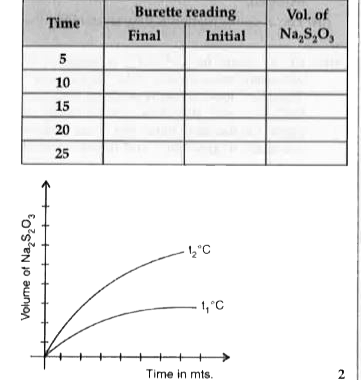 Conclusion: The rate of chemical reaction increases with increase in temperature. |
|
| 3. |
Describe aboutthe structure , natureand propeties of starch. |
|
Answer» Solution :(i) STARCH is usedfor eneryg storagein PLANTS. POTATOES, corn , wheat and rice are therichsourcesof strach . (ii) It is a polymer of glucosein whichglucoe molecules and lined by `alpha` (1,4) glcosidicbonds of starch . (iii) Starch can beseparated into twofractions namely, watersolubleamylose andwaterinsolubleamylo pectin . Starchcontainabout20% ofamylase and about80%amylopectin. (vi) Amyloseis composedunbranced chain upto 4000 `alpha` - Dglucosemolecules joined molecules joinedby `alpha`(1,4) glycosidicbonds . (v) At branchpoints , newchains of 24 of 30 glucose molecules are linked by `alpha` (1,6) glycosidicbondswith iodince solution amylo pectin a purplecolour. (vi) 
|
|
| 4. |
Describe about the properties of colloids. |
|
Answer» Solution :(i) Colour:- The colour of a sol is not always the same as the colour of the substance in the bulk. For example, bluish tinge is given by diluted milk in reflected light and reddish tinge in transmitted light. (ii) Size:- The size of colloidal particles ranges from `1 m mu` to `1 mu m`diameter. (iii) Colloidal solutions are heterogeneous in nature: They have two distinct phases. Experiments like dialysis, ultrafiltration show the heterogeneous in nature but they are considered as borderline cases. (iv) Filterability: As the size of pores in ordinary filter paper are large, the colloidal particles easily pass through the ordinary filter papers. (v) Non setting nature: Colloidal solutions are quite stable i.e., they are not affected by gravtiy. (vi) CONCENTRATION and density: When the colloidal solution is dilute, it is stable. When the volume of medium is decreased, coagulation occurs. Density of sol decreases with decrease in the concentration. (vii) Diffusability: Unlike true solution, colloids diffuse less readily through membranes. (viii) Colligative properties: The colloidal solutions show colligative properties such as elevation of boiling point, depression in freezing point and osmotic PRESSURE. These properties are used to determine molecular weight of colloidal particles. (ix) Shape of colloidal particles: Colloidal particles have various shapes ` (##FM_CHE_XII_V02_C10_E02_390_S01.png" width="80%"> (x) Optical property : The path of the light is VISIBLE when it is passes through a colloidal solution due to the scattering of light by colloidal particles. This is known as TYNDALL effect. (xi) Kinetic property: When colloidal solution is viewed through an ultra microscope, they showed a random, zigzag ceaseless motion which is called Brownian movement. (xii) Electrical property: Helmholtz double layer, electrophoresis and electro osmosis are electrical properties of colloids. |
|
| 5. |
Describe about the working principle of Leclanche cell. |
|
Answer» Solution :(i) Leclanche cell : `{:("Anode",:,"Zinc container"),("Cathode",:,"GRAPHITE rod in contact with" MnO_2),("ELECTROLYTE",:,"Ammonium chloride and Zinc chloride in water"):}` emf of the cell = 1.5 V. (ii) Cell reaction: Oxidation at anode `Zn_((s)) to Zn_((AQ))^(2+) + 2e^(-) ""............(1)` Reduction at cathode `2NH_(4(aq))^(+) + 2e^(-) to 2NH_(3(aq)) + H_(2(g)) "" ...........(2)` (iii) The hydrogen gas is oxidised to water by `MnO_2` `H_(2_(g)) + 2MnO_(2_(s)) to Mn_2O_(3_(s)) + H_2O_((l))"" .........(3) ` Adding equations 1,2,3 the overall redox reaction `Zn_((s)) + 2NH_(4(aq))^(+) + 2MnO_(2(s)) to Zn_((aq))^(2+) + Mn_2O_(3(s)) + H_2O_((l)) + 2NH_3 "" ............(4)` (iv) The AMMONIA produced at the cathode combines with `Zn^(2+)` to form a complex ion `[Zn(NH_3)_(4)]^(2+) (aq)`. As the reaction proceeds, the concentration of `NH_4^+` will decrease and the aqueous `NH_3` will INCREASE which lead to the decrease in the emf of the cell. |
|
| 6. |
Describe about the postulate of VB theory (or) Valence bond theory. |
|
Answer» Solution :`(i)` The ligand `to` metal bond in a coordination complex is covalent in nature. It is formed by the sharing of electrons between the CENTRAL metal atom and electron donor ligand. `(ii)` Each ligand should have atleast one filled orbital containing a lone pair of electrons. `(iii)` In order to accommodate the electron pairs DONATED by the ligands, the central metal ionpresent in a complex provides required number of vacant orbitals. `(iv)` These vacant orbitals of central metal atoms undergo hybridisation, the process of mixing of atomic orbitals of comparable energy to FORM equal number of new orbitals called hybridised orbitals with same energy. `(v)` The vacant hybridised orbitals of the central metal ion, linearly overlap with filled orbitals of the ligands to form coordinate covalent sigma bonds between the metal and the ligand. `(vi)` The hybridised orbitals are directional and their orientation in space gives a definite geometry to the complex ion. 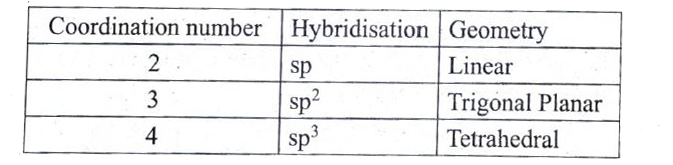 `(vii)` In the octahedral complexes, if the (`n-1)d` orbitals are involved in hybridisation they are called inner orbital complexes or low SPIN complexes (or) spin paired complexes. If the nd orbitals are involved in hybridisation, such complexes are called outer orbital complexes (or) high spin (or) spin free complexes. Here `..n..` represents the principalquantum number of the outermost shell. `(viii)` The complexes containing a central metal atom with unpaired electron (s) are paramagnetic . If all the electrons are paired, then the complexes will be DIAMAGNETIC. `(xi)` Ligands such as `CO`, `CN^(-)`, en and `NH_(3)` present in the complexes cause pairing of electrons present in the central metal atom . Such ligands are called strong field ligands. `(x)` Greater the overlapping between the ligand orbitals and the hybridised metal orbital, greater is the bond strength. |
|
| 7. |
Describe about the crystal field splitting in tetrahedral complex. |
|
Answer» Solution :`(i)` Consider a cube in which the central metal atom is PLACED at its centre (i.e., origin of the coordinate AXIS). The FOUR ligands approach the central metal atom along the direction of the leading diagonals from the alternate corners of the cube. `(ii)` In this field the `t_(2g)` orbitals (`d_(xy),d_(yz)` and `d_(zx)`) are pointing close to the direction in which ligands are approaching than the `.eg.` orbitals. (`dx^(2)-y^(2)` and `dz^(2)`). As a result, the energy of `t_(2g)` orbitals increases by `2//5Deltat` and that of .e. orbitals decreases by `3//5Deltat` as shown in the figure. This SPLITTING is INVERTED when compared to octahedral field. 
|
|
| 8. |
Describe about thedoublestrandhelix structure ofDNA . |
|
Answer» Solution :(i) Waston and Crick postulateda 3-dimensionalmodel of RNAstructurewhichconsistedof twoantiparalleld helical DNA chains wound aroundthe sameaxis to FROMA righthanded doublehelix. (II) Thehydrophilicbackbones of alternatingdeoxyribose and phosphate groupare on the outsideof thedoublehelix, facingthe surrodingwater . The purineand pyrimidinebases of both stands are stackedinsidethe doublehelix,withtheirhydrophobicand ringstrcutures very close together and perpendicular to thelongaxis ,therebyreducingthe replusions betweenthe CHARGED phosphategroups. The offsetpairing ofthe twostrandscreates a majorgrooveand minorgrooveon the surface of the duplex. (iii) The modalrevealedthat there are 10.5 pairs`(36A^(@))`per turn of thehelix and `3.4A^(@)`between the stackedbases. They alsofound thethat each base is hydrogenbonded to a base in oppositestrandto forma planar base pair . (iv)Two hydrogen bonds are formedbetweenadenineand thymineand threehydrogenbonds are fomed between guanine and cytosineotherpairingtendstodestablizes the double helicalstrcutre . Thisspecifcassocation of thetwo chains of thedoublehelix is knowas complementarybasepairing . (a) Hydrogen bodingbetweencomplementarybase pairs. (B) Base - stackinginteractions. The complementarybetweenthe DNAstrands is attributableto thehydrogenbondingbetweenbase pairs butbasestackinginteractionare largely non - specific,makethe majorcontrribution to thestabilityofthe doublehelix. ,  `)
|
|
| 9. |
Describe about lead stroage battery construction and its uses. |
|
Answer» Solution :Lead STORAGE battery : (i) `{:("Anode",:,"Spongy lead"),("Cathode",:,"Lead plate bearing" PbO_2),("Electrolyte",:,"38% by mass of " H_2SO_4" with density 1.2 g//ml"):}` (ii) Oxidation occurs at the anode `Pb_((s)) to Pb_((aq))^(2+) + 2e^(-) "".............(1)` The `Pb^(2+)` ions COMBINE with `SO_4^(2-)` to form `PbSO_4` precipitate `Pb_((aq))^(2+) + SO_(4)^(2-) to PbSO_(4(s)) ""..........(2)` (iii) Reduction occurs at the cathode `PbO_(2(s)) + 4H_((aq))^(+) + 2e^(-) to Pb_((aq))^(2+)+ 2H_2O_((l)) ""...........(3)` The `Pb^(2+)` ions also combines with `SO_4^(2-)` ions to form sulphuric acid to form `PbSO_4` Precipitate. `Pb_((aq))^(2+) + SO_(4(aq))^(2-) to PbSO_4 "" ...............(4)` (vi) The overall reaction is, `(1) + (2) + (3) + (4)` `Pb_((s)) + PbO_(2(s)) + 4H_((aq))^(+) + 2SO_(4(aq))^(2-) to 2PbSO_(4(s)) + 2H_2O_((l))` (v) The emf of a single cell is about 2V. Usually six such cells are combined in series to produce 12 volts. (vi) The emf of the cell DEPENDS on the concentration of `H_2SO_4`.As the cell reaction uses `SO_(4)^(2-)` ions, the concentration `H_2SO_4` decreases. When the cell potential falls to about 1.8 V, the cell has to be rechanged. (vii) Recharge of the cell : During reachrge process, the role of anode and cathode is REVERSED and `H_2SO_4` is regenerated. Oxidation occurs at cathode (now anode) `overset(+2)(PbSO_(4_(s))) + 2H_2O_((l)) + overset(+4)(PbO_(2_(s))) + 4H_((aq))^(+) + overset(2+)(SO_(4(aq))) + 2e^(-)` Reduction occurs at anode (now cathode) `PbSO_(4_(s)) + 2e^(-) to Pb_((s)) + SO_(4(aq))^(2-)` Overall reaction `2PbSO_(4(s)) + 2H_2O((I)) to Pb_((s)) + PbO_(2(aq)) + 4H_((aq))^(+) + 2SO_(4(aq))^(2+)` The above reaction is exactly the reverse of redox reaction which takes place while discharging. (VIII) Uses : Lead storage battery is used in automobiles, trains, inverters. |
|
| 10. |
Describe about lithium - ionbattery and its uses. |
|
Answer» Solution :(i) Lithium-ion battery `{:("Anode",:,"Porous graphite"),("CATHODE",:,"Transition metal oxide as " CoO_2),("Electrolyte",:,"Lithium salt in an orgainc solvent"):}` (ii) At the anode oxidation occurs `Li_((s)) to Li_((aq))^(+) + e^(-)` At the cathode reduction occurs. (iii) Overall reactions `Li_((s)) + CoO_(2) to Li CoO_(2(s))` (iv) Both electrodes ALLOW `Li^(+)` ions to move in an out of their structures. During discharge the `Li^(+)` ions produced at the anode moves TOWARDS cathode through the non-aquaeous electrolyte. (v) When a potential greater than the emf produced by the cell is applied across the electrode, the cell reaction is reversed and now the `Li^(+)` ions move from cathode to anode where they become embedded on the porous electrode. This is known as INTERCALATION. (vi) Uses : This Li-ion battery is used in celluar phones, LAPTOP computer and digital camera. |
|
| 11. |
Describe about lead storage battery construction and its uses. |
|
Answer» Solution :Lead storage battery : 1. Anode `"":""` Spongy lead CATHODE `":"`Lead plate bearing `PbO_(2)` Electrolyte `":"`38% by mass of `H_(2)SO_(4)` with density 1.2 g/ml 2. Oxidation occurs at the anode `""Pb_((s)) rarr Pb^(2+)""_((aq))+2e^(-)".................(1)"` The `Pb^(2+)` ions combine with `SO_(4)""^(2-)` to form `PbSO_(4)` PRECIPITATE `""Pb^(2+)""_((aq))+SO_(4)""^(2-) rarr PbSO_(4(s))".....................(2)"` 3. Reduction occurs at the cathode `""PbO_(2(s))+4H^(+)""_((aq))+2e^(-) rarr Pb^(2+)""_((aq))+2H_(2)O_((l))"....................(3)"` The `Pb^(2+)` ions also combines with `SO_(4)""^(2-)` ions to form sulphuric acid to form `PbSO_(4)` Precipitate `""Pb^(2+)""_((aq))+SO_(4)""^(2-)""((aq)) rarr PbSO_(4)"......................(4)"` 4. The overall reaction is, `(1)+(2)+(3)+(4)` `Pb_((s))+PbO_(2(s))+4H^(+)""_((aq))+2SO_(4)""^(2-)""_((aq)) rarr 2PbSO_(4(s))+2H_(2)O_((l))` 5. The emf of a single cell is about 2V. Usually six such cells are combined in series to produce 12 volts. 6. The emf of the cell depends on the concentration of `H_(2)SO_(4)`. As the cell reaction uses `SO_(4)""^(2-)` ions, the concentration `H_(2)SO_(4)` decreases. When the cell potential falls to about 1.8 V, the cell has to be recharged. 7. Recharge of the cell: During recharge process, the role of anode and cathode is reversed and `H_(2)SO_(4)` is regenerated. Oxidation occurs at the cathode (now anode) `overset(+2)(PbSO_(4(s)))+2H_(2)O_(l) rarr overset(+4)(PbO_(2(s)))+4H^(+)""_((aq))+overset(2-)(SO_(4(aq)))+2e^(-)` Reduction occurs at anode (now cathode) `PbSO_(4(s))+2e^(-) rarr Pb_((s))+SO_(4)""^(2-)""_((aq))` Overall reaction `2PbSO_(4(s))+2H_(2)O_((l)) rarr Pb_((s))+PbO_(2(s))+4H^(+)""_((aq))+2SO_(4)""^(2-)""_((aq))` The above reaction is exactly the reverse of redoxreaction which TAKES place while discharging. 8. Uses: Lead storage battery is usedin automobiles, trains, inverters. |
|
| 12. |
Describe about (i) Dialysis (ii) Electro dialysis. |
|
Answer» Solution :(i) Dialysis:- Thomas Graham separated the electrolyte from a colloid USING a SEMIPERMEABLE membrane. In this method, the colloidal solution is taken in a bag made up of semipermeable membrane. It is suspended in a trough of flowing water, the electrolytes diffuse out of the membrane and they are carried away by water. (ii) Electro dialysis:- The presence of electric field increases the speed of removal of electrolytes from colloidal solution. The colloidal solution containing an electrolyte as impurity is placed between two dialysing membranes enclosed into two COMPARTMENTS FILLED with water. When current is PASSED, the impurities pass into water compartment and get removed periodically. This process is faster than dialysis, as the rate of diffusion of electrolytes is increased by the application of electricity. 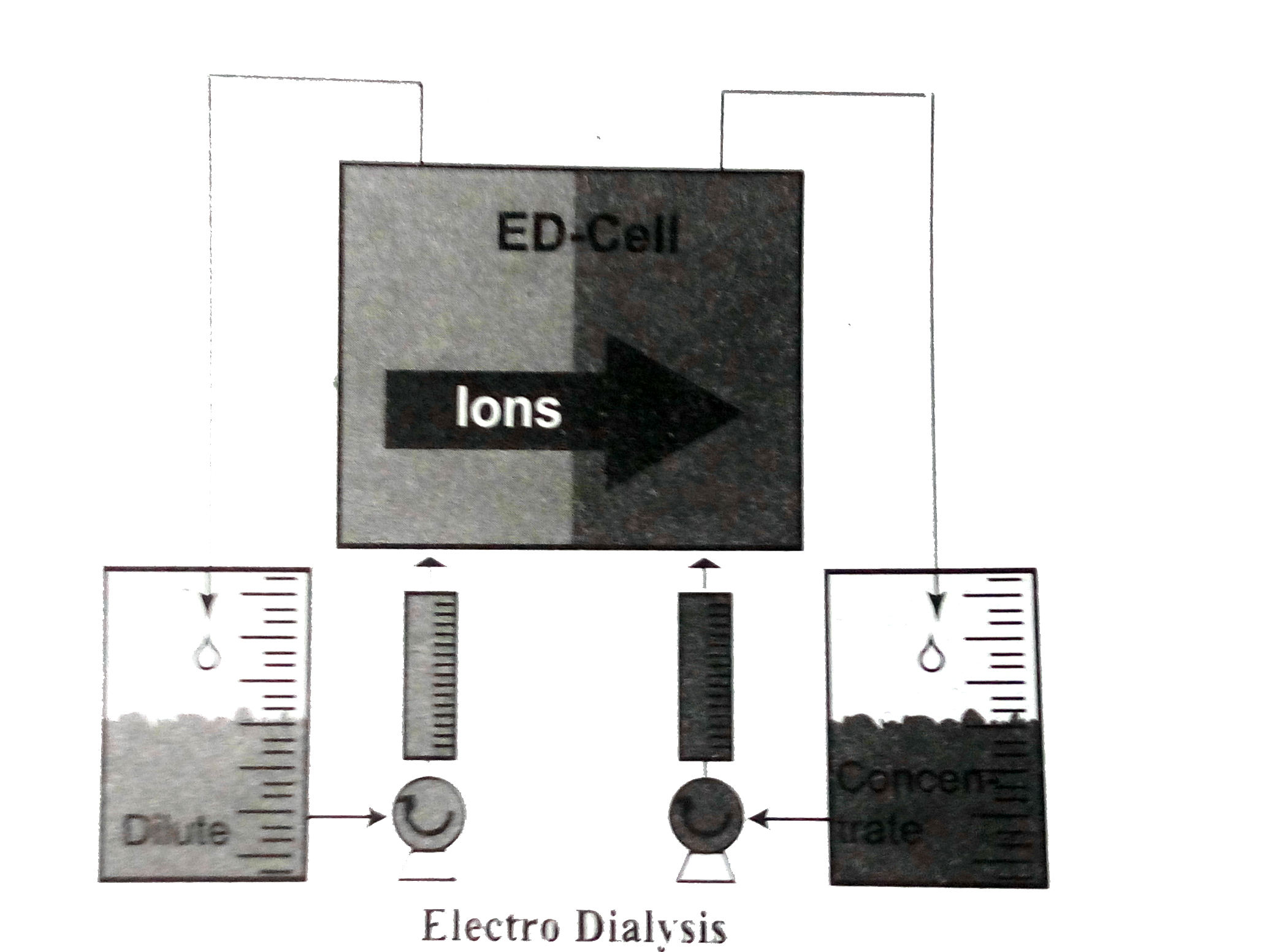
|
|
| 13. |
Describe about condensation methods of preparation of colloids. |
|
Answer» Solution :When the substance for colloidal particle is present as small sized particle, molecule or ION, they are brought to the colloidal dimension by condensation methods. i. Oxidation method:- When hydroiodic acid is treated with iodic acid `I_(2)` sol is OBTAINED. `HIO_(3)+5HI to 3H_(2)O +3I_(2"(sol)")` ii. Reduction method:- GOLD sol is prepared by reduction of auric chloride using formaldehyde. `2AuCl_(3)+3HCHO+3H_(2)O to 2Au_((sol))+6HCl+3HCOOH` iii. Hydrolysis:- Ferric chloride is hydrolysed to get ferric hydroxide colloid `FeCl_(3)+3H_(2)O to Fe(OH)_(3)(sol)+3HCl` iv. Double decomposition:- When hydrogen sulphide gas is passed through a solution of ARSENIC OXIDE, a yellow coloured arsenic sulphide is obtained as a colloidal solution. `As_(2)O_(3)+3H_(2)S to As_(2)S_(3)+3H_(2)O` v. Decomposition:- When few drops of an acid is added to a dilute solution of sodium thiosulphate, sulphur colloid is produced by the decomposition of sodium thio sulphate. `S_(2)O_(3)^(2-)+2H^(+) to S_((sol))+H_(2)O+SO_(2)` |
|
| 14. |
Describe about condensation methods of preparation of colloids. (OR) Describechemical methods of preparation of colloids. |
|
Answer» Solution :When the substance for colloidal particle is present as small sized particle, molecule or ion, they are brought to the colloidal dimension by condensation methods. (i) Oxidation METHOD:- When hydroiodic acid is treated with iodic acid `I_(2)` sol is obtained. `HIO_3 + 4HI to 3H_2O _ 3I_(2"(sol)")` (ii) Reduction method:- Gold sol is prepared by reduction of auric chloride using formaldehyde. `2AuCl_3 + 3HCHO + 3H_2O to 2Au_("(sol)") + 6HCl + 3HCOOH` iii) Hydrolysis:- FERRIC chloride is hydrolysed to get ferric hydroxide colloid `FeCl_3 + 3H_2O to Fe(OH)_3 "(sol)" +3HCl` (iv) DOUBLE decomposition:- When hydrogen sulphide gas is passed through a solution of arsenic oxide, a YELLOW coloured arsenic sulphide is obtained as a colloidal solution. `As_2O_3 + 3H_2S to As_2 S_3 + 3H_2O` (v) Decomposition:- When few drops of an acid is added to a dilute solution of sodium thiosulphate, sulphur colloid is PRODUCED by the decomposition of sodium thio sulphate. `S_2O_3^(2-) +2H^(+) to S_("(sol)") + H_2O + SO_2` |
|
| 15. |
Describe about Claisen condensation. |
Answer» Solution :Esters containing at LEAST one `alpha`- hydrogen atom undergo self condensation in the presence of a STRONG BASE such as sodium ethoxide to FORM `BETA`- keto ester. This reaction is known as Claisen condensation. 
|
|
| 16. |
Describe a simple test that will allow you to distinguish between the compounds: [Co(NH_(3))_(5)Br]SO_(4) and [Co(NH_(3))_(5)SO_(4)]Br. |
|
Answer» Solution :i) Treat both the isomers separately with aqueous `BaCl_(2)` solution. The ISOMER which gives a white precipitate is `[Co(NH_(3))_(5)Br]SO_(4)`. ii) Treat both the isomes separately with aqueous `AgNO_(3)` SOLUTIONS. The isomer which gives a light yellow precipate is `[Co(NH_(3))_(5)SO_(4)]Br`. |
|
| 17. |
Describe a method for the preparation of sol of platinum in water. |
| Answer» SOLUTION :A colloidal sol of platinum is prepared by electrical dispersion or Bredig.s arc method. In this method two platinum electrodes are immersed in water. The dispersion medium is kept cool by surrounding it with freezing mixture. An electric arc is STRUCK between the electrodes, the tremendous HEAT generated by the arc vapourises the platinum which condenses immediately to give colloidal platinum sol. The solution is STABILIZED by adding a small amount of KOH. | |
| 18. |
Describe a method forrefiningofnickel. |
|
Answer» SOLUTION :Whenimpure nickel is healted inacurrentofCOat330 - 350K, itformsvolatilenickeltetracarbonylcomplex leavingbehind the impurities. Thenickeltetracarbonylethus obtainedis thenheatedto ahighertemperature (450- 470K ), whenitundergoesthermaldecompositionto givepure nickel. `underset ("Impurenickel")(NI) +4 COoverset (330 -350K ) tounderset ("Nickel tetracarbonyl")(Ni (CO)_4) overset (450 - 470K )tounderset ("PURE nickel ") (Ni ) +4 CO`. Themethodiscommonlycalled as Mondprocess forrefiningof nickel. |
|
| 19. |
Describe a method for the identification of primary, secondary and tertiary amines. Also write chemical equations of the reactions involved. |
|
Answer» Solution :Primary, secondary and tertiary amines can be distinguished by the following tests : 1. Nitrous acid test : Primary aliphatic aminesreact with `HNO_(2)` at 273-278 K to form alcohol with brisk effervescence of `N_(2)`. Primary aromatic amines react with `HNO_(2)` at 273 - 278 K to form arenediazonium salt which give coupling reaction with alkaline b-naphthol to forming orange or red ppt. Aliphatic and aromatic secondary amines react with `HNO_(2)` to form N-nitrosoamine which are OILY yellow compounds. On warming with a crystal of phenol and a few drops of conc. `H_(2)SO_(4)`, they form a green solution which turns blue on adding NaOH and then red on dilution. This test is called Liebermann nitroso reaction. Aliphatic tertiary amines form nitrite salts with `HNO_(2)` while aromatic tertiary amines undergo electrophilic substitution to form green coloured p-nitrosoamines. 2. Hinsberg test : In this test, the amine is shaken with benzene sulphonyl chloride (Hinsberg REAGENT) in the presence of excess of aqueous KOH solution. Primary amine GIVES a clear solution which on acidification gives an insoluble N-alkylbenzene sulphonamide according to the following reaction :  Tertiary amine does not react due to absence of hydrogen attached to nitrogen. Therefore, it remains insoluble in alkaline solution but dissolves on acidification to give a clear solution. 
|
|
| 20. |
Describe a method for refining nickel. |
|
Answer» Solution :For REFINING nickel is heated in a stream of CARBON MONOXIDE forming volatie complex (nickel tetracarbonyl). `Ni + 4CO overset(330 - 350K)to Ni(CO)_4` The carbonyl is subjected to high temperature so that the complex DECOMPOSES to give the pure metal. `Ni(CO)_4 overset(450 - 470 K)to Ni+4CO` This process is called Mond.s process. |
|
| 21. |
Describea methodfor refining nickel. |
|
Answer» Solution :The impure nickel is HEATED in a stream of carbon monoxide at AROUND 350 K.The nickel reacts with the CO to form a highly volatile nickel .The SOLID impurities are left behind. `Ni(s)+4CO(G)TONI(CO)_(4)(g)` On heating the nickel tetracarbonyl around 460K,the complex decomposes to give pure metal. `Ni(CO)_(4)(g)toNi(S)+4CO(g)` |
|
| 22. |
Describe adsorption theory of catalysis. |
|
Answer» Solution :Adsorption theory: LANGMUIR explained the action of catalyst in heterogeneous catalysed reactions based on adsorption. The reactant MOLECULES are adsorbed on the catalyst surfaces, so this can also be called as contact catalysis. According to this theory, the reactants are adsorbed on the catalyst surface to form an activated complex which subsequently decomposes and gives the PRODUCT. The various steps involved in a heterogeneous catalysed reaction are given as follows: 1. Reactant molecules diffuse from bulk to the catalyst surface. 2. The reactant molecules are adsorbed on the surface of the catalyst. 3. The absorbed reactant molecules are activated and form activated complex which is decomposed to form the products. 4. The product molecules are desorbed. 5. The product diffuse away from the surface of the catalyst. Advantages of adsorption theory: The adsorption theory explains the following 1. Increase in the activity of a catalyst by increasing the surface area. Increasein the surface area of metals and metal OXIDES by reducing the particle size increases the rate of the reaction. 2. The action of catalytic poison occurs when the poison blocks the active centres of the catalyst. 3. A promoter or activator increases the number of active centres on the surfaces. |
|
| 24. |
Desalination of sea water can be done by |
|
Answer» OSMOSIS |
|
| 25. |
Derive the value of pH of salt solution in terms of K_a and concentration of electrolyte. |
|
Answer» SOLUTION :`pH+poH=14` `pH=14-pOH` `=14-[-log_10[OH^-]` `=14+log[OH^-]` `THEREFORE pH=14+log[K_hC]^(1//2) ` `pH=14+log[(K_wC)/K_a]^(1/2)` `pH=14+(1/2logK_w+1/2logC-1/2logK_a)` `pH=14-7+1/2logC-1/2log K_a` `pH=14-7+1/2logc+1/2pK_a because-logK_a=pK_a` `therefore pH=7+1/2 pK_a+1/2 log C` |
|
| 26. |
Derive the value of solubility produce from molar solubility? |
|
Answer» Solution :(i) Solubility can be calculated from MOLAR stability. i.e, the maximum number of MOLES of the solute that can be dissolved in one litre of the solution. (ii) For a solute `X_m Y_n` `X_mY_n(s) LEFTRIGHTARROW mX^(n+)(aq)+nY^(m-) (aq)` From the above stoichiometricall BALANCED equation, it is clear that 1 mole of `X_m Y_n (s)` dissociated to furnish m moles of x and n moles of Y. If is the molar solubility of `X_m Y_n` then `[X^(n+)]=ms and [Y^(m-)]=ns` `therefore K_(sp)=[X^(n+)]^m [Y^(m-)]^n` `K_(sp)=(ms)^m (ns)^n` `K_(sp)=(m)^m (n)^n (s)^(m+n)` |
|
| 27. |
Derive the unit of specific conductance. |
|
Answer» SOLUTION :UNIT of `kappa` `kappa=1/rho.l/A(1/"ohm".m/m^(2))` `" "=ohm^(-1)m^(-1)=mho" "m^(-1)" (or) "SM^(-1)` |
|
| 28. |
Derive the relationship between relative lowering of vapour pressure and mole fraction ofthe volatile liquid. |
|
Answer» Solution : Let A and B represent the solvent and the SOLUTE respectively. `x_A`and `x_B`stand for the molefraction of solvent and solute, respectively. `p_A^0` and `P_A` represent the vapour pressure of A in the pure liquid and solution, respectively. `p_A prop x_A` `p_A = p_A^0 xx x_A`....(i) `x_A + x_B = 1` form (i) and (ii) we have `p_A = p_A^0 ( 1- x_B)` `(P_A)/(p_A^0) = 1 - x_B " or" x_B= 1 - (p_A)/(p_A^0) = (p_A - p_A^0)/(p_A^0) " or " (p_A^0 -p_A)/(p_A^0) = x_B` RELATIVE lowering of vapour pressure of a solution is equal to mole FRACTION of the solute. |
|
| 29. |
Derive the relationship between relative lowering of vapour pressure and molar mass of solute. |
|
Answer» Solution :When a non-voltile solute is added to a solvent, the vapour of the solution decreases. The vapour PRESSURE of a solvent `(P_(1))` in a solution cvontaining a non- VOLATILE solute is given by Raoult's law, Vapout pressure of the pure solvent `=P_(1)^(@)` Vapour pressure of the solvent in solution `=P_(1)` `P_(1)=x_(1)P_(1)^(@)` `DeltaP_(1)=P_(1)^(@)-P_(1)` `=P_(1)^(@)-x_(1)P_(1)^(@)` `=P_(1)^(@)(1-x_(1))` In a binary solution, `1-x_(1)=x_(2)` `DeltaP_(1)=P_(1)^(@)x_(2)` `DeltaP_(1)//P_(1)^(@)=(P_(1)^(@)-P_(1))//P_(1)^(@)=x_(2)` The lowering of vapour pressure relative to the vapour pressure of pure solvent is called relative lowering of vapour pressure. `DeltaP_(1)//P_(1)^(@)to` Relative lowering of vapour pressure Thus, the relative lowering in vapour presure depends only on the concentration of solute particles and is INDEPENDENT of their IDENTITY. If the solution contains more than one non-volatile solute, then the relative lowering in vapour pressure of a solvent is equal to the sum of the mole FRACTIONS of all the non-volatile solutes. If `n_(1)and n_(2)` are respectively the number of moles of the solvent and solute in a binary solution, then the relative lowering in the vapour pressure of the solvent, `(P_(1)^(@)-P_(1))//P_(1)^(@)=x_(1)+x_(2)+x_(3)+...+x_(n)` if `n_(1) and n_(2)` are the number of moles of the solvent and solute, `(P_(1)^(@)-P_(1))//P_(1)^(@)=n_(2)//(n_(1)+n_(2))` For dilute solutions `n_(2)lt lt n_(1)` `n_(1)=W_(1)//M_(1),n_(2)=W_(2)//M_(2)` `(P_(1)^(@)-P_(1))//P_(1)^(@)=(W_(2)xxM_(1))//(W_(1)xxM_(2))` or `(P_(1)^(@)-P_(1))/(P_(1)^(@))=(W_(2)M_(1))/(W_(1)M_(2))` or ` (DeltaP_(1))/(P_(1)^(@))=(W_(2)M_(1))/(W_(1)M_(2))` `W_(1)` = Mass of solvent `W_(2)=` Mass of solute `M_(1)=` Molar mass of solvent `M_(2)=` Molar mass of solute |
|
| 30. |
Derive the relationship between relative lowering of vapour pressure and mole fraction of the volatile liquid. |
|
Answer» <P> Solution :According to RAOULT's law, `(p^(@)-p_(s))/(p^(@))=x_(2)` (MOLE fraction of the non-volatile solute)Mole fraction of the volatile liquid, `x_(1)=1-x_(2) or x_(2)=1-x_(1)` `therefore""(p^(@)-p_(s))/(p^(@))=1-x_(1)""or ""x_(1)=1=(p^(@)-p_(s))/(p^(@))=(p_(s))/(p^(@)).` |
|
| 31. |
(i) Derive the relation between pH and pOH (ii) Give three uses of emulsions. |
|
Answer» Solution :A relation between `pH and pOH` can be established using their FOLLOWING definitions `pH=-log_(10)[H_3 O^+]""…(1)` `pOH=-log_(10)[OH^-]""…(2)` ADDING equation (1) and (2) `pH+pOH=-log_(10)[H_3 O']-log_(10)[OH^-]` `=-(log_(10)[H_3O^+][OH^-] +log_(10)[OH^-])` `pH+pOH=-log_(10)[H_3 O^+][OH^-]` `[because loga+logb=LOG ab]` We know that `[H_3O^+][OH^-]=K_w` `rArr pH+pOH=-log_(10)K_w` `rArr pH+pOH=pK_w ""[because pK_w=-log_(10)^(K_w)]` at `25^@ C` the IONIC product of water, `K_w=1xx10^(-14)` `pK_w=-log_(10)10^(-14)=14 log_(10)10` `=14` `therefore (2) rArr therefore `At `25^@ C, pH +pOH=14` |
|
| 32. |
Derive the relationship between Gibb's free energy and maximum work obtained from galvanic cell and equillibrium constant. |
|
Answer» Solution :(i) In a galvanic cell, chemical energy is converted into ELECTRICAL energy. The electrical energy produced by the cell is equal to the product of the total charge of the electrons and emf of the cell which drives these electrons between the electrodes. (ii) If .n. is the number of moles of electrons exchanged between the oxidising and reducing agent in the overall cell reaction, then the electrical energy produced by the cell is given as below. Electrical energy = change of `.n.` moles of electrons `xx E_("cell") "" .......(1)` Charge of 1 mole of electrons = one Faraday = 1F `:. ` Charge of n moles of electrons = nF `"" ..........(2)` (iii) Electrical energy = `nFE_("cell")"" ..............(3)` This energy is used to do electric work. Therefore the maximum work that can be obtained from a galvanic cell is `(W_("max"))_("cell") = -nFE_("cell") "" .................(4)` Here the -ve sign is introduced to indicate that work is done by the system on the surroundings. (iv) Second law of thermodynamics states that the maximum work done by the system is equal to the change in Gibbs FREE energy of the system. `W_("max") = Delta G "" ...............(5)` (v) `:. Delta G = -nFE_("cell") "" ................(6)` For a spontaneous cell reaction, the `DeltaG` should be negative. The above expression indicates that `E_("cell")` should be positive to get a negative `DeltaG` value. (vi) When all the cell COMPONENTS are in their standard state, the equation (6) becomes `Delta G^@ = -nFE_("cell")^@ ""..................(7)` (vii) The standard free energy change is related to the equilibrium constant as per the following equation. `Delta G^@ = -RT ln K_(eq) ""..................(8)` Comparing equations (7) and (8) `nFE_("cell")^(@) = RT ln K_(eq)"" ....................(9)` `:. E_("cell")^(@) = (2.303 RT)/(nF) LOG K_(eq)"" ...................(10)`. |
|
| 33. |
Derive the relation between the half-life period andrate constant of first order reaction. |
|
Answer» Solution : Consider the following reaction, `{:(,A to B),(,a""0),(,(a-X)""x):}` CONCENTRATION at time t = 0 Concentration at time t = t If `[A]_(0)` and `[A]_(t)` arethe CONCENTRATIONS of A at start and after time t,then `[A]_(0)= a` and`[A]_(t) = a -x` The velocity constant or the specific rate constant k for the first order reaction can be represented as, `k=(2.303)/(t) log_(10). ([A]_(0))/([A]_(t))` `thereforek = (2.303)/(t) log_(10).((a)/(a-x))` where, a is the initial concentration of the reactant A, x is the concentration of the product B after time t, so that (a - x) is theconcentration of the reactant A after time t. If `t_(1//2)`is the half-lifeon a reaction , TENAT `t = t_(1//2), x = a//2` , hencea - x = a - a/2 = a/2 Now, `k = (2.303)/(t) log_(10).((a)/(a-x))` `THEREFORE t = (2.303)/(k)log_(10).(a)/((a-x))` Hence, `t_(1//2) = (2.303)/(k) log_(10).(a)/(a//2)` ` = (2.303)/(k) log_(10)2` `= (2.303 xx 0.3010)/(k)` ` because t_(1//2) = (0.693)/(k)` |
|
| 34. |
Derive the relation between pH and pOH. |
|
Answer» Solution :`pH=-log_10[H_3O^+]`……….(i) `pOH=-log_10[OH^-]`…….(ii) ADDING equations (1) and (2) `pH+pOH=(-log_10[H_3O^+])+(-log_10[OH^-])` `=-[(-log_10[H_3O^+])+(log_10[OH^-])` `pH+pOH=-log_10[H_3O^+][OH^-]` `[H_3O^+][OH^-]=K_w` `therefore pH+pOH=-log_10 K_w` `pH+pOH=pK_w[ because pK_w=-log_10^(K_w)]` At `25^@C` the IONIC product of water `K_w=1 times 10^-14` `pK_w=-log_10 10^-14=14 LOG _10=10=14` `pK_w=14` `therefore pH+pOH=14` at `25^@C` |
|
| 35. |
(b) Show that the half life period for a zero order reaction is directly proportional to initial concentration. |
|
Answer» Solution :we know that the rate CONSTANT of zero ORDER reaction is `K-([R]_(0)-[R])/(t)` Where K = rate constant, `[R]_(0)=` initial concentration `"[R] = concentration at any time"` `"t = time"` `"When "t=t_(1//2)" then "[R]=([R]_(0))/(2)` Substitute these values in equation (1) we get `K=([R]_(0)-([R]_(0))/(2))/(t_(1//2))` `K=(2[R]_(0)-[R]_(0))/(2t_(1//2))` `K=([R]_(0))/(2t_(1//2))` `t_(1//2)=([R]_(0))/(2K) or t_(1//2) ALPHA [R]_(0)` Thus half life of the zero order reaction is dependent on initial concentration. |
|
| 36. |
Derive the relation between EMF and free energy. |
|
Answer» SOLUTION :(i) Thermodynamic principles can be employed to derive a RELATION between electrical energy and the maximum amount of work `(W_(max))`. (ii) The maximum amount of work OBTAINABLE from the cell is the product of charge flowing per mole and maximum potential difference E, through which the charge is transferred. `W_(max)=-nFE "...(1)"` where, n = number of moles of electrons transferred F `""=`Faraday (96495 coulombs) E `""=` EMF of the cell According to THERMODYNAMICS, `W_(max)=DeltaG "...(2)"` From (1) and (2) `DeltaG=-nFE` when E is positive, `DeltaG` is positive `DeltaG` will be negative and the cell reaction is spontaneous. |
|
| 37. |
Derive the order of reaction for decomposition of H_(2)O_(2) from the following data. {:("Time (in minutes)",10,15,20,25,oo),("Volume of" O_(2) "given",6.30,8.95,11.40,13.5,35.75):} by H_(2)O_(2) |
|
Answer» Solution :Volume of `O_(2)` at any given time `PROP` Moles of `H_(2)O_(2)` decomposed `:. a prop 35.75` At `t=10, x prop 6.30` `K=2.303/10 "LOG" 35.75/(35.75-6.30)` `=1.94xx10^(-2)` At `t=15, x prop 8.95` `K=2.303/15 "log" 35.75/(35.75-8.95)` `=1.94xx10^(-2)` At `t=20, x prop 11.40` `K=2.303/20 "log" 35.75/(35.75-11.40)` `=1.94xx10^(-2)` At `t=25, x prop 13.50` `K=2.303/25 "log" 35.75/(35.75-13.50)` `=1.94xx10^(-2)` SINCE `K` values are constant using first order equation and thus, reaction OBEYS first order kinetics `K=1.92xx10^(-2) min^(-1)` |
|
| 38. |
Derive the mathematical expression or show the relationship between the extent of a adsorption of a gas on the surface of a solid (with lower and higher ranges of pressure). Calculate the extent of adsorption at one atmosphere. |
|
Answer» Solution :`(x)/(m) PROP P^(1)` at low pressure , where.x. is mass of ADSORBATE and .m. is mass of adsorbent . `x/m prop P_0`at high pressure . `x/m prop P^(1//n)` at moderate pressure , where `1/n` lies between 0 and 1 . Mathematically, it can be represented as : `x/m=kP^(1//n)` At 1 atm ,` x/m = k(1)^(1//n)` or `x/m=k` At 1 atm EXTENT of adsorption is EQUAL to .k. ( constant). 
|
|
| 39. |
Derive the integrated rate law for afirst order reaction ? |
|
Answer» Solution :A reaction rate depends on the reactant concentration raise to the power is called a first ORDER reaction. First order reaction. `A rarr` product Rate law can be expressedas Rate `=k[A]^1` Where, k is the first order rate constant `(-d[A])/(dt)=k[A]^1` `=(-d[A])/([A])=k dt""...(1)` Integrate the above equation (1) between the limits of time t = - time equal to t , while the concentration varies from initial concentration `[A_0]" to" [A]` at the later times. `int_(A_0)^(A) (-d[A])/([A])=kint_0^t dt` `-LN[A]_A_0^A=k(t)_0^t` `-ln[A]-[In[A_0])=k(t=0)` `ln[A]+In [A_0]=kt ` `ln(([A_0])/([A]))=kt""...(2)` This equation (2) is in natural logarithm . to convert it into usual logarithm the with base 10 , we have to MULTIPLY the term by 2.303 `2.303log(([A_0])/([A]))=kt` `k=2.303/tlog(([A_0])/([A]))"".....(3)` |
|
| 40. |
Derive the integrated rate equation for rate constant of Zero order reaction. |
|
Answer» <P> Solution :Consider a ZERO reaction `R rarr P`RATE `= K[R]^(0)` Rate `= K xx 1` where K = rate constant (or) velocity constant. Rate `= (-d[R])/(dt)` `(-d[R])/(dt) = K rArr d[R] = -K dt` `int d[R] = -K. int d t` `[R] = -Kt + 1` I = integration constant To find I, when t = 0, `[R] = [R_(0)]` `[R_(0)] = -k xx 0 + 1` `I = [R_(0)]` Substituting in eq. (1) `[R] = -kt + [R_(0)]` `K = [R_(0)] - [R]//t` |
|
| 41. |
Derive the hydrolysis constant for the hydrolysis of salt of strong base and weak acid. Deduce its pH. |
|
Answer» Solution :Let us find a RELATION between the equilibrium constant for the hydrolysis reaction (hydrolysis constant) and the dissociation constant of the acid. `K_h=([CH_3COOH][OH^-])/([CH_3COO^-][H_2O])` `K_h=([CH_3 COOH][OH^-])/([CH_3 COO^-])""...(1)` `CH_3 COOH_((aq)) hArr CH_3 COO_((aq))+H_((aq))^+` `K-a=([CH_3 COO^-][H^+])/([CH_3 COOH]) ""...(2)` `(1)xx(2)` `rArr K_b. K_a=[H^+][OH^-]` we know that `[H^+][OH^-]=K_w` `K_h.K_a=K_w` `K_b` VALUE in TERM of degree of hydrolysis (h) and the concentration of salt (C) for the equilibrium can be obtained as in the case of Ostwald's dilution law. `K_h=h^2 c` and i.e., `[OH^-]=sqrt(K_h.C)` PH of salt solution in terms of `K_a ` and the concentration of the ELECTROLYTE. `pH+pOH=14` `pH=14-pOH=14-{-log[OH^-]} = 14+log[OH^-]` `therefore pH=14+log(K_h C)^(1/2)` `pH=14+log((K_w C)/(K_a))^(1/2)` `pH=14+((1)/(2)logK_w+(1)/(2)log C-(1)/(2)log K_a) ""[because K_w=10^(-14)]` `pH=14-7+(1)/(2) log C+(1)/(2) pK_a` `(1)/(2)logK_w=(1)/(2)xxlog10^(-14)=(-14)/(2)(I)=-7` `pH=7+(1)/(2)pK_a+(1)/(2)log C` `[-log K_a=pK_a]` |
|
| 42. |
Derive the expression to calculate density of unit cell. |
|
Answer» Solution : LET the edge length of unit cell = a pm `therefore`VOLUME of unit cell `= a^3 xx 10^(-30) cm^3` Let the no. of atoms persent per unit cell - Z HENCE, the mass of ATOM `(m) = (M)/(N_A)` present in unit cell . M = MOLAR mass, `N_A` = Avogadro.s number The total mass of unit cell = `(Z xx M)/(N_A)` The density of a unit cell is given by d = `("Total mass of unit cell")/("Total volume of unit cell")` `d = (Z xx M)/(N_A xx a^3 xx 10^(-30)) g/(cm^3)`. |
|
| 43. |
Derive theexpressionforintergrated ratelaw for zeroorderreaction A to Products. |
|
Answer» Solution :Considera zero order , `A to ` Products The rateof thereactionis , Rate ` =(-d[A])/(DT)` By ratelaw, Rate` = k xx [A]^(0) = k` `therefore- d[A] = k xx dt` If `[A]_(0)`is theinitial CONCENTRATIONOF the reaction A at t= 0AND `[A]_(t)` isthe concentration of A present after time t, then by integratingabove equation, `UNDERSET([A]_(0))overset([A]_(t))int - d[A] = underset(t = 0)overset( t= t)intkdt` `underset([A]_(0))overset([A]_(t))int - d[A] = underset( 0)overset( t)intkdt` `-[A]_([A]_(0))^([A]_(t)) = k [t]_(0)^(t)` ` - ([A]_(t) - [A]_(0)) = kt` `therefore [A]_(0) - [A] _(t) = kt` ` therefore k= ([A]_(0) - [A]_(t))/(t)` This is the integrated rate law EXPRESSION for rate constant for zeroorder reaction. |
|
| 44. |
Derive the equation showing the relation between the concentration [R]_(1) and [R]_(2) at time t_(1) and t_(2) |
|
Answer» SOLUTION :The intergrated rate equation for first order reaction is as, In [R]=-k`t_(1)+In [R]_(0)` ….V(A) So,time =`t_(1)` and that time concentration `[R]_(1)` then equation is In `[R]_(1)=-kt_(1)+IN[R]_(0)`and `t_(2)` the equation is……VII(A) In `[R]_(2)=-k t_(2)+In [R]_(0)` .......VII(B) Substracting VII (A) from VII (B), In `[R]_(1)-In [R]_(2)=-kt_(1)-(-kt_(2))` `THEREFORE In [R]_(1)-In [R]_(2)=-kt_(1)+kt_(2)` `therefore In ([R]_(1))/([R]_(2))=k(t_(2)-t_(1))` .......VIII(A) Taking log in this equation , 2.303 log `([R]_(1))/([R]_(2))=k(t_(2)-t_(1))` `therefore log ([R]_(1))/([R]_(2))=(k)/(2.303)(t_(2)-t_(1))` ....VIII(B) From the above equation the following equation for k `k=(1)/((t_(2)-t_(2))) In ([R]_(1))/([R]_(2))`.......IX(A) and `k=(2.303)/((t_(2)-t_(1)))` log `([R]_(1))/([R]_(2))` .......IX (B) In these equations .If `t_(1)` =zero then `[R]_(1)=[R]_(0)` and after t time ,`t_(2)` =t then `[R]_(2)=[R]` so,in this SITUATION above both equations are as under: `k=(1)/(t)` In `([R]_(0))/([R])` .......XA and `k=(2.303)/(t)` log `([R]_(0))/([R])` or .......XB  (The equation is like a form comparing with y=mx +c.The PLOT of log `([R]_(0))/([R])` against t is straight line with egative slope.) |
|
| 45. |
Derive the expression for integrated rate law(equation) for the first order reaction. |
|
Answer» Solution :CONSIDER the FOLLOWING first order reaction, A`to` B. The rate of the chemical reaction is given by the rate lawexpression as, Rate R = K [A] where [A] is the concentration of the reactant A and k is the velocity constant or specific rate of the reaction. The instantaneous rate is given by, `R = k[A] = (-d[A])/(dt)` ` (-d[A])/([A]) = k.dt` If `[A_(0)]` is the INITIAL concentration of the reactant and `[A]_(t)` at TIME t. then by integrating the above equation, `-underset([A_(0)])overset([A]_(t))int (d[A])/([A]) = k underset(0)overset(t)int dt` ` therefore- log_(e).([A_(0)])/([A]_(t)) = kt ""thereforelog_(e).([A_(0)])/([A]_(t)) = kt` `therefore k = (1)/(t) log_(e).([A_(0)])/([A]_(t)) ""thereforek = (2.303)/(t) log_(10).([A_(0)])/([A]_(t))` Thisis theintegranted rateequationfor the firstorderreaction . Thisis also calledintegrated rate law. |
|
| 46. |
Derive the equation, alpha=(i-1)/(n-1) Derive a relation between degree of dissociation and van't Hoff factor. |
|
Answer» Solution :Consider one mole of a substance An (like an electrolyte), which on dissociation in the solution gives n number of particles A. Let `alpha` be the degree of dissociation at equilibrium. Then, the dissociation equilibrium can be represented as, `An Leftrightarrow nA` `{:(,"At start",1,0,"mole"),(,"At equilibrium",1-alpha,nalpha,"mole"):} ` At start, let the number of moles of An (or particles) be 1. At equilibrium The total number of moles of particles `=1-alpha+nalpha` `=1+nalpha-alpha` `=1+alpha(n-1)` THEORETICAL COLLIGATIVE properties are DUE to 1 mole while the observed colligative properties are due to `1+alpha(n-1)` moles of particles in the solution. The van't HOFF factor i, will be, `i=("Observed colligative property")/("Theoretical colligative property")` Now, Colligative property `alpha` Number of particels in the solution. ` therefore i=(1+alpha(n-1))/(1)` `therefore hati=1+alpha(n-1)` `therefore alpha(n-1)=hati-1` `therefore alpha=(i-1)/((n-1))` This is the relation between degree of dissociation and van't Hoff factor i. |
|
| 47. |
Derive relation between kappa_(a) and Lamda_(m)^(@) for solution of weak electrolyte. |
|
Answer» SOLUTION :* At CONSTANT temperature, solution of weak electrolyte solution, If `alpha`=DEGREE of dissociation of solution c=concentration of solution in MOLARITY `Lamda_(m)`=MOLAR conductivity of solution `Lamda_(m)^(@)`=limiting molar conductivity of solution `therefore alpha=(Lamda_(m))/(Lamda_(m)^(@))=("Molar resistivity of solution")/("Limiting molar resistivity of solution")` * For weak electrolyte like acetic acid, `therefore kappa_(a)=(calpha^(2))/((1-alpha))=(cLamda_(m)^(2))/((Lamda_(m)^(@))^(2)(1-(Lamda_(m))/(Lamda_(m)^(@))))` `kappa_(a)=(cLamda_(m)^(2))/(Lamda_(m)^(@)(Lamda_(m)^(@)-Lamda_(m)))`. |
|
| 48. |
Derive Raoult's law for non-volatile solutes. |
|
Answer» <P> Solution :Raoult.s law. It states that at any TEMPERATURE, partial vapour pressure of a volatile component of a solution is equal to the vapour pressure of that component and its mole fraction in SOLUTIONS.Let two volatile liquid components A and B of a solution has mole fractions `X_A and X_B` respectively. Let `P_(A)^(@) =` V.P. of pure A in solution. `P_(B)^@ = V.P.` of pure B in solution. `P_(A)` = Partial V.P. of A in solution. `P_B` = Partial V.P. of B in solution. According to Raoult.s law, `P_A = P_(A)^(@)X_A` `P_B = P_(B )^(@) X_B` TOTAL V.P. of solution, `P = P_A + P_B ` `P = P_(A)^(@) X_A +P_(B)^(@) X_B` If the component B is a non-volatile solute. `P_B = 0` ` therefore P = P_A = P_(A)^(@) X_ A` `or (P_A)/(P_(A)^(@))=X_A` `(P_A)/(P_(A)^(@))=1-X_B` or ` 1-(P_A)/(P_(B) ^(@) )=X_B` `(P_A^(@)-P_A)/(P_(A)^(@))=X_B` |
|
| 49. |
Derive Nernst equation for the cell. Ni(s)|Ni^(2+) (aq. 0.1 M)||Ag^(+) (aq. 0.1 M)|Ag (s) and also find its cell potential. Given : E_(Ag^(+)//Ag)^(@)=0.80 volt and E_(Ni^(2+)//Ni)^(@)=-0.25 volt |
|
Answer» Solution :Cell reaction, `NI+2Ag^(+) rarr 2Ag+Ni^(2+),""E_(cell)^(@)=1.05` volt Nernst EQUATION, `E_(cell)=E_(cell)^(@)-0.0591/2 "log "([Ni^(2+)])/([Ag^(+)]^(2))` `=(1.05-0.0295)` volt `=1.02` volt |
|
| 50. |
Derive Nernst equation for the following galvanic cell. Ni_((S))|Ni_((aq))^(2+)||Ag_((aq))^(+)|Ag |
|
Answer» SOLUTION :* The cell reaction is as follows: Anode: `Ni_((S))toNi_((AQ))^(2+)+2e^(-)`. ..(Reduction) Cathode: `2Ag_((aq))^(+)+2e^(-) to 2Ag_((S))`. . . (Oxidation) Redox reaction: `Ni_((S))+2Ag_((aq))^(+) to Ni_((aq))^(2+)+2Ag_((S))` If `E_(cell)`=Non standard electrode potential. `E_(cell)^(Theta)`=Standard electrode potential. n=Number of electrons TAKING part in the reaction at equilibrium. * `E_(cell)=E_(cell)^(Theta)-(RT)/(2F)LN([Ni_((aq))^(2+)])/([Ag_((aq))^(+)]^(2))` `therefore E_(cell)=E_(cell)^(Theta)-(0.0591)/(2)"log"_(10)([Ni_((aq))^(2+)])/([Ag_((aq))^(+)]^(2))`. |
|