

Saved Bookmarks
This section includes 7 InterviewSolutions, each offering curated multiple-choice questions to sharpen your Current Affairs knowledge and support exam preparation. Choose a topic below to get started.
| 1. |
Consider the following first order reaction, 2A(g) rarr 2B(g) + C(g) Starting with pure A having pressure 2 atm initially, the total pressure is 3 atm after 2 hrs. Then total pressure after 4 hrs will be : |
| Answer» Answer :D | |
| 2. |
Consider the following first order reaction taking place at 308 K in 0.5 N HCl Sucrose to Glucose + Fructose At t = 0, the initial total rotation of the mixture is 32.4^(@). After 10 minutes, the total rotation of sucrose is 28.8^(@). If the rotation of sucrose per mole is 85^(@), that of glucose is 74^(@) and fructose is -86.04^(@), what will be the half-life of the reaction ? |
|
Answer» Solution :Suppose rotation per mole of sucrose, GLUCOSE and FRUCTOSE are `r_(1),r_(2)` and `r_(3)` respectively Sucrose `to` Glucose + Fructose `{:("At "t=0,,,a,,,0,,,0),("At time "t,,,a-x,,,x,,,x):}` `ar_(1)=32.4" or "a=(32.4)/(r_(1))=(32.4)/(85)=0.38` `(a-x)r_(1)+xr_(2)-xr_(3)=28.8` `ar_(1)+x(r_(2)+r_(3)-r_(1))=28.8` or `x(r_(2)+r_(3)-r_(1))=28.8-32.4=-3.6` `x(74-86.04-85)=-3.6" or "x=0.037` For a first order reaction `k=(2.303)/(t)log""(a)/(a-x)=(2.303)/(10)log""(0.38)/(0.38-0.037)=9.21xx10^(-3)min^(-1)` `t_(1//2)=(0.693)/(k)=(0.693)/(9.21xx10^(-3))=75.2" min"` |
|
| 3. |
Consider the following figure at 500 K.Assuming ideal gas behaviour, calculate the total pressure if the barriers are removed from the compartment.Assume that the volume of barriers is negligible. |
|
Answer» `n_A=(PV)/(RT)=(1xx1)/(RT),n_B=(1.5xx2)/(RT)=(3)/(RT)` `n_C=(2.5xx4)/(RT)=(10)/(RT),n_D=(2XX3)/(RT)=(6)/(RT)` `n=n_A+n_B+n_C+n_D=(1+3+10+6)/(RT)=20/(RT)` Total PRESSURE is given as `P_("Total")=(nRT)/Vimplies P_("Total")=20/(RT)xx(RT)/7=2.85` |
|
| 4. |
Consider the following experimental facts. I. When Cl_2 gas is passed into KI solution containingCHCl_3, violet colour appears in CHCl_3 layer. II. When Cl_2 gas is passed into KBr solution containing CHCl_3, orange colour appears in CHCI_3 layer. III. When Brą gas is passed into KI solution containing CHCI_3, violet colour appears in CHCl_3 layer. Select the correct experimental facts. |
|
Answer» I and II thus `2KI +CI_2to2KCI+I_2"(violetin " CHCI_3)` `CI_2 `oxidisesKIto `I_2` thus(I )ISTRUE `2KBr+CI_2` OXIDISES KBrto `Br_2 ` thus(II )is true ` 2KIBr_2to2KBr+I_2 ` thus(III)is alsotrue ( violetin ` CHCI_3)` |
|
| 5. |
Consider the following equilibrium in a closed container N_(2)O_(4)(g)hArr2NO_(2)(g) At a fixed temperature, the volume of the reaction container is halved. For this change, which of the following statements hold true regarding the equilibrium constant (K_(p)) and degree of dissociation (alpha)? |
|
Answer» Neither `K_(p)` nor `alpha` changes `N_(2)O_(4)hArr2NO_(2)` `{:(a,0),(a-X,2x):}` Let total pressure =P `thereforep_(NO_(2))=(2x)/(a+x)xxP,p_(N_(2)O_(4))=(a-x)/(a+x)xxP` `impliesK_(p)=((P_(NO_(2)))^(2))/(P_(N_(2)O_(4)))=(4x^(2)P^(2))/((a+x)^(2))xx((a+x))/(P(a-x))=(4x^(2)P)/((x^(2)-x^(2)))` Since `K_(p)=` constants, so `x prop(1)/(sqrt(P)).` So when volume is halved, pressure gets doubled and thus x `( or alpha)` will decrease. |
|
| 6. |
Consider the following equilibrium, Which of the following best describes the equilibrium constant K of this interconversion ? |
|
Answer» `K LT 1` |
|
| 7. |
Consider the following equilibrium in a closed container: N_(2)O_(4(g))iff2NO_(2(g)) At a fixed temperature, the volume of the reactioncontainer is halved. For this change, which of the following statements, holds true regarding the equilibrium constant (K_(p)) and degree of dissociation (alpha)? |
|
Answer» <P>NEITHER `K_(p)` nor `ALPHA` changes |
|
| 8. |
Consider the following equilibrium in a closed container :N_(2)O_(4)(g) hArr 2NO_(2)(g)At a fixed temperature, the volume of the reaction container is halved. For this change, which of the following statements, holds true regarding the equilibrium constant (K_(p)) and the degree of dissociation (alpha) ? |
|
Answer» <P>NEITHER `K_(p)`nor `ALPHA` changes. |
|
| 9. |
Consider the following equilibrium in a closed container N_2O_4(g) hArr 2NO_2(g) At a fixed temperature , the volume of the reaction container is halved. For the this change, which of the following statement holds true regarding the equilibrium constant (K) and degree of dissociation (alpha) ? |
|
Answer» NEITHER `K_p "nor" ALPHA` CHANGES |
|
| 10. |
Consider the following equilibrium AgCldarr+2NH_(3)hArr[Ag(NH_(3))_(2)]^(+)+Cl^(-) White precipitate of AgCl appears on adding which of the following? |
|
Answer» `NH_(3)` |
|
| 11. |
Consider the following equation H_(4)P_(2)O_(7) + 2NaOHto Na_(2)H_(2)P_(2)O_(7) + 2H_(2)O If 534 gm of H_(4)P_(2)O_(7) is reacted with 3.0 xx 10^(24) formula units of NaOH ,then total number of moles of H_(2)O is produced is (N_(A) = 6 xx 10^(23) ) |
|
Answer» |
|
| 12. |
Consider the following equations for a cell reaction {:(A+Biff C + D,E^(o)=x" volt, K"_(eq)="k"_(1)),(2A+2Biff2C+2D,E^(o)=y" volt, K"_(eq)="k"_(2)):} then which of these is the correct relation ? |
|
Answer» `X = y , K_(1) = K_(2)` |
|
| 13. |
Consider the following E^(o) values E_(Fe^(3+)//Fe^(2+))^(o)=+0.77V E_(Sn^(2+)//Sn)^(o)=-0.14V Under standard conditions the potential for the reactio Sn_((s))+2Fe_((aq))^(3+)to2Fe_((aq))^(2+)+Sn_((aq))^(2+) is |
|
Answer» 0.91 V `E_(cell)^(o)=E_(SN//Sn^(2+))^(o)+E_(Fe^(3+)//Fe^(2+))^(o)=(0.14)+(0.77)` `E_(cell)=0.91` VOLTS |
|
| 14. |
Consider the following eneryg profile for the reaction. X + Y = R +S. Which of the following deductions about the reaction is not correct ? |
|
Answer» the energy of activation for the backward REACTION is 80kJ |
|
| 15. |
Consider the following elements with their period number and valence electrons. {:("Elements","Period number","Total valence"e^(-)),(P,2,4),(Q,2,6),(R,3,7),(S,3,3),(T,3,6),(U,3,4):} According to the given informations, answer the following questions : Choose the incorrect statement : |
|
Answer» `SR_(3)` is a hypovalent COMPOUND Lewis acidic character of `SiCl_(4) gt AlCl_(3)` |
|
| 16. |
Consider the following Ellingham diagram for carbon Which of thefollowing statements is incorrect for the above Ellingham diagram |
|
Answer» Upto `710^(@)C`, the reaction of formation of `CO_(2)` is energetically more favourable but above `710^(@)C,` theformation of `CO` is preferred where ,`DeltaG^(@)=`standard Gibbs' free energy of the RACTION `DeltaS^(@)=` standard ENTROPY ofthe reaction `DeltaH^(@)=` standard enthalpy of the reaction T= temperature from the above equation it is clear that `DeltaG^(@)` will be more negative when `DeltaS^(@)` is less negative (or `DeltaS^(@)` is high). |
|
| 17. |
Consider the following elements with their period number and valence electrons. {:("Elements","Period number","Total valence"e^(-)),(P,2,4),(Q,2,6),(R,3,7),(S,3,3),(T,3,6),(U,3,4):} According to the given informations, answer the following questions : Choose the correct statement : |
|
Answer» Q has maximum value of electron affinity T and U belong to DIFFERENT GROUPS. |
|
| 18. |
Consider the following elements with their electronegativity value: {:("Element",A,B,C,D),("Electronegativity (Pauling scale)",3.77,1.12,2.25,3.10):} Q. Select correct statement: |
|
Answer» OXIDE of element D is more acidic than that of A |
|
| 19. |
Consider the following elements with their electronegativity value: {:("Element",A,B,C,D),("Electronegativity (Pauling scale)",3.77,1.12,2.25,3.10):} Q. Incorrect statements is: |
|
Answer» AOH is more ACIDIC than DOH |
|
| 20. |
Consider the following elements A, B, C and D and their outer electronic configurtions are ns^(2)np^(1), ns^(2)np^(3), ns^(2)np^(4) and ns^(2)np^(5) respectively. Element E also has same outer electronic configuration like D but shows only single oxidation state(-1). If element A, B , C and D belong to same period as that of sodium. Consider the following compounds. (i)CE_(4)(ii)BD_(2)E_(3)(iii)DE_(3)(iv)DE_(2)(v)BD_(3)E_(2)(vi)C_(2)E_(2)(vii)DE(viii)A_(2)D_(6). Then calculate the value of "x+y", (where x and y are total number of polar and non-polar compounds). |
Answer» 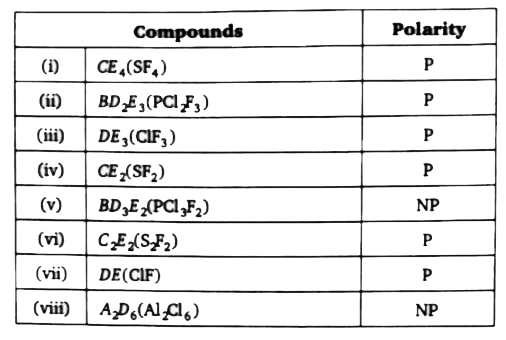
|
|
| 21. |
Consider the following electronic configuration of an element(P): [Xe]4f^(14)5d^(1)6s^(2) Then correct statement about element 'P' is |
|
Answer» It BELONGS to 6th PERIOD and 1st group Atomoic number =71 Period number=6th Group number=3rd |
|
| 22. |
Consider the following electrode potentials{:(,Mg^(+2)+2e^(-)toMg,,,E^(0)=-2.37V),(,V^(+2)+2e^(-)toV,,,E^(0)=-1.18V),(,Cu^(+2)e^(-)toCu^(+),,,E^(0)=0.15V):} Which of the following reactions will proceed from left to right spontaneously ? |
|
Answer» `MG^(+2)+VtoMg+V^(2+)` |
|
| 23. |
Consider the following electrochemical cell. (a). Write a balanced net ionic equation for the spontaneous reaction that take place in the cell. (b). Calculate the standard cell potential E^(0) for the cell reaction. (c). If the cell emf is 1.6V what is the concentration of Zn^(2+)? (d). How will the cell potential be affected if Kl is added to Ag^(+) half-cell? |
|
Answer» Solution :(a) The SPONTANEOUS reaction taking place in the cell is : `Zn(s)+2AG^(+)(aq) to Zn^(2+)(aq)+2Ag(s)` (b) `E_(cell)^(@)=E_(cathode)^(@)-E_(anode)^(@)=0.80-(-0.76)=1.56V` (c ) ACCORDING to Nernst equation : `E_(cell)=E_(cell)^(@)-(0.0591)/(2)"log"([Zn^(2+)])/([Ag^(+)]^(2))` `1.60=1.56-(0.0591)/(2)"log"([Zn^(2+)])/((0.1)^(2))` `0.04=-0.02955" log"([Zn^(2+)])/((0.01))` `"log"([Zn^(2+)])/((0.01))=(0.04)/((-0.02955))=-1.356` `([Zn^(2+)])/(0.01)="Antilog"(-1.356)="Antilog"(overset(-)(2).644)4.4xx10^(-2)` `[Zn^(2+)]=4.4xx10^(-4)M` (d) On adding KI solution to `Ag^(+)//Ag` half-cell (cathode half cell) `Ag^(2+)` ions will be precipiated as Agl. Thus, the `[Ag^(+)]` will decrease and `E_(cell)` will reduce according to the Nernst equation. `Ag^(+)+I to Agl`. |
|
| 24. |
Consider the following E^(@) values E_(Fe)^(@).^(3+)._(//Fe^(2+))=+0.77V,E_(Sn^(2+)._(Sn))^(@)=-0.14V Under standard conditions, the potential for the reaction Sn(s)+2Fe^(3+)(aq)rarr2Fe^(2+)(aq)+Sn^(2+)(aq) is |
|
Answer» `1.68V` `=0.77-(-0.14)=0.91V` |
|
| 25. |
Consider the following E^(@) values E^(@)(Fe^(3+)|Fe^(2+))=+0.77V,E^(@)(Sn^(2+)|Sn)=-0.14Vunder standard conditions , the potemtial for the reaction : Sn(s)+2Fe^(3+)(aq)to2Fe^(2+)(aq)+Sn^(2+)(aq)is |
|
Answer» 0.19 V `=0.77-(-0.14)=+0.91V` |
|
| 26. |
Consider the following E^(0) values E_(Fe^(3+) // Fe^(2+))^(0) = + 0.77 V , E_(Sn^(2+) // Sn)^(0)=-0.14 VUnder standard condition the potential for the reaction Sn_((s)) + 2Fe_((aq))^(3+) to 2Fe_((aq))^(2+) + Sn_((aq))^(2+) is |
|
Answer» 1.68V |
|
| 27. |
Consider the following diagram in which an electrochemical cell is coupled to an electrolytic cell. What will be the polarity of electrodes 'A' and 'B' in the electrolytic cell ? |
|
Answer» SOLUTION :A will have NEGATIVE POLARITY. B will have POSITIVE polarity. |
|
| 28. |
Consider the following diagram in which an electrochemical cell is coupled to an electrolytic cell. What will be the polarity of electrodes A and B in the electrolytic cell ? |
|
Answer» Solution :* ELECTRODE (A) has negative electric charge and electrode (B) has positive electric charge, because electrochemical cell of Zn-Cu is attached with electrolytic cell. * In electrochemical cell Zn is OXIDIZED `(ZntoZn^(2+)+2e^(-))` such electrons are MOVED on the Zn METAL and hence, it is negative, so the electrode (A) attached with it become positive. * In cell, copper ion undergoes reduction reaction and hence amount of electron get reduced and so copper become positive and the electrode attached with it become negative. |
|
| 29. |
Consider the following diagram in which an electrochemical cell is coupled to an electrolytic cell. What will be the polarity of electrodes 'A' and 'B' in the electrolytic cell ? |
| Answer» Solution :In the electrolytic CELLS COUPLED with an electrochemical cell, electrode 'A' will have negative polarity SINCE it is connected to copper plate in the electrochemical cell which has positive polarity, At the same TIME electrode 'B' have positive polarity. | |
| 30. |
Consider the following decay ._(Z)^(A)Xrarr_(Z+1)^(A)Y+_(-1)^(0)e,X is unstable because: |
|
Answer» its nucleus has EXCESS ENERGY |
|
| 31. |
Consider the following data for the reaction: A+B toProducts Determine the order of reaction with respect to A and with respect to B and the overall order of the reaction. |
|
Answer» Solution :The rate law may be expressed as: Rate = `K[A]^(p)[B]^(q)` Comparing experiments 2 and 3, `(Rate)_(2) = (k[0.2]^(p)[2.0]^(q))/(K[0.2]^(p)[1.0]^(q))= (8.4 xx 10^(-3))/(8.4 xx 10^(-3))=1` `[2]^(q) = [2]^(0),q=0` Comparing experiments 1 and 2, `(Rate)_(2) = k[0.20]^(p)[1.0]^(q) = 8.4 xx 10^(-3)` `(Rate)_(1) = k[0.10]^(p)[1.0]^(q) = 2.1 xx 10^(-3)` Dividing eqn. (III) by (iv), `(Rate)_(2)/(Rate_(1)) = (k[0.20]^(p)[1.0]^(q))/(k[0.10]^(p)[1.0]^(q)) = (8.4 xx 10^(-3))/(2.1 xx 10^(-3))=4` ORDER w.r. to A = 2, B=0, Overall order = 2. |
|
| 32. |
Consider the following decay ._(Z)^(A)Xrarr_(Z-1)^(A)Y+_(+1)^(0)e,(beta^(+))X is unstable because: |
|
Answer» its NUCLEUS has EXCESS ENERGY |
|
| 33. |
Consider the following decay series: A to B to C to D Where, A,B and C are radioactive elements with half lives of 4,5 sec, 15 days and 1 sec respectively and D is non-radioactive element, Starting with 1 mole of A, the numbe of moles B,C andleft after 30 days are: |
|
Answer» One mole of D and none of A, B or C |
|
| 34. |
Consider the following data: {:("Element","Atomic weight"),(A,12.01),(B,35.5):} A and B combine to form a new substance X. if 4 moles of B combine with 1 mole of A to give 1 mole of X, then the weight of 1 mole of X is: |
|
Answer» 154g |
|
| 35. |
Consider the following conversions: (i) O_((g))+e^(-) to O_((g))^(-),DeltaH_(1) (ii) F_((g))+e^(-) to F_((g))^(-),DeltaH_(2) (iii) Cl_((g))+e^(-) to Cl_((g))^(-),DeltaH_(3) (iv) O_((g))^(-) +e^(-) to O_((g))^(2-),DeltaH_(4) the according to given information the incorrect statement is : |
|
Answer» `DeltaH_(3)` is more negative than `DeltaH_(1) and DeltaH_(2)` Second electron gain enthalpy for an element is always positive. |
|
| 36. |
Consider the following conversions : I. CH_(3) underset(CN)underset(|)("CHCHO") overset(H_(3) O^(+))(rarr) CH_(3) underset("COOH")underset(|)(CH_(3)"CHCHO") II. underset(OH)underset(|)(CH_(3)"CHCN")overset(H_(3)O^(+))(rarr) CH_(3) underset(OH) underset(|)("CHCOOH") III. overset(O)overset(||)(CH_(3)"CCN")overset(H_(3)O^(+))(rarr ) overset(O)overset(||)(CH_(3) "CCOOH") In which case(s), preference group of nomenclature changes ? |
| Answer» ANSWER :A | |
| 37. |
Consider the following covalent compounds in their solid state and find the value of expression (X+Y+Z). N_(2)O_(5),Cl_(2)O_(6),PC l_(),I_(2)Cl_(6),XeF_(6),PB r_(5) Where X=total number of compounds in which central atom of cationic or anionic part is sp^(3) hybridized. Y=Total number of compounds having 90^(@) bond angle either in cationic or anionic part. Z=Total number of compounds having 109^(@)28' bond angle either in cationic or anionic part. |
Answer» 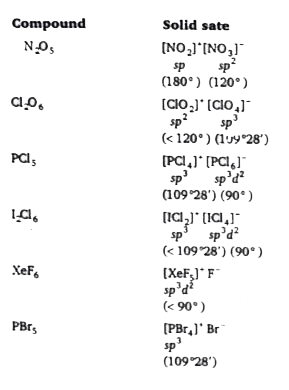 x=1+1+1+1=4 y=1+1=2 z=1+1+1=3 x+y+z=4+2+3=9 |
|
| 38. |
Consider the following conversion : Amongst the following, how many methods can be used in any one of steps involved in the mentioned conversion? i. Hoffmann bromamide degradation ii. Gabriel phthalimide synthesis iii. Sandmeyer reaction iv. Clemmensen reduction v. Mendius reduction |
|
Answer» |
|
| 39. |
Consider the following concentration cell : M(s)|M^(+)(aq, 0.04M)||M^(+)(aq, 0.08M)|M(s).|E_("cell")| for the cell is 60 mV. In the cell, if the concentration of the solution of M^(+) ions is 0.04 M instead of 0.02M, then the cell potential will be - |
|
Answer» 60 mV |
|
| 40. |
Consider the following configuration (A),(B) and (C ). (A) Which of the following statements is correct? |
|
Answer» `(A)` and `R-`configuration |
|
| 41. |
Consider the following configurations (A),(B),(C ) and (D) (A) which of the following statements is not correct? |
|
Answer» `(A)` and `(C )` are enantiomers 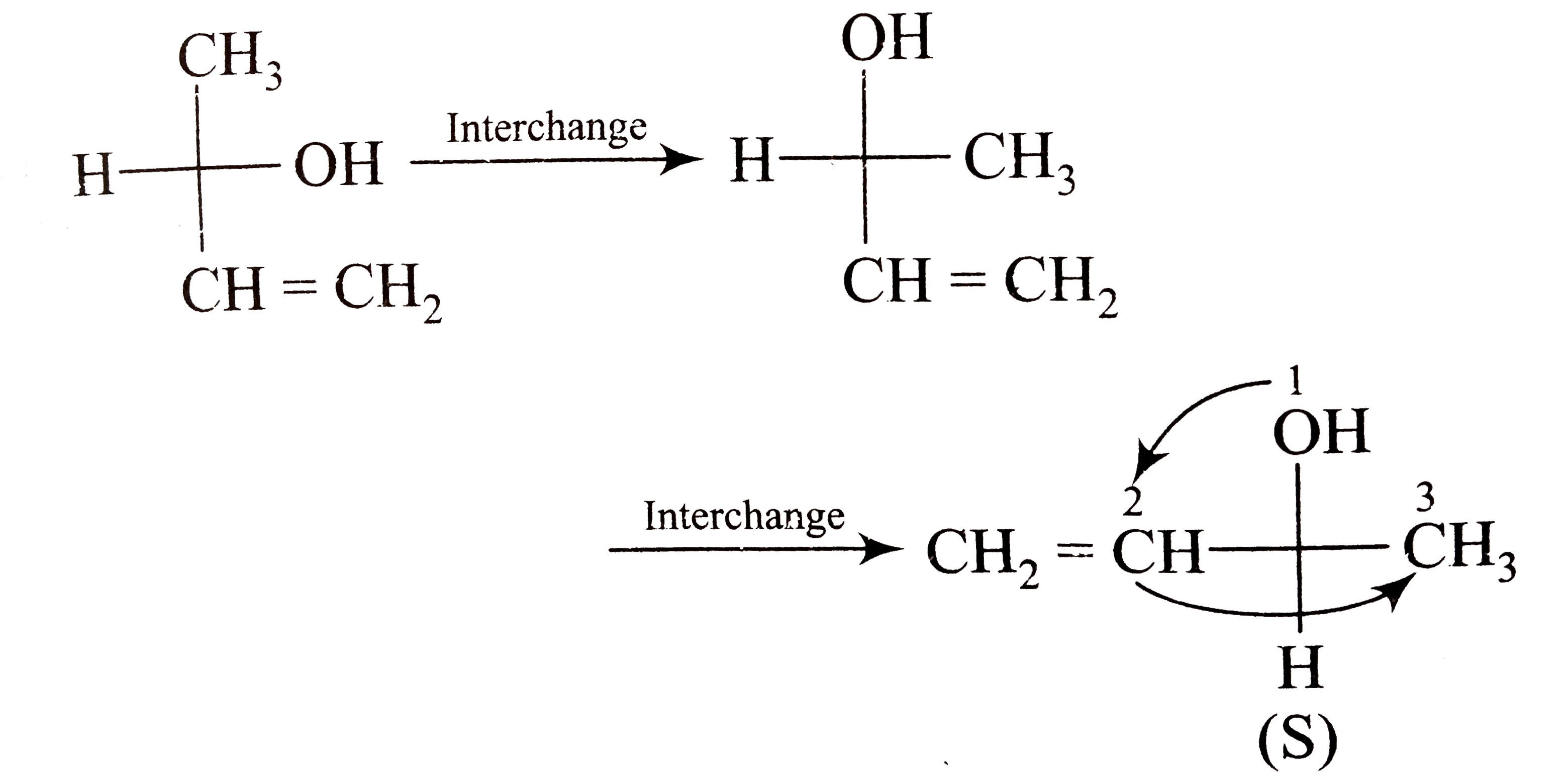 Alternatively, the priority order in the ORIGINAL `(A)` with `H` on the horizontal is `R`, but this is wrong and the molecules is actually `S`. similarly, configuration `B` is `R` (the enantiomers), `C` is `S` (identical) and `D` is `R` (the enantiomer). THUS `A` and `C` are not enantiomers but identical compounds. |
|
| 42. |
Consider the following compounds. (P) XeF_(2)(Q) XeF_(4) (R ) XeF_(6) The correct order of tendancy of accept F^(-) ion is : |
|
Answer» <P>`P GT Q gt R` |
|
| 43. |
Consider the following compounds with their regular geometries. Calculate value of (x+y-z)^(2), where x is total number of axial d-orbitals having zero nodal plane, y and z are total no. of non-axial and axial d-orbitals respectively each one having two nodal planes used in hybridisation of central atoms of compounds A to E. |
Answer» 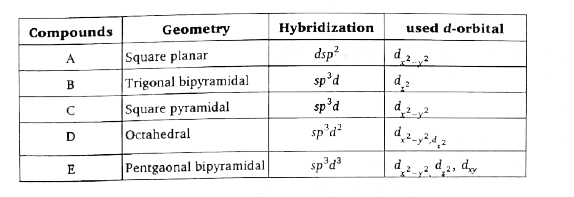 `x=d_(x^(2))=3` `y=d_(xy)=1,(x+y-z)^(2)=(3+1-4)^(2)=0` `z=d_(x^(2)-y^(2))+4` |
|
| 44. |
Consider the following compounds.I) DDTII) Gammexane III) Carbon tetrachloride IV) ChlorobenzeneThe correct sequence of these compounds in the increasing order of percentage of chlorine in them is |
|
Answer» III, II, I, IV 
|
|
| 45. |
Consider the following compounds, which of these will release CO_(2) with 5% NaHCO_(3)? |
|
Answer» (i), (II) and (III) |
|
| 46. |
Consider the following compounds, I, 1,2-hydroxybenzene II 1,3-dihydroxybenzene III 1,4-dihydroxybenzene IV. Hydroxybenzene |
|
Answer» `I lt II lt III lt IV`  1,4-dihydroxybenzne, adn isomer of dihydroxybenzene shows highest BOILING point due to intermolecular H-bonding followed by META ORTHO isomer. Hence, correct option is (b) |
|
| 47. |
Consider the following compounds How many of the above compounds are less reactive than benzene in aromatic electophilic substitution reaction? |
|
Answer» |
|
| 48. |
Consider the following compounds (I)CH_(3)-underset(underset(CH_(3))(|))overset(overset(CH_(3))(|))C-Br(II)CH_(3)-underset(underset(CH_(3))(|))C-Br (III) CH_(3)-CH_(2)-CH_(2)BrTheir reactivity toward E1 is |
|
Answer» I GT II gt III |
|
| 49. |
Consider the following compounds (i) C_(6)H_(5)COCl "" (ii) (##ERRL_CHE_V02_C20_E01_142_Q01.png" width="80%"> (iii) (##ERRL_CHE_V02_C20_E01_142_Q02##) "" (iv) (##ERRL_CHE_V02_C20_E01_142_Q03.png" width="80%"> The correct decreasing order of their reactivity towards hydrolysis is |
|
Answer» `(II) GT (iv) gt (III) gt (i)` |
|
| 50. |
Consider the following compounds and select the incorrect statement from the following : NH_(3),PH_(3),H_(2)S, SO_(2), SO_(3), BF_(3), PCl_(3), IF_(7), P_(4), H_(2) |
|
Answer» 3 MOLECULES out of given compounds involve `SP^(2)` hybridisation |
|