Saved Bookmarks
This section includes 7 InterviewSolutions, each offering curated multiple-choice questions to sharpen your Current Affairs knowledge and support exam preparation. Choose a topic below to get started.
| 1. |
Consider the following reaction , 2NO(g) + 2H_(2)(g) to N_(2)(g) + 2H_(2)O(g) The rate law for the reaction is first order with respect to H_(2) and second order with respect to NO.Write the rate law for the reaction. |
|
Answer» |
|
| 2. |
Consider the following reaction 2CH_3CO_2C_2H_5overset(C_2H_5O^(-)Na^(+))underset(Delta)(to) P (Major) Majorproduct P is |
|
Answer» `CH_3-oversetunderset(||)(O)(C)-C_2H_5` `2CH_3CO_2C_2H_2 underset(DELTA)overset(C2H_4O^(-)Na^+)(to)` `CH_3-oversetunderset(||)(O)(C )- CH_2CO_2C_2H_5` |
|
| 3. |
Consider the following reaction. (1R,3S)-cis-Bromo-3-methylcyclohexane ltbr gtThe product formed in the reaction is |
|
Answer» (1R,3S)-cis-3-methylcyclohexanol |
|
| 4. |
Consider the following processes{:(,DeltaH(kJ//mol)),(1//2ArarrB,+150),(3Brarr2C+D,-125),(E+Ararr2D,+350):} For B+DrarrE+2C,DeltaH will be |
|
Answer» `-325 kJ//mol` `2xx` eq.(i) + eq. (ii) -eq. (iii) `DeltaH=300-125-350=-175` |
|
| 5. |
Consider the following perhalate ions in acidic medium ClO_(4)^(-)(I),BrO_(4)^(-)(II),IO_(4)^(-)(III) Arrange these in the decreasing order of oxidizing power |
| Answer» Answer :D | |
| 6. |
Consider the following oxyanions : PO_(4)^(3-), P_(2)O_(6)^(4-), SO_(4)^(2-), MnO_(4)^(-), CrO_(4)^(2-), S_(2)O_(5)^(2-), S_(2)O_(7)^(2-) and find the value ofR+Q-P where P=Number of oxy aions having three equivalent X-O bonds per central atom O=Number of oxy anions having two equivalent X-O bonds per central atom R=Number of oxy anions having four equivalent X-O bonds per central atom |
Answer» 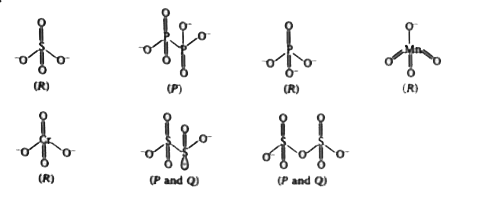 `P=3, R=4, Q=2` |
|
| 8. |
Consider the following organic compound, overset(1)CH_3 - overset(2)CH_2- overset(3)CH_2- overset(4)CH_2-Coverset(5)H_2-C overset(6)H_2 - C overset(7)H_3 To make it chiral compound, the attack should be on carbon |
|
Answer» 1 |
|
| 9. |
Consider the following organic compound: CH_(3)-CH_(2)-CH_(2)-CH_(2)-CH_(2)-CH_(2)-CH_(3) To make it a chiral compound, the attack should be on carbon: |
|
Answer» 1 |
|
| 10. |
Consider the following orders (I) MgOgtAl_(2)O_(3)gtCr_(2)O_(3)gtFe_(2)O_(3) (Thermal stability) (II)CaOgtMgOgtZnO gtPbO (Temperature at which reduction by carbon takes place at least theoretically) (III) Cr_(2)O_(3)gtFe_(2)O_(3)gtMgO (Temperature at which reduction by Al takes place) |
|
Answer» II,III |
|
| 11. |
Consider the following orders: (i) HF gt HCl gt HBr gt HI: Lewis basic character. (ii) CH_(4) lt C Cl_(4) lt CF_(4): Electornegativityy of central 'C'-atom. (iii) Mg^(2+) lt K^(+) lt S^(2-) lt Se^(2-): ionic radius then calculate vlaue of |x-y|^(2), where x and y are correct and incorrect order respectively. |
|
Answer» (II) (T) (III) (T) |
|
| 12. |
Consider the following order: (i) HF gt HCl gt HBr gt HI: Lewis basic character (ii) CH_(4) lt C Cl_(4) lt CF_(4): Electronegatively of central 'C'- atom (iii) Mg^(2+) lt K^(+) lt S^(2-) lt Se^(2+) Stable oxidation state (vi) LiF gt NaF gt KF gt RbF, Lattice energy (vii) F^(-)(aq) gt Cl^(-)(aq) gt Br^(-) (aq) gt I^(-) (aq), Electrical conductance (viii) Li^(+) lt Mg^(2+) lt Al^(3+) : Hydration energy (ix) Cl gt Br gt F gt I: Electron affinity (x) BeCl_(2) lt AlCl_(3) lt SiCl_(4): Lewis acidic character Then calculate value of (x-y), where x and y are correct and incorrect order respectively. |
|
Answer» |
|
| 13. |
Consider the following orders: (1) H_(2)SO_(4) gt H_(2)SO_(3):boiling point (2) H_(2)O gt HF: Extent of H-bond (3) H_(2)O lt H_(2)O_(2): Strength off H-bond. |
|
Answer» |
|
| 14. |
Consider the following nuclear reactions: (1) ._(7)^(14)N + ._(2)^(4)HE to ._(8)^(17)O + ._(1)^(1)H (2) ._(4)^(9)Be + ._(1)^(1)H to ._(3)^(9)Li + ._(2)^(4)He (3) ._(12)^(24)Mg + ._(2)^(4)He to ._(14)^(27)Si + ._(0)^(1)n (4) ._(5)^(10)B + ._(2)^(4)He to ._(7)^(13)N + ._(0)^(1)n Example of induced radioativty would include the reactions: |
|
Answer» 3 and 4 |
|
| 15. |
Consider the follwing nuclear reactions: ._(92)^(238) M rarr ._(y)^(x)N + 2 ._(2)He^(4) ._(y)^(x)N rarr ._(B)^(A)L + 2beta^(+) |
|
Answer» 142 Applying mass number balance & nuclear CHARGE balance 92=y+4 `""` y=88 238=x+8 ` ""` x=230 `._(Y)^(X)N rarr _(B) ^(A) L+2 beta^(+) (._(+1)e^(0))` Applying mass number balance & nuclear charge balance 230=A+0 `""` A=230 88=B+2 ` "" ` B=86 No. of neutrons in ELEMENT L is 230-86=144. |
|
| 16. |
Consider the following nuclear reactions ._(92)^(238)M rarr ._(X)^(Y)N + 2alpha, ._(X)^(Y)N rarr ._(B)^(A)L + 2beta The number of neutrons in the element L is |
|
Answer» 142 `._(92)^(238)M RARR ._(X)^(Y)N + 2 ALPHA (2 xx ._(2)^(4)He) or ._(88)^(230)N` `._(88)^(230)N rarr ._(B)^(A)L + 2 ._(+1)^(0)e or ._(90)^(23)L` `.:` No of NEUTRON in L `= 230 - 86 = 140` |
|
| 17. |
Consider the following nuclear reaction : ""_(92)^(238)Mto""_(y)^(x)N+2""_(2)^(4)He ""_(y)^(x)Nto""_(B)^(A)L+2beta^(+) The number of neutrons in the element L is |
|
Answer» 140 `""_(88)^(230)Nto_(86)^(230)L+2""_(+1)overset(0)E` No. of neutrons =230-86=144 |
|
| 18. |
Consider the following nuclear reaction, ._(92)^(238)M rarr ._(y)^(x)N + 2 ._(2)^(4)He ._(y)^(x) N rarr ._(B)^(A) L + 2beta^(+) |
|
Answer» 140 `._(y)N^(x) rarr ._(B)L^(A) + 2 beta^(+)` `._(y)N^(230) overset((92 - 2 xx2)rarr N^((238 - 4 xx 2)) = ._(88)N^(230)` `._(88)N^(230) overset(2beta^(+))rarr ._((88 -2))L^((230)) = ._(86)L^(230)` Total no of neutrons in `._(86)L^(230)` `230 - 86 = 144` |
|
| 19. |
Consider the following molecule : underset((1))(H_(2)C)=underset((2))C=underset((3))C=underset((4))C=underset((5))(CF_(2)) Ih hybridization of C_((1)) carbon atom is sp^(2)(s+p_(y)+p_(z) and hybridization of C_((4)) carbon atom is sp(s+p_(z)) . Then according to given information the correct statement(s) is / are : |
|
Answer» <P>Nodal plane of `PI`-bond between `C_((2)) and C_((3))` LIES in xz-plane, formed by sideways overlapping of `p_(y)`-orbitals |
|
| 20. |
Consider the following metallurgical processes : (I) Electrolysis of molten mixiure of about 40% metal chloride and 60% calcium chloride (II) Heating the impure metal with l_2 at around 523 K to from metal iodide and their subsequent decomposition at higher temperature to yield pure metal (III) Heating the sulphide ore in the presence of air untill a part of it is converted to its oxide and the further heating the oxide in the absence of air with metal sulphide to produce metal The process used for obtaining titanium sodium and copper repsectively are |
|
Answer» (I), (II), (III) |
|
| 21. |
Consider the following metallurgical process: (P) Heating impure metal with CO and distilling the resulting volatile cabonyl (b.p. 43^(@)C) and finally decomposing at 150^(@)-200^(@)Cto get the pure metal. (Q) Heating the sulphide ore in air unitl a part is converted to oxide and then further heating in the absence of air to let the oxide react, with unchangedmetal sulphide. (R) Electrolysis of the molten electrolyte containing approximately equal amounts of the metal chloride and NaCl to obtian the metal The processes used for obtaining manesium nickel and copper are respectively: |
|
Answer» <P>P,Q and R only |
|
| 22. |
Consider the following metallurgical processes: (I) Heating impure metal with CO and distilling the resulting volatile carbonyl (b.p. 43^(@)C) and finally decomposition at 150^(@)-200^(@)C to get the pure metal. (II) Heating the sulphide ore in air until a part is converted to oxide and then further heating in theabsence of air to let the oxide react with unchanged metal sulphide. (III) Electrolysis of the moltenelectrolyte containing approximatelyequal amounts of the metal chloride and NaCl to obtain the metal. The processes used for obtaining magnesium , nickel and copper are respectively. |
|
Answer» (I), (II) and (III) |
|
| 23. |
Consider thefollowingmetallurgical operations for twoores of copper(X) and(Y).X overset ("Calcination")to"Black ppt." (C ) +CO_2+H _ 2 OY overset ("Roasting") to "Metal M"+"Gas(G)"Identify(X),(Y),(Z), (M) and(G). |
|
Answer» Solution :Sincecalcinationproduces in additiontometaloxide (C ), i.e., CUO, `CO_ 2 andH_2 O`, therefore, THEORE (X)maybebasiccoppeercarbonate or Malachite. ` underset ("Basic copper carbonate (X) or Malachite") (CuCO_ 3 .Cu (OH)_ 2 )overset (Delta) tounderset ("Cupricoxide (C )")( 2CuO)+CO _ 2uparrow+H_ 2 O` Since roasting ore (Y)producescoppermetal(M),therefore, ore(Y) may becuprous sulphide, chalcociteor copperglance `(Cu_ 2 S)`. ` Cu_2S `isfirstpartiallyoxidisedto`Cu_2 O `whichthenreactswiththeremaining`Cu_2 S`to formcoppermeetal(M) and `SO _ 2`asgas` (G) `. ` underset("Copper glance")(2 Cu_2S) +3 O _ 2to2 Cu _2O +2SO_ 2 ,2 Cu_2O+Cu _ 2 S tounderset ("Copper(M)") (6 Cu)+SO_2` THUS,ore (X) is malachite, ore (Y) is copper glance, compound(C ) isculpricoxide,metal(M)iscopperandgas (G) is SULPHURDIOXIDE `(SO_2) `. |
|
| 24. |
Consider the following list of reagents : Acidified K_(2)Cr_(2)O_(7), alkaline KMnO_(4), CuSO_(4), H_(2)O_(2),Cl_(2),O_(3),FeCl_(3),HNO_(3) and Na_(2)S_(2)O_(3). The total number of reagents that can oxidise aqueous iodide to iodine is |
|
Answer» `K_(2)Cr_(2)O_(7)+KI+H_(2)SO_(4)rarrK_(2)SO_(4)+Cr_(2)(SO_(4))_(3)+I_(2)+H_(2)O` `2CuSO_(4)+4KIrarr 2CuI darr+I_(2)+2K_(2)SO_(4)` `H_(2)O_(2)+2KIrarr2KOH+I_(2)` `H_(2)O+2KI+O_(3)rarr 2KOH+O_(2)+I_(2)` `FeCl_(3)+2KIrarr2KCl+FeCl_(2)+I_(2)` `HNO_(3)+KIrarr KNO_(3)+I_(2)+NOuarr` `Na_(2)S_(2)O_(3)+KI rarr "no reaction."` Note : In `H_(2)O_(2) and O_(3),I^(-)` to `tI_(2)` oxidation will occur initially. However as concentration of KOH builds up, it will begin causing disproportionation of resulting `I_(2)` to `IO_(3)^(-)`. |
|
| 25. |
Consider the following liquid - vapour equilibrium Liquid iff VapourWhich of the following relations is correct |
|
Answer» `(dlnG)/(dT^(2))=(DeltaH_(V))/(RT^(2))` `(dlnP)/(dT)=(DeltaH_(v))/(RT^(2))` |
|
| 26. |
Consider the following liquid -vapour equilibrium. "Liquid" hArr "Vapour" Which of the following relations is correct ? |
|
Answer» `(dInG)/(DT^(2)) = (DeltaH_(v))/(RT^(2))` |
|
| 27. |
Consider the following ligands NH_(2)^(-), acac, OH^(-), Gly, O_(2)^(-), Phen, DMG, NO_(2)^(-),CO_(3)^(2-),Cl^(-),CH_(3)COO^(-),en,SO_(4)^(2-). Then calculate vlaue of "P+Q-R-S" here P: total number of ligands which act as bridging as well as monodentate only. Q: Total number of flexidentate ligands. R: Total number of bidentate ligands only S: Total number of unsymmetrical bidentate ligands. |
|
Answer» `Q=SO_(4)^(2-),NO_(2)^(-),CO_(3)^(2-),CH_(3)COO^(-)=4` REN,acac, Phen, DMG, Gly=5 S=DMG, Gly=2 4+4-5-2=1 |
|
| 28. |
Consider the following isomerism: (i) Ionization (ii) Hydrate (iii) Coordination (iv) Geometrical (v) Optical Which of the above isomerism are exhibited by [Cr(NH_(3))_(2)(O)_(2)Cl_(2)]^(-)? |
|
Answer» (i) and (v) |
|
| 29. |
Consider the following ionization steps : M(g) rarr M^(+)(g) +e^(-), DeltaH=100eV M(g) rarr M^(2+)(g)+2e^(-),DeltaH=250eV Select correct statement(s)a)I.E._(1) " of "M(g)is 100eVb)M^(+)(g) rarr M^(2+)(g)+e^(-),DeltaH=150eVc)I.E._(2)of M(g) is 250eVd)I.E._(2) of M(g) is 14=150eV |
|
Answer» `I.E_(1)` of M(g) is 100 EV |
|
| 30. |
Consider the following isolatin/purification pocess: (P) Heating impure metal with I_(2) at 150-200^(@)C and passing the resulting volatile iodidle on hot tungsten filament at 1400^(@)C to get the pure metal. (Q) Heating the sulphide ore in air unitil a part is converted to oxide and then further heating in the absence of air to let the oxide react with unchanged metal sulphide to get the metal. (R) Electrolysis of the molten electrolyte containing metal oxide and cryolite or flourspar to obtain the metal The process used for obtaining aluminium, titanium and lead are respectively, |
|
Answer» P,Q and R only |
|
| 31. |
Consider the following ionization enthalpies of two elements 'A' and 'B' Which of the following statements is correct ? |
|
Answer» Both 'A' and 'B' belong to group -1 where 'B' comes below 'A'. Here, 1st ionization enthalpy of A and B is greater than group I(Li 520 `kJmol^(-1)` to Cs374`kJmol^(-1)`), which means ELEMENT A and B belong to group -2 and all three given ionization enthalpy values are less for element B means B will COME below A |
|
| 32. |
Consider the following ionisation reactions: If monovalent positive ion of A, divalent positive ion of B and trivalent positive ion of C have zero electron.Then incorrect order of corresponding I.E. is: |
|
Answer» `C_(3) gt B_(2) gt A_(1)` 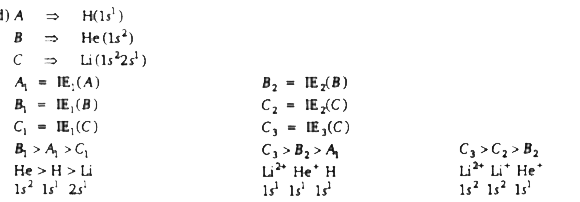
|
|
| 33. |
Consider the following iodides : {:(PI_(3),AsI_(3),SbI_(3)),(102^(@),100.2^(@),99^(@)):} The bond angle is maximum in PI_(3), which is : |
|
Answer» DUE to small size of phosphorous |
|
| 34. |
Consider the following halogen containing compounds (i) CHCl_(3)(ii) C Cl_(4) (iii) CH_(2)Cl_(2)(iv) CH_(3)Cl The compounds with a net zero dipole moment are |
|
Answer» (II) and (V) only |
|
| 35. |
Consider the following information (F=F or Cl) According to given information choose the incorrect order of bond length : |
|
Answer» `ggtagtdgtb` 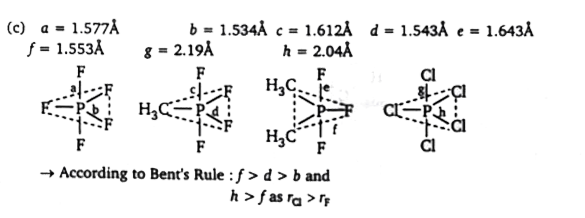
|
|
| 36. |
Consider the following haloakanes 1 CH_(3)F 2 CH_(3)Cl 3 CH_(2)Br 4 CH_(3)I The increasing order of reactivity in nucelophilic subsittutionreaction is |
|
Answer» `1 lt 2 lt 4 lt 3` |
|
| 37. |
Consider the following halides : (I) BF_(3) "" (II) BCl_(3) (III) BBr_(3) "" (IV) BF_(3) The Lewis acid strength of these halides follows the order : |
|
Answer» `I LT II lt III lt IV` |
|
| 38. |
Consider the following half reactions and choose the correct alternative (i) Cl_(2(g))+2e^(-) rarr 2Cl_((aq))^(-)E^(@)=1.36V (ii) Br_(2(l))+2e^(-)rarr 2Br_((aq))^(-)E^(@)=1.07V (iii) I_(2(s))+2e^(-)rarr 2I_((aq))^(-)E^(@)=0.53V |
|
Answer» `Br_(2)` cannot OXIDIZE `I^(-)` |
|
| 39. |
Consider the following graphs Choose the correct statements |
|
Answer» According to both graphs MOLE fraction of A `gt` mole fraction of B in condensate |
|
| 40. |
Consider the following half-cell reactions. What combination of two half-cells would result in a cell with the largest potential? |
|
Answer» I and II 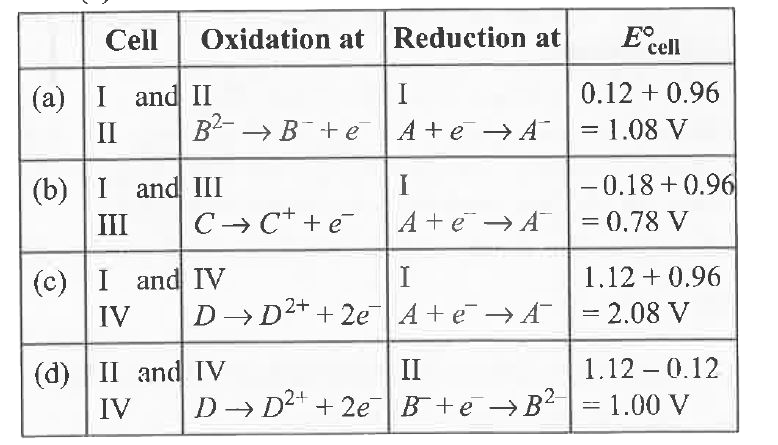
|
|
| 41. |
Consider the following half cell reactions : Mn^(2+) + 2e^(-) to Mn E^(@) = -1.18 V Mn^(2+) to Mn^(3+) + e^(-)E^(@0 = -1. 51 V The E^@ for the reaction 3Mn^(2+) to Mn + 2Mn^(3+), and the possibility of the forwad reactions are respectively |
|
Answer» 2.69V and spontaneous `2[Mn^(2+) + e^(-)] (E_("ox")^(@)) = -151 V` `3Mn^(2+) to Mn^(3+) + 2 Mn^(3+) E_("cell")^(@)= ?` `E_("cell")^(@) = (E_("ox")^@) + (E_("Red")^@)` `= -1.51 - 1.18` and non spontaneous `=2.69 V` SINCE `E^@` is -ve `DELTAG` is +ve and the given forward cell reaction is non-spotaneous. |
|
| 42. |
Consider the following groups attached to benzene ring and how many of these show -"I" effect only- NH_2,- NH_3, - F, - CH_2OH, - CH_3,- NHCOR, -OCH_3, - OH |
|
Answer» 2 |
|
| 43. |
Consider the following graph of Z vs 1/V_m drawn at low pressure and inversion temperature, using the virial form of vanderwaal's equation : Z=1+(b+1/(RT))1/V_m+b^2/V_(m^2)+b^2/V_(m^3)+.... Find crictical molar volume (V_c) in cm^3 ? |
|
Answer» At inversion TEMPERATURE `T=(2a)/(RB)` `Z=1+(b-(a/(Rxx2a))/(Rb))1/V_m=1+(b-b/2)1/V_m=1+b/2xx1/V_m` SLOPE`=b/2 " " =(1.02-1.01)/(0.011-0.001)=0.01/0.01=1` `b=2 cm^3` `V_c=3b=6 cm^3` |
|
| 44. |
Consider the following graph and choose the correect option |
|
Answer» A represent vapour compsition and `B` represent LIQUID composition |
|
| 45. |
Consider the following gas - phase reaction :2A(g)+B(g)rArrC(g)+D(g)An equilibrium mixture of reactants and products is subjected to the following changes :-(I)A decrease in volume(II) An increase in temperature(III) Addition of reactants(IV) Addition of an inert gas at constant volume .Whichof these changes affect the composition of the equilibrium mixture but leaves the value of K_(c) unchanged : - |
|
Answer» I, II |
|
| 46. |
Consider the following gaseous equilibria with equilibrium constants K_(1) and K_(2) respectively.SO_(2(g))+(1)/(2)O_(2(g))hArr SO_(3(g))2SO_(3(g))hArr 2SO_(2(g))+O_(2(g))The equilibrium constants are related as …………. |
|
Answer» `K_(1)^(2)=(1)/(K_(2))` `K_(2)=(1)/(K_(1)^(2))` |
|
| 47. |
Consider the following four elements, which are represented according to long form of periodic table. Here W, Yand Z are left, up and right elements with respect to the element 'X' and 'X' belongs to 16th group and 3rd period. then according to given information the incorrect statement regarding given elements is: |
|
Answer» Maximum electronegativity: Y |
|
| 48. |
Consider the following four electrodes: P=Cu^(2+)(0.0001M)//Cu(s)""Q=Cu^(2+)(0.1M)//Cu(s) R=Cu^(2+)(0.01M)//Cu(s)""S=Cu^(2+)(0.001M)//Cu(s) If the standard electrode potential of Cu^(2+)//Cu is +0.34V, the reduction potentials in volts of the above electrodes follow the order: |
|
Answer» PgtSgtRgtQ Thus, greater is `Cu^(2+)` ION concentration, greater will be the REDUCTION potential. |
|
| 49. |
Consider the following four electrode : A = Cu^(2+) (0.0001 M)// Cu(S)B=Cu^(2+) (0.1M)//Cu(s) C =Cu^(2+) (0.01 M )//Cu(s) D) = Cu^(2+) (0.001 M )// Cu(s) If the standard reduction potential of Cu^(+2)// Cu is + 0.34 V , the reduction potential ( in volts ) of the above electrodes follow the order |
|
Answer» `A GT D gt C gt B` |
|
| 50. |
Consider the following five group (According to modern periodic table) of elements with their increasing order to atomic numbers : Group 1 to A, B, C, D, E "" " Group" 2 to F,G,H,I,J Group 13 to K,L,M,N,O "" " Group" 15 to P,Q,R,S,T "" " Group " 17 to U,V,W,X,Y IF first and last element of each group belongs to 2nd and 6th period respectively and Z represents to carbonate ion (CO_(3)^(2-)) then consider the following orders. (i) O^(+) gt H^(2+) , Polarising power (ii) T^(3+) gt S^(3+) gt R^(3+) , Stability of cation (iii) U^(-)(aq) gt V^(-)(aq) gt W^(-)(aq) gt X^(-)(aq), Size (iv) JV_(2) lt IV_(2) lt GV_(2) lt LV_(3) , Covalent character (v) GZ gt IZ gt JZ , Thermal stability (vi) AV gt BV gt CV gt DV gt EV , Thermal stability (vii) C_(3)P gt B_(3)P gt A_(3)P , Lattice energy (viii) KU_(3) lt KV_(3) lt KW_(3) lt KX_(3), Melting point Then calculate value of |p-q|^(2) , here p and q are correct and incorrect orders in the given eight orders respectively. |
|
Answer» G-2 F(Be),G(Mg),H(Ca),I(Sr),J(Ba) G-13 K(B),L(Al),M(Ga),N(In),O(Tl) G-15 P(N),Q(P),R(As),S(SB),T(Bi) G-17 U(F),V(Cl),W(Br),X(I),Y(At) (i) `Ti^(+) gt Ca^(2+)`, Polarising power(T) (ii) `Bi^(3+) gt Sb^(3+) gt As^(3+)`, Stability of cation (T) (iii) `F^(-)(aq) gt Cl^(-)(aq) gt Br^(-)(aq) gt I^(-) (aq)`, Size (T) (iv) `BaCl_(2) gt SrCl_(2) gt MgCl_(2) lt AlCl_(3)`, Covalent nature (T) (v) `MgCO_(3) gt CaCO_(3) gt SrCO_(3) gt BaCO_(3)` , THERMAL stability (F) (vi) `LiCl gt NaCl gt KCl gt RbCl gt CsCl`, Thermal stability (T) (vii) `K_(3)N gt Na_(3)N gt Li_(3)N` , Lattice energy (F) (viii) `BF_(3) lt BCl_(3) lt BBr_(3) lt BI_(3)`, Melting point (T) `implies |p-q|^(2)|6-2|^(2)=16` |
|