

Saved Bookmarks
This section includes 7 InterviewSolutions, each offering curated multiple-choice questions to sharpen your Current Affairs knowledge and support exam preparation. Choose a topic below to get started.
| 1. |
Arrange p-methylaniline (I), m-methyl aniline (II), aniline (III), o-methyl aniline (IV), in the order of basicity. |
|
Answer» `I GT II gt III gt IV`  O-methyl ANILINE basic nature decreases due to ortho effect |
|
| 2. |
Arrange oxides of chlorine in decreasing order of reactivity. |
|
Answer» SOLUTION :REACTIVITY of OXIDES of CHLORINE: `Cl_2OgtClO_2gtCl_2O_6gtCl_2O_7` |
|
| 3. |
Arrange nucleophilicity of the following species in decreasing order for substitution reactions: (1) Coverset(circ)H_(3) (2) Noverset(circ)H_(3) (3) Ooverset(circ)H (4) Coverset(circ)H_(2)O |
| Answer» Answer :A | |
| 4. |
Arrange NH_(4)^(+), H_(2)O, H_(3)O^(+), HF and OH^(-) in increasing order of acidic nature |
|
Answer» `H_(3)O^(+) lt NH_(4)^(+) lt HF lt OH^(-) lt H_(2)O` Acidic nature in DECREASING order. |
|
| 5. |
Arrange N, O and S in order of decreasing electron affinity: |
|
Answer» SgtOgtN |
|
| 6. |
Arrange living power of given nucleophilic groups: CH_(3)-underset(O)underset(||)overset(O)overset(||)S-overset(ө)O (2) F_(3)C-underset(O)underset(||)overset(O)overset(||)S-overset(ө)O (3) CH_(3)-overset(O)overset(||)C-overset(ө)O (4) F_(3)C-overset(O)overset(||)C-overset(ө)O |
| Answer» Answer :A | |
| 7. |
Arrange N, O and S in correct order of electron affinity :- |
| Answer» Answer :A | |
| 8. |
Arrange K^(+) , Zn^(2+) , H^(+) and Cu^(2+) ions in order of their tendency to be liberated at the cathode. [Given:mE_(Cu^(2+)|Cu)^(0) = +0.34 V , E_(2H^(+)|H_2)^(0) = 0.00 V, E_(Zn^(2+)|Zn = -.0.76 V, E_(K^(+)|K) = -2.93 V] |
|
Answer» Solution :The increasing order of standard electrode potential of the given ions: `K_(K^(+)|K)^(0) lt E_(Zn^(2+)|Zn)^(0) lt E_(2H^(+)|H_(2))^(0) lt E_(Cu^(2+)|Cu)^(0)` . AMONG the given electrodes . `K^(+)|K` and `Cu^(2+)|Cu` have the lowest and highest reduction potential RESPECTIVELY. Thus , `Cu^(2+)` has the highest tendency to get REDUCED whereas K has the highest tendency to get oxidised. Thus the order of increasing tendencies to get liberated at cathode is : `K^(+) lt Zn^(2+) lt H^(+) lt Cu^(2+)` |
|
| 9. |
Arrange in the increasing order of atomic radii of the following elements O,C,F,Cl, Br: |
| Answer» Answer :A | |
| 10. |
Arrange in the decreasing order of basic nature, a. i. Pyrrole ii. Pyridine ii. Aniline b. i. Diphenylamine ii. Aniline ii. Cyclohexyl amine c. i. p-Nitroaniline ii. Anilineiii. P-Methyl aniline. |
Answer» Solution :Pyridine GT Aniline gt Pyrrol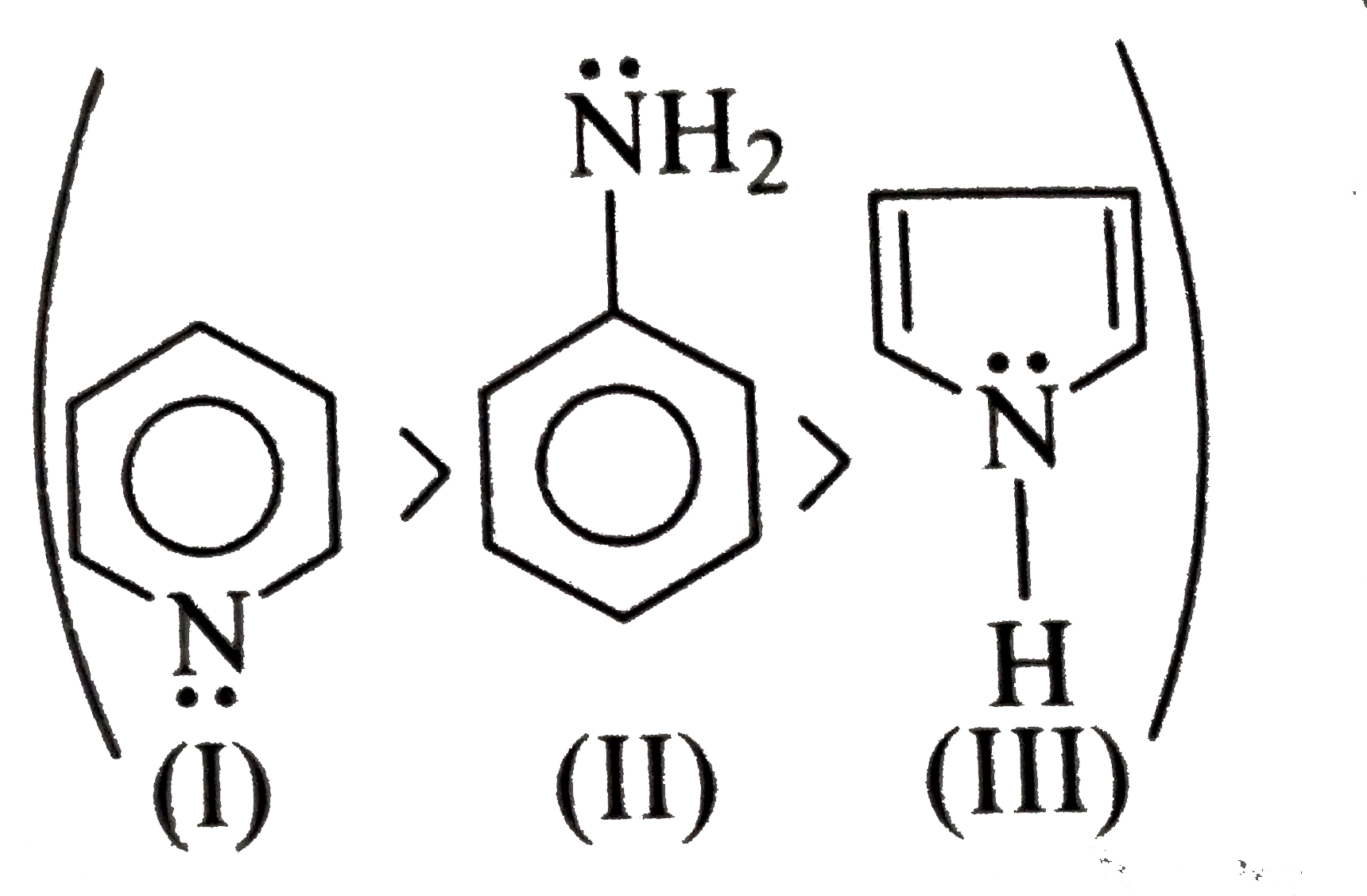 . . In (I) , lone PAIR of(N) is not in delocalisation of`BAR(e)`. In (II) and (III) lone pair of (N) is used in delocalisation of`pi bar(e)`. But in (III), ` LP bar(e)`s on (N) are INVOLVED in aromatiocity , so it is less basic tha (II) b. `(iii) gt (ii) (i)` c. `(iii) gt (ii) gt (i) ` |
|
| 11. |
Arrange in order of reactivity towards S_(N)2 reactions: (3) 1-bromobutane, 1-bromobutane,1-bromo-3-methylbutane,1-bromo-2,2-dimethly propane, 1-bromo-2-methylbutane, 1-bromo-3methylbutane. |
|
Answer» Solution :`underset(1-"bromobutane"(A)("UNBRANCHED"1^(@))"alkyl" "halide")(CH_(3)CH_(2)CH_(2)CH_(2)Br)` `underset(1-"bromo-2,2-dimethylpropane" (B)("two" CH_(3)"group at" beta-"carbon"))(CH_(3)-underset(CH_3)underset(|)overset(CH_(3))overset(|)(C^(beta))-overset(alpha)(C)H_(2)-Br)` `underset(1-"bromobutane"-2-"methylbutane"(C)("one" CH_(3)"group at" beta-"carbon"))(CH_(3)CH_(2)-overset(CH_3)overset(|)(.^(beta)C)-overset(alpha)(C)H_(2)-Br)` `underset(1-"bromobutane"-3-"methylbutane"(D)("one" CH_(3)"group at" gamma-"carbon"))(CH_(3)-overset(CH_3)overset(|)(.^(gamma)C)-overset(beta)(C)H_(2)-overset(alpha)(C)H_(2)-Br)` `S_(N)2` reactivity of `1^(@)` alkyl halides decreases as the alkyl substituents on the carbon chain get closer to the `alpha`-carbon. Thus `S_(N)2`reactitvity of unsubsituted `1^(@)` alkyl halide, A, is maximum. Reactivity of `gamma`-subsituted `1^(@)` alkyl halide, D, is somewhat lessthan that of A. The reactivity of `beta`-substituted alkyl halides B and C are less than that of D. Out of B and C, the former is less reactive beacuse its `alpha`-carbon becones more CROWDED by the presence of two methyl groups on the `beta`-carbon. Thus, `S_(N)2` reactivity decreases in the sequence: A > D > C > B. |
|
| 12. |
Arrange in the ascending order of first ionisation potential : Na , Mg , Al , Si |
| Answer» Solution :`NA LT Al lt MG lt SI` | |
| 13. |
Arrange in order of increasing acid strength |
|
Answer» `X GT Z gt Y` |
|
| 14. |
Arrange in order of decresing trend towards S_(E) reactions, {:("Chlorobenzen","Benzene","Anilinium chloride","Toluene"),(I,II,III,IV):} |
|
Answer» `IgtIgtIIIgtIV` |
|
| 15. |
Arrange in order of decreasing trend towards S_E(Substitution electrophilic) reactions:(I) Chlorobenzene(II) Benzene (III) Anilinium chloride (IV) Toluene |
|
Answer» II GT I gt III gt IV |
|
| 16. |
Arrange in order of boiling points : (i) C_(5) H_(5) - O - C_(2), H_(5), C_(4) H_(9) COOH, C_(4) H_(9) OH (ii) C_(3) H_(7) CHO, CH_(3) COC_(2), H_(5), C_(2)H_(5) COOCH_(3) (CH_(5)CO)_(2) O |
|
Answer» SOLUTION :(i) `C_(4)H_(9) COOH > C_(6) H_(9) OH > C_(2)H_(5) - O - C_(2)H_(5)` (ii) `(CH_(3)CO)_(2)O > C_(2)H_(5) COOCH_(3) > CH_(3) CO C_(2) H_(5) > C_(3) H_(7) CHO` |
|
| 17. |
Arrange in order of decreasing trend towards electrophilic substitution reactions: Chlorobenzene (I) , benzene(II), toluene(III), anilinium chloride (IV) |
|
Answer» `III GT II gt I gt IV` |
|
| 18. |
Arrange in increasing order of solubility of AgBr in the given solutions : (i) 0.1 M NH_(3)(iI) 0.1M AgNO_(3) (iii) 0.2M NaBr(iv) pure water |
|
Answer» `(III) LT (II) lt (IV) lt (i)` |
|
| 19. |
Arrange the following in the order of property indicated for set. HF, HCl, HBr, HI in the increasing acidic strength. |
| Answer» SOLUTION :HF`LT`HCl`lt`HBr`lt`HI | |
| 20. |
Arrange HClO_(4), HClO_(3), HClO_(2), HClO in order of (i) decreasing acidic strength (ii) increasing oxidizing power. Give reasons. |
|
Answer» Solution :(i) Acidic strength : `HClO_(4) gt HClO_(3) gt HClO_(2) gt HClO` Reason : All these acids on losing a proton give their corresponding conjugate bases, i.e., `ClO^(-), ClO_(2)^(-), ClO_(3)^(-) and ClO_(4)^(-)`. Their structures are :  Since oxygen is more electronegative than chlorine, therefore, the dispersal of the -ve CHARGE present on oxygen atom (singly BONDED to CI) INCREASES as the number of oxygen atoms attached by a double bond to chlorine increasess due to `d pi- p pi` back bonding. In other words, stability of the conjugate bases increases in the order : `CIO^(-) lt CIO_(2)^(-) lt CIO_(3)^(-) lt CIO_(4)^(-)`. Thus, due to increase in stability of the conjugate base, acidic strength increases in the same order : `HCIO lt HCIO_(2) lt HCIO_(3) lt HCIO_(4)`. (ii) Oxidizingpower : `HCIO_(4) lt HCIO_(3) lt HCIO_(2) lt HCIO` Reason : As the stability of the oxoanion increases, its tendency to decompose to give`O_(2)` decreases and hence its oxidising power decreases. Sincethe stability of the oxoanion decreases in the order : `ClO_(4)^(-)gt ClO_(3)^(-) gt ClO_(2)^(-) gt ClO^(-)`, therefore, the oxidising power of their oxacids increases in THEREVERSE order, i.e., `HClO_(4) lt HClO_(3) lt HClO_(2) lt HClO`. |
|
| 21. |
Arrange HCIO_4, HCIO_3, HCIO_2 and HCIO in the increasing order of acidic strength and explain on the basis of the structure of their anions. |
|
Answer» SOLUTION :The increasing order of acid STRENGTH is : `HCIO ltHCIO_2ltHCIO_3ltHCIO_4` Reason. This can be explained on the basis of Lowry Bronsted concept. According to this concept, a strong acid has a weak conjugate base and a weak acid has a strong conjugate base. Let us consider the stabilities of the conjugate bases, `ClO^(-), ClO_2^(-) , ClO_3^(-) ` and `ClO_4^(-)`formed from these acids, `HCIO, HCIO_2, HCO_3 ` and `HCIO_4`respectively. These anions are stabilized by the delocalisation of the CHARGE between oxy gen atoms. If the ion is stabilized to greater extent, it has lesser attraction for the proton and therefore, will behave as weaker base (lesser tendency for the reaction to go in backward direction). Consequently, the corresponding acid will be strong because weak conjugate base has strong acid and strong conjugate base has weak acid and vice VERSA. Now, the charge stabilization is minimum in `ClO^-`and maximum in `ClO_4^-`. The charge stabilization increases in the order: `HClO^(-) LT HClO_(2)^(-) lt HClO_(3)^(-) lt HClO_(4)^(-)` 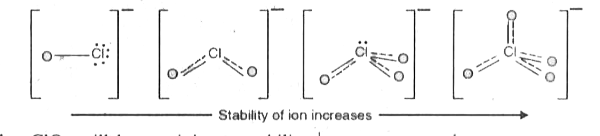 This means that `CIO^-`will have minimum stability and therefore, will have maximum attraction for the `H^+` . In other words, `ClO^-`will be strongest base and so its conjugate acid HCIO will be the weakest acid.Similarly, in this series, `ClO_(4)^(-)`is the weakest base (maximum stabilized) and its conjugate acid `HCIO_4`is the strongest acid. Thus, the acidic strength increases in the order. `HClO lt HClO_2 lt HClO_3 lt HClO_4` |
|
| 22. |
Arrange HClO, HBrO and HIO in order of decreasing acidic strength giving reason. |
| Answer» Solution :`H-O-Cl GT H-O-BR gt H-O-I`. This is because ELECTRONEGATIVITIES DECREASE in the order `Clgt Br gt I`. | |
| 23. |
Arrange HCHO, CH_3CHO and CH_3COCH_3 in order of increasing reactivity towards HCN. |
| Answer» SOLUTION :`HCHO>CH_3CHO>CH_3COCH_3` | |
| 24. |
Arrange H_2SO_4 (I) , H_3PO_4 (II) HClO_4 (III) in decreasing order of acidic nature: |
|
Answer» IgtIIIgtII |
|
| 25. |
Arrange group 15 hydrides in increasing order of their boiling points. |
|
Answer» Solution :Increasing ORDER of boiling POINTS : `{:(,PH_(3),lt,AsH_(3),lt,NH_(3),lt,SbH_(3),lt,BiH_(3)),("Boiling point",185.5,,210.6,,239.6,,256.0,,290.0):}` |
|
| 26. |
Arrange following compound in decreasing order order of reactivity for hydrolysis reaction: (I). C_(6)H_(5)COCl (II). |
|
Answer» IIgtIVgtIgtIII |
|
| 27. |
Arrange following complex ions in increasing order of crystal field splitting energy (Delta_(0)), Cr(Cl)_(6)]^(3-), [Cr(CN)_(3)]^(3-), [Cr(NH_(3))_(6)]^(3+) |
|
Answer» Solution :The order of increasing `Delta_(0)` VALUE for the complex ions is: `[CrCl_(6)]^(3-) lt [Cr(NH_(3))_(6)]^(3+) lt [Cr(CN)_(4)]^(3-)` This is because of increasing order of the `Delta_(0)` VALUESOF the ligands in the spectrochemical series. |
|
| 28. |
Arrange F_2, Cl_2, Br_2 and I_2in the order of increasing bond dissociation enthalpy. |
| Answer» SOLUTION :The ORDER is `F_2 LT Cl_2 GT Br_2 gt I_2`. | |
| 29. |
Arrange following complex ions in increasing order of crystal field splitting energy (Delta_(0)) : [Cr(Cl)_(6)]^(3-),[Cr(CN)_(6)]^(3-),[Cr(NH_(3))_(6)]^(3+) |
| Answer» SOLUTION :From spectrochemical SERIES, CFSE of LIGANDS is in the order : `CL^(-)ltNH_(3)ltCN^(-)` | |
| 30. |
Arrange each set of compounds in orderr of increasing boiling points. (i) Bromomethane, bromoform, chloromethane, dibromomethane. (ii) 1-Chloropropane, isopropyl chloride, 1-chlorobutane. |
|
Answer» Solution :(i) For the same ALKYL group, boiling point increases with the size of the halogen atom. Therefore, boiling point of BROMOMETHANE is HIGHER than that of chloromethane. Further, the boiling points increase as the number of halogen ATOMS increases. therefore, the boiling point of bromoform with three Br atoms is the highest, followed by dibromomethane with two Br atoms while bromomethane with oe Br atom is the lowest. combining al the arguments presented above, the boiling points of the four COMPOUNDS discussed above increase in the order: chloromethaneltbromomethaneltdibromomethaneltbromoform. (ii) For the same halogen, boiling point increases as the size of the alkyl group increases. therefore, the boiling point of 1-chlorobutane is higher than those of 1-chloropropane and isopropyl chloride. further, the boiling point decreases as the braching increases, therefore, the boiling point of 1-chloropropane is higher than that of isopropyl chloride. combining these two arguments, the boiling points of the three compounds discussed above increase in the order: Isopropyl chloridelt1-chloropropanelt1-chlorobutane. |
|
| 31. |
Arrange each set of compounds in order of increasing boiling points: (ii) 1-Chloropropane, isopropylchloride, 1-chlorobutane. |
|
Answer» SOLUTION :(i). The boiling points of organic compounds are linked with the van der Waal's forces of attraction which depend upoon the MOLECULAR size. In the present CASE, all the compounds contains oly one CARBON atom. The molecular size depends upon size of the halogen atom and also upon the number of halogen atoms present in different molecules. the increasing order of boiling points is: `CH_(3)Cl` (chloromethane) `ltCH_(3)Br` (bromomethane) `lt CH_(2)Br_(2)` (dibromomethane) `lt CHBr_(3)` (Bromoform) (ii). The sae criteria is followed in this case. We all know the the branching of the carbon atom chain decreases the size of the isomer and this decreases its boiling point as compared to straight chain isomer. the increasing order of boiling points is: `(CH_(3))_(2)CHCl` (isopropylchloride or 2-chloropropane) `lt ClCH_(2)CH_(2)CH_(3)` (1-chloropropane) `lt ClCH_(2)CH_(2)CH_(2)CH_(3)` (1-chlorobutane) |
|
| 32. |
Arrange each set of compounds in order of increasing boiling points. (i) Bromomethane, Bromoform, Chloromethane, Dibromomethane. (ii) 1-Chloropropane, Isopropyl chloride, 1-Chlorobutane. |
|
Answer» Solution :(i) For the same alkyl group, boiling point increases with the size of the halogen atom. THEREFORE, boiling point of bromomethane is HIGHER than that of CHLOROMETHANE. Further, the boiling points increase as the number of halogen atoms increases. Therefore, the boiling points of dibromomethane and bromoform are higher than that of bromomethane and the boiling point of bromoform is higher than that of dibromomethane. Thus, boiling points of the four COMPOUNDS increase in the order : Chloromethane`gt` bromomethane `gt` dibromomethane `gt` bromoform (ii)For the same halogen, boiling point increases as the size of the alkyl group increases. Therefore, the boiling point of 1-chlorobutane is higher than those of 1-chloropropane and isopropyl CHLORIDE. Further, the boiling point decreases as the branching increases, therefore, the boiling point of 1-chloropropane is higher than that of isopropyl chloride. Thus, the boiling points of the three compounds are in the order : Isopropyl chloride `gt`1-chloropropane `gt` 1-chlorobutane |
|
| 33. |
Arrange each set of compounds in order of increasing boiling points (I) (a) Bromomethane, (b) Bromoform, (c ) Chloromethane and (d) Dibromomethane (II) (p) 1-chloropropane , (q) Isopropyl chloride and (r ) 1-Chlorobutane |
| Answer» SOLUTION :The increasing order of boiling POINTS is (I) `b gt d gt a gt c`, (II) `r gt p gt Q` | |
| 34. |
Arrange each set compounds in order of increasing boiling points. Bromomethane, Bromoform , Chloromethane, Dibromomethane |
| Answer» SOLUTION :`CH_3Cl LT CH_3Br lt CH_2Br_2 lt CHBr_3` | |
| 35. |
Arrange each set compounds in order of increasing boiling points. 1-Chloropropane, Isopropyl chloride, 1-chlorobutane |
| Answer» SOLUTION :`CH_3-CHCl-CH_3 LT CH_3-CH_2-CH_2Cl lt CH_3-CH_2-CH_2-CH_2Cl` | |
| 36. |
Arrange dipole moments of these compounds in decreasing order |
|
Answer» 3,1,2 |
|
| 37. |
Arrange decreasing order of reactivity of these compounds for nucleophilic substitution reaction. (1) CH_3-CH_2-O-underset(O)underset(||)overset(O)overset(||)S-CF_3 (2) CH_3-CH_2-O -TsCl (3) CH_3-CH_2-Cl (4) CH_3-CH_2-Br Select the correct answer from the codes given below |
|
Answer» 3,4,1,2 |
|
| 38. |
Arrange colloidal solutio, true solution and supernsion in decreasing order of particle size. |
| Answer» | |
| 39. |
Arrange Ce^(3+),La^(3+),Pm^(3+), and Yb^(3+) in increasing order of their ionic radii |
|
Answer» `YB^(3+) LT PM^(3+) lt CE^(3+) lt La^(3+)` |
|
| 40. |
Arrange Ce^(3+),La^(3+),P m^(3+) and Yb^(3+) in increasing order of their ionic radii, |
|
Answer» `Yb^(3+) lt P m^(3+) lt CE^(3+) ltLa^(3+)` |
|
| 41. |
Arrange Ce^(3+), La^(3+), Pm^(3+) and Yb^(3+) in increasing order of their ionic radii |
|
Answer» `Yb^(3+) lt PM^(3+) lt Ce^(3+) lt La^(3+)` |
|
| 42. |
Arrange basicity of given compounds in decreasing order. a) CH_3 - CH_2 - NH_2b) CH_2 = CH - NH_2c) CH -= C - NH_2d) C_6 H_5 -NH_2 |
| Answer» SOLUTION :1 | |
| 43. |
Arrange A,B, C in increasing potential energy: |
|
Answer» |
|
| 44. |
Arrange : |
|
Answer» I-A,II-D,III-G,iv-B |
|
| 45. |
Arragne the following in decreasingorder of bond angle |
|
Answer» `NH_3 gt NF_3 gt PF_3 gt PH_3` alpha`{:(""1),(BAR"Electronegativity of"),("Halogen (or) Hydrogen"):}` `{:(NF_3gtPF_3),(NH_3gtPH_3):}impliesNH_3gtPF_3 " "PF_3gtPH_3:.{:(NH_3,gtNF_3,gtPF_3,gtPH_3),(107^(0)28.,102^(0)2.,96.3^(0),93^(0)36.):}` |
|
| 46. |
Aromatic amines are important synthetic intermediates. What are the products obtained when aniline is treated with bromine water? |
Answer» SOLUTION :
|
|
| 47. |
Aromatisation of n-heptane by passing over (Al_2O_3 + Cr_2O_3) catalyst at 773 K gives |
|
Answer» Benzene 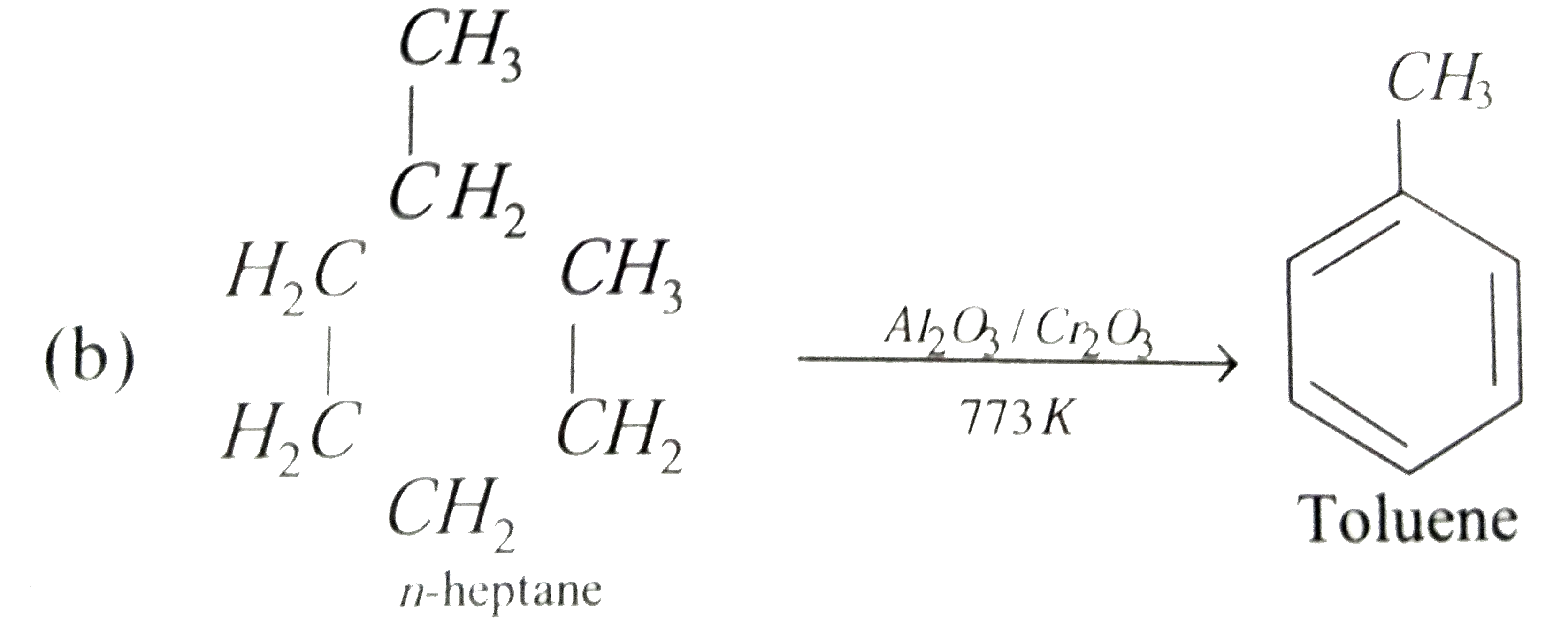
|
|
| 48. |
Aromaticity order for the following aromatic compound will be |
|
Answer» `AGTBGTC` |
|
| 49. |
Aromaticity in benzene is due to: |
|
Answer» Three DOUBLE bonds |
|
| 50. |
Aromatic rings containing -NH_(2)-NHR or -NR_(2) groups do not undergo Friedel-Crafts reaction. Why? |
Answer» Solution :`-NH_(2), -NHR and -NR_(2)` groups are ELECTRON RELEASING groups, but these are CONVERTED into powerful electron-attracting groups as a result of Lewis ACID -Lewis base reaction with `AlCl_(3)`. 
|
|