

Saved Bookmarks
This section includes 7 InterviewSolutions, each offering curated multiple-choice questions to sharpen your Current Affairs knowledge and support exam preparation. Choose a topic below to get started.
| 1. |
Arrange the following complexes in order of increasing electrical conductivity:[CO(NH_(3))_(3)Cl_(3)], [Co(NH_(3))_(5)Cl]Cl_(2),[Co(NH_(3))_(6)]Cl_(3) |
| Answer» Solution :`[Co(NH_(3))_(3)]Cl_(3)]` lt `[Co(NH_(3))_(5)Cl]Cl_(2)`lt `[CO(NH_(3))_(4)Cl_(3)]` More NUMBER of ions `lt`more ELECTRICAL conductivity | |
| 2. |
Arrange the following complexes in order of increasing electrical conductivity : [Co(NH_(3))_(3)Cl_(3)],[Co(NH_(3))_(5)Cl]Cl_(2),[Co(NH_(3))_(6)]Cl_(3),[Co(NH_(3))_(4)Cl_(2)]Cl |
| Answer» Solution :`[CO(NH_(3))_(3)Cl_(3)]lt[Co(NH_(3))_(4)Cl_(2)]Cllt[Co(NH_(3))_(5)Cl]Cl_(2)lt[Co(NH_(3))_(6)]Cl_(3)`. This is because number of ions produced from these complexes are 0, 2, 3 and 4 RESPECTIVELY. | |
| 3. |
Arrange the following complex ions in increasing order of crystal field splitting energy (Delta_(0)) : [Cr(Cl)_(6)]^(3-),[Cr(CN)_(6)]^(3-),[Cr(NH_(3))_(6)]^(3+) |
|
Answer» Solution :CRYSTAL FIELD splitting energy INCREASES in the ORDER : `[Cr(Cl)_(6)]^(3-)lt[Cr(Cl)_(6)]^(3-)lt[Cr(CN)_(6)]^(3-)` |
|
| 4. |
Arrange the following complex in increadsing order of stretching vibrational frequency of C-O bond : (P) [(PPh_(3))_(3)Mo(CO)_(3)]""(Q) [(Ph_(2)PCl)_(3)Mo(CO)_(3)] (R )[(PhPCl_(2))_(3)Mo(CO)_(3)]""(S) [(PCl_(3))_(3)Mo(CO)_(3)] |
|
Answer» `PgtQgtRgtS` 
|
|
| 5. |
Arrange the following : CH_(3)NH_(2)(I), (CH_(3))_(2)NH (II), C_(6)H_(5)NH_(2)(III) " and " (CH_(3))_(3)N (IV) in increasing order of basicity in aqueous medium |
|
Answer» `II LT I lt IV lt III` |
|
| 6. |
Arrange the following: CH_(3)CH_(2)CH_(2)Cl (I),CH_(3)CH_(2)CHClCH_(3)(II),(CH_(3))_(2)CHCH_(2)Cl(III) and (CH_(3))_(3)C-Cl(IV) in order of decreasing tendency towards S_(N)2 reaction |
|
Answer» IgtIIIgtIIgtIV `1^(@) gt 2^(@) gt 3^(@)`, further, amongst `1^(@)` ALKYL halides, unsubstituted alkyl halides are more reactive than SUBSTITUTED alkyl hlaides. Thus, the overall decreasing reactivity in `S_(N)2` reaction is: i.e., `underset(I)(CH_(3)CH_(2)CH_(2)CL(1^(@))) gt underset(III)((CH_(3))_(2)CHCH_(2)Cl(1^(@))) gt underset(II)(CH_(3)CH_(2)CHClCH_(3)(2^(@))) gt underset(IV)((CH_(3))_(3)C-Cl(3^(@)))` |
|
| 7. |
Arrange the following CH_3NH_2(I), (CH_3)_2NH(II), C_6H_5NH_2(III) and (CH_3)_3N (IV) in increasing order of basicity in aqueous madium : |
|
Answer» II `LT` I `lt`IV `lt` III |
|
| 8. |
Arrange the following carboxylic acid in their decreasing acidity (1) {:(COOH),("|"),(COOH):}""Oxalic acid(2) HOOC- CH_(2) - COOHMolonic acid (3) {:(CH_(2) - COOH),("|"),(CH_(2) - COOH):}""Succinic acid |
|
Answer» `3 gt 2 gt 1` |
|
| 9. |
Arrange the following CH_3CH_2CH_2Cl(I), CH_3CH_2-CHCl - CH_3 (II), (CH_3)_2CHCH_2Cl (III) and (CH_3)_3C - Cl(IV) in order of decreasing tendency towards S_N^2 reaction |
|
Answer» `I GT III gt II gt IV ` |
|
| 10. |
Arrange the following carbonyl compounds in increasing order of their reactivity in nucleophilic addition reactions. (i) Ethanal, Propanal, Propanone, Butanone. (ii) Benzaldehyde, p-Tolualdehyde, p-Nitrobenzaldehyde, Acetophenone. |
Answer» Solution : As we move from `"ethanal"to"Propanal"to"propanal"to"butanone"`, the +I-effect of the alkyl group INCREASE. As a result, electron density on the carbon atom of the carbonyl group grogressively increases and hence attack by the nucleophili become slower and slower. thus, the REACTIVITY increases in the reverse order, i.e., butanoneltpropanoneltpropanallt ethanal. (ii) Acetophenone is a KETONE, while all others are aldehydes, therefore, it is the least REACTIVE. in p-tolualdehyde, there is a `CH_(3)` group at the p-position w.r.t. to the carbonyl group, which increases the electron density on the carbon of the carbonyl group by hyperconjugation effect thereby making it less reactive than BENZALDEHYDE.  . . On the other hand, in p-nitrobenzaldehyde, the `NO_(2)` group is a powerful electron-withdrawing group. It withdraws electrons, both by inductive and resonance effect thereby decreasing the electron-density on the carbon atom of the carbonyl group. this facilitates the attack of the nucleophile and hence makes it more reactive than benzaldehyde.  . . Therefore, the overall ractivity increases in the order: acetophenoneltp-tolualdehydeltbanzaldehydeltp-nitrobenzaldehyde. |
|
| 11. |
Arrange the following carbanions in decreasing order of stability : (i) CH-=C^ϴ (ii) CH_3-C=C^ϴ (iii) CH_2=overset(ϴ)(C )H CH_3-overset(ϴ)(C )H_2 |
|
Answer» IV gt III gt I gt II |
|
| 12. |
Arrange the following c ompounds in order of decreasing acidity: |
|
Answer» IIgtIVgtIgtIII |
|
| 13. |
Arrange the following : C_2 H_5 NH_2, C_6 H_5 NHCH_3 , (C_2 H_5)_2 NH and C_6 H_5 NH_2 (ii) In decreasing order of basic strength : C_6 H_5 NH_2 , C_6 H_5N (CH_3)_2 , (C_2 H_5)_2 NH and CH_3 NH_2 (iii) Increasing order of basic strength : (a) Aniline, p-nitroanilineand p-toluidine (b) C_6 H_5 NH_2, C_6 H_5 NHCH_3 , C_6 H_5 CH_2 NH_2(iv) Decreasing order of basic strength in gas phase : C_2 H_5 NH_2 , (C_2 H_5) NH, (C_2 H_5)_3 N and NH_3 (v) Increasing order of boiling point : C_2 H_5 OH , (CH_3)_2 NH, C_2 H_5 NH_2 (vi) Increasing order of solubility in water : C_6 H_5 NH_2 , (C_2 H_5)_2 NH, C_2 H_5 NH_2 |
|
Answer» Solution :(i) `C_6 H_5 NH_2 gt C_6H_5 NHCH_3 gt C_2 H_5 NH_2 gt (C_2H_5)_2 NH` (ii) `(C_2 H_5)_2 NH gt CH_3 NH_2 gt C_6 H_5 N (CH_3)_2 gt C_6 H_5 NH_2` (III) (a) p-nitroaniline `lt ` ANILINE `lt ` p-toluidine (b) `C_6 H_5 NHCH_3 lt C_6 H_5 CH_2 NH_2` (IV) `(C_2 H_5)_2 N gt (C_2 H_5)_2 NH gt C_2 H_5 NH_2 gt NH_3` (V) `(CH_3)_2 NH lt C_2 H_5 NH_2 lt C_2 H_5 OH` (vi) `C_6 H_5 NH_2 lt (C_2 H_5)_2 NH lt C_2 H_5 NH_2` |
|
| 14. |
Arrange the following carbanions in decreasing orde of stability: HC-=bar(C)(I),""H_(3)C-C-=bar(C)(II), H_(2)C=bar(C)H(III),""H_(3)C-bar(C)H_(2)(IV) |
|
Answer» `IVgtIIIgtIgtII` |
|
| 15. |
Arrange the following bases in increasing order of their basic strength |
|
Answer» 7 `P^(4)` SHULD be 8 but the `p^(45)` an acid cannot be greater than 7 hence the CORRECT answer will be `lt` 7 |
|
| 16. |
Arrange the following as indicated:(i) BeSO_(4), MgSO_(4).. CaSO_(4). SrSO_(4), BaSO_(4)(increasing order of solubility) (ii) Be(OH)_(2), Mg(OH)_(2) Ca(OH)_(2)(increasing of solubility) (III) BeCO_(3). MgCO_(3) CaCO_(3), (increasing stability) (iv) BeCl_(2), MgCl_(2), CaCl_(2), SrCl_(2) (increasing lattice energy) (v) BeCl_(2), MgCl_(2), CaCl_(2), SrCI_(2) (increasing order of hydrolysis) |
|
Answer» Solution :(1) `BeSO_(4) < MgSO_(4) < CaSO_(4)< SrSO_(4)< BaSO_(4)` (II) `Be(OH)_(2) |
|
| 17. |
Arrange the following as indicated below : HF, HCl , HBr, HI - increasing acidic strength . |
|
Answer» |
|
| 18. |
Arrange the following as indicated below : F_(2), Cl_(2), Br_(2), I_(2) - increasingbond dissociation enthalpy. |
|
Answer» <BR> Solution :`I_(2) lt F_(2) lt Br_(2) lt Cl_(2)`. |
|
| 19. |
Arrange the following as directed: (i) In an increasing order of basic strength: C_(6)H_(5)NH_(2),C_(6)H_(5)N(CH_(3))_(2),(C_(2)H_(5))_(2)NH and NH_(3)NH_(2) (ii) In decreasing order of basic strength: aniline, p-nitroaniline and p-toluidine. (iii) In increasing order of pK_(a) values: C_(2)H_(5)NH_(2),C_(6)H_(5)NHCH_(3),(C_(2)H_(5))_(2)NH and C_(6)H_(5)NH_(2) |
| Answer» Solution :Hint : (i) `C_(6)H_(5)NH_(2) lt C_(6)H_(5)N(CH_(3))_(2) lt CH_(3)NH_(2) lt (C_(2)H_(5))_(2)` (II) p-toluidine `lt` toluidine `lt` aniline `lt` p-nitroaniline (iii) `(C_(2)H_(5))_(2)NH lt C_(2)H_(5)NH_(2) lt C_(2)H_(5)NH_(2) lt C_(6)H_(5)NHCH_(3) lt C_(6)H_(5)NH_(2)`. | |
| 20. |
Arrange the following as indicated. (a) As_(2)O_(3), P_(2)O_(3), N_(2)O_(3).(Decreasing acid strength)(b) PF_(3). PCI_(3), PBr_(3). Pl_(3)(Decreasing Lewis acid strength) |
| Answer» SOLUTION :(a)`N_(2)O_(3)>P_(2)O_(3)>AS_(2)o_(3)`<(b)`PF_(3)>PCI_(3)>PBr_(3)>PI_(3)` | |
| 21. |
Arrange the following amines in the order of increasing basicity. |
|
Answer»

|
|
| 22. |
Arrange the following amines in the decreasing order of their basic strength Aniline (I), Benzylamine (II), p-toluidine (III) |
|
Answer» <P>I gt II gt III  p - toluidine is most basic because of `+I` effect of `CH_(3)` group. Aniline is least basic because LONE pair of `-NH_(2)` groups is in CONJUGATION with BENZENE ring. |
|
| 23. |
Arrange the following amines in the increasing order of basicity : n-Butylamine (I), sec-Butylamine (II), Isobutylamine (III), tert-Butylamine IV. |
|
Answer» `I lt II lt III lt IV` Steric hindrance decrease the AVAILABLITY of lone pair no nitrogen ATOM which in TURN decreases the basic character. Thus, increasing order of basic character is : `IV lt III lt II lt I`. Here the `+I` effect of the ALKYL group operates in a direction opposite to that due to steric hindrance i.e., `+I` effect of tert-butyl group is maximum thus (IV) has to be most basic while it is least for (I) which has to be least basic. However, in this case steric factors far out weights the `+I` effect of the R-group. As such the net effect is that due to steric factors |
|
| 24. |
Arrange the following alkyl halides in order of dehydrohalogenation, C_2H_5I,C_2H_5Cl,C_2H_5Br,C_2H_5F |
|
Answer» `C_2H_5F GT C_2H_5Cl gt C_2H_5Br gt C_2H_5I` |
|
| 25. |
Arrange the following amides according to their relative reactivity when treated with Br_(2) in excees of strong base. |
|
Answer» `P gt Q gt R gt S` |
|
| 26. |
Arrange the following alkyl halides in order of dehydrohalgenation, C_2H_5I , C_2H_5Cl , C_2H_5Br , C_2H_5F |
|
Answer» `C_2H_5FgtC_2H_5ClgtC_2H_5BrgtC_2H_5I` |
|
| 27. |
Arrange the following alkyl halides in decreasing order of the rate of beta-elimination reaction with alcohlic KOH. (i) CH_(3) - underset(CH_(3))underset(|)overset(H)overset(|)(C) - CH_(2)Br (ii) CH_(3)-CH_(2)-Br (iii) CH_(3)-CH_(2)-CH_(2)-Br |
|
Answer» `i gt II gt iii` `i gt ii gt iii`. |
|
| 28. |
Arrange the following alkenes towards order of increasing reactivity in cationic polymerization. H_(2)C=CHCH_(3),H_(2)C=CHCI,H_(2)C=CHC_(6)H_(5),H_(2)C=CHCO_(2)CH_(3). |
|
Answer» Solution :Reactivity TOWARDS cationic polymerization increases as the stability of the inmtermediate carbocation increases. Since the stability of the intermediate carbocations increases in the order : `H_(3)C-overset(+)(CH)-CO_(2)CH_(3)ltH_(3)C-overset(+)(CH)-CILT CH_(3)-overset(+)(CH)-CH_(3)lt H_(3)C-overset(+)(CH)-C_(6)H_(5)` therefore, reactivity of the corresponding alkenes towards cationic polymerization increases in the same order : `H_(2)C=CHCO_(2)CH_(3)lt H_(2)C=CHCI lt H_(2)C=CHCH_(3)lt CH_(2)=CHC_(6)H_(5)` . |
|
| 29. |
Arrange the following alkenes in order of increasing reactivity towards anionic polymerization. H_2C=CHCH_(3), H_(2)C=CF_(2), H_(2)C=CHCN,H_(2)C=CHCH_(6)H_(5) |
|
Answer» Solution :REACTIVITY towards anionic polymerization increases as the stability of the stability of the intermediate carbonion increases. Since the stability of the intermediate carbanion increases in the order : `BCH_(2)-overset(-)(CH)-CH_(3)lt BCH_(2)-overset(-)(CH)-C_(6)H_(5)lt BCH_(2)-overset(-)(CF)_(2)lt BCH_(2)-overset(-)(CH)-CN` (where B is any nucleophile or the base) , therefore , reactivity of the CORRESPONDING ALKENES towards anionic polymerization increasesin the same order : `CH_(2)=CHCH_(3)ltCH_(2)=CHC_(6)H_(5)ltCH_(2)=CF_(2)ltCH_(2)=CHCN`. |
|
| 30. |
Arrange the following alkenes in order of increasing reactivity towards anionic polymerization. H_(2)C=CF_(2), H_(2)C=CHCN, H_(2)C=CHCH_(3), H_(2)C=CHC_(6)H_(5) |
|
Answer» Solution :Reactivity of alkene towards anoinic POLYMERIZATION increases as the stability of the INTERMEDIATE carbanion increases. The stability of the carbanion increases as : `BH_(2)C-CH^(-)-CH_(3) lt BCH_(2)-CH^(-)-C_(6)H_(5) lt BCH_(2) -""^(-)CF_(2) lt BCH_(2)-CH^(-)-CN` (where B is any base or a a necleophile) Therefore, the reactivity of the corresponding alkene towards anionic polymerization increases in the same order : `CH_(2)=CHCH_(2) lt CH_(2)=CH-C_(6)H_(5)ltCH_(2)=CF_(2)ltCH_(2)=CHCN` |
|
| 31. |
Arrange thefollowingalcohols in the increasing orderof esterification : (a) sec -Butyl alcohol (b) tert-Butyl alcohol (c) n-Butyl alcohol |
|
Answer» `C GT B gt a ` |
|
| 32. |
Arrange the following alcohols in order of increasing reactivity towards sodium metal. (i) CH_(3)OH (ii) (CH_(3))_(2)CH-OH (iii) CH_(3)CH_(2)OH (iv) (CH_(3))_(3)C-OH |
|
Answer» `(III) LT (II) lt (i)` |
|
| 33. |
Arrange the following acids : 1. H_(2)SO_(3), 2. H_(3)PO_(3). 3. HClO_(3) In the increasing order of acid strength |
|
Answer» `1 gt 2 gt 3` |
|
| 34. |
Arrange the following alcohols in order of increasing reactivity towards Lucas reagent: 2-butanol, 1-butanol, 2-methyl-2-propanol. |
| Answer» SOLUTION :The order of REACTIVITY of ALCOHOLS towards Lucas REAGENT FOLLOWS the sequence: `3^(@) gt 2^(@) gt 1^(@)`. Thus, the correct sequence of reactivity is : 2-methyl-2-propanol `(3^(@))gt`2-butanol `(2^(@))`gt1-butanol `(1^(@))`. | |
| 35. |
Arrange the following according to liquification pressure (n-pentane, iso-pentane, neo-pentane) |
|
Answer» SOLUTION : `a_(N-pentane) gt a_(iso-pentane) gt a_(neo-pentane)` liquification pressure `=LP` `LP_(n-pentane) lt LP_(iso-pentane) lt LP_(neo-pentane)` `b` is roughly related with size of the molecule. (Thumb RULE) `b = N_(A)4 {(4)/(3)PIR^(3)}` |
|
| 36. |
Arrange the following : (a) C_(6)H_(5)OH,m-ClC_(6)H_(4)OH and p-ClC_(6)H_(4)OHin decreasing order of their acidity. (b) m-NO_(2)C_(6)H_(4)OH,C_(6)H_(5)OH and p-NO_(2)C_(6)H_(4)OH in decreasing order of their acidity. (c ) o^(-),m- and p- bromophenol in order of increasingbasicity. (d) o^(-),m- and p-nitrophenol in order of increasing basicity. (e ) Carbonic acid , phenol , p-nitrophenol and benzoic acid in order of increasing acidity. (f) m-Cresol,phenol,m-chlorophenol and m-nitrophenol in order of increasing acidity. |
Answer» SOLUTION :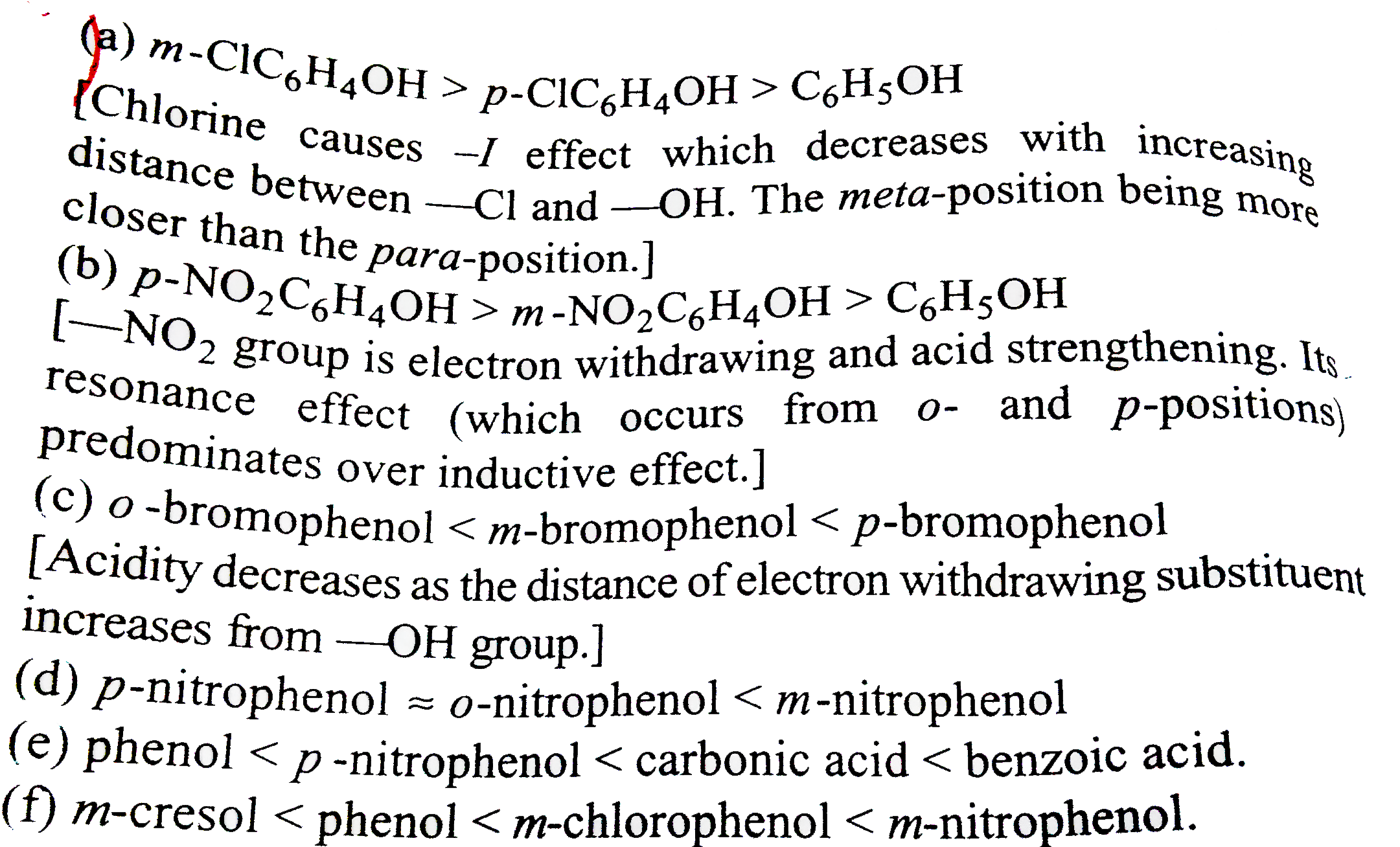
|
|
| 37. |
Arrange the followign in the increasing order of basicity . Aniline, p-Nitroanilene, p-toluidine |
|
Answer» SOLUTION :The increasing ORDER of basicity is : p-Nitroaniline `LT` ANILINE `lt ` p-toluidine. |
|
| 38. |
Arrange the followig compounds in increasing order of boiling points: (a) pentan-1-ol, butan-1-ol, butan-2-ol, ethanol, propan-1-ol, methanol. (b) pentan-1-ol, n-butane, pentanal, ethoxyethane. |
|
Answer» Solution :(a) Boiling points increase REGULARLY as the molecular mass increases due to the corresponding increase in their van der waals forces of ATTRACTION. Thus, boiling points increase in the order: METHANOL, ethanol, propan-1-ol, butan-1-ol and pentan-1-ol. Among ISOMERIC alcohols, `2^(@)` alcohols have lower boiling points than `1^(@)` alcohols due to a corresponding decrease in the extent of H-bonding because of steric hindrance. thus, the b.p. of butan-2-ol is lower methanolltethanolltpropan-1-olltbutan-2-olltbutan-1-olltpentan-1-ol (b) Boiling points of ethers having molecular mass equal to or less than n-butane (i.e., 58 g `mol^(-1)`) are higher than those of the corresponding n-alkanes. however, the boiling points of ethers having molecular mass equal to or higher than n-pentane (i.e., 72 g `mol^(-1)`) are lower than the corresponding n-alkanes . thus, b.p. of n-butane is lower than that of ethoxyethane. further, the b.ps of alcohols are much higher than those of alkanes, and ethers of comparable molecular masses due to intermoleclar H-bonding. however, b.ps of aldehydes are lower than those of corresponding alcohols due to absence of H-bonding but are still higher than those of alkanes and ethers of comparable molecular mass. thus, the overall INCREASING order of b.ps is n-butanltethoxyethaneltpentanalltpentan-1-ol. |
|
| 39. |
Arrange the compounds of each set in order of reactivity towards S_(N)2 displacement :(i) 2- Bromo-2-methylbutane, 1-Bromopentane, 2-Bromopentane(ii) 1-Bromo-3-methylbutane, 2-Bromo-2-methylbutane, 2-Bromo-3-methylbutane(iii) 1-Bromobutane, 1-Bromo-2,2-dimethylpropane,1-Bromo-2-methylbutane, 1-Bromo-3-methylbutane. |
|
Answer» Solution :The reaction follows `S_(N)2` path if the substrate offers minimum steric hinderance to the nucleophile. Thus order of reactivity of alkyl halides by `S_(N)2` path is : Methyl halide `gt 1^(@)` halide `gt 2^(@)` halide `gt gt gt 3^(@)` halide. (i) `underset((1^(@)))("1-Bromopentane")gt underset((2^(@)))("2-Bromopentane")gt underset((3^(@)))("2-Bromo-2-methylbutane")` (ii)`underset((1^(@)))("1-Bromo-3-methylbutane")gt underset((2^(@)))("2-Bromo-3-methylutane")gt underset((3^(@)))("2-bromo-2-methylbutane")` (iii) 1-bromobutane `gt` 1-Bromo-3-methylbutane `gt` 1-Bromo-2-methylbutane `gt` 1-Bromo-2, 2 - dimethyl propane In (iii), all the halides are primary `(1^(@))`. However, the presence of bulky GROUP such as `-CH_(3)` (methyl) on `BETA` - CARBON decreases the reactivity towards `S_(N)2` due to steric hindrance. Thus, 1-Bromo-2, 2-dimethyl propane is least reactive. |
|
| 40. |
Arrange the compounds of each set in order of reactivity towards S_(N)2 displacement : (i) 2- Bromo-2-methylbutane , 1- Bromopentane, 2- Bromopentane (ii) 1-Bromo -3- methylbutane, 2- Bromo -2- methylbutane, 3- Bromo -2- methylbutane. (iii) 1-Bromobutane, 1- Bromo -2, 2- dimethylpropane, 1- Bromo -2- methylbutane, 1- Bromo -3- methylbutane. |
|
Answer» Solution :The reactivity `S_(N)2` reactions is affected by STERIC hindrance , greaterthe steric hindrance smaller the reactivity (i) `underset("2-Bromo-2-METHYLBUTANE "(3^(@))) (CH_(3) - underset(Br) underset(|) overset(CH_(3)) overset(|) C - CH_(2) CH_(3) ) "" underset("1 - Bromopentane "(1^(@) )) (CH_(3)CH_(2)CH_(2)CH_(2)CH_(2) - Br) ""underset("2 - Bromopentane "(2^(@)))(CH_(3) - underset(Br) underset(|)CH - CH_(2)CH_(2)CH_(3))` On steric grounds, the order of reactivityin `S_(N)2`reactions follows the order : `1^(@) gt 2^(@) gt3^(@) ` . Therefore , order of reactivity of the given alkyl bromides is: 1 - Bromopentane ` gt ` 2 - Bromopentane ` gt ` 2 - Bromo -2- methylbutane . (ii) `underset("1 - Bromo -3- methylbutane "(1^(@))) (CH_(3) - overset(CH_(3))overset(3|) (CH) - overset(2)CH_(2)overset(1)CH_(2)Br ) "" underset("2 -Bromo -2- methylbutane "(3^(@))) (overset(1)CH_(3) - underset(Br) underset(|) overset(CH_(3))overset(2|) C - overset(3)CH_(2) overset(4)CH_(3)) "" underset("3-Bromo -2- methylbutane "(2^(@))) (overset(4)CH_(3) - underset(Br) underset(|) overset(3) (CH) - overset(CH_(3))overset(2|) CH - overset(1)CH_(3))` On steric grounds, the order of reactivity of alkyl halides in `S_(N)2` reactions of the given alkyl bromides is : 1 -Bromo -3- methylbutane ` gt` 2 - Bromo -3- methylbutane ` gt` 2 - Bromo -2- methylbutane . (iii)  Steric hindrance is MAXIMUM in II with three methyl group on `beta` - carbon , followed by III , with two alkyl groups on `beta` - carbon atom , followed by IV , with ONE alkyl group on `beta` - carbon atom . Thus , the reactivity of the given alkylbromides decreases in the order : 1 - Bromobutane ` gt` 1-Bromo -3- methylbutane ` gt` 1 - Bromo -2- methylbutane ` gt` 1 - Bromo -2- , 2 dimethylpropane |
|
| 41. |
Arrange the compounds of each set in order of reactivity towards S_(N)2 desplacement: (i) 2-Bromo-2-methylbutane, 1-Bromopentane, 2-Bromopentane. (ii) 1-Bromo-3-methylbutane, 2-Bromo-2-methylbutane, 2-Bromo-3-methylbutane. (iii) 1-Bromobutane, 1-Bromo-2,2-dimethylpropane, 1-Bromo-2-methylbutane, 1-Bromo-3-methylbutane. |
|
Answer» Solution :The reactivity in `S_(N)2` reactions depends upon steric hindrance , more the steric hindrance slower the reaction. (i) `underset("2-Bromo-2-methylbutane "(3^(@)))(CH_(3)-underset(Br)underset(|)OVERSET(CH_(3))overset(|)(C)-CH_(2)CH_(3))""underset("1-Bromopentane "(1^(@)))(CH_(3)CH_(2)CH_(2)CH_(2)CH_(2)-Br)""underset("2-Bromopentane "(2^(@)))(CH_(3)-underset(Br)underset(|)(C)H-CH_(2)CH_(2)CH_(3))` Since due to steric reasons, the order of reactivity in `S_(N)2` reactions follows the order: `1^(@) gt 2^(@) gt 3^(@)`, therefore, order of reactivity of the given alkyl bromides is: 1-Bromopentanegt2-Bromopentanegt2-Bromo-2-methylbutane. (ii) `underset("1-Bromo-3-methylbutane "(1^(@)))(CH_(3)-overset(CH_(3))overset(|)(.^(3)C)H-overset(2)(C)H_(2)overset(1)(C)H_(2)Br)""underset("2-Bromo-2-methylbutane "(3^(@)))(overset(1)(C)H_(3)-underset(Br)underset(|)overset(CH_(3))overset(|)(.^(2)C)-overset(3)(C)H_(2)overset(4)(C)H_(3))""underset("2-Bromo-3-methylbutane "(2^(@)))(overset(1)(C)H_(3)-underset(Br)underset(|)overset(2)(C)H-overset(CH_(3))overset(|)(.^(3)C)H-overset(4)(C)H_(3))` Since due to steric reasons, the order of reactvity of alkyl halides in `S_(N)2` reactions follows the order: `1^(@)gt2^(@)gt3^(@)`, therefore, the order of reactivity of the given alkyl bromides is: 1-Bromo-3-methylbutane `(1^(@))gt2-`Bromo-3-methylbutane `(2^(@))gt`2-Bromo-2-methylbutane `(3^(@))` (iii) `underset("1-Bromobutane "(1^(@)" with no branching"))(CH_(3)CH_(2)CH_(2)CH_(2)Br)""underset("1-Bromo-2,2-dimethylpropane "(1^(@)" with two "beta-"METHYL groups"))(CH_(3)-underset(CH_(3))underset(|)overset(CH_(3))overset(|)(.^(beta)C)-overset(alpha)(C)H_(2)Br)""underset("1-Bromo-2-methylbutane "(1^(@)" with one "beta-"ethyl GROUP"))(CH_(3)CH_(2)-overset(CH_(3))overset(|)(.^(beta)C)H-overset(alpha)(C)H_(2)Br)""underset("1-Bromo-3-methylbutane "(1^(@)" with one methyl group "gamma-"position"))(CH_(3)-overset(CH_(3))overset(|)(.^(gamma)C)H-overset(beta)(C)H_(2)-overset(alpha)(C)H_(2)-Br)` Since in case of `1^(@)` alkyl halides, steric hindrance increases in the order: n-alyl halides, alkyl halide with a substituent at any position other than the `beta`-position, one substituent at the `beta`-position, two SUBSTITUENTS at the `beta`-position, therefore, the reactivity decreases in the same order. THUS, the reactivity of the given akyl bromides decreases in the order: 1_bromobutanegt1-Bromo-3-methylbutanegt1-Bromo-2-methylbutanegt1-Bromo-2,2-dimethylpropane. |
|
| 42. |
Arrange the compounds of each set in increasing order of reactivity towards S_(N^(2)) displacement : (i) 2-Bromo-2-methylbutane, 1-Bromopentane, 2- Bromopentane. (ii) 1-Bromo-3-methylbutane, 2-Bromo-2- methylbutane, 2-Bromo-3-methylbutane. |
|
Answer» SOLUTION :(i) `"2-Bromo-2-METHYLBUTANE" LT "2-Bromopentane" lt "1-Bromopentane"`. (II) `"2-Bromo-2-methyl BUTANE" lt "2-Bromo-3- methylbutane" lt "1-Bromo-3-methylbutane"`. |
|
| 43. |
Arrange the compound of each set in order of decreasing reactivity towards (S_(N^(2))) displacement. (a). 2-bromo-2-methylbutane,1-Bromopentane,2-Bromopentane (b). 1-Bromo-3-methylbutane,2-Bromo-2-methylbutane, 2-Bromo-3-methylbutane (c). 1-Bromobutane, 1-Bromo-2,2-dimethylpropane, 1-Bromo-2-methylbutane, 1-Bromo-3-methylbutane. |
Answer» Solution :The REACTIVITY of a particular haloalkane towards `S_(N^(2))` reaction is inversely proportional to the steric HINDRANCE around the carbon atom involved in C-X BOND. More the steric hindrance, lesser will be the reactivity. In the light of this the DECREASING ORDER of reactivity in all the three cases is as follows: 
|
|
| 44. |
Arrange the complexes CoCl_3. 6NH_3,CoCl_3. 5NH_3, CoCl_3. 4NH_3 and CoCl_2 . 3NH_3 in the descending order of conductivity of their aqueous solutions. |
| Answer» Solution :Aquesous solution containing one mole of `CoCl_3. 6HNH_3 , CoCl_3 . 5NH_3, CoCl. 4NH_3 and CoCl_3 . 3 NH_3` GIVES RESPECTIVELY 4,3,2 and zero moles of IONS. Thus the conductivity ORDER is `CoCl_3 . 3NH_3`. Aqueous solution of `CoCl_3 . 3NH_3` does not POSSESS any ions and it is non conductor of electricity. `CoCl_3 . 3NH_3` is a non electrolyte. | |
| 45. |
Arrange the bonds in increasing order of bond polarity : Br- Cl , B - Cl , Be - Cl , Ba - Cl |
| Answer» SOLUTION :`Br-CL LT B - Cl lt Be -Cl lt Ba-Cl` | |
| 46. |
Arrange the basicity in increasing order of TeO_2, SO2 and SeO_2 |
| Answer» SOLUTION :`TeO_2 LT SeO_2 ltSO_2` | |
| 47. |
Arrange the acids (I) H_(2)SO_(3) (II) H_(3)PO_(3) (III) HClO_(3) in the decreasing order of acidity |
|
Answer» `I gt III gt II` |
|
| 48. |
Arrange the acids (i) H_2SO_3 (ii) H_3PO_3 and (iii) HClO_3 in the decreasing order of acidity. |
|
Answer» `(i) gt (iii) gt (ii)` |
|
| 49. |
Arrange the acids (i) H_(2)SO_(3) (ii) H_(3)PO_(3) and (iii) HClO_(3) in the decreasing order of acidity. |
|
Answer» `(i) gt (iii) gt (II)` |
|
| 50. |
Arrange the acidic tendencies of the following non-metallic oxides in decreasing order |
|
Answer» `SO_(3) GT N_(2)O_(5) gt SiO_(2) gt CO_(2) gt H_(2)O` |
|


