

Saved Bookmarks
This section includes 7 InterviewSolutions, each offering curated multiple-choice questions to sharpen your Current Affairs knowledge and support exam preparation. Choose a topic below to get started.
| 1. |
Aqueous solutions of two compounds M - O - H and M' - O - H have been prepared in two different beakers. If the electronegativity of M = 3.5, M' = 1.72, O = 3.0 and H = 2.1, then the solution respectively are |
|
Answer» acidic , acidic |
|
| 2. |
Aqueous solution of an acetate salt, when heated with FeCl_3 solution gives a blood red solution due to the formation of : |
|
Answer» `FE(CNS)_3` |
|
| 3. |
Aqueous solutions of Na_(2)S_(2)O_(3) on reaction with Cl_(2) gives |
|
Answer» `Na_(2)S_(4)O_(6)` HENCE,(B) is the correct ANSWER. |
|
| 4. |
Aqueous solution of aluminium sulphate would show |
|
Answer» `H^(+)` IONS |
|
| 5. |
Aqueous solution of alpha-amino acid is slightly acidic, which is due to |
|
Answer» ACIDIC CHARACTER of `NH_3^(+)` |
|
| 6. |
Aqueous solutions of hydrogen suphide and sulphur dioxide when mixed together , yeild _________. |
|
Answer» SULPHUR and water |
|
| 7. |
Aqueous solutions of HNO_(3), KOH, CH_(3)COOH and CH_(3)COONa of identical concentrations are provided. The pair (s) of solutions which form a buffer upon mixing is (are) |
|
Answer» `HNO_(3)` and `CH_(3)COOH` `CH_(3)COONa+HNO_(3)RARR CH_(3)COOH + NaNO_(3)` (d) `CH_(3)COOH + CH_(3)COONa`-mixture will act as buffer. |
|
| 8. |
Aqueous solution of AgNO_3 is electrolysed using inert electrodes. At the end of electrolysis |
|
Answer» pH of the SOLUTION INCREASES `[H^(+)]uarr [pH]^DARR pH = log""(1)/([H^(+)])` |
|
| 9. |
Aqueous solutions of hydrogen sulphide and sulphur dioxide when mixed together, yield |
|
Answer» SULPHUR and water |
|
| 10. |
Aqueous solution of a salt (V) is alkaline to litmus. On strong heating, it swells-up to give a glassy material. When conc. H_(2)SO_(4) is added to a hot concentrated solution of (V), white crystals of a weak acid separates out. Hence, the compound (Y) is |
|
Answer» `Na_(2)SO_(4)10H_(2)O` `Na_(2)B_(4)O_(7)+7H_(2)Otounderset(ubrace("Strong base WEAK acid")_("Alkaline"))(2NaOH+4H_(2)BO_(3))` `Na_(2)B_(4)O_(7)overset(Delta)toubrace(2NaBO_(2)+B_(2)O_(3))_("Glassy-bead")` `Na_(2)B_(4)O_(7)+H_(2)SO_(4)+5H_(2)OtoNa_(2)SO_(4)+4H_(2)BO_(3)` Hence,(D) is the correct answer. |
|
| 12. |
Aqueous solution of a salt 'A', when mixed with NaoH solution and warmed, a black precipitate is formed. Black ppt. is filtered and dissolved in dil. H_(2)SO_(4) solution. The resulting solution gives a chocolate coloured precipitate with potassium ferrocyanide solution. the filtrate obtained after filtering off the black precipitate, upon warming with Zn and NaOH evolves a pungent smelling gas. the resulting solution also responds to the ring test. the filtrate does not evolve any gas when it is boiled with urea in the presence of H_(2)SO_(4). Q. The chocolate coloured precipitate is: |
|
Answer» `Fe_(2)[Fe(CN)_(6)]` `2CuSO_(4)+K_(4)[Fe(CN)_(6)] to underset("chocolate ppt.")(Cu_(2)[Fe(CN)_(6)]darr)+2K_(2)SO_(4)` |
|
| 13. |
Aqueous solution of which salt will not be hydrolysed? |
|
Answer» POTASSIUM nitrate |
|
| 14. |
Aqueous solution of a salt 'A', when mixed with NaoH solution and warmed, a black precipitate is formed. Black ppt. is filtered and dissolved in dil. H_(2)SO_(4) solution. The resulting solution gives a chocolate coloured precipitate with potassium ferrocyanide solution. the filtrate obtained after filtering off the black precipitate, upon warming with Zn and NaOH evolves a pungent smelling gas. the resulting solution also responds to the ring test. the filtrate does not evolve any gas when it is boiled with urea in the presence of H_(2)SO_(4). Q. The filtrate obtained after filtering off the black precipitate consists of: |
|
Answer» `NO_(2)^(-)` |
|
| 15. |
Aqueous solution of a salt 'A', when mixed with NaoH solution and warmed, a black precipitate is formed. Black ppt. is filtered and dissolved in dil. H_(2)SO_(4) solution. The resulting solution gives a chocolate coloured precipitate with potassium ferrocyanide solution. the filtrate obtained after filtering off the black precipitate, upon warming with Zn and NaOH evolves a pungent smelling gas. the resulting solution also responds to the ring test. the filtrate does not evolve any gas when it is boiled with urea in the presence of H_(2)SO_(4). Q. Salt 'A' consists of: |
|
Answer» `Cu^(2+)` 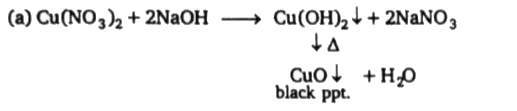
|
|
| 16. |
Aqueous solution of which of the following compounds is the best conductor ofelectric current ? |
|
Answer» Ammonia, `NH_(3)` |
|
| 17. |
Aqueous solution of 3% non-volatile solute exerts a pressure of 1 bar at the boiling point of the solvent. Calculate the molar mass of solute. |
|
Answer» Solution :DATA: (i) Vapour pressure of water at its [BOILING point temperature]`=P^(@)=1.013` bar (ii) Vapour pressure of solution at normal boiling point P=1bar 3% solution=3g of solute in 100G of solution. (iii) Mass of solute=3g(iv) Mass of solvent=100-3=97g (v) RELATIVE lowering of vapoure pressure`=(P^(@)-P)/(P)=(1.013-1)/(1.013)=0.0128` (vi) Molar mass of water=18g `mol^(-1)` Formula, `M_(2)=(W_(2))/(W_(1))xx(M_(1))/([(P^(@)-P)/(P^(@))])` Substitution: `M_(2)=(3)/(97)xx(18)/(0.0128)` ANSWER `M_(2)=43.49g//mol`. |
|
| 18. |
Aqueous solution having highest pH is |
|
Answer» `0.1 M NH_4CL` |
|
| 19. |
Aqueous solution contains Zn(CH_(2)COO)_(2),Cd(CH_(3)COO)_(2) and Cu(CH_(3)COO)_(2) on passing H_(2)S gas, therte is a precipitate of ……. As sulphide |
|
Answer» `ZN^(2+)` |
|
| 20. |
Aqueous sol. Of two compound M_(1)-O-H & M_(2)-O-H are prepared in two different beakers. If EN of M_(1) =3.4, M_(2)+1.2,O=3.5& M=2.1. Then nature of sol. Will be respectively |
|
Answer» ACIDIC, Basic |
|
| 21. |
Aqueous sodium cyanide is used as a reagent in the metal extraction. This process is called |
|
Answer» PYROMETALLURGY |
|
| 22. |
Aqueous silver nitrate is subjected to electrolysis, using platinum electrodes. What will be the nature of the solution after some time? |
| Answer» Solution :At platinum cathode reduction takes place, `Ag_((aq))^(+)+E^(-) rarr Ag_((s))`At platinum anode oxidation takes place, `2H_(2)O_((l)) rarr 4e^(-) +O_(2)+4H_((aq))^(+)`.As a result of the conversion of WATER to proton, the solution becomes ACIDIC (nitric ACID ) The pH of the solution decreases. | |
| 23. |
Aqueous NaOH reacts with white Phospho rous to form Phosphine and |
| Answer» Answer :1 | |
| 24. |
Aqueous NaCl solution is electrolyzed using platinum electrodes. What is the product formed at cathode? |
|
Answer» NA |
|
| 25. |
Aqueous HCL is an acidic solution whereas aqueous NH_3is a basic solution. Justify this statement. |
|
Answer» Solution :`HCl+H_2O leftrightarrow H_3O^(+)+ Cl^-` In this CASE, in ADDITION to auto ionisation of water. HCl molecule also produces `H_3O^+` ion by donating a proton to water and hence `[H_3O^+] gt [OH^-]` . It means that the AQUEOUS HCl solution is acidic. Similarly in BASIC solution such as aqueous `NH_3,[OH^-] gt [H_3O^+]` and it is basic. |
|
| 26. |
Aqueous ethanolic solution of 2-3% Iodine is |
|
Answer» ANTISEPTIC |
|
| 27. |
Aqueous copper sulphate solution (blue in colour) gives : (i) a green precipitate with aqueous potassium fluoride and (ii) a bright green solution with aqueous potassium chloride. Explain these experimental results. |
|
Answer» Solution :Aqueous `CuSO_(4)` solution EXISTS as `[Cu(H_(2)O)_(4)]SO_(4)` which has blue colour. (i) When KF is added, weak `H_(2)O` ligands are replaced by F ligands forming `[CuF_(4)]^(2-)` ions which is a green precipitate. `[Cu(H_(2)O)_(4)]^(2+)+4F^(-)tounderset("Tetrafluorocuprate(II)(Green ppt.)")([CuF_(4)]^(2-))+4H_(2)O` (ii) When KCl is added, weak `H_(2)O` ligands are replaced by `CL^(-)` ligands forming `[CuCl_(4)]^(2-)` ion which has bright green colour. `[Cu(H_(2)O)_(4)]^(2+)+4Cl^(-)tounderset("Tetrachlorocuprate(II)(Bright Green solution)")([CuCl_(4)]^(2-))+4H_(2)O` |
|
| 28. |
Aqueous copper sulphate solution (blue in colour) gives (i) a green precipitate with aqueous potassium fluoride, and (ii) a bright green solution with aqueous potassium chloride. Explain these experimental results. |
|
Answer» Solution :Aqueous `CuSO_(4)` solution exists as `[Cu(H_(2)O)_(4)]SO_(4)` which has blue COLOUR due to `[Cu(H_(2)O)_(4)]^(2+)` ions. (i) When KF is added, the weak `H_(2)O` LIGANDS are replaced by `F^(-)` ligands FORMING `[CuF_(4)]^(2-)` ions which is a green precipitate. `[Cu(H_(2)O)_(4)]^(2+)+4F^(-)rarrunderset(("Green ppt."))underset("Tetrafluorocuprate(II)")([CuF_(4)]^(2-))+4H_(2)O` (ii) When KCl is added, `Cl^(-)` ligands replace the weak `H_(2)O` ligands forming `[CuCl_(4)]^(2-)` ION which has bright green colour. `[Cu(H_(2)O)_(4)]^(2+)+4Cl^(-)rarrunderset(("Green solution"))underset("Tetrachlorocuprate(II)")([CuCl_(4)]^(2-))+4H_(2)O` Alternatively, directly we can write the REACTION as : `CuSO_(4)(aq)+4KF(aq)rarrK_(2)[CuF_(4)]+K_(2)SO_(4)` `CuSO_(4)(aq)+4KCl(aq)rarrK_(2)[CuCl_(4)]+K_(2)SO_(4)` |
|
| 29. |
Aqueous copper sulphate solution and aqueous silver nitrate solution are electrolysed separated electrolytic cells. Will the mass of copper and silver deposited on the cathode be same different ? Explain your answer. |
|
Answer» Solution :* It will be different. ACCORDING to Faraday.s second law, the amounts of different substances liberated by the same quantity of electricity passing through the electrolytic solution are Proportional `("Atomic mass of meta")/("No. of electrons")` to their chemical EQUIVALENT weights electrons required to reduce the cation. Here, for the electrode reactions: `Ag^(+)+e^(-) to Ag and Cu^(2+) +2e^(-) to Cu` * Hence, one mole of `Cu^(2+) and Ag^(3+)` REQUIRE 2 mol of electron (2F) and 1 mol of electrons `(F_(1))` respectively. |
|
| 30. |
Aqueous copper sulphate solution and aqueous silver nitrate solution are electrolysed by 1 ampere current for 10 minutes in separate electrolytic cells. Will the mass of copper and silver deposited on the cathode be same or different ? Explain your answer. |
| Answer» Solution :Different. ACCORDING to Faraday.s second law, amounts of different substances liberated by the same quantity of electricity PASSING through the electrolytic solutions are proportional to their chemical equivalent weights. SINCE the equivalent weights of copper and SILVER are different, we shall obtain different masses of copper and silver. | |
| 31. |
Aqueous 10% NaHCO_3 solution is used as a reagent for identifying X'. Which one of the following compounds yields 'X' on hydrolysis? |
|
Answer» `CH_(3) CO_(2) C_(2) H_(5)` |
|
| 32. |
Aquatic animals are more comfortable in cold water rather in warm water. Give reason. |
| Answer» SOLUTION :Because solubility of oxygen in more in COLD WATER than in WARM water. | |
| 33. |
Aquaregia is |
|
Answer» 1:3 conc. `HNO_(3)` and conc. HCI |
|
| 34. |
Aqua regia is used for dissolving which metals |
|
Answer» Alkali |
|
| 36. |
Aqua regia is a mixture of ________ and _______ in the ratio of 3:1. |
| Answer» SOLUTION :CONC. HCL. Conc. `HNO_3.` | |
| 37. |
Aqua regia is a mixture of .......... and ............ in the ratio 3:1 . |
| Answer» SOLUTION :CONC. HCL. Conc. `HNO_3.` | |
| 38. |
Aqua-regia is a mixture of: |
|
Answer» `3HCL + HNO_3` |
|
| 39. |
Aquaregia is a mixture of |
|
Answer» `HCl +CH_(3)COOH` |
|
| 40. |
Aqua regia is a mixture of .......... . |
| Answer» SOLUTION :CONC. `HNO_(3)` (1 part) + conc. HCL(3 parts) | |
| 41. |
Aqua regia is |
|
Answer» `conc. HC + conc. HNO_3 in 1: 3 ratio` |
|
| 42. |
Aqua regia has the composition : |
|
Answer» 1 PART CONC. `HNO_3 + 2` PARTS conc. HCI |
|
| 43. |
Aqua regia a mixture of? |
|
Answer» `3:` ratio of conc HCl and Conc. `HNO_(3)` |
|
| 44. |
Aqua fortis is : |
|
Answer» `HNO_3` |
|
| 45. |
Aqueous solution of HCI conducts electricity because : |
|
Answer» It UNDERGOES ionisation |
|
| 46. |
Aq. Solutionof CH_3CH_2COONa on electrolysis gives propane. Is it true or false? |
| Answer» SOLUTION :n-butane | |
| 47. |
Aq solution contains Zn(CH_(3)COO)_(2) Cd(CH_(3)COO)_(2) and Cu(CH_(2)COO)_(2) on passing H_(2)Sgas there is precipitateof …….. As sulphide. |
|
Answer» `ZN^(2+),CD^(2+)` |
|
| 48. |
Aprotic solvent is : |
|
Answer» `CCl_4` |
|
| 49. |
Approximately what percentage of air by volume gets used in a process of combustion: |
| Answer» ANSWER :A | |
| 50. |
Approximately linearrelationship between the square roots of the frequencies of the X-raysemitted by a number of different elements and the atomic numbers was discovered by: |
|
Answer» Newland |
|