

Saved Bookmarks
This section includes 7 InterviewSolutions, each offering curated multiple-choice questions to sharpen your Current Affairs knowledge and support exam preparation. Choose a topic below to get started.
| 1. |
An element belonging to chalcogen group is : |
|
Answer» CARBON |
|
| 2. |
An element (atomic mass = 60) having fcc structure has density of 6.23 g cm^(-3). The edge length of its unit cell is : |
| Answer» Answer :A | |
| 3. |
An element (atomic mass = 31) crystallises in a cubic structure. The density of the metal is 5.4g*cm^(-3). The number of unit cells is 3.1g of metal is 6.022xx10^(22). The number of atoms per unit cell is- |
|
Answer» 6 |
|
| 4. |
An element (atomic mass = 100 // mol) having bcc structure has unit cell edge 400 pm. The density of the element is : |
|
Answer» `10.376g cm^(-3)` Z = 2 ( bcc), M100 g `mol^(-1)` a = `400 xx 10^(-10) cm = 4 xx 10^(-8) cm`, `N_(A) = 6.02 xx 10^(23)` `:. d = ( 2 xx 100)/( ( 4 xx 10^(-8))^(3) xx ( 6.02 xx 10^(23)))` `= 5.19 g cm^(-3)` |
|
| 5. |
An element (atomic mass = 100 g/mole) having b.c.c. structure has unit cell edge 4.00 Å. The density in g/cc of the element is |
|
Answer» 10.376 |
|
| 6. |
An element (at. mass = 60) having face centred cubic unit cell has a density of 6.23g cm^(-3). What is the edge length of the unit cell? (Avogadro's constant = 6.023 xx 10^(23) mol^(-1)) |
|
Answer» `a^3=(4 xx 60)/(6.023 xx 10^(23) xx 6.23) cm^3 = 6.396 xx 10^(-23) cm^3`, `a = 4 xx 10^(-8)` cm = 400 PM |
|
| 7. |
An element A occupies group number 17 and period number 2, shows anomalous behaviour . A reacts with water forms a mixture of B,C and acid D. B and C are allotropes. A also reacts with hydrogen violently even in dark to given an acid D. Identify A,B,C and D write the reactions. |
|
Answer» Solution :i) The element A that occupies group number 17 and period number 2 is fluorine ii) Fluorine reacts with water and FORMS a mixture of B and C `2F_2 + 2H_2 O to 4HF + O_2` `3F_2 + 3H_2 O to 6HF + O_3` Therefore B is Oxygen and C is Ozone. iii) Fluorine reacts with hydrogen to give D. `F_2 + H_2 to 2HF` D is hydrofluorine ACID. |
|
| 8. |
An element A occupies group number 17 and period number 2, is the most electronegative element. Element A reacts with another element B, Which occupies group number 17 and period number 4, to give a compound C. CompoundC undergoes sp^3 d^2hybridisation and has octahedral structure. Identify the elements A and B and the compound C. Write the reactions. |
|
Answer» (ii) The element of group number 17 and period number 4 is BROMINE (B). (III) (A) and (B) react to give an interhalogen COMPOUND (C) bromine penta fluoride. `UNDERSET((A)) (Br_(2))+underset((B))(5F_(2)) rarr underset((C))(2BrF_(5))` (C) undergoes `sp^(3)p^(2)` hybridisation and has octahedral structure. 
|
|
| 9. |
An element A has three isotopes A^(20), A^(21), A^(22). The % abundance of A^(20) is 90% by mole and average atomic mass of the element A is 20.18 then mole % abundance of A^(21) would be - |
|
Answer» Solution :`{:(,A^(20),A^(21),A^(22),M_(avg) = 20.18,),(,darr,darr,darr,,),(% "by moles",90%,(10 - x)%,x%,,):}` `M_(avg) = sum %` of ISOTOPE `xx` atomic mass `20.18 = (90 xx 20 + (10 - x) 21 + x xx 22)/(100)` `2018 = 1800 + 210 - 21 x + 22 x` `2018 = 2018 + x` `x = 8 %` `%` abundance of `.^(21)A = (10 - x) = 2%` |
|
| 10. |
An element A forms a chloride which contains 29.34% by weight of chloride and is isomorphous with KCl. The atomic weight of A is |
|
Answer» 85.49 |
|
| 11. |
An element (A) extracted from kernite. A reacts with nitrogen at high temperature gives B. A reacts with alkali to form C. Find out A, B and C. Give the chemical equations. |
|
Answer» SOLUTION :(i) An element (A) extracted form kernite is boron. (ii) Boron reacts with NITROGEN at high TEMPERATURE gives Boron nitride (B) `UNDERSET((A))(2B)+N_(2) overset(Delta)(to)underset((B))(2BN)` 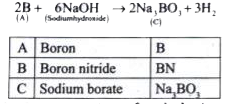
|
|
| 12. |
An element 'A' exists as a yellow solid in standard state. It forms a volatile hydride 'B' which is a foul smelling gas and is extensively used in qualitative analysis of salts. When treated with oxygen, 'B' forms an oxide 'C' which is a colourless and pungent smelling gas. The gas when passed through acidified KMnO_(4) solution, decolourises it. 'C' gets oxidised to another oxide 'D' in the presence of heterogeneous catalyst. Identify A, B, C, D and also give the chemical equations of reaction of 'C' with acidified KMnO_(4) solution and for conversion of 'C' into 'D'. |
|
Answer» Solution :(i) The data suggests that the yellow solid 'A' is sulphur `(S_(8))`. The volatile hydride 'B' with a punget smell is hydrogen sulphides `(H_(2)S)` gas. Upon treatment with oxygen, `H_(2)S` is converted to sulphur dioxide `(SO_(2))` which is a colourless pungent smelling gas 'C'. (iii) The gas 'C' DECOLOURISES acidified `KMnO_(4)` solution and is also converted another oxide `SO_(3)` 'D' in the presence of heterogeneous catalyst platinised ASBESTOS. The chemical reactions involved are as follow : `underset((A))(S_(8)(s))+8H_(2)(g) overset("heat") to underset((B))(8H_(2)S(g))` `underset((B))(2H_(2)S(g))+3O_(2)(g) overset("heat") to underset((C ))(2SO_(2)(g))+2H_(2)O(g)` `underset((C ))(2SO_(2)(g))+O_(2)(g) overset(Pt)to underset((D))(2SO_(3))(g)` `2KMnO_(4)+3H_(2)SO_(4)to K_(2)SO_(4)+2MnSO_(4)+3H_(2)O+5(O)` `[SO_(2)+2H_(2)O to H_(2)SO_(4)+2H]xx5` `(2H+O to H_(2)O xx5)/(underset(("Violet"))(2KMnO_(4))+5SO_(2)+2H_(2)O to underset(("Colourless"))(K_(2)SO_(4)) +underset(("Colourless"))(2MnSO_(4))+2H_(2)SO_(4)` |
|
| 13. |
An element 'A' exists as a yellow solid in standard state. It forms a volatile hydride 'B' which is a foul smelling gas and is extensively used in qualitative analysis of salts. When teated with oxygen, 'B' forms an oxide 'C' which is a colourless, pungent smelling gas. This gas when passed through acidified KMnO_(4) solution, decolourises it. 'C' gets oxidised to another oxide 'D' in the presence of a heterogeous catalyst. Identify A, B, C, D and also give the chemical equation of reaction of 'C' with acidified KMnO_(4) solution and for conversion of 'C' to 'D'. |
|
Answer» Solution :(i) SINCE element 'A' is a yellow solid in the standard state and forms a foul smelling gas 'B' which is extensively USED in qualitative analysis of salts, therefore, the element 'A' must be sulphure `(H_(2)S)`. `UNDERSET(("Yellow solid, A"))underset("Sulphur")(S) + H_(2) overset("Heat")rarr underset(("Foul smelling gas, B"))underset("Hydrogen sulphide")(H_(2)S)` (ii) Since the volatile gas 'B' reacts with OXYGEN to form a colourless pungent smelling gas 'C' which decolourises acidified `KMnO_(4)` solution, the gas 'C' must be sulphur dioxide `(SO_(2))`. `underset("Hydrogen suphide (B)")(2H_(2)S) + 3O_(2) rarr 2 H_(2)O + underset(("Colourless pungent smelling gas C"))underset("Sulphur dioxide")(2SO_(2))` The gas C being a reducing agent reduces acidified `KMnO_(4)` solution. `{:(""2KMnO_(4)+3H_(2)SO_(4) rarr K_(2)SO_(4)+2MnSO_(4)+3H_(2)O+5[O]),(""SO_(2)+H_(2)O+[O] rarr [H_(2)SO_(4)] xx 5),(bar(underset(("Pink"))(2KMnO_(4))+5SO_(2)+2H_(2)rarr K_(2)SO_(4)+underset(("Colourless"))(2MnSO_(4))+2H_(2)SO_(4))):}` (iii) Since the colourless pungent smelling gas 'C', i.e., `SO_(2)`, can be oxidised to another oxide 'D' in the presence of a heterogeneous CATALYST (i.e., Pt or `V_(2)O_(5)`), therefore, the oxide 'D' must be sulphur trioxide `(SO_(3))`. `underset("Sulphur dioxide (C)")(2SO_(2)) + O_(2) rarr underset("Sulphur trioxide (D)")(2SO_(3))` Thus, 'A' is sulphur (S), 'B' is hydrogen sulphide, `(H_(2)S)`. 'C' is sulphur dioxide `(SO_(2))` and 'D' is sulphur trioxide `(SO_(3))`. |
|
| 14. |
An element A exist in two isotopic forms A^15 and A^16 . If the average atomic mass of A was found to be 15.24, then the % relative abundance of A^15 will be |
|
Answer» 0.1 |
|
| 15. |
An element A emits an alpha particle and form B. A and B are |
|
Answer» isotopes |
|
| 16. |
An element Adissolves both in acid and alkali. It is an example of |
|
Answer» Allotropic NATURE of A |
|
| 17. |
An element A dissolves both in acid and alkali. It is an example of : |
|
Answer» ALLOTROPIC NATURE of A |
|
| 18. |
An element A belongs to 14th group and occupies period number 6. A reacts with conc. HCl to give B an acid. A is used to prepare C which is used as an antiknock in automobilies. Identify the element A and the compounds B and C write the reactions |
|
Answer» Solution :1. As per the position in the periodic table, the element A is lead. 2. Lead with Conc. HCl GIVES B `PB + 4HCl to H_2 PbCL_4 + H_2 ` `therefore ` Compound B is chloroplumbic ACID. 3. Compound C is tetraethyl lead. |
|
| 19. |
An element A (at.wt.=75) and B (at.wt. =25) combine to form a compound . The compound contains 75% A by weight. The formula of the compound will be : |
|
Answer» `A_2B` |
|
| 20. |
An element A and B constiture bcc type crystallinestructure. Element A occupies body centre positionand Bis at thecorners of cube. What is the formula of thecompound ? Whatarethecoordinationnumbers of A and B? |
|
Answer» SOLUTION :FORMULA = AB, coordinationnumberof A= 8, coordinationnumber= of B= 8 |
|
| 21. |
An element ._(96)X^(227) emits 4alpha and 5 beta particles to form new element Y. Then atomic number and mass number of Y are |
|
Answer» 93, 211 On equations mass number `227 = y + 4 xx 4 + 0, y = 211` On EQUATING atomic number `96 + y + 2 xx 4 - 5, y = 93` |
|
| 22. |
An element ‘X’ (At mass = 40 g mol–1) having f.c.c. structore, has unit celledge length of 400 pm.Calculate the density of ‘X’ and the number of unit cells in 4 g of ‘X’ (N_A = 6.022 × 10^23 mol^–1) |
|
Answer» SOLUTION :`d=(zM)/(a^3N_A)` =`(4 times 40)/((4 times 10^-8) times 6.022 times 10^-23)` `=4.15g//cm^3` No of UNIT cells=total no of atoms 4 =`[4/40 times 6.022 times 10^23]//4` `=1.5 times 10^22` |
|
| 23. |
An element ‘A’ exist as a yellow solid in standard stae. It forms a voilet hydride ‘B’ which is a foul smelling gas and is extensively used in qualitative analysis of salts. When reated with oxygen. ‘B’ forms an oxide ‘C’ which is a colourless and pungent smelling gas. The gas when passed through acidified kMnO_(4) solution, decolourises it, ‘C’ gets oxidised to another oxide ‘D’ in the presence of heterogenous catalyst. Identifier A, B, C, D and also give the chemical equation of reaction ‘C’ with acidified KmnO_(4) solution and for conversion of ‘C’ into ‘D’. |
|
Answer» Solution :`underset(("A"))(S_(8)(s))+8H_(2)(g)overset("heat")rarrunderset(("B"))(8H_(2)S(g))` `underset(("B"))(2H_(2)S(g))+3O_(2)(g)overset(Delta)rarrunderset(("C"))(2SO_(2))(g)+2H_(2)O(g)` `underset(("C"))(2SO_(2))(g)+O_(2)(g)overset("Pt.")rarrunderset(("D"))(2SO_(3))(g)` OVERALL : `underset(("voilet"))(2KMnO_(4))+5SO_(2)+2H_(2)Orarrunderset(("colourless"))(K_(2)SO_(4))+underset(("colourless"))(2MnSO_(4))+2H_(2)SO_(4)` |
|
| 24. |
An electroytic cell contains a solution of Ag_2SO_4 and platinum electrodes. A current is passeduntil 1.6 g of O_2 has been liberated at anode. The amount of Ag deposited at cathode would be : |
|
Answer» `1.6g` |
|
| 25. |
An electrophilic reagent is : |
|
Answer» Electron DEFICIENT SPECIES |
|
| 26. |
An electronic vacuum tube wassealed off during an experiment at a pressure of 8.2xx10^(-10) atm at 27^(@)C The volume of the tube was 30dm^(3). The number of gas molecules remaining in the tube are |
|
Answer» `6.02xx10^(14)` `=10^(-9)` mol`=6.02xx10^(14)` MOLECULES |
|
| 27. |
An electronic vacuum tube was sealed off during an experiment at a pressure of 8.2 xx 10^(-10) atm at 27^(@)C. The volume of the tube was 30 dm^(3). The number of gas molecules remaining in the tube are : |
|
Answer» `6.023 XX 10^(14)` `n = ( 8 .2 xx 10^(-10)xx 30)/( 0.082 xx 300) = 1 xx 10^(-9)` Molecules of gas `= 1 xx 10^(-9) xx 6.02 xx 10^(23)` `= 6.02 xx 10^(14)` |
|
| 28. |
An electron will have the highest energy in the set: |
|
Answer» 3, 2, 1, 1/2 |
|
| 29. |
An electron will have highest energy with which one of the followng sets of four quantum numbers? |
|
Answer» `{:(n""l""m""s),(3""2""1""+1/2):}` |
|
| 30. |
An electron, practically at rest, is initially accelerated through a potential difference of 100 volts. It then has a de Broglie wavelength =lambda_(1) Å. It then get retarded through 19 volts and then has a wavelength lambda_(2) Å. A further retardation through 32 volts changes the wavelength to lambda_(3)Å, What is (lambda_(3)-lambda_(2))/(lambda_(1))? |
|
Answer» |
|
| 31. |
An electron practically at rest, is initially accelerated through a potential difference of 100 volts. It then has a de Broglie wavlength =lambda_(1)Å. It then get retorted through 19 volts and then has a wavelength lambda_(2)Å . A further retardation through 32 volts changes the wavelength to lambda_(3). What is the value of (lambda_(3)-lambda_(2))/(lambda_(1))? |
|
Answer» `(20)/(41)` |
|
| 32. |
An electron jumps from n^(th) level to 1^(st) level, the fact ( s) which is // are correct of H - atoms is // are |
|
Answer» Number of spectral lines `= ( N ( n - 1))/( 2)` |
|
| 33. |
An electron of a velocity x is found to have a certain wavelength.The velocity to be possessed by the neuron to have half the de Broglie wavelength possessed by electron is: |
|
Answer» `x//1840` TOTAL spin `=3xx1/2=3/2` |
|
| 34. |
An electron is allowed to move freely in a closed cubic box of length 10 cm. The maximum uncertainty in its velocity will be observed as |
|
Answer» `4xx10^(-3)m//s` |
|
| 35. |
An electron is a hydrogen atom is its ground state absorbs 1.50 times as much energy as the minimum required for its escape from the atom. What is the wavelength of the emitted electron? |
|
Answer» `4.70Å` |
|
| 36. |
An electron in the ground state of hydrogen was excited to a higher energy level using monochromatic radiations of wave length (lambda )975 Å . The longest wave length that appears in the resulting spectrum is due to transition from: |
|
Answer» `n_(4) to n_(1)` `E = (12400)/(975)eV = 12.72 eV` [For a radiaton of WAVELENGHT x `Å` we know `E = (12400)/(x) eV`] `E = 13.6 [(1)/(n_(1)^(2)) - (1)/(n_(2)^(2))]eV` ` or12.72 = 13.6 [1 - (1)/(n_(2)^(2))] ""[becauseE = 12.72 eV]` or ` (1)/(n_(2)^(2))k = (13.6-12.72)/(13.6) = (0.88)/(13.6) = (1)/(16)` or `n_(2)^(2) = 16 , n_(2) ~= 4` The transition `n_(4) to n_(3)`willgivethe longestwave lenght. |
|
| 37. |
An electron in an isolataed atom, may be described by four quantum number n,l,m and s. The value of m for electron most easily removed from a gaseous atom of n-alkaline earth metal is |
|
Answer» same as the maximum VALUE of N for the element |
|
| 38. |
An electron in a hydrogne atom in its ground state absorbs 1.50 times as much energy as the minium required for its escape from the atom. What is the wavelength of the emitted electron ? |
|
Answer» `4.7 Å` |
|
| 39. |
An electron has spin quantum number +1//2 and a magnetic quantum number -1. It cannot be present in |
|
Answer» s-orbital |
|
| 40. |
An electron has a total energy of 2 MeV. Calculate the effective mass of the electron in kg and its speed. Assume rest mass of electron 0.511 MeV. |
|
Answer» |
|
| 41. |
an electron beam can undergo diffraction by crystals. Through what potential should a beam of electrons be accelerated so that its wavelength is equal to 1.6 angestrom ? |
|
Answer» `58.90`V |
|
| 42. |
An electrolytic cell is constructed for preparing hydrogen. For the average current of 1 ampere inthe circuit, the time required for producing 112 ml of H_2 at STP is approximately |
| Answer» Answer :D | |
| 43. |
An electrolytic cell contains a solution of AgNO_(3) and Pt electrodes. A current is passed until 1.6 gm of O_(2) has been liberated at anode. The amount of Ag deposited has liberated at cathode would be |
|
Answer» 1.6 G Now 1F `-=` 107.8 g of AG. `THEREFORE 0.2F -=21.6` g of Ag. |
|
| 44. |
An electrolytic cell contains a solution of Ag_(2)SO_(4)and platinum electrodes. Current is passed until 1.6 g. of O_(2)has been liberated at anode. The amonut of Ag deposited at cathode would be |
|
Answer» 0.8g |
|
| 45. |
An electrolytic cell contains a solution of Ag_(2)SO_(4) and platinum electrodes. A current is passed until 1.6 gof O_(2) has been liberated at anode. The amount of silver deposited at cathode would be |
|
Answer» `107.88g` `therefore`of `Ag =21.6` g |
|
| 46. |
An electrolytec cell contains a solution of AgNO_3 andhave platinum electrodes. A current is passed untill 1.6 g ofO_2 has been liberated at anode. The amount of silver peposited at cathode would be : |
|
Answer» `107.88`G |
|
| 47. |
An electrolyte |
|
Answer» FORMS complex ions in solution |
|
| 48. |
An electrode is prepared by dipping an Ag strip into a solution saturated withsilver thiocyanate, AgSCN, and containing 0.10 M SCN^- . The emf of the voltaic cell constructed by connecting this electrode as the cathode to the standard hydrogen half cell as the anode is 0.45 V. What is K_(sp)of AgSCN? |
| Answer» SOLUTION :`1 XX 10^(-2)` | |
| 49. |
An electrode is prepared by dipping a silver strip into a solution saturateed with AgACN and contanining 0.10 M SCN^(-). The e.m.f. of voltaic cell constructed by connecting this, as the cathode, to the standard hydrogen half-cell as anode was found to be 0.45 V. What is the solubility product of AgSCN. (Given E_(Ag^(+)//Ag)^(@) = 0.80 V) |
|
Answer» |
|
| 50. |
An electrochemical cell is set up as follows : Pt (H_(2), atm ) | 0.1 M HCl |0.1 M acetic acid | (H_(2) , 1 atm ) Pt EMF of this cell will not be zero because |
|
Answer» the temperature is constant |
|