Saved Bookmarks
This section includes 7 InterviewSolutions, each offering curated multiple-choice questions to sharpen your Current Affairs knowledge and support exam preparation. Choose a topic below to get started.
| 1. |
An antibiotic contains nitro group attached to aromatic nucleus. It is |
|
Answer» Tetracycline 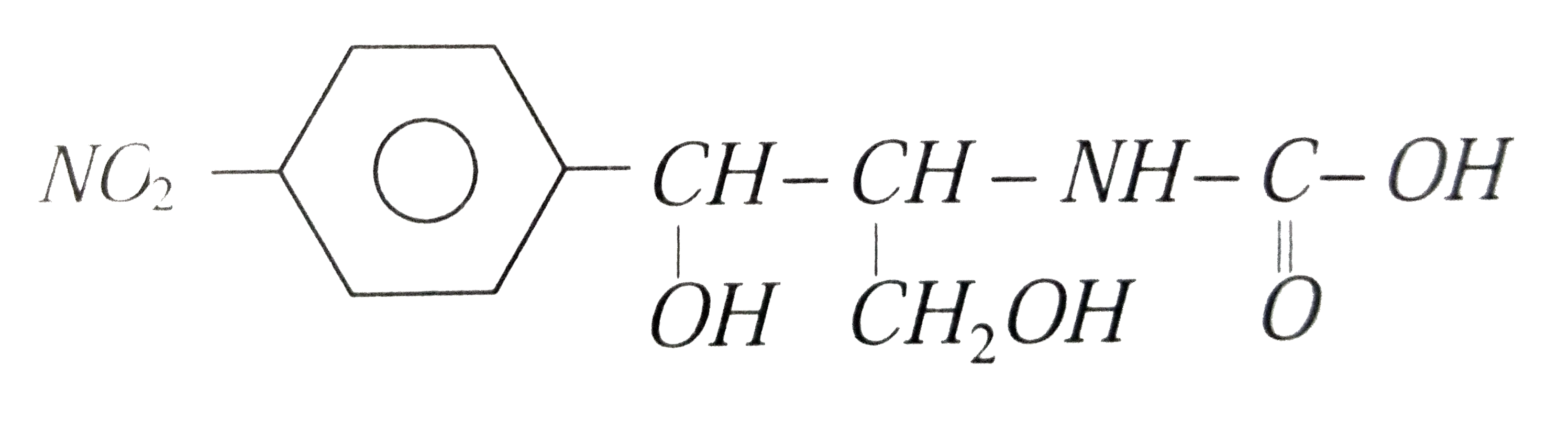
|
|
| 2. |
An antibiotic with a broad spectrum |
|
Answer» KILLS the antibodies |
|
| 3. |
An antibiotic contains nitro group attached to aromatic nucleus . It is : |
|
Answer» Penicillin |
|
| 4. |
…………………..an anti cancer agent used to treat stomach and colon cancer. |
|
Answer» |
|
| 5. |
An anti-freeze solution is prepared from 222.6 g of ethylene glycol C_(2) H_(4) (OH)_(2) and 200 g of water . Calculate themolality of the solution. If the density of this solution be 1.072 g mL^(-1) , what will be the molarity of the solution ? |
|
Answer» Solution :Mg of `C_(2) H_(4) (OH)_(2) = 62 g mol^(-1)` Molality = `(n_(B))/(W_(A))xx 1000 = (W_(B))/(M_(B) xx W_(B)) xx 1000 = (222.6 xx 1000)/(62 xx 200) = 17.95 m ` DENSITY= `("Mass")/("Volume")` So , Volume = `("Mass")/("Density") = (422.6)/(1.072) = 394.22` ml `M = (n_(B))/(V) xx 1000` `= (222.6)/(394.22 xx 62) xx 1000 = 9.11` M |
|
| 6. |
An antibiotic contains nitro group attached to aromatic nucleus in its structure. It is |
|
Answer» PENCILLIN |
|
| 7. |
An analytical balance has uncertainity in measurement equal to pm1 mg. Then the result in terms of persentage would be if the weight of a compound is 10 g |
|
Answer» `10pm0.1%` |
|
| 8. |
An anhybride and an ester can be distinguished with |
|
Answer» `C_2H_5OH` |
|
| 10. |
An analyst starts a first order chemica reaction at 8.00 A.M. in the morning at the laboratory temperature of 27^(@) C At 1.00 P.M. he discovered that only 10% of the reaction was complete by that time To speed-up the reaction he increased the temperature to 127^(@) C At 4.00 P.M. he found that only 50% of the reaction was complete Any how he did not want to stay in laboratory beyond 5.00 P.M. but he could not leave the laboratory until the reaction was 90% complete Fortunately he found a suitable catayst adding which at 4.00 P.M. at 127^(@) C he could meet the target of 5.00 P.M. and 90% Answer the following questions based on theabove observation (Use l n 10/9 = 0.1 l n 9/5=0.6, l n10=2.3 l n5=1.6,l n8=2) What was the activation energy of the catalyzed pathway? |
|
Answer» `4.92 kcal//mol` |
|
| 11. |
An analysis of the hydrolysis products of salmine, a polypeptide from salmon gave following result of weights of amino acidsd in gram per 109.66g of salmine{:(Ie :,"Isoleusine : 1.31","Alanine : 0.89","Serine : 7.35","Argemine : 86.40"),(,"valine : 3.51","Glycine : 3.0","Proline : 6.90",):} {:("molecular weight of salmine is : 10, 966","molecular weight of Serine : 105"),("molecular weight of alanine is : 89","molecular weight of Argenine : 174"),("molecular weight of Isoleucine : 131","molecular weight of Protine : 115"),("molecular weight of Valine : 117","molecular weight of Glycine : 75"):}Salmine is also known as |
|
Answer» `Ala. Arg_(50).Gly_(4).Ile Pro_(6). Ser_(7)Val_(3)` |
|
| 12. |
An analyst starts a first order chemica reaction at 8.00 A.M. in the morning at the laboratory temperature of 27^(@) C At 1.00 P.M. he discovered that only 10% of the reaction was complete by that time To speed-up the reaction he increased the temperature to 127^(@) C At 4.00 P.M. he found that only 50% of the reaction was complete Any how he did not want to stay in laboratory beyond 5.00 P.M. but he could not leave the laboratory until the reaction was 90% complete Fortunately he found a suitable catayst adding which at 4.00 P.M. at 127^(@) C he could meet the target of 5.00 P.M. and 90% Answer the following questions based on theabove observation (Use l n 10/9 = 0.1 l n 9/5=0.6, l n10=2.3 l n5=1.6,l n8=2) What was the activation energy of the original pathway? |
|
Answer» `10.14 kcal//mol` |
|
| 14. |
An analysis of pyrex glass showed 12.9%B_(2)O_(3),2,2% Al_(2)O_(3).3.8% Na_(2)O,0.4% K_(2)O and remaining is SiO_(2). What is the ratio of silicon to boron atoms in the glass? |
|
Answer» Solution :PERCENTAGE composition of `B_(2)O_(3)=12.9%` Percentage composition of `SiO_(2)=100-[12.9+2.2+3.8+0.4]` =80.7% Number of moles of `B_(2)O_(3)=("MASS")/("Molar mass")=(12.9)/(70)=0.184` Number of moles of boron atoms `=2xx0.184` Number of moles of `SiO_(2)=("Mass")/("Molar mass")=(80.7)/(60)=1.345` Number of moles of silicon atoms =1.345 `("Number of atoms of silicon")/("Number of atoms of boron")=(N_(A)xx1.345)/(N_(A)xx0.184)=(7.3)/(1)` Where `N_(A)=` AVOGADRO's number. |
|
| 15. |
Choose the most appropriate answer from the following options : Identify the metallic oxide which is amphoteric in nature : Calcium oxide Barium oxide Zinc oxide Copper(ll)oxide |
|
Answer» `NA2O` |
|
| 16. |
An amphoteric oxide out of the following is : |
|
Answer» `NA2O` |
|
| 17. |
An amount of solid NH_(4)HSis placed in a flask already containing ammonia gas at a certain temperature and 1.0 atm pressure. Ammonium hydrogen sulphide decomposes to yield NH_(3)and H_(2)Sgases in the flask. When the decomposition reaction reaches equilibrium, the total pressure in the flask rises to 2 atm. What will be the equilibrium constant for NH_4HS decomposition at this temperature? |
|
Answer» <P> Then, `1.0 + x + x=2x+1.0=2.0` (given) `rArr x=0.5` atm `P_(NH-(3)) =1.0 + 1.5 1.5 atm, p-(H_(2)S) = 0.5 atm^(2)` `0.75 atm^(2)` |
|
| 18. |
An amount of solid NGH_(4)HS is placed ina flask already containg ammonia gas at a certain temperaturee and 0.50 atm. Pressue. Ammounium hydrogen sulphide decomposes to yield H_(3)and H_(2)S gases in the flask. When the decomposition reaction reaches equlibrium, the total pressure in the flask rises to 0.84 atm. The equilibrium constant for NH_(4)HS decompositions at this temperaturee is |
|
Answer» `0.30` Total PRESSURE `=0.5+2x=0.84 i.e., x=0.17` `K_(p)=P_(NH_(3)).P_(H_(2)S)=(0.67).(0.17)=0.1139` |
|
| 19. |
An amorphous solid (X) burns in air to form a gas ( Y) which turns lime water milky. This gas decolourises aqueous solution of acidified KMnO_(4). Gas (Y) reacts with oxygen to give another gas (Z) which is responsible for acid rain. X, Y and Z are |
|
Answer» X-C, Y-CO, Z-`CO_2` `{:(SO_2+,Ca(OH)_2to , CaSO_3 darr , + H_2O),("(Y)",,"white ppt.",):}` `{:(2KMnO_4+,5SO_2+,2H_2OtoK_2SO_4+,2MnSO_4 +,2H_2SO_4),("Purple","(Y)",,"colourless",):}` `{:(2SO_2+,O_2to,2SO_3),("(Y)",,"(Z)"):}` `underset"(Z)"(SO_3) + H_2O to H_2SO_4` (responsible for ACID RAIN ) |
|
| 20. |
An amorphous solid 'A' which has a crown shaped structure, burns in air to form a gas 'B' which turns lime water milky. 'B' is also produced by roasting of sulphide ores. 'B' undergoes oxidation in the presence of V_(2)O_(5) to give 'C' and to carry out this oxidation low temperature and high pressure is mandatory to get a good yeild of 'C'. 'C' is then absorbed in H_(2)SO_(4) to give 'D'. 'D' is then diluted to give a very important. 'E' in concentrated form, when combined with Cu metal, gives compound 'F'. From this description Give two important functions of 'E' in the chemical industry. |
|
Answer» SOLUTION :(i) MANUFACTURE of FERTILISERS LIKE ammonium sulphate. (ii) In detergent inductry. |
|
| 21. |
An amorphous solid 'A' which has a crown shaped structure, burns in air to form a gas 'B' which turns lime water milky. 'B' is also produced by roasting of sulphide ores. 'B' undergoes oxidation in the presence of V_(2)O_(5) to give 'C' and to carry out this oxidation low temperature and high pressure is mandatory to get a good yeild of 'C'. 'C' is then absorbed in H_(2)SO_(4) to give 'D'. 'D' is then diluted to give a very important. 'E' in concentrated form, when combined with Cu metal, gives compound 'F'. From this description Give a balanced chemical equation for the conversion of 'E' to 'F'. |
| Answer» SOLUTION :`Cu+2H_(2)SO("CONC.")toCuSO_(4)+SO_(2)+2H_(2)O` | |
| 22. |
An amorphous solid 'A' which has a crown shaped structure, burns in air to form a gas 'B' which turns lime water milky. 'B' is also produced by roasting of sulphide ores. 'B' undergoes oxidation in the presence of V_(2)O_(5) to give 'C' and to carry out this oxidation low temperature and high pressure is mandatory to get a good yeild of 'C'. 'C' is then absorbed in H_(2)SO_(4) to give 'D'. 'D' is then diluted to give a very important. 'E' in concentrated form, when combined with Cu metal, gives compound 'F'. From this description Elucidate the structure of 'A' to 'F'. |
Answer» SOLUTION :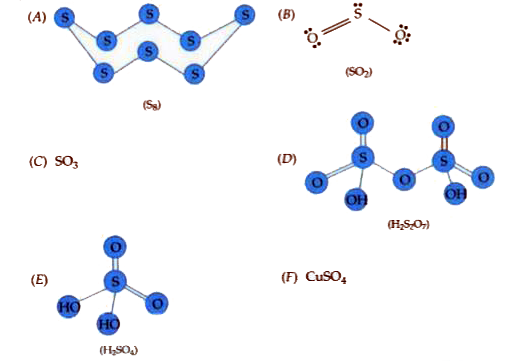
|
|
| 23. |
An amorphous solid "A" burns in air to form a gas "B" which turns lime water milky. The gas is also produced as a by-product during roasting of sulphide ore. This gas decolourises acidified aqueous KMnO_4 solution and reduces Fe^(3+) to Fe^(2+)Identify the solid "A" and the gas "B" and write the reactions involved. |
|
Answer» Solution :(A) `S_(8)`, (B) `SO_(2)` with OXYGEN (air), `S_(8)` oxidises to `SO_(2)` `S_(8) + 8O_(2) overset(Delta)to 8SO_(2)` `SO_(2) + Ca(OH)_(2) to CaSO_(3) + H_(2)O` `5SO_(2) + underset("violet")(2MnO_(4)^(-)) + 2H_(2)O to 5SO_(4)^(2-) + 4H^(+) + underset("COLOURLESS") (2MN^(2+))` `2Fe^(3+) + SO_(2) + 2H_(2)O to underset("green")(2Fe^(2+)) + SO_(4)^(2-) + 4H^(+)` |
|
| 24. |
An amorphous solid "A" burns in air to form a gas "B" which turns lime water milky. The gas is also produced as a by-product during roasting of sulphide ore. This gas decolourises acidified aqueous KMnO_4 solution and reduces Fe^(3+) to Fe^(2+). Identify the solid "A" and the gas "B" and write the reactions involved. |
|
Answer» Solution :The solid A is sulphur , `S_8` and the gas B is `SO_2`. The reactions are given as under : `S_8 + 8O_2 OVERSET(Delta)to 8SO_2` `2MnO_4^(-) + 5SO_2 + 2H_2O to 5SO_4^(2-) + 4H^(+) + underset("(Colourless)")(2MN^(2+))` `2Fe^(3+) + SO_2 + 2H_2O to 2Fe^(2+) + SO_4^(2-) + 4H^(+)` `SO_2` is produced as a by - product during roasting of sulphide ore. The sulphides are converted into oxideswith the EVOLUTION of `SO_2`. |
|
| 25. |
An amorphous solid (A) burns in air to form a gas (B) which turns lime water milky . The gas is also produced as a byproductduring roasting of sulphide ore. This gas decolourises acidifiedaqueousKMnO_(4) solution and reduces Fe^(3+) to Fe^(2+). Identify the solid 'A' and the gas 'B' and write the reactions involved. |
|
Answer» (ii) As the gas 'B' is obtained when amorphous solid 'A' burns in air therefore, amorphous solid 'A' must be sulphur `s_(8)`. `underset("(A)")(S_(8))+8O_(2) overset(Delta)RARR underset("(B)")(8SO_(2))` Gas (B) reduces acidified aqueous KMnO4 solution and reduces `Fe^(3+)` to `Fe^(2+)` salts as shown below: `underset("(yellow)")(2MnO_(4)^(-))+underset("(B)")(SO_(2))+2H_(2)O rarr underset("(GREEN)")(2Fe^(2+)+SO_(4)^(2-)+4H^(+))` (IV) Thus, solid 'A' is `S_(8)` and gas 'B' is `SO_(2)`. |
|
| 26. |
An amorphous solidA burnsin airto form a gas B whichturns limewatermilky. Thegasis also producedduringroasting of sulphide ore. This gasdecolourises acidifedaqueousKMnO_(4) solutionand reduces Fe^(3+) to Fe^(2+). Identify the solid 'A' and thegas B and write thereactionsinvolved . |
|
Answer» Solution :`A to S_(8) , B to SO_(2) , S_(8) + 8O_(2) OVERSET(Delta)to 8SO_(2)` `underset("(VIOLET)")(2MnO_(4)^(-)) + 5SO_(2) + 2H_(2)O to5SO_(4)^(2-) +4H^(+) + underset("(colouless)")(2Mn^(2+))` `2Fe^(3+) + SO_(2) + 2H_(2)Oto 2Fe^(2+) + SO_(4)^(2-) + 4H^(+)` |
|
| 27. |
An amorphous solid 'A' burns in air to form a gas 'B' which turns lime water milky. The gas is also produced as a by-product during roasting of sulphide ore. This gas decolourises acidified aqueous KMnO_(4) solution and reduces Fe^(3+) to Fe^(2+). Identify the solid "A" and the gas "B" and write the reaction involved. |
|
Answer» Solution :(i) Since gas 'B' is obtained as a by-product during roasting of sulphide, therefore, gas 'B' must be `SO_(2)`. `2 ZnS + 3 O_(2) rarr 2 ZnO + 2 SO_(2) (B)` (ii) Since gas 'B' is obtained when AMORPHOUS SOLID 'A' burns in air, therefore, amorphous solid 'A' must be SULPHUR, `S_(8)` `S_(8) (A) + 8 O_(2) rarr 8 SO_(2) (B)` (iii) Gas 'B' reduces ACIDIFIED `KMnO_(4)` solution and reduces `Fe^(3+)` to `Fe^(2+)` salts as shown below : `{:(underset(("Purple"))(2MnO_(4)^(-)) + underset((B))(5SO_(2))+ 2H_(2)O rarr underset(("COLOURLESS"))(2Mn^(2+))+5SO_(4)^(2-) + 4H^(+)),(underset(("Yellow"))(2Fe^(3+))+underset((B))(SO_(2))+2H_(2)O rarr underset(("Green"))(2Fe6(2+)) + SO_(4)^(2-) + 4 H^(+)):}` Thus, solid 'A' = `S_(8)` and gas 'B' = `SO_(2)`. |
|
| 28. |
An amorphous solid ‘A’ burns in air to form a gas ‘B’ which turns lime water milky. The gas is also produced as a by-product during roasting of sulphide ore. This gas decolourises acidified aq. KMnO_(4) solution. Identify the solid ‘A’ and the gas ‘B’ and write the reaction involved. Write its any two uses. |
| Answer» SOLUTION :It is USED as BLEACHING AGENT and DISINFECTANT. | |
| 29. |
An amorphous solid ‘A’ burns in air to form a gas ‘B’ which turns lime water milky. The gas is also produced as a by-product during roasting of sulphide ore. This gas decolourises acidified aq. KMnO_(4) solution. Identify the solid ‘A’ and the gas ‘B’ and write the reaction involved. What happens when SO_(2) is passed through water and reacts withNaOH ? Write balanced equation. |
|
Answer» Solution :`2NaOH+SO_(2)(G)rarrNa_(2)SO_(3)(aq)+H_(2)O` `Na_(2)SO_(3)(aq)+SO_(2)+H_(2)Orarr2NaHSO_(3)(aq)` |
|
| 30. |
An amorphous solid ‘A’ burns in air to form a gas ‘B’ which turns lime water milky. The gas is also produced as a by-product during roasting of sulphide ore. This gas decolourises acidified aq. KMnO_(4) solution. Identify the solid ‘A’ and the gas ‘B’ and write the reaction involved. How is SO_(2) prepared in laboratory ? |
| Answer» Solution :`Na_(2)SO_(3)(s)+H_(2)SO_(4)(aq)rarrSO_(2)(g)+Na_(2)SO_(4)(aq)+H_(2)O(L)` | |
| 31. |
An amorphous solid ‘A’ burns in air to form a gas ‘B’ which turns lime water milky. The gas is also produced as a by-product during roasting of sulphide ore. This gas decolourises acidified aq. KMnO_(4) solution. Identify the solid ‘A’ and the gas ‘B’ and write the reaction involved. |
| Answer» SOLUTION :`A = S_(8), B = SO_(2) (G)` | |
| 32. |
An ammonia solution is 9.9% ammonia by mass and has a density of 0.99 g/mL. Calculate the pH of the solution. K_b (NH_4OH) = 1.7 xx 10^(-5) |
|
Answer» |
|
| 33. |
An amino acid with a phenolic hydroxyl group is |
|
Answer» alanine |
|
| 34. |
An amine (X) reacts with benzene sulphonyl chloride and the product thus obtained is soluble in KOH . The amine (X) is |
|
Answer» `1^(@)`amine |
|
| 35. |
An amine reacts with CH_(3)SO_(2)Cl and the product is soluble in alkali, amine is |
| Answer» Answer :1 | |
| 36. |
An amino acid is characterized by two pKa values the one correspondingto the more acidic site is designated as pKa_1 and the other corresponding to the less acidic site is designated as pKa_2 The isoelectric point also called isoionic point (pI) is the pH at which concentration of zwitter ion is maximum . pI is the average of pKa_1 and pKa_2.Generally the value of pI is slightly less than 7. some amino acids have side chain with acidic or basic groups.These amino acids have pKa_3 value also for the side chain.Acidic amino acid have acidic side chains and basic amino acids have basic side chains . pI for acidic amino acid is average of pKa_1 and pKa_3.pI for basic amino acid is the average of pKa_2 and pKa_3. {:(S.NO,"Amino acid",p^(Ka1),p^(Ka2),p^(Ka3)("side chain")),(I,"Aspartic acid",1.88,9.6,3.65),(II,"Glutamic acid",2.19,9.67,4.25),(III,"Lysine",2.18,8.95,10.53),(IV,"Arginine",2.17,9.04,12.48):} In the table given above the acidic amino acids are |
| Answer» Solution :`P_3^(KA)` value of side chain DETERMINES the NATURE of amino acid | |
| 37. |
An amine reacts with C_6H_5SO_2Cl and the productis soluble in alkali amine is |
| Answer» ANSWER :B | |
| 38. |
An amine reacts with C_6H_5SO_2Cl and the product is soluble in alkali, amine is : |
| Answer» Answer :A | |
| 39. |
An amine reacts with benzenesulphonyl chloride to form a white precipitate which is insoluble in aq. NaOH. The amine is |
|
Answer»
|
|
| 40. |
An amine hormone is |
|
Answer» Cortisone |
|
| 41. |
An amine A reacts with benzene sulphonyl chloride and the product, thus, formed is soluble in KOH. The correct representation of the functional group of amine is |
|
Answer» `-NH`  On the other HAND `2^(@)` amines react with benzene sulphonyl chloride to give a product which is insoluble in `KOH` whereas `3^(@)` amines do not react with benzene sulphonyl chloride. |
|
| 42. |
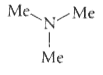
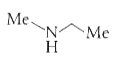
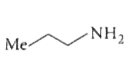
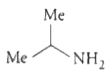
An amine C_(3)H_(9)N reacts with benzene sulphonyl chloride to fonn a white precipitate which is insoluble in aq. NaOH. The amine is |
|
Answer»
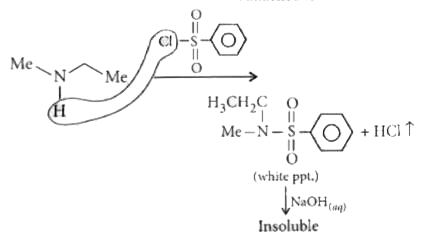
|
|
| 43. |
An ambident nycleophile is |
|
Answer» AMMONIA |
|
| 44. |
An alumina-silica clay called bentonite is dropped from aeroplanes in the slurry form for : |
|
Answer» FERTILIZING the soil |
|
| 45. |
An alpha- paticle approaches the target nucleus of copper (Z = 29) is such a way that the vlaue of impact parameter is zero. The distance of closest approach will be |
|
Answer» `(2pi epsilon_(0)(K.E.)_(alpha))/(29e^(2))` |
|
| 46. |
An alpha-helix is a structural feature of |
|
Answer» Sucrose. |
|
| 47. |
An alpha-amino acid exists as, overset(+)(NH_3)-underset(R)underset(|)CH-COOH at (pH=2) and its isoelectric point is 6. The amino acid at pH 10.97 will exist as : |
|
Answer» `OVERSET(+)(NH_3)-UNDERSET(R)underset(|)CH-COO^-` |
|
| 48. |
An alloy which does not contain copper is : |
|
Answer» Solder |
|
| 49. |
Which of the following alloys does not contain copper? |
| Answer» ANSWER :A | |
| 50. |
An alloy weighing 1.05g of Pb-Ag was dissolved in desired amount of HNO_(3) and the volume was made 350 mL. An Ag electrode was dipped in solution and E_(cell) of the cell underset(1 atm)(Pt H_(2)|)underset(1 M)(H^(+))"||"Ag^(+)|Ag was 0.503V at 298K. calculate the percentage of lead in alloy. ("given," E_(Ag^(+)//Ag)^(@)=080V) |
|
Answer» |
|