

Saved Bookmarks
This section includes 7 InterviewSolutions, each offering curated multiple-choice questions to sharpen your Current Affairs knowledge and support exam preparation. Choose a topic below to get started.
| 1. |
Mercury is purified by: |
|
Answer» passing through DILUTE `HNO_(3)` |
|
| 2. |
Mercury is purified by : |
|
Answer» Solidifying |
|
| 3. |
Mercury is in liquid form because… |
|
Answer» as d-orbital is COMPLETELY FILLED up so d-d OVERLAPPING is not possible |
|
| 4. |
Mercury is emitted into air by : |
|
Answer» BURNING coal |
|
| 5. |
Mercury is a liquid metal because |
|
Answer» It has a completely FILLED d- orbital that prevents d-d overlapping of ORBITALS |
|
| 6. |
Mercury is a liquid at 0^(@)C because of: |
|
Answer» very HIGH ionisation energy |
|
| 7. |
Mercury is a liquid at 0^@C because of |
|
Answer» Very high ionisation ENERGY |
|
| 8. |
Mercury (II) chloride solution on reaction with gaseous ammonia forms: |
|
Answer» `Hg(NH_(3))Cl*HgO` |
|
| 9. |
Mercury forms amalgams with all except : |
|
Answer» Al |
|
| 10. |
Mercuric iodate [Hg_(5)(IO_(6))_(2)] reacts witha mixture of KI and HCI according to the following equation . Hg_(5)(IO_(6))_(2) +34 KI +24 HCl to 5K_(2)HgI_(4) +8I_(2) +24KCl +12H_(2)O The liberated odine is treated with na_(2)S_(2)O_(3) solution , 1 mL of which isequivalentto 0.0499g of CuSO_(4).5H_(2)O.What volume( in mL ) of Na_(2)S_(2)O_(3) solutionwill be required to react with iodine liberated from 0.7245 g of [Hg_(5) (IO_(6))_(2)] ? [Hg = 200.5 , Cu = 63.5 ,I = 127 ] |
|
Answer» Solution :From the stoichmetry of the given EQUATIONS , `Hg_(5) (IO_(6))_(2) +34 KI+24 HCI to 5K_(2)HgI_(4) +8I_(2) +24KCI +12H_(2)O` and `2Cuso_(4) .5H_(2)O + 4KI to Cu_(2)I_(2) + 2K_(2)SO_(4) +I_(2)` we have , ` 8 xx " moles of " Hg_(5)(IO_(6))_(2) = " moles of " I_(2)` and moles of `CuSO_(4) .5H_(2)O = 2 xx" moles of " I_(2)` ` :. " moles of " I_(1) = 1/2 xx " moles of " CuSO_(4) .5H_(2)O ` ` = 8 xx " moles of " Hg_(5) (IO_(6))_(2)` or moles of `CuSO_(4) .5H_(2)O = 16 xx` moles of `Hg (IO_(6))_(2)` `("wt . of " CuSO_(4).5H_(2)O)/(249.5) = 16 xx (0.7245)/(1448.5){{:(CuSO_(4).5H_(2)O=249.5),(Hg_(5)(IO_(6))_(2)=1448.5):}}` ` :. ` wt of `CuSO_(4) .5H_(2)O = 1.9967 G ` Since `0.0499` g of `CuSO_(4) . 5H_(2) = 1 ` mL of `Na_(2)S_(2)O_(3)` ` :.1.9967 " g of " CuSO_(4) . 5H_(2)O = (1.9967)/(0.0499) = 40` mL |
|
| 11. |
Mercurous ion can be represented as |
|
Answer» `HG^(+)` |
|
| 12. |
Mercuric chloride reacts withphosphine give |
| Answer» Answer :A | |
| 13. |
Mercuric chloride is reduced to mercurous chloride by: |
|
Answer» ACETIC acid |
|
| 14. |
Mercuric chloirdieisreducedtomercurouschloride by . |
|
Answer» acethicacid |
|
| 15. |
Mercuric chloride is converted into mercury by: |
|
Answer» placing copper METAL in aqueous solution of `HgCl_(2)` |
|
| 16. |
Mention which of the following are addition polymers? (i) terylene (ii) nylon-6,6 (iii) neoprene (iv) teflon. |
| Answer» SOLUTION : NEOPRENE and TEFLON. | |
| 17. |
Mention two uses of sulphuric acid. |
|
Answer» SOLUTION :(i) In the manufacture of fertilizers. (ii) In the manufacture of paints, pigments DYES, drugs and explosives. (iii) In the refining of petroleium (iv) In the electric batteries (v) As drying and dehydrating agent (VI) In the manufacture of detergents, `HCl, HNO_(3), H_(3)PO_(4)` etc. (vii) In the manufacture of alum (VIII) As LABORATORY reagent |
|
| 18. |
Mention two reactions of benzene to show its behaviours isdifferent from that of the open chain unsaturatedhydrocarbons. |
|
Answer» Solution :Benzene does not decolourise bromine-water. 2 Benzene does NTO REACT with halogen acids such as HCl,HBR etc. |
|
| 19. |
Mention two important uses of sulphanilic acid. |
| Answer» Solution :Sulphanilic ACID is USED in the manufacture of (i) DYES (ii) sulpha drugs. | |
| 20. |
Mention two important uses of each of the following : Nylon-6 |
| Answer» SOLUTION :Nylon-6 : For making tyre cords, FABRICS, ROPES ETC. | |
| 21. |
Mention two important uses of sulfanilic acid. |
| Answer» SOLUTION :It is used : (i) in the MANUFACTURE of DYES. (ii) in the manufacture of sulfa DRUGS. | |
| 22. |
Mention two important uses of each of the following: (i) Bakelite (ii) Nylon 6 |
|
Answer» Solution :USEOF `{:(,"(i)BAKELITE " ," (ii)NYLON 6"),(,"(a) for makingcombs","(a) for makingtyre CORD"),(,"(b) for making electrical switches ","(b) formakingfabrics and ROPE"):}` |
|
| 23. |
Mention two important uses of each of the following : Bakelite |
| Answer» Solution :Bakelite : For making COMBS, electrical switches, HANDLES of UTENSILS,computer DISC ETC. | |
| 24. |
Mention twoimportantsubstances present in the 'anodemud' obtainedin theelectrorefiningofcopper. |
| Answer» SOLUTION :TWO importantsubstancespresentin theanode mudaresilverandgold. | |
| 25. |
Mention two important functions of carbohydrates in plants. |
| Answer» Solution :Major energy SOURCE, storage MOLECULES like STRACH in plants. | |
| 26. |
Mention two important features of solid catalysts and explain then with the help of suitable example . |
| Answer» Solution :Heterogeneous CATALYST, activity and selectivity of catalysts. Example, HYDROGENATION of UNSATURATED HYDROCARBONS in presence of Raney Ni or any other example. | |
| 27. |
Mention two example of emulsifying agents for o/w emulsions and w/o emulsions. |
| Answer» SOLUTION :For o/w EMULSIONS : PROTEINS , GUMS, SOAPS, | |
| 28. |
Give two difference between starch and cellulose. |
| Answer» SOLUTION :`{:("Starch",,"Cellulose"),((i)" MADEUP of " prop - "D GLUCOSEUNITS.",,"Madeup of" beta "-D glucoseunits."),((II)"Haslinearandbranchedpolymeric chains",,"It is alinearpolymer."):}` | |
| 29. |
Mention two classes of nitrogen containing bases found in nucleotides. |
| Answer» SOLUTION :PURINES and PYRIMIDINES. | |
| 30. |
Mention to which oxyacids N_(2)O, N_(2)O_(4) and N_(2)O_(5) are anhydrides? |
|
Answer»
`N_(2)O_(3) +H_(2)O to 2HNO_(2), N_(2)O_(5)+H_(2)O to 2HNO_(3)` `N_(2)O_(4)+H_(2)O to HNO_(2) +HNO_(3)` |
|
| 31. |
Mention threee areas in which H_2SO_4 plays an important role. |
|
Answer» SOLUTION :Three areas in which `H_2SO_4` has important applications are given below : (i) It is used as an electrolyte in STORAGE batteries. (ii) It is used in PETROLEUM REFINING, detergent industry and in the manufacture of paints, pigments and dyes. (iii) `H_2SO_4`is used in the manufacture of fertilisers such as AMMONIUM sulphate, calcium superphosphate. |
|
| 32. |
Mention three characteristics of ideal solutions. What cause deviation from ideal behaviour ? Discuss the positive deviations from ideal behaviour. |
|
Answer» Solution :Characteristics of an ideal solution (1) It must obey Raoult.s law (2) `Delta `H (MIX) = 0 (3)`Delta `V (mix) = 0 Cause of positive deviations from Raoult.s law. Consider a binary solution having components A and B. If the A B interactions in the solution are weaker than the A-A and B-B interactions in the two liquids forming the solution, then the escaping tendency of A and B types of molecules from the solution becomes 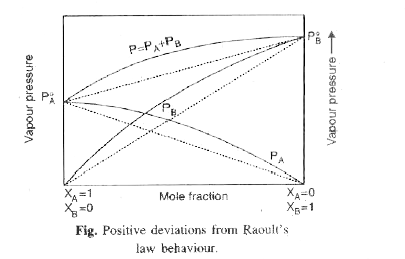 more than pure liquids. As a result each component of the solution has a partial vapour pressure greater than expected on the basis of Raoult.s law. The total vapour pressure will be greater than the corresponding vapour pressure expected in case of ideal solution of the same composition. This type of behaviour of solution is described as positive deviations from Raoult.s law. This may be expressed as `P_A gt P_(A)^(@)x_A` or ` P_Bgt P_(B)^(@) x_(B)` The positive deviations have been shown in Fig. In the figure, dotted lines show the ideal behaviour. Explanation for positive deviations. Let us consider a solution of ethanol and cyclohexane. In ethanol, the molecules are held together due to hydrogen bonding as shown below. 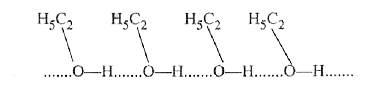 On adding cyclohexane, the cyclohexane molecules come in between the molecules of ethanol, and break the hydrogen bonds. As the RESULTING solution has weaker intermolecular attractions decreases, THEREFORE the escaping tendency of alcohol and cyclohexane molecules from the solution increases. Hence the vapour pressure of the solution is greater than the vapour pressure as expected from Raoult.s law |
|
| 33. |
Mention three areas in which H_2SO_4 plays an important role. |
| Answer» Solution :(i) In manufacture of fertilizers, (ii) In manufacture of PIGMENTS, paints and DRY STUFFS, (iii) In detergent industry. | |
| 34. |
Mention three areas in which H_(2)SO_(4) plays an important role. |
|
Answer» Solution :(i) `H_(2)SO_(4)` is used in the manufacture of fertilizers such as AMMONIUM sulphate, CALCIUM super phosphate. (ii) It is used as an ELECTROLYTE in stroge BATTERIES. (iii) It is used in petroleum refining, detergent INDUSTRY and in the manufacture of paints, pigments and dyes. |
|
| 35. |
Mention the uses the carbon monoxide. |
|
Answer» SOLUTION :(i) Equimolar mixture of hydrogen and carbon monoxide -water gas and the mixture of carbon monoxide and NITROGEN producer gas are important industrial fuels. (II) Carbon monoxide is a good reducing agent and can reduced many METAL oxides to metals. (iii) Carbon monoxide is an important ligand and forms carbonyl compound with transition metals. |
|
| 36. |
Mention three anomalouos behaviour of oxygen. |
|
Answer» Solution :(i) Oxygen is diatomic gas while other ELEMENTS of this GROUP are solids. (ii) Oxygen FORMS hydrogen bonds while other elements do not. (iii) Oxygen has a maximum covalency of FOUR while other elements can SHOW a maximum of six. |
|
| 37. |
Mention the uses of the potash alum. |
|
Answer» Solution :(i) It is used for purification of water. (ii) It is also used for water PROOFING and TEXTILES (III) It is used in dyeing, PAPER and LEATHER tannineg industries (iv) It is employed as a styptic agent to arrest bleeding. |
|
| 38. |
Mention the uses of sulphurdioxide? |
|
Answer» SOLUTION :(i) Sulphur dioxide is used in BLEACHING hair, silk, wool etc………… (II) It can be used for DISINFECTING crops and plants in agriculture. |
|
| 39. |
What are the uses of silicon tetra chloride ? |
|
Answer» Solution :(i) SILICON tetrachloride is used in the PRODUCTION of semiconducting silicon. (II) It is used as a starting meterial in the synthesis of silica gel, SILICIC ester, a BINDER forceramic materials. |
|
| 40. |
Mention the uses of PCl_(3) and PCl_(5)? |
|
Answer» SOLUTION :(i) Phosphorus trichloride is used as a chlorinating AGENT and for the PREPARATION of `H_(3)PO_(3)`. (ii) Phosphorous pentachloride is a chlorinating agent and is USEFUL for replacing hydroxyl groups by chlorine atom. |
|
| 41. |
Mention the uses of phosphorus? |
|
Answer» Solution :(i) The RED phosphorus is used in the match BOXES. (ii) It is also used for the PRODUCTION of certain alloys such as phosphor BRONZE. |
|
| 42. |
Mention the uses of oxygen. |
|
Answer» Solution :1. Oxygen is one of the essential COMPONENT for the survival of living organisms. 2. It is used in welding (oxyacetylene welding) 3. LIQUID oxygen is used as FUEL in rockets etc. |
|
| 43. |
Mention the uses of nitrogen? |
|
Answer» Solution :(i) Notrogen is used for the manufacture of AMMONIA, nitric acid and CALCIUM CYANAMIDE etc. (ii) LIQUID nitrogen is used for producing low TEMPERATURE required in cryosugery, and so in biological preservation |
|
| 44. |
Mention the uses of Neon? |
| Answer» Solution :Neon is used in advertisement as neon sign and the BRILLIANT RED glos is caused by passing electric CURRENT through neon gas under LOW pressure. | |
| 45. |
Mention the uses of methanol. |
|
Answer» Solution :(i) Methanol is uscd as a solvent for PAINTS, VARNISHES, SHELLAC, gums, CEMENT, ete. (ii) Methanol is used in the manufacture of dyes, DRUGS, perfumes and formaldehyde. |
|
| 46. |
Mention the uses of hydrochloric acid ? |
|
Answer» Solution :(i) Hydrochloric acid is used for the manufacture of chlorine, ammonium chloride, GLUCOSE from corn starch etc., (II) It is used in the extractionof glue from BONE and also for purification of bone black. |
|
| 47. |
Mention the uses of Gold (Au). |
|
Answer» Solution :Uses of Gold (Au): 1. Gold, one of the expensive and precious METALS. It is used for coinage, and has been used as standard for monetary SYSTEMS in some countries. 2. It is used extensively in jewellery in its alloy form with copper. It is also used in electroplating to cover other metals with a thin LAYER of gold which are used in watches, artifical limb JOINTS, cheap jewellery, DENTAL fillings and electrical connectors. 3. Gold nanoparticles are also used for increasing the efficiency of solar cells and also used an catalysts. |
|
| 48. |
Mention the uses of Glycerol. |
|
Answer» Solution :1. Glycerol is used as a sweetening agent in confectionery and BEVERAGES. 2. It is used in the MANUFACTURE of COSMETICS and transparent soaps. 3. It is used in making printing inks and stamp pad ink and lubricant for watches and clocks. 4. It is used in the manufacture of explosive like dynamite and cordite by mixing it with china clay. |
|
| 49. |
Mention the uses of formic acid? |
|
Answer» Solution :FORMIC acid. It is used (i) for the dehydration of hides. (ii) as a coagulating agent for rubber latex (III) in medicine for TREATMENT of gout (iv) as an antiseptic in the PRESERVATION of fruit juice |
|
| 50. |
Mention the uses of formaldehyde. |
|
Answer» Solution : (i) 40% aqueous solution of formaldehyde is called formalin. It is used for preserving biological specimens. (II) Formalin has hardening effect, hence it is used for tanning. (iii)Formalin is used in the PRODUCTION of thermo setting plastic known as bakelite, which is OBTAINED by HEATING PHENOL with formalin. |
|