

Saved Bookmarks
This section includes 7 InterviewSolutions, each offering curated multiple-choice questions to sharpen your Current Affairs knowledge and support exam preparation. Choose a topic below to get started.
| 1. |
Mention the uses of formic acid ? |
|
Answer» Solution :Formic acid. It is USED (i) for the dehydration of HIDES. (ii) as a coagulating agent for rubber latex (iii) in medicine for TREATMENT of GOUT (iv) as an antiseptic in the preservation of fruit juice |
|
| 2. |
Mention the uses of Ethyl acetate? |
|
Answer» Solution :ETHYL acetate is USED (i) in the preparation of artificial fruit essences. (II) as a solvent for LACQUERS. (iii) in the preparation of organic SYNTHETIC reagent like ethyl acetoacetate |
|
| 3. |
Mention the uses of Brownian movement. |
|
Answer» Solution :(i) Brownian MOVEMENT enables us to calculate Avogadro Number. (ii) It is used to confirm kinetic THEORY which considers the ceaseles rapid movement of molecules that increases with increase in temperature. (iii) It is used to understand the stability of colloids. As the PARTICLES are in CONTINUOUS rapid movement, they do not come close and HENCE not get condensed. That is Brownian movement does not allow the particles to be acted on by force of gravity. |
|
| 4. |
Mention the uses of aromatic ketone. |
|
Answer» Solution :(i) Acetophenone has been used in perfumery and as a HYPNOTIC under the NAME HYPHONE. (ii)Benzophenone is used in perfumery and in the PREPARATION of benzhydrol drop. |
|
| 5. |
Mention the uses o boron trifluoride. |
|
Answer» SOLUTION :(i) BORON trifluoride is USED for preparing `HBF_(4)` a catalyst in organic CHEMISTRY (ii) It is ALSO used as a fluorinating reagent. |
|
| 6. |
Mentionthe uses of Glycerol . |
|
Answer» Solution :1. Giycerolis USED as asweeteningagentin confectioneryand BEVERAGES. 2. It isusedin themanufactureof COSMETIC sand transparentsoaps. 3. It isusedin makingprintinginksand stamppadinkand lubricantforwatchesand clocks . 4.It isusedin themanufactureof explosivelikedynamineand corditeby mixingit withchinaclay. |
|
| 7. |
Mention the use of boric acid. |
|
Answer» SOLUTION :(i) Boric acid is used in the manufacture of pottery GLAZES, glass, enamels and pigments. (ii) It is used as an ANTISEPTIC and as an eye LOTION. (iii) It is ALSO used as a food preservative. |
|
| 8. |
Mention the unit of K for zero order reaction. |
|
Answer» MOLE `"LITRE"^(-1) "SECOND"^(1)` |
|
| 9. |
Mention the types of compounds formed when small atoms like H, C and N get trapped inside the crystal lattice of transition metals. Also give physical and chemical characteristics of these compounds. |
|
Answer» Solution :COMPOUNDS formed when small atoms like H, C and N get trapped inside the crystal lattice of transition metals are called interstitial compounds. Properties of such compounds are : (i) High melting POINTS HIGHER than those of pure metals. (ii) These compounds are very hard. (iii) They retain metallic CONDUCTIVITY. (iv) They are chemically inert. |
|
| 10. |
Mention the typeof linakge responsible for theformationof the following (i) Primary structureof proteins (ii) Cross linking of polypeptidechains (iii) alpha - helixformation (iv) beta - sheet structure . |
Answer» SOLUTION :
|
|
| 11. |
Mention the type of hybridisation and magnetic propety of the following complexex using VB theory a [FeF_6]^(4-)b)[Fe(CN)_6]^(4-) |
|
Answer» SOLUTION :` (a) [FeF_6]^(4-) ` : Fe atom -outer electronic configuration `3d^(6) 4S^(2) ` ` (##SUR_CHE_XII_V01_C05_E12_001_S01.png" WIDTH="80%"> `F^(-) ` is weak field ligand In ` [FeF_6]^(4-) ` the hybridisation take place is ` sp^(3) d^(2) ` The number of unpaired electrons =4. ` therefore mu =sqrt( 4(4+2) ) =sqrt(24) =4.90 BM` The MOLECULE is paramagnetic due to the presence of unpaired electrons The geometry of the molecules is octahedral (b) `[Fe(CN)_6]^(4-) ` ` (##SUR_CHE_XII_V01_C05_E12_001_S02.png" width="80%"> In ` [Fe(CN)_6^(4-)` complex ,the ` CN^(-) ` ligand is a powerful ligand it forces the unpaired electrons in the 3d level to pair um inside. Hence the species has no unpaired electron after hybridisation ,So the molecule is diamagnetic ` (##SUR_CHE_XII_V01_C05_E12_001_S03.png" width="80%"> The geometry of the molecule is octahedral |
|
| 12. |
Mention the type of compounds formed when small atoms like H, C and N get trapped inside the crystal lattice of transition metals. Also give physical and chemical characteristics of these compounds. |
|
Answer» SOLUTION :The interstitial compounds are FORMED when small sized atoms such as H, B,C and N gets trapped in the interstitials of the metal atoms. The properties of interstitial compounds are: (i) Melting points are high and even higher than pure metals. (II) These compounds are extremely hard (iii) Metallic conducitivity is RETAINED (iv) They are chemically inert |
|
| 13. |
Mention the type of compounds formed when small atoms like H,Cand N get trappedinside the crystal lattice of transition metals, Also give physical and chemical characteristic of these compounds. |
|
Answer» SOLUTION :INTERSTITIAL COMPOUNDS CHARACTERISTICS . |
|
| 15. |
Mention the two crystal systems in which all edge lengths in their unit cell are the same. |
| Answer» SOLUTION :CUBIC and RHOMBOHEDRAL [or TRIGONAL] | |
| 16. |
Mention the specific type of isomerism exhibited by each of the following pairs: {:("1,2-Dibromoethane","and","1,1-dibromoethane"),("n-Butylalcohol","and","diethylether"),("Propionic acid","and","Methylacetate"),("o-Methylphenol","and","benzylalcohol"),("Maleic acid","and","fumaric acid"),("n-Butane","and","Isobutane"),("o-Nitrophenol","and","m-nitrophenol"),("Acetic acid","and","methyl formate"):} |
| Answer» Solution :(a) Position (B) Functional (c)Functional (d) Functional (E) Geometrical (F) CHAIN (G) Position (h) Functional. | |
| 17. |
Mention the SI unit for molar conductivity. |
| Answer» SOLUTION :`Sm^2 mol^-1` | |
| 18. |
Mention the role of cryolite in the extraction of aluminium. |
|
Answer» |
|
| 19. |
Mention the reactions occurring at (i) anode (ii) cathode, during working of a mercury cell. Why does the voltage of a mercury cell remain constant during operation ? |
|
Answer» Solution :The cell reaction are as follows: `{:("ANODE", Zn(HG) + 2OH^(-) to ZnO(s) + H_(2)O(l) + 2e^(-)),("Cathode", HgO(s) + H_(2)O(l) + 2e^(-) to Hg(l) + 2OH^(-)),("Net reaction", Zn(Hg) + HgO(s) to ZnO(s) +Hg(l)):}` Voltage of the mercury cell REMAINS CONSTANT because ions are not involved in the net reaction. |
|
| 20. |
Mention the reactions occuring at (i) anode (ii) cathode , during working of a mercury cell. Why does the voltage of a mercury cell remain constant during its operation? |
|
Answer» Solution :Working of mercury cell: Anode: `Zn(Hg)+2OH^(-) to ZnO(s)+H_2O(l)+2e^(-)` (Amalgam) Cathode: `HgO(s)+H_2O(l)+2e^(-) to Hg(l)+2OH^(-)` Net REACTION: `Zn(Hg)+HgO(s) to ZnO(s)+Hg(l)` AMalgam The operating voltage for mercury cell is 1.35 V and show consistancy throughout its life as the overall reaction does not involve any ION in solution WHOSE CONCENTRATION can change during its life time. |
|
| 21. |
Mention the ratio of 1-chloro-2-methylpropane and 2-chloro-2-methylpropane obtained on photochemical chlorination of 2-methylpropane. |
| Answer» SOLUTION :They will be abtained in 5:9 RATIO | |
| 22. |
Mention the reaction representing example of leaching. |
|
Answer» `3Fe_(2)O_3 + CO to 2Fe_3O_4 + CO_2` |
|
| 23. |
Mention the properties of silicones. |
|
Answer» Solution :(i) All silicones are water repellent. (ii)They are thermal and ELECTRICAL INSULATORS. (III) Chemically they are inert. (IV) Lower silicones are oily liquids whereas higher silicones with long chain structure are waxy solids. (v) The viscosity of silicon oil remains constant and doesn.t change with temperature and the don.t thicken during winter? |
|
| 24. |
Mention the proper choice for the True and False statement. For True statement T and for False statement F are mentioned. (a) Oxygen element possesses -2, -1, +1, +2, oxidation state. (b) The value of electron gain enthalpy of CI element is more negative than that of F element. (c) Ozone is colourless in solid form. (d) Chlorine water when kept for longer times loses yellow colour. |
|
Answer» TFTF |
|
| 25. |
Mention the products formed in the following : (i) Zinc oxide is treated with excess of sodium hydroxide solution. (ii) Iodine is added to a solution of stannous chloride. (iii) Sulphur dioxide gas , water vapour and air are passed over heated sodium chloride. |
| Answer» | |
| 26. |
Mention the principle in iodometry. |
|
Answer» Solution :Even mild oxidants can oxidise iodide to IODINE. The iodine LIBERATED is titrated using sodium thiosulphate in volumetry, using STARCH indicator. Starch - iodine is blue and at the END point blue colour disappears. `2Na_(2)S_(2)O_(3)+I_(2)rarr2NaI+Na_(2)S_(4)O_(6)` |
|
| 27. |
Mention the number of d-electrons in Fe^(+) (Z=26) |
|
Answer» 4 `:.` No. of d-electrons 
|
|
| 28. |
Mention the major product formed in the following reaction: i) ii) 2-bromopentane overset("alc KOH")rarr iii) CH_(3)Br+" Nal" overset("dry acetone")rarr |
Answer» Solution :i)  II) `"2 - bromopentane "overset("alc KOH")rarr CH_(3)-CH=CH-CH_(2)-CH_(3)` III) `CH_(3)I+"NAL "overset("dry acetone")rarr CH_(3)-I` |
|
| 29. |
Mention the major product formed in the following C_(2)H_(5)OH underset(443K)overset("Conc."H_(2)SO_(4))to |
| Answer» SOLUTION :DIETHYL ETHER | |
| 30. |
Mention the major product formed by the following reacton: (a) 2- "Bromo pentane" overset"KOH(Alc.)"underset"Heat"rightarrow (c) C_(2)H_(5)Br+AgCN overset"Heat"rightarrow |
|
Answer» Solution :(a) `underset("2-Bromopentane")(CH_(3) CH_(2) CH_(2) underset(BR)underset(|)(CH)-CH_(3)+KOH_((ALC)) overset("Heat")to underset("PENT -2-ene"))(CH_(3)CH_(2)CH=CH-CH_(30+KBr+H_(2)O))` (B)  (c) `C_(2)H_(5)-Br+AgCN overset("Heat")to underset("Ethyl isocynide")(C_(2)H_(5)NC+AgBr)` |
|
| 31. |
Mention the main postulates of Werner theory. |
|
Answer» SOLUTION :(i) Metal ion has two TYPES of VALENCY. (ii)Primary valency and SECONDARY valency. (iii) Secondary valency is equal to coordination number. |
|
| 33. |
Mention the inductive effect in monochloro acetic acid. |
Answer» Solution :(i) In MONOCHLORO acetic acid, the -I effect of CHLORINE (electron WITHDRAWING group) increases its STRENGTH.  (ii) This effect weakens the -O-H BOND. There by facilitating the removal of `H^(+)` from -OH group. This acid `(ClCH_(2)COOH)` becomes stronger than formic acid. |
|
| 35. |
Mention the important uses of each : PVC |
|
Answer» SOLUTION :Uses ofPVC : (a) It is used for MAKING RAINCOATS, hand bags ETC. (b) It is used in making water pipes. |
|
| 36. |
Mention the important uses of each : Nylon-6, 6 |
|
Answer» SOLUTION :USES of Nylon-6, 6 : (a) It is used in making carpets, textile FIBRES etc. (b) It is used for making ELASTIC hosiery. |
|
| 37. |
Mention the hybridised state of carbonyl carbon atom. |
| Answer» SOLUTION :CARBOXYL CARBON ATOM is `sp^(2)` hybridised. | |
| 39. |
Mention the geometry, magnetic property and type of hybridization in [Ni(CN)_4]^(2-) complex. |
|
Answer» SOLUTION :Square PLANAR complex Diamagnetic `dsp^2` HYBRIDIZATION |
|
| 40. |
Using VBT, explainthe geometry and magnetic property of [Ni(CN)_(4)]^(-2). (Atomic Number of Ni=28). |
|
Answer» Solution : GEOMETRY - Square planar complex Magnetic PROPERTY - DIAMAGNETIC HYBRIDISATION - `DSP^(2)` |
|
| 41. |
Mention the geometry and magentic property of tetracarbonylnickel complex with structure. |
Answer» SOLUTION :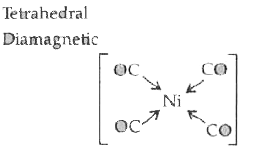
|
|
| 42. |
Mention the geometrical shapes shown by the- following types of hybrid orbitals.sp^3 |
|
Answer» Solution :Tetrahedral SHAPE EXAMPLE: `[ZN(NH_3)_4]^(2+)` |
|
| 43. |
Mention the geometrical shapes obtained by the following types of hybrid orbitals dsp^2 |
|
Answer» Solution :SQUARE PLANAR Example: `[NI(CN)_4]^(2-)[CU(NH_3)_4]^(2+)` |
|
| 44. |
Mention the geometrical shapes obtained by the following types of hybrid orbitals d^2sp^3 |
|
Answer» Solution :OCTAHEDRAL EXAMPLE : `[Cr(NH_3)_6]^(3+)[FE(CN)_6]^(3-)` |
|
| 45. |
Mention the fuels and oxidants used in fuel cells ? |
|
Answer» |
|
| 46. |
Mention two factors that decide order of the reaction. |
|
Answer» Solution :(i) Relative CONCENTRATION of REACTANTS. (ii) Multistep REACTION. |
|
| 47. |
Mention the factors that affect the rate of a chemical reaction. |
|
Answer» SOLUTION :Factors influencing the rate of REACTION are: (i)Concentration of reactants. (ii)SURFACE area (If reactant of catalyst is a solid) (iii)TEMPERATURE (iv)PRESENCE of catalyst (v)Nature reactant (vi)Presence of light |
|
| 48. |
Mention the factors affecting the reaction rate. |
|
Answer» Solution :The rate of the reaction is affected by the FOLLOWING factors. (i) Nature and state of the REACTANT (II) Concentration of the reactant (iii) Surface area of the reactant (iv) Temperature of the reaction (V) Presence of a CATALYST |
|
| 49. |
Mention the factors affecting the reaction rate . |
|
Answer» SOLUTION :The rate of the reaction is affected by the following FACTORS. (i)NATURE and state of the reactant (ii)Concentration of the reactant (III)surface area of reactant (iv)temperature of the reaction. (V)Presence of a catalyst |
|