

Saved Bookmarks
This section includes 7 InterviewSolutions, each offering curated multiple-choice questions to sharpen your Current Affairs knowledge and support exam preparation. Choose a topic below to get started.
| 1. |
Match column I with column II and select the correct answer using the codes given in the list. |
|
Answer» |
|
| 2. |
Match column I with column II and select the correct answer using the codes given in the list. |
|
Answer» |
|
| 3. |
Match column-I with column-II and select the correct answer :- |
|
Answer» <P>`(P) to(4) , (Q) to(1) , (R) to(2) , (S) to(3)` |
|
| 4. |
Match column-I with column-II : {:((A)" Real gas at high pressure",(p)PV=RT+Pb),((B)" Force of attraction among gas Molecules is negligible",(q)PV=nRT),((C)" At high temp. and low pressure",(r)Z=1),((D)" Real gas at NTP",(s) (P+(an^(2))/(V^(2)))(V-nb)=nRT):} |
| Answer» SOLUTION :`A RARR (p), B rarr (q), C rarr (q,R), D rarr (s)` | |
| 6. |
Match Column-I with Column-II |
|
Answer» `{:(P,Q,R,S),(II,I,III,IV):}` |
|
| 8. |
Match column-I to column-II standard entropy in KJ/k-molar at 25^(@)C {:("Column-I","Column-II"),(1.DeltaH_(C-C),(p)733.48),(2.DeltaH_(C-H),(q)97.81),(3.DeltaH_(C=C),(r)434.3),(4.DeltaH_(C-=C),(s)454.64),(5.DeltaH_(C=O),(f)804.22):} Using the dat (all values are in KJ/mol at 25^(@)C) given below: {:(DeltaH_("combustion")^(@)("ethane")=-1559.8 "",""DeltaH_("combustion")("ethane")=-1410.9),(DeltaH_("combustion")^(@)("acetylene")=-1299.7 "",""DeltaH_("combustion")("acetaldehyde")=-1192.3),(DeltaH_(f)^(@)CO_(2)(g)=-393.5 "",""DeltaH_(f)^(@) "of" H_(2)O(l)=-285.8),(DeltaH^(@) "for" C_(s) ("graphite") rarr C_(g)=716.68 "","""Bond energy of H-H =435.94"),("Bond energy of O=O=498.94 "","" ):} |
|
Answer» `{:(,1,2,3,4,5),((A),q,s,r,p,t):}` `15559.8 = 2 xx (-285.8)+ 3 xx (-285.8)-DeltaH_(f(C_(2)H_(6))` `implies "" DeltaH_(f(C_(2)H_(6)) =- 84.6.` 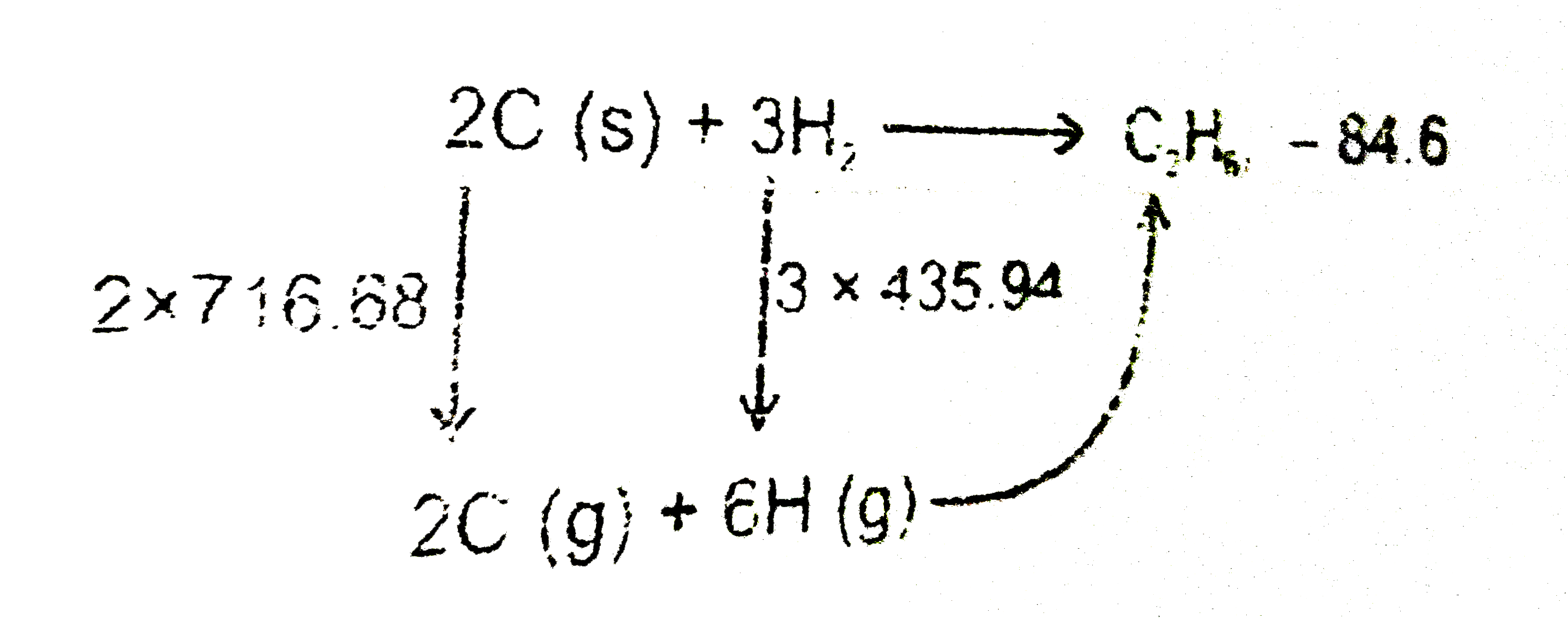 `DeltaH' =0-6 xx BE_(C-H)-BE_(C-C)` `2XX 716.68 + 3 xx 435.94 - 6BE_(C-H) - BE_(C-C) =- 84.6.` `6BE_(C-H)+BE_(C-C) = 2741.18 KJ. ""......(i)` `Ch_(2)CHO + (5)/(2)O_(2) rarr 2CO_(2) + 2H_(2)O, 1192.3.` `-1192.3 = 2xx (-393.5)+ 2 xx (-285.8)-1192.3` 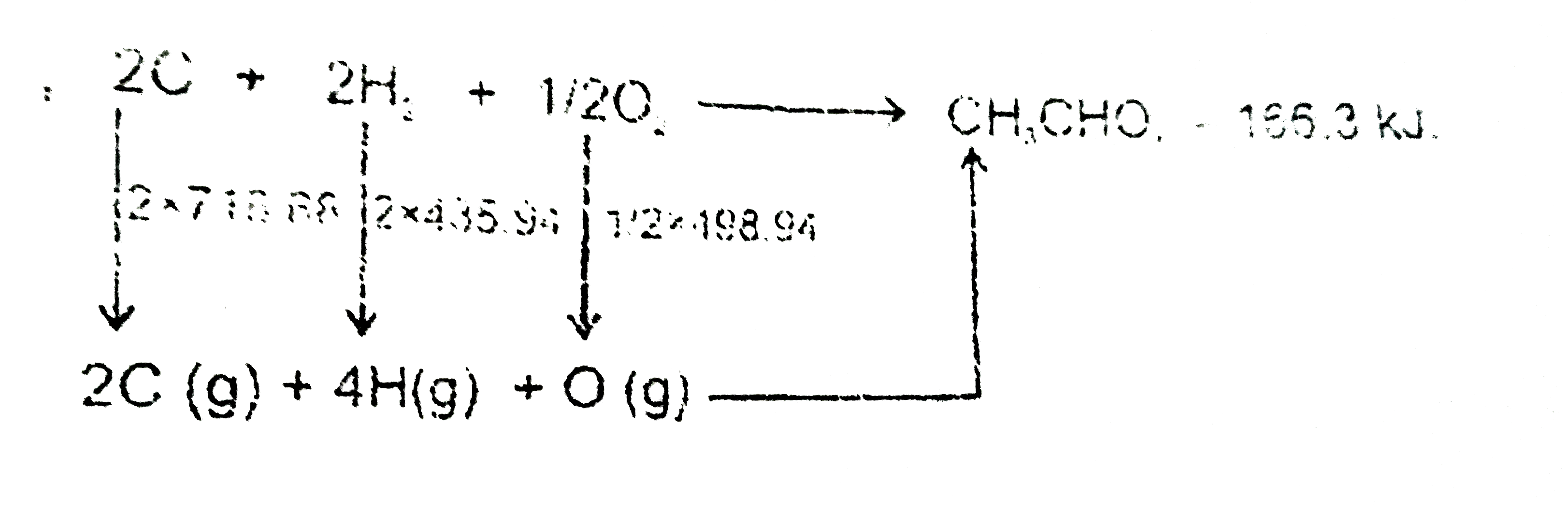 `DeltaH_(f(CH_(3)CHO)) =- 116.3 KJ.` `DeltaH'=0-4 xx BE_(C-H)-BE_(C=0)` `-166.3 =2xx 716.68 + 2 xx 435.94 +(1)/(2) xx 498.94 - 4BE_(C-H) - BE_(C=0) "".....(ii)`  `DeltaH' = 0-2 xx BE_(C=0)` `716.68 + 498.94 -2 xx BE_(C=0)=- 393.5` `BE_(C=0)=804.56 KJ. "".....(iii) ` Now we can find all bond energies. |
|
| 11. |
Match COLUMN-I (Species) with COLUMN-II (O-N-O angle) and select the correct answer using the codes given below the lists : |
|
Answer» Solution :A) `NCl_3+4H_(2)O rarr NH_(4)OH + 3HOCl` B) `PCl_(3)+3H_(2)O rarr H_(3)PO_(3)+3HCl` C) `PCl_(5)+4H_(2)O rarr H_(3)PO_(4) +5HCl` D) `PF_(3)+H_(2)O rarrNO` Hydrolysis (DUE to strong P - F bond) |
|
| 12. |
Match COLUMN-I (Species) with COLUMN-II (O-N-O angle) and select the correct answer using the codes given below the lists : |
Answer» SOLUTION :
|
|
| 13. |
Match COLUMN-I (Species) with COLUMN-II (O-N-O angle) and select the correct answer using the codes given below the lists : |
Answer» SOLUTION :
|
|
| 14. |
Match COLUMN-I (Species) with COLUMN-II (O-N-O angle) and select the correct answer using the codes given below the lists : |
|
Answer» SOLUTION :A) `4NH_(3)+5O_(2)rarr4NO +6H_(2)O` B) `P_4+3NaOH+3H_(2)Orarr3NaH_(2)PO_(2)+PH_(3)` C) `NH_(4)NO_(3) overset(Delta)rarrN_(2)O+2H_(2)O ` D) `Pb(NO_3)_2overset(Delta)rarr2PbO+4NO_2+O_2` |
|
| 15. |
Match COLUMN-I (Species) with COLUMN-II (O-N-O angle) and select the correct answer using the codes given below the lists : |
|
Answer» SOLUTION :A) `CO_2` - colourless, acidic gas B) `SO_2-CO_(2)+H_(2)OrarrH_(2)CO_3` (Carbonic acid) `SO_2+H_(2)O rarr H_(2)SO_3` (Sulphurous acid) C) `NO_2-17` VALENCE `E^(-)` s - Paramagnetic - Broun COLORED gas and acid `2NO_(2)+H_(2)O rarr HNO_(2)+HNO_3` D) `N_2O` - colourless, Neutral |
|
| 16. |
Match COLUMN-I (Species) with COLUMN-II (O-N-O angle) and select the correct answer using the codes given below the lists : |
Answer» SOLUTION :
|
|
| 17. |
Match COLUMN-I (Species) with COLUMN-II (O-N-O angle) and select the correct answer using the codes given below the lists : |
|
Answer» Solution :A) `underset("acid")(HOCl)OVERSET(Delta)RARR underset("Anhyride")(Cl_2O+H_2O)` B) `underset("acid")(HNO_3)overset(Delta)rarrunderset("ANHYDRIDE")(N_2O_5+H_2O)` C) `H_3PO_4overset(Delta)rarrP_2O_5+H_(2)O` D) `HClO_(4)overset(Delta)rarrCl_(2)O_7+H_(2)O` |
|
| 18. |
Match COLUMN-I (Species) with COLUMN-II (O-N-O angle) and select the correct answer using the codes given below the lists : |
|
Answer» Solution :A) `Mg+underset("Verydil")(2HNO_3)rarrMg(NO_3)_2+UL(H_2)""` B) `4Zn+underset("dil")(10HNO_3)rarr4Zn(NO_3)_(2)+ul(N_2O)+5H_2O` C) `4Sn+underset("dil")(10HNO_3)rarr4Sn(NO_3)+ul(NH_(4)NO_3)+3H_2O` D) `3Pb+3HNO_3rarr3Pb(NO_3)+4H_2O+ul(2NO)` |
|
| 19. |
Match column (I) (process) with column (II) (electrolyte) {:("Column (I) (process)", "Column (II) (electrolyte)"),( (1) "Castner Kellner.s cell", (P) Cu),( (2) "Self-reduction", (Q) "fused " (Al_(2)O_(3)+Na_(3)AlF_(6)+CaF_(2))),( (3) "Hall-Heroult", (R ) "Brine solution"):} |
|
Answer» <P> |
|
| 20. |
Match COLUMN-I (Species) with COLUMN-II (O-N-O angle) and select the correct answer using the codes given below the lists : {:("COLUMN - I","COLUMN - II"),("A)" NO_(2)^(+),"p)" 180^@),("B)" NO_(2),"r)" 132^@),("C)" NO_(2)^(-),"r)" 120^@),("D)" NO_(3)^(-),"s)" 115^@):} |
Answer» SOLUTION :
|
|
| 21. |
Match column-I (Solution of salts of salts of...) with column-II (pH of the solution is given by): |
|
Answer» |
|
| 22. |
Match COLUMN-I (Species) with COLUMN-II (O-N-O angle) and select the correct answer using the codes given below the lists : {:("COLUMN - I","COLUMN - II"),("(Mixtures)","(Solution used for separation)"), ("A)" N_2 and CO,"p) Water"),("B)" N_2 and O_2,"p)"H_2SO_4),("C)" N_2 and NH_3,"r) Ammonical CuCl"),("D)" PH_3 and NH_3,"s) Pyrogallol"):} |
|
Answer» Solution :A) `N_2 and CO-H_(2)SO_4` B) `N_2 and O_2` - pyrogallol absorbs `O_2` C) `N_(2) and NH_3 rarr NH_3` - is ABSORBED on water as it is water soluble `NH_3+H_(2)OrarrNH_4OH` D) `PH_(3) and NH_3 rarrNH_3` FORM salts with `H_2SO_4` while `PH_3` does not `2NH_3H_(2)SO_(4)rarr(NH_(4))_2SO_(4)` |
|
| 23. |
Match column I containing magnitude of observed colligative property with column II having concentration of electrolytes. Assume all solutions to behave like very dilute aqueous solution with perfectly non-volatile solute. |
|
Answer» |
|
| 24. |
Match Column-I (Compounds) with Column - II (Oxidation states of Co) and select the correct answer using the codes given below the Columns |
Answer»  GLYCINATE is bidentate ligand , `NH_(2)-CH_(2)-COO^(-)` |
|
| 25. |
Match Column-I (Compounds) with Column - II (Oxidation states of Co) and select the correct answer using the codes given below the Columns |
|
Answer» |
|
| 26. |
Match column I and column II {:("(A)Benzene sulphonyl chloride", " (p) zwitter ion") , ("(B) Sulphanilic acid " , "(q)Hinsberg reagent"),(" (C)Alkyl diazonium salts" ,"(r) Dyes") , ( "(D)Aryl diazonion salts" , " (s) Conversion to alcohols"):} |
|
Answer» A-p, B-q, C-s, D-r |
|
| 27. |
Match column-I and column-II and select the answer : |
|
Answer» (a-s), (b-r), (c-q), (d-p) |
|
| 28. |
Match column A (catalyst) with column B (process) {:("Column A", " ""Column B"),(1. SO_(2),i. "Cracking of hydrocarbons"),(2. Pt, ii."Alkylation of benzene"),(3. "Zeolites", iii."Automobile converter"):} |
|
Answer» 1-(i), 2-(II), 3-(iii) |
|
| 29. |
Match column I and column II {:( "((A)Ammolysis", " (p) Amine with lesser no. of carbon atom") , ("(B) Gabriel phthalimide " , "(q) Detection of primary amine"),(" (C)Hoffmann bromide amide degradation" ,"(r) Reaction of pthalimide with KOH and R-X") , ( "(D)Carbylamine reaction" , " (s) Reaction of alkyl halides with" NH_(3)):} |
|
Answer» A-s, B-r, C-p, D-q |
|
| 30. |
Mass of O_(2) that can be obtained from 500 ml 15 V H_(2)O_(2) aqueous solution is__________ |
|
Answer» `6.42 gm` `M = (15)/(11.2)` Moles of `H_(2)O_(2) = (15)/(11.2) xx (1)/(2)` mole `H_(2)O_(2) rarr H_(2)O + (1)/(2) O_(2)` Moles of `O_(2)` FORMED `= (15)/(11.2) xx (1)/(4)` MASS of `O_(2) = (15)/(11.2) xx (1)/(4) xx 32` `= 10.7 gm` |
|
| 31. |
Match Column-A and Column-B. {:(""A,""B),("(P)Distillation","(x) Titanium"),("(Q) Van arkel","(Y) Zinc"),("(R ) Mond carbonyl", "(Z) Nickel"):} |
|
Answer» <P>`P to X, Q to Y , R to Z` (Q) Titanium (Ti) is obtained by Van Arkel method. (R) Nickel (Ni) is obtained by MOND CARBONYL process. |
|
| 32. |
Match column–I with column–II and select the correct answer using the codes given below : Column–I (Metals) (I) Iron & copper (II) Zirconium & Titanium (III) Lead & Tin (IV) Copper & Tin Column–II (Method used for refining) (P) Poling (Q) Bessemerisation(R) Van–Arkel(S) Liquation |
|
Answer» `I to P , II to S , III to R , IV to Q` |
|
| 33. |
Match column–I and column–II and select the correct answer using the codes given below the lists: |
|
Answer» I–(3) II–(1), III–(4), IV–(2) |
|
| 34. |
Match column–I (process) with column–II (electrolyte) : Column–I (process) (i) Downs cell (ii) Dow sea water process (iii) Hall–Heroult (iv) Moissan Column–II (electrolyte) (W) Fused MgCl_2 (X) fused (Al_2O_3 + Na_3AlF_6 + CaF_2) (Y) fused KHF_2 (Z) fused (40%NaCl + 60% CaCl_2 ) Choose the correct alternate |
|
Answer» `(i) to Z , (II) to W , (iii) to X , (IV) to Y` |
|
| 35. |
Match box is………. |
|
Answer» CUBIC |
|
| 36. |
Match and followings |
| Answer» Solution :(i) -(c) (II)-(a) (iii) - (d) (IV)-(d) (iv)- (B) (v)-(G) (vi) -(f) (vii) - (e) | |
| 37. |
Massicot is prepared by : |
|
Answer» Heating TIN in AIR at about `300^@C` |
|
| 38. |
Mass of one atom of oxygen is/are: |
|
Answer» 16amu |
|
| 39. |
Mass of one atom of an element is 4.0X10^-24 g. This is equal to |
|
Answer» 2.4 u |
|
| 40. |
Mass of human DNA molecule is 1 fg. It may be expressed in kilogram as : |
|
Answer» `1 xx 10^(-12 ) kg ` `1 = (10^(-15) g)/(1 fg)` Now ` 1G = 10^(-3) kg ` `1 = (10^(-3) g)/(1g)` ` 1fg= 1 fg xx ( (10^(-15) g)/(1fg) ) xx ( (10^(-3) kg)/(1g) )` `= 10^(-18) kg ` |
|
| 41. |
Mass of neutron is……..times the mass of electron. |
|
Answer» 1840 |
|
| 42. |
Mass of H_(2)O present in air in 10 lit. closed vessel with 80% relative humidity at 1 atm and 400 K ? [Vapour pressure of water at 300 K = 0.04 atm] |
|
Answer» 0.18 gm `P_(H_(2)O(g)) = 0.8 xx 0.04` PV = nRT for water wapour `0.8 xx 0.04 xx 10 = n_(H_(2)O) xx (0.08)/(10) xx 400` `n_(H_(2)O) = 0.01` `W_(H_(2)O) = 0.01 xx 18 = 0.18 gm` |
|
| 43. |
Mass of copper deposited by the passage of 2 A of current for 965 seconds through a 2M solution of CuSO_(4) is (At.mass of Cu = 63.5) |
|
Answer» `0.325` g `W = Z xx ixx t ` , But `Z = (E)/(96500)` [E = EQ. MASS of `Cu = (63.5)/(2)` in `CuSO_(4)`, Cu is in + 2 state] `= (63.5)/(2) xx (2 xx 965)/(96500) = 0.635` g |
|
| 44. |
Mass of a typical star is 1.0xx10^(30) kg. Assume that a star is typically 3//4 hydrogen and 1//4 helium by mass. The estimated number of protons (which are present in H as well as He) in a typical star is approximately |
|
Answer» |
|
| 46. |
Mass of ""_(3)^(7) Li is 7.016004 amu. Mass of proton is 1.007277 amu and mass of neutron is 1.008665 amu. Mass defect of lithium nucleus in amu is |
|
Answer» `0.04948` amu and NEUTRONS = `7- 3 = 4`. Mass of 3p and 4n = `3 XX 1.007277 + 4 xx 1.008665` amu `= 7.056491` amu `:.` Mass defect = `7.056491 - 7.016005 = 0.040486` amu. |
|
| 47. |
Mass of 0.1 mole of methane is |
|
Answer» 1.6 g `0.1=(w)/(M_(CH_(4)))` `0.1=(w)/(16)(becauseM_(CH_(4))=16)rArrw=1.6gm`. |
|
| 48. |
Mass number and atomic number of an atom are 232 and 90 respectively. How many alpha- particles of this atom must emit, after the emission of 2 beta-particles, such that the mass number and atomic number of new element are 212 and 82 respectively |
|
Answer» In above nuclear reaction, `232 = 212 + m xx 4` or `m = (232 - 212)/(4) = 5 alpha`- PARTICLES |
|
| 49. |
Mass defect in the nuclear reactions may be expressed in terms of the atomic masses of the parent and daughter nuclides in place of their nuclear masses. The mass defect of nuclear reaction, ._(4)Be^(10) rarr ._(5)B^(10)+e^(-) is |
|
Answer» `DELTAM = at` MASS of `._(4)Be^(10)`- at mass of `._(5)B^(10)` |
|
| 50. |
Mass defect in the nuclear reactions may by expressed in terms of the atomic masses of the parent and daughter nuclides in place of their nuclear masses. The mass defect of the nuclear reaction""_(5)B^(8) rarr_(4)Be^(8) + e^(+) is |
|
Answer» <P>`Delta m="At. mass of " ._(5)B^(8)-"At. mass of " _(4)B^(8)` Mass defect `(Delta m)=(5m_(p)+3m_(N))-[(4m_(p)+4m_(N) )+m_(e+)]` `""=(5m_(p)+3m_(N))-[(4m_(p)+4m_(N))+m_(e+)]+5m_(e)- -5m_(e)-` `(because m_(e^(-)=M_(e+)))" " =(5m_(p)+3m_(N)+5M_(e^(-)))-[4m_(p)+4m_(N)+4m_(e^(-))]-2m_(e^(-))` =At mass of `._(5)B^(8)`-At. mass of `._(4)Be^(8)` mass of two electron |
|