

Saved Bookmarks
This section includes 7 InterviewSolutions, each offering curated multiple-choice questions to sharpen your Current Affairs knowledge and support exam preparation. Choose a topic below to get started.
| 1. |
Mass defect in the nuclear reactions may be expressed in terms of the atomic masses of the parent and daughter nuclides in place of their nuclear masses. The mass defect of the nuclear reaction: ._(5)B^(8) rarr ._(4)Be^(8)+e^(+) is |
|
Answer» `Deltam=at` mass of `._(5)B^(8)-at` mass of `._(4)Be^(8)` |
|
| 2. |
Mass and energy are conserved. It is demonstrated by ___________ . |
|
Answer» FIRST LAW of thermodynamics |
|
| 3. |
Mass and energy are conserved is demonstrated by |
|
Answer» first law of thermodynamics |
|
| 4. |
Marshall's acid overset(H_(2)O) to A+B Aoverset(H_(2)O)toB+C If P and Q represent maximum number of atoms that can lie in a plane of compound A and C respectively. Then, find out value of (P-Q). |
|
Answer» `underset((A))(H_(2)SO_(5))+H_(2)O to underset((C))(H_(2)O_(2))+underset((B))(H_(2)SO_(4))` 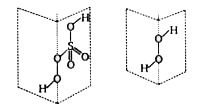 P=5 Q=3 P-Q=5-3=2 |
|
| 5. |
Marshall's acid (H_(2)S_(2)O_(8)) or peroxodisulphuric acid is prepared by the electrolytic oxidation of mmolH_(2)SO_(4) as : 2H_(2)SO_(4) rarr H_(2)S_(2)O_(8)+2H^(o+)+2e^(-) O_(2)(g) and H_(2)(g) are obtained as byproducts. In such electrolysis 4.48L of H_(2)(g) and 1.12L or O_(2)(g) were produced at STP. The weight of H_(2)S_(2)O_(8) formed is a. 9.7g""b.19.4g""c.14.5g""d.29.1g |
|
Answer» Solution :`b.` Refer Section `(point h)`. Aqueous `UNDERSET((dil or conc))(H_(2)SO_(4)) overset(El ectrolysis)rarr2H^(o+)+SO_(4)^(2-)` At anode, two reactions are COMPETING `:` `i. 2SO_(4)^(2-) rarr S_(2)O_(8)^(2-)+2e^(-)` `ii. H_(2)O rarr (1)/(2)O_(2)+2H^(o+)+2e^(-)` At cathode, only one reaction occurs `:` `2H^(o+) (` from `H_(2)SO_(4)) +2e^(-) rarr H_(2)(g)` SINCE onereaction at cathode and two reactions at anode are taking place, therefore, the EQUIVALENT of `H_(2)(g)` produced at cathode at cathode should be equal to the equibalent of `O_(2)(g)` produced `+` equivalent of `H_(2)S_(2)O_(8)` formed. `:.` Equivalent of `H_(2)=`Equivalent of `O_(2)+` Equivalent of `H_(2)S_(2)O_(8)` `(4.48)/(22.4//2)=(1.12)/(22.4//4)+(W_(H_(2)S_(2)O_(8)))/(194//2)` `0.4=0.2+(W)/(97)` `:. W_(H_(2)S_(2)O_(8)=19.4g` |
|
| 6. |
Marshall's acid is used for laboratory preporations of : |
|
Answer» `H_2O ` |
|
| 8. |
Marsh test is applied for the detection of |
|
Answer» N |
|
| 10. |
Markownikoff's rule provides guidance of addition of HX on |
|
Answer» `CH_(2)=CH_(2)` |
|
| 11. |
Marsh gas mainly contains _____ . (H_2S, CO, C_2H_2, CH_4) |
|
Answer» METHANE |
|
| 12. |
Markownikoff's rule governs the addition of |
|
Answer» ASYMMETRICAL reagent to symmetrical alkenes |
|
| 13. |
Markownikoff rule provides guidance of addition of HBr |
|
Answer» `CH_2=CH_2`  According to MARKOWNIKOFF's rule H atom or POSITIVE part GOES to that CARBON atom which more hydrogenated |
|
| 14. |
Markovnikov's rule governs the addition of |
|
Answer» UNSYMMETRICAL REAGENTS to SYMMETRICAL ALKENES |
|
| 15. |
Mark the wrong statement. Carbon differs from other elements due to : |
|
Answer» its ABILITY to form multiple bonds |
|
| 16. |
Mark the wrong statement. Halogens are all coloured |
|
Answer» This is DUE to absorbption of visible light by their molecules resulting in the excitation of outer electrons to higher ENRGY levels. |
|
| 17. |
Mark the wrong statement about H_2SO_4 . |
|
Answer» It acts as a reducing agent It is less viscous than water. |
|
| 18. |
Mark the wrong statement among the following. The iron ore after washing is roasted with a little coal in excess of air. During roasting |
|
Answer» moisture is REMOVED |
|
| 19. |
Mark the wrong statement about enzymes |
|
Answer» Enzymes are highly specific both in BINDING chiral substrates and in catalysing their reactions |
|
| 20. |
Mark the wrong statement about denaturation of proteins |
|
Answer» The primary structure of the protein does not change |
|
| 21. |
Mark the wrong staement among the following. The iron ore after washing is roasted witha little coasl in excess of air. During roasting |
|
Answer» Moistuyre is removed |
|
| 22. |
Mark the variety of iron which has highest melting point |
|
Answer» PIG iron |
|
| 23. |
Mark the strongest acid |
|
Answer» HF |
|
| 24. |
Markthe incorrentstatements. |
|
Answer» Catalyst PROVIDES an alternative pathway to REACTION mechanism Catalyst does not change the enthalpy change of reaction. Energy of reactant and product remain same in both catalysed and UNCATALYSED reaction. Hence, (a) and (d) are incorrect statements. |
|
| 25. |
Mark the steel in which carbon % is highest |
|
Answer» MILD steel |
|
| 26. |
Mark the incorrect statements: |
|
Answer» CATALYST provides an alternative pathway to reaction mechanism. |
|
| 27. |
Mark the incorrect used of the polymer. |
|
Answer» HIGH density POLYTHENE - Buckets , pipes |
|
| 28. |
Mark the incorrect statements. |
|
Answer» Catalyst provides an ALTERNATIVE PATHWAY to reaction MECHANISM. |
|
| 29. |
Mark the incorrect statement (s). |
|
Answer» Potassium dichromateoxidises a secondaryalcoholinto a ketone . Tertiary alcohols are resistanceto oxidation in NEUTRAL or alkaline`KMnO_(4)`solutionbut are readilyoxidisedin acidic solution ` (KMnO_(4)//H_(2)SO_(4))` to a mixtureof a ketoneand an acid eachcontaininglessernumber of carbonatomsthan theoriginalalcohol. |
|
| 30. |
Markthe incorrect statement (s) for fuel cell |
|
Answer» it is USED in pollo space programme and for drinking water supply for astronauts |
|
| 31. |
Mark the incorrect pair from the following. |
|
Answer» Schottky defect- Equal number of cations and anions are missing |
|
| 32. |
Mark the incorrect example. |
|
Answer» KERATIN and myosin-Fibrous PROTEINS |
|
| 33. |
Mark the incorrect statement. |
|
Answer» Copper is EXTRACTED by SMELTING in a reverberatory furnace. |
|
| 34. |
Mark the gas which turns lime water milky |
|
Answer» `H_(2)S` `Ca(OH)_(2)(aq.)+CO_(2)tounderset(("milky"))(CaCO_(3))darr+H_(2)O` `Ca(OH)_(2)+SO_(2)tounderset(("milky"))(CaSO_(3))darr+H_(2)O` |
|
| 35. |
Mark the halogen which shows electropositive character: |
|
Answer» F |
|
| 37. |
Mark the correct statement (s). (1) Manganese exhibits +7 oxidation state (2) Zinc forms coloured ions (3)[CoF_(6)]^(3-) is diamagnetic (4) Sc forms +4 oxidation state (5) Zn exhibits only +2 oxidation state. |
|
Answer» 1 and 2 |
|
| 38. |
Mark the correct statements out of the following |
|
Answer» He has highest `IE_(1)` in the periodic table. |
|
| 39. |
Mark the correct statements about halogens. |
|
Answer» Electron AFFINITY of halogens is in the order `F gt Clgt Brgt I`. |
|
| 40. |
Mark the correct statements out of the following: |
|
Answer» `He` and the highest `I.E_(1)` in the periodic table |
|
| 41. |
Mark the correct statements(s) (1) Manganeses exhibits +7 oxidation state (2) Zinc forms coloured ions (3) [CoF_(6)]^(3-) is diamagnetic (4) Sc forms +4 oxidation state (5) Zn exhibits only +2 oxidation state |
|
Answer» (i) and (II) |
|
| 42. |
Mark the correct statements: |
|
Answer» Hg forms an AMALGAM with iron |
|
| 43. |
Mark the correct statement about thiokol rubber . |
|
Answer» It is a SYNTHETIC POLYSULPHIDE RUBBER |
|
| 44. |
Mark the correctstatement |
|
Answer» METHYL AMINE isslightlyacidic |
|
| 45. |
Mark the correct statement |
|
Answer» Methyl amine is slightly acidic |
|
| 46. |
Mark the correct relationship between the boiling points of very dilute solutions of BaCl_(2)(t_(1)) and LCl(t_(2)) ,having the same molarity |
|
Answer» `t_(1)=t_(2)` |
|
| 47. |
Mark the compound which turns black with NH_(4)OH |
|
Answer» Lead chloride |
|
| 48. |
Mark the compound which turns black with NH_4 OH |
|
Answer» LEAD CHLORIDE 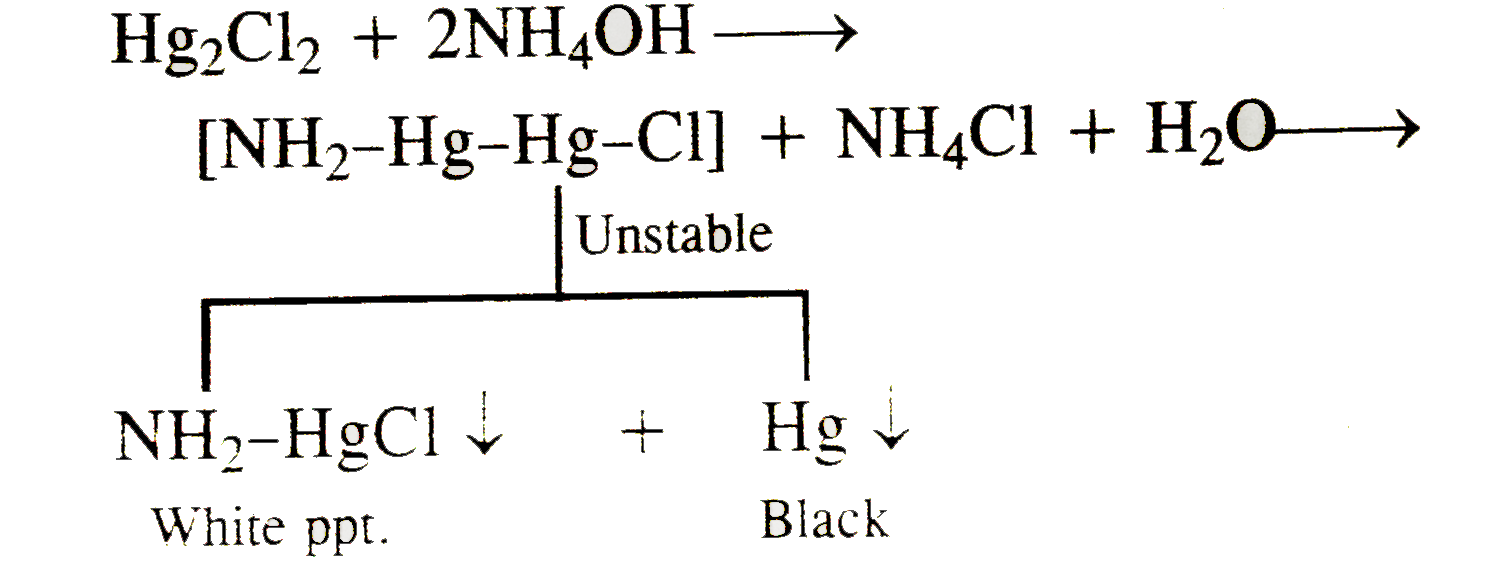
|
|
| 49. |
Mark the axymmetric carbon atoms and give the number of optical isomers in the following compounds: (i) CH_(3)-(CHOH)_(2)-COOH (ii) HOCH_(2)-(CHOH)_(4)-CHO (iii) HOCH_(2)-(CHOH)_(4)-CH_(2)OH |
Answer» Solution : the compound cannot be divided into equal HALVES and it consists of two ASYMMETRIC carbon atoms Hence, the NUMBER of d- and il-(optically active ) isomers, `a=2^(n)=2^(2)=4` and Number of meso forms, m=0 So, Total optical isomers `=a+m-4+0=4`   Where, `n=4,a=2((4-1))-2^(3)=8,m=2^((4//2-1))=2^((2-1))=2`. `r=(8)/(2)=4` So, Total optical isomers =8+2=10 |
|