Saved Bookmarks
This section includes 7 InterviewSolutions, each offering curated multiple-choice questions to sharpen your Current Affairs knowledge and support exam preparation. Choose a topic below to get started.
| 1. |
In which of the following pairs both the solids belong to same type ? |
|
Answer» SOLID `CO_(2)`, ZnS |
|
| 2. |
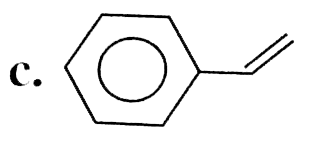
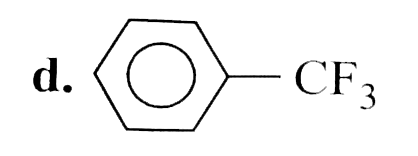
In which case will SE not be in m- position? |
|
Answer»
c. It is weakly deactivating BTU `o, p-` director. d. `(-CF_(3))` group, `(a),(b)` and `(d) are `m-` director. |
|
| 3. |
In which of the following pairs, both the minerals are oxides ? |
|
Answer» SYLVINE, salpetreb |
|
| 4. |
In which case, the order of acidic strength is not correct? |
|
Answer» `HI gt HBR gt HCl` `HClO_(4)gt HBrO_(4)gt HIO_(4)` |
|
| 5. |
IN which of the following pairs, both the ions are coloured in aqueous solutions ? |
|
Answer» `Sc^(3+), Ti` |
|
| 6. |
In which case the product is neither a cyclic ether nor open chain symmetrical ether- |
|
Answer» `CH_(3)-CH=CH-CH_(3)overset(C_(6)H_(5)CO_(3)H)to` |
|
| 7. |
In which of thefollowingpairs both thehydrides are not of the sametype |
|
Answer» `"PH"_(3),"SIH"_(4)` |
|
| 8. |
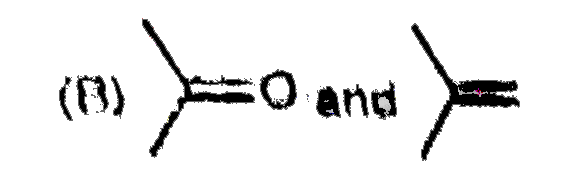
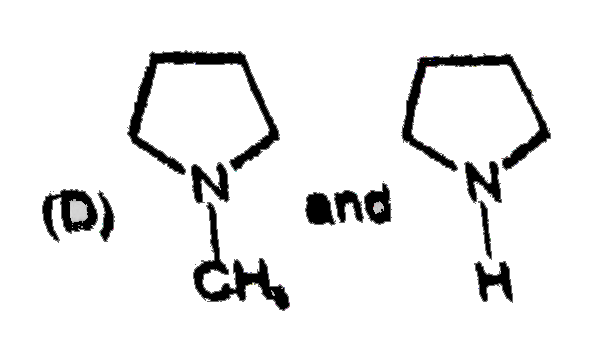
In which case second has lower boiling point than first ? |
|
Answer»

|
|
| 9. |
In which of the following pairs both the complexes show optical isomerism? |
|
Answer» `Cis-[CrCl_(2)(OX)_(2)]^(2-),"trans"-[CrCl_(2)(OX)_(2)]^(3-)` 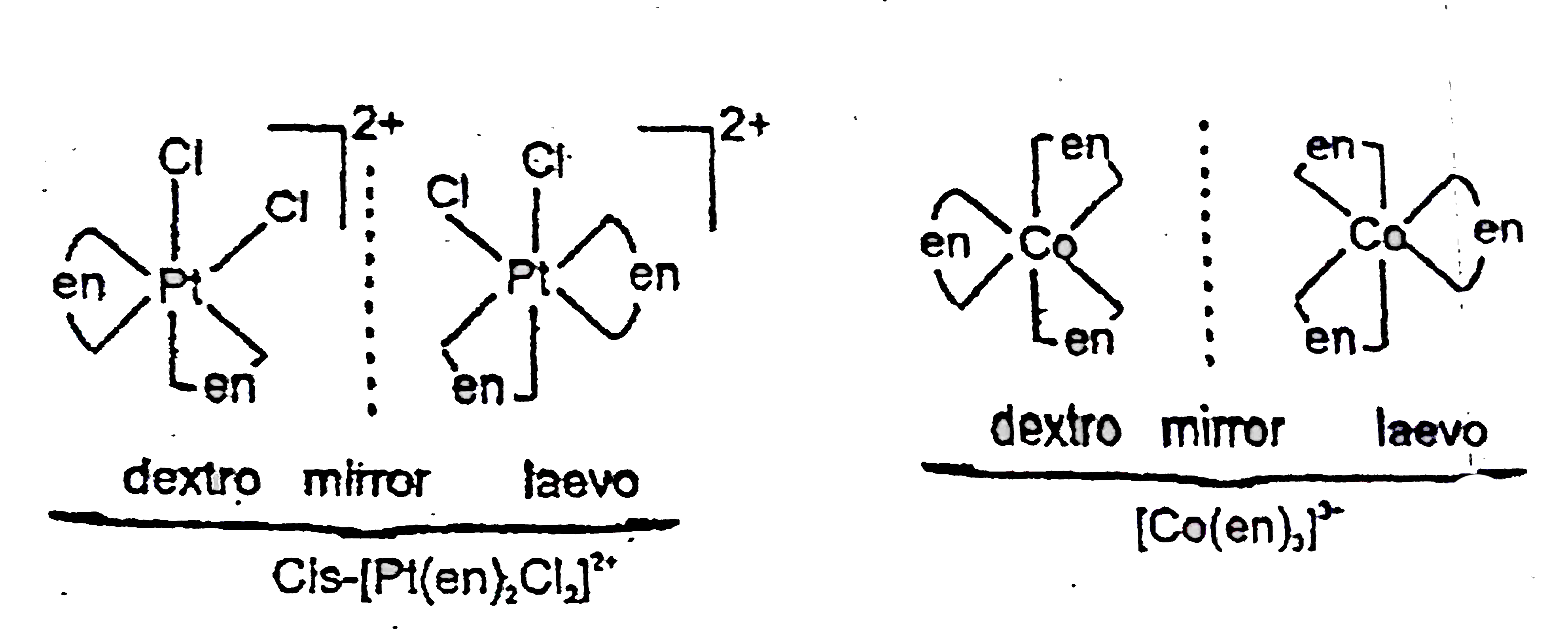
|
|
| 10. |
In Which case (s), there is change in oxidation number ? |
|
Answer» AQUEOUS solution of `CrO_(4)^(2-)` is acidified `overset(+6)Cr_(2)O_(4)^(2-)+3overset(+4)SO_(2)+2H^(+)rarr2overset(+3)Cr^(3+)+3overset(+6)SO_(4)^(2-)+H_(2)O" "("change")` `overset(+6)Cr_(2)O_(7)^(2-)+2OH^(-)rarr2overset(+6)CrO_(4)^(2-)+H_(2)O" "("no change")` `overset(+6)CrO_(2)Cl_(2)+2NaOHrarrNaoverset(+6)CrO_(4)+2HCl" "("no change")`. |
|
| 11. |
In which of the following pairs both the complexes show optical isomerism - |
|
Answer» `cis - [CR(C_(2)O_(4))_(2)Cl_(2)]^(3-) , cis - [CO(NH_(3))_(4)Cl_(2)]`<BR>`[Co(en)_(3)]Cl_(3), cis-[Co(en)_(2)Cl_(2)]CL` |
|
| 12. |
In which case the carbon-carbon bond length is same ? |
|
Answer» 2-butene |
|
| 13. |
In which of the following pairs both the complexes show optical isomerism ? |
|
Answer» CIS-`[Cr(C_(2)O_(4))_(2)Cl_(2)]^(3-)`, TRANS-`[Co(NH_(3)_(4)Cl_(2)]`<BR>`[Co(en)_(3)Cl_(3)`, cis-`[Co(en)_(2)Cl_(2)]Cl` |
|
| 14. |
In which case reaction is spontaneous |
|
Answer» `DeltaH-ve, DeltaS+ve` |
|
| 15. |
In which of the following pairs both the complexes do not show optical isomerism ? |
|
Answer» `cis-[Cr(en)_(2)Cl_(2)]" and "cis-[CO(NH_(3))_(4)Cl_(2)]` `[Pt("en")Cl_(2)]` does not show O.I. and G.I. |
|
| 16. |
In which of the following pairs at least one of the compounds give positive Tollens test? |
|
Answer» GLUCOSE and sucrose |
|
| 17. |
In which case racemic mixture is obtained on mixing its mirror images in 1:1 molar ratio ? |
|
Answer» `[Cr(en)_(3)]^(3+)` |
|
| 18. |
In which of the following pairs both are nucleophiles ? |
|
Answer» `BF_(3),AlCl_(3)` |
|
| 19. |
In which case racemic mixture is obtained on mixing its mirror images (d & l form) is 1:1 molar ratio: |
|
Answer» trans-`[Co(GLY)_(3)]` |
|
| 20. |
In which of the following pairs are the ions isoelectronic ? |
|
Answer» `Mg^(2+),Ar` |
|
| 21. |
In which of the following pair of metals, both are commercially extracted from their respective ores by carbon reduction method ? |
|
Answer» ZN, Cu |
|
| 22. |
In which of the following pair, both the species are isoelectronic but the first one is large in size than the second? |
|
Answer» <P>`S^(2-),O^(2-)` |
|
| 24. |
In which of the following pair both the crystals are not of the same type ? |
| Answer» Answer :A | |
| 25. |
In which case R - COOH is not product? |
|
Answer» `R - CN + RMGX to` |
|
| 26. |
In which of the following ozone acts as reducing agent? |
|
Answer» `BaO_(2)+O_(3)rarrBaO+2O_(2)` |
|
| 27. |
In which of the following ozone is completely consumed? |
|
Answer» KI is oxidised to `I_(2)` by ozone |
|
| 28. |
In which case of mixing of a strong acid and a base, each being of 1 N concentration, the increase in temperature is the highest ? |
|
Answer» 20 mL ACID and 30 mL alkali |
|
| 29. |
In which of the following ozone acts as reducing agent ? |
|
Answer» `BaO_2 + O_3 to BAO + 2O_2` |
|
| 31. |
In which case of mixing of a strong acid and a strong base each of 1 M concentration. Temperature increase is the highest ? |
|
Answer» 15 ml acid and 40 ml alkali |
|
| 32. |
In which of the following oxidation number of chlorine is +5 is : |
|
Answer» HCIO |
|
| 33. |
In which case methyl-t-butyl ether is formed |
|
Answer» `(CH_(2)H_(5))_(3)CONa+CH_(3)Cl` |
|
| 34. |
In which of the following ores at least metal is in +3 oxidation state and crystal system is orthorhombic |
|
Answer» Haematite |
|
| 35. |
In which of the following orders base, phosphate and sugar are arranged in the nucleotide of DNA ? |
|
Answer» Base-Phosphate-sugar |
|
| 36. |
In whichcase Methyl-butyl ether is formed ? |
|
Answer» `(C_2H_5)_3CONa+CH_3Cl ` |
|
| 37. |
In which of the following options all species contain X–O–X bonds in structure (X = central atom) |
|
Answer» `H_(2)S_(2) O_(5), S_(3), O_(9), S_(2)O_(6)^(-2)` |
|
| 38. |
In which case methyl t-butyl ether is formed ? |
|
Answer» `(C_3H_5)_3CONa+CH_3Cl` |
|
| 39. |
In which case is a reaction possible at any temperature ? |
|
Answer» `DELTAHLT0, DeltaSgt0` |
|
| 41. |
In which case is a reaction impossible at any temperature ? |
|
Answer» `DELTAHGT0,DeltaSgt0` |
|
| 42. |
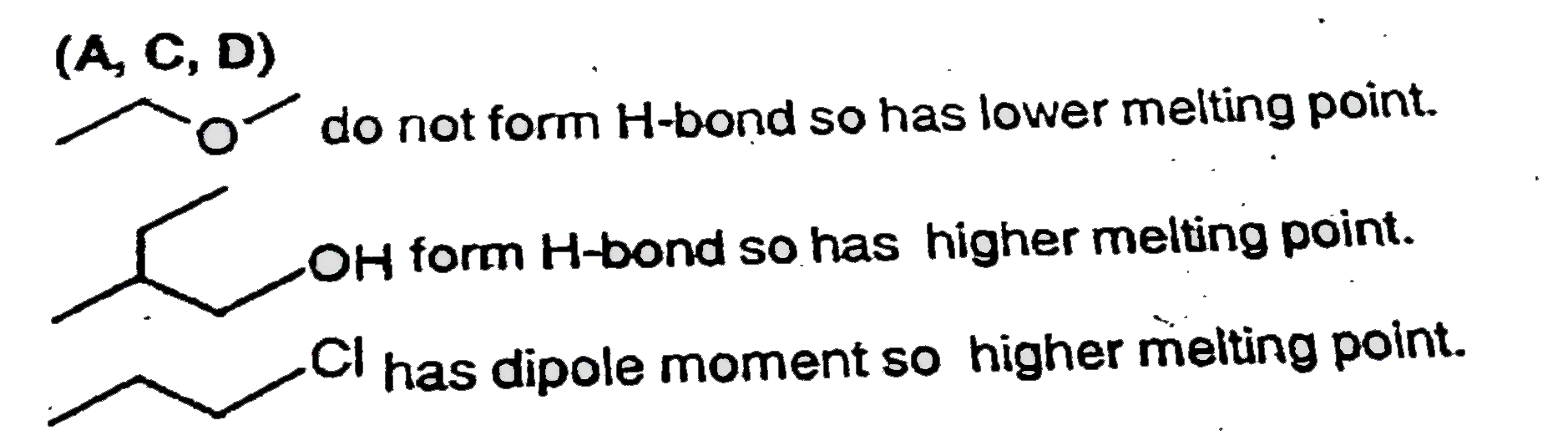
In which case first has lower melting point than second ? |
|
Answer»
|
|
| 43. |
In which case first has higher solubility than second ? (I)Phenol, Benzene , (II)Nitrobenzene, Phenol , (III)o-Hydroxybenzaldehyde, p-Hydroxy benzaldehyde , (IV)Ethanal, Dimethylether, (V) |
|
Answer» only I 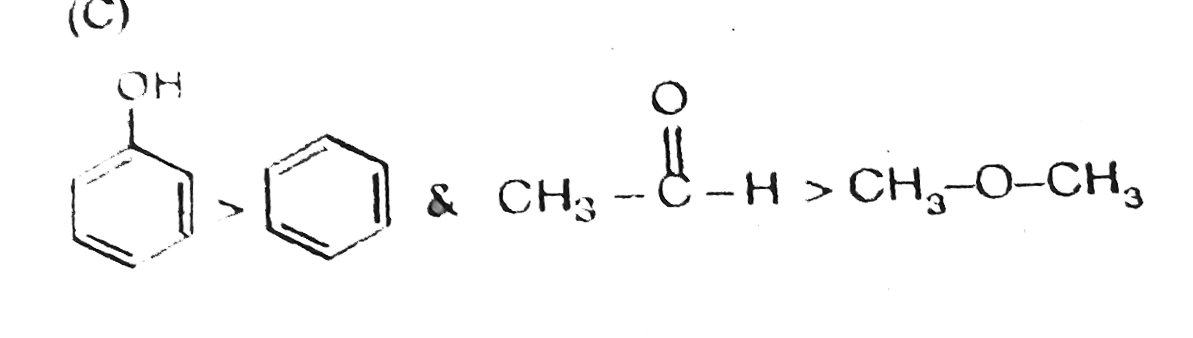
|
|
| 44. |
In which case formation of butane nitrile. is possible ? |
|
Answer» `C_3H_7Br+KCN` |
|
| 45. |
In which case ether is formed- |
|
Answer» `(CH_(3))_(3)C-Br+overset(ө)(CN)` |
|
| 46. |
In which case (E_(cell)-E_(Cell)^(@)) is zero: |
|
Answer» `Cu|Cu^(2+)(0.01M)||AG^(+)(0.1M)|Ag` |
|
| 47. |
In which of the followingoctahedral complexes of Co(Z = 27) will the magnitude of Delta_(0) be the highest? |
|
Answer» `[CO(NH_(3))_(6)]^(3+)` |
|
| 48. |
In which of the following octahedral complexes of Co(at. no. 27), will the magnitude of Delta_(0) be the highest ? |
|
Answer» `[Co(C_(2)O_(4))_(3)]^(3-)` |
|
| 49. |
In which of the following octahedral complexes of cobalt (atomic number = 27) will the magnitude of Delta_0 be the highest? |
|
Answer» `[CO(C_2O_4)_3]^(3-)` |
|