Saved Bookmarks
This section includes 7 InterviewSolutions, each offering curated multiple-choice questions to sharpen your Current Affairs knowledge and support exam preparation. Choose a topic below to get started.
| 1. |
In which equilibrium reaction the equilibrium whould shift to the right , if the total pressure is increased: |
|
Answer» `N_2 + 3H_2 ⇌2NH_3` |
|
| 2. |
In which of the following paris, both ions are coloured in aqueous solution? |
|
Answer» `Ni^(2+),Ti^(4+)` |
|
| 3. |
In which fo the following reaction the product formed by anti markonikoff rule is observed: |
|
Answer» `ClCH=CH_(2)overset(HCl)to` |
|
| 4. |
In which of the following pairs the two species have identical bond order? |
|
Answer» `N_(2)^(-),O_(2)^(2-)` |
|
| 5. |
in which emulsion coloured droplets are obtained when oil soluble dye is added to it? |
|
Answer» COLD CREAM |
|
| 6. |
In which of the following pairs, tripositive ions of bothwill have same colour ? |
|
Answer» Pm (61), ER (68) |
|
| 7. |
In which electrolysis one faraday can produce one mole at cathode or anode ? |
|
Answer» aq NACL |
|
| 8. |
In which electrolysis equal volumes of gases are released at anode and cathode during electrolysis |
|
Answer» AQ NACL (C)` aq HCOOK to 2CO_2 + 2OH+ H_2 + H_2 , (d) aq H_3COOK to C_2H_6 + 2CO_3 + 2KOH + H_2` |
|
| 9. |
In which of the following pairs, the two species are not isostructural ? |
|
Answer» `PCl_(4)^(+) and SiCl_(4)` |
|
| 10. |
In which direction will the following equilibria I and II proceed? I:H_(2)SO_(4)(aq)+NH_(3)(aq)hArrNH_(4)^(+)(aq)+HSO_(4)^(-)(aq) II: HCO_(3)^(-)(aq)+SO_(4)^(-)(aq)hArr HSO_(4)^(-)(aq)+CO_(3)^(2-)(aq) |
|
Answer» I forward &II backward  Here acidic STRENGTH is compared among the `2` ACIDS in the reaction & basic strength is compare among `2` bases in that reaction only. 
|
|
| 11. |
In which of the following pairs, the two species are isostructural ? |
|
Answer» `BrO_(3)^(-) and XeO_(3)` |
|
| 12. |
In which direction can the reaction, 2Hg+2Ag^+(aq.) |
|
Answer» SOLUTION :( C ) 3 eq. of Ag and Cu, zero EQUIVALENT of Na and Al will bedeposited. NOTE electrolysis of `NaCl _(aq)` and AlCl_(aq) does not GIVE Na and Al metal at cathode. Thus molar ratio is `3/1:3/2` for Ag:Cu or `3:3/2` or 6:3:0:0 for Ag : CL: Al: Na |
|
| 13. |
In which direction can the reaction, 2Hg+2Ag^+(aq.) |
|
Answer» SOLUTION :(B) `S propAC` , S = k (AC)/ `IMPLIES` K = `S/(AC)` = `(SM)/m^2 (m^3)/"MOLE"`=`S("mole")^-1m^2` |
|
| 14. |
In which of the following pairs, the two species are isostructural : |
|
Answer» `BrO_(3)^(-)`and`XeO_(3)` |
|
| 15. |
In which of the following pairs, the two species are iso - structural? |
|
Answer» `SO_(3)^(2-) and NO_(3)^(-)` |
|
| 16. |
In which conversion , bond length decreases ? |
|
Answer» `N_(2) to N_(2)^(+)` |
|
| 17. |
In which of the following pairs, the size of thefirst species is not more than the second? |
|
Answer» LI,F |
|
| 18. |
In which crystal structure, both vacancy and interstitial defects are observed at the same time? |
|
Answer» AgI |
|
| 19. |
In which of the following pairs, the ionisation energy of the first species is less than of the second |
|
Answer» <P>`O^(+)` , O |
|
| 20. |
In which condition the rate of physisorption increases? |
|
Answer» By DECREASING pressure. |
|
| 21. |
In which condition reaction become spontaneous ? |
|
Answer» VALUE of `E^@` and `DELTAG^@` is negative |
|
| 22. |
In which of the following pairs, the hybridisation of the central atoms in same ? |
|
Answer» `CIF_3, CIF_3O` Steric number of `CIF_3O_2 =5+0=5(sp^3d)` Steric number of `CIF_2O^(+) =3+1=4(sp^3)` Steric number of `CIF_4O^(-) =5+1=6(sp^3d^2)`Steric number of `XeOF_4 =5+1=6(sp^3d^2)` |
|
| 23. |
In which of the following pairs, the first one is chiral and the second one is achiral? |
|
Answer» LACTIC ACID, ETHANOL |
|
| 24. |
In which compound the reacting electrophile will be directed to ortho and para position ? |
|
Answer»
|
|
| 25. |
In which of the following pairs, the first ion has larger magnetic moment than the other ? |
|
Answer» `FE^(3+), Fe^(2+)` |
|
| 26. |
In which compound does vanadium has an oxidation number of +4 ? |
|
Answer» `NH_4VO_2` |
|
| 27. |
In which of the following pairs, the first substanceis more covalent than the second ? |
| Answer» Answer :D | |
| 28. |
In which compound, the oxidation state of phosphorus is +4 |
|
Answer» <P>`P_(4)O_(11)` 4X+(-2x8)=0 4x-16=0 `x=16/4=+4` |
|
| 29. |
In which of the following pairs the enthalpy of neutralization is less than or more than the standard value |
|
Answer» `HNO_(3) and NaOH` |
|
| 30. |
In which compound heat of combustion is highest : |
|
Answer»
|
|
| 31. |
In which of the following pairs, the first compound does not have higher boiling point than the second ? |
|
Answer» `H_(2)O` and `H_(2)S` |
|
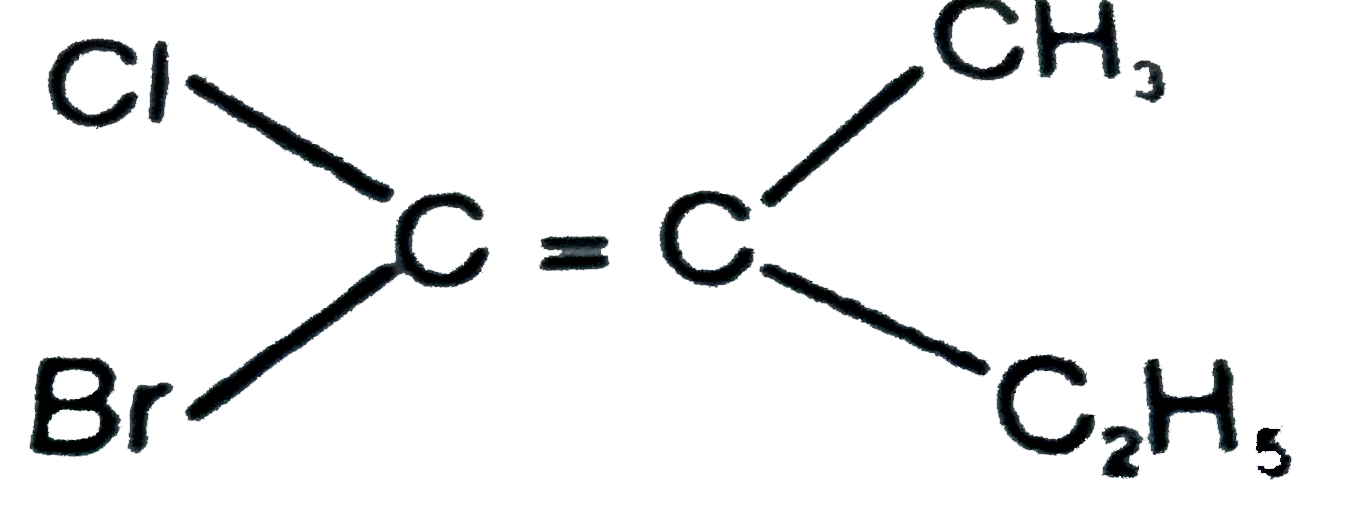
| 32. |
In which compound, Cis-Trans nomenclature cannot be used? |
|
Answer» `CH_(3)-CH=CH-CH_(3)` |
|
| 33. |
In which compound does oxygen has an oxidation state of +2 : |
|
Answer» `H_2O_2` |
|
| 34. |
In which of the following pairs, the constants/quantities are not mathematically related to each other |
|
Answer» Gibb's free energy an standard CELL potential (b) `E_(cell)^(o)=(2.303RT)/(NF)logK_(c)` (c) `K=Ae^(-E_(a//RT))` |
|
| 35. |
In which of the following pairs, the atomic size is almost the same ? |
| Answer» Answer :B | |
| 36. |
In which classes, the polymers classified on the basis of molecular forces ? |
|
Answer» Solution :On the basis of intermolecular forces OPERATING between the different POLYMER chains, polymers are classified as: (i) ELASTOMERS (ii) Fibres (iii) Thermoplastics (iv) Thermosetting PLASTICS. |
|
| 37. |
In which of the following pairs of ions, the higher oxidation state in aqueous solution is more stable than the other? I. TI^(+), TI^(3+)II. Cu^(+),Cu^(2+) III. Cr^(2+),Cr^(3+)IV. V^(2+),VO^(2+)(V^(4+)) |
| Answer» Answer :D | |
| 38. |
In which of the following pairs of molecules / ions, both the species are not likely to exist ? |
|
Answer» `H_(2)^(+), He_(2)^(2-)` |
|
| 39. |
In which classes, the polymers are classified on the basis of molecular forces ? |
|
Answer» SOLUTION :On the basis of intermolecular forces of attraction operating between the different POLYMER chains , polymers are classified into the FOLLOWING classes : 1.Elastomers 2. FIBRES 3. Thermoplastics and 4. Thermosetting plastics. |
|
| 40. |
In which cell, the free energy of a chemical reaction is directly converted into elecricity ? |
|
Answer» Lechanche CELL |
|
| 41. |
In which of the following pairs of carbocations, the first carbocation is more stable than the second ? (i) CH_(2) = CH - CH_(2) and CH_(2) = CH - CH_(2) - overset(+)(CH_(2)) (ii) CH_(3) - NH - overset(+)(CH_(2)) and overset(+)(CH_(2)) - OH (iii) CH_(3) - O - CH_(2) - overset(+)CH_(2) and CH_(3) - O - overset(+)(CH_(2)) (IV) CH_(3) overset(+)(CH) - CH_(2) CH_(2) CH_(3) and CH_(3) CH_(2) - overset(+)(CH) - CH_(2) CH_(3) |
|
Answer» (i),(II) and (iii) THEREFORE, first carbocation is more stable than the second 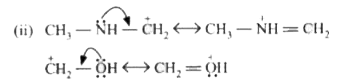 In both the cases, +ve charge is dispersed due to resonance but in the second carbocation +ve charge is located on a more electronegative O-atom. Therefore, first carbocation is more stable than second. (iii) Second carbocation 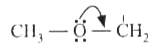 is stabilized by resonance but first `(CH_(3) - O - CH_(2) - overset(+)(CH_(2)))` is not. Therefore, carbocation second is more stable than the frst. (iv) First carbocation `(CH_(3) overset(+)("CHCH"_(2)) CH_(2) CH_(3))`has FIVE a-hydrogen atoms and hence five hyperconjugation structures are possible while the second carbocation `(CH_(3) CH_(2) overset(+)("CHCH"_(2)) CH_(3))` has only four `alpha`-hydrogen atoms and hence has four hyperconjugative structures. Therefore, first carbocation is little more stable than the second. Thus, the correct answer is option (B). |
|
| 42. |
In which cell the free energy of a chemical reaction is directly convertd into electricity |
|
Answer» Leclanche CELL |
|
| 43. |
In which of the following pairs of complexes the central metal/ions do have same effective atomic number? |
|
Answer» `[CR(CO)_(6)]" and "[FE(CO)_(5)]` |
|
| 44. |
In which cases products formed are not according to reaction? |
| Answer» Answer :A::C::D | |
| 45. |
In which of the following pairs is the probability of finding the electron in only xy - planeis zero forboth orbatals ? |
|
Answer» `3d_(xy),4d_(x^(2)y^(2))` |
|
| 46. |
In which cell, construction like galvanic cell can be observed ? Explain. What is fuel cell ? Write a note on it. |
|
Answer» Solution :* Galvanic cell directly converts chemical energy into electricity and is highly EFFICIENT. Fuel cell has galvanic cell like construction. * Cell in which chemical energy is directly converted into electrical energy and having galvanic cell like arrangement is called as fuel cell. * Construction : in fuel cells reactants are FED continuously to the electrodes and products are removed continuously from the ELECTROLYTE compartment. galvanic cells are DESIGNED to convert the energy of combustion of fuels like hydrogen, METHANE, methanol, etc. directly into electrical energy. * Advantages of fuel cell : (i) By this cell, there is no pollution of air and noise. (ii) Fuel cell has high efficiency of 70% or more than that while thermal power station has low efficiency of 40% and less. (iii) Various fuels can be used in fuel cells. |
|
| 47. |
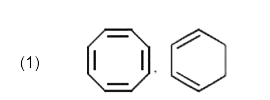
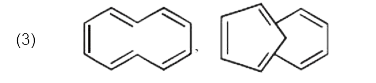
In which of the followingpair's first compound is having higher resonance energy? |
|
Answer»
|
|
| 48. |
In which of the following pairs do 1 g of each have an equal number of molecules? |
|
Answer» `N_(2)O` and CO |
|
| 49. |
In which of the following pairs both the species are not isostructural ? |
|
Answer» Diamond, silicon carbide |
|
| 50. |
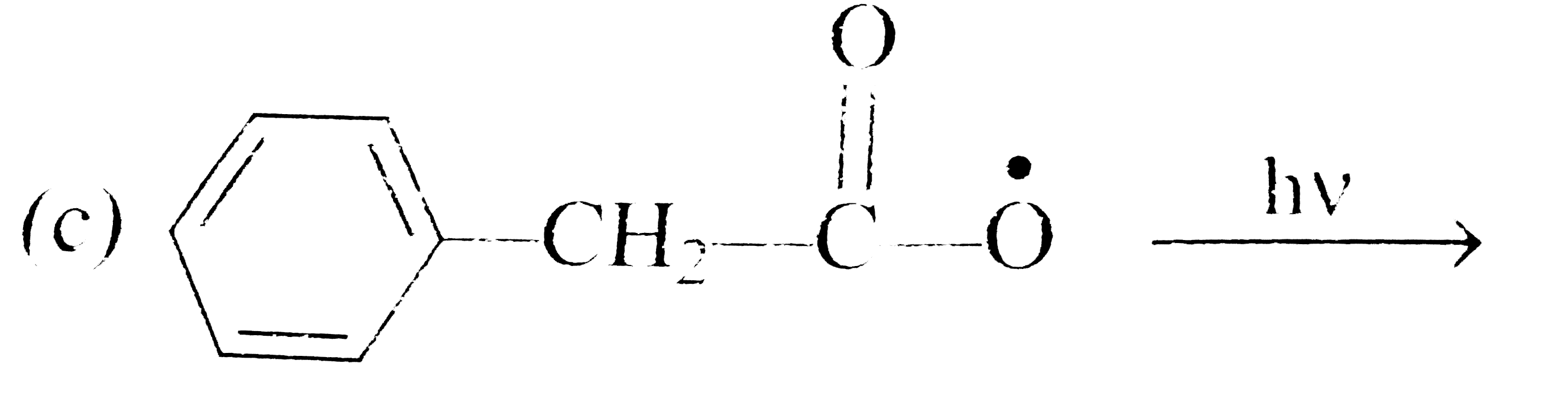
In which cases, free radicals can be formed by homoytic fission? |
|
Answer» `H_(3)C-OVERSET(O)overset(||)C-CH_(3)overset(hv)RARR` `R-N=N-Roverset(hv)rarr2R^(.)+N-=N` `Ph-CH_(2)-overset(O)overset(||)C-overset(.)Ooverset(hv)rarrPh-overset(.)CH_(2)+overset(O)overset(||)C=O` `CH_(3)-O-O-CH_(3)overset(hv)rarr2CH_(3)-O` |
|