

Saved Bookmarks
This section includes 7 InterviewSolutions, each offering curated multiple-choice questions to sharpen your Current Affairs knowledge and support exam preparation. Choose a topic below to get started.
| 1. |
In the depression of freezing point experiment, it is found that |
|
Answer» The vapour pressure of the solution is equal to that of pure SOLVENT |
|
| 2. |
In the dehydrohalogenation of 2-bromobutane, which conformation leads to the formation of cis-2-butene? |
|
Answer»
|
|
| 3. |
In the decomposition of N_2O_5, the rate of reactionis-(d[N_2O_5])/(dt) = k [N_2O_5]. For determination of the units of k, |
|
Answer» UNITS of TIME are required |
|
| 4. |
In the decomposition of hydrogen peroxide which acts as a negative catalyst? |
| Answer» Solution : a (or) b | |
| 5. |
In the following sequence of reaction , "Toluene " overset(KMnO_(4)) to A overset(SOCl_(2)) to B underset(BaSO_(4))overset(H_(2)+Pd) to C. The product C is |
|
Answer» `C_(6)H_(5)-COOH` |
|
| 6. |
In the decomposition of H_(2)O_(2) at a given temperature T, the energy of activation decreases from E_(1) to E_(2) by the use of a catalyst. How many times does the rate of the catalysed reaction increase? |
|
Answer» `(E_(1)-E_(2))` |
|
| 7. |
In the decomposition of hydrogen peroxide acts a negative catalyst. |
|
Answer» `H_2S` |
|
| 8. |
In the following sequence of reactions , A overset("Reduction")to B overset(HNO_2)to CH_3 CH_2 OH The compound A is |
|
Answer» PROPANE nitrile |
|
| 9. |
In the decay process: A overset(-alpha)(to) B overset(-alpHa)(to) C overset(-beta)(to)C 1. A and B are isobars2. A and D are isotopes 3. C and D are isobars4. A and C are isobars The correct answer is : |
|
Answer» 1 and 2 |
|
| 10. |
In the decomposition of H_2O_2 at 300 K, the energy of activation was found to be 18 kcal//"mol" white it decreases to 6 kcal//"mol" when the decomposition was carried out in the presence of a catalyst at 300 K.How many (Give you answer by multiplying 10^7) |
|
Answer» Then we know `K=Ae(-EA)/(RT)` For uncatalysed Rxn `K_1=Ae(-Ea)/(RT) " " [T=300 K , R=2]` `K=Ae(-18xx10^3)/(2xx300)`..(i) and for CATALYSED Rxn `K_2=Ae(-6xx10^3)/(2xx300)`...(ii) Equation (2)/(1) `K_2/K_1=e((18-6)xx10^3)/(2xx300)` `K_2/K_1=e^20` `K_2/K_1=4.85xx10^8` Then catalysed reaction is `4.85xx10^8` times faster than uncatalysed Rxn. |
|
| 11. |
In the following sequence of reaction Toluene overset(KMnO_(4)+KOH "")(rarr)A overset(SOCl^(2) "")(rarr) B overset(H_(2)//Pd"")underset(BaSO_(4)"")(rarr)C The product C is |
|
Answer» `C_(6)H_(5)COOH` |
|
| 12. |
In the decomosition of H_(2)O_(2) at 300K, the energy of activation was found to be 18kcal/mole while it decreased to 6 kcal/mole when the decomposition was carried out in the presence of a catalyst at 300K. How many times is the catalysed reaction faster than the uncatalysed one ? |
|
Answer» |
|
| 13. |
In the decay series : Aoverset(-alpha)toBoverset(-beta)toCoverset(-beta)toD |
|
Answer» A and B are ISOBARS |
|
| 14. |
In the following sequence of reaction, the final product (Z) is CH-=CH underset(H_(2)SO_(4))overset(Hg^(2+))rarr X underset(H_(2)O)overset(CH_(3)MgX)rarr Y overset([O])rarr Z |
|
Answer» ethanol |
|
| 15. |
In the dark brown ring test for nitrate ions |
|
Answer» The colour is DUE to charge transfer SPECTRA |
|
| 16. |
In the d-block, the elements which do not generally show the characteristics of transition elements include "….................., …..................." and "…...................." |
|
Answer» |
|
| 17. |
In the following sequence of reaction, the final product (Z) is CH-=CH overset(Hg^(2+))underset(H_(2)SO_(4)) to X overset(CH_(3)MgX) underset(H_(2)O) to Y overset([O]) to Z |
|
Answer» ethanal 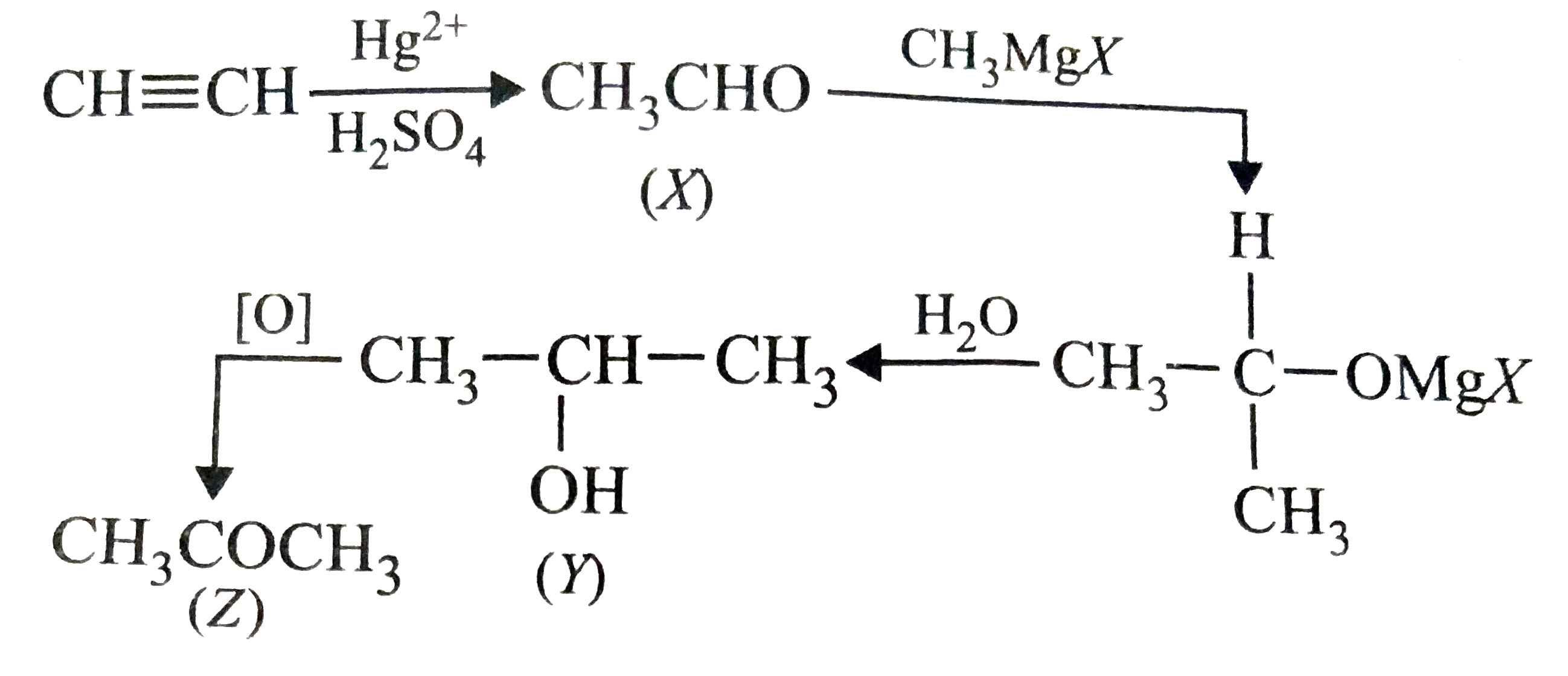
|
|
| 18. |
In the cynamide extraction process of silver ore argentite from, name the oxidizing and reducing agents. Write the chemical equations of the reactions involved. |
|
Answer» SOLUTION :`4Ag+8NaCN+2H_(2)O+O_(2) to 4Na[AG(CN)_(2)]+4NaOH` `2[Ag(CN)_(2)]^(-)(AQ)+Zn(s) to [Zn(CN)_(4)]^(2-) (aq) +2Ag(s)` (i) OXIDISING agent `-O_(2)` (ii) Reducing agent =Zn |
|
| 19. |
In the cyanide solution acts as a: |
|
Answer» PRESENCE of `O_(2)` is required to OXIDISE `Na_(2)` into `Na_(2)SO_(4)`. |
|
| 20. |
In the cyanide process for the extraction of silver, sodium cyanide is used to |
|
Answer» CONVERT SILVER into a SOLUBLE silver complex |
|
| 21. |
In the cyanide process for extraction of gold and silver from ores, the cyanide solution acts as a……… |
|
Answer» leaching agent to bring ores into solution. |
|
| 22. |
In the cyanide extraction process of silver from argentite ore, the oxidising and reducing agents used as |
|
Answer» `O_(2) and CO` respectively |
|
| 23. |
Inthecyanideextraction processof silverfrom argentiteore,the oxidisingandreducing agentsusedare |
|
Answer» ` O_ 2andCO`RESPECTIVELY |
|
| 24. |
In the cup and cone arrangement of blast furnace, the cone enables __________. |
|
Answer» INTRODUCTION of pre-heated AIR into the furnace |
|
| 25. |
In the following sequence of reaction, the end product is : HC equiv CH overset(Hg^2+)underset(H_2SO_4) rarrA overset(CH_3MgX)underset(H_2O)rarrB overset(O)rarr C |
|
Answer» Acetaldehyde |
|
| 26. |
In the following sequence of reaction product ' C' is H- CHO + CH_(3) -CH_(2)-CH_(2) -MgXoverset((i) "dry ether " ) underset((ii) H_(3) O^(+) ) (rarr)A overset(conc. H_(2) CO_(4) " ")(rarr) B overset ((i)B_(2)H_(6)//THF)underset((ii) H_(2)O_(2) // OH)(rarr)C |
|
Answer» `Ch_(3)-CH=CH-CH_(3)` |
|
| 27. |
In the cubic close packing, the unit cell has |
|
Answer» 4 TETRAHEDRAL VOIDS each of which is shared by four ADJACENT unit cells. `therefore` Number of tetrahedral voids = 8 
|
|
| 28. |
In the crystalline solids the smallest repeating part in the lattice is known as unit cell. The unit cells are described as simple (points at all corners), body centred (points at all the corners and it the centre), face centred (points at all the corners and centre of all faces), and end centred (points at all hte corners and centres of two opposite and faces) unit cells. In two common tyupes of packing ccp and hcp, 26% of space is left unoccupied in the form of interstitial sites. For the stable ionic crystalline structures, there is difinite radius ratio limit for a cation to fit perfectly in the lattice of anions, called radius ratio rule. This also defines the coordination number of an ion, which is the number of nearest neighbours of opposite charges. This depeds upon the ratio of radii of two types of ions, r_(+)//r_(-). This ratio for coordination numbers 3,4,6,and 8 is respectively 0.155 - 0.225, 0.225 - 0.414, 0.414 - 0.732 and 0.732 - 1 respectively. A face centred lattice a metal M and a body centred cubic lattice of metal N contain same number of 2.25 xx 10^(22) unit cells. If density of M is twice than that of N, the ratio between the number of atoms per unit cell is |
|
Answer» `4 :1` |
|
| 29. |
In the crystals of which of the following ionic compounds would you expect maximum distance between the centres of the cations and anion |
| Answer» Answer :C | |
| 30. |
In the following sequence of reaction, the end product is, CH_3CHOoverset (HCN) rarr Aoverset (H_2O)rarrB |
|
Answer» `CH_3COOH` |
|
| 31. |
In the crystal structure of metallic Zn, the layers of Zn atoms have stacking sequence ABABAB… . What type of close-packed structure is formed in the crystal of Zn? How many Zn atoms are there in the unit cell of Zn crystal? |
| Answer» SOLUTION :In three dimensions, the close-packed STRUCTURE with stacking SEQUENCE ABABAB… is CALLED a hexagonal close-packed structure. The unit CELL in the close-packed structure is hexagonal unit cell. This unit cell contains 6 atoms. Hence, the number of Zn atoms per unit cell in Zn crystal is 6. | |
| 32. |
In the crystalline solid MSO_(4).nH_(2)Oof molar mass 250 g mol^(-1), the percentage of anhydrous salt is 64 by weight. The value of n is |
|
Answer» 2 TOTAL mass of `H_(2)O` in `MSO_(4).nH_(2)O = 250-160 = 90` g/mole Therefore, the value of N `=90/18 =5` |
|
| 33. |
In the following sequence of reaction how many nucleophilic substitution taking place. |
Answer» 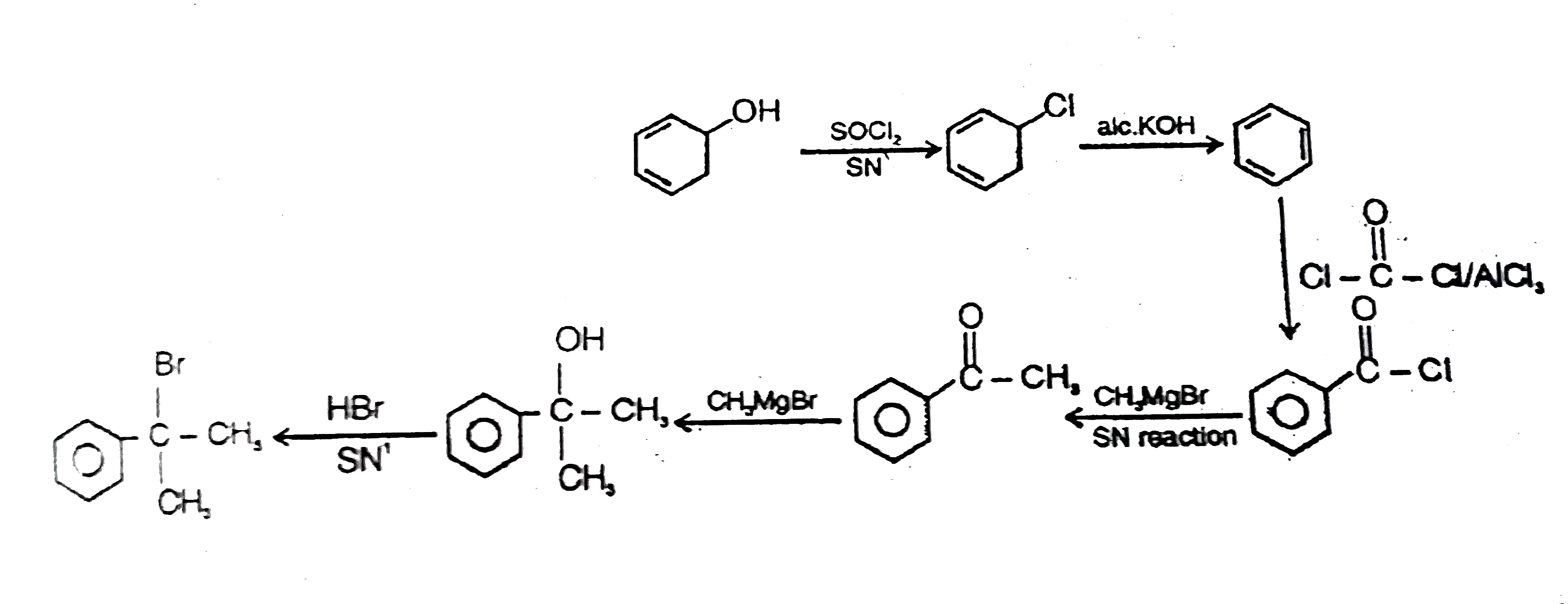
|
|
| 34. |
In the crystalA^(2+)B^(2-),having anions in the face-centred cubicpacking if the radius of the anion is 1.84 Åideal radius of thecationpresent in the tetrahedral hole will be |
|
Answer» `0.225 Å` `=0.225xx1.84 Å =0.414 Å`. |
|
| 35. |
In the course of chemical reaction, an oxidant |
|
Answer» GAINS electron |
|
| 36. |
In the following sequence of reaction :CH_3CH_2CH_2I overset(KOH(alc.))rarr(A) overset(HBr)rarr(B) overset(KOH(aq.))rarr [C] .C is: |
|
Answer» Propene |
|
| 37. |
In the corrections made in the ideal gas equation for real pases, the reduction in pressure due to attractive forces is directly proportional to |
| Answer» Answer :D | |
| 38. |
In the coordination compound ,Na_(2)[Pt(CN)_(4)] the Lewis acids is |
|
Answer» `[Pt(CN)_(4)]^(2-)` |
|
| 39. |
In the following sequence of reaction : CH_3CH_2CH_2I overset(KOH(alc.))rarr(A) overset(Br_2)rarr(B) overset(NaNH_2)underset(NH_3)rarr [C] : The end product Cis : |
|
Answer» Alkene |
|
| 40. |
In the coordination entity [Fe(CN)_(6)]^(4-) the oxidation state of iron is represented as………. . |
|
Answer» |
|
| 41. |
In the following sequence of reaction CH_(3)CH_(2) OH overset(P + I_(2)) to A overset(Mg) underset("ether") to B overset(HCHO) to C overset(H_(2)O) to D Find the number of -OH group in compound D. |
|
Answer» |
|
| 42. |
In the coordination compound K_(4)[Ni(CN)_(4)], the oxidation state of nickel is : |
| Answer» SOLUTION :`overset(+4)K_(4)[overset(0)NI(overset(-4)CN)_(4)]` | |
| 43. |
In the following sequence of reaction CH_(3) - CH_(2) - OH overset(PH_(v))(to) A underset("ether")overset(Mg)(to) B overset(HCHO)(to) C overset(H_(2)O)(to) D The product D is: |
|
Answer» n-butylalcohol |
|
| 44. |
In the following sequence of the reactions : CH_(3)CH_(2)CH_(2)I overset(KOH(Alc.))rarr A overset((i) Br_(2))underset((ii) alc. KOH)rarr B overset(Na//NH_(3))rarr C The end product C is : |
|
Answer» alkene |
|
| 45. |
In the conversion of starch to ethyl alcohol, the following enzymes are used |
|
Answer» INVERTASE, ZYMASE, Emulsin |
|
| 46. |
In the following sequence fo reaction end product is . CH -= CH overset(Hg^(+)//H_(2)SO_(4))to B overset([O]) to C overset(Ca) to D overset("dry distillati on ") to E |
|
Answer» ACETALDEHYDE |
|
| 47. |
In the conversion of I_2 rarr IO_3^-the oxidation state of iodine changes from |
|
Answer» 0 to +6 |
|
| 48. |
In the conversion of K_2Cr_2O_7 to K_2CrO_4 the oxidation number of chormium : |
|
Answer» Increases |
|
| 49. |
In the following sequence of reactions, CH_(3)CH_(2)CH_(2)Br overset("KOH"(Alc))(rarr) " (A) " overset("HBr")(rarr) " (B) " overset("KOH"(aq))(rarr) (C )The product (C) is |
|
Answer» propene |
|


