

Saved Bookmarks
This section includes 7 InterviewSolutions, each offering curated multiple-choice questions to sharpen your Current Affairs knowledge and support exam preparation. Choose a topic below to get started.
| 1. |
Give two differencebetween Hormones and vitamins . |
Answer» SOLUTION :
|
|
| 2. |
Give the biological functions of the following proteins: (i) Haemog |
|
Answer» Solution :(i) Haemoglobin PRESENTS in BLOOD transports OXGYEN from LUNGS to all the tissues of the body and `CO_2` from the tissues to the lungs for exhale. (ii) Collagen is a fibrous protein PRESENT in connecting tissues of tendons , cartilages and bones. |
|
| 3. |
Give two conditions for the positive deviation of non-ideal solutions. |
|
Answer» <P> Solution :(i) A-B INTERACTIONS are smaller than A-A and B- -B interactions.(ii) `P_(A) GT P_(A)^(0) x_(A) , P_(B) gt P_(B)^(0) x_(B)`. (iii) `Delta H_("mixing ") gt 0 ` OR POSITIVE or + ve (iv) `Delta V_("mixing") gt 0 ` OR positive or + ve |
|
| 4. |
Give two consequences of lanthanoid contraction. |
|
Answer» Solution :DUE to lanthanide contraction (i) Similarity in ATOMIC sizes of elements of SECOND and third transition series. (ii) The SEPARATION of lanthanides in PURE state become difficult. |
|
| 5. |
Give two characteristics of an ideal solution. |
|
Answer» Solution :(i) There is no change in enthalpy when an ideal solution is FORMED from their components, i.e., `DeltaH_("mixing")=0`. (ii) There is no change in VOLUME when an ideal solution is formed from their components, i.e, `DeltaV_("mixing")=0`. |
|
| 6. |
give two applications of zeolites. |
| Answer» | |
| 7. |
Give the basic requirement for vapour phase refining. |
|
Answer» (i) The METAL should FORM a volatile COMPOUND with a suitable reagent. (II) The volatile compound is decomposedto give the pure metal. |
|
| 8. |
Give total number of reaction which at least 1 carbon oxidise during reaction. |
|
Answer» |
|
| 9. |
Give two applications of colloids. |
| Answer» Solution :(i) These are USED as FOOD articles e.g. milks and cheese, butter etc. (II) These are used as MEDICINES. | |
| 10. |
Give the balancedequation for the reaction between chlorine with cold NaOH and hot NaOH. |
|
Answer» Solution :Reaction with alkali: Chlorine reacts with cold dilute alkali to give CHLORIDE and hypochlorite while with hot concentrated alkali CHLORIDES and CHLORATES are formed. `Cl_(2)+H_(2)O rarr HCl +HOCl` `HCl+NaOH rarr NaCl+H_(2)O` `HOCl +NaOH rarr NaOCl+H_(2)O` overall reaction `Cl_(2)+2NaOH rarr underset("Sodium HYPO chlorite")(NaOCl) + NaCl+H_(2)O` `(Cl_(2)+H_(2)OrarrHCl+HOCl)xx3` `(HCl+NaOH rarr NaCl+H_(2)O)xx3` `(HOCl+NaOH rarr NaOCl+H_(2)O)xx3` `3NaCl rarr NaClO_(3)+2NaCl` overall reaction `3Cl_(2)+6NaOH rarr NaClO_(3)+5NaCl+3H_(2)O` |
|
| 11. |
Give the balanced equation for the reaction between chlorine with cold NaOH and hot NaOH. |
|
Answer» Solution :(i) Reaction between CHLORINE with cold`NaOH:` `Cl_(2)+H_(2)Orarr HCl+HOCl` `HCl+NaOH rarr NaCl+H_(2)O` `HOCl+NaOH rarr NaOCl+H_(2)O` OVERALL reaction, `Cl_(2)+underset("(cold)")(2NaOH)rarr underset("(Sodium hypochlorite)")(NaOCl)+underset("(Sodium chloride)")(NaCl+H_(2)O)` Chlorine reacts with cold `NaOH` to give sodium chloride and sodium hypochlorite. (ii) Reason between chlorine with hot `NaOH`: `Cl_(2)+H_(2)Orarr HCl+HOCl` `HCl+NaOH rarr NaCl+H_(2)O` `HOCl+NaOH rarr NaOCl+H_(2)O` `3NaOClrarr NaClO_(3)+2NaCl` Overall reaction, `3Cl_(2)+underset("(Hot)")(6NaOH)rarr underset("(Sodium chlorate)")(NaClO_(3))+underset("(Sodium chloride)")(5NaCl)+3H_(2)O` Chlorine reacts with hot `NaOH` to give sodium chlorate and sodium chloride. |
|
| 12. |
Give the atomic number of the inert gas atom in which the total number of d-electrons is equal to the difference in the number of total p- and s- electrons. |
|
Answer» `1s^2 2s^2 2p^6 3s^2 3p^6 3d^10 4s^2 4p^6` Total number of d-electrons = 10 Total number of p-electrons =6+6+6=18 Total number of s-electrons =2+2+2+2=8 Difference in total number of p- and s- electrons =18-8 =10 So INERT gas is `._36Kr` |
|
| 13. |
Give the amino acid sequence of the following polypeptides using the data given by partial hydrolysis. (a) (overset(2)(Ser),overset4(Hyp),overset(3)(Pro),overset(1)(Thr))overset(H_3O^(+))toSer, Thr+Thr, Hyp+Pro, Ser |
|
Answer» SOLUTION :`{:(A,B,C,D),(3,2,1,4):}` (a)Pro-Ser-Thr-Hyp. |
|
| 14. |
Give the alcohol and alkene required to prepare the following ethers by alkoxy mercuration-demercuration. {:("(a) Di-isopropyl ether","(b) Di-sec-butyl ehter",,,),("(c) Ethyl-isopropyl ether","(d) Di-tert-butyl ether",,,),("(e) 1-Phenyl-1-ethoxypropane",,,,),("(f) 1-Methyl-1-methoxycyclohexane",,,,):} |
Answer» SOLUTION :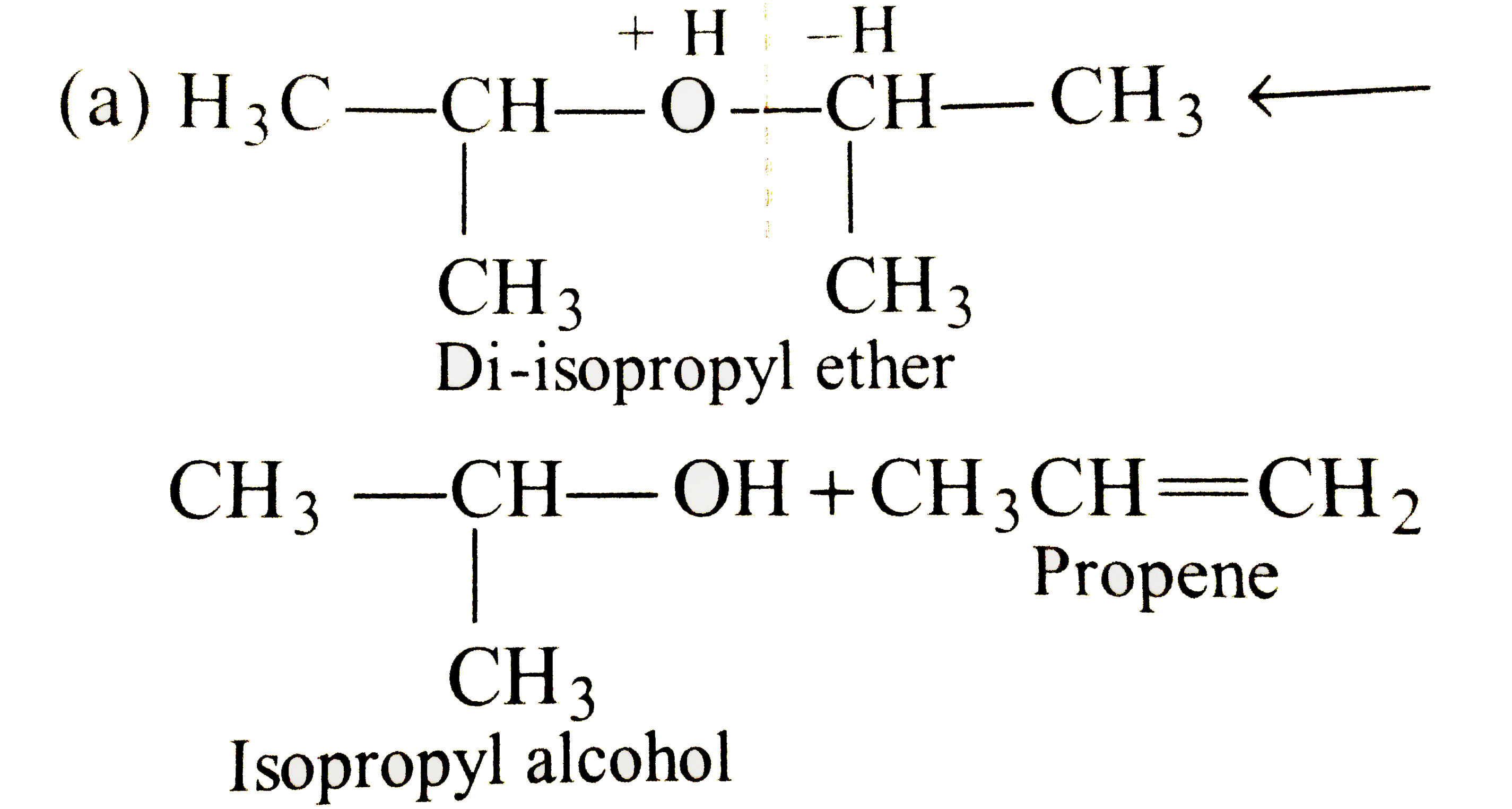
|
|
| 15. |
Give that the standard electrode potentials (E^@) of metals are: K^+//K=-2.93V, Ag^+//Ag=0.80V,Cu^(2+)//Cu=0.34 V, Mg^(+2)//Mg=-2.37V, Cr^(3+)//Cr=-0.74V, Fe^(2+)//Fe=-0.44V Arrange these metals in an increasing order of their reducing power. |
|
Answer» Solution :More NEGATIVE REDUCTION potential values more is reducing power. `Ag^+//Alt Cu^(2+)//Cu LT FE^(2+)//Fe lt Cr^(3+) //Cr lt Mg^(2+)//Mg lt K^+//K` |
|
| 16. |
Give test to differentiate 1,1-dichloroethane and 1,2-dichloroethane : |
|
Answer» 2,4-DNP then aq. KOH `underset(Cl)underset(|)(CH_(2))-underset(Cl)underset(|)(CH_(2))overset(aq.KOH)rarr underset(OH)underset(|)(CH_(2))-underset(OH)underset(|)(CH_(2)) overset(2,4-DNP)rarr -ve` test. |
|
| 17. |
Give test to differentiate (Bromobenzene) Ph-Br and benzyl bromide (PhCH_(2)Br). |
|
Answer» (i) AQ. KOH (II) Na `(b rarr AgCl)` will FORM with `Ph-CH_(2)-Br` `(c rarr Ph-CO_(2)H)` will form with `PH-CH_(2)-Br`. |
|
| 18. |
Give teh reason for the following : Orthonitrophenol is more acidic than orthomethoxy phenol. |
| Answer» Solution :NITRO group is electron withdrawing which increases ACIDIC CHARACTER due to stabilisation of o - nitrophenoxide ion. `-OCH_(3)` group is electron releasing which DECREASES acidic character due to destabilisation of o-methoxyphenoxide ion. | |
| 19. |
Give symbolic representation of following reaction : Mg_((S))+Co_((aq))^(2+) hArr Mg_((aq))^(2+)+Co_((S)) |
|
Answer» `""^(Theta)Co_((S))|Co_((1M))^(2+)||Mg_((S))^(2+)|Mg_((S))^(o+)` |
|
| 20. |
Give te equations for the reaction between benzoyl chloride and diethyl cadmium. |
| Answer» Solution :`2H_(6)H_(5)COCL +(C_2H_5)Cd rarr 2C_6H_(5)COC_(2)+H_5+CdCl_(2)` | |
| 21. |
Give tbe principles involved in the manufacture of sulphuric acid by contact procces with equations : |
|
Answer» Solution :Manufacture of sulphuric acid (contact process). It involves following STEPS: (i) Production of sulphur dioxide. It is carried out by buming powdered sulphur or roasting of sulphur rich ORES. `S_6+8O_2to8SO_2` `4FeS_2+11O_2to2Fe_2O_3+8SO_2` (ii) Oxidation of sulphur dioxide to sulphur trioxide `2SO_2(g)+O_2(g)overset(400-500^(@)C)underset(15-12atm) TEMPERATURE `=400-450^(@)C`, Pressure =1.5 to 2 atm Catalyst=Pt asbestos or vanadium pentoxide `V_2O_5` (iii) Conversion of `SO_3` into `H_2SO_4" "SO_3` is absorbed in conc. `H_2SO_4` to produce OLEUM or pyrosulphuric acid `SO_3+underset(conc)(H_2SO_4)tounderset("oleum")(H_2S_2O_7)` So is not absorbed in water as the reaction is highly exothermic and a mist of acid particles is formed. Sometimes it becomes difficult to handle the operation. (iv) dilution of oleum and formation of `H_2SO_4` Oleum is diluted with calculated quantity of water to obtain `H_2SO_4` is required concentration `underset("oleum")(H_2S_2O_7)+underset("water")tounderset("sulphuric acid")(2H_2SO_4)` 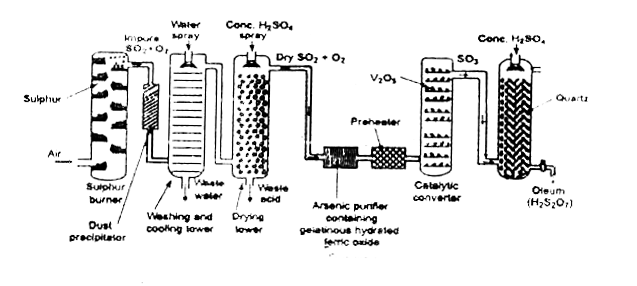 |
|
| 22. |
Give suitable explanation for the following: (i) Chloral hydrate is a geminaldiol but still stable. How? (ii) Out of and CH_(3)CH_(2)CHO which is more reactive towards nucleophilic addition? (iii) Why does pure HCN fail to react with aldehydes and ketones? (iv) Hydrazones of aldehydes and ketones are not prepared in strongly acidic medium. Why? (v) Sodium bisulphite is used to purify aldehydes and ketones. Explain. |
Answer» Solution :(i) 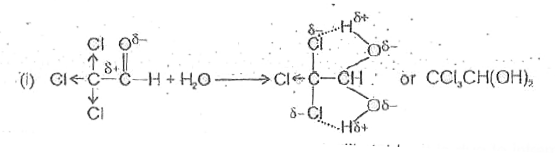 Chloral hydrate is a geminaldiol and still stable. It is due to intramolecular hydrogen bonding between Cl and OH groups of adjacent carbon atoms. (ii) Propionaldehyde is more reactive, because in benzaldehyde, due to -M effect of -CHO group, it pulls ELECTRONS from benzene ring as a result electrophilicity on carbon of carbonyl group decreases and attack of nucleophile does not take place so effectively. (iii) HCN is mainly a covalent compound and cannot PROVIDE `CN^(-)` ions readily for NUCLEOPHILIC attack on carbonyl compounds. When reaction is carried out in the presence of base, it helps in ionising the acid and in LIBERATING `CN^(-)`. (iv) During hydrazone preparation, hydrazine (i.e.,  ) acts as a nucleophile. In strongly acidic medium hydrazine gets protonated and does not act as a nucleophile. As a result hydrazone of aldehydes and ketones cannot be prepared. ) acts as a nucleophile. In strongly acidic medium hydrazine gets protonated and does not act as a nucleophile. As a result hydrazone of aldehydes and ketones cannot be prepared. (v) Except benzophenone, aldehydes and ketones react with saturated solution of `NaHSO_(3)` to form white CRYSTALLINE precipitate of their addition products. Which can be easily decomposed by aqueous HCI or NaOH to regenerate these compounds in pure state. |
|
| 23. |
Give suitable explanation for the following: (i) Chloral hydrate is a geminaldiol but still stable. How? (ii) Out of and CH_(3)CH_(2)CHO which is more reactive nucleophilic addition? (iii) Why does pure HCN fail to reac with aldehydes and ketones? (iv) Hydrazones of aldehydes and ketones are not prepared in strongly acidic mediu. Why? (v) Sodium bisulphite is used to purify aldehydes and ketones. Explain. |
Answer» Solution :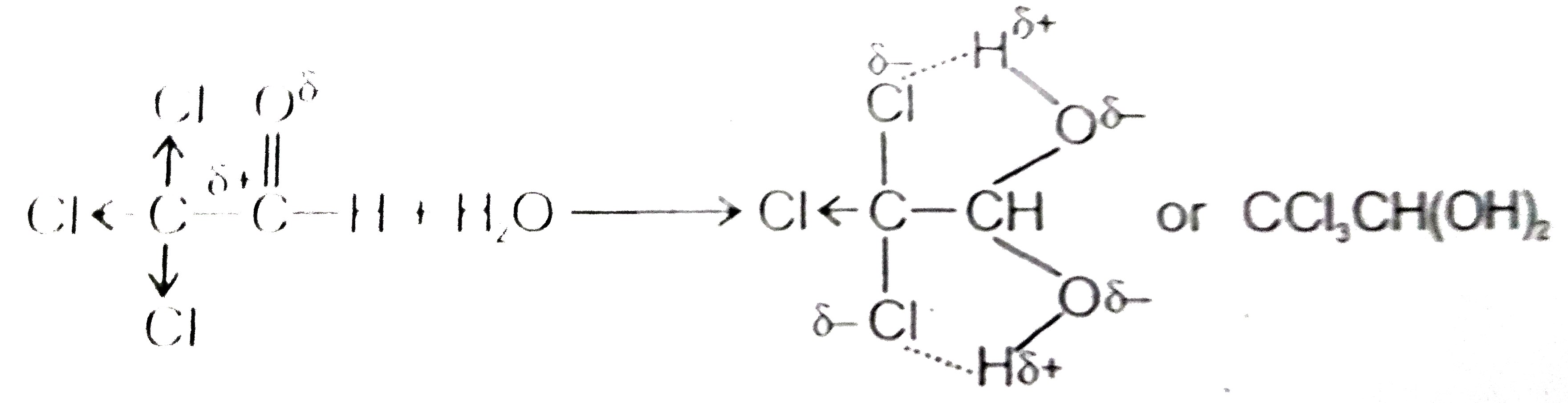 Chloral hydrate is a geminaldiol and still stable. It is due to INTRAMOLECULAR hydrogen bonding between Cl and OH groups of adjacent carbon atoms. (II) Propionaldehyde is more reactive, because in benzaldehyde, due to -M effect of -CHO group, it pulls electrons from benzene ring as a result electrophilicity on carbon of carbonyl group decreases and attack of nucleophile does not take place so efectively. (iii) HCN is a mainly a covalent compound and cannot provide `CN^(-)` ions readily for nucleophilic attack on carbonyl compounds. When reaction is carried out in the presence of base, it helps in ionising the acid and in liberating `CN^(-)` (iv) During hydrazone preparatin, hydrazine (i.e., `NH_(2)NH_(2)`) acts as a nucleophile. In stronly acidic medium hydrazine gets protonated and does not act as a nucleophile. As a result hydrazone of aldehydes and ketones cannotbe prepared. ( v) Except BENZOPHENONE, aldehydes and ketones react with saturated solution `NaHSO_(3)` to form white crystaline PRECIPITATE of thier addition products. Which can be easily decomposed by aqueous HCl or NaOH to regenerate these compounds in pure state. |
|
| 24. |
Give structures of the products A,B and C in the following reactions: CH_(3)COOH underset(Delta)overset(NH_(3))to A overset(NaOH-Br_(2))to B overset(CHCl_(3)+Alc.KOH)toC |
| Answer» Solution :`underset("Acetic acid")(CH_(3)COOH) overset(NH_(3))to CH_(3)COONH_(4) underset(-H_(2)O)overset(Delta)to underset("ACETAMIDE (A)")(CH_(3)CONH_(2)) underset(("Hofmann bromamide reaction"))overset(NaOH-Br_(2))to underset("Methylamine (B)")(CH_(3)NH_(2)) underset(("Carbylamine reaction"))overset(CHCl_(3)+Alc.KOH)to underset("Methylisocyanide (C)")(CH_(3)-N overset(to)(=)C)` | |
| 25. |
Give structures of the products you would expect when each of the following alcohol reacts with (a) HCl-ZnCl_(2) (b) HBr and (c) SoCl_(2). (i) Butan-1-ol (ii) 2-Methylbutan-2-ol |
|
Answer» Solution :(a) With `HCl-ZnCl_(2)` (Lucas reagent), 2- Methylbutan -2- ol is a `3^(@)` ALCOHOL. It reacts with Lucas reagent to PRODUCE turbidity immediately due to the formation of insoluble tert-alkyl chloride. Butan-1-ol is a `1^(@)` alcohol and does not react with Lucas reagent at room temperature. `underset("2-Methylbutan-2-ol "(3^(@)))(CH_(3)-overset(CH_(3))overset("|")underset(OH)underset("|")"C "-CH_(2))CH_(3)+HCl"(conc.)"overset("Anhyd. "ZnCl_(2))underset(-H_(2)O)rarrunderset("(Turbidity)")underset("2-Chloro-2-Methylbutane")(CH_(3)-underset(Cl)underset("|")overset(CH_(3))overset("|")"C "-CH_(2)CH)` `underset("Butan-1-ol "(1^(@)))(CH_(3)CH_(2)CH_(@)CH_(2)OH)+HCl" (conc.)" overset("Anhyd. "ZnCl_(2))rarr"No REACTION at room temperature"` (B) With `HBr` both the alcohols react to produce the corresponding alkyl bromides. `underset("Butan-1-ol "(1^(@)))(CH_(3)CH_(2)CH_(@)CH_(2)OH)+HBroverset(Delta)rarr underset("1-Bromobutane")(CH_(3)CH_(2)CH_(2)CH_(2)Br)+H_(2)O` `underset("2-Methylbutan-2-ol "(3^(@)))(CH_(3)-overset(CH_(3))overset("|")underset(OH)underset("|")"C "-CH_(2))CH_(3)+SOCl_(2)overset(Delta)rarr underset("2-Chloro-2-methylbutane")(CH_(3)-underset(Cl)underset("|")overset(CH_(3))overset("|")"C "-CH_(2)CH_(3))+SO_(2)+HCl` |
|
| 26. |
Give structures of the four optically active structural isomers of C_4 H_8 O_3 (A to D) and evolve CO_2 with aq. NaHCO_3. Find the structure of (A), the isomer that reacts with LiAlH_4 to give an achiral neutralization equivalent of 74. Alcohol (B) is not oxidized with an acid solution of Na_2 Cr_2 O_7. What is the formula and name of the original compound? |
Answer» SOLUTION :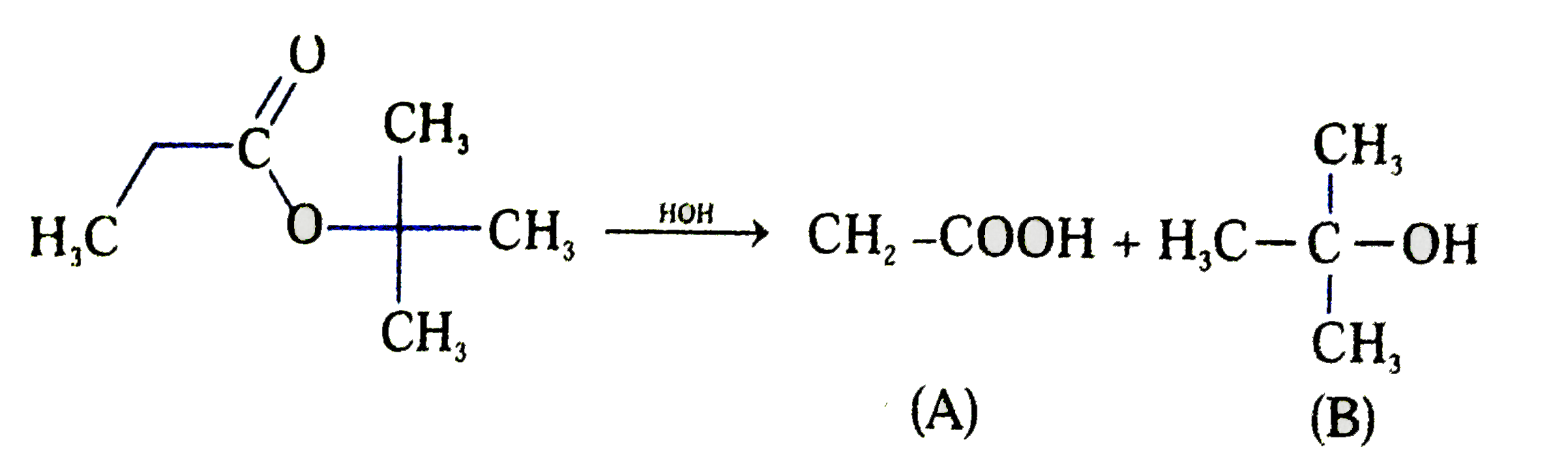
|
|
| 27. |
Give structures of A, B and C in the following reactions : (i) C_(6)H_(5)NO_(2) overset(Sn+HCl)(rarr)A underset(273K)overset(NaNO_(2)+HCl)(rarr)B overset(H_(2)O)(rarr)C (ii) CH_(3)CN overset(H_(2)O//H^(+))(rarr)A underset(Delta)overset(NH_(3))(rarr)B overset(Br_(2)+KOH)(rarr)C |
|
Answer» Solution :(i) `C_(6)H_(5)NO_(2) overset(Sn+HCl)(rarr) underset(underset("Aniline")((A)))(C_(6)H_(5)NH_(2)) underset(273K)overset(NaNO_(2)+HCl)(rarr) underset(underset(underset("chloride")("Benzene diazonium"))((B)))(C_(6)H_(5)N_(2)^(+)CL^(-)) overset(H_(2)O)(rarr) underset(underset("PHENOL")((C)))(C_(6)H_(5)OH)+N_(2)+HCl` (ii) `CH_(3)CN overset(H_(2)O//H^(+))(rarr) underset(underset("Acetic acid")((A)))(CH_(3)COOH) underset(Delta)overset(NH_(3))(rarr) underset(underset("Ethanamide")((B)))(CH_(3)CONH_(2)) overset(Br_(2)+KOH)(rarr) underset(underset("Methanamine")((C)))(CH_(3)NH_(2))` |
|
| 28. |
Give structures of (A),(B),(X),(Y) in the given scheme of reactions, if reagents a,b,c,d,e and f are Br_(2)CH_(3)COOH, NaNO_(2)//H_(2)SO_(4), CuBr,HNO_(3)//H_(2)SO_(4), Br_(2)//Fe and Sn//HCl respectively. |
|
Answer» |
|
| 29. |
Give structures of A,B and C in the following reactions: CH_(3)Br overset(KCN)toAoverset(LiAlH_(4))toB underset(273K)overset(HNO_(3))toC |
| Answer» Solution :`UNDERSET("BROMOMETHANE")(CH_(3)BR) underset(-KBr)overset(KCN)to underset("Ethanitrile (A)")(CH_(3)CN) overset(LiAlH_(4))to underset("ETHANAMINE (B)")(CH_(3)CH_(2)NH_(2)) underset(273K)overset(HNO_(2)) underset("Ethanol (C)")(CH_(3)CH_(2)OH)` | |
| 30. |
Give structures/configuration of the products in the following reactions: |
Answer» SOLUTION :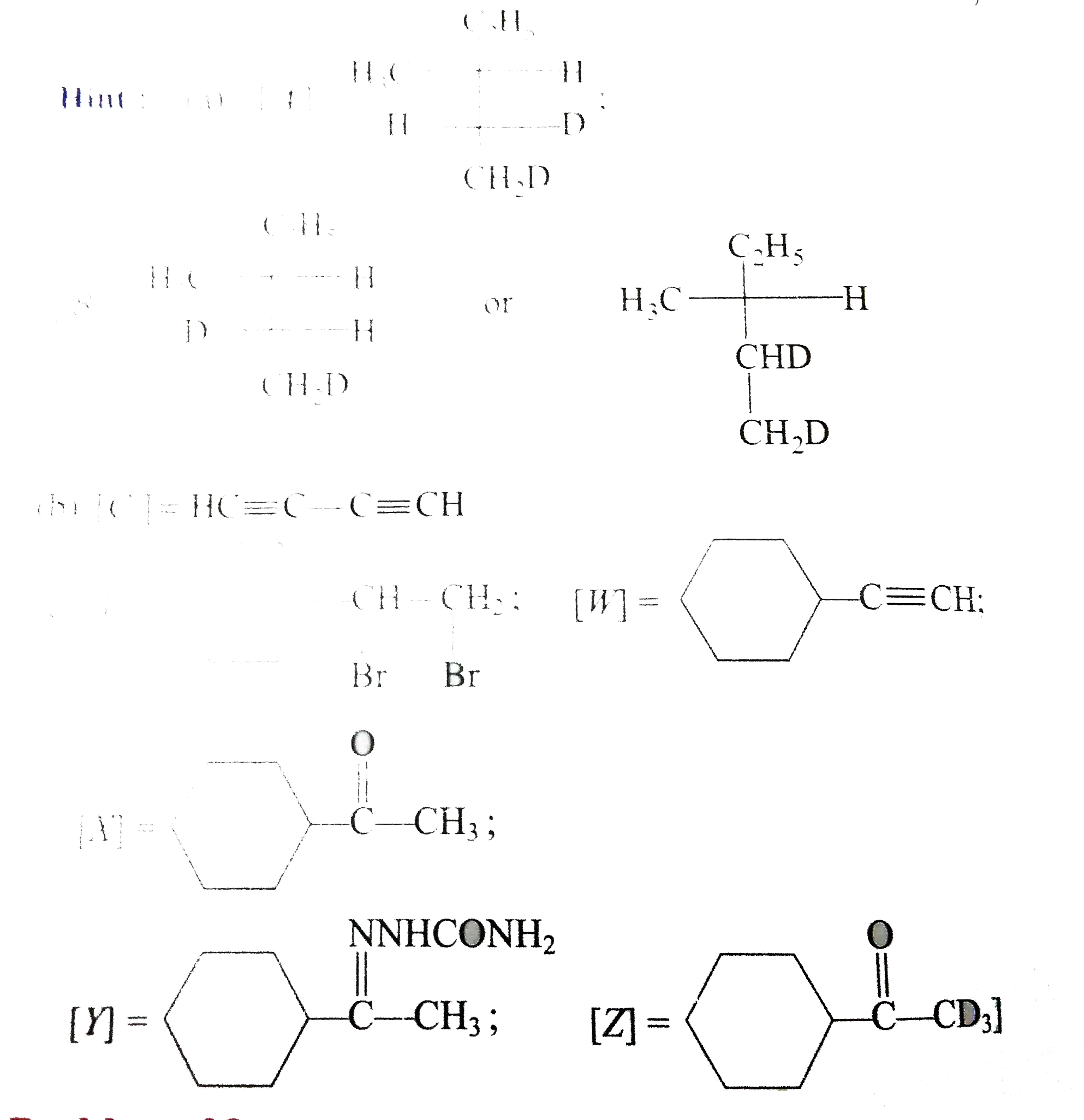
|
|
| 31. |
Give structure of the products you would expect when each of the following alcohol reacts with (a) HCl-ZnCl_(2) (b) HBr and (c) SOCl_(2), (i) Butan-1-ol (ii) 2-Methylbutan-2-ol. |
|
Answer» Solution :(a) With `HCL-ZnCl_(2)` (Lucas reagent). 2-methylbutan-2-ol (ii) being a `3^(@)` alcohol, reacts with Lucas reagent to produce turbidity IMMEDIATELY due to the formation of insoluble tert-alkyl chloride while butan-1-ol (i) being a `1^(@)` alcohol does not react with Lucas reagennt at ROOM temperature `underset("2-Methylbutan-2-ol "(3^(@)))(CH_(3)-underset(OH)underset(|)overset(CH_(3))overset(|)(C)-CH_(2)CH_(3))+HCl(conc.) overset("Anhyd. "ZnCl_(2))to underset("2-Chloro-2-methylbutane (White turbidity)")(CH_(3)-underset(CL)underset(|)overset(CH_(3))overset(|)(C)-CH_(2)CH_(3))+H_(2)O` `underset("Butan-1-ol "(1^(@)))(CH_(3)CH_(2)CH_(2)CH_(2)-OH)+HCl(conc.)overset("Anhyd. "ZnCl_(2))to` No reaction at room temperature (b) Both the alcohols react to produce the corresponding alkyl bromides. `underset("Butan-1-ol "(1^(@)))(CH_(3)CH_(2)CH_(2)CH_(2)OH)+HB r overset(Delta)to underset("1-Bromobutane")(CH_(3)CH_(2)CH_(2)CH_(2)Br)+H_(2)O` `underset("2-Methylbutan-2-ol "(3^(@)))(CH_(3)-underset(OH)underset(|)overset(CH_(3))overset(|)(C)-CH_(2)CH_(3))+HB r overset(Delta)to underset("2-Bromo-2-methylbutane")(CH_(3)-underset(Br)underset(|)overset(CH_(3))overset(|)(C)-CH_(2)CH_(3))+H_(2)O` (c) Both the alcohols react to form the corresponding alkyl chlorides. `underset("Butan-1-ol "(1^(@)))(CH_(3)CH_(2)CH_(2)CH_(2)OH)+SOCl_(2) overset(Delta)to underset("1-CHlorobutane")(CH_(3)CH_(2)CH_(2)CH_(2)Cl)+SO_(2)uarr+HCl uarr` `underset("2-Methylbutan-2-ol")(CH_(3)-underset(OH)underset(|)overset(CH_(3))overset(|)(C)-CH_(2)CH_(3))+SOCl_(2)overset(Delta)to underset("2-Chloro-2-methylbutane")(CH_(3)-underset(Cl)underset(|)overset(CH_(3))overset(|)(C)-CH_(2)CH_(3))+SO_(2)uarr+HCl uarr` |
|
| 32. |
Give structure of monomer unit of Nylon-6 . |
Answer» SOLUTION :CAPROLACTAM, 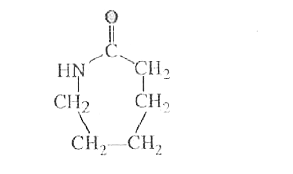
|
|
| 33. |
Give structure for the products of the reaction when butanal is treated with each of the following reagents (a) overset(oplus)(A) g(NH_(3)) overset(oplus)(O) H then HOH / H^(oplus) (b) overset(oplus)(O) H/HOH, Delta (c)NH_(2)OH//H^(oplus) (d) C_(6)H_(5)Li then HOH (e) C_(6)H_(5)CHO, overset(oplus)(O) H,Delta (f) CHequiv CNa then HOH / H^(oplus) (g) CH_(2)OH– CH_(2)OH,H^(oplus) (h) SH–CH_(2)–CH_(2)–CH_(2)–SH then Raney Ni/H_(2) (i) CH_(3)MgBr then H_(2)O (j) HCN (k) NaBH_(4) (1) CH_(3)-CH_(2)-overset(Br)overset(|)(CH)-COOC_(2)H_(5) and Zn then H_(2)O/ H^(oplus) (Reformatsky reaction) |
|
Answer» Solution :`(a) C-C-C-overset(O)overset(||)(C )-OH "" (b) CH_(3)-CH_(2)-CH_(2)-CH = underset(CHO)(C )-CH_(2) CH_(3) ` (c ) C - C - C - C - C = N - OH`"""(d)"C - C - C - overset(OH)overset(|)(C )-Ph ""(e ) Ph - CH= underset(CHO)underset(|)(C ) - CH_(2) - CH_(3)` (f)C - C - C - `overset(OH)overset(|)(CH)-C equiv CH "" (G)""(h)`C - C - C - C (j) `overset((i) 2^(@)"ALCOHOL")("Cyanohydrine") "" (k) 1^(@)` alcohol (L)`CH_(3)-CH_(2)_CH_(2)-overset(OH)overset(|)(CH)-underset(ET)underset(|)(CH)-CH_(2)H` 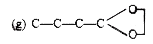
|
|
| 34. |
Give stereochemical formulas for A-D. are enantiomers of each of other. |
Answer» Solution :Compound A is a benzenesulfonate ester which forms with retention of configuration from (R)-2-butanol. B is the `S_(N)2`PRODUCT FORMED by reactions with HYDROXIDE which occurs with inversion of configuratio. C is a BENZOATE ester. Fomration of which does ot afect the configuration at the chirality centre. Saponification of C to from D does not effect the chirality CENTER either. since it is an acyl substitution reaction. 
|
|
| 35. |
Givestructuralformulaeand IUPACnames ofthe followingcompounds : (I )Tert-Amylchloride, (ii)sec-buty, iodide , (iii )neo-Hexyl bromideand (iv ) Iso-pentylchloride |
|
Answer» Solution :i) `(CH_3)_2C(CI)CH_2CH_3 ""`2-Chloro-2-methylbutane ii) `CH_3CH(I)CH_2CH_3 ""` 2-Iodobutane III) `(CH_3)_3 C CH_2 CH_2Br ""` 1-Bromo-3, 3-dimethyl butane iv) `(CH_3)_2 CHCH_2 CH_2Cl ""` 1-Chloro-3-methylbutane |
|
| 36. |
Give specific term to show the effect of the following processes: (a) Ferric hydroxide is mixed with arsenic sulphide sol (ii) Ferric chloride solution is mixed with freshly prepared precipitate of ferric hydroxide (c ) H_(2)S gas is passed throgh arsenic oxide solution (d) A beam of ligh is passed throhyg arsenic oxide solution. |
| Answer» Solution :(a) Coagulation (b) PEPTIZATION(c ) Double DECOMPOSITION(d) TYNDALL effect | |
| 37. |
Givesomeimportantvitaminsnameandtheirdeficiency disease. |
| Answer» Solution :`{:(,"NameofVitamin",,"Deficiencydisease"),(a., "Vitamin" A,, "Night blindness"),(B., "Vitamin" B_1 ,,"Beriberi"),(C., "Vitamin" B _2,,"Cheilosis"),(d., "Vitamin" B_6,,"CONVULSIONS"),(e.,"Vitamin" B_(12),,"Pernicious anaemia"),(f., "Vitamin" C,, "Scurvy(bleeding of gums)"),(g., "Vitamin"D,,"Rickets"),(h., "Vitamin" K ,, "Coagulationof blood") :}` | |
| 38. |
Give some uses of (application) of d- and f-block elements. |
|
Answer» Solution :The important uses of lanthanides are GIVEN below. (i) They do not find any use in pure state. They are USED in PRODUCTION of alloy steels to improve the strength and workability of steel. A well known alloy is misch-metal which is used in making magnesium BASED alloy (Mg mixed with 3% of misch-metal). This is purophoric alloy which is used in making BULLETS, shells and lighter flints. (ii) Their oxides are used in glass industry for polishing glass and making coloured glass for goggles and television screens. (iii) Mixed oxides of lanthanides are used in petroleum cracking . |
|
| 39. |
Give some examples of the ions which are coloured but diamagnetic in nature. |
| Answer» Solution :Dichromate ion `(Cr_(2)O_(7)^(2-)),` CHROMATE ion `(CrO_(4)^(2-))` and permanganate ion `(MnO_(4)^(-))` are diamagnetic, due to ABSENCE of unpaired electrons. But these are coloured due to charge TRANSFER phenomenon. | |
| 40. |
Give simple chemical tests to distinguish between the following pairs of compounds : (i) Propanal and Propanone (ii) Acetophenone and Benzophenone (iii) Phenol and Benzoic acid (iv) Benzoic acid Ethyl benzoate (v) Pentan -2- one and Pentan -3- one (vi) Benzaldehyde and Acetophenone (vii) Ethanal and Propanal. |
|
Answer» Solution :(i) Propanal `(CH_(3)CH_(2)CHO` and Propanone `(CH_(3)COCH_(3))` : 1. Tollen.s reagent test : Propanal being an aldehyde reduces Tollen.s reagent but propanone being a ketone does not reduce Tollen.s reagent. `underset("Propanal")(CH_(3)CH_(2)CHO)+2[Ag(NH_(3))_(2)]^(+)+3OH^(-)rarr underset("Silver mirror")(CH_(3)CH_(2)COO^(-)+Agdarr)+4NH_(3)+2H_(2)O` `underset("Propanone")(CH_(3)COCH_(3))+[Ag(NH_(3))_(2)]^(+)rarr"No silver mirror"` 2. Iodoform test : Propanone is a methyl ketone, therefore, it gives iodoform test with `I_(2)//NaOH(NaOI)`, but propanal does not. `underset("Propanone")(CH_(3)COCH_(3))+3NaOIrarr CH_(3)COONa +underset("(yellow ppt.)")underset("Iodoform")(2NaOH+CHI_(3))` `underset("Propanal")(CH_(3)CH_(2)CHO)overset(NaOI)rarr"No yellow ppt."` (ii) Acetophenone `(C_(6)H_(5)COCH_(3))` and Benzophenone `(C_(6)H_(5)COC_(6)H_(5))` : The two compounds can be distinguished by performing iodoform test. Acetophenone contains `CH_(3)CO-` group, hence, it gives iodoform test. As there is no `CH_(3)CO-` group in benzophenone, it does not respond to iodoform test. `underset("Acetophenone")(C_(6)H_(5)COCH_(3))+3NaOIoverset(I_(2)//NaOH)rarr underset("Sodium benzoate")(C_(6)H_(5)COONa)+2NaOH+underset("yellow ppt.")underset("Iodoform/")(CHI_(3))` `underset("Benzophenone")(C_(6)H_(5)COC_(6)H_(5))+NaOI rarr" No yellow ppt. of "CHI_(3)` (iii) Phenol `(C_(6)H_(5)OH)` and Benzoic acid `(C_(6)H_(5)COOH)`: The two compounds may be distinguished by the following tests : 1. `FeCl_(3)` test : Phenol gives a voilet colour with neutral `FeCl_(3)` but benzoic acid gives buff coloured ppt. of ferric benzoate. `underset("Phenol")(C_(6)H_(5)OH)+FeCl_(3)rarr "Violet colour"` `underset("Benzoic acid")(3C_(6)H_(5)COOH)+FeCl_(3)rarrunderset("(Buff coloured ppt.)")underset("Ferric benzoate")((C_(6)H_(5)COO)_(3)Fe)+3HCL` 2. Sodium bicarbonate test : Phenol is a weaker acid than benzoic acid while benzoic acid decomposes sodium bicarbonate, phenol does not. `underset("Benzoic acid")(C_(6)H_(5)COOH)+NaHCO_(3)rarrunderset("Sodium benzoate")(C_(6)H_(5)COONa)+CO_(2)uarr+H_(2)O` `underset("Phenol")(C_(6)H_(5)OH)+NaHCO_(3)rarr"No reaction"` (iv) Benzoic acid `(C_(6)H_(5)COOH)` and Ethyl benzoate `(C_(6)H_(5)COOC_(2)H_(5))` : 1. Iodoform test : Ethyl benzoate on boiling with excess of `NaOH` solution gives ethyl alcohol along with sodium acetate which on heating with more of `NaOH and I_(2)(NaOI)` gives a yellow ppt. of Iodoform. Benzoic acid does not give this test. `underset("(Ethyl benzoate)")(C_(6)H_(5)COOC_(2)H_(5))+NaOH overset("Boli")rarr C_(6)H_(5)COONa+underset("Ethyl alcohol")(C_(2)H_(5)OH)` `C_(2)H_(5)OH+4I_(2)+6NaOH overset(Delta)rarr HCOONA+5NaI+5H_(2)O+underset("Iodoform")(CHI_(3))` `underset("Benzoic acid")(C_(6)H_(5)COOH)overset(I_(2)//NaOH)underset(NaOI)rarr "No yellow ppt. of "CHI_(3)` 2. Sodium bicarbonate test : Benzoic acid gives effervescence with `NaHCO_(3)` solution while ethyl benzoate does not. `underset("Benzoic acid")(C_(6)H_(5)COOH)+NaHCO_(3)rarr C_(6)H_(5)COONa+CO_(2)uarr+H_(2)O` `underset("Ethyl benzoate")(C_(6)H_(5)COOC_(2)H_(5))+NaHCO_(3)rarr"No effervescence"` (v) Pentan -2- ONE `(CH_(3)COCH_(2)CH_(2)CH_(3))` and Pentan -3- one `(CH_(3)CH_(2)COCH_(2)CH_(3))` : Iodoform test : Pentan -2- one is a methyl ketone, therefore, it gives iodoform test with `NaOI`. Pentan -2- one is not a methyl ketone, hence, it does not respond to iodoform test. `underset("Pentan -2- one")(CH_(3)COCH_(2)CH_(2)CH_(3))+3NaOI rarr underset("Sodium butanoate")(CH_(2)CH_(2)CH_(2)COONa)+underset("(yellow ppt.)")underset("Iodoform")(2NaOH+CHI_(3))` `CH_(3)CH_(2)COCH_(2)CH_(3)+3 NaOI" rarr "No formation of iodoform"` (vi) Benzaldehyde `(C_(6)H_(5)CHO)` and Acetophenone `(C_(6)H_(5)COCH_(3))` : 1. Iodoform test : Acetophenone is a methyl ketone. It responds to idoform test while benzaldehyde does not. `underset("Acetophenone")(C_(6)H_(5)COCH_(3))+3NaOIrarr C_(6)H_(5)COONa+2NaOH+underset("(yellow ppt.)")underset("Iodoform")(CHI_(3)darr)` `underset("Benzaldehyde")(C_(6)H_(5)CHO)+3NaOIrarr"No yellow ppt."` 2. Tollens. reagent test : Benzaldehyde being an aldehyde reduces Tollens. reagent whereas acetophenone does not. `underset("Benzaldehyde")(C_(6)H_(5)CHO)+2[Ag(NH_(3))_(2)]^(+)+3OH^(-)rarr C_(6)H_(5)COO^(-)+2H_(2)O+underset("Silver mirror")(4NH_(3)+2Agdarr)` `underset("Benzophenone")(C_(6)H_(5)COCH_(3))overset("Tollens.")underset("reagent")rarr "No formation of silver mirror"` (vii) Ethanal `(CH_(3)CHO)` and Propanal `(CH_(3)CH_(2)CHO)` : The two compounds can be distinguished by iodoform test : `underset("Ethanal")(CH_(3)CHO)+3NaOIrarr underset("Sodium methanoate")(HCOONa)+2NaOH+underset("(yellow ppt.)")underset("Iodoform")(CHI_(3))` `underset("Propanal")(CH_(3)CH_(2)CHO)+3NaOIrarr"Noyellow ppt."` |
|
| 41. |
Give simple tests to distinguish between the following pair of compounds. (i) Benzaldehyde and Benzoic acid (ii) Propanal and propanone. |
|
Answer» Solution :(i) ADD `NaHCO_(3)`, benzoic ACID will give brisk ettervscence WHEREAS benzaldehyde will not give this TEST. |
|
| 42. |
Give simple chemical tests to distinguish between the following pairs of compounds : C_(6) H_(5) CHO and C_(6) H_(5) COCH_(3) |
|
Answer» Solution :`C_(6) H_(5) CHO` being an aldehyde gives silver mirror with Tollen.s reagent WHEREAS `C_(6) H_(5) COCH_(3)` does not. `C_(6) H_(5) CHO + 2[Ag(OH)_(2) ]^(+) + 3OH^(-) RARR C_(6) H_(5) COO^(-) + underset( "Silver mirror")(2Ag) + 2H_(2) O + NH_(3)` |
|
| 43. |
Give simple chemical tests to distinguish between the following pairs of compounds : (i) Ethanal and propanal(ii) Benzoic acid and phenol. |
|
Answer» SOLUTION :(i) Distinguish between Ethanal and PROPANAL `:` `CH_(3) CHO` and `CH_(3) CH_(2) CHO` Ethanal gives the iodoform test with `I_(2) //NaOH` whereas propanal does not. `CH_(3) CHO + 3NAOI rarr UNDERSET("Iodoform Yellow ppt.")(CHI_(3)) + HCOONa + 2NaOH` (ii) Distinction between Benzoic acid and phenol `:`  Benzoic acid gives an effervescence with a saturated solution bicarbonate while phenol does not. `underset("Benzoic acid")(C_(6) H_(5) COOH ) + NaHCO_(3) rarr underset("Sod. benzoate")(C_(6) H_(5) COONa) + CO_(2) + H_(2) O` |
|
| 44. |
Give simple chemical test to distinuish between Ethanol and Phenol. |
| Answer» Solution :Add NEUTRAL `FeCl_(3)` to both the compounds, PHENOL will give violet COLOURATION while ETHANOL does not. | |
| 45. |
Give simple chemical test to distinguish between the following pairs of compounds: (i) Ethanal and propanal (ii) Benzoic acid and phenol. |
|
Answer» SOLUTION :(i) Iodoform test: ETHANAL gives this due to the PRESENCE of NaOH and `I_(2)` `underset("Ethanal")(CH_(3)CHO)+4NaOH+3I_(2)tounderset(("yellow PPT Iodoform"))(CHI_(3))+HCOONa+3NaI+3H_(2)O` `CH_(3)CH_(2)CHO+4NaOH+3I_(2)to` No reaction. (ii) Sodium bicarbonate test: Benzoic acid gives brisk effervescence of `CO_(2)` when react with `NaHCO_(3)`, while phenol does not give it as it is a weak acid. 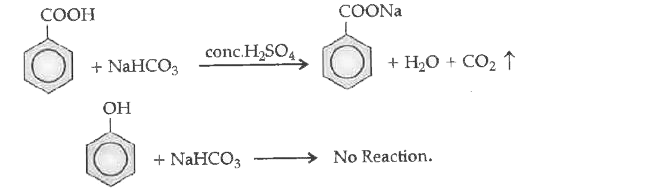
|
|
| 46. |
Give simple chemical test to distinguish between the following pairs of compounds : (i) Benzaldehyde and benzoic acid(ii) Propanal and propanone. |
|
Answer» Solution :(i) Distinguish between benzaldehyde and BENZOIC ACID `:` 1. Action of sodium hydrogencarbonate solution `underset("Benzoic acid")(C_(6) H_(5) COOH ) + NaHCO_(3) rarr C_(6)H_(5) COONa + CO_(2)uarr + H_(2) O` `underset("Benzaldehyde")(C_(6)H_(5) CHO) + NaHCO_(3) rarr `No reaction brisk reaction takes place with benzoic acid but not with benzaldehyde. 2. Tollen.s test Benzaldehyde forms a bright silver mirror with Tollen.s reagent . Benzoic acid does not give this test. `C_(6) H_(5) CHO + 2[ Ag ( NH_(3))_(2) ]^(+)+ 3OH^(-) rarrC_(6) H_(5) COO^(-) + 2Ag + 2H_(2) O + 4NH_(3)` |
|
| 47. |
Give short notes on the following : (a) Kolbe’s reaction (b) Riemer Tiemann reaction (c) Coupling reaction |
|
Answer» Solution :(a) Kolbe's reaction: In this reaction, phenol is first converted into SODIUM phenoxide which is more reactive than phenol towards electrophilic substitution reaction with `CO_(2)`. TREATMENT of sodium phenoxide with `CO_(2)` at 400 K, 4-7 bar pressure followed by ACID hydrolysis gives salicylic acid.  (ii) Riemer- Tiemann reaction: On treating phenol with `CHCl_(3)//NaOH`, a-CHO groupis introduced at ortho position. This reaction proceeds through the formation of substituted benzal chloride INTERMEDIATE.
|
|
| 48. |
Give shape, bond length and bond angle in Ammonia molecule respectively. |
|
Answer» LINEAR, 101.5 PM, 104.5° |
|
| 49. |
Give self-explanatory equation for the preparation of Polyacrylonitrile (PAN). |
| Answer» Solution :`underset("Acrylonitrile")(N C_(2)=overset(CN)overset(|)(CH) underset("PEROXIDE CATALYST")overset("POLYMERISATION")to underset("Polyacrylonitrile")([-CH_(2)-overset(CN)overset(|)(CH)]_(Q))` | |