

Saved Bookmarks
This section includes 7 InterviewSolutions, each offering curated multiple-choice questions to sharpen your Current Affairs knowledge and support exam preparation. Choose a topic below to get started.
| 1. |
Give the common and IUPAC names of the compound , CH_(2) = CH - CO - CH = CH_2 |
| Answer» SOLUTION :The common name of `CH_(2) =CH - CO - CH = CH_2` is divinyl ketone . IUPAC name is 1, 4 - pentadien -3- one. | |
| 4. |
Give the co-ordination number of La in the compound Na[La EDTA (H_(2)O)_(4)].3H_(2)O (Here EDTA^(4-) shows it's maximum denticity.) |
|
Answer» `"EDTA"^(4-)` is HEXADENTATE. |
|
| 5. |
Give two examples of corrosion. |
| Answer» Solution : RUSTING of IRON and TARNISHING of silver are EXAMPLES of corrosion. | |
| 6. |
Give two examples of colligative properties. |
| Answer» SOLUTION :(i) LOWERING of VAPOUR pressure. (ii) OSMOTIC pressure. | |
| 7. |
Give the classification of polymers obtained from esters of acrylic acid (CH_(2)=CH.COOH). |
Answer» SOLUTION :
|
|
| 8. |
Give two examples of antidepressants. |
| Answer» SOLUTION : IPRONIAZID, PHENELZINE. | |
| 9. |
Give the classification of proteins based on molecular shape. |
|
Answer» Solution :Based on its molecular shapes, the proteins are classified as FIBROUS proteins and the Globular proteins. (i) Fibrous proteins : The proteins that consist of linear, thread like polypeptide chains arranged or twisted to form a fibre are called fibrous proteins. In fibrous proteins, the polypeptide chains run parallel and are held together by hydrogen and disulphide bonds. These proteins are INSOLUBLE in water. Some common EXAMPLES are keratin (present in silk, hair, wool) and myosin (present in muscles) etc. (ii) Globular proteins : In these types of proteins, the polypeptide chains are folded to give SPHEROIDAL shape. These proteins are water soluble. Proteins such as insulin, albumin etc. are globular proteins. |
|
| 11. |
Give the classification of amino acids based on number of amino and carboxyl groups. |
|
Answer» Solution :(i) Acidic amino acids : The amino acids with greater NUMBER of carboxyl groups COMPARED to amino groups are called acidic amino acids. For example, aspartic acid, glutamic acids etc. are acidic amino acids. (ii) Basic amino acids : The amino acids with greater number of amino group than carboxyl group are called basic amino acids. For example, arginine, LYSINE etc. (iii) NEUTRAL amino acids : The amino acids with equal number of carboxyl and amino groups are called neutral amino acids. For example, alanine, phenyl alanine, Leucine etc. |
|
| 12. |
Give two examples for Strong acid (ii) Give two examples for Strong base |
|
Answer» SOLUTION :STRONG ACID: `HClO_4,H_2SO_4` |
|
| 13. |
Give two examples each of thermoplastic and thermosetting plastics. |
|
Answer» Solution :THERMOPLASTIC polymers: Polythenes, POLYVINYLS. THERMOSETTING polymers : Bakelite, urea-formaldehyde. |
|
| 14. |
Give the class of drug in which Salvarsan belong ? |
| Answer» SOLUTION :ANTIMICROBIAL (ANTIBACTERIAL) | |
| 15. |
Give the chemical test to distinguish between (a) Hexane (I), MeCH=CHCl (II), Propylchloride (III), and CH_(2)=CHCH_(2)Cl (IV) (b) (V) CH_(3)Cl, (VI) CH_(3)Br, and (VII) CH_(3)I |
|
Answer» Solution :a. (IV) is allyl CHLORIDE which reacts with `AgNO_(3)` in cold to givea white precipiate of `AgCl, (I)` does not have `(Cl)` group so no reaction. (III) is `1^(@) RX` which REACTSWITH `AgNO_(3)` in hot to give a white precipiate of `AgCl`, since `(II)` is less reactivbe than `(IV)` (II) is vinyl chloride which is inert even when heatedand doesnot give white precipitate with `AgNO_(3)`. (I) can be distinugulashed from others by adding `Br_(2)` in `CCl_(4)` to each the red-brown colour of `Br_(2)` is not decolourised by `(I)` while inothers (alkens) it dissapers. b. `(V) CH_(3)Cl overset(Aq. NaOH)(rarr) CH_(3) OH + Cl overset(Ag NO_(3))(rarr) underset(NH_(3))underset("soluble in")underset("White ppt"..,)(AgCl)` `(VI) CH_(3) Br underset(NaOH)overset(Aq.)(rarr) CH_(3)OH + Br^(@) overset(Ag NO_(3))(rarr) underset("in" NH_(3))underset("Partly sounle")underset("ppt"..:)underset("Pale yellow")(AgBr)` 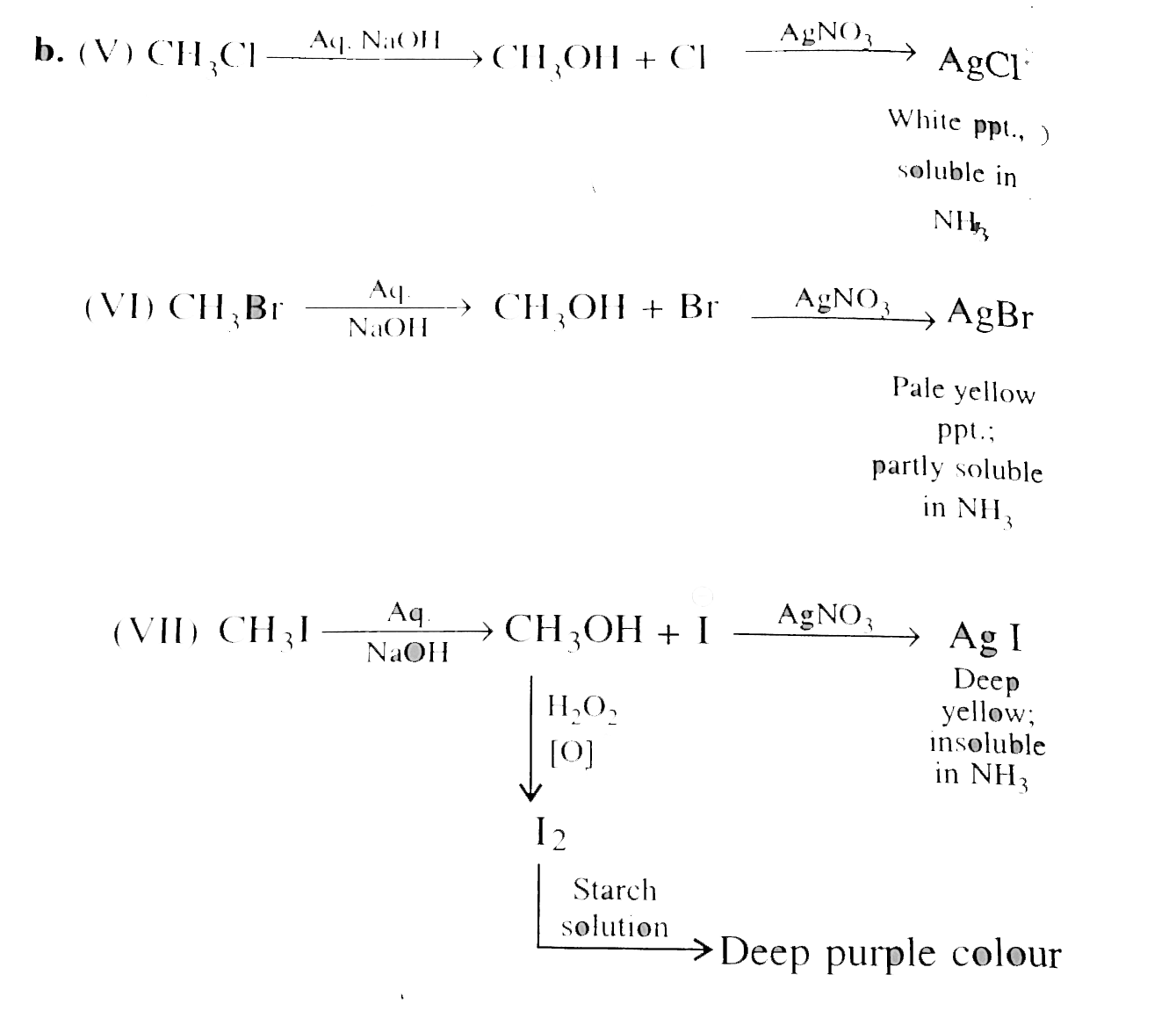
|
|
| 17. |
Give the class of drug in which Bithional belong ? |
| Answer» SOLUTION :ANTISEPTIC | |
| 18. |
Give two example of ores which can be concentrated by magnetic separation method. |
| Answer» SOLUTION :1. HAEMATITE , `Fe_2O_3`, 2. MAGNETITE, `Fe_3O_4`. | |
| 19. |
Give the class of drug in which Amoxycillin belong ? |
| Answer» SOLUTION : BROAD SPECTRUM ANTIBIOTIC | |
| 20. |
Give two example of organic compounds used as antiseptics. |
|
Answer» SOLUTION :(i) PHENOL `(0.2%)` (II) IODOFORM. |
|
| 21. |
Give the chemical tests to distinguish between the following pairs of compounds : (i) Ethylamine and Aniline "" (ii) Aniline and Benzylamine |
|
Answer» Solution :(i) Ethylamine and Aniline : Take the two compounds in two separate test tubes. Add DIL. HCl to both to dissolve the substance. Add sodium nitrite solution to both the test tubes and cool the test tubes to `5^(@)C`. Add alkaline solution of phenol to both the test tubes. An orange DYE will be obtained in the test TUBE containing aniline. (II) Aniline and Benzylamine : Take one mL of aniline and benzylamine separately in two test tubes. Add dil. HCl to dissolve. Add one mL of dil. solution of sodium nitrite. A brisk effervescence is obtained in the test tube containing benzylamine due to the following REACTION : `""C_(6)H_(5)CH_(2)NH_(2)+HNO_(2) rarr C_(6)H_(5)CH_(2)OH+N_(2)uarr+H_(2)O` |
|
| 22. |
Give the chemical reaction when ethanal is heated with hydrogen iodide and red phosphorus under high pressure. |
|
Answer» <P> Solution :ALDEHYDES are reduced to ALKANES.`underset("Ethanal")(CH_(3)CHO)+4HI overset("red P,pressure")to underset("Ethane")(CH_(3)CH_(3)+2I_(2)+H_(2)O` |
|
| 23. |
Give two equations to illustrate the chemical behaviour of phosphine. |
|
Answer» Solution :(i) Phosphine reacts with halogens to GIVE phosphorous penta halides. `PH_(3)+4Cl_(2)rarr PCl_(5)+3HCl` (ii) Phosphine forms coordination compound with lewis ACIDS such as boron trichloride. `BCl_(3)+PH_(3)rarr underset("Coordination compound")([Cl_(3)Blarr :PH_(3)])` (iii) Phosphine precipitates some METAL from their salt solutions. `3AgNO_(3)+PH_(3)rarr Ag_(3)P+3HNO_(3)` |
|
| 24. |
Give the chemical test of distinguish between : CH_(3)CHO and CH_(3)-overset(O)overset(||)C-CH_(3) |
| Answer» Solution :`CH_(3)CHO` GIVES TOLLEN's reagent test. `CH_(3)CHO+2AgNO_(3)+2NH_(4)OH to CH_(3)COOH+underset("Silver mirror")(2Ag+2NH_(4))NO_(3)+2H_(2)O`. | |
| 25. |
Give two example of food preservatives. |
| Answer» SOLUTION :Sorbic ACID (or its SALT) and SODIUM BENZOATE. | |
| 26. |
Give two example of antihistamine drug. |
| Answer» SOLUTION :TERFENADINE (SELDANE) and Brompheniramene. | |
| 27. |
Give the chemical reactions involved in the leaching of alumina from bauxite |
|
Answer» Solution :`Al_(2)O_(3)(s)+2NaOH(aq)+3H_(2)O(L)to2Na[Al(OH)_(4)]` `2Na[Al(OH)_(4)]+CO_(2)toAl_(2)O_(3).xH_(2)O+2NaHCO_(3)` `Al_(2)O_(3).xH_(2)O(s)overset(1470K)(to)Al_(2)O_(3)(s)+xH_(2)O(g)` |
|
| 28. |
Give two difination of solubility of a substance. Show that the total vapour pressure over that solution of two liquids A and B at a p[articular temprature varies linerluy wioth the mole fraction of the solute. |
|
Answer» Solution :It may be defined as the MAXIMUM amount of the SLUTE that can desso=ilve in 100 grams of the solvent to from a saturated solution at a given temperature. For ANSWER consult section 6. (Ideal and non-ideal SOLUTIONS) |
|
| 29. |
Give the chemical test of distinguish between : CH_(3)CHO and C_(6)h_(5)CHO. |
| Answer» SOLUTION :`CH_(3)CHO` gives brick RED ppt. `CH_(3)CHO+2CuSO_(4)+4NaOH to CH_(3)COOH +underset("Brick red ppt.")(Cu_(2)O+N)aSO_(4)+2H_(2)O` | |
| 30. |
Give two differences between white phosphorus and red phosphorus. |
Answer» SOLUTION :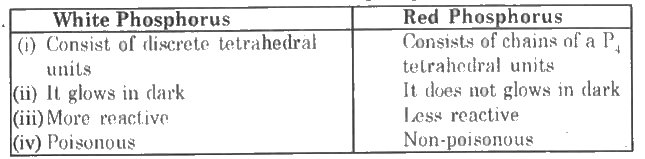
|
|
| 31. |
Give the chemical reactions showing oxidizing nature of potassium dichromate |
|
Answer» Solution :In acidic medium, the dichromate ion act as very good oxidizing agent.. The reaction can be represented as: `Cr_(2)O_(7)^(2-) + 14H^(+) + 6E^(-) rarr 2Cr^(3+) + 7H_(2)O (E^(@) = +1.33V)` Acidified dichromate solution oxidizes iodides to iodine, sulphides to sulphur, Sn(II) to Sn(IV), Fe(II) to Fe(III) etc. The half reactions of each species are: (i) `6I^(-) rarr 3I_(2) + 6e^(-)` (ii) `3H_(2)S rarr 6H^(+) + 3S+ 6e^(-)` (iii) `3Sn^(2+) rarr 3Sn^(4+) + 6e^(-)` (iv) `6Fe^(2+) rarr 6Fe^(3+) + 6e^(-)` The full ionic reaction can be obtained by adding half-reaction of potassium dichromate to the half reaction for the reducing agent Ex: `Cr_(2)O_(7)^(2-) + 14H^(+) + 6Fe^(2+) rarr 6Fe^(3+) + 2Cr^(3+) + 7H_(2)O` |
|
| 32. |
Give two differences between Starch and Cellulose. |
Answer» SOLUTION :
|
|
| 33. |
Give the chemical reaction to support that +5 oxidation state of Bi is less stable than +3 state. |
Answer» Solution :Due to INERT pair effect, Bi can show +3 and +5 oxidation states. SINCE the inert pair effect is maximum in case of Bi, therefore, its +5 oxidation STATE is less STABLE than +3 oxidation state. This is evident from the observation that `BiCI_(3)` even on prolonged heating with `CI_(2)` does not form `BiCI_(5)` 
|
|
| 34. |
Give any two differences between Frenkel and Schottky defects. |
| Answer» Solution :`{:("S.No.","Schottky defect","Frenkel defect"),((i),"Density DECREASES","No CHANGE in density."),((ii),"Observed when cations and ANIONS","Observed when cations and anions"),(,"have similar size.","differ in their size."),((iii),"Equal number of cations and anions","The smaller ion gets dislocated from"),(,"are missing from lattice points","its lattice point. "):}` | |
| 35. |
Give two differences between peptides and proteins. |
Answer» SOLUTION :
|
|
| 36. |
Give the chemical names of two detegents. |
| Answer» SOLUTION :SODIUM dodecyl SULPHATE and sodium dodecyl BENZENE sulphonate. | |
| 37. |
Give the chemical names of two compounds acting as soap. |
| Answer» SOLUTION :SODIUM (or POTASSIUM) stearte (or OLEATE or PALMITATE) | |
| 38. |
Give two differences between linear polymers and branched chain polymers. |
| Answer» Solution :Linear POLYMERS : HIGH density, m.pt, tensile STRENGTH , branched-chain polymers : low density, m. pt., tensile strength | |
| 39. |
Give the chemical formula of potassium hexacyanoferrate(II). What is the common name for this compound? |
|
Answer» Solution :`K_(4)[Fe(CN)_(6)]` Potassium Ferrocyanide |
|
| 40. |
Give the chemical formula of potassium hexacyano ferrate (II) |
| Answer» Solution :`K_(4)[FE(CN)_(6)]` | |
| 41. |
Give two differences between p-type & n-type semiconductors. |
Answer» SOLUTION :
|
|
| 42. |
Give the chemical formula for the compound potassium hexacyanocobaltate(III). |
| Answer» SOLUTION :`K3[CO(CN)_(6)]` | |
| 43. |
Give the structure of Cumene. |
|
Answer» |
|
| 44. |
GivetwodifferencesbetweenAmyloseandAmylopectin. |
| Answer» Solution :`{:("Amylose",,"AMYLOPECTIN"),((i)" Watersolublecomponent ofthestarch.",,"Waterinsolublecomponent ofthestarch."),((ii)" Linearpolymerof " PROP "-D- glucoseunits",,"Branched polymerof" prop " - D - Glucoseunits"):}` | |
| 45. |
The composition of .copper matte. is, |
| Answer» SOLUTION :`Cu_(2)S+` traces of FES or cuprous SULPHIDE + traces of ferrous sulphide. | |
| 46. |
Givetwo difference between Hormonesand vitamins. |
Answer» SOLUTION :
|
|
| 47. |
Give the characteristics of first order reaction. |
|
Answer» Solution :(i) When the concentration of the reactant is increased by 'n' times, the rate of reaction is also increased by n times. That is, if the concentration of the reactant is doubled, the rate is doubled. (ii)The UNIT of rate constant of a first order reaction is `sec^(-1)` or `"time"^(-1)`. `k_(1)=("rate")/((a-x))=("mol lit"^(-1)sec^(-1))/("mol lit"^(-1))` (iii) The time required to complete a definite FRACTION of reaction is independent of the initial concentration, of the reactant if `t_(1//u)` is the time of one 'u' th fraction of reaction to take PLACE then from equation. `k_(1)=(2.303)/(t)"log"(a)/(a-x)` `x=(a)/(u)` and `t_(1//u)=(2.303)/(k_(1))"log"(a)/(a-(a)/(u))`, `t_(1//u)=(2.303)/(k_(1))"log"(u)/((u-1))` SINCE, `k_(1)=` rate constant, `t_(1//u)` is independent of initial concentration 'a'. |
|
| 48. |
Give the cell reactions for following cells : underset("(1 M)")(Al(s)|Al^(3+)(aq))"||"underset("(1 M)")(Cu^(2+))(aq)|Cu(s) |
| Answer» Solution :`{:((LHE):2AL to2Al_((AQ))^(3+)+6e^(-)),("(Oxidation half reaction) (At -ve electrode)"),((RHE):3Cu_((aq))^(2+)+6e^(-)to3Cu),("(Reduction half reaction) (At +ve electrode)"),(ulbar(" OVERALL cell reaction" : 2Al_((s))+3Cu_((aq))^(2+)to2Al_((aq))^(3+)+3Cu_((s))"")):}` | |
| 49. |
Give two difference between Hormones and vitamins |
Answer» SOLUTION :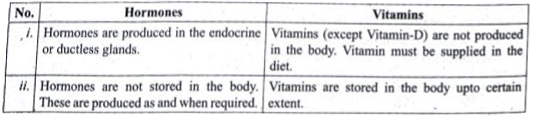 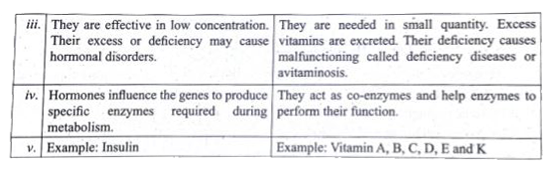
|
|
| 50. |
Give the bond energies of N equiv N, H-H and N-H bonds as 945, 436 and 391 kJmol^-1 respectively, the enthalpy of the following reaction N2(g) +3H2(g) →2NH3(g)is: |
| Answer» Answer :A | |