

Saved Bookmarks
This section includes 7 InterviewSolutions, each offering curated multiple-choice questions to sharpen your Current Affairs knowledge and support exam preparation. Choose a topic below to get started.
| 1. |
Give reasons for the following : (a) Measurement of osmotic pressure method is preferred for the determination of molar masses of macromolecules such as proteins and polymers . (b) Aquatic animals are more comfortable in cold water than in warm water . (c) Elevation of boiling point of 1M KCl solution is nearly double than that of 1 M sugar solution. |
|
Answer» SOLUTION :For ANSWER consult SECTION 12. For answer consult section 3. For answer consult answer to 14. |
|
| 2. |
Give relation between standard Gibbs energy of the reaction and equilibrium constant. |
|
Answer» `Delta_(r)G^(@)=-nF E_("cell")^(0)` `Delta_(r)G^(0)to` Standard Gibbs energy of the REACTION. `n to ` No. of ELECTRONS INVOLVED in the reaction. `E_("cells")^(0) to` Standard potential of the cell. |
|
| 3. |
Give relation between half reaction time (t_(1//2)) and initial concentration of reactant for (n-1) order reaction |
|
Answer» `t_(1//2)PROP[R]_(0)^(n-2)` |
|
| 4. |
Give reduction reaction of nitroethane by H_2//Ni . |
| Answer» SOLUTION :`C_2 H_5 NO_2 + 3H_2 UNDERSET(DELTA)OVERSET(NI)to C_2 H_5 NH_2 + 2H_2 O` | |
| 5. |
Givereasons : The dipole moment of chlorobenzene is lower than that of cyclohexyl chloride. |
Answer» Solution : Chlorine is more ELECTRONEGATIVE than carbon. This CREATES a positive charge on carbon linked to Cl in cyclohexyl chloride. In CHLOROBENZENE the electrons on chlorine participate in resonance with the ring. This decreases separation of charges. Hence dipole moment of chlorobenzene is LOWER than that of cyclohexyl chloride. |
|
| 6. |
Give reasons : Solid PCl_5 is an ionic compound. |
| Answer» Solution :SOLID `PCI_5` is an ionic COMPOUND : In the solid state, it exists as an ionic solid,`[PCl_4]^(+) [PCl_6]^(-)`in which the cation `[PCl_4]^(+)`is tetrahedral and the anion, `[PCl_6]^(-)` is octahedral. This is because tetrahedral and octahedral structures are more symmetrical and, THEREFORE, more STABLE compared to bipyramidal STRUCTURE of `PCl_5`. | |
| 7. |
Givereasons : S_(N)1 reactions are accompanied by recemisation in optically active alkyl halides. |
| Answer» Solution : In the first STEP of the mechanism, a CARBONIUM ion is produced which is PLANAR. In the second step the NUCLEOPHILE attaches to the carbonium ion from the front side and back side with equal probability. Hence racemisation takes place. | |
| 8. |
Give reasons: Methanol is mescible with water while iodo-methane isnot. |
|
Answer» Solution :(i) Methanol `(CH_(3)OH)` is miscible with WATER because it is able to form hydrogen bonding with water due to the PRESENCE of hydroxyl group whereas iodo-methane `(CH_(3)I)` does not contai -OH group. (ii) Since it is not able to form hydrogen bonding with water it is insoluble in water. |
|
| 9. |
Give reasons : Ozone is thermodynamically unstable. |
| Answer» Solution : Ozone is thermodynamically unstable : Ozone is thermodynamically unstable with respect to oxygen because its decomposition into oxygen results in the liberation of HEAT ie, DH is NEGATIVE. Also there is INCREASE in ENTROPY in this conversion i.e., DS is positive. These two effects reinforce each other resulting in large negative Gibb.s energy change (DG) for its conversion to oxygen. | |
| 10. |
Give reasons: On the basis of E^@ values. O_2 gas should be libersted at anode but it is Cl_2 gas which is liberated in the electrolysis of aqueous NaCl. |
| Answer» SOLUTION :DUE to overpotential / OVERVOLTAGE of `O_2` | |
| 11. |
Give reasons : (i)Xenon does not form fluorides such as XeF_(3) and XeF_(5).(ii)Out of noble gases, only xenon is known to form established chemicals compounds. |
|
Answer» (ii)Except radon which is radioactive, Xe has least ionization enthalpy among noble gases and hence it readily forms chemical compounds particularly with `O_(2)` and `F_(2)`. |
|
| 12. |
Give reasons: (i) Zirconium (Z = 40) and Hafnium (Z = 72) have almost similar atomic radii. (ii) d-block elements exhibit more oxidation states than f-block elements. (iii) The enthalpies of atomization of the transition metals are high (iv) The variation in oxidation states of transition metals is of different type from that of the non transition metals. (v) Orange solution of potassium dichromate turns yellow on adding sodium hydroxide to it. |
|
Answer» SOLUTION :(i) Due to lanthonoid contraction, Hf has similar atomic size (158 pm) to that of Zr (160 pm). (ii) f-block elements show limited number of oxidation states due to large energy gap between outer f, d and s-sub-shells. (iii) Due to the presence of large number to unpaired electrons in their atoms, they form strong INTERATOMIC METALLIC bonds. Hence, transition metals have high enthalpies of atomization. (iv) The variability in oxidation states of transition metals is due to incomplete filling of d-orbitals in such a way that their oxidation states differ from each other by unity. e.g.,` Fe^(2+) and Fe^(3+)`. In case of non-transition elements, the oxidation states differ by two units e.g., `Pb^(2+) and Pb^(4+)` and this is due to ns electrons. (v) `underset("Orange")(K_2Cr_2O_7) + 2NAOH to underset("Yellow")(K_2CrO_4) + Na_2CrO_4 + H_2O` . |
|
| 13. |
Give reasons : (i) Xenon does not form fluorides such as XeF_(3) and XeF_(5). (ii) Out of noble gases, only xenon is known to form established chemical compounds. |
|
Answer» Solution :(i) All the FILLED orbitals of Xe have paired electrons. The promotion of one, two or three electrons from the 5 p-filled orbitals to the 5 d-vacant orbitals will give rise to two, four and six half-filled orbitals respectively. So Xe can COMBINE with even but not odd number of F atoms. Hence, it cannot form `XeF_(3) and XeF_(5)`. (ii) Except RADON which is radioactive, Xe has lowest ionization enthalpy among noble GASES and hence it readily forms chemical compound with strong oxidising agents such as `O_(2) and F_(2)`. |
|
| 14. |
Give reasons : (i) Xenon does not form fluorides such as XeF_(3) and XeF_(5). (ii) Out of noble gases, only xenon is known to form established chemical compounds. |
|
Answer» Solution :(i) All the filled orbitals of Xe have paired electrons. The promotion of one, two or three electrons from the 5P filled orbitals to the 5d-vacant, orbitals will give rise to two, four and six half-filled orbitals. So, Xe can combine with even but not odd number of F atoms. HENCE, it cannot form `XeF_(3) and XeF_(5)`. (ii) Except radon which is radioactive Xe has least ionization energy among noble gases and hence it readily forms chemical compounds particularly with `O_(2) and F_(2)`. |
|
| 15. |
Give reasons : (i) The alpha-hydrogen atoms of aldehydes and ketones are acidic in nature. (ii) Propanone is less reactive than ethanal towards addition of HCN. (iii) Benzoic acid does not give Friedel-Crafts reaction. |
Answer» Solution :(i)  Oxygen being more electronegative than carbon draws the electrons towards it making carbon positive. Carbon, in turn, draws the electrons. (ii) Propanone is less reactive than ETHANAL towards addition of HCN. `CH_(3)-overset(O)overset(||)C-CH_(3), CH_(3)-overset(O)overset(||)C-H` This is because the nucleophile CIST FACES steric hindrance while attaching to propanone. (in) Benzoic acid does not give Friedel-Crafts reaction. This is because — COOH group is deactivating and the ALUMINIUM chloride (Lewis acid) gets bonded to the CARBOXYL group |
|
| 16. |
Give reasons : (i) SO_(2) is reducing while TeO_(2) is an oxidizing agent. (ii) Nitrogen does not form pentahalide. (iii) Icl is more reactive than I_(2). |
|
Answer» Solution :(i) + 6 OXIDATION stateof S is more stable than+4. Hence, `SO_(2)` act as reducing agent. Since stabilityof +6 oxidation decreases from S to TE. Hence, reducing character of dioxide decreases while oxidising character increases. Thus, `TeO_(2)` acts as an oxidising agent. (ii) Nitrogen does not form Pentahalides due to the absence of empty d-orbital. (iii) ICl is more reactive than `I_(2)` because the over lapping of orbitals of two dissimilar ATOMS is less EFFECTIVE than the OVERLAPPING of orbitals of similar atoms. Hence, I-Cl bond is weaker and more reactive. |
|
| 17. |
Give reasons : (i) Shaving soaps contain glycerol. (ii) Antacids should not be used for longer time. |
|
Answer» Solution :(i) Shaving SOAPS contain glycerol to PREVENT rapid drying. (ii) EXCESSIVE ANTACIDS make the stomach alkaline and trigger the production of even more ACID. (ii) Excessive antacids make the stomach alkaline and trigger the production of even more acid. |
|
| 18. |
Give reasons: (i) p-Nitrobenzoic acid and higher K_(a) value than benzoic acid. (ii) Acetone is highly soluble in water but benzophenone is not. |
Answer» Solution :(i) p-Nitrobenzoic acid has higher `K_(a)` value than benzoic acid.  Nitro group is electron-withdrawing group. It tends to release more protons from the carboxylic group. THUS, the dissociation of p-Nitrobenzoic acid TAKES place to a greater extent compared to benzoic acid. Hence, p-Nitrobenzoic acid has greater `K_(a)` value than benzoic acid.  (ii) Acetone is highly soluble in water but benzophenone is not : Acetone is highly soluble in water because of hydrogen bonding. Benzophenone is not soluble in water because it does not form hydrogen BOND with water because of steric HINDERANCE of bulky phenyl GROUPS. |
|
| 19. |
Give reasons: i) Nitrogen exists as a diatomic molecule ii) Nitrogen cannot form a pentahalide iii) Aluminium does not dissolve in conc. HNO_(3) |
|
Answer» SOLUTION :i) Nitrogen form DIATOMIC MOLECULES becasue it forins stable `ppi - ppi` multiple bond with itself. ii) DUE to non availability of d.orbitals in its valence shell. iii) Due to formation of passive film of OXIDE on the surface. |
|
| 20. |
Give reasons :(i) Mn shoes the highest oxidation state of +7 with oxygen but with fluorine it shows the highest oxidation state of +4 . (ii)Transition metals show variable oxidation state. (iii) Actinoids show iregularitiesin their electronic configuration. |
|
Answer» SOLUTION :(i)Manganese canform `p pi - d pi` bond with oxygen by utilizing 2p orbital of oxygen and 3d orbital of Mn . Hence, it can show HIGHEST oxidation state of `+7`. With FLUORINE, Mn cannote FORM such `p pi - d pi` bond. Hence, with fluorine it can show a MAXIMUM oxidaion state of `+4` . (ii Art. (iii) Art. |
|
| 21. |
Give reasons: i) Cu^(+2) (aq) is more stable than Cu^(+) ii) Ionisation enthalpy increases along transition elements from left to right iii) Zn has highest value for E^(@)(M^(3+)//M^(2+)) among 3d series elements |
|
Answer» Solution :i) `cu^(2+)` is more stable than cut due to much inore negative `DeltaH_("hyd")^(@)" of "cu^(2+)`. II) Ionisation enthalpy increases along transition elements from LEFT to right due to increase in NUCLEAR charge as ELECTRON fill the inner .d.orbitals. iii) Due to the removal of the electron from stable do configuration of `2N^(2+)` |
|
| 22. |
Give reasons : (i) Copper displaces silver from silver nitrate solution. |
| Answer» SOLUTION :COPPER is above SILVER in electro chemical SERIES. | |
| 23. |
Give reasons: (i) C–Cl bond length in chlorobenzene is shorter than C–Cl bond in CH_(3)Cl. (ii) The dipole moment of chlorobenzene is lower than that of cyclohexyl chloride (iii) SN_(1) reactions are accompained by racemization in optically active alkyl halides |
|
Answer» SOLUTION :(i) In chlorobenzene, each carbon atom is `sp^(2)` hybridised/ resonating structures / partial donable bond character. (II) Due to + R effect in chlorobenzene / difference in hybridization i.e., `sp^(2)` and `sp^(3)` RESPECTIVELY (iii) Due to formation of planer CARBOCATION |
|
| 24. |
Give reasons : (i) Boiling point of alkyl bromide is higher than alkyl chloride. (ii) Alkyl halides are better solvents than aryl halides. |
|
Answer» (ii) C – X is more polar in HALOALKANES |
|
| 25. |
Give reasons :(i) Aquatic species are more comfortable in cold water than in hot water. (ii) 10 mL of liquid A was mixed with 10 mL of liquid B. The volume of the resulting solution decreases to 19.8 ml. |
| Answer» Solution : (i) SOLUBILITY of oxygen in water is more in cold water (lower temperature) than hot water.Therefore aquatic species are more comfortable in cold water. (II) This happens because of increase in INTERMOLECULAR attractions between A - B INCOMPARISON to A - A or B - B interactions. | |
| 26. |
Give reasons: i) Aspirin finds use in prevention of heart attacks. ii) Sodium laurylsulphate is a anionic detergent |
|
Answer» SOLUTION :i) It has antiblood CLOTTING ACTION so aspirin FINDS use in prevention of heart attacks. ii) The anion of it has cleansing action. |
|
| 27. |
Give reasons : (i) Aniline is a weaker base than cyclohexyl amine. (ii) It is difficult to prepare pure amines by a ammonlysis of alkyl halides. |
| Answer» SOLUTION :(i) Cyclohexyl amine is more basic than aniline becuase aniline is a resonance hybrid of various resonance structures. As a RESULT, in aniline the electron DONATING CAPACITY of nitrogen for PROTONATION is considerably decreased. | |
| 28. |
Give reasons: (i) Aniline does not undergo Friedal Crafts reaction. (ii) Aromatic primary amines cannot be prepared by Gabriel,s phthalimide synthesis. (ii) Aliphatic amines are stronger bases than ammonia. |
|
Answer» Solution :(i) The amino GROUP reacts with anhydrous `AlCl_3` which is used as a catalyst in Friedel Crafts reactionAs `AlCl_3` is not available for the reaction, the reaction does not take PLACE. (ii) This is because aryl halide does not undergo nucleophilic substitution with the anion formed by PHTHALIMIDE. (iii) Alkyl groups are electron donating `R to NH_2` they increase the electron density on N and make the compound more basic. |
|
| 29. |
Give reasons : (i) Actinoids show variable oxidation states. (ii) Zr and Hf have almost identical radii. |
| Answer» Solution :(i) Due to COMPARABLE energies to 5F, 6d and 7S levels. (ii) It is due to LANTHANOID CONTRACTION. | |
| 30. |
Give reasons: i) Actinoids show variable oxidation state. ii) Zr and Hfhave almost identical radii. |
|
Answer» Solution :i) Do to comparable energies of 5f, 6D and 7S LEVELS. ii) DUE to lanthanide contraction. |
|
| 31. |
Give reasons for the observations : Lyophilic sol is more stable than lyophobic sol. |
| Answer» SOLUTION :DUE to HYDRATION, | |
| 32. |
Give reasons for the observations : It is incressary to remove CO when ammonia is prepared by Haber's process. |
| Answer» SOLUTION :CO ACTS as POISON for the CATALYST, | |
| 33. |
Give reasons for the observations : Leather gets hardened after tanning. |
| Answer» SOLUTION :APPLICATION (IV) | |
| 34. |
Give reasons for the Leather gets hardened after tanning |
| Answer» SOLUTION :Animal SKIN is a positively charged colloidal substance. Tanning is also colloidal in NATURE, but is negatively charged. This leads to mutual coagulation resulting in HARDENING of leather. | |
| 35. |
Give reasons for the following:White phosphorus is much more reactive than red phosphorus. |
| Answer» Solution :It is because `.P_4` is MONOMERIC whereas RED PHOSPHORUS is polymeric, WHITE `P_4`has lower bond dissociation ENERGY than red phosphorus. | |
| 36. |
Give reasons for the following: Where R is an alkyl group , R_3P=O exists but R_3N=O does not . |
| Answer» Solution :There are no d-orbitals in the valence SHELL in N, therefore the covalency of N is RESTRICTED to FOUR. Therefore, it cannot form the compound `R_3N=O` which requires the valency of FIVE. However, I can EXPAND its covalency to five and form compounds like `R_3P=O`. | |
| 37. |
Give reasons for the following: Transition metals form alloys. |
| Answer» SOLUTION :DUE to COMPARABLE radiki / comparable SIZE. | |
| 38. |
Give reasons for the following: PbCl_4 is more covlalentthan PbCl_2 . |
| Answer» Solution :A covalent COMPOUND is formed by sharing of ELECTRONS and an ionic compound is formed by transfer of electrons. It is energetically not feasible for Pb to LOSE 4 electrons to form `PbCl_4`. Hence, it shares four electrons with four CHLORINE atoms to form `PbCl_4`. On the other hand, Pb can lose two electrons to two chlorine atoms and form ionic `PbCl_2`. | |
| 39. |
Give reasons for the following: Sulphur in vapour state shows paramagnetic behaviour. |
| Answer» Solution :In VAPOUR STATE sulphur partly exists as `S_(2) ` MOLECULE which has TWO unpaired electrons like `O_(2)`. | |
| 40. |
Give reasons for the following:Phosphinic acid behaves as a monoprotic acid. |
Answer» SOLUTION :Phosphinic acid has only one replaceable HYDROGEN as SEEN from the structure 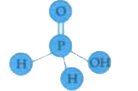
|
|
| 41. |
Give reasons for the following: Ozone is thermodynamically less stable than oxygen. |
| Answer» SOLUTION :Because DECOMPOSITION of ozone into oxygen results in the LIBERATION of heat (`Delta`H is negative) and an increase in ENTROPY (`Delta`S is positive), resulting in large negative Gibbs energy change (`Delta`G) for its conversion into oxygen. | |
| 42. |
Give reasons for the following observations : SF_(6) is kinetically an inert substance. Or SF_(6) is inert towards hydrolysis. Or SF_(6) is much less reactive than SF_(4). Or SF_(4) is easily hydrolysed whereas SF_(6) is not easily hydrolysed. |
| Answer» Solution :In `SF_(6)`, S is sterically PROTECTED by six F atoms and hence does not ALLOW `H_(2)O` molecules to attack the S atom. Furthermore, F does not have d-orbitals to accept the electrons donated by `H_(2)O` molecules. As a result of these two RESASONS, `SF_(6)` does not undero hydrolysis. In CONSTRAST, in `SF_(4)`, S is not sterically protected since it is surrounded by only four F atoms. As a result, attack of `H_(2)O` molecules on S atom can take place easily and hence hydrolysis occurs. | |
| 43. |
Give reasons for the following observations: Powdered substances are more effective adsorbents. |
| Answer» Solution :ADSORPTION INCREASES with the increase in SURFACE area of the ADSORBENT. On powdering, the surface area increases. Therefore the extent of adsorption also increases. | |
| 44. |
Give reasons for the following observations : Peptizing agent is added to convert precipitate into colloidal solution. |
| Answer» Solution :The PRECIPITATE absorbs one of the IONS of the ELECTROLYTE used as peptizing agent. This causes the development of positive or negative charge on the precipitate. Ultimately, the precipitate BREAKS up into particles of colloidal size on SHAKING. | |
| 45. |
Give reasons for the following observations: NH_3 gas adsorbs more readily than N_2 gas on the surface of charcoal. |
| Answer» Solution :The amount of GAS adsorbed by a solid DEPENDS upon the nature of the gas. EASILY liquefiable gases are more easily adsorbed. As `NH_3` gas is more liquefiable (it has a higher BOILING point) compared to `N_2`, it is more readily adsorbed. | |
| 46. |
Give reasons for the following observations : Lyophilic sol is more stable than lyophobic sol. |
| Answer» Solution :Lyophilic sol is more STABLE than LYOPHOBIC sol because the former is COVERED by a LAYER of the solvent which protects by lyophobic sol. | |
| 47. |
Give reasons for the following observations : Leather gets hardened after tanning. |
| Answer» Solution :Animal hides are colloidal in nature. Hide has positively CHARGED particles. When soaked in tannin (which contains NEGATIVELY charged particles), MUTUAL coagulation TAKES place which results in hardening of leather. | |
| 48. |
Give reasons for the following observations : It is necessary to remove CO when ammonia is prepared by Haber's process. |
| Answer» Solution :It is NECESSARY to remove CO when ammonia is prepared by Haber.s process. It is because CO ALSO has a tendency to link to the CATALYST Fe|Mo and thus acts as a poison. | |
| 49. |
Give reasons for the following observations : (i) It is difficult to prepare pure amines by ammonolysis of alkyl halides. (ii) Electrophilic substitution in case of aromatic amines takes place more readily than in benzene. |
|
Answer» SOLUTION :(i) It is because PRIMARY AMINES formed react with more alkyl halide to form `2^(@)" and "3^(@)` amines. That is we get MIXTURE of amines, which need to be separated. (ii) It is because `-NH_(2)` group is electron releasing and increases electron density on benzene RING. |
|
| 50. |
Give reasons for the following observations : (i) Halogens are strong oxidising agents. (ii) Noble gases have very low boiling points. (iii) O and Cl have nearly same electronegativity, yet oxygen forms H bond while Cl doesn't. |
|
Answer» SOLUTION :(i) Halogens have one electron less than the octet in their last orbit. They have a strong tendency to gain the electrons and change to halide ION `X+e^(-)toX^(-)` Thus, they GET reduced easily. In other words, they act as strong oxidising agents. (ii) Noble gases have the smallest atomic SIZE in their period. VAN der Waals. force of attraction is small because of small size. Therefore noble gases have low boiling points. (iii) Oxygen is in the second period and chlorine is in third period of the periodic table. Therefore Cl has the bigger atomic size. In view of this, the electron density on oxygen is more compared to chlorine. Therefore, oxygen forms H-bond but chlorine does not. |
|