Saved Bookmarks
This section includes 7 InterviewSolutions, each offering curated multiple-choice questions to sharpen your Current Affairs knowledge and support exam preparation. Choose a topic below to get started.
| 1. |
For the cell Zn|Zn^(2+)||Cu^(2+)|Cu if the concentration of Zn^(2+) and Cu^(2+) ions is doubled, the emf of the cell: |
|
Answer» Doubles |
|
| 2. |
For the cell: Zn(s)|ZnSO_(4)(aq)||CuSO_(4)(aq)Cu(s), calculate standard cell potential if standard state reduction electrode potentials for Cu^(2+)//Cu and Zn^(2+)//Zn are +0.34V and -0.76V respectively. |
|
Answer» |
|
| 3. |
For the cell Zn|Zn^(2+) (C_1)||Zn^(2+) (C_2)|Zn. DeltaG is negative if : |
|
Answer» `C_1 = C_2` |
|
| 4. |
For the cell Zn|Zn^(+2)||Cu^(+2)|Cu, if the concentration of Zn^(+2) and Cu^(+2) ions is doubled, the emf of the cell |
|
Answer» doubles |
|
| 5. |
For the cell, Zn(s)abs(Zn^(2+))abs(Cu^(2+))Cu(s), the standard cell voltage, E^(0)""_(cell) is 1.10 V.When a cell using these reagents was prepared in the lab, the measured cell voltage was 0.98One possible explanation for the observed voltage is : |
|
Answer» there were `2.00` mole of `Cu^(2+)` but only `1.00` mol of `Zn^(2+)` |
|
| 6. |
For the cell Zn(s)|Zn^(2+) (2M)||Cu^(2+) (0.5 M)|Cu(s) (a) Write equation for each half reaction. (b) Calculate the cell potential at 25^@C |
|
Answer» SOLUTION :(a) Half reaction OXIDATION half reaction: (i) `Zn(s) to Zn^(2+) (aq) +2e^(-)` Reduction half reaction: (II) `Cu^(2+) (aq) +2e^(-) to Cu(s) ` `E_(cell)^@=E_(cathode)-E_(anode)` `=+0.34-(-0.76)=1.1` `E_(cell)^@=E_(cell)^@-0.059/2log""(Products)/(Reactants)` `Zn_((s))+Cu^(2+) (0.5M)to Cu_((s))+Zn^(2+)(2M)` `E_(cell)^@=1.1-0.059/2 LOG""2/0.5` `=1.1-0.0295 times 0.6020` `=1.1 -0.0177` =1.082V |
|
| 7. |
For the cell Zn(s) | Zn^(2+)(2 M) ||Cu^(2+) (0.5 M) | Cu(s) (a) Write the equation for each half-reaction. (b) Calculate the cell potential at 25^(@) C. [Given, E_(Zn^(2+)//Zn)^(@) =-0.76 V, E_(Cu^(2+)//Cu)^(@) = +0.34 C] |
|
Answer» Solution :`E^(@) =0.34 -(-0.76) = 1.1 V` `E_("cell") =E_("cell")^(@) -(0.0591)/2 LOG (ZN^(2+))/(Cu^(2+)) =1.1 -0.0591/2 log 2/0.5` `=1.1 -0.0295 log 4 = 1.1 -0.0295 xx 0.6021 = 1.1 - 0.0177 = 1.0823` V |
|
| 8. |
For the cellZn(s) | Zn^(2+) || Cu^(2+) | Cu(s) , the standard cell voltageE_("cell")^(0) is 1.10 V . When a cell using these reagents was prepared in the lab, the measured cell voltage was 0.97 V . One possible explanaiton of the observed voltage is |
|
Answer» there are 2.00 mol of `Cu^(2+) ` bu only 1.00 mol of `ZN^(2+) ` `0.98 = 1.1 + (0.0591)/(2) log""([Cu^(+2)])/([Zn^(+2)]) ,` So , ` [Zn^(+2)] gt [Cu^(+2)]^(2)` |
|
| 9. |
For the cell Zn |Zn^(2+) | | Cu^(2+) | Cu , if the concentration of Zn^(2+) and Cu^(2+) ions is doubled , the emf of the cell |
|
Answer» DOUBLES |
|
| 10. |
For the cell Zn// Zn^(2+) // // Cu^(2+) // Cu , if the concentration of Zn^(2+) and Cu^(2+) ions is doubled , the emf of the cell |
| Answer» | |
| 11. |
For the cell, TI|TI^(+)(0.001M)|Cu^(2+)(0.1M)|Cu,E_(cell) at 25^(@)C is 0.83 V. this can be increased |
|
Answer» by increasing `[CU^(2+)]` |
|
| 12. |
For the cell, TI|TI^(+)(0.001 M)||Cu^(2+)(0.1 M)|Cu(s),E_(cell)^(@) at 25^(@)C is 0.83" V". It can be increased by : |
|
Answer» INCREASING `[Cu^(2+)]` |
|
| 13. |
For the cell ,Tl |Tl^+(0.001M)|| Cu,E_(cell) at 25^@ C is 0.83V.E_(cell) can be increased : |
|
Answer» By increasing `[CU^(2+)]` |
|
| 14. |
For the cell reaction Zn_((s)) + Cu_("0.1 M")^(2+) to Zn_(0.1 M)^(2+) + Cu_((s)) if the standard EMF of the cell is E^(@), then |
|
Answer» `E GT E^(@)` `E = E^(@) + 0.059` V |
|
| 15. |
For the cell reaction, Sn(s)+Pb^(2+)(aq)toSn^(2+)(aq)+Pb(s), E_(Sn^(2+)//Sn)^(@)=-0.136V, E_(Pb^(2+)//Pb)^(@)=-0.126V, Calculate the ratio of concentration of Pb^(2+) to Sn^(2+) ion at which the cell reaction will be reversed? |
|
Answer» SOLUTION :For the given cell, `E_(cell)^(@)=E_(Pb^(2+)//Pb)^(@)-E_(Sn^(2+)//Sn)^(@)=0.126-(-0.136)=0.01V` For the given cell REACTION, `E_(cell)=E_(cell)^(@)-(0.0591)/(2)"log"([Sn^(2+)])/([Pb^(2+)])=0.01-(0.0591)/(2)"log"([Sn^(2+)])/([Pb^(2+)])=0.01+0.0295"log"([Pb^(2+)])/([Sn^(2+)])` At equilibrium `E_(cell)=0` `therefore0.01+0.0295"log"([Pb^(2+)])/([Sn^(2+)])=0` or `"log"([Pb^(2+)])/([Sn^(2+)])=-(0.01)/(0.0295)=-0.3390=overline(1).6610` `THEREFORE([Pb^(2+)])/([Sn^(2+)])="Antilog "overline(1).6610=0.458` THUS, so long as `([Pb^(2+)])/([Sn^(2+)]) gt0.458`, the cell reaction as given will place. when `([Pb^(2+)])/([Sn^(2+)]) lt 0.458,E_(cell)` will become -ve, i.e., the reaction will be reversed. |
|
| 16. |
For the cell reaction X(s)+ 2Y^(+) to X^2 + 2Y k_c has been found to be 10^12. The E_("Cell")^@ is : |
|
Answer» 0.708 V |
|
| 17. |
For the cell reaction : Sn (s) + Pb^(2+) (aq) to Sn^(2+) (aq) + Pb (s) E_(Sn^(2+)|Sn)^(@) = -0.140 , E_(Pb^(2+) |Pb)^(@) = -0.126 V Calculate the ratio of concentration of Pb^(2+) to Sn^(2+) ion at which the cell reaction be reversed . |
|
Answer» Solution :For the cell , `E^(@) = E_(PB^(2+)|Pb)^(@) - E_(Sn^(2+) |Sn)^(@) = -0.126 - (-0.140)` `= 0.014 V ` Applying Nernst equation `E = E^(@) - (0.059)/(2) log ([Sn^(2+)])/([Pb^(2+)])` `= 0.014 + (0.059)/(2) "log" ([Pb^(2+)])/([Sn^(2+)])` At equilibrium , E = 0 `therefore 0.014 + (0.059)/(2) log ([Pb^(2+)])/([Sn^(2+)]) = 0` or log `([Pb^(2+)])/([Sn^(2+)]) = - (0.014xx 2)/(0.059) = -0.474` `therefore ([Pb^(2+)])/([Sn^(2+)]) =` antilog `(-0.474) = 0.336` Thus ,the cell reaction will occur TILL `([Pb^(2+)])/([Sn^(2+)])` is more than `0.336` V . When `([Pb^(2+)])/([Sn^(2+)])` BECOMES less than 0.336 V , `E_(cell)` will become negative and reaction will be reversed . |
|
| 18. |
For the cell reaction, Ni|Ni^(2+)||Ag^(+)|Ag Calculate the equilibrium constant at 25^(@)C. How much maximum work would be obtained by the operation of this cell ? |
|
Answer» |
|
| 19. |
For the cell reaction Ni (s)|NI^(2+)(aq)||Ag^(+)(aq)|Ag(s), calculate the equilibrium constant at 25^(@)C. How much maximum work would be obtained for the operation of this cell ? (Given E_(Ni^(2+)//Ni)^(@)=-0.25" V " and E_(Ag^(+)//Ag)^(@)=0.80" V ") |
|
Answer» `E_(cell)^(@)=E_(cathode)^(@)-E_(anode)^(@)=0.80-(-0.25)=1.05" V "` `E_(cell)^(@)=(0.0591)/(n)log K_(c )"or""log "K_(c )=(nE^(@)cell)/(0.0591)` `log K_(c )=(1.05xx2)/(0.0951)=35.6 "or"K_(c )="Antilog "35.6=3.981xx10^(35)` `(-DeltaG^(@))=Max.work =nFE^(@) cell` `=2" MOL"xx(96500" C mol"^(-1))xx(1.05" V")=202650" J "=202.65 KJ` |
|
| 20. |
For the cell reaction, Mg_((s))+Cu_((aq))^(2+) rarr Cu_((s)) +g^(2+)(aq.) the standard reduction potentials of Mg and Cu are -2.37 V and 0.34 V respectively. The e.m.f. of the cell is |
|
Answer» 2.03V |
|
| 21. |
For the cell reaction, Cu_(C_(2))^(2+)(aq)+Zn(s) to Zn_(C_(1))^(2+)(aq)+Cu(s) The change in free energy (DeltaG) at a given temperature is a function of : |
|
Answer» In `C_(1)` `-DeltaG` is a function of In `(C_(2)//C_(1))` |
|
| 22. |
For the cell reaction Cu^(2+)(C_(1aq))+Zn_((s))+Zn^(2+)(C_(2aq))+Cu_((s)) of an electrochemical cell, the change in free energy at a given temperature is a function of |
|
Answer» ln `(C_(1))` HENCE `DeltaG` is the FUNCTION of `ln ((C_(2))/(C_(1)))` |
|
| 23. |
For the cell reaction, 2H_(2)(g)+O_(2)(g)to2H_(2)O(l),Delta_(r)S_(298K)^(@)=-0.32" kJ "K^(-1) What is the value of Delta_(f)H^(@)(H_(2)O)? Given: O_(2)(g)+4H^(+)(aq)+4e^(-)to2H_(2)O(l),E^(@)=1.23V |
|
Answer» `-189.71 " kJ "mol^(-1)` `DeltaG^(@)=-nFE_(cell)^(@)=-4xx96500xx1.23J` `=474780J=-474.78kJ` (n=4 for the given cell raction) `DeltaG^(@)=DeltaH^(@)-TDELTAS^(@)` ORR `DeltaH^(@)=DeltaG^(@)-TDeltaS^(@)` `=-474.78kJ+298K(-0.32kJK^(-1))` `=-474.8-95.36kJ=-570.16 kJ` This is enthalpy change for the formation of 2 moles of `H_(2)O` `therefore` Enthalpy change for the formation of 1 mole of `H_(2)O(Delta_(f)H^(@))=-(570.16)/(2)=-285.08kJ`. |
|
| 24. |
For the cell reaction 2Fe_((aq))^(3+)+2I_((aq))^(-) to 2Fe_((aq))^(2+)+I_(2(aq)) E_(cell)^(Theta)=0.24V at 298K. The standard Gibbs energy (Delta_(r)G^(Theta)) of the cell reaction is : [Given that Faraday constant F=96500 C mol^(-1)] |
|
Answer» 23.16 KJ `mol^(-1)` `DELTAG^(@)=-nFE^(@)""` (where,n=2) `=-2xx96500xx(0.24)` `=-46320J` `=-46.32` kJ `mol^(-1)` |
|
| 25. |
For the cell reaction ,Cu^(2+)(aq)(C_2) +Zn(s) rarrZn^(2+)(aq)(C_1)+Cu(s), the change in free energy(Delta G) at a given temperature is a function of : |
|
Answer» `lnC_1` |
|
| 26. |
For the cell reaction 2Fe^(3+)(aq) + ""^(21-)(aq) to 2Fe^(2+)(aq) + 1_2 (aq) E_("cell")^(@) = 0.24V at 298K.The standard Gibbs energy (Delta, G^@) of the cell reactions is : |
|
Answer» `-46.32 KJ MOL^(-1)` |
|
| 27. |
For the cellreaction 2Fe^(3+)(aq)+21^(-)(aq) rarr 2Fe^(2+)(aq)+1_(2)(aq)E_(cell)^(@)=0.24V at 298 K. The standard Gibbs energy (Delta, G^(@)) of the cell reactions is : |
|
Answer» `-46.32" KJ "MOL^(-1)` |
|
| 28. |
For the cell reaction, 2Cr^(4+)+Coto2Ce^(3+)+Co^(2+)""E_((cell))^(@) is 1.89V and E_(Co//Co^(2+))^(@)=-0.028. If E_(Ce^(4+)//Ce^(3+))^(@) |
|
Answer» `-1.64V` `E_(Cell)^(@)=E_("cathode")^(@)-E_("anode")^(@)=1.89=E_(Cell)^(@)-(-0.28)` `E_(Cell)^(@)=-1.89-0.28=1.61`VOLT. |
|
| 29. |
For the cell Pt|H_2(0,4atm)|H^+(pH=1)||H^+(pH=2)|H_2(0.1atm)|Pt The measured potential at 25^(@)C is |
|
Answer» (-0.1)V |
|
| 30. |
For the cell prepared from electrode A and B, electrode A:(Cr_2O_7^(2-))/(Cr^(3+)), E_("red")^(0)=+1.33V and electrode B :(Fe^(3+))/(Fe^(2+)), E_("red")^(0)=0.77 V, which of the following statement is not correct ? |
|
Answer» The electrons will flow B to A (in the OUTER circuit) when connections are made. Anode is B `implies` is NEGATIVE electrode. `implies` electrons flow from B to A . `implies` e.m.f=(1.33-0.77) V |
|
| 31. |
For the cell prepared from electrode A and B , Electrode A : Cr_(2)O_(7)^(2-) | Cr^(3+) , E_("red")^(@) = 1.33 V and Electrode B : Fe^(3+) | Fe^(2+) , E_("red")^(@) = 0.77V . Which of the following statement is correct ? |
|
Answer» The electrons will flow from B to A when connection are MADE `E_(cell)^(@)= E_(RP_(Cr))^(@) - E_(RP_(Fe))^(@)` `= 1.33 - 0.77 = + 0.56` V |
|
| 32. |
For the cell prepared from electrodA , Cr_2O_7^(2-) |Cr^(3+) , E_("red")^(@) = + 1.33Vand electrode B: Fe^(3+) | Fe^(2+), E_("red")^(@) = 0.77V. Which of the following statement is correct ? |
|
Answer» The ELECTRONS will flow from B to A when the connection is made |
|
| 33. |
For the cell Mg_((s))|Mg_((aq.))^(2+)||Ag_((aq.))^(+)|Ag_((s)), calculate the equilibrium constant at 25^(@)C and the maximum work that can be obtained during operation of cell. (Given, E_(Mg//Mg^(2+))^(@) = +2.37 V and E_(Ag^(+)//Ag)^(@) = +0.80V, R = 8.314 J) |
|
Answer» |
|
| 34. |
For the cell prepared from electrode A and B: Electrode A:Cr_2O_7^(2-)|Cr^(3+),E_(red)^@ =+1.33 V and Electrode B:Fe^(3+)/Fe^(2+),E_(red)^@=0.77 V.Which of the following statements are correct : |
|
Answer» THEELECTRONS will flow from B to A when CONNECTION are made |
|
| 35. |
For the cell: Mg(s)|Mg^(2+)(aq)||Ag^(+)(aq)|Ag(s), calcualte the equilibrium constant of the cell reaction at 25^(@)C and maximum work that can be obtained by operating the cell, E_(Mg^(2+)//Mg)^(@)=-2.37V and E_(Ag^(+)//Ag)^(@)=+0.80V(R=8.31" J "mol^(-1)K^(-1)). |
|
Answer» |
|
| 36. |
For the cell Mg(s) |Mg^(2+)(aq)||Ag^(+)(aq)|Ag (s), calculate the equilibrium constant at 25^@C and maximum work that can be obtained during operation of cell. Given : E_(Mg^(2+)|Mg)^@ = + 2.37 V and E_(Ag^(2+)|Ag)^@ = 0.80V |
|
Answer» Solution :`{:("Oxidation at anode", Mg to Mg^(2+)+2e^(-), (E_("ox")^(@)) = 2.37V),("Reduction at cathode ", Ag^+ + e^(-) to Ag, (E_("red")^@) = 0.80 V):}` `:. E_("cell")^(@) = (E_("ox")^(@))_("anode") + (E_("red")^(@))_("cathode") = 2.37 + 0.80 = 3.17V` Overall reaction, `Mg + 2Ag^(+) to Mg^(2+) +2Ag` `DeltaG^@ = -NFE^@` `= -2 XX 96400 xx 3.17` `= -6.118 xx 10^5J` We know that `W_("MAX") = DeltaG^@` `:. W_("max") = +6.118 xx 10^5 J` Relationship between `DeltaG^@` and `K_(eq)` is `Delta G = -2.303 RT log K_(eq)` `DeltaG = -2.303 xx 8.314 xx 298 log K_(eq) "" [ :. 25^@C = 298 K]` `log K_(eq) = (6.118 xx 10^5)/(2.303 xx 8.314 xx 298) IMPLIES (6.118 xx 10^5)/(5705.84)` `log K_(eq) = 107.223` `K_(eq) = "Antilog" (107.223)` . |
|
| 37. |
For the cell Mg_((s))abs(Mg^(2+)""_((aq)))abs(Ag^(+)""_((aq)))Ag_((s)), calculate the equilibrium constant at 25^(@)C and maximum work that can be obtained during operation of cell. Given : E_(Mg^(2+)|Mg)^(@)=-237V " and " E_(Ag^(2+)|Ag)^(@)=0.80V |
|
Answer» Solution :oxidation at anode `MG rarr mg^(2+)+2e^(-)"...(1)"` `""(E_("ox")^(@))=2.37V` Reduction at cathode `Ag^(+)+e^(-) rarr Ag "...(2)"` `""(E_("red")^(2))=0.80V` `therefore E_("CELL")^(@)=(E_("ox")^(@))_("anode")+(E_("red")^(@))_("cathode")` `""=2.37+0.80` `""=3.17V` Overall REACTION Equation (1) + `2 times " equation (2)" rArr` `Mg+2Ag^(2+) rarr Mg^(2+)+2Ag` `""DELTAG^(@)=-nfE^(@)` `""=-2 times 96500 times 3.17` `""=611.810J` `DeltaG^(@)=-6.12 times 10^(5)J` `W=6.12 times 10^(5)J` `DeltaG^(@)=-2.803" RT log " K_(c)` `rArr logK_(c)=(6.12 times 10^(5))/(2.803 times 8.314 times 298)` `""K_(c)=` Antilog of (107.2). |
|
| 38. |
For the cell Mg|Mg^(2+)||Ag^(+)|Ag, calculate the equilibrium constant at 25^(@)C and the maximum work that can be obtained during the operation of the cell. (Given : E_(Mg//Mg^(2+))^(@)=2.37 volt and E_(Ag^(2+)//Ag)^(@)=0.80 volt |
|
Answer» |
|
| 39. |
For the cell , Hg,Hg_2 Cl_2//Cl (0.1M)//Cl^(-)(0.01M)//Cl_2, Pt E_("cell")^@ is 1.10V , Hence , E_("cell")is |
|
Answer» 1.1591V |
|
| 40. |
For the cell: Cu(10g)|underset((C_(1)))(CuSO_(4))"solution""||"underset((C_(2)))(ZnSO_(4))"solution""|"Zn(10g),E_("cell")=EV E_("cell") for the cell : Cu(20g)|underset((C_(1)))(CuSO_(4))"solution""||"underset((C_(2)))(ZnSO_(4))"solution""|"Zn(20g), is |
| Answer» Answer :A | |
| 41. |
For the cell given below Zn|Zn^(2+)||Cu^(2+) | Cu, (E_("cell")-E_("cell")^(0))is -0.12 V . It will be when : |
|
Answer» `[ZN^(2+)]//[CU^(2+)]=10^(2)` `log""([Zn^(+2)])/([Cu^(+2)]) = (0.12 XX 2)/(0.06) = (0.24)/(0.06) = 4, ([Zn^(+2)])/([Cu^(+2)]) = 10^(4)` |
|
| 42. |
For the cell: A|A^(m+)||B^(n+)|B,E_("cell")=-1.1V |
|
Answer» right ELECTRODE is cathode |
|
| 43. |
For the cell (at 298 K ) Ag_((g)) // AgCl_((s)) // Cl_((aq))^(-) ||AgNO_(3(aq)) // Ag_((s)) Which of the following is correct ? |
|
Answer» The EMF of the cell is zero when `[Ag^(+)]_("ANODIC " ) = (Ag^(+) )_("cathodic")` `E_("cathode")^(0) = E_(Ag^(+)//Ag)^(0) + (0.059)/(1) log [Ag^(+)] , E_("cell") =E_(O.P)^(0)-(0.059)/(1) log[Ag^(+)] + E_(R.P)^(0) + (0.059)/(1) log""(1)/([Cl^(-)])` E.M.F of cell is zero when `[Ag^(+)]_("cathode") = [Ag^(+)]_("anode")` |
|
| 44. |
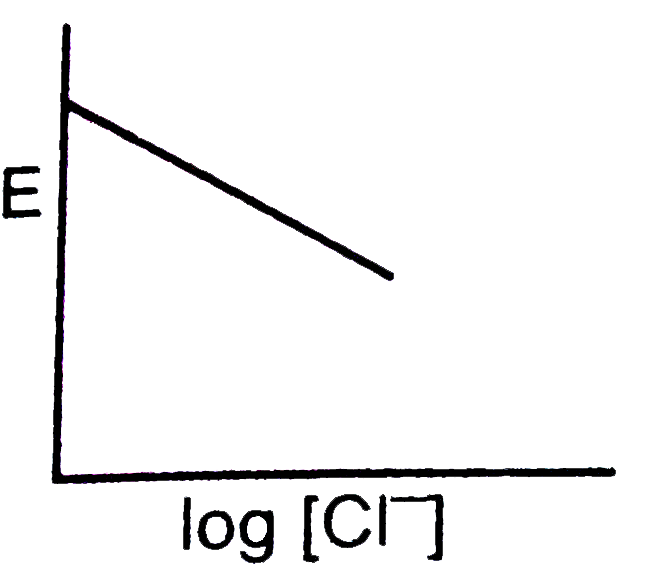
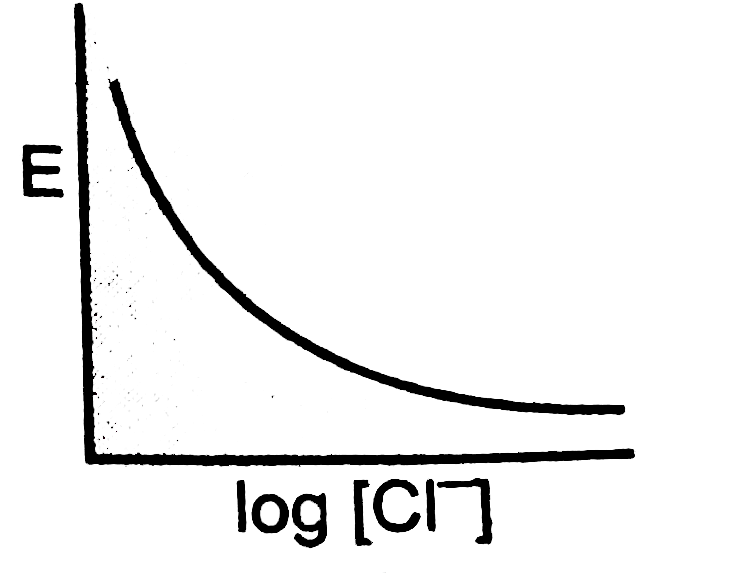
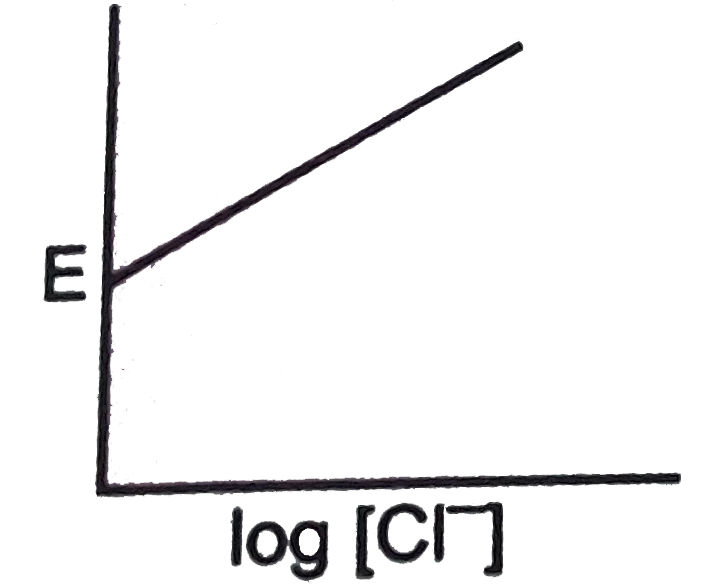
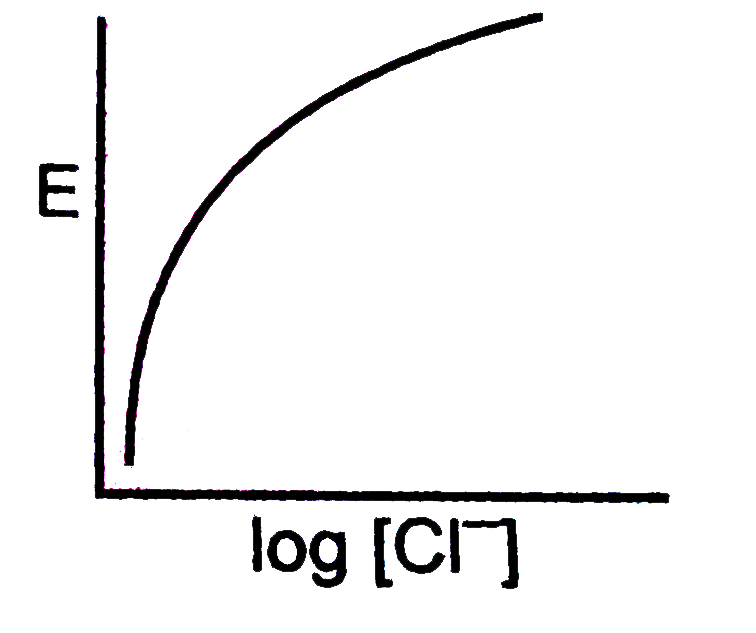
For the calomel electrode Hg,Hg_(2)|Cl^(-)(aq), electrode potential measured at different Cl^(-) ion concentration are plotted against log [Cl^(-)]. The variation is correctly represented by the plot. |
|
Answer»
`Hg_(2)Cl_(2)(s)+2e^(-)to2Hg(l)+2Cl^(-)(AQ)` `E=E^(@)-(0.0591)/(2)log[CL^(-)]^(2)` or `E=E^(@)-0.0591log[Cl^(-)]` THUS, plot of E vs log `[Cl^(-)]` is linear with a negative slope (i.e., E decreases LINEARLY with log `[Cl^(-)]`) |
|
| 45. |
For the carbylamine reaction we need hot alc. KOH and |
|
Answer» any AMINE and CHLOROFORM |
|
| 46. |
For the carbylamine reaction we need hot alcoholic KOH and : |
|
Answer» Any AMINE and chloroform |
|
| 47. |
For the bimolecular gaseour reaction: 2R(g) to Products, the fraction of molecules having sufficient energy for effective collision is 2.06 xx 10^(-9) at 127^(@) C. The activation energy for reaction is about (ln 2.06 = 0.727, ln 10 = 2.303) . |
|
Answer» 16 kJ/mole |
|
| 48. |
For the bleaching of hair, the substance used is : |
|
Answer» `SO_2` |
|
| 49. |
For the allotropic change represented by the equation C (graphite) toC (diamond), DeltaH = 1.9 kJ. If 6 g of diamond and 6 g of graphite are separately burnt to yield CO_(2), the heat liberated in first case is |
|
Answer» LESS than in the SECOND CASE by 1.9 KJ |
|
| 50. |
For the allotropic change represented by equation C(diamond) rarr C(graphite), the enthalpy change is DeltaH=-1.89 kJ. If 6g of diamond and 6g of graphite are separately burnt to yield carbon dioxide, the heat liberated in the first case is |
|
Answer» Less than in the second case by 1.89 kJ `C_(("graphite"))+O_(2)rarrCO_(2), DeltaH=-DeltaH_(1)` `C_(("diamond"))+O_(2)rarrCO_(2), DeltaH=-DeltaH_(2)` `(-DeltaH_(1))-(-DeltaH_(2))=1.89 kJ` for 12 G `C_("Diamond")rarrC_("graphite")` for combustion of 6g, `C_("Diamond")rarrC_("graphite") =-1.89//2=-0.945 kJ`. |
|