Saved Bookmarks
This section includes 7 InterviewSolutions, each offering curated multiple-choice questions to sharpen your Current Affairs knowledge and support exam preparation. Choose a topic below to get started.
| 1. |
For the decay: ""_(228)Ac overset(-beta)rarr ""^(228)Th overset(-alpha)rarr ""^(224)Ra where lamda (Ac)= 3.14 xx 10^(-5) s^(-1) and lamda(Th)= 1.148 xx 10^(-8) s^(-1). Determine the time for the radioactive daughter to reach its maximum activity |
| Answer» Solution :We have, `t= (2.303 (LOG lamda_(1)-log lamda_(2)))/(lamda_(1)-lamda_(2))= (2.303 (log 3.14 XX 10^(-5) - log 1.148 xx 10^(-8)))/(3.14 xx 10^(-5)-1.148 xx 10^(-8))` = `2.52 xx 10^(5)s` | |
| 2. |
Match the Column |
|
Answer» 0 |
|
| 3. |
For the correct assingment of electronic configuration of a complex, the valence bond theory often requires the measurement of : |
|
Answer» molar conductance |
|
| 4. |
For the conversionof CH_(3)OH intomethane , the regentusedis : |
|
Answer» <P>SODIUM |
|
| 5. |
For the consecutive reaction Aoverset(k_1("time"^(-1)))toBoverset(k_2("time"^(-1)))toCfollowing curves were obtained depending upon the relative values of k_1 & k_2 . Now which of the following is the correct match ? |
|
Answer» FIGURE 1 `(k_1 lt k_2)` In figure 1, [B] increased to a MAXIMUM VALUE during reaction.This is possible when rate of formation of B is more than rate of decay of B in C. i.e. `k_1 gt gt k_2` In figure 2, [B] is maintained to a very low value .This means that B is decaying as soon as it is formed.This is possible when `k_2 gt gt k_1` |
|
| 6. |
Forthe conversion of carbolic acid to picricacid, the reagents used are ____________. |
|
Answer» alc. `HNO_2` in the PRESENCE of CONC. `HNO_3` |
|
| 7. |
For the concentration cell Pt(H_(2))|(HA(0.1M)),(NaA(1M))||(Ha(1M)),(NaA(1M))|(H_(2))Pt""(pK_(a)" of "HA=4) Calculate the cell potential. |
|
Answer» Solution :Hydrogen electrodes have been SET up in TWO acidic BUFFER solution. For the buffer, `Ha(0.1M),NaA(1M)`, `[H^(+)]=K_(a)([HA])/([A^(-)])=10^(-4)xx(0.1)/(1)=10^(-5)M` for the buffer, `HA(1M),NaA(1M)`, `[H^(+)]=10^(-4)xx(1)/(1)=10^(-4)M` for concentration cell, `E_(cell)=(0.0591)/(n)"log"(c_(2))/(c_(1))=(0.0591)/(n)"log"(10^(-4))/(10^(-5))=0.0591Vcong=0.06V` |
|
| 8. |
For the compounds CH_3Cl , CH_3I , CH_3Br and (##CHY_CHE_ORG_XII_P2_PYQ_18_E01_058_Q01.png" width="80%"> which of the following is thecorrect order of C-halogen bond length ? |
|
Answer»
|
|
| 9. |
For the compounds CH_3 CI, CH_3Br, CH_3I and CH_3F,the correct order of increasing C-halogen bondlength is : |
|
Answer» `CH_3 LT CH_3Cl lt CH_3Br lt CH_3I` |
|
| 10. |
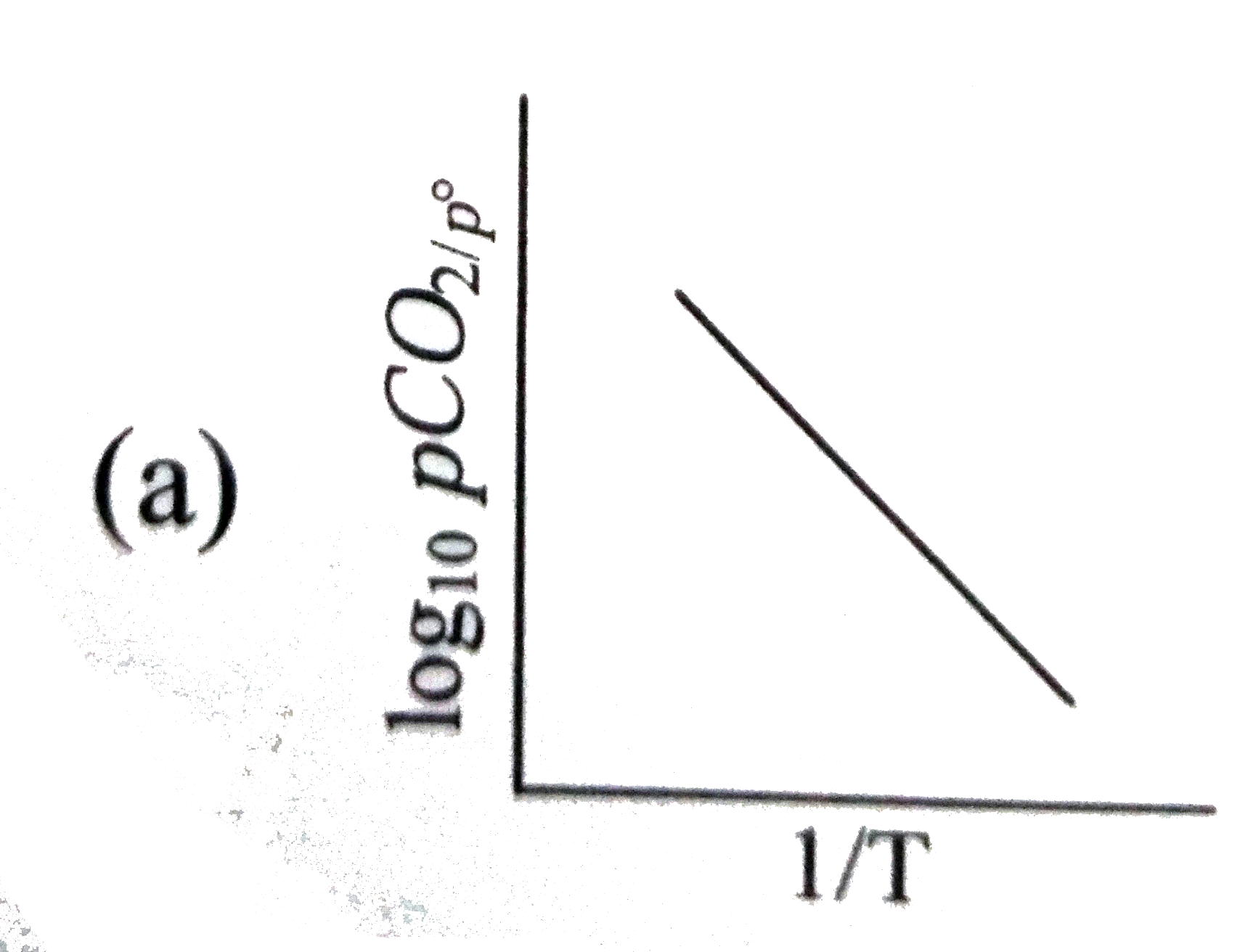
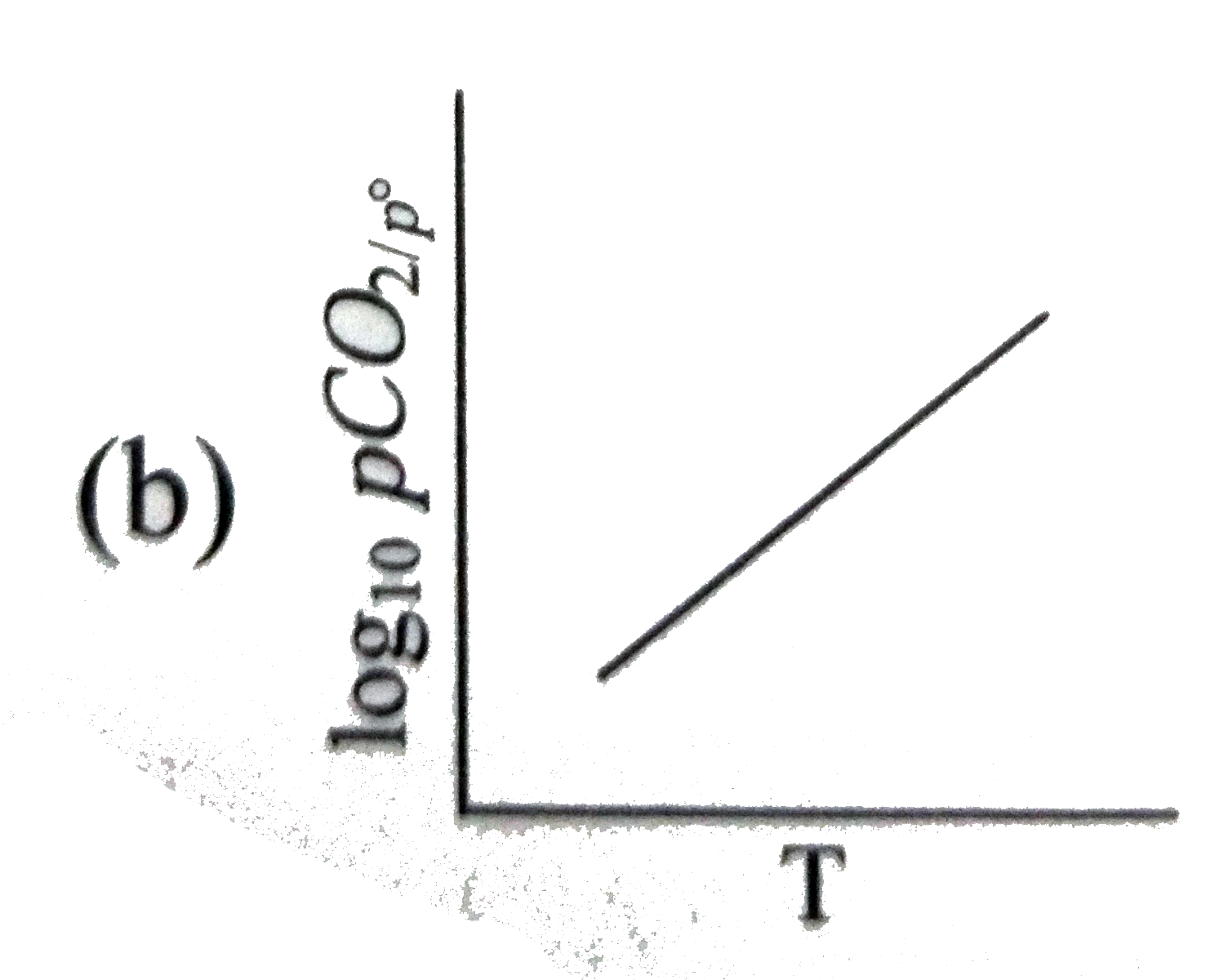
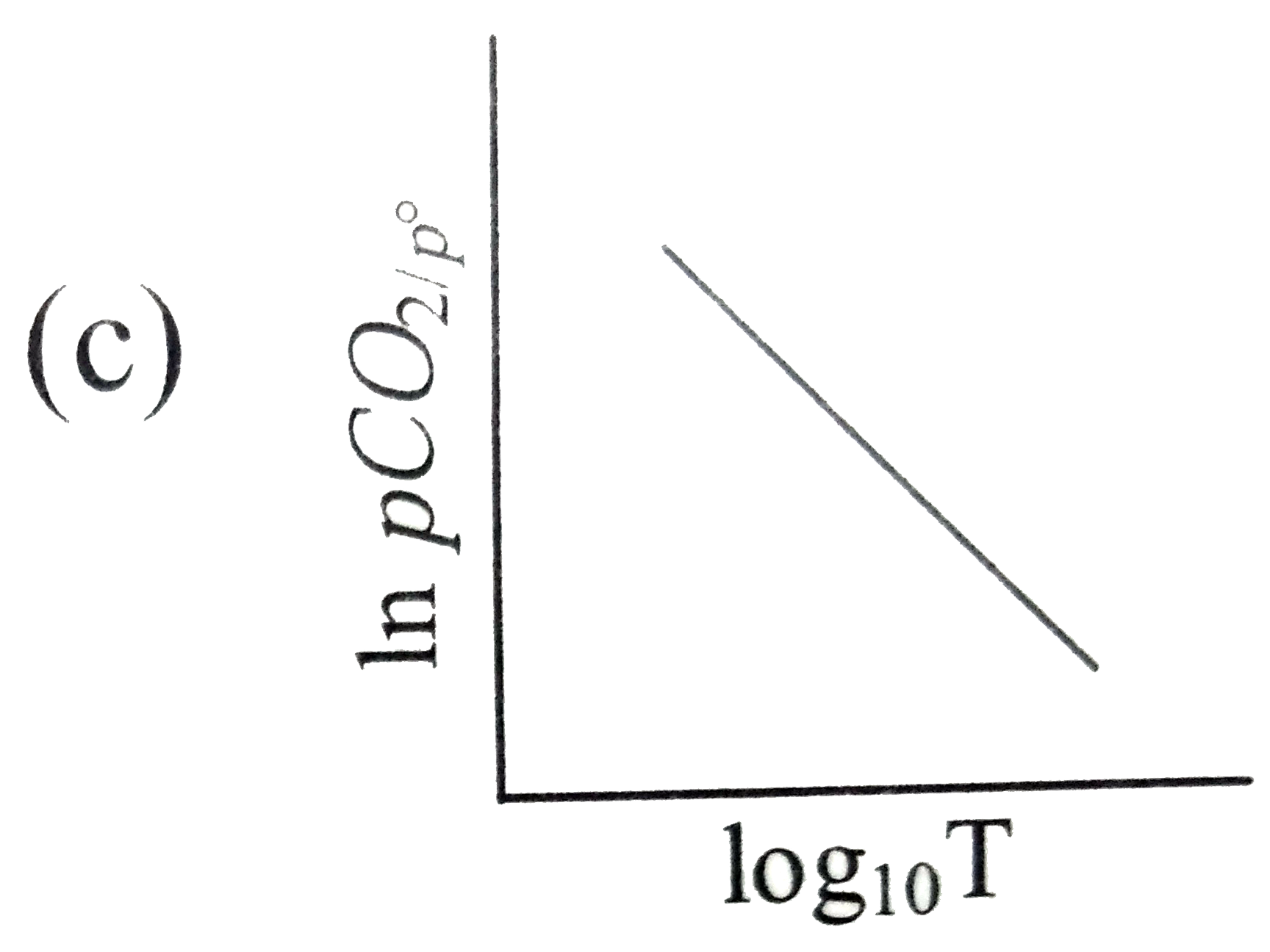
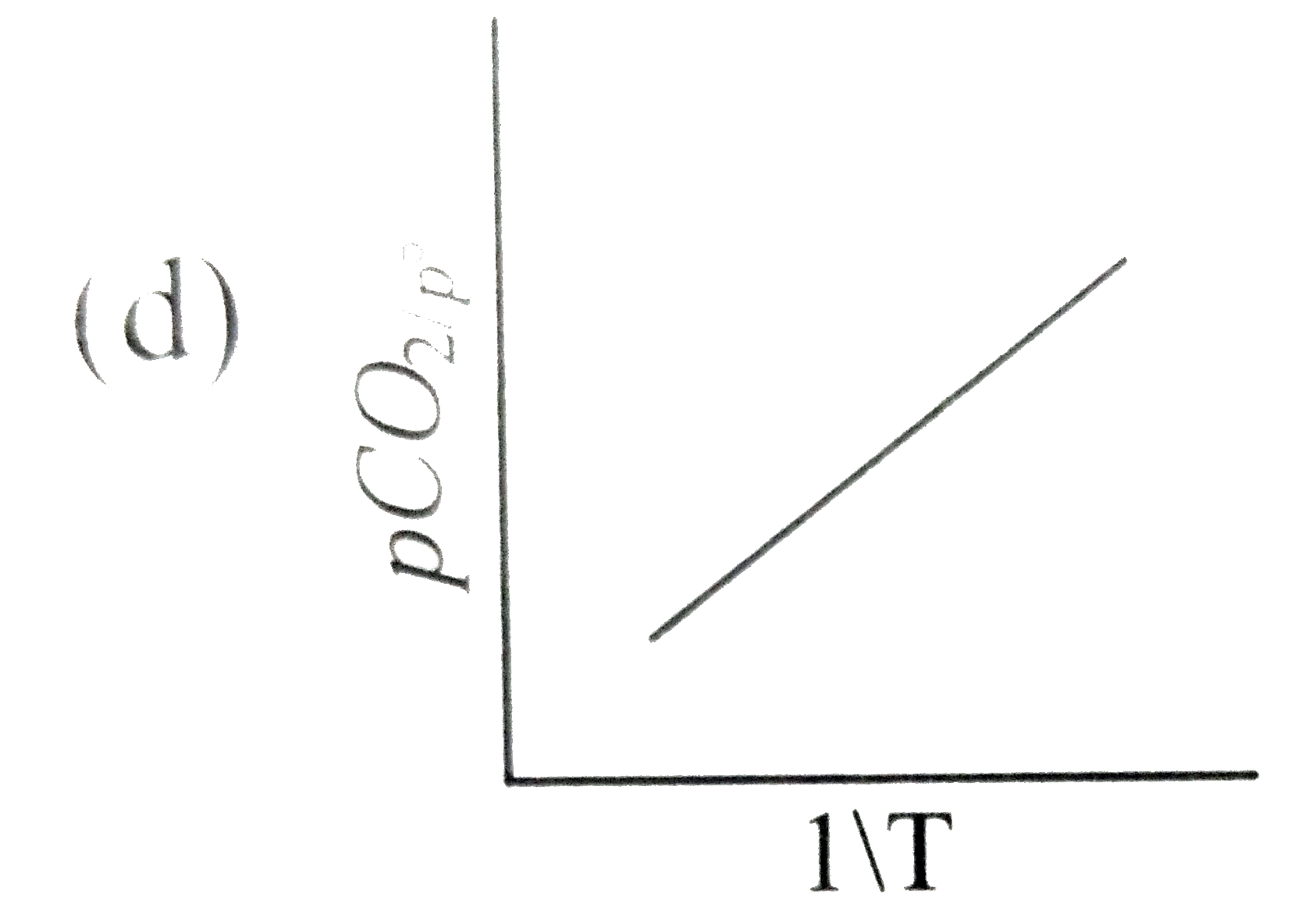
For the compound A-CH_(2)-CH_(27)-A draw the newman projection formula of all the stable conformational it mu_(obs) = 2D " and " X_(anti) = 0.75 " then find " mu_(gauche.)("If "A= NO_(2)) |
|
Answer» |
|
| 11. |
For the complex K_(2)[Cr(NO)(NH_(3))(CN)_(4)],mu=1.73 BM. (i) Write IUPAC name. (ii) What will be structure ? (iii) How many unpaired electrons are present in the central metal ion ? (iv) Is it paramagnetic or diamagnetic ? (v) Calculate the EAN of the complex. (vi) What will be the hybridisation of the complex. |
|
Answer» (II) Octahedral(III) One unparied electron(iv) It is paramagnetic with one UNPAIRED electron (v) `EAN=24-1+2xx6=35` (iv) `d^(2)SP^(3)` |
|
| 12. |
For the complex ML_(2), Stepwise formation constants M+L to ML ML+L to ML_(2)are 4 and 3 respectively. Hence, overall stability constant for M+2L to ML_(2) is : |
|
Answer» 12 |
|
| 13. |
For the complexes showing the square pyramidal structure, the d-orbital involved in the hybridisation is: |
|
Answer» `d_(X^(2)-y^(2))` |
|
| 14. |
For the complex MC_(2) stepwise formation constants for M+LhArrML""ML+LhArrML_(2) are 4 and 3 respectively. Overall stability constant is xy. The value of x+y is |
|
Answer» |
|
| 15. |
For the complex ion [F(en)_(2)CI_(2)]^(+) write the hybridization type and magnetic behavior. Draw one of the geometrical isomer of the complex ion which is optically active. [A tomic No, :Fe=26] |
|
Answer» Solution :`[F(en)_(2)CI_(2)]^(+)` OXIDATION number of FE `x+2(O)+2(-1)=+1x=3 Fe^(3+)=3d^(5)` 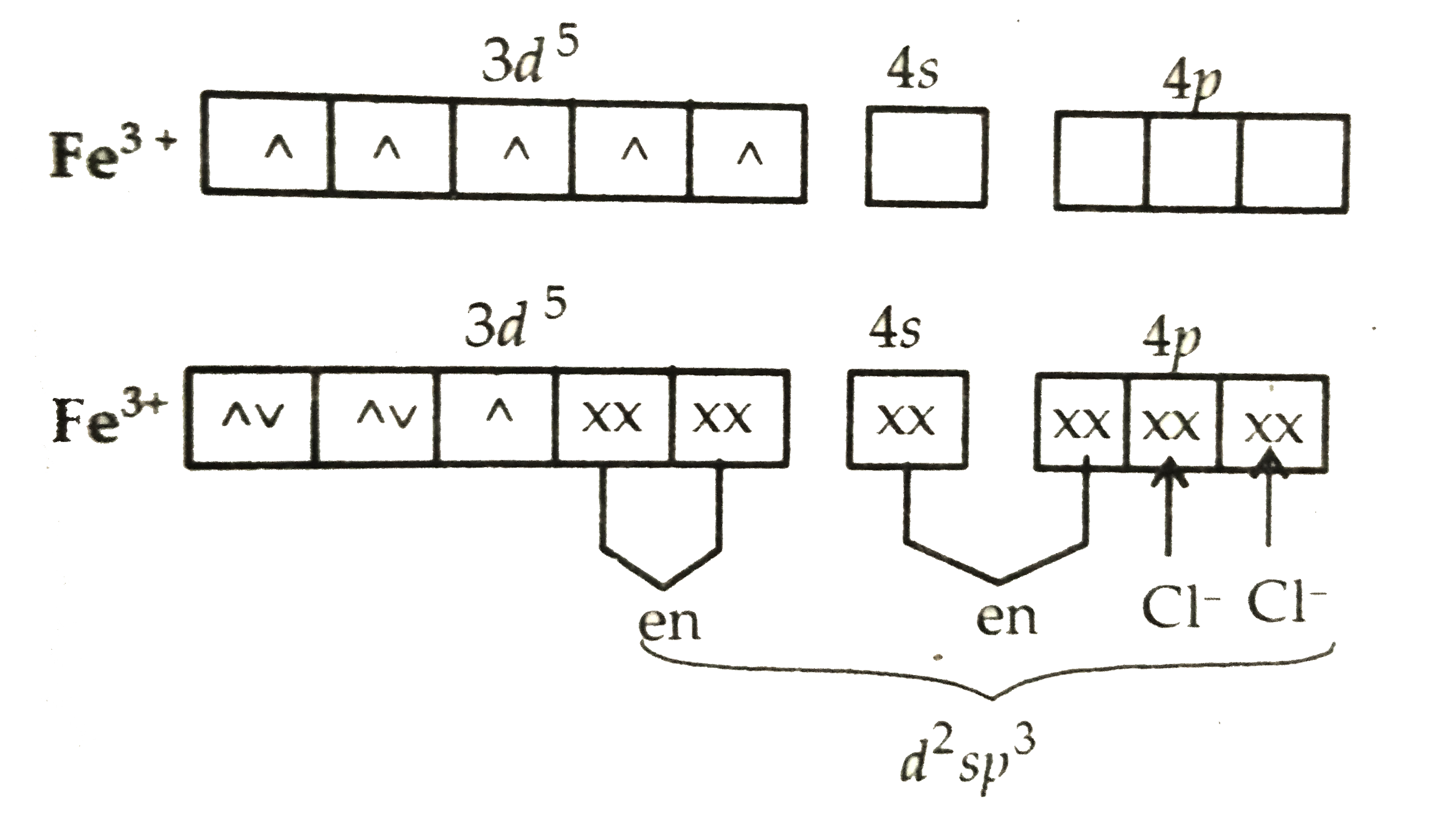 Hybridisation `=d^(2)sp^(3)` Magnetic behaviour = PARAMAGNETIC Cis-form of geomettical isomer is optically ative. as mirror images are non-super impossible. 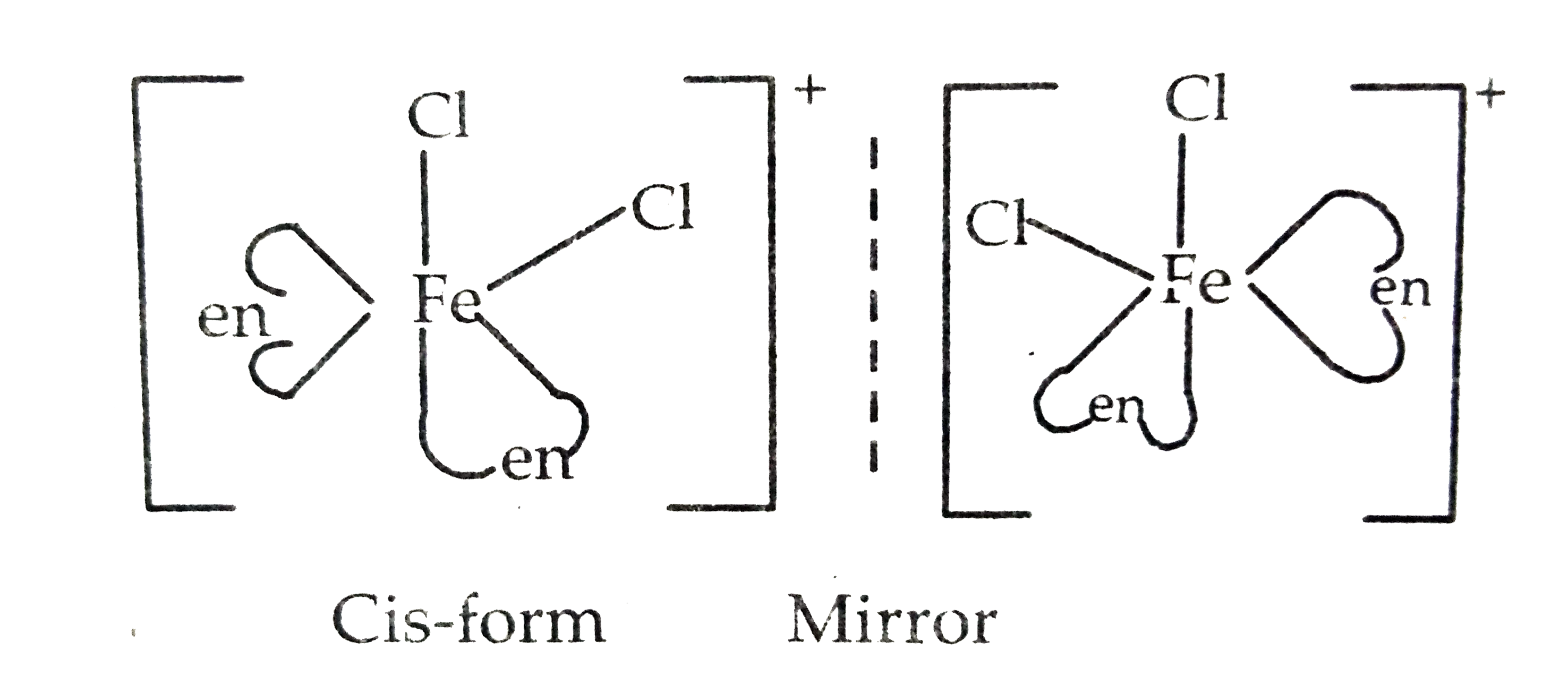
|
|
| 16. |
For the complex [Fe(H_(2)O)_(6)]^(3+), write the hybridisation, magnetic character and spin of the complex. |
Answer» Solution :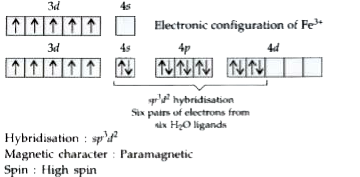 HYBRIDISATION : `sp^(3)d^(2)` MAGNETIC character : PARAMAGNETIC Spin : High spin |
|
| 17. |
For the complex [Fe(en)_(2)Cl_(2)]Cl, identify the following : Oxidation number of iron. |
| Answer» SOLUTION :OXIDATION NUMBER of iron in the complex `[Fe(EN)_(2)Cl_(2)]CL` is +3. | |
| 18. |
For the complex [Fe(en)_(2)Cl_(2)]Cl, identify the following : Name of the complex. |
| Answer» SOLUTION :Dichloridobis(ethane-1, 2-diammine)IRON(III) CHLORIDE. | |
| 19. |
For the complex [Fe(en)_(2)Cl_(2)]Cl, (en = ethylene diamine), identify whether there is an optical isomer also |
Answer» SOLUTION :The cis- ISOMER exhibits OPTICAL isomerism ALSO. 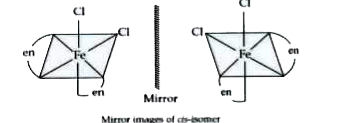
|
|
| 20. |
For the complex [Fe(en)_(2)Cl_(2)]Cl, identify the following : Magnetic behaviour of the complex. |
Answer» Solution :It will OCCUR in two geometrical FORMS GIVEN below : 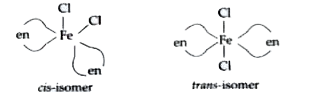
|
|
| 21. |
For the complex [Fe(en)_(2)Cl_(2)]Cl, identify the following : Hybrid orbitals and shape of the complex. |
Answer» Solution :EN lies high in the spectrochemical series. It will result in the pairing of electrons. Inner complex will be formed using `d^(2)sp^(3)` HYBRIDISATION. The shape OBTAINED will be octahedral. 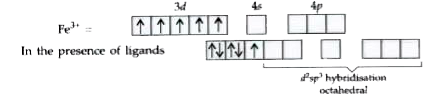 In the presence of LIGANDS |
|
| 22. |
For the complex [Fe(en)_(2)Cl_(2)]Cl, (en = ethylene diamine), identify the oxidation number of iron |
|
Answer» Solution :X + 0 - 2 = 1 or x = 3 Thus, OXIDATION state is +3. Iron is PRESENT as FE(III). |
|
| 23. |
For the complex [Fe(en)_(2)Cl_(2)]Cl, (en = ethylene diamine), identify the magnetic behaviour of the complex |
| Answer» Solution :Paramagnetic. There is one UNPAIRED ELECTRON LEFT. | |
| 24. |
For the complex [Fe(en)_(2)Cl_(2)]Cl, (en = ethylene diamine), identify the number of geometrical isomers, |
Answer» SOLUTION :TWO, CIS- and TRANS- 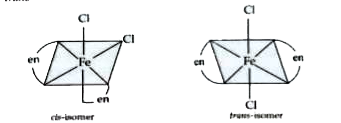
|
|
| 25. |
For the complex [Fe(en)_(2)Cl_(2)]Cl, (en = ethylene diamine), identify name of the complex. |
| Answer» SOLUTION :Dichloridobis(ethane-1, 2-diamine)-IRON-(III) CHLORIDE. | |
| 26. |
For the complex [Fe(en)_(2)Cl_(2)]Cl, (en = ethylene diamine), identify the hybrid orbitals and the shape of the complex |
| Answer» Solution :`d^(2)sp^(3)` octahedral. This is DUE to the reason that EN group is HIGH in the spectrochemical series. Fe(III) is in strong octahedral field. | |
| 27. |
For the complex [Fe(en)_(2)Cl_(2)]Cl, (en = ethylene diamine), identify : (i) the oxidation number of iron (ii) the hybrid orbitals and the shape of the complex (iii) the magnetic behaviour of the complex(iv) the number of geometrical isomers (v) whether there is an optical isomer also, and (vi) name of the complex (At. no. of Fe = 26). |
| Answer» SOLUTION :[(i) + 3 (ii) `d^(2)SP^(3)` (iii) paramagnetic (iv) 2 (cis and trans) (v) YES for cis (vi) dichloridobis (ethylene DIAMINE) iron (III) chloride] | |
| 28. |
For the complex [Fe(CO)_(5)], write the hybridisation, magnetic character and spin of the complex. |
Answer» SOLUTION :ELEC. config. of FE 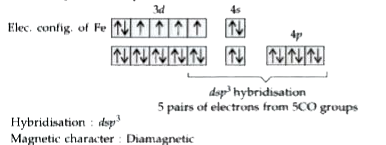 Hybridisation : `dsp^(3)` MAGNETIC CHARACTER : Diamagnetic Spin : Low spin |
|
| 29. |
For the complex, Ag^(+)+2NH_(3) hArr [Ag(NH_(3))_(2)^(+)] ((dx)/(dt))=2xx10^(7)L^(2)mol^(-1)[Ag^(+)]NH_(3)]^(2)-1xx10^(-2)s^(-1) [Ag(NH_(3)_(2)^(+)] Hence, ratio of rate constants of the forward and backward reaction is : |
|
Answer» `2XX10^(7)L^(2)MOL^(-2)` |
|
| 30. |
For the complex [Fe(CN)_(6)]^(3-), write the hybridisation type, magnetic character and spin nature of the complex. |
Answer» SOLUTION :E.C. of `FE^(3+)` 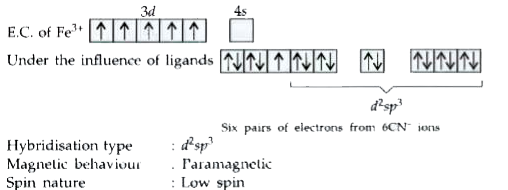 Hybridisation TYPE : `d^(2)sp^(3)` Magnelic BEHAVIOUR . Paramagnelic SPIN nature : Low spin |
|
| 31. |
For the complex,[Co(NH_(3))_(5)CO_(3)]CIO_(4)the coordination number,oxidationnumber,of d-electronsand number of unopaired electronson themetalare, respectively |
|
Answer» Solution :Coordiantion number of Co in ` [Co(NH_(3))_(5)CO_(3)]CIO_(4) = 6 ` Oxidation numberof Co in ` [Co(NH_(3))_(5)CO_(3)]^(+)` ` Rightarrowx -2 = +1Rightarrowx = + 3 ` ` Co^(3+) (Z = 27) : 3d^(6)` Number of d-electrons = 6 ` (##MTG_WB_JEE_CHE_MTP_01_E02_032_S01.png" width="80%"> |
|
| 32. |
For the complete combustion of ethanol, C_(2)H_(5)OH(l)+3O_(2)(g) to 2CO_(2)(g)+3H_(2)O(l) the amount of heat produced as measured in bomb calorimeter is 1364.47 kJ mol^(-1) at 25^(@)C. Assuming ideality, the enthalpy of combustion DeltaH_("comb") for the reaction will be (R=8.314 J K^(-1)mol^(-1)) |
|
Answer» `-1366.95kJmol^(-1)` USE `DeltaH=DeltaU+Deltan_(g)RT)` |
|
| 33. |
For the combustion of 1 mole of liquid benzene at 25^(@)C , the heat of reaction at constant pressure is given by, C_(6)H_(6)(l)+7(1)/(2)O_(2)(g) to 6CO_(2)(g)+3H_(2)O(l),DeltaH=-780980 "cal" What would be the heat of reaction at constant volume ? |
|
Answer» SOLUTION :We have, `DeltaH=DeltaU+Deltan_(g)RT` …(Eqn.8) Here, `Deltan_(g)=6-7.5=-1.5` Thus, `DeltaU=DeltaH-Deltan_(g)RT` `=-780980-(-1.5)xx2xx298` `=-780090 "CALORIES"`. |
|
| 34. |
For the coagulation of 200 mL of As_(2)S_(3) solution, 10 mL of 1 M NaCl is required. What is the coagulating value (number of milli moles of solute needed of coagulation of 1 liter of solution) of NaCl. |
| Answer» ANSWER :C | |
| 35. |
For the [CoF_(6)]^(3-) ion the mean pairing energy is found to be 21000cm^(-1). The magnitudeof Delta_(0) is 13000cm^(-1). Calculate the crystal field stabilization energy for this complex ion corresponding to low spin and high spin states. |
|
Answer» Solution :Mean PAIRING ENERGY `=21,000cm^(-1)` `Delta_(0)=13000cm^(-1)` `[CoF_(6)]^(3-)`, `Co=3d^(7)4s^(2)`, `co^(3+)=3d^(6)` 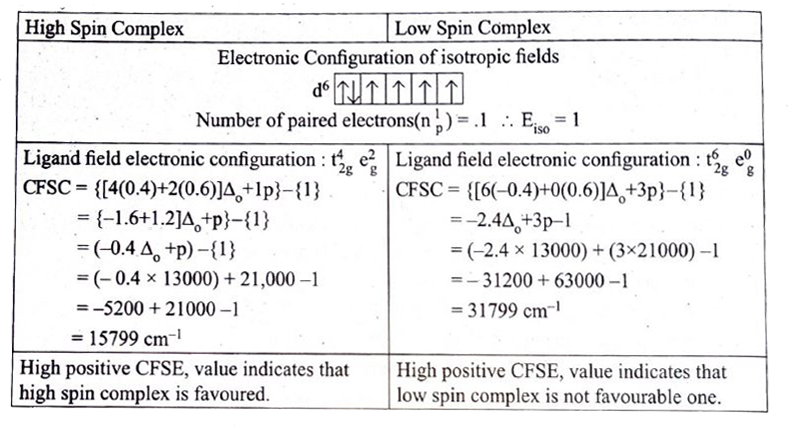
|
|
| 36. |
For the coagulation of 40ml of ferric hydroxide sol, 10ml of 0.4 M KCI is required. Then, coagulation value of KCI is |
|
Answer» 10 |
|
| 37. |
For the coagulation of 100 ml of arsenous sulphide sol 4 ml of 1 M NaCl is required . What would be the flocculation value of NaCl? |
|
Answer» Solution :4 ml of 1 M NACL contains =`1/1000 times 4=4` milli moles Thus 100 ml of `As_2S_3` SOL REQUIRES NaCl for complete coagulation = 4 milli moles `therefore`1 L i.e. 1000 ml of the sol requires NaCl for complete coagulation = 40 milli moles `therefore` Flocculation value = 40. |
|
| 38. |
For the coagulation of 100 ml of arsenious sulphide sol, 5 ml of 1 M NaCl is required. What is the flocculation value of NaCl? |
|
Answer» Solution :5 ml of 1 M NaCl contains NaCl ` = 1/1000 xx 5 ` moles = 5 MILLIMOLES Thus, 100 ml of `As_2S_3`SOL require NaCl for COMPLETE coagulation = 5 millimoles . `THEREFORE`1L, i.e., 1000 ml of the sol require NaCl for complete coagulation = 50 millimoles `therefore `By definition, FLOCCULATION value of NaCl = 50. |
|
| 39. |
For the coagulation of 100ml of arsenious sulphide solution, 5ml of IM NaCl is required. Calculate the flocculation value. |
|
Answer» Solution :NUMBER of millimoles of electrolyte NaCl REQUIRED to coagulate 100ml of sol =1xx5=5. Number of millimoles of electrolyte required to coaguate 1000ml of sol =5xx10=50. The minimum number of moles of electrolyster PER litre required to cause precipitation is called floculation VALUE. Flocculating value of NaC=50millimole `L^(-1)` = 005 mol `L^(-1)` |
|
| 40. |
For the chemical reaction , N_(2(g))+3H_(2(g))hArr2NH_(3(g)) What is the correct option? |
|
Answer» `3(d[H_(2)])/(dt)=2(d[NH_(3)])/(dt)` RATE CONSTANT=`(-d[N_(2)])/(dt)=-(1)/(3)(d[H_(2)])/(d)=+(1)/(2)(d[NH_(3)])/(dt)` |
|
| 41. |
For the chemical reaction A to products, the rate of disappearance of A is given by : -r_A=-(dC_A)/(dt)=k_1C_A//(1+k_2 C_A) At low C_A the reaction is of the first order with rate constant: |
|
Answer» `k_1//k_2` |
|
| 42. |
For the chemical reaction, 4HBr+O_(2)to2H_(2)O+2Br_(2) Rate=k[HBr][O_(2)] What is the proable mechanism of the reaction ? |
| Answer» SOLUTION :`{:(HBr+O_(2)toHOOBr,,("SLOW")),(HOOBr+HBrto2HOBr,,("FAST")),(HOBr+HBrtoH_(2)O+[Br_(2)]xx2,,("fast")):}` | |
| 43. |
For the chemical reaction A+2Bto2C+D. The experimentally determined information has been tabulated below: for the reaction, a)Calculate the order of reaction w.r.t. both the reactants A and B b) Write the expression for rate law. c) Calculate the value of the rate constant d) Write the expression for the rate of reaction in terms A and C. |
|
Answer» SOLUTION :a) Calculation of order with respect to A and B Let the rate law equation for the reaction be : rate = `k[A]^(x)[B]^(y)` The rates for the four experiments may be written as: 0.96 = `k[0.30]^(x)[0.30]^(y)` `0.384= k[0.60]^(x)[0.30]^(y)` `0.192 = k[0.30]^(x)[0.60]^(y)` `0.768 = k[0.60]^(x)[0.60]^(y)` Dividing eqn (ii) by eqn. (i), we get `(0.384)/(0.96) = (k[0.60]^(x)[0.30]^(y))/(k[0.30]^(x)[0.30]^(y))` or `4= (2)^(x)` `(2)^(2)=(2)^(x)` or x=2 Dividing eqn. (iii) by eqn. (i), we get `(0.192)/(0.096) = (k[0.30]^(x)[0.60]^(y))/(k[0.30]^(x)[0.30]^(y))or 4=(2)^(x)` `(2)^(2) = (2)^(x) or x=2`. Dividing Eqn. (iii)by eqn. (i), we get `0.192/0.096= (k[0.30]^(x)[0.60]^(y))/(k[0.30]^(x)[0.30]^(y))` or 2 = `(2)^(y)` `(2)^(') = (2)^(y)` or y=1 Order w.R.t. A= 2, B=1 ltrbgt Rate law expression , Rate(r) = `k[A]^(2)[B]^(1)` c) Rate constant(k) = `("Rate"(r))/([A]^(2)[B]^(2))=(0.096)/(0.027) = 3.56` d) Rate of reaction in TERMS A and C, Rate = `(-d[A])/(dt) = 1/2(d[C])/(dt)` |
|
| 44. |
For the chemical reaction, 5Br^(-)+BrO_(3)^(-)+6H^(-)to3Br_(2)+3H_(2)O the rate expression is rate =k[Br^(-)][BrO_(3)^(-)][H^(+)]^(2), calculate: (a) order of reaction (b) apparent molecularity of reaction |
|
Answer» SOLUTION :ORDER REACTION `=1+1+2=4` APPARENT MOLECULARITY `=5+1+6=12` |
|
| 45. |
For the chemical reaction A rarr B it is found that the rate of the reaction doubles when the concentration of A is increased four times . The order in terms of A for this reaction is : |
| Answer» ANSWER :D | |
| 46. |
For the chemical reaction 3X(g)+Y(g) hArr X_(3)Y(g), the amount of X_(3)Y at equilibrium is affected by |
|
Answer» Temperature and pressure |
|
| 47. |
For the chemical equlibrium, CaCo_(3(s))hArrCaO(s)+CO_(2)(g),DeltaH_(r)^(@) can be cetermined from which one of the following plots |
|
Answer»
`CaCO_(3(s))hArrCaO_((s))+CO_(2(g))` `K_(p)-P_(CO_(2))and K_(C)=[CO_(2)]` `(because[CaCO_(3)]=1and [CaO]=1"for solids")` According to Arrhenius equation we have `K=Ae^(-DeltaH_(r)^(@)//RT)` Taking logarithm, we have `logK_(p)=logA-(DeltaH_(r)^(@))/(RT(2.303))` This is an equation of straight line. When `log K_(p)` is plotted against `1//T.` we get a straight line. 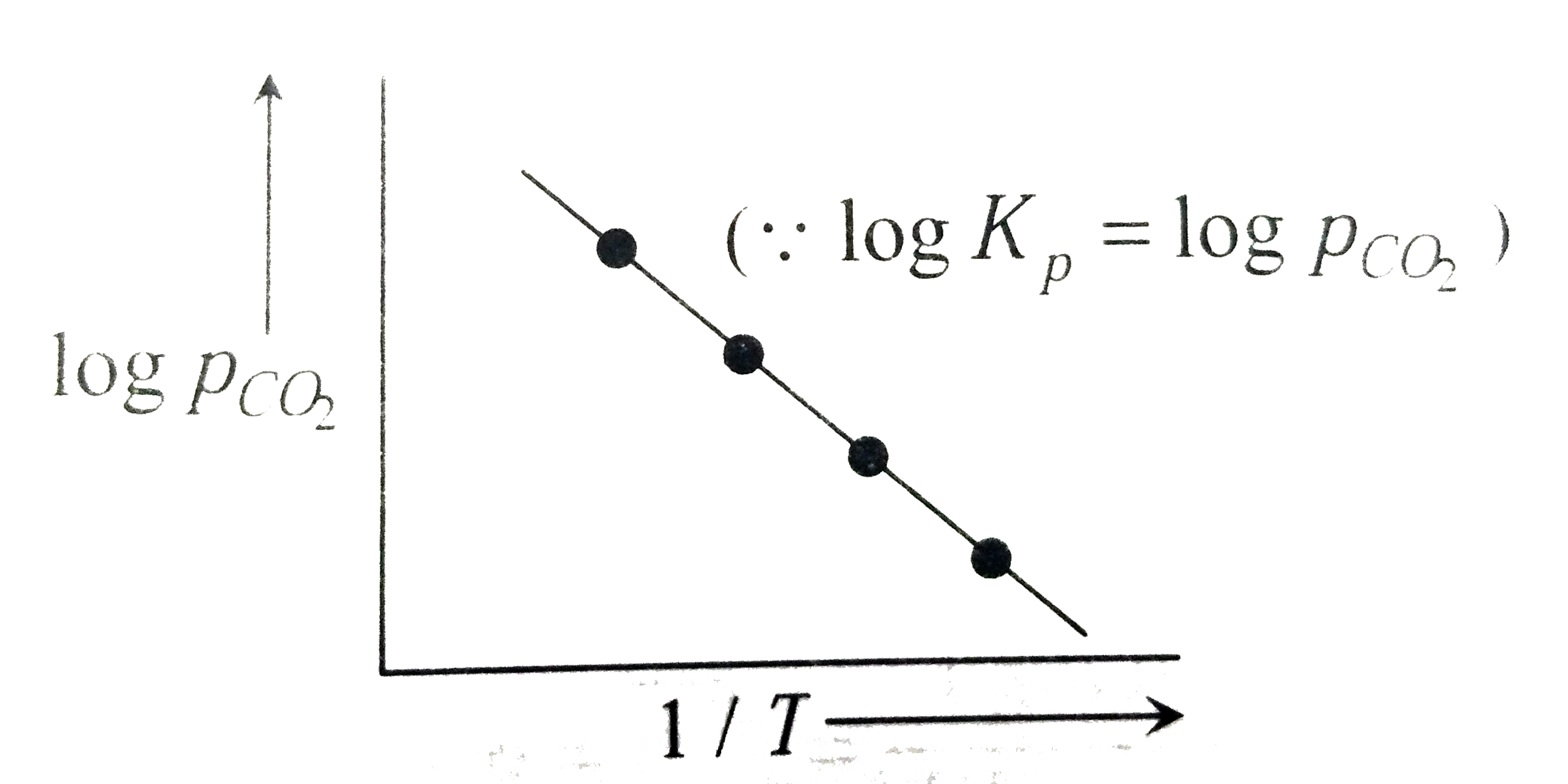 The intercept of this line= log A, slope `=-DeltaH_(r)^(@)//2.303R` Knowing the value of slope from the PLOT and universal gas constant `R,DeltaH_(r)^(@)` can be calculated. (Equation of straight line`:Y=mx+C.` Here, `{:(logK_(p)=-(DeltaH_(r)^(@))/(2.30R)((1)/(T))+log A),(" "T""m""x""C):}` |
|
| 48. |
For the chemical reaction, 3X(g) + y(g) rarr X_3Y(g): the amount of X_3 Y at equilibrium is affected by: |
|
Answer» TEMPERATURE and PRESSURE |
|
| 49. |
For the chemical equilibrium, CaCO_(3)(s) hArr CaO(s)+CO_(2)(g) Delta_(r)H^(ɵ) can be determined from which one of the following plots? |
|
Answer»
|
|
| 50. |
For the cells2Ag + Pt^(2+) to 2Ag^(+)+ Pt , E^@ = 0.4V2Ag + F_2 to 2Ag^(+) + 2F^(-) , E^@ = 2.07Vif the potential for the reaction Pt to Pt^(2+) + 2eis assigned as zero, determine the potential for the following electrodes.(i) Ag to Ag^(+) + e(ii) F^(-) to 1/2 F_2 + e |
| Answer» SOLUTION :`-0.4V, -2.47 V` | |