Saved Bookmarks
This section includes 7 InterviewSolutions, each offering curated multiple-choice questions to sharpen your Current Affairs knowledge and support exam preparation. Choose a topic below to get started.
| 1. |
Find out X and Y in the following reaction Xoverset(I_(2)//HgO)to" iodobenzene "overset(2Na)toY |
|
Answer» TOLUENE and ALKYL BENZENE |
|
| 2. |
Find out work done for the given cell Cr|Cr^(+3) || Fe^(+2)| Fe E_(Cr//Cr^(3+))^(@) = 0.74 V, E_(Fe^(2+)//Fe)^(@) = -0.44 V |
|
Answer» Solution :`E_("cell")^(@) = E_("cathode")^(@) - E_("ANODE")^(@)` `=-0.44 V + 0.74 V = 0.30` V [since cell reaction `2Cr + 3Fe^(2+) to 2Cr^(3+) + 3Fe`, n = 6 mol ELECTRON] `W= -nFE^(@) =-6 xx 96500 xx 0.30 W = 173.7` KJ |
|
| 3. |
Find out which of the following is the strongest oxidizing agent. |
|
Answer» `CL^(-)` |
|
| 4. |
Find out total number of representative elements in the given element: Cd, Nb, Ta, Te, Ra, Mo, Po, Pd, Tc |
|
Answer» |
|
| 5. |
Find out the wrong statement about corey House reaction. |
|
Answer» The rate of reaction for alkane SYNTHESIS by corey House reaction SI `1^(@) R-X gt 2^(@) R-X gt 3^(@) R-X` |
|
| 6. |
Find out the volume of Cl_(2) at STP produced by the action of 100cm^(3) of 0.2 N HCl on excess of MnO_(2). |
|
Answer» `"HCl PRESENT in "100cm^(3)" of 0.2 N HCl"=(0.2)/(1000)xx"100g eq.= 0.02g eq."xx"36.5 g = 0.73 g"` |
|
| 7. |
Find out the volume in mL of 0.1 N HCl solution required to react completely wth 1.0 g of a mixture of Na_(2)CO_(3) and NaHCO_(3)containing equimolar amounts of the two compounds . |
|
Answer» Solution :Let the amount of `Na_(2)CO_(3)` in 1 G of mixture be X g and sincethe `Na_(2)CO_(3) and NaHCO_(3)`are in equimolar amounts , `x/106 = (1-x)/84 , " where " {{:("mol . WT . Of "Na_(2)CO_(3)=106),(" mol .wt of "NaHCO_(3)=84):}}` ` :. "" x = 0.558 g ` Thus wt. of `na_(2)CO_(3) = 0.558 g ` and wt. of `NaHCO_(3) = 1 - 0.558 = 0.442 g ` Now , m.e of HCL = m.e of `Na_(2)CO_(3) + " m.e of " NaHCO_(3)` m.e of HCl = eq. of `Na_(2)CO_(3) xx 1000 + " eq. of " NaHCO_(3) xx 1000 ""...(Eqn.3)` If v is the volume of HCl in mL then `0.1 xx v = (0.558)/53 xx 1000 + (0.442)/84 xx 1000 "" ...(Eqn. 4i)` ` :. "" v = 157 .9 mL ` |
|
| 8. |
Find out the value of electrostatic potential eneryg of two electrons separated by 3.0Å in vacuum. Express your answer in joules and electron volt. |
|
Answer» |
|
| 9. |
Find out the total number of stereoisomers of the given following compound. Cl-CH=CH-overset(Cl)overset(|)underset(H)underset(|)C-CH=CH-Cl |
Answer» 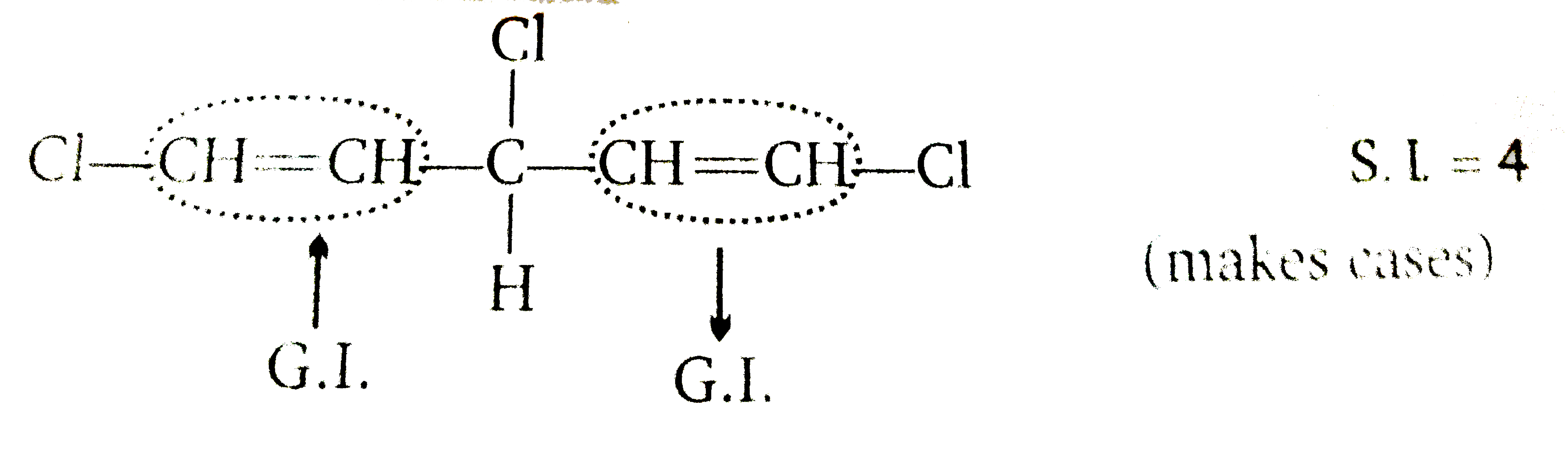
|
|
| 10. |
Find out the total number of species having atleast one adjacent bond angles is le 90^(@) BrF_(5),XeO_(3),SiCl_(4),SOF_(4),SO_(3),PCl_(5),IO_(2)F_(2)^(Theta) |
| Answer» | |
| 11. |
Find out the total number of stereocentre in the given compound. CH_(3)-CH=CH-underset(Br)underset(|)CH-underset(Cl)underset(|)CH-CH_(3) |
Answer» 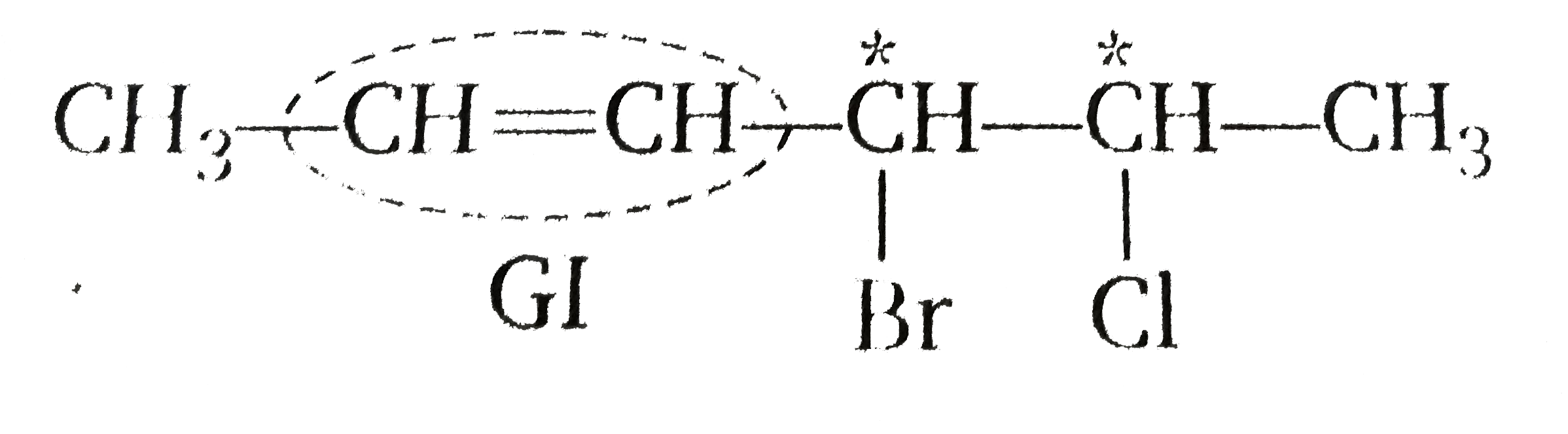 STEREOCENTRES `=2+2=4` STEREOCENTRES `=2+2=4`
|
|
| 12. |
Find outthetotalnumberof isomers includingstereoisomers obtinedbydichlorination of propane . |
|
Answer» |
|
| 13. |
Find out the total number of cyclic isomers of C_(4)H_(10) which areopticallyactive ? |
|
Answer» |
|
| 14. |
Find out the total number of compound which have p_(pi)-d_(pi) types of back bonding BF_(3),B_(3)N_(3)H_(6),O(SiH_(3))_(2),(SiH_(3))NCS,Ocl_(2),SCl_(2),PH_(3),PF_(3) |
| Answer» | |
| 15. |
find out the standard free energy change at60^(@)Cand at 1 atn if the N_(2)O_(4) is 50 % dissociated |
|
Answer» `-800 .0 kJ mol^(-1)` ` N_(2)O_(4)` is 50 %dissociated , the mole fraction of thesubstance is given by `x_(n2O4)= (1-05)/(1 + 0.5), x_(no2)= (2xx0.5)/(1+0.5)` `P_(n2O4)=0.5/1.5xx 1 atm , p_(no2)1/1.5 XX 1atm` the equilibrium CONSTANT ` K_(p)` is given by`k_(p) =(P_(no_(2)))^(2)/(P_(N_(2)O_(4)))=1.5/((1.5)^(2)(0.5))=1/0.75=1.33` ` Delta_(a)G^(Theta)=-RT in K_(p)` `=- 8.314 Jk^(-1)mol^(-1)xx333 K xx 2.303xx 0.1239` `=-789.89 JK^(-1) mol^(-1)` |
|
| 16. |
Find out the product of the following reactions. (i) CH_(3)CH(Cl)COOH underset((ii)H_(2)"O"//Delta)((i) NaNO_(2))(to)? [X] (i) CH_(3)CH_(2)-Br+NaNO_(2)overset("alcohol" //Delta)(to)[Y] |
|
Answer» Solution :(i) `underset((alpha-"Chloropropionic ACID"))(CH_(3)-OVERSET(Cl)overset(|)(CH)-COOH)+NaNO_(2)overset(H_(2)"O"//Delta)(to)underset(("Nitro ethane"))(CH_(3)-CH_(2)-underset((X))(NO_(2))+NaCl+CO_(2)` (ii) `CH_(3)-underset(("Ethyl BROMIDE"))(CH_(2)-Br+NaNO_(2))overset("Alcohol"//Delta)(to) underset(("Nitro ethane")(Y))(CH_(3)-CH_(2)-NO_(2)+)NaBr` |
|
| 17. |
Find out the reaction in which obtained product give positive isocyanide test :- |
|
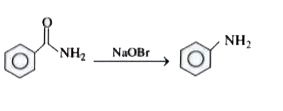
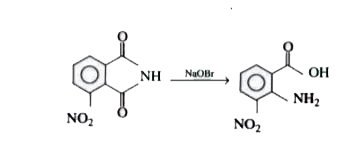
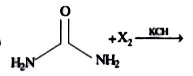
Answer»
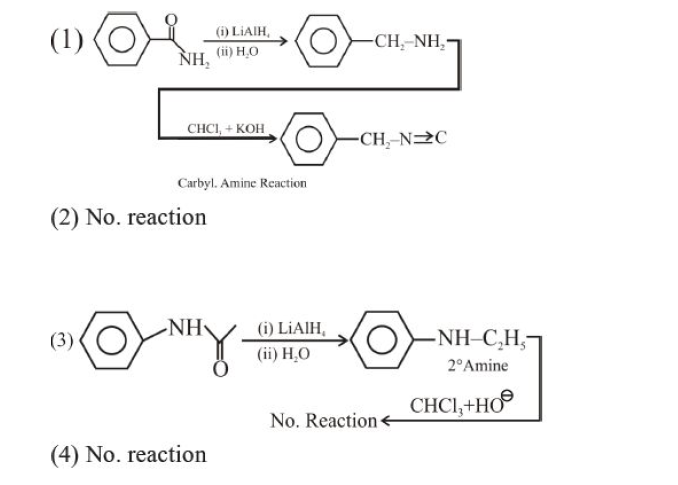
|
|
| 18. |
Find out the period number of the inert gas atom in which the total number of d-electron is equal to the difference in the number of total p-and s-electrons |
|
Answer» `1S^(2)2s^(2)2p^(6)3S^(2)3p^(6)3d^(10)4s^(2)4p^(6)` Total NUMBER of d-electron = 10 Total number of p-electrons = 6+6+6=18 Total number of s-electrons = 2+2+2+2=8 DIFFERENCE in total number of p-and s-electrons =18-8=10 So inert gas is `._(36)Kr`. Now since At. No. is 36 so, period no. is (4) |
|
| 19. |
Find out the percentage of the reactant molecules crossing over the energy barrier at 325K, given that DeltaH_(325)=0.12kcal, E_(a(b))=+0.02kcal. |
|
Answer» Solution :Given , `DeltaH=0.12xx10^(3)cal`, `E_(a(B))=0.02xx10^(3)cal` (`E_(a)` can NEVER be negative) `:. DeltaH=E_(a(f))-E_(a(b))` `:.E_(a(f))=0.12xx10^(3)+0.02xx10^(3)cal` `=0.14xx10^(3)cal` `%` of molecule crossing over the BARRIER `=100xxe^(-E_(a(f))//RT)` `=100xxe^(-140//(2xx325))` `=100xx0.8065=80.65%` |
|
| 20. |
Find out the oxidation number of S in (i) SO_(2)Cl_(2) and (ii) Na_(2)S_(2)O_(3) |
|
Answer» SOLUTION :(i) `overset(x)(S)overset(-2)(O_(2))overset(-1)(Cl_(2))""therefore""x+2(-2)+2(-1)=0 or x= +6` (ii) `Na^(+).^(-)O-UNDERSET(O)underset(||)overset(S)overset(uarr)(S)-O^(-)Na^(+)` Since there is a coordinate bond between the two S atoms, therefore, ACCEPTOR S atom has an O.N. of -2. The O.N. of the other S atom an be calculated as follows : `underset(("for Na"^(+)))(2 XX (+1)) underset(("for O atoms"))(+3 xx (-2)) + x underset(("for coordinate S"))(+1 xx (-2)) or +2 - 6 + x - 2 = 0 or x = +6 ` Thus, the two S atoms in `Na_(2)S_(2)O_(3)` have oxidation numbers of -2 and +6. |
|
| 21. |
Find out the number of waves made by a Bohr electron in one complete revolution in its third orbit. |
|
Answer» Solution :`(NH)/(2PI) = MVR , (2pir)/(h//mv) = (2pir )/(LAMDA) = n` 3 |
|
| 22. |
Find out the number of reagents that converts 1^(@) alcohol to aldehyde. K_(2)Cr_(2)O_(7)// dil. H_(2)SO_(4), KMnO_(4)//H^(+)//Delta, H_(3)C-overset(O)overset(||)(S)-CH_(3)(DMSO), ceric ammonium nitrate, NBS,(C_(5)H_(5)Noverset(+)(H))_(2)Cr_(2)O_(7)^(2-),""(C_(5)H_(5)NH)^(+)ClCrO_(3)^(-)),[(CH_(3))_(3)CO]_(3)Al in acetone. |
|
Answer» |
|
| 23. |
Find out the number of products obtained by crossed Cannizzaro's reaction between (a) H-overset(O)overset(||)C-H+Ph-overset(O)overset(||)C-Hoverset(NaOH)underset(H_(2)O)rarr (b) Ph-overset(O)overset(||)C-H+(CH_(3))_(3)C-overset(O)overset(||)C-Hoverset(NaOH)underset(H_(2)O)rarr |
|
Answer» |
|
| 24. |
Find out the number of atoms per unit cell in a face-centred cubic structure having only single atoms at its lattice points. |
|
Answer» SOLUTION :Contribution made by the atoms present at eight corners = 1 Contribution made by the atoms at the CENTRE of six FACES = `1/2 xx6 = 3` TOTAL number of atoms PER unit cell =1+3=4 |
|
| 25. |
Find out the number of 1-2 shifts during the conversion of |
|
Answer» |
|
| 26. |
Find out the most stable oxidised species. |
|
Answer» `CR^(3+)` |
|
| 27. |
Find out the most stable ion in its reduced form. |
|
Answer» `Cl^(-)` |
|
| 28. |
Find out the molar conductivity of an aqueous solution of BaCl_(2) at infinite dilution when ionic conductances of Ba^(2+) and Cl^(-) ion are 127.30 S cm^(2)mol^(-1) and 76.34 S cm^(2)mol^(-1) respectively. |
|
Answer» |
|
| 29. |
Find out the molality of solution prepared by dissolving 2.89 g of NaCl in 0.159 litre of water. Density is 1.00 gm/mL. |
|
Answer» |
|
| 30. |
Find out the maximum number of possible isomers of the octahedral complex [Co(C_(2)O_(4))_2(NH_3)_2] |
|
Answer» Solution :Cis and TRANS geometrical ISOMERS. Cis-isomer can exist as PAIR of optical isomers . TOTAL no. of isomers = 3 |
|
| 31. |
Find out the molality of solution formed by dissolving 29.22 g of NaCl in 2.00 kg of water. |
|
Answer» |
|
| 32. |
Find out the maximum number of isomers (including steroisomers) that are possible on monochlorination of the given compound: CH_(3)-CH_(2)-underset(H)underset(|)overset(CH_(3))overset(|)(C)-CH_(2)-CH_(3) |
|
Answer» |
|
| 33. |
Find out the longest wavelength of absorption line for hydrogen gas containing atoms in ground state. |
|
Answer» |
|
| 34. |
Find out the incorrect statement among the following. |
|
Answer» ferric alum is commonly known as Mohr's salt. |
|
| 35. |
Find out the incorrect pair |
|
Answer» `Sc^(3+), Ti^(4+)` |
|
| 36. |
Find out the incorrect order of the dipole moment among the following pair of compound |
|
Answer» `NH_(3) gt NF_(3)` |
|
| 37. |
Find out the incorrect order of bond angles |
|
Answer» `NO_2^+`>`NO_2^`>`NO_2^-` |
|
| 38. |
Find out the incorrect pair. |
|
Answer» Tetragens-`ns^(2)NP^(2)` |
|
| 39. |
Findout theincorrectmatch. |
|
Answer» `electron -DUALNATURE |
|
| 40. |
Find out the example of phosphoprotein |
|
Answer» PLASMA membrane |
|
| 41. |
find out the entroupy change in surroundings when 1 mole of H_(2)O(l)is fromed under standard conditionsDelta_(f)H^(-)=286kJmol^(-1) |
|
Answer» ` 959.7 JK^(-1) mol^(-1)` ` Delta_(r)H^(Theta)=-286kJ mol^(-1)` when 1 mole of ` H_(2)O(l)` is formed, 286 kJ of heat is released. This heat is ABSORBED by the surrounding . `i.e.q_("SURR")= + 286 kJ mol ^(-1)` `DeltaS=(q_(surr))/T=(286 kJ mol^(-1))/(298K)` `=959.7 Jk^(-1)mol^(-1)` |
|
| 42. |
Find out the correct reaction |
|
Answer»
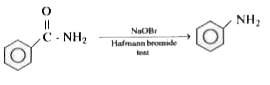
|
|
| 43. |
Find out the correct pair |
| Answer» Solution :Hf, Zr . This PAIR has same atomic radius whereas others have different atomic radius. | |
| 44. |
Find out the correct match.a.First law of thermodynamics b.isothermal change c.state function d.adiabatic changei.DeltaU=W ii.q=-Wiii.q+W. iv.DeltaU=q+W |
|
Answer» a(iv),b(II),C(iii),d(iv) |
|
| 45. |
Find out the correct pair. |
|
Answer» ORTHO SILICATE- SORO silicate |
|
| 46. |
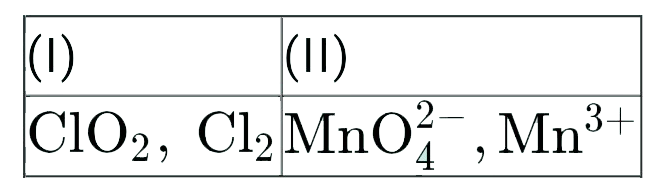
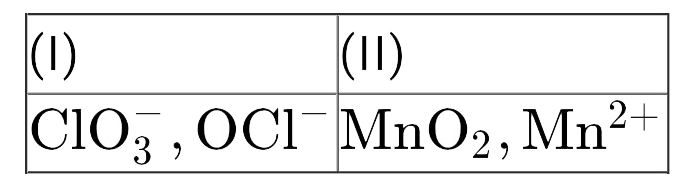
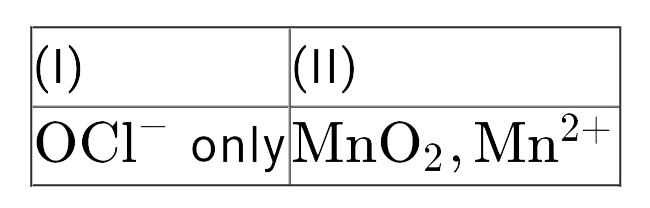
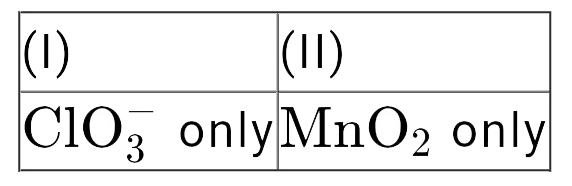
Find out the compounds that will disproportionate in their aqueous solution. (I)ClO_(4)^(-)overst(+0.36V)rarr ClO_(3)^(-) overset(+0.33V)rarr ClO_(2) overset(+0.66V)rarr OC l^(-)overset(+0.40V)rarr(1)/(2)Cl_(2)overset(+1.36)rarr Cl^(-) (II)MnO_(4)^(-)overset(+0.56)rarrMnO_(4)^(2-)overset(+2.22V)rarrMnO_(2)overset(+0.95V)rarrMn^(3+)overset(+1.55)rarrMn^(2+)overset((-0.19)V)rarrMn |
|
Answer»
|
|
| 47. |
Find out the correct graph |
|
Answer» (## AAK_MCP_03_NEET_CHE_E03_021_A001 ##)' |
|
| 50. |
Find out products C and D in the following reaction CH_(3) -COCH_(3) + CH_(3) Mgl overset((i) " dry ethaet")underset((ii) H_(3) O^(+))(rarr)A overset(conc.H_(2)SO_(4)" ")(rarr)B overset((i) O_(3))underset((ii) H_(3)O^(+))(rarr)C+D |
|
Answer» `CH_(3)-CH_(2)-CHOand H-CHO` |
|
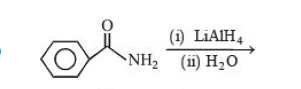
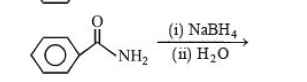
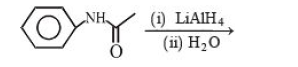
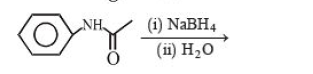
 final product in the above reaction