

Saved Bookmarks
This section includes 7 InterviewSolutions, each offering curated multiple-choice questions to sharpen your Current Affairs knowledge and support exam preparation. Choose a topic below to get started.
| 1. |
Fe(OH)_3 and Cr(OH)_3 precipitates are separated by |
|
Answer» `Ag.NH_3` |
|
| 2. |
Fe(OH)_(3) and Cr(OH)_(3) ppt are sepurated by |
|
Answer» AQ `NH_(3)` |
|
| 3. |
Fe(OH)_3 and Cr(OH)_3 ppts. are separated by : |
|
Answer» AQUEOUS `NH_3` |
|
| 4. |
Fe(OH)_(2) is precipitated from Fe(II)solutions as a while solid turns dark green and then brown due to the formation of: |
|
Answer» `Fe(OH)_(2) and Fe(OH)_(3)` |
|
| 5. |
Fe(OH)_(3) and Al(OH)_(3) ppt. can be separated by (a) ___when (b)___ becomes soluble due totheformation of (c ) ___ and (d) ____ remaininsoluble. |
|
Answer» |
|
| 6. |
FeO crystal has a simplecubic structureand each edge of the unitcell is 5 Å . Takingdensity of the oxide as 4g/cc, the number ofFe^(2+) and O^(2-)ionspresentin eachunitcell are |
|
Answer» `4 Fe^(2+) and 4O^(2-)` ` 1.25xx 10^(22) cc ` Density of FeO = 4 g/cc Mass of unit cell = ` 1.25 xx 10^(-22) xx 4 = 5 xx 10^(-22) g ` Mass of 1 molecule`= 72/ ( 6.023 xx 10^(23)) = 1.195 xx 10^(22) g ` HENCE,number of FeOmolecules PER UNITCELL ` (5 xx 10^(-22))/( 1.195 xx 10^(-22)) = 4.18 =4 ` Hence, there are four `Fe^(2+)`and four ` O^(2-)`ions in eachunitcell,. |
|
| 7. |
FeO is a _________ compound and it is _________ deficient. |
| Answer» SOLUTION :NON - STOICHIOMETRIC, METAL | |
| 9. |
Fenton's reagent is _______ |
|
Answer» `H_(2)O_(2)//FE^(2+)` |
|
| 10. |
[Fe(NO_2)_3Cl_3] and [Fe(O-NO)_3Cl_3] shows |
|
Answer» LINKAGE isomerism |
|
| 12. |
femous oxide has cubes structure and each edgeof the unit cell is 5.0 Å .Assuming of the oxide as 4.0g//cm^(3) then the number of Fe^(2+) and O^(2) inos present in each unit cell will be |
|
Answer» `FOUR Fe^(2+) and two O^(2-)` Weight of a unit `= (72 xx n)/(6.023 xx 10^(23))` VOLUME of one cell `= ("length of corner")^(2)` `= (5 Å)^(2) = 125 xx 10^(-29) cm^(3)` `"Density" = ("wt. of cell")/("volume")` `4.09 = (72 xx n)/(6.023 xx 10^(23) xx 125 xx 10^(-24))` `n = (3079.2 xx 10^(-1))/(72)` `= 42.7 xx 10 = 4.27 ~~ 4 ` |
|
| 13. |
Feldspar is : |
|
Answer» Potassium SODIUM aluminosilicate |
|
| 14. |
Fe^(II)Cl(CN)_(4)(O_(2))]^(4-) is named as : |
|
Answer» Chloridotetracyanidodioxidoferrate (II) ion |
|
| 15. |
Fehling's solution reduces______aldehydes but not_________alehydes. |
| Answer» SOLUTION :ALIPHATIC, AROMATIC | |
| 16. |
Fehling's solution is reduced by : |
|
Answer» SODIUM FORMATE |
|
| 17. |
Fehling's solution is a mixture of _____ and _____. |
| Answer» SOLUTION :ALKALINE solution of `C_USO_4`, solution of SODIUM POTASSIUM TARTRATE | |
| 18. |
Fehling's solution is |
|
Answer» Alkaline `CuSO_(4)^(+)`Rochelle salt (Sod. pot, tartrate ) |
|
| 19. |
The colour of the precipitate formed when a reducing sugar is heated with Fehling's solution is : |
|
Answer» Acidified copper SULPHATE solution |
|
| 20. |
Fehlings solution is |
|
Answer» `AgNO_(3)` solution `+ NAOH` solution `+ NH_(4)OH` |
|
| 21. |
Fehling.s solution is used in the detection of : |
|
Answer» ACIDIFIED copper sulphate solution |
|
| 22. |
Fehling.s solution consists of two separate alkaline solution. If one is CuSO_4,The other is: |
|
Answer» `NaHCO_3` |
|
| 23. |
Fehling's solution can make distinction between |
|
Answer» `CH_(3)CHO` and `C_(6)H_(5)CHO` |
|
| 24. |
Fehling.s solution and Benedict.s solution are reduced by glucose to form : |
| Answer» Answer :B | |
| 25. |
Fehling's solution 'A' consists of an aqueous solution of copper sulphate, while Fehling's solution 'B' consists of an akaline solution of ………….. |
|
Answer» Solution :SODIUM POTASSIUM tartarate `NaOOC-CH(OH)CH(OH)COOK`. |
|
| 26. |
Fehling solution 'A' consists of an aqueous solution of copper sulphate while fehling solution 'B' consists of an alkaline solution of______. |
| Answer» SOLUTION :ROCHELLE SALT. | |
| 27. |
Fehling solution is |
|
Answer» acidified `CuSO_(4)` solution |
|
| 28. |
Fehling's reagent contains |
|
Answer» COPPER sulphate, Rochelle salt and sodium hydroxide |
|
| 29. |
[Fe(H_(2)O)_(6)]^(3+) is strongly paramagnetic whereas [Fe(CN)_(6)]^(3-) is weakly paramagnetic . Explain. |
| Answer» Solution :In both the complexes, `Fe` is in `+3` oxidation state with the CONFIGURATION `3d^(5)`. `CN^(-)` is a STRONG field ligand. In its presence , `3d` electrons pair up leaving only one unpaired electron. The hybridisation is `d^(2)sp^(3)` forming inner orbital COMPLEX. `H_(2)O` is a weak ligand. In its presence `3d` electrons do not pair up. The hybridisation is `sp^(3)d^(2)` forming an outer orbital complex containing five unpaired electrons, hence it is strongly paramagnetic. | |
| 30. |
[Fe(H_(2)O_(6)]^(3+) is strongly paramagnetic whereas [Fe(CN)_(6)]^(3-) is weakly paramagnetic. Explain. |
| Answer» Solution :In both the complexes, `Fe is in +3` OXIDATION state with the configuration `3d^(5)` `CN^(-)` is a strong ligand. In its presence, 3d ELECTRONS PAIR up leaving only one unpaired electron. The hybridization is `d^(2)sp^(3-)` forming inner orbital complex. `H_(2)O` is a weak ligand. In its presence, 3d electrons do not pair up. The hybridization is `sp^(3)d^(2)` forming an outer orbital complex containing five unpaired electrons. Hence, it is STRONGLY PARAMAGNETIC | |
| 31. |
[Fe(H_(2)O)_(6)]^(3+) is strongly paramagnetic whereas [Fe(CN)_(6)]^(3-) is weakly paramagnetic. Explain. |
| Answer» Solution :Fe is in +3 oxidation STATE in both compounds with the configuration `3d^(5)`. In the PRESENCE of strong `CN^(-)` ligand, 3d electrons pair up leaving only one unpaired electron. The hybridisation is `d^(2)sp^(3)` forming inner ORBITAL complex. In the presence of weak `H_(2)O` ligand, 3d electrons do not pair up. The hybridisation is `sp^(3)d^(2)` forming an outer orbital complex containing five unpaired electrons. HENCE, it is strongly paramagnetic. | |
| 32. |
[Fe(H_(2)O)_(6)]^(3+)is strongly paramagnetic whereas [Fe(CN)_(6)]^(3-) is weakly paramagnetic. Explain. |
| Answer» Solution :In both the complexes, Fe is in +3 oxidation state with the configuration `3d^(5)`. `CN^(-)` is a strong ligand. In its presence, 3d electrons pair up leaving only ONE unpaired electron. The hybridisation is `d^(2)SP^(3)` forming inner orbital complex. `H_(2)O` is a WEAK ligand. In its presence, 3d electrons do not pair up. The hybridisation is `sp^(3)d^(2)` forming an OUTER orbital complex CONTAINING five unpaired electrons. Hence, it is stronglyparamagnetic. | |
| 33. |
[Fe(H_(2)O)_(6)]^(2+) is |
|
Answer» PALE GREEN COMPLEX |
|
| 34. |
[Fe(H_(2)O)_(6)]^(2+) and [Fe(CN)_(6)]^(4-) differ in: |
|
Answer» GEOMETRY, MAGNETIC MOMENT 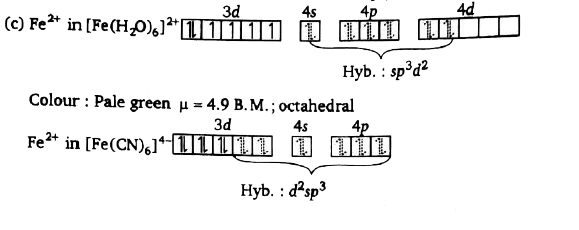
|
|
| 35. |
[Fe(H_2O)_6 NO] and [Cr(NH_3)_6](NO_2)_3 both are paramagnetic species with 'spin' only magnetic moment of 3.93 B.M. The hybridisation of central metal ions in these species respectively are : |
|
Answer» Both `sp^3d^2` 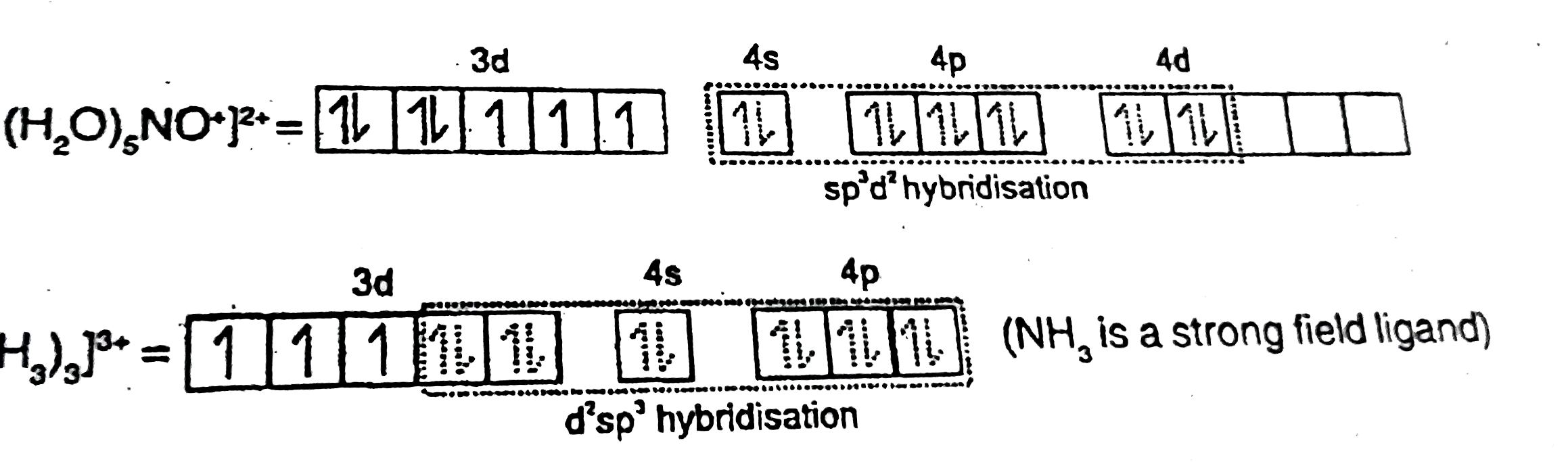
|
|
| 36. |
[Fe(H_(2)O)_(5)NO]^(2+) is a complex formed in the brown ring test for NO_(3)^(-) ion. In this complex. |
|
Answer» NO TRANSFERS its electronto `Fe^(2+)` so that we have iron as `Fe(I)` and NO as `NO_^(+)` `NO rarr NO^(+) + E^(-)`, `{:(Fe^(2+) ,+,e^(-),rarr,Fe^(+)),((3d^(6)),,,,(3d^(7))),("4 unpaired "e^(-),,,,"3 unpaired "e^(-)):}` `mu` for `Fe^(+) = sqrt(n(n+2))= sqrt(3 xx 5)` BM `= sqrt(15) BM =3.87 BM` |
|
| 37. |
[Fe(H_(2)O)_(5)NO]^(2+) is a complex formed during the brown ring test for NO_(3)^(-) ion. In this complex, |
|
Answer» there are THREE unpaired ELECTRONS so that its magnetic moment is 3.87 B.M.  `therefore` Magnetic moment of `Fe^(+) = sqrt(n(n+2))` BM `=sqrt(3xx5)BM = 3.87 BM` All statements are correct. |
|
| 38. |
[Fe(en)_(2)(H_(2)O)_(2)]^(2+)+en to "complex"(X). The correct statement about complex (X) is : |
|
Answer» It is a low SPIN COMPLEX |
|
| 39. |
[Fe(e n)_(2)(H_(2)O)_(2)]^(2+) +e n to complex (x). The correct statement about the complex (x) it is |
|
Answer» a LOW spin complex `Fe^(+2) = 3d^(6), t_(2g) ^(6) eg^(0)` low spin, diamagnetic |
|
| 40. |
[Fe(en)_(2)(H_(2)O)_(2)]^(2+)+ento complex (x). The correct statement about the complex (x) is |
|
Answer» it is a LOW spin complex  (en) is a STRONG field ligand so regrouping takes PLACE as shown below.  So it is a low spin complex and diamagnetic. |
|
| 41. |
Fedral regulations set an upper limit of 50 parts per millison (ppm) of NH_(3) in the air in a work environment ( that is , 50 mL NH_(3) per 10^(6) mL of air).The density of NH_(3)(g) at room temperature is 0.771 g/L .Air from a manufacturing operation was drawn through a solution containing 100 mL of 0.0105 M HCl . The NH_(3) reacts with HCl as follows: NH_(3)(aq)+HCl(aq)toNH_(4)Cl(aq) After drawing air through the acid solution for 10 minutes at a rate 10 litres/min the acid was titrated .The remaining acid required13.1 mL of 0.0588 M NaoH to reach the equivalence point . How many ppm of NH_(3) were in the air ? |
| Answer» SOLUTION :`61.6 PPM` | |
| 42. |
Fedral regulations set an upper limit of 50 parts per millison (ppm) of NH_(3) in the air in a work environment ( that is , 50 mL NH_(3) per 10^(6) mL of air).The density of NH_(3)(g) at room temperature is 0.771 g/L .Air from a manufacturing operation was drawn through a solution containing 100 mL of 0.0105 M HCl . The NH_(3) reacts with HCl as follows: NH_(3)(aq)+HCl(aq)toNH_(4)Cl(aq) After drawing air through the acid solution for 10 minutes at a rate 10 litres/min the acid was titrated .The remaining acid required13.1 mL of 0.0588 M NaoH to reach the equivalence point . How many grams of NH_(3) were drawn into the acid solution ? |
| Answer» SOLUTION :`0.00475g` | |
| 43. |
FeCr_(2)O_(4)+NaOH+"air" to (A)+Fe_(2)O_(3)(A)+(B) to Na_(2)Cr_(2)O_(7) Na_(2)Cr_(2)O_(7)+X overset(Delta) to Cr_(3),O_(3) Cr_(3)+Y(Delta) to Cr Na_(2)CrO_(4) and Fe_(2)O_(3) are separated by : |
|
Answer» DISSOLVING in conc `H_(2)SO_(4)` |
|
| 44. |
FeCr_(2)O_(4)+NaOH+"air" to (A)+Fe_(2)O_(3)(A)+(B) to Na_(2)Cr_(2)O_(7) Na_(2)Cr_(2)O_(7)+X overset(Delta) to Cr_(3),O_(3) Cr_(3)+Y(Delta) to Cr (X) and (Y) are : |
|
Answer» C and Al |
|
| 45. |
FeCr_(2)O_(4)+NaOH+"air" to (A)+Fe_(2)O_(3)(A)+(B) to Na_(2)Cr_(2)O_(7) Na_(2)Cr_(2)O_(7)+X overset(Delta) to Cr_(3),O_(3) Cr_(3)+Y(Delta) to Cr Compounds (A) and (B) are : |
|
Answer» `Na_(2)CrO_(4). H_(2)SO_(4)` `underset((A))(2Na_(2)CrO_(4))+underset((B))(H_(2)SO_(4))to Na_(2)SO_(4) to Na_(2)Cr_(2)O_(7)+Na_(2)SO_(4)+H_(2)O` `{:(Na_(2)Cr_(2)O_(7)+3C to 2Na_(2)CrO_(2)+3CO),(2NaCrO_(2)+H_(2)O to Cr_(2)O_(3)+2NaOH), (Cr_(2)O_(3)+2Al to Al_(2) O_(3)+2Cr):}` |
|
| 46. |
FeCr_(2)O_(4)+NaOH+"air" to (A)+Fe_(2)O_(3) (A)+(B) to Na_(2)Cr_(2)O_(7) Na_(2)Cr_(2)O_(7)+X overset(Delta)to Cr_(2)O_(3) Cr_(2)O_(3)+Y overset(Delta)to Cr Na_(2)CrO_(4) and Fe_(2)O_(3) are separated by : |
|
Answer» dissolving in CONC. `H_(2)SO_(4)` |
|
| 47. |
FeCr_2O_4+Na_2CO_3+O_2overset("Fusion")to[X]underset(H_2O)overset(H^+)to[Y]underset(H_2O_2)overset(H^+)to[Z] Which of the following statements is true for the compounds [X],[Y] and [Z] ? |
|
Answer» In all three COMPOUNDS , the CHROMIUM is in +6 oxidation STATE `Na_2Cr_2O_7+H_2SO_4to2CrO_3("chromic anhydride")+Na_2SO_4+H_2O` |
|
| 48. |
FeCr_(2)(chromite ) is a good soure of chromium and its compounds like Na_(2)CrO_(4),Na_(2)Cr_(2)O_(7) P:FeCr_(2)O_(4)+NaOH+airto A+Fe_(2)O_(3)Q: A+Bto Na_(2)Cr_(2)O_(7)R:Na_(2)Cr_(2)O_(7)+Xoverset(Delta)toCr_(2)O_(3)S:Cr_(@)O_(3)+YtoCr Na_(2)CrO_(4)and Fe_(2)O_(3)are separated by: |
|
Answer» Dissolving in CONC ,`H_(2)SO_(4)` |
|
| 49. |
FeCr_(2)O_(4)+Na_(2)CO_(3)+O_(2) overset("Fusion")(to) [X] overset(H^(+))underset(H_(2)O)(to) [Y] overset(H_(2)O"/"H^(+))(to) [Z] Which of the following statement is true for the compounds [X], [Y] and [Z]? |
|
Answer» In all THREE COMPOUNDS, the chromium is in +6 oxidation state |
|