

Saved Bookmarks
This section includes 7 InterviewSolutions, each offering curated multiple-choice questions to sharpen your Current Affairs knowledge and support exam preparation. Choose a topic below to get started.
| 1. |
F_(3)CI_(3) on reaction with K_(4)[Fe(CN)_(6)] in aqueous solution gives blue colour. These are separeted by a semipermeable membrene. Will tere be the appearance of a blue colour on the side X due to osmosis ? |
| Answer» Solution :OSMOSIS will take PLACE from te side Y to the side X because 0.01 M `FeCI_(3)` solution is less concentrated. But there will be no formation of blue colour on the side X. Actually, only molecules/particles of water (solvent) will pass through the semipermeable membreane. Neither the `FE^(3+)` ions nor the `CI^(-)` ions will be able to MIGRATE. Therefore, no CHEMICAL reaction will occur and no colour change will take place. | |
| 2. |
Facial-meridional isomers is associated with which one of the following complex (M =central metal) . |
|
Answer» `[M(A A)_(2)]` |
|
| 3. |
Fabroin is term related to |
|
Answer» HAIR |
|
| 4. |
Fac and Mer isomerism is associated with which of the following general formula? |
|
Answer» `[M(A A)_(2)]` |
|
| 5. |
F_3C-CH=CH_2 overset(HBr)(rarr) (A) overset(Nal) underset(dry acetone)(rarr) (B) |
|
Answer» F_3C-CH(BR)-CH_3 and F_3C-CH(I)-CH_3` |
|
| 7. |
F_(2)C = CF_(2) is a monomer of which substance ? |
|
Answer» TEFLON |
|
| 9. |
F_(2)C = CF_(2) is a monomer of which polymer ? |
|
Answer» TEFLON |
|
| 10. |
F_(2) shows disproportionation reactions (R ) F_(2) is the weakest oxidising agent and it is always reduced. |
|
Answer» Both (A) and (R ) are true and (R ) is the CORRECT explanation of (A) |
|
| 12. |
F_(2) reacts with H_(2)S and forms |
|
Answer» `HF +SF_(4)` |
|
| 13. |
F_2 on treatment with methane gives: |
|
Answer» `CH_2F_2` |
|
| 15. |
F_2 is largely used in: |
|
Answer» MAKING freon |
|
| 16. |
F_2 is isolated by |
|
Answer» ELECTROLYSIS of HF |
|
| 17. |
F_(2) is a stronger oxidising agent than CI_(2). |
|
Answer» Solution :The elcetrode potential of `F_(2) and Cl_(2)` are : `F_(2) + 2e^(-) rarr 2 F^(-) , E^(@) = + 2.87 V and Cl_(2) + 2e^(-) rarr 2 Cl^(-) , E^(@) = 1.36 V` Since `E^(@)` for `F_(2)//F^(-)` electrode is higher than that of `Cl_(2)//Cl^(-)` electrode, therefore, `F_(2)` is more EASILY reduced than `Cl_(2)`. In other words, `F_(2)` is a stronger oxidising agent than `Cl_(2)`. For example, `F_(2)` OXIDISES `CL^(-)` IONS to `Cl_(2)` but `Cl_(2)` does not oxide `F^(-)` ions to `F_(2)`. 
|
|
| 18. |
F_(2) is a stronger oxidizing agent than Cl_(2) in aqueous solution. This is attributed to many factors except |
|
Answer» HEAT of dissociation |
|
| 19. |
F_2 has lower bond dissociation enthalpy than Cl_2. Why? |
| Answer» Solution : Fluorine is expected to have the highest value of bond DISSOCIATION ENERGY because it has the smallest size and highest eletronegativity value among HALOGENS. DUE to its extremely small size, the repulsions among shared electrons take place which reduces its bond dissociation enthalpy, which is LESS than that of `Cl_2`. | |
| 20. |
F_2 combines with all non-metals directly except: |
|
Answer» `N_2` |
|
| 21. |
F_2 absorbs ........ portion of light and appear yellow and I_2 absorbs .......... portion of light and appears violet |
|
Answer» RED and Green |
|
| 22. |
F_(2) +2NaOH ( Cold and diluted ) rarr 2NaF + H_(2) O + B, the correct statement regarding B is |
|
Answer» It is morepoisonous PALE yellow GAS than that of `F_(2)` |
|
| 23. |
F is. |
|
Answer» `H-UNDERSET(O)underset(||)(C)-underset(OH)underset(|)(C)H-underset(O)underset(||)(C)-underset(O)underset(||)(C)H` 
|
|
| 24. |
Explain the purification of colloidal solution. |
|
Answer» Solution :Colloidal solutions when prepared contain excessive amount of electrolytes and some other soluble impurities. While the presence of traces of electrolyte is essential for the stability of the colloidal solution, larger QUANTITIES coagulate it. Therefore, it is necessary to reduce the concentration of these soluble impurities to requisite minimum. The process used for reducing the amount of impurities to a requisite minimum is known as purification of colloidal solution. The purification of colloidal solution is carried out by the FOLLOWING methods: (i) Dialysis : It is a process of removing a dissolved substance from a colloidal solution by means of diffusion through a suitable membrane. Since particles (ions or smaller molecules) in a true solution can pass through animal membrane (bladder) or parchment paper or cellophane sheet but not the colloidal particles. This membrane can be used for dialysis. The apparatus used for this purpose is called dialyser. A bag of suitable membrane containing the colloidal solution is SUSPENDED in a vessel through which fresh water is continuously flowing. The molecules and ions diffuse through membrane into the outer water and pure colloidal solution is left behind.  (ii) Electro-dialysis : Ordinarily, the process of dialysis is quite slow. It can be made FASTER by applying an electric field if the dissolved substance in the impure colloidal solution is only an electrolyte. The process is named electrodialysis. The colloidal solution is placed in a bag of suitable membrane while pure water is taken outside. Electrodes are fitted in the compartment as shown in figure. The ions present in the colloidal solution migrate out to the oppositely charged electrodes.  (iii) Ultrafiltration : Ultrafiltration is the process of separating the colloidal particles from the solvent and soluble solutes present in the colloidal solution by specially prepared filters, which are permeable to all substance except the colloidal particles. Colloidal particles can pass through ordinary filter paper because the pores are too large. The pores of filter paper can be reduced in size by impregnating with collodion solution to stop the flow of colloidal particles. The usual collodion is a `4%` solution of nitrocellulose in a mixture of alcohol and ether. An ultra-filter paper MAY be prepared by soaking the filter paper in a collodion solution, hardening by formaldehyde and then finally drying it. Thus, by using ultra-filter paper, the colloidal particles are separated from rest of the materials. Ultrafiltration is a slow process. To speed up the process, pressure or suction is applied. The colloidal particles left on the ultra-filter paper are then stirred with fresh dispersion medium (solvent) to get a pure colloidal solution. |
|
| 25. |
F-centres in ionic crystal ........... |
|
Answer» LATTICE SITES containing electrons |
|
| 26. |
Explain the process of vulcanization of rubber. |
Answer» Solution :NATURAL rubber becomes soft at high temperature  and brittle at low temperatures and brittle at low temperatures  and shows high water absorption CAPACITY. It is soluble in non-polar solvents and is non-resistant to attack by oxidizing agents. and shows high water absorption CAPACITY. It is soluble in non-polar solvents and is non-resistant to attack by oxidizing agents. To improve upon these physical properties, a process of vulcanization is carried out. This process consists of heating a mixture of raw rubber with sulphur and an APPROPRIATE additive at a temperature range between 373 K to 415 K. On vulcanization, sulphur forms cross links at the reactive sites of double BONDS and thus the rubber gets stiffened.  In the manufacture of tyre rubber, `5%` of sulphur pu is used as a crosslinking agent. The probable structures of vulcanized rubber molecules are depicted in above STRUCTURE. |
|
| 27. |
Explain the process of zone refining. Give two examples of elements purified by this process. |
|
Answer» Solution :ZONE refining is based on the principle that when molten soluution of the IMPURE metal is ALLOWED to cool, the pure metal crystallises out while impurities are left behind. In this METHOD, impure metal rod is heated with the help of circular heater so that both metals and impurities melt. When the circular heater is moved further, the metal is recrystallised but impurities move along with the heater and reach the other END, which is discarded. Si and Ge are purified by this method. |
|
| 28. |
F- centres in an ionic crystal are a.lattice sites containing electrones b. interstitial sites containing electrons c. lattice cites that are vacant |
|
Answer» |
|
| 29. |
Explain the process of recharging of lead storage battery. |
|
Answer» Solution :During recharge PROCESS, the role of ANODE and cathode is reversed and `H_(2)SO_(4)` is regenerated. OXIDATION OCCURS at the cathode (now act as anode) `overset(+2)(Pb)SO_(4(s))+2H_(2)O(l) rarr overset(+4)(Pb)O_(2(s))+4H_((aq))^(+)+SO_(4)^(2-)(a)+2e^(-)` Reduction occurs at the anode (now act as cathode) `PbSO_(4(s))+2e^(-) rarr Pb_((s))+SO_(4(aq))^(2-)` Overall reaction : `2PbSO_(4(s))+2H_(2)O(l) rarr Pb_((s))+PbO_(2(s))+4H_((aq))^(+)+2SO_(4(aq))^(2-)` Thus, the overall cell reaction is exactly the reverse of the redox reaction which takes place while discharging. |
|
| 30. |
F-centres are |
|
Answer» Interstitial sites containing CATIONS. |
|
| 32. |
Explain the process of obtaining "blister copper" from "copper matte" with equations. |
|
Answer» Solution :Copper matte is charged into SILICA lined convertor. some silica is also added and hot air blast is blown toconvert the REMAIN FeS, FeO and `Cu_2//Cu_2O` to the metallic copper. FOLLOWING reactions takes place:`2FeS+3O_2to 2FeO+2SO_2` `FeO+SiO_2to FeSiO_3` `2Cu_2+3O_2 to 2Cu_2O+2SO_2` The solidified copper OBTAINED has blistered APPERANCE due to the evolution of S`O_2 ` and so its called blister copper. |
|
| 33. |
Explain the process of obtaining 'blister copper' from copper matte'' with equations. |
|
Answer» Solution :Copper matte is mixture of cuprous sulphide and little quantity of ferrous sulphide. Copper matte along with some quantity of silica is taken in CONVERTER in which HOT air is blown. (a) Remaining ferrous sulphide OXIDISES to ferrous oxide, which in turn combines with silica to form slag ferrous silicate `2FeS + 3O_(2) rarr 2FeO + 2SO_(2)"" FeO + SiO_(2) rarr FeSiO_(3)` (b) Part of cuprous sulphide oxidises to cuprous oxide which combines with remaining cuprous sulphide forming blister copper. `2Cu_(2)S + 3O_(2) rarr 2Cu_(2)O + 2SO_(2) "" 2Cu_(2)S + Cu_(2)S rarr 6Cu + SO_(2)` |
|
| 34. |
f-block elements exhibit different oxidation state, colour, complex formation like properties. The size oflanthanides decreases due to poor screening effect of 4f electrons. It is called lanthanide contraction. Lanthanide hydroxides are basic in nature The colour of lanthanide ion is due to |
|
Answer» f-f TRANSITIONS in PARTIALLY FILLED f-orbitals |
|
| 35. |
Explain the process of Drug-enzyme interaction. |
|
Answer» SOLUTION :Drugs inhibit any of the above mentioned ACTIVITIES indicated in figure of enzymes. These can block the binding site of the enzyme and prevent the binding of substrate, or can inhibit the catalytic activity of the enzyme. Such drugs are called enzyme inhibitors. Drugs inhibit the ATTACHMENT of substrate on active site of enzymes in two different WAYS : (i) Drugs compete with the natural substrate for their attachment on the active SITES of enzymes. Such drugs are called competitive inhibitors. 
|
|
| 36. |
f-block elements are known as "…..............." |
|
Answer» |
|
| 37. |
Explain the process of calcination. |
|
Answer» Solution :(1) Calcination is a process in which the ore is heated to a high TEMPERATURE below the melting point of the metal in the absence of air or limited supply of air in a reverberatory furnace. (2) Following changes take place during calcination : (i)Moisture and water from hydrated ores, volatile impurities and organic matter are removed. (ii)ore becomes prorous. (iii) Carbonates decompose to OXIDES. `ZnCO_(3)overset(DELTA)toZnO + CO_(2)` `CuCO_(3)overset(Delta)to CUO + CO_(2)` `underset(("Dolomite"))(CaCO_(3)), MgCO_(3)overset(Delta)toCaO + MgO + 2CO_(2)` `2Fe_(2)O_(3).3H_(2)O overset(Delta)to2Fe_(2)O_(3(s)) + 3H_(2)O` |
|
| 38. |
Explain the proces of desalination of sea water. |
Answer» Solution :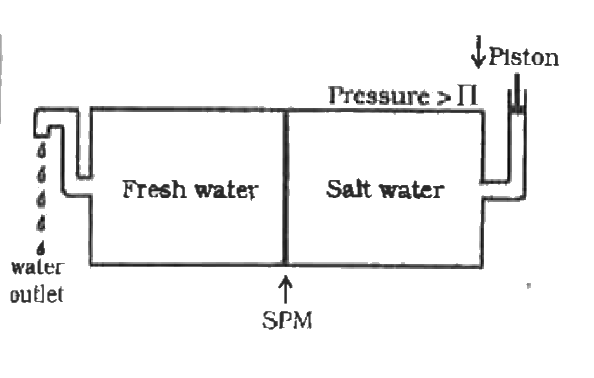 Sea water is SEPARATED from FRESH water by cellulose acetate semipermeable membrane. When pressure more than OSMOTIC pressure is applied on sea water side pure water squeezed out of the sea water through the membrane due to REVERSE OSMOSIS. |
|
| 40. |
Explain the principles involved in the manufacture of ammonia by Haber's process. |
|
Answer» Solution :(i) `N_(2)(g) + 3H_(2)(g) to 2NH_(3)(g)` (ii) According OT Le-Chatelier’s principle, the forward reaction is favoured by low temperature and high pressure. (iii) Optimum conditions in the process are 700 K atm. and Fe catalyst containing `K_2O` and `AI_(2)O_(3)`promoter. |
|
| 41. |
f-Block are also called.........elements. |
| Answer» SOLUTION :inner-transition | |
| 42. |
Explain the principle of electrolytic refining with an example. |
|
Answer» Solution :The crude metal is refined by electrolysis. It is carried out in an electrolytic cell containing aqueous solution of the salts of the metal of interest. The rods of impure metal are used as anode and thin strips of pure metal are used as cathode. The metal of interest dissolves from the anode, PASS into the solution while the same amount of metal ions from the solution will be deposited at the cathode. During electrolysis, the less electropositive IMPURITIES in the anode, settle down at the bottom and are removed as anode mud. Let us understant this process by considering electrolytic refining of silver as an example. Cathode : Pure silver Anode : Impure silver rods Electrolyte : Acidified aqueous solution of silver nitrate. When a current is passed through the electrodes the following REACTIONS will take place Reaction at anode : `2Ag (s) rarr Ag^(+) (aq) + 1e^(-)` Reaction at cathode : `Ag^(+) (aq) + 1e^(-) rarr Ag(s)` During electrolysis, at the anode the silver atoms lose ELECTRONS and ENTER the solution. The positively charged silver cations migrate towards the cathode and get discharged by gaining electrons and deposited on the cathode. Other metals such as copper, zinc etc., can also be refined by this process in a similar manner. `Cr_(2) O_(3) + 2A1 overset(Delta)rarr 2Cr + Al_(2) O_(3)` |
|
| 43. |
E^(@)Zn^(2+)//Zn = -0.77V. What is the 'E' value of the electrode containing 0.01M Zn^(2+) ions |
|
Answer» |
|
| 44. |
Explain the principle and working of the method of electrolytic refining of metals. Give one example. |
|
Answer» Solution :In this method, the impure metal is made as anode. A strip of the same metal in pure form is used as cathode. They are put in a suitable electrolytic bath containing soluble SALT of the same metal. The more basic metal remains in the solution and the less basic ones goes to the anode mud. EXAMPLE : Copper is refined using the an electrolytic method. Anodes are of impure copper and pure copper strips are taken as cathodes. The electrolyte is ACIDIFIED solution of copper sulphide and the net result of electrolysis is the transfer of copper in pure form from the anode to the cathode. ELECTRODE reactions are GIVEN as under : Anode : `Cu to Cu^(2+) +2e^(-)` Cathode : `Cu^(2+) +2e^(-) to Cu`. |
|
| 45. |
Explain the preparation of silicones. |
|
Answer» Solution :Generally silicones are prepared by the HYDROLYSIS of dialkyldichlorosilanes `(R_(2)SiCl_(2))` or diaryldichlorosilanes `Ar_(2)SiCl_(2)`, which are prepared by PASSING vapours of RCl or ArCl over silicon at 570 K with copper as a catalyst. `2RCl+Si overset(Cu//570K)to R_(2)SiCl_(2)` The hydrolysis of dialkylchloro silanes `R_(2)SiCl_(2)` yields to a straight chain polymer which grown from both the sides. `Cl-underset(R)underset(|)overset(R)overset(|)Si-Cl underset(-2HCl)overset(+2H_(2)O)toHO-underset(R)underset(|)overset(R)overset(|)Si-OH` `HO-underset(R)underset(|)overset(R)overset(|)Si-OH+HO-underset(R)underset(|)overset(R)overset(|)Si-OH underset(-H_(2)O)toHO-underset(R)underset(|)overset(R)overset(|)Si-O-underset(R)underset(|)overset(R)overset(|)Si-OH+HO-underset(R)underset(|)overset(R)overset(|)Si-OH` `underset(-H_(2)O) to HO-underset(R)underset(|)overset(R)overset(|)Si-O-underset(R)underset(|)overset(R)overset(|)Si-OH-underset(R)underset(|)overset(R)overset(|)Si-OH underset(-H_(2)O) to Etc` The hydrolysis of monoalkylchloro silanes `RSiCl_(3)` yields to a very COMPLEX cross LINKED polymer. LINEAR silicones can be converted into cyclic or ring silicones when water molecules is removed from the terminal -OH groups. 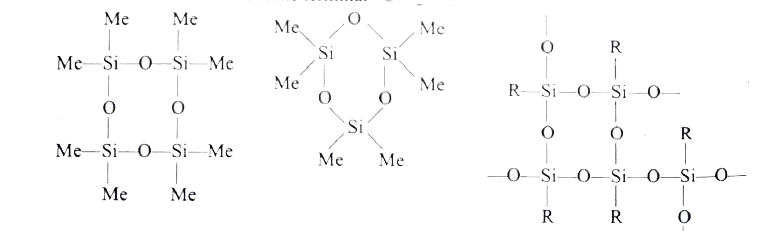
|
|
| 46. |
Explain the preparation of silicon tetrachloride. |
|
Answer» Solution :(i) SILICON tetrachloride can be prepared by PASSING dry chlorine over an intimate mixture of silica and carbon by heating to 1675 K in a porcelain TUBE. `SiO_(2)+2C+2Cl_(2)toSiCl_(4)+2CO` (ii) On commercial SCALE, reaction of silicon with hydrogen chloride gas occurs above `600 K`. `Si+4HCl to SiCl_(4)+2H_(2)` |
|
| 48. |
Explain the preparation of potassium permanganate from MnO_(2) Write the balanced chemical equations for the reactions involved. |
|
Answer» Solution :Potassium PERMANGANATE is prepared by the fusion of `MnO_(2)`with an alkali METAL hydroxide and an OXIDISINGAGENT like `KNO_(3)`. This RESULTS in the formation of the dark green `K_(2)MnO_(4)`which disproportionates in a neutral or acidic solution to give potassium permanganate. `2MnO_(2) +4KOH +O_(2)to 2K_(2)MnO_(4) +2H_(2)O` `3K_(2)MnO_(4) +4H^(+)to 2KMnO_(4) +MnO_(2) +2H_(2)O +4K^(+)` |
|
| 49. |
Explainthe preparation of Nylon - 6.6 and Buna-S . |
|
Answer» SOLUTION :Preparation of Nylon - 6.6 Nylon- 6.6,can bepreparedby mixingequimolaradipicacidand hexanthylene- DIAMINE to form a nylon saltwhichon heatingeliminatea watermoleculeto formamidebonds.  It is used in TEXTILES , manufactureof cardsetc. Preparationof Buna - S It isa co- polymer.It is obtainedby the POLYMERISATION of buta -1.3, dieneand styrene in the ratio 3 :1in thepresenceof SODIUM . 
|
|
| 50. |
Explain the preparation of Nylon - 6 , 6 with equation. |
|
Answer» Solution :It is obtained by CONDENSATION polymerisation of hexamethyl diamine with adipic acid under high pressure and at high pressure. `UNDERSET("Adipic")(nHOOC-(CH_(2))_(4)-COOH)+underset("Hexamethyl diamine")(nH_(2)N-NH_(2)rarr)underset("Nylon - 6")([overset(H)overset(|)N-(CH_(2))_(6)-overset(H)overset(|)N-overset(O)overset(||)C-(CH_(2))_(4)-overset(O)overset(||)C-])` |
|

