Saved Bookmarks
This section includes 7 InterviewSolutions, each offering curated multiple-choice questions to sharpen your Current Affairs knowledge and support exam preparation. Choose a topic below to get started.
| 1. |
[Fe (NO_(2))_(3) Cl_(3)] and [Fe (O-NO)_(3) Cl_(3)] shows |
|
Answer» Linkage ISOMERISM |
|
| 2. |
Fe drops of conc. HNO_3 are added to group II filtrate before proceeding for group III in order to : |
|
Answer» MAKE acidic medium |
|
| 3. |
Fe + conc. underset((gt80%))(HNO_(3))rarr X . Then X will be |
|
Answer» `Fe_(2)O_(3)` |
|
| 4. |
Fe CI_(3) gives positive test with |
|
Answer»
|
|
| 5. |
Fe, Al and Cr are grouped together in qualitative analysis, because |
|
Answer» these have three electrons in VALENCY shell. |
|
| 6. |
Fe^(+3)oxidises NH_(2) to ........ |
|
Answer» `NO_2` |
|
| 7. |
Fe , Al and Cr are grouped together in qualitative analysis because : |
|
Answer» these have three electrons in the valence SHELL |
|
| 8. |
Fe^(+2) reduces NH_(2)OH to ...... |
|
Answer» `NH_(3)` |
|
| 9. |
FCC structure possesses the most close packing of atoms in it. |
|
Answer» If both Statement- I and Statement- II are TRUE, and Statement - II is the correctexplanation of Statement– I. |
|
| 10. |
Favourable conditions for physical adsorption are |
| Answer» Answer :A | |
| 11. |
Favourable conditions for electrovalency are |
|
Answer» Low charge on ions, LARGE cation, small anion |
|
| 12. |
Fats, on alkaline hydrolysis , gives |
|
Answer» Oils `{:(CH_(2)OCOR""CH_(2)OH),(|""|),(CHOCOR+3NaOH to CHOH + underset("Soap")(3RCOONa)),(|""|),(underset("Fat")(CH_(2)OCOR)""CH_(2)OH):}` |
|
| 13. |
Fats on alkaline hydrolysis give ………………………. . |
|
Answer» Oil+SOAP |
|
| 14. |
Fats contain higher percentage of |
|
Answer» UNSATURATED FATTY acids |
|
| 15. |
Fats are ester of |
|
Answer» sugar |
|
| 16. |
Fats contain higher percentage of : |
|
Answer» UNSATURATED FATTY acids |
|
| 17. |
Fats and oils are mixture of |
|
Answer» GLYCERIDES and SATURATED FATTY acids |
|
| 18. |
Fats and oils are formed from respectively. |
|
Answer» glycerol and long CHAIN UNSATURATED acids only |
|
| 20. |
Fats and oils. |
|
Answer» Solution :The NATURALLY OCCURRING triesters of glycerol in which all the three `-OH` groups are esterified with long chain fatty acids are called FATS and oils. They are ALSO called triacylglycerol (TAG) or triglycerides. 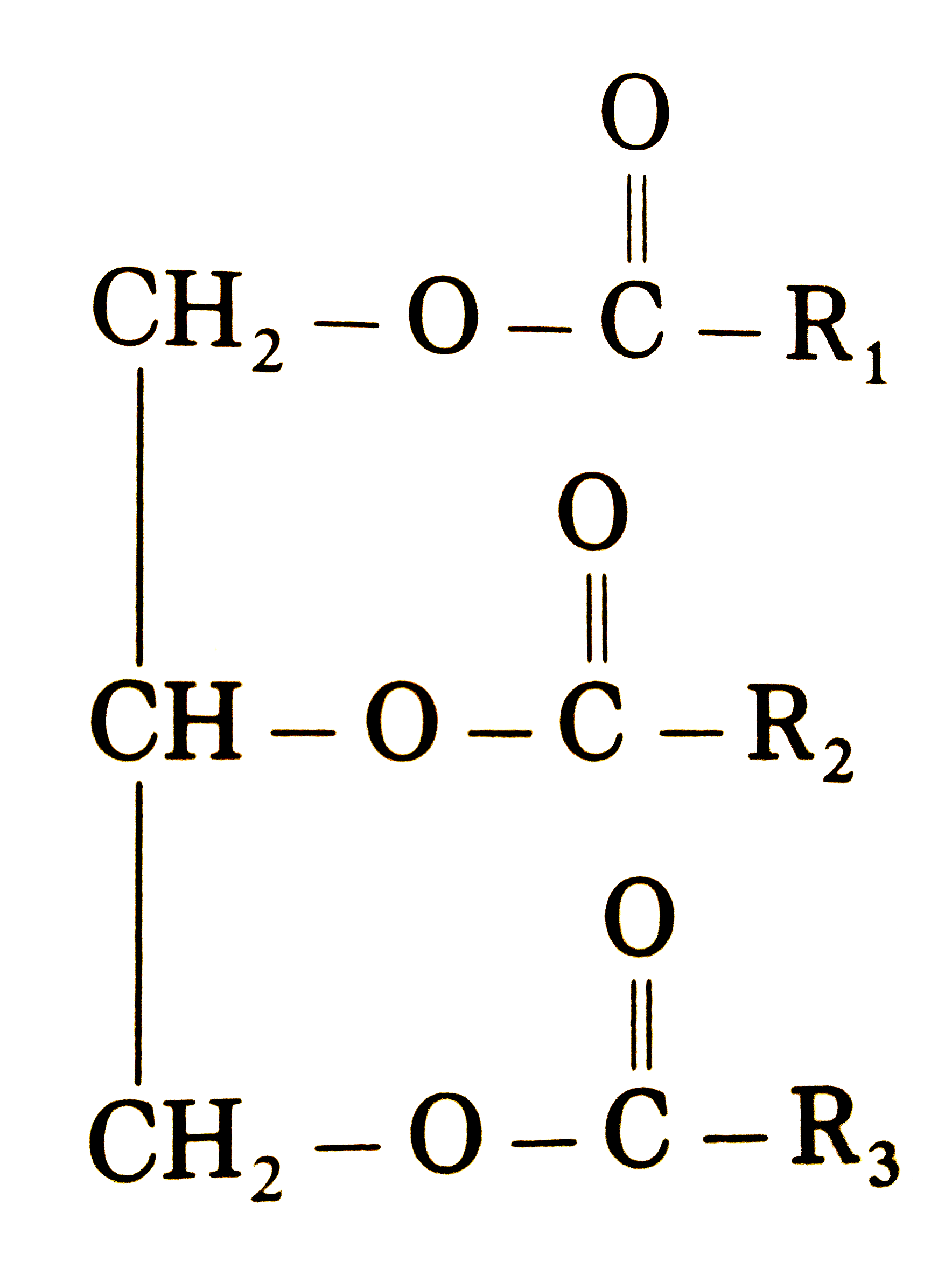
|
|
| 21. |
Fats and oils are : |
|
Answer» Polyhydric alcohols |
|
| 22. |
"Fat"overset("Hydrolysis")rarr"Carboxylic acid "+" Alcohol." Which of the following will make the reaction to occur very rapidly ? |
|
Answer» LIPASE |
|
| 23. |
Fats and oil are formed from |
|
Answer» Giycerol and long CHAIN unsaturated acids only |
|
| 24. |
Fat consists of |
|
Answer» monohydroxy carboxylic acid |
|
| 25. |
Fast and oils serve as : |
|
Answer» RESERVE FOOD for the body |
|
| 27. |
Farnesence is a compound found in the waxy coating of apples. On hydrogenation it gives 2,6,10-Trimethyl dodecane. On ozonolysis it gives one mole acetone, one mole of formoaldehyde, one mole of 2-Methylpentanedial and one mole of 4-Oxopentanal. The structure proposed for Farnesence may be |
|
Answer»
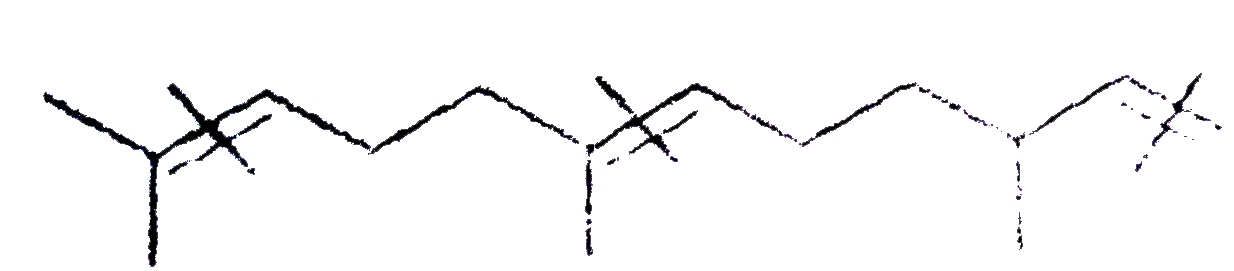 , `OVERSET(O_(3)//ZN)RARR 2-"methylpentanedial+4-oxopentanal+formaldehyde"`. , `OVERSET(O_(3)//ZN)RARR 2-"methylpentanedial+4-oxopentanal+formaldehyde"`.
|
|
| 28. |
Faraday's laws of electrolysis are related to the |
|
Answer» Atomic NUMBER of the reaction Here `E_(1) and E_(2)` are equivalent weight of the IONS. |
|
| 29. |
Faraday's law of electrolysis is not applicable when |
|
Answer» temperature is INCREASED |
|
| 30. |
Faraday's laws hold good at |
|
Answer» all PRESSURES |
|
| 31. |
Faraday.s laws hold good at: |
|
Answer» All pressures |
|
| 32. |
Faraday.s law of electrolysis fails when: |
|
Answer» TEMPERATURE is increased |
|
| 33. |
Faraday's laws of electrolysis are related to |
|
Answer» ATOMIC NUMBER of the cation |
|
| 34. |
Faraday's first law of electrolysis can be expressed as |
|
Answer» `W alpha Q` |
|
| 35. |
Faraday's law of electrolysis are related to |
|
Answer» ATOMIC NUMBER of the cation |
|
| 36. |
Faraday's first law of electrolysis can be expressed as : |
|
Answer» `W PROP Q` |
|
| 37. |
Faraday constant is defined as |
|
Answer» Charge CARRIED by 1 electron |
|
| 38. |
Faradays constant is defined as |
|
Answer» CHARGE CARRIED by 1 electron |
|
| 39. |
Faraday has the dimension of |
|
Answer» Coulombs |
|
| 40. |
Faraday is equal to : |
|
Answer» `96.5` COULOMB` "equivalent"^(-1)` |
|
| 41. |
Faraday. |
| Answer» Solution :It is DEFINED as the quantity of the ELECTRIC charge on one MOLE of electrons. It has value, 1 F = 96500 C/mol. | |
| 42. |
False statement is |
|
Answer» Chloroform is heavier than WATER ORDER of nucleophilicity amongst the halide ion are as `I^(-) GT Br^(-) gt Cl^(-)`. |
|
| 43. |
Factor that can affect the rate of a chemical reaction between a solid and a solution include all of the following except the : |
|
Answer» CONCENTRATION of the REACTANTS in solution |
|
| 44. |
Factose is a : |
|
Answer» reducing sugar |
|
| 45. |
Facial and meridionalisomerism will be exhibitedby: |
|
Answer» `[CO(NH_(3))_(3)Cl_(3)]` |
|
| 46. |
Face centred cubic crystal lattice of copper has density of 8*966" g. cm"^(-3). Calculate the volume of the unit cell. Given molar mass of copper is 63*5"g. mol"^(-1) and Avogadro number N_(A) is 6*022xx10^(23)"mol^(-1). |
|
Answer» Solution :Density of the unit CELL `(d)=("Maxx of the unit cell"(M))/("Volume of the unit cell"(V))`. . . (i) Let number of atoms in the unit cell be Z and mass of each atom m then `M=Zxxm` Mass of each atom `(m)=("Atomic mass")/("Avogadro's no.")` Thus from equation (i) `d=(ZXX"Atomic mass")/("Avogadro's no." xx V)` . . . .(ii) For FACE centered cubic lattice (FCC), the TOTAL no. of atoms in the unit cell `(Z)=(1)/(8)xx8+(1)/(2)xx6` `=1+3=4` So, `8*966"g cm"^(-3)=(4xx63*5"g mol"^(-1))/(6*022xx10^(23)"mol^(-1)xxV)` or, Volume of the unit cell `(V)=(254)/(53*99xx10^(23))cm^(3)` `=4*7xx10^(-23)cm^(3)` Hence, the volume of the unit cell is `4*7xx10^(-23)cm^(3)`. |
|
| 47. |
Face - centred cubiccrystallattics of copperhasdensityof 8.966g cm^(-3). Calculatethe volumeof the unitcell . Givenmolarmass ofcopperis 63. 5 g mol^(-1)and AvogadronumberN_(A)is 6.022xx 10^(23) mol^(-1) |
| Answer» SOLUTION :volumeof unitcell= 4.702 `xx 10^(23) CM^(-3)` | |
| 48. |
Fac-mer isomerism is shown by……… . |
|
Answer» `[Co(EN)_(3)]^(3+)` |
|
| 49. |
Fac-Mer isomerism is associated with which one of the following complexes ? (M = central metal) |
|
Answer» `[M(A A)_(2)]` |
|