

Saved Bookmarks
This section includes 7 InterviewSolutions, each offering curated multiple-choice questions to sharpen your Current Affairs knowledge and support exam preparation. Choose a topic below to get started.
| 1. |
Extremely pure samples of Ge and Si are non-conductors ,but their conductivity increases suddenly on introducing …….. In their crystal lattice . |
|
Answer» As |
|
| 2. |
Explain the preparation of Nylon-6, 6 with equation. |
|
Answer» Solution :Preparation of NYLON 6,6: it is prepared by CONDENSATION polymerisation and hexamethylene dimine with adipic acid under high PRESSURE at high temperature. `nHOOC-(CH_(2))_(4)-COOH+nH_(2)N-(CH_(2))_(6)-NH_(2) underset("high pressure")overset(553)to [-overset(H)overset(|)(N)-(CH_(2))_(6)-overset(H)overset(|)(N)-overset(O)overset(||)(C)-(CH_(2))_(4)-overset(O)overset(||)(C)-]_(n)`. |
|
| 3. |
Extractionof Zn is based on the followingthermodynamic reaction.(A) 2ZnS + 3O_(2) to 2ZnO+ 2SO_(2)(B) ZnO + C to Zn + CO"" DeltaG_(f)^(0) are givenZnS = - 2 xx 10^(2) kJ//"mol"SO_(2) = -3 xx 10 ^(2) KJ//"mole"CO_(2) = -2 xx 10 ^(2)KJ//"mole" ZnO = -3 xx 10^(2) KJ//"mol"DeltaG^(0)for thereaction(A) is - X xx 10^(5) J//"mol"The value of X a will be |
|
Answer» |
|
| 4. |
Explain the preparation of Nylon-2-nylon-6. |
Answer» Solution :It is an alternating polyamide COPOLYMER of GLYCINE `(H_(2)N - CH_(2) - COOH)` and AMINO caproic acid `[H_(2)N(CH_(2)) _(5)COOH]` and is biodegradable. 
|
|
| 5. |
Explain the preparation of diborane. |
|
Answer» Solution :(i) Diborane can also be obtained in small quantities by the reactioni of IODINE with SODIUM borohydride in diglyme. `2NaBH_(4)+I_(4)toB_(2)H_(6)+2NaI+H_(2)` (ii) On heating magnesium boride with HCL a mixture of volatile boranes are obtained. `2Mg_(3)B_(2)+12HClto6MgCl_(2)+B_(4)H_(10)+H_(2)` `B_(4)H_(10)+H_(2)to 2B_(2)H_(6)` (Diborane) |
|
| 6. |
Extractionh of zinc from zinc blende is achieved by |
|
Answer» electrolyticreduction |
|
| 7. |
Explain the preparation of colloidal platinum by Bredig arc method. |
Answer» SOLUTION : (i) An electrical arc is struck between electrodes dispersed in water surrounded by ice. (ii) When a current of 1 amp /100V is passed an arc produced forms vapours of metal which immediately condense to form COLLOIDAL solution. (iii) By this method, colloidal solution of many metals like copper, silver, gold, platinum, etc. can be PREPARED ALKALI hydroxide is added as an stabilising agent for the colloidal solution. 
|
|
| 8. |
Explain the preparation of carboxylic acids from Grignard reagent . Give equation. |
Answer» Solution :Grignard reagent react with solid `CO_(2)` to form SALTS of carboxylic acid with ACIDIFICATION with MINERAL forms carboxylic acid. 
|
|
| 9. |
Extraction of zinc from zinc blende is achieved by |
|
Answer» ELECTROLYTE reduction |
|
| 10. |
Explain the preparation of carboxylic acid from Grignard reagent. Give equation. |
Answer» SOLUTION :Carvon dioide gas is bubbed through ethereal solution of Grignard reagent to give an addition compound which on hydrolysis gives CARBOXYLIC acid.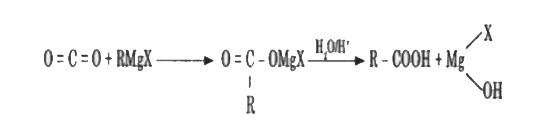
|
|
| 11. |
Extraction of zinc from zinc blende is achieved |
|
Answer» ELECTROLYTIC reduction |
|
| 12. |
Extraction of zinc from zinc blende is achieved by : |
|
Answer» Electrolytic reduction |
|
| 13. |
Explain the preparation of Buna-N with equation. |
Answer» Solution :1,3-butadiene and ACRYLONITRILE is treated in presence of PEROXIDE CATALYST to GET Buna-N.  Note- In Buna-N bu STANDS for butudiene na-Sodium catalyst N-Nitrile |
|
| 14. |
Extraction ofzinc blendeisachieved by |
|
Answer» ELECTROLYTICREDUCTION `ZnO+C OVERSET ( "reduction ") toZn+CO `. |
|
| 15. |
Explain the position of lanthanoids in the periodic table. |
|
Answer» Solution :(1) Position of Lanthanoids in the periodic table : `"Group - 3,PERIOD - 6".` (2) They interrupt the third transition series of d-block elements (i.e. 5d series) in the sixth period. (3) They are 14 elements from `._(58)Ce` to `._(71)Lu` and their positon is in between La and Hf. Since they follow lanthanum, they are called lanthanoids. (4) They are called 4f-series elements and for the convenience they are placed separately below the main periodic table. (5) Actual position of lanthanoids is in between Lanthanum (Z = 57) and Hafnium (Z= 72). (6) Their position is justified due to following reasons. : (i) All these elements have the same electronic configuration in ULTIMATE and penultimate shells, one electron in 5d-orbital and two electrons in 6s-orbital. (ii) Group valence of all lanthanoids is 3. (iii) All lanthanoids from `._(58)Ce` to `._(71)Lu` have smiliar physical and chemical properties. |
|
| 16. |
Explain the position of d-block elements in the periodic table. |
|
Answer» Solution :(i) d-block ELEMENTS are PRESENT in Group-3 to Group-12 in the periodic table. (II) These elements are placed between s-block elements in the left and p-block elements in the right. |
|
| 17. |
Extraction of silver from its ore involving NaCN , air and an active metal is known as : |
|
Answer» Pattinson's method |
|
| 18. |
Explain the physical and chemical properties of dioxygen. |
|
Answer» Solution :Physical properties : Dioxygen is a colourless and ODOURLESS gas. The water solubility is `3.08 cm^3` per 100 `cm_3` water at 293 K which is just sufficient for the vital support of marine and aquatic life. It has three stable isotopes : 160, 170 180. It liquefies at 90 K and freezes at 55 K. Molecular oxygen, (`O_(2)`) is paramagnetic due to presence of unpaired electrons in `pi^(*)`orbitals. (B) Chemical properties : (i) Reaction with metals : Dioxygen directly reacts with nearly all metals and except Au and PT to form oxides. For example : `2Ca + O_(2) to 2CaO` `4AL + 3O_(2) to 2Al_(2)O_(3)` `4Fe + 3O_(2) to 2Fe_(2)O_(3)` (ii) Reaction with non-metals `C + O_(2) to CO_(2)` `P_(4) + 5O_(2) to P_(4)O_(10)` (iii) Reaction with compounds: `2ZnS + 3O_(2) to 2ZnO + 2SO_(2)` `CH_(4) + 2O_(2) to CO_(2) + 2H_(2)O` Catalytic oxidation - `2SO_(2) + O_(2) overset(V_(2)O_(5)) to 2SO_(3)` `4HCl + O_(2) overset(CuCl_(2))to 2Cl_(2) + 2H_(2)O` |
|
| 19. |
Explain the phenomenon of reverse osmosis. OR How can pure water be obtained from sea water or from ocean ? |
|
Answer» Solution :The phenomenon of the passage of solvent like water under high pressure from the CONCENTRATED aqueous solution like sea water into pure water through a semipermeable membrane is called reverse osmosis. The osmotic pressure of sea water is about 30 atmospheres. Hence when pressure more than 30 atmospheres is applied on the solution side, regular osmosis stops and reverse osmosis starts. Hence pure water from sea water enters the other side of pure water. 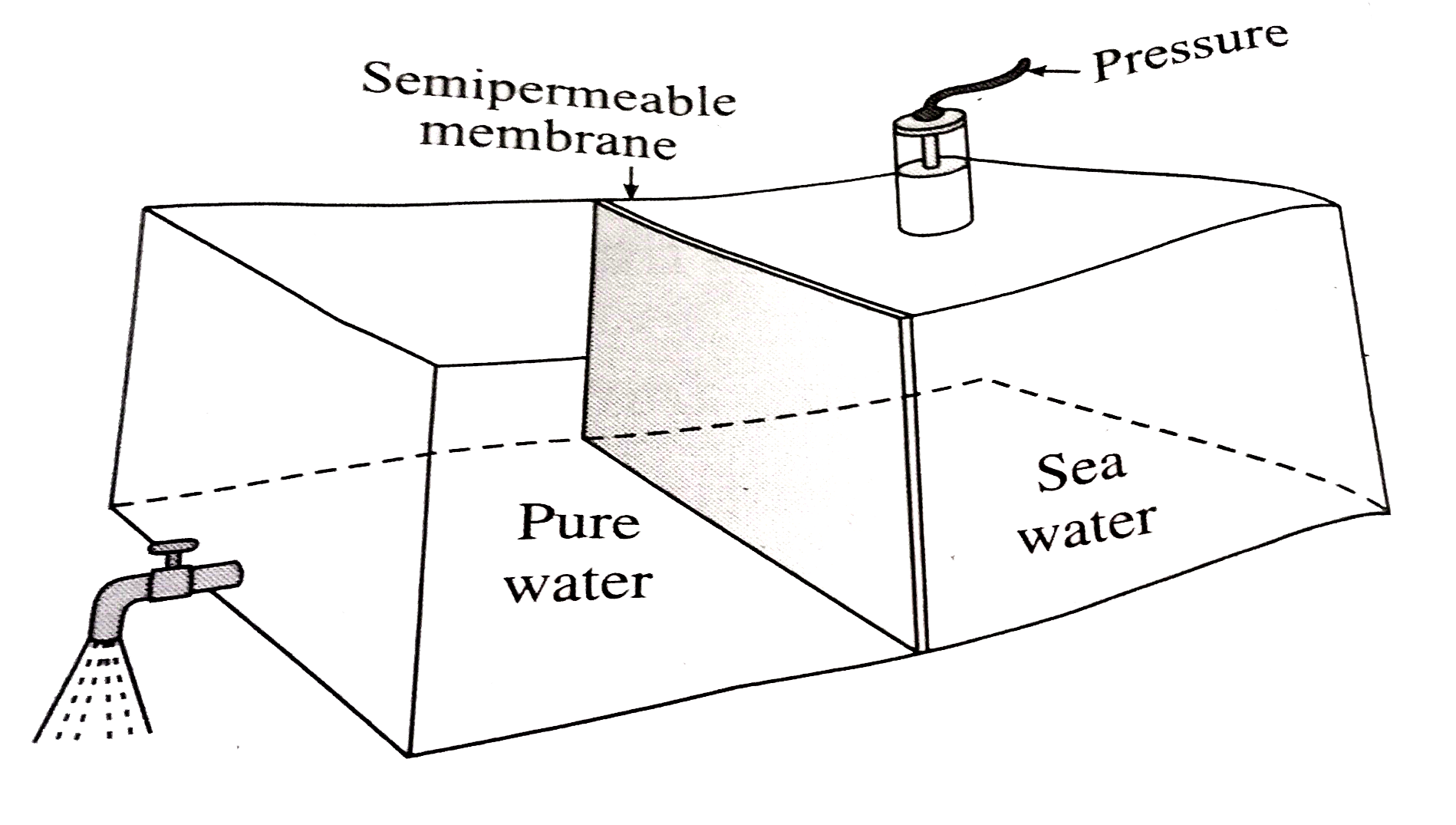 For this purpose of suitable semipermeable mem- brane is REQUIRED which can withstand high pressure conditions over a long period. This method is used successfully in Florida since 1981 producing more than 10 MILLION litres of pure water per DAY. |
|
| 20. |
Extraction of silver form its ore involving NaCN, air and an active metal is known as: |
|
Answer» Pattinson's method |
|
| 21. |
Explain the photoelectric effect . |
|
Answer» Solution :Photoelectric effect : J.J Thomson and P . Lenard showed that "when a beam of light of suitable wavelength is allowed to fall on the surface of a metal , the electrons are emitted from the surface of the metal". This PHENOMENON is CALLED , photoelectric effect. Explanation of photoelectric effect by Einstein : Einstein (1905) explained photoelectric effect with the help of Planck's quantum THEORY of radiation. According to quantum theory of radiation , a photon of light of frequency , `upsilon` is as-sociated with energy equal to `upsilon` . When a photon of light frequency `upsilon(upsilon` is higher than threshold frequency ) falls on a metal some of the energy associated with the photon is consumed to separate the electron from the surface and the remaining energy is imparted to the ejected electron , to given it certain velocity , say equal to v . Due to this velocity , the emitted electron gains kinetic energy to`(1)/(2)mv^(2)`. The proton of energy which is consumed to separate the electron is equal to the binding energy of the electron . This energy is called 'thresh-old energy' or ' work function ' and is equal to the product of h and threshold frequency`(upsilon_(0))` of a photon of radiation falling on the metal surface . THUS this energy is equal to `(hupsilon_(0))` . This above discussion shows that `hupsilon` is equal to the sum of `(1)/(2)mv^(2)` (K.E. of oneelectron ) and`hupsilon_(0)` i.e., `hupsilon=hupsilon_(0)+(1)/(2)mv^(2)` |
|
| 22. |
Explainthe oxidation statesof 4dserieselements. |
Answer» SOLUTION :
|
|
| 23. |
Extraction of metal from the ore cassiterite involves |
|
Answer» carbonreductionofanoxides ore ` SN O _2+ 2 CtoSn+2CO` Extraction oftin alsoinvolvesremoval ofimpuritiesof Cuand Fe.Thus,OPTIONS (a, c, d) arecorrect. |
|
| 24. |
Explain the oxidation states of 3d series elements. |
|
Answer» Solution :(i) The first transition metal Scandium exhibits only +3 oxidation state, but all other transition elements exhibit variable oxidation states by losing electrons from (n-1) d orbital and ns orbital as the energy difference between them is very small. ii) At the BEGINNING of the 3d SERIES, +3 oxidation state is stable but TOWARDS the end +2 oxidation state becomes stable. (iii) The number of oxidation states INCREASES with the number of electrons available, and it decreases as the number of paired electrons increases. For example, in 3d series, first element Sc has only one oxidation state +3, the middle element Mn has six DIFFERENT oxidation states from +2 to +7. The last element Cu shows +1 and +2 oxidation states only. (iv) `Mn^(2+)(3d^(5))` is more stable than `Mn^(4+)(3d^(5))`is due to half filled stable configuration. |
|
| 25. |
Explain the order of strength of the following acids. p-nitrophenol gt m-nitrophenol gt phenol gt cresol |
|
Answer» Solution :p-nitrophenol `gt` m-nitrophenol `gt` phenol `gt` cresol : (a) In aromatic acid, the nitro GROUP (electron withdeawing group) ESPECIALLY at ORTHO or para POSITION increases its strength due to -I effect. (b) So p-nitro phenol is more acidic than m-nitro phenol and it is more acidic than phenol. (C) But cresol contains `CH_(3)` group which has +I effect (electron repelling group) and due to this strength of the acid decreases. So phenol is more acidic than cresol. 
|
|
| 26. |
Extraction of metals from sulphide cres is done by |
|
Answer» Electrolysis |
|
| 27. |
Explain the order of strength of the following acids. C Cl_(3)COOHgtCHCl_(2)COOHgtCH_(2)ClCOOHgtCH_(3)COOH |
|
Answer» Solution :`C Cl_(3)COOHgtCHCl_(2)COOHgtCH_(2)ClCOOHgtCH_(3)COOH` : (a) Any factor that weakens the -COOH bond will facilitate the cleavage to release `H^(+)` more easily. The degree of IONISATION increases and acid becomes relatively a stronger acid. (b) The acid strength increases with increase in elecronegativity of substituents. (c) In MONOCHLORO ACETIC acid, the -I effect of chlorine increases the strength of the acid. (d) Thus monochloro acetic acid is stronger than acetic acid is GREATER than monochloro acetic acid. 
|
|
| 28. |
Explain the orientation of-COOH group, when present on benzene ring. |
Answer» SOLUTION :The `-COOH` GROUP is ELECTRON WITHDRAWING and is meta-orienting . 
|
|
| 29. |
Explaintheoctablralgeometryof complexes usingcrystal fieldtheory. |
Answer» Solution :(1) In an octahedral complex `[MX_(6)]^(n pm)`+, the metal atom or ion is placedat thecentre of regularoctaherdronat sixvertices of theoctahedron. 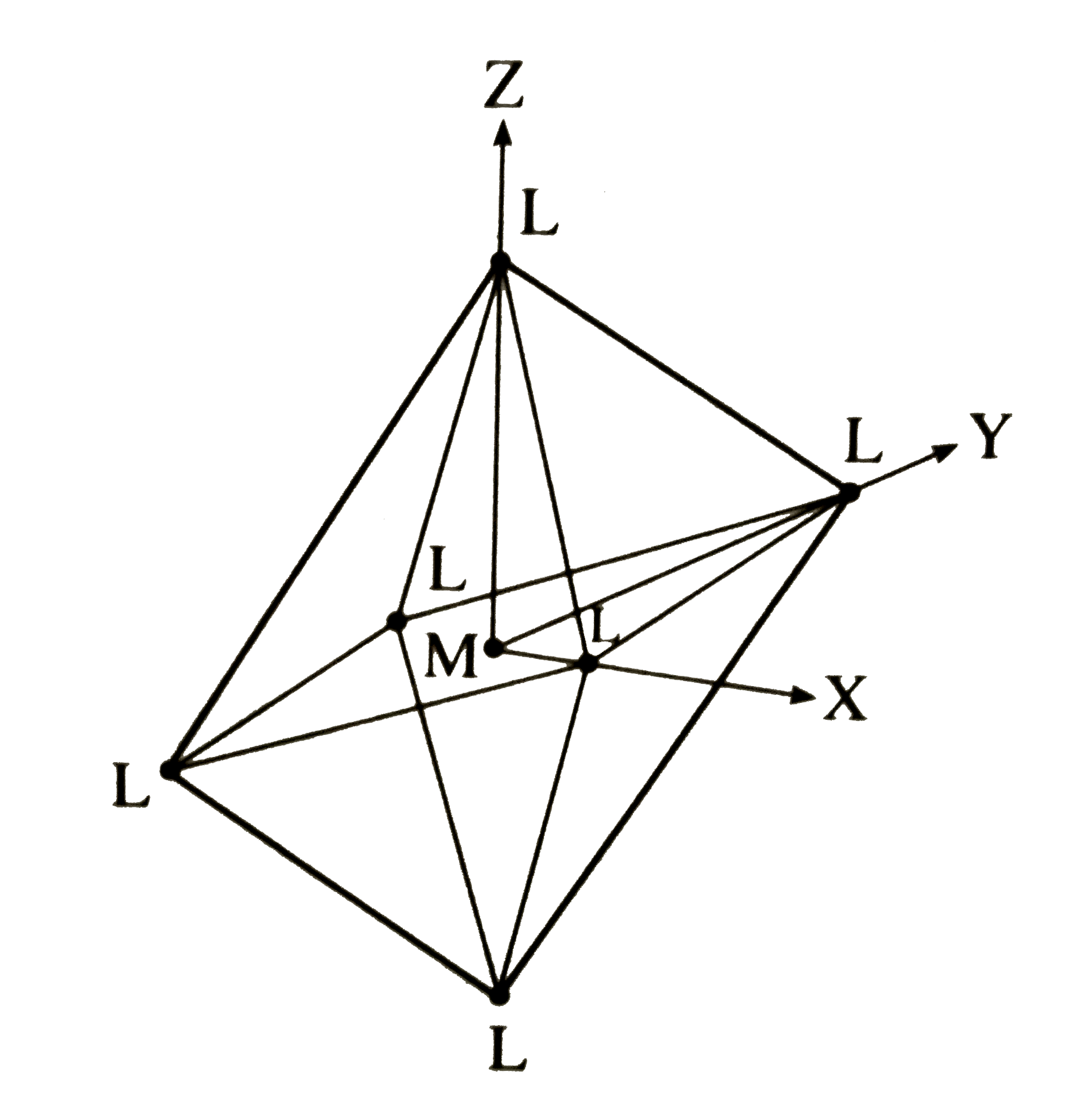 (2) Amongfivedegenerate d-orbitals,TWO orbitalsnamely`d_(X^(2) - y^(2))` and `d_(z^(2))`are axialand havemaximum electron densityalong theaxes, whileremaing three d-oritalsnamely `d_(xy) ,d_(yz) ` and `d_(zx)`are planarand havemaximum electron density in the planes and in- bewteenthe axes. (3) Hence, when the ligands approach a metal ion, the orbitals `d_(x^(2)-y^(2))` and `d_(z^(2))`experience greater repulsion and the orbitals `d_(xy) ,d_(yz) and d_(zx)`experienceless repulsion. (4)Thereforethe energy of `d_(x^(2) - y^(2))` and `d_(z^(3))`increasewhilethe energyof `d_(xy), d_(yz)andd_(zx)`decrease and fived - orbital losedegeneracyand splitinto two pointgroup . Theorbitals`d_(xy), d_(xy) and d_(zx)`form `t_(2g)` groupof lower energywhile `d_(x^(2) - y^(2))` and `d_(z^(2))`form `e_(g)`groupof higherenergy . Thus `t_(2g)`has three degenerate orbitalswhile`e_(g)`hastwo degenerateorbitals. 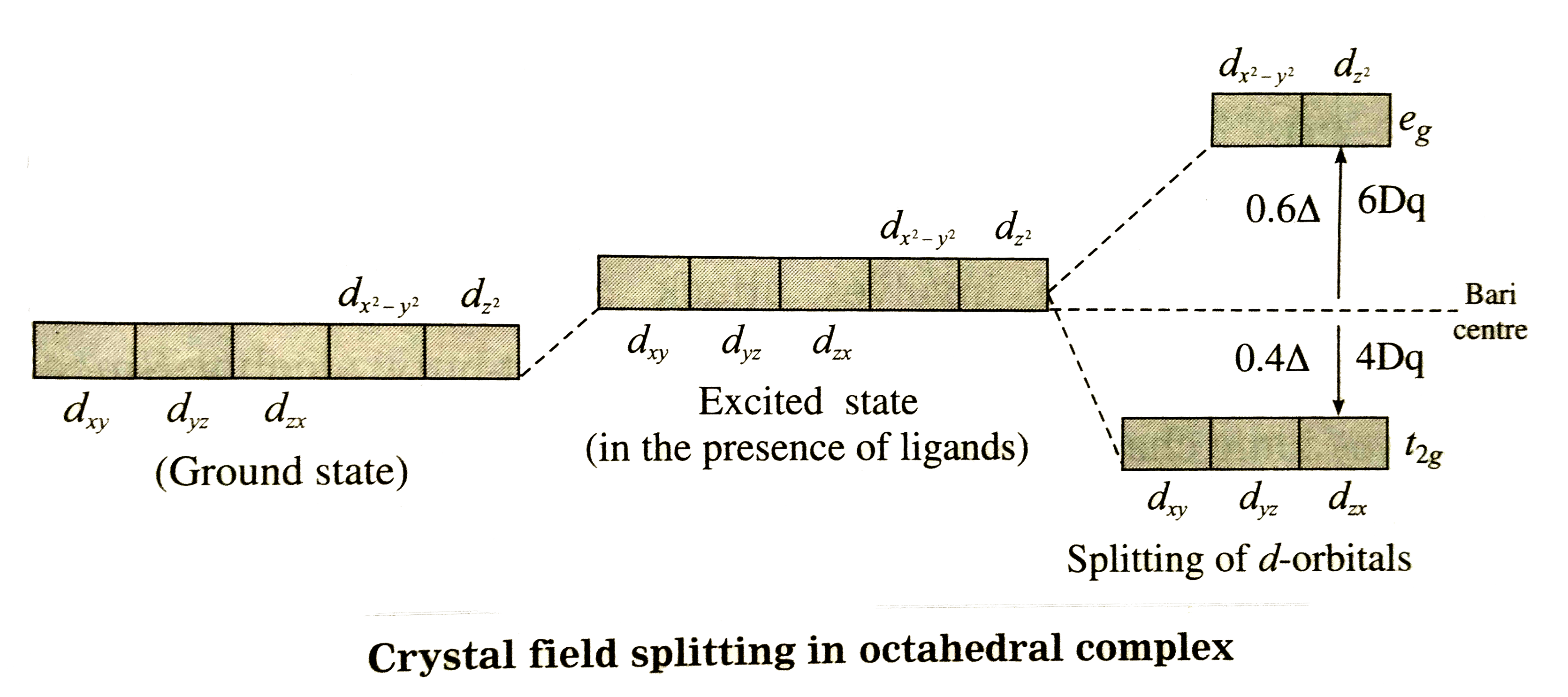 (5) Experimental calculations show that the energy of `t_(2g)` orbitals is lowered by `0.4Delta_(0)` or `4D_(q)` and energy of `e_(g)` orbital is increased by `0.6Delta` or `6D_(q)`. Thus energy difference between ty and eg orbitals is `Delta_(0)` or `10D_(q)` which is crystal field splitting energy. (6)CFSE increases with the INCREASING strength of ligands and oxidation state of central metal ion. |
|
| 30. |
Extraction of metal from sulphide ore is made by : |
|
Answer» ELECTROLYSIS |
|
| 31. |
Extraction of gold (Au) involves the formation of complex ions 'X' and 'Y. Gold ore overset("Roasting")underset(CN^(-),H_(2)O,O_(2))to HO^(-)+X overset("Zn")to Y+Au 'X' and 'Y' are respectively |
|
Answer» `Au(CN)_(2)^(-)` and `ZN(CN)_(4)^(2-)` `2[Au(CN)_(2)]_((aq))^(-)+Zn_((s))rarr 2Au_((s))+[Zn(CN)_(4)]_((aq))^(2-)` |
|
| 32. |
Extractionofgold(Au)involves theformationofcomplex ions 'X' and 'Y' Gold oreoverset ("Roasting") underset (CN^(-),H _2O,O_2 ) toHO ^(-) + Xoverset(Zn) toY+ Au 'X' and'Y' arerespectively |
|
Answer» ` Au(CN)_(2)^(-) and Zn(CN)_4^(2-) ` `2 [Au(CN)_2]^(-) + Zn to2 Au+ [ underset((Y))(Zn(CN)_4)]^(2-) ` |
|
| 33. |
Extraction of lead by reduction methods is done by |
|
Answer» Adding more GALENA into reverberatory FURNACE |
|
| 34. |
Extraction of gold(Au) involves the formation of complex ions'X' and 'Y'.Gold ore underset(CN^(-) , H_(2)O, O_(2))to HO^(-) + 'X' overset(Zn) to 'Y' + Au X and Y are respectively________. |
|
Answer» `[AU(CN)_(2)]^(-) and [Zn(CN)_(4)]^(2-)` |
|
| 35. |
Extraction of gold and silver involves leaching with cyanide ion. Silver is later recovered by |
|
Answer» Distillation |
|
| 36. |
Extraction of gold and silver involves leaching with CN^(-) ion. Silver is latter recovered by.... |
|
Answer» Displacement with zinc |
|
| 37. |
Extraction of gold and silver involves leaching with CN^(-) ion. Silver is later recovered by- |
|
Answer» Liquation |
|
| 38. |
Extraction ofgoldand silverinvolvesleachingwithCN^(-)ion.Silveris laterrecoveredby |
|
Answer» DISTILLATION |
|
| 39. |
Extraction of gold and silver involves leaching the metal with CN^(-) ion. The metal is recovered by |
|
Answer» roasting of metal complex `2Na[M(CN)_(2)]+ Zn overset(O_(2))to Na_(2)[Zn(CN)_(4)]+2M` |
|
| 40. |
Extraction of gold and silver involves leaching with CN^(-)ion.silver is later recovered by: |
|
Answer» LIQUATION |
|
| 41. |
Extraction of gold and silver involves leaching the metal with CN-ion. The metal is recovered by ........... |
|
Answer» Displacement of metal by some other metal from the complex ion. `2[M(CN)_(2)]^(-) + Zn to [Zn(CN)_4]^(2-) + 2M (M = AU, AG)` 
|
|
| 42. |
Extraction of gold and silver involves leaching the metal with CN^- ion. The metal is recovered by ............. |
|
Answer» DISPLACEMENT of METAL by some other metal from the COMPLEX ion. |
|
| 43. |
Extraction of gold and silver involves leaching the metal with CN^(-) ion. The metal is later recovered by …………… |
|
Answer» DISPLACEMENT method |
|
| 44. |
Extraction of gold and silver involves leaching the metal with CN^(-) ion. Sliver is later recovered by : |
|
Answer» distillation |
|
| 45. |
Extractionofgoldandsilverinvolves leachingthemetalwithCN^( - )ion.The metal isrecoveredby ....... . |
|
Answer» displacementof metalbysomeother metalfromthecomplex ion |
|
| 46. |
Extraction of gold and silver involved leaching withCN^(-)ions. Silver is later recovered by |
|
Answer» DISPLACEMENT with Zn |
|
| 47. |
Extraction of copper from pyrites is more difficult than that from its oxide ore through reduction. |
|
Answer» |
|
| 48. |
Extraction of copper from copper pyrite (CuFeS_(2)) involves |
|
Answer» Crushing followed by concentration of the ORE by froth floatation PROCESS. |
|
| 49. |
Extraction of copper by smelting uses silica as an additive to remove ........ |
| Answer» SOLUTION :`FeO + SiO_2 to FeSiO_3` | |
| 50. |
Explain the order of relative reactivity of acid derivatives. |
|
Answer» Solution : (i) The reactivity of the acid derivatives follows the ORDER `R - undersetoverset(||)(O)(C ) - Cl gt R - undersetoverset(||)(O)(C ) - O - undersetoverset(||)(O)(C ) - R gt R - undersetoverset(||)(O)(C ) - OR. gt R - undersetoverset(||)(O)(C ) - NH_2` (II) The above order of reactivity can be explained in terms of (a) Basicity of the leaving group (B) Resonance EFFECT (iii) Weaker bases are good leaving groups. Hence acyl derivatives with weaker bases as leavinggroups (L) can EASILY rupture the bond and are more reactive. The correct order of the basicity of the leaving group is `H_2N^(-) : gt O^(-) R gt RCOO^(-) : gt Cl^(-1)` Hence the reverse is the order of reactivity. (iv) Lesser the electronegativity of the group, greater would be the resonance stabilization as shown below. 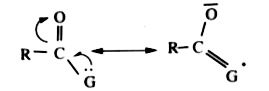 This effect makes the molecule more stable and reduces the reactivity of the acyl compound. The order of electronegativity of the leaving groups follows the order – Cl > - OCOR > - OR > - NH, Hence the order of reactivity of the acid derivatives with nucleophilic reagent follows the order Acid halide > Acid anhydride > esters > Acid amides |
|