

Saved Bookmarks
This section includes 7 InterviewSolutions, each offering curated multiple-choice questions to sharpen your Current Affairs knowledge and support exam preparation. Choose a topic below to get started.
| 1. |
Explain the variation of molar conductivity with concentration for strong and weak electrolytes. |
|
Answer» Solution :(1) Molar conductivity is the conductance of all the ions produced from one mole of an electrolyte. The molar conductivity of both, strong and weak electrolytes increases with dilution or the decrease in concentration of the ELECTROLYTIC solution. As thedilution increase , the dissociation of the electrolyte increases, hence the total number of ions increases, therefore, the molar conductivity increases. (3) Molar conductivity `^^_(m)`is given by `^^_(m) = (k)/(C) = k XX V` where k isconductivityand C or V are concentration or dilution of the solution respectively. (4) On dilution, the molarconductivity of strong electrolytes increaserapidly and APPROACHES to a maximum limiting VALUE at infinitedilution or zero concentration and respresented as `^^ oo` or `^^_(0)` or `^^_(m)^(0)` . (5)In caseof weakelectrolytes, the molarcondutivityis lowandcondutivityis lowandincreaseslowly in highconcentrationregionbut incereaserapidlyat lowconcentrationor high dilutionsincetheextent of dissocitateinreasewith dilutionrapily. For strong electrolytes, the linear variation of molar conductivity (Am) with the concentration is represented by Kohlrausch relation, `^^_(m) = ^^_(0) - a sqrt(c)`where a isa constant . `^^_(0)`values for strongelectrolytescan be obtained by extrapolating the linear graph to zero concentration (or infinite dilution). However A, for the weak electrolytes cannot be obtained by this method, since the graph increases exponentially at very high dilution and does not intersect `^^_(m)` AXIS, 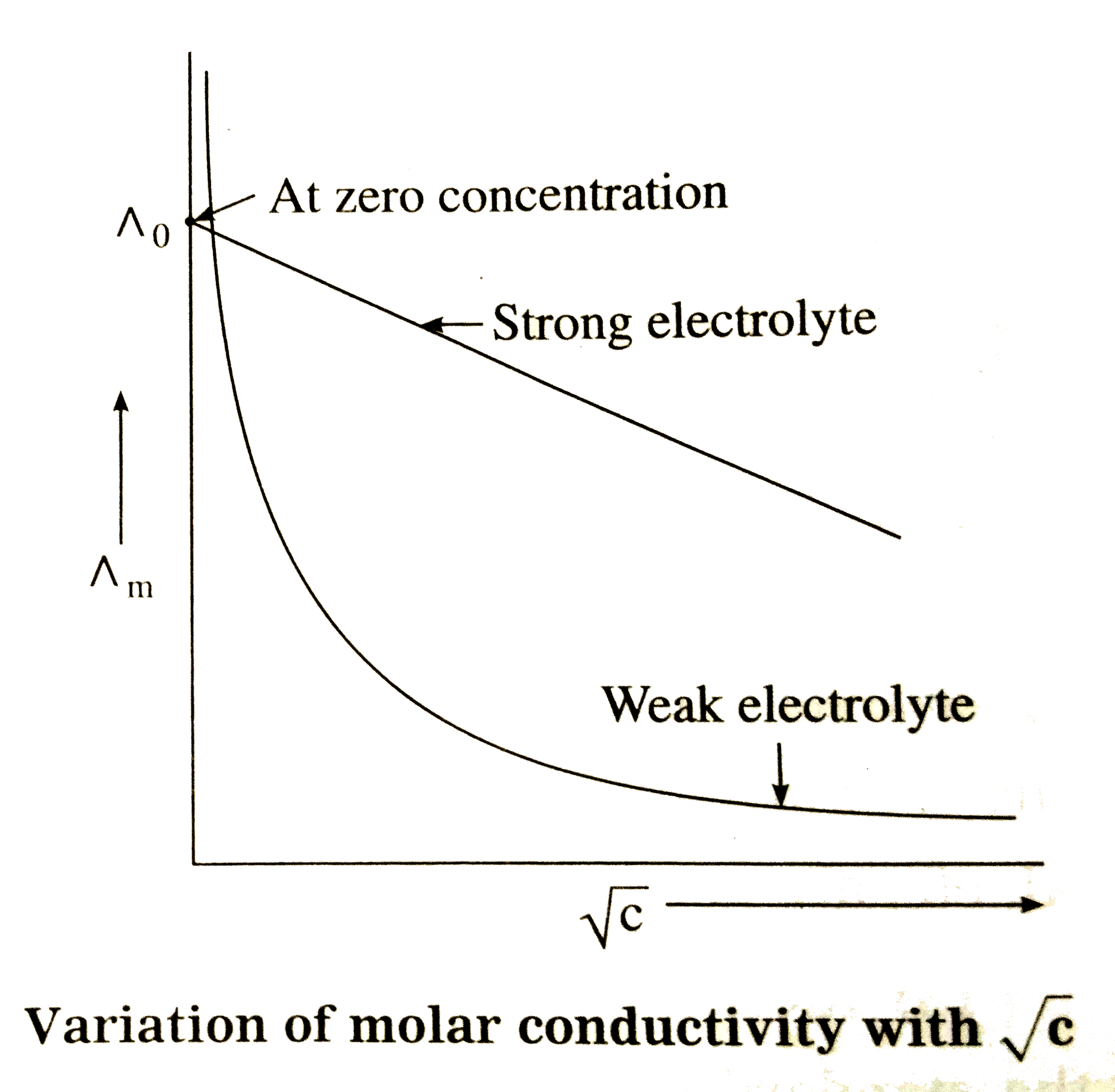
|
|
| 2. |
Explain the variation of adsorption with pressure. |
| Answer» | |
| 3. |
Explain the effect of catalyst on reaction rate with an example. |
|
Answer» Solution :(i) A catalyst is substance whichalters the RATE of a reaction withoutitselfundergoingany permanentchemical change. (ii)in the PRESENCE of a catalyst, the ENERGY of acitvationis lowered and hence, greater number of MOLECULES can crossthe energy barries and change over to PRODUCTS, thereby increasingthe rate of thereaction. |
|
| 4. |
Explain the variation in the oxidation states of 3d-block elements. |
|
Answer» Solution :(i) From Sc to Mn, the minimum OXIDATION STATE is the number of ELECTRONS present in 4s-orbital and maximum oxidation state is the sum of the electrons present in 4s- and 3d-orbitals. EXAMPLE: `Mn (3d^54s^2) : +2, +3, +4, +5, + 6, +7.` (ii) From Fe to Zn, the maximum oxidation state decreases from + 6 to + 2. It is due to the pairing of electrons in the 3d - subshell and removal of these electrons becomes difficult. Example: `Zn (3d^(10) 4s^(2))`. |
|
| 5. |
Explain the effect of catalyst on the activation energy of the reaction with the graph. |
Answer» SOLUTION :ACCORDING to ARRHENIUS equation, lesser the activation energy `(E_(a))` faster will be the rate of reaction. In the presence of CATALYST, a reaction proceeds in an ALTERNATIVE pathway with lesser activation energy. Thus, the reaction takes place faster. 
|
|
| 6. |
Explain the variation in metallic and non-metallic character of group 15 elements. |
|
Answer» Solution :(i) Down the group, from N to Bi, non1netallic character DECREASES due to GRADUAL increase in atomic size, gradual decrease in ionisation enthalpy and the increase in ELECTROPOSITIVE character of the ELEMENTS. (II) N and Pare non-metals, As and Sb are rnetalloids while Bi is metal. Thus group 15 elements include all types of elements. |
|
| 7. |
Explain the distinction between adsorption and absorption. |
|
Answer» Solution :In adsorption, the substance is concentrated only at the surface and does not penetrate through the surface to the bulk of the adsorbent, while in ABSORPTION the substance is uniformly distributed throughout the bulk of the solid. For example, when a chalk stick is dipped in ink, the surface retains the colour of the ink DUE to adsorption of COLOURED molecules while the solvent of the ink goes deeper into the stick due to absorption. On breaking the chalk stick, it is found to be WHITE from inside. A distinction can be made between absorption and adsorption by taking an example of water vapour. Water vapours are absorbed by anhydrous calcium chloride but adsorbed by silica gel. In adsorption the CONCENTRATION of the adsorbate increases only at the surface of the adsorbent, while in absorption the concentration is uniform throughout the bulk of the solid. |
|
| 8. |
Explain the dual behaviour of matter. Discuss its significance to microscopic particles like electrons. |
|
Answer» Solution :de - Broglie's hypothesis :The light is found to exhibit wave nature as well as particle nature (dual nature ) . Based on this idea of ' duel nature of light '. De Broglie in 1924 proposed that " all micro -particles including the electron moving with high velcoity are as sociated with dual nature (i.e., ) both particle wave nature . De- broglie an expression for the wavelength of the moving electron . Expression for de-Broglie wavelengths : According to 'Planck's quantum theory' , ENERGY of a photon , `E=hupsilon, " But " upsilon=(c)/(lamda)` `thereforeE=h.(c)/(lamda)......(1)` Einstein's mass - energy equivalence equation is `E=mc^(2)"".......(2)` combining eqns. (1) and (2) , `(h.c)/(lamda)=mc^(2)" or " lamda=(h)/(mc)=(h)/(p)` (p=mc=momentum) This equations is applicable to photons as well as to all microparticles , moving with high speed . `therefore` We can write in general, `lamda=(h)/(p)=(h)/(mv)` where m = mass of the microparticle and v = its velocity `lamda` , is called , de-Broglie wavelength or material wavelength . Significance of de - Broglie's CONCEPT: According to Bohr's theory , electron revolves in an ORBIT in which its angular momentum (mvr) is an integral multiple of`(h)/(2pi) ` . Bohr assumed electron as a particle . Hence his equation can be taken as `"mvr"=n((h)/(2pi))` where n = a whole number . According de Broglie , electron behaves as a standing (or stationary ) wave which extends round the nucleus in a circular orbit . If the ends of the electron wave meet to give a regular series of crests and troughs , the electron - wave is said to be 'in phase' . It means , there is constructive INTERFERNCE of electron waves and the electron motion has a character of standing wave or non-energy radiating motion . Always it is a necessary condition motion . Always it is a necessary condition to get an electron-wave in phase'such that the circumference fo the Bohr's orbit `(=2pir)` is equal to the whole number of multiple of the wavelength`(lamda)` of the electron -wave . `nlamda=2pir` `lamda=(2pir)/(n)` But`lamda=(h)/("mv")` (de-Broglie) `therefore(2pir)/(n) = (h)/("mv") "ormvr"=(nh)/(2pi)` 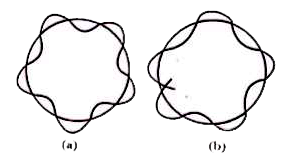 (a) Wave in - phase(b) Wave out -of phase This is Bohr's equation which stipulates that "the angular momentum of an electron moving round the nuclecus is an integral multiple of`(h)/(2pi)`" . This shows that, de-Broglie's theory and Bohr's theory are in agreement with each other . |
|
| 9. |
Explain the variation in ionization enthalpies of transition elements in 3d series. |
|
Answer» Solution :(i) First ionization enthalpy: The first ionization enthalpy follows a irregular trend. This is because, the first electron when removed alters the relative energies of 3d and 4s orbitals. The electrons are first removed from 4s and then from 3d orbitals. In first transition series going from scandium to zinc, the nuclear charge increases with the increase in atomic number and the electrons are added in 3d orbitals. The increase in nuclear charge is opposed by the sheilding effect of 3d electrons, as a result the atomic radii decreases less rapidly and so there is slight increase in ionization enthalpy in 3d series. (ii) Successive ionization enthalpies: In general the third ionization enthalpy is HIGHER than second ionization enthalpy which in turn is higher than first ionization enthalpy. The high values of successive ionization enthalpies is attributed to high effective nuclear charge and poor sheilding of one d-electron by other. The second ionization enthalpy of CHROMIUM is higher than MANGANESE while the third ionization enthalpy of manganese is higher than chromium. In case of chromium, the second electrons is to be removed from half FILLED `(d^(5))` subshell which is extra stable and hence requires greater energy for ionization. In case of manganese, the third electron is to be removed from half filled `(d^(5))` subshell and so third ionization enthalpy is higher for manganese than chromium `""_(24)Cr^(+) : [Ar] 3d^(5) 4s^(0) rarr ""_(24)Cr^(2+) : [Ar] 3d^(4)` `""_(25)Mn^(2+) : [Ar] 3d^(5) 4s^(0) rarr ""_(25)Mn^(3+) : [Ar] 3d^(4)` (More DIFFICULT to attain) Thus, for manganese, it is difficult to remove the third electrons. Similary, third ionization enthalpy of Mn is higher than Fe because `Mn^(2+)` has `d^(5)` configuration while `Fe^(2+)` has `d^(6)` configuration. So, the removal of electron from `Mn^(2+)` is difficult as the subshell is half filled. `Fe^(2+) : [Ar] 3d^(6) 4s^(0) rarr Fe^(3+) : [Ar] 3d^(5)` `Mn^(2+) : [Ar] 3d^(5) 4s^(0) rarr Mn^(3+) : [Ar] 3d^(4)` (More difficult to attain) The First ionization enthalpy of Cu is less than zinc because the removal of 4s electron in copper will result in `d^(10)` configuration (fully filled) while the second ionization of Zn is lower than copper as removal of second electron from zinc results in `d^(10)` configuration (fully filled). `""_(29)Cu: [Ar] 3d^(10) 4s^(1) rarr ""_(20)Cu^(+): [Ar] 3d^(10) 4s^(0)` [Easy to attain] `""_(30)Zn^(+) : [Ar] 3d^(10) 4s^(1) rarr ""_(30)Zn^(2+): [Ar] 3d^(10) 4s^(0)` [Easy to attain] (iii) Stability of `M^(2+)` ions in gaseous state: The stability of `M^(2+)` ions in gaseous state depends on the summation of first and second ionization enthalpies and enthalpy of atomization. Lower is the sum of ionization enthalpy, greater is the thermodynamic stability. The dominant factor is second ionization enthalpy. This explains why the `Zn^(2+) and Mn^(2+)` ions are formed easily adn removal of third electron in difficult. the high values of third ionization enthalpies of Ni, Cu and Zn indicates why it is difficult to obtain oxidation states higher than two for these elements. |
|
| 10. |
Explain the difference between covalency and oxidation state by taking the example of N_(2)O_(5). |
Answer» Solution :Covalency and oxidation states are two different concepts and should not be used interchangebly. Although N cannot have a covalency of 5, it can have an oxidation state of +5 in its compounds with oxygen, i.e., `N_(2)O_(5)`  In `N_(2)O_(5)`, each N atom shares two of its valence electrons with an oxygen atom to form a N=O bond, one electron with the second oxygen atom to form a N-O bond the LONE pair of electrons with the THIRD oxygen atom to form a coordinate bond (N `rarr` O). For a coordinate bond in which donor atom is LESS electronegative (e.g., N in `N_(2)O_(5)`) and the acceptor atom is more electronegative (e.g., O in `N_(2)O_(5)`), the donor atom (i.e., N atom) is assigned an oxidation state of +2. THUS, the total oxidation state of N in `N_(2)O_(5)` is +5 as calculated below : `{:((+2),+,(+1),+,(+2),=,+5),((N = O),,(N - O),,(N rarr O),,):}` But for a coordinate bond irrespective of the nature of donor atom whether more or less electronegative, covalency is always 1 (for each shared pair of elctrons, covalency is counted as one). Thus, N can have an oxidation state of +5 but cannot have a covalency of 5. At the MAXIMUM, it can have a covalency of 4. |
|
| 11. |
Explainthevariationin E_M^(3+) //m^(2+)^(0) 3DSeries. |
|
Answer» SOLUTION :1. in transitionseriesas wemovedownfrom Tito Znthe standardreductionpotential `E_(m^(2+))^(0)` valueis approaoachingtowardslessnegativevalueand copperhasa positive . 2.`E_(m^(2+)//M)^(0) ` value formangancesand zincare morenagativethen regulartrend.it isdue to`d^(10)` configurationin `ZN^(2+)` 3. Thehighreductionpotentialof `Mn^(3+) // Mn^(2+)` indicates`Mn^(2+)` is morestablethan`Mn^(3+)` 4.Thehighreductionpotentialof `Mn^(3+)` indicates`Mn^(2+)` morestablethen `Mn^(3+)` 5 `Mn^(3+)` has a`3d^(4)` configurationwhilethatof `Mn^(2+)` is `3d^(5)` the extrastabilityassociated witha HALF filledd sub-shellmakesreducationof `Mn^(3+)` veryfeasible`[E^(0) =+1.51V]` |
|
| 12. |
Explain the difference between rust formation and passivity of a metal. |
|
Answer» Passivity on the other hand is the process wherein the metal stops reacting due to the formation of an impervious layer on its surface. `Fe,Al,Cr,` when dipped in conc. `HNO_(3)` have initially some reaction which ceases COMPLETELY after some time. Thereafter, the metals stops reacting with any reactant. |
|
| 13. |
Explain the difference between instantaneous rate of a reaction and average rate of a rate of a reaction. |
Answer» SOLUTION :
|
|
| 14. |
Explain the variation in E_(M^(2+)//M^(3+)+ 3d series |
|
Answer» Solution :1. In transition series, as we move down from Ti to Zn, the standard REDUCTION potential `E_(M^(2+)//M^(3+)` value is approaching towards less negative value and copper has a positive reduction potential. i.E. elemental copper is more stable than `CU^(2+)`, 2. `E_(M^(2+)//M^(3+)` value for manganese and zinc are more negative than regular TREND. It is due to extra stability ARISES due to the half filled d configuration in `Mn^(2+)` and completely filled `d^(10)` configuration in `Zn^(2+)` 3. The standard electrode potential for the`M^(3+)//M^(2+)`half cell gives the relative stability between`M^(3+)` and `M^(2+)` 4. The high reduction potential of`M^(3+)//M^(2+)`indicates `M^(2+)` is more stable than `M^(3+)`, 5. For `Fe^(3+)//Fe^(2+)` the reduction potential is 0.77 V, and this low value indicates that both `Fe^(3+)` and `Fe^(2+)` can exist under normal condition. 6. `Mn^(3+)` has a `3d^(4)` configuration while that of `Mn^(2+)` ss `3d^(5)`. The extra stability associated with a half filled d sub-shell makes the reduction of `Mn^(3+)` very feasible [`E^(0) = +1.511`] |
|
| 15. |
Explain the difference between chain and step growth polymerisation. |
|
Answer» Solution :Chain GROWTH polymerisation. Chain growth polymerisation involves the formation of polymers by addition of monomers through a chain reaction. The reaction is initiated by a free radical or an ion obtained from an ORGANIC peroxide or a suitable acid or base added in a small quantity. The polymers formed by the above PROCESS are known as chain growth polymers. Polythene, PVC and polystyrene are IMPORTANT examples of chain growth polymerisation. Step growth polymerisation. Step growth polymerisation involves the formation of polymers through a series of inter-molecular condensation reactions which TAKE place in a step-wise manner. The polymers formed by the above process are called step growth polymers. Nylon-66 and bakelite are examples of step growth polymerisation. |
|
| 16. |
Explainthe variationin E_(m^(2+))^(0) //M 3dseries . |
|
Answer» SOLUTION :(I ) in 3dseriesas we movefrom Ti to Znthe standardreductionpotential `[(E_(0))/(M)]` valueisapproachingtowardslessnegativevalueand copperhas a positivereductionpotential i.E.,elementalcopperis morestablethan `Cu^(2+)` (ii) Thereare twodeviationsIn the generaltrendsshowthat `[(E_(m^(2+))^(0))/(M)]`VALUE formanganese andzincare morenegativethan thhe regulartrend . (iii)It isdue to extrastability whicharises dueto the half - FILLED`d^(5)` configuration in `MH^(2+)` andcompletelyfilled`d^(10)` configurationin`Zn^(2)` 
|
|
| 17. |
Explain the difference between Buna-N and Buna -S |
|
Answer» SOLUTION :Buna-N is a COPOLYMER of 1, 3- butadiene and ACRYLONITRILE `(CH_2=CH-CN)` WHEREAS Buna-S is a copolymer of 1, 3 - butadiene styrene `(C_6H_5-CH=CH_2)` |
|
| 18. |
Explain the utlity of alum for purifying water. |
| Answer» Solution :The NEGATIVELY charge colloidal particles of impurities geet coagulated by `AL^(3+)` ions and SETTLE down and pure water can be DECANTED off. | |
| 19. |
Explain the uses of Radon. |
|
Answer» SOLUTION :Uses of Radon : (i) It is being radioactive, it is used in the treatment of cancer. (ii) RN is used in X-ray photography for studying the interiors of METALS or steel castings. (iii) Being GASEOUS radioactive element, it is used for research in RADIOCHEMISTRY. |
|
| 20. |
Explain the difference between Buna -N and Buna -S |
| Answer» Solution :Both are COPOLYMERS. Whereas BUNA- N is a copolymer of 1,3-butadiene and ACRYLONITRILE, Buna -S is a copolymer of 1,3-butadiene and STYRENE. | |
| 21. |
Explain the difference between Buna-N and Buna-S. |
| Answer» Solution :Both are COPOLYMERS. Buna-N is a COPOLYMER of 1, 3-butadiene and ACRYLONITRILE while Buna-S is a copolymer of 1, 3-butadiene and styrene. | |
| 22. |
Explain the dehydration of primary, secondary and tertiary alcohols. |
|
Answer» Solution :Ethanol (primary) alcohol undergoes dehydration in presence of Conc. `H_(2)SO_(4)or Conc. H_(3)PO_(4)" at 443K` `underset("Ethanol")(C_(2)H_(5)OH) underset(443K)overset("Conc."H_(2)SO_(4))to underset("Ethene")(C_(2)H_(4))+H_(2)O` Isopropyl alcohol (secondary alcohol) undergo dehydration FORMING propene. `underset("2-propanol")(CH_(3)underset(OH)underset(|)(CHCH_(3))) underset(440K)overset(85%//H_(2)SO_(4))to underset("Propene")(CH_(3)-CH)=CH_(2)+H_(2)O` Tert-butyl alcohol undergo dehydration to form 2-methyl propene `underset("Tert-butyl alcohol")(CH_(3)-underset(CH_(3))underset(|)overset(CH_(3))overset(|)(C)-OH) underset(358 K)overset(20% H_(2)OSO_(4))to underset("2-methyl propene")(CH_(3)-overset(CH_(3))overset(|)(C)=CH_(2)+H_(2)O` |
|
| 23. |
Explain the types of silicones. |
|
Answer» Solution :(i) Linear silicones: They are obtained by the hydrolysis and subsequent condensation of dialkyl or diaryl silicon chlorides. (a) Silicon RUBBERS: These silicones are bridged together by methylene or similar groups. (B) Silicon RESINS: They are obtained by blending silicones with organic resins such as acrylic ESTERS. (ii) Cyelic silicones: These are obtained by the hydrolysis of `R_(2)SiCl_(2)` (III) Cross linked silicones: They are obtained by hydrolysis of `RSiCl_(3)` |
|
| 24. |
Explain the types of complexes based on the charge on the complex. |
|
Answer» Solution :The coordination compounds can be classifed into the following types based on the net charge of the complex ION. A coordination compound in which the complex ion `(a)` carries a net positive charge is called a cationic complex. Example `[AG(NH_(3))_(2)]^(+)` `(b)` carries a net NEGATIVE charge is called an anionic complex. Example `[Ag(CN)_(2)]^(-)` `(c )` BEARS no net charge is called a neutral complex. Example `[Ni(CO)_(4)]` |
|
| 25. |
Explain the Decarboxylation of Carboxylic acid. |
|
Answer» `(##ANE_PKE_CHE_XII_C12_E01_087_S01##)` |
|
| 26. |
Explain the type of isomers possible for the formula [Cr(H_(2)O_(6)]Cl_(3) with their colour. |
|
Answer» Solution :`(i) CrCl_(3)6H_(2)O` has three hydrate isomers. `(ii) [Cr(H_(2)O)_(6)]Cl_(3)`-A VIOLET colour compound and GIVE `3` chloride ions in solution. `(iii)[Cr(H_(2)O)_(5)]Cl_(2)H_(2)O`-A pale green colour compound and gives `2` chloride ions in solution. `(iv) [Cr(H_(2)O)_(4)Cl_(2)]Cl.2H_(2)O`-Adark green colour compound and gives one chloride ION insolution. |
|
| 27. |
Explain the conversion of the above acid to the following. |
|
Answer» ` 
|
|
| 28. |
Explain the trends in M^(3+)//M^(2+) electrode potentials |
|
Answer» Solution :The SCANDIUM has LOW value of `m^(3+)//M^(2+)` potentials because of its noble gas configuration. The highest value of `M^(3+)//M^(2+)` is for zinc because `Zn^(2+)` has `d^(10)` configuration which is extra stable. High value of `Mn^(3+)//Mn^(2+)` is due to half-filled `(d^(5))` orbitals in `Mn^(2+)` while low values of `Fe^(3+)//Fe^(2+)` SHOWS extra stability of `Fe^(3+) (d^(5))`. The vanadium has comparatively less negative values because of higher stability of `V^(2+)` that has half filled configuration `(t_(2g)^(3))`  The high value of `Co^(3+)//Co^(2+)` is because of high values of CFSE of `t_(2g)^(5) e^(2) [Co^(2+)]` system in a AQUEOUS medium The high values of `M^(3+)//M^(2+) " of " Mn^(3+) and Co^(3+)` indicates that they are good oxidizing agents while `Ti^(2+), V^(2+), Cr^(2+)` etc. are good reducing agents and thus these liberates `H_(2)` from acids Ex: `2Cr_((aq))^(2+) + 2H_((aq))^(+) rarr 2Cr_((aq))^(3+) + H_(2(aq)) uarr` In presence of oxidizing agents such as `HNO_(3)`, the chromium forms layer of oxide `Cr_(2)O_(3)` on its surface and hence it is passive towards oxidation. |
|
| 29. |
Explain the conversion of the 3,4-dinitrobenzoic acid to the following. |
|
Answer» |
|
| 30. |
Explain the trend in base strengths of 1^(@),2^(@),3^(@) methyl amines in gaseous phase. |
| Answer» SOLUTION :The trend `3^(@)GT2^(@)GT1^(@)` for the base strengths of amines. This is due to INCREASE in + I EFFECT of alkyl groups. | |
| 32. |
Explain the conversion of benzene to nitrobenzene. |
Answer» Solution :When benzene is heated at 330K with a NITRATING mixture `("CON."HNO_3+"Con."H_2SO_4)`, electrophilic SUBSTITUTION TAKES PLACE to form nitro benzene. (Oil of mirbane) 
|
|
| 33. |
Explain the therapeutic action of antacids and antihistamines. |
|
Answer» Solution :(a) Antacids : Over production of acid in the stomach causes irritation and pain. In severe cases, ulcers are developed in the stomach. Until 1970, only treatment for acidity was administration of antacids, such as sodium hydroxide. HOWEVER, excessive hydrogencarbonate can make the stomach alkaline and trigger the production of even more acid. Metal hydroxides are better alternatives because of being insoluble, these do not increase the pH above neutrality. These treatments control only symptoms, and not the cause. Therefore, with these metal salts, the patients cannot be TREATED easily. In advanced stages, ulcers become life threatening and its only treatment is removal of the affected part of the stomach. A major breakthrough in the treatment of hyperacidity came through the discovery according to which a chemical, histamine, stimulates the secretion of pepsin and hydrochloric acid in the stomach. The drug cimetidine (Tegamet), was designed to prevent the INTERACTION of histamine with the receptors present in the stomach wall. This resulted in release of lesser amount of acid. The importance of the drug was so much that it remained the largest selling drug in the world until another drug, ranitidine (Zantac), was discovered.  (b) Antihistanmines : Histamine is a potent vasodilator. It has various functions. It contracts the smoothmuscles in the bronchi and gut and relaxes other muscles, such as those in the walls of fine blood vessels. Histamine is ALSO responsible for the nasal congestion associated with common cold and allergic RESPONSE to pollen. Synthetic drugs, brompheniramine (Dimetapp) and terfenadine (Seldane), act as antihistamines. They interfere with the natural action of histamine by competing with histamine for binding sites of receptor where histamine exerts its effect. Now the question that arises is, "Why do above mentioned antihistamines not affect the secretion of acid in stomach ?" The reason is that antiallergic and antacid drugs work on different receptors. 
|
|
| 34. |
write the conversion of the 3,4-dinirtobenzoic acid to the following. |
|
Answer» `(##ANE_PKE_CHE_XII_C12_E02_013_S01##)` |
|
| 35. |
Explain the thermal decomposition of potassium chlorate by intermediate compound formation theory. |
|
Answer» SOLUTION :(i) THERMAL decomposition of `KClO_(3)` in the presence of `MnO_(2)` PROCEEDS as follows: (ii) ` underset("Reactant")(2KClO_3) + underset("Catalyst")(6MnO_2) to underset("intermediate COMPOUND")(6MnO_3) + underset("product")(2KCl)` `6MnO_3to underset("Catalyst")(6MnO_2) + underset("Product")(3O_2)` |
|
| 36. |
Explain the construction and working of Westron standard cell. |
|
Answer» Solution :Westron cell `(` figure`)`consists of an `H-` shaped glass vessel with two platinum leads in its two arms at the bottom. The positive electrode is mercury covered with a paste of mercurous sulphate `(Hg_(2)SO_(4))` and `Hg`. The negative electrode consists of `Cd-Hg` amalgam containing `12%`to `24% Cd` by weight . Some crystals of `3CdSO_(4).8H_(2)O` are kept over the electrodes and the remaining portion is filled wiht a saturated solution of `CdSO_(4)`. The ends are then sealed. This is represented as `:` `Cd(Hg)|Cd^(2+)(` Saturated `)||Hg_(2)SO_(4)(s)|Hg` Westron CELLS are reversible and are not damaged by the PASSAGE of current through it. Their `EMF` does not vary much change in temperature. The reversible REACTION that occurs in the cell during its operation is `:` Anode reaction `(` from amalgam `):` `Cd(s) rarr Cd^(2+)+2e^(-)` `[E^(c-)._((Cd^(2+)|Cd))=-0.403V]` Cathode reaction `:` `Hg_(2)SO_(4)(s) +2e^(-)rarr2Hg(1)+SO_(4)^(2-)` `[E^(c-)._(Hg_(2)SO_(4)|2Hg)]=0.6153V` Cell reaction `:` `ulbar(Cd(s)+Hg_(2)SO_(4)rarr Cd^(2)=2Hg(1)+SO_(4)^(2-))` `E^(c-)._(cell)=(E^(c-)._(reduction ))_(c)-(E^(c-)._(reduction))_(a)` `=0.6153V-(-0.403)=1.0183V.` 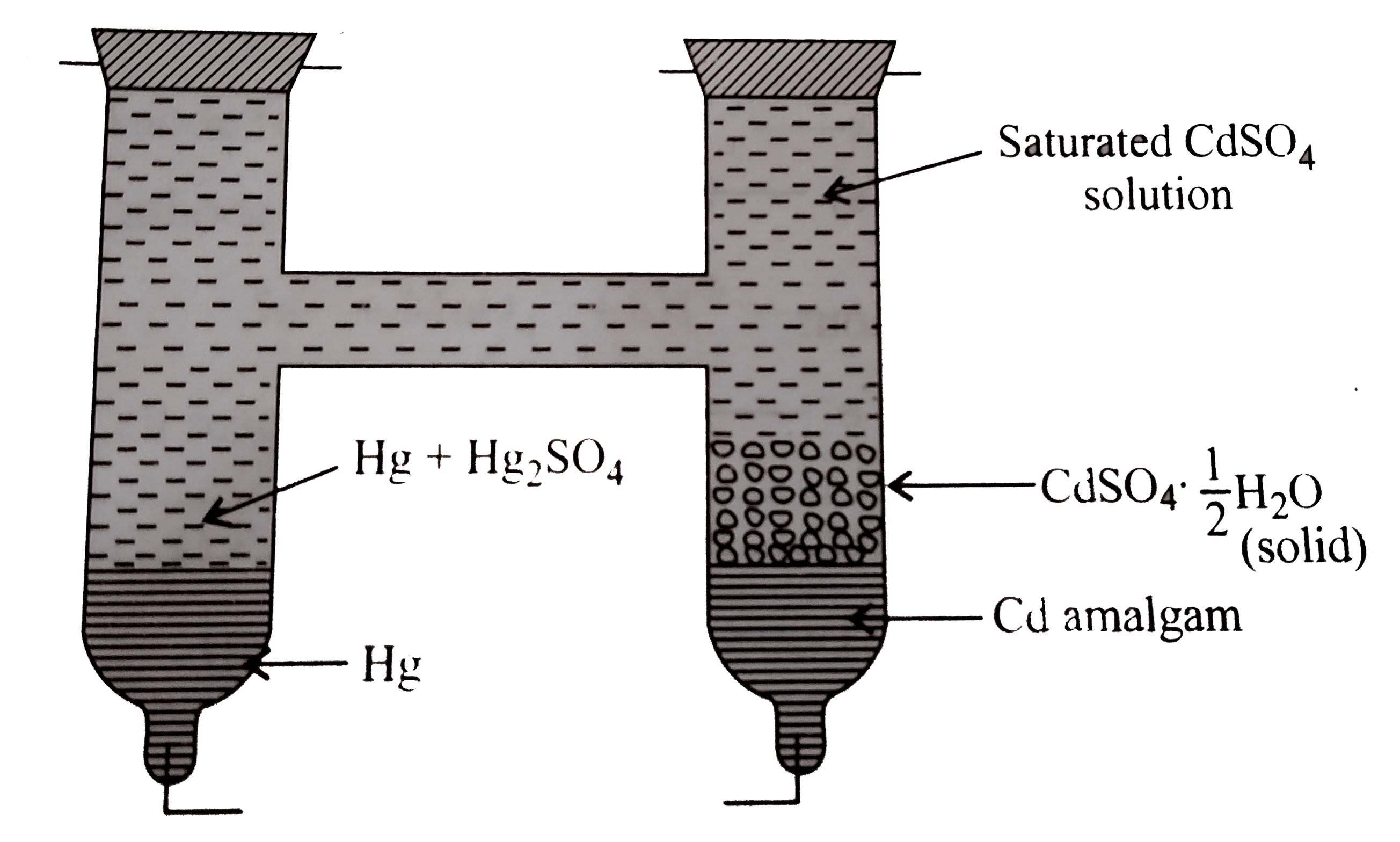 Since the activities of element and solid substance `(Cd-Hg_(2)SO_(4))` and mercury are unity and `[Cd^(2+)]` and `[SO_(4)^(2-)]` in saturated solution are constant and the standard potential of `Cd|Cd^(2+)` and the standard potential of `Hg,Hg_(2)SO_(4)|SO_(4)^(2-)` are also constant, the `E_(cell)` is constant `(=1.0183V)` at `298K`. |
|
| 37. |
Explain the terms with suitable examples : (i) Alcosol (ii) Aerosol (iii) Hydrosol. |
|
Answer» Solution :(i) Alcosol : Colloidal sol, in which alcohol is used as DISPERSION medium is called alcosol. In this sol, dispersion phase is in SOLID FORM. e.g. alcosol of cellulose nitrate made in ethyle alcohol. (ii) Aerosol : Colloidal sol, in which dispersian medium is gaseous and dispersion phase is in solid form is called aerosol. e.g. smoke. (III) Hydrosol : Colloidal sol in which water is used as dispersion medium and disperssion phase is in solid form its KNOWN as hydrosol, e.g. sol of starch, gold sol. |
|
| 38. |
Explain the conversion of acetic acid into methane and ethane in separate steps. |
|
Answer» Solution :Sodium acetate on decarboxylation gives methane . `CH_(3) COOH overset(NAOH)(to) CH_(3) COO^(-) Na^(+) overset(NaOH)underset(CAO)(to) CH_(4) + Na_(2) CO_(3)` Electrolysis of aqueous conc. , sodium acetate gives ethane . `2 CH_(3) COO Na^(+) + 2H_(2) O overset("Electrolysis")(to) CH_(3) - CH_(3) + 2 CO_(2) + 2 NaOH + H_(2)` |
|
| 39. |
Explain the terms with suitable examples : (i) Alcosol (ii) Aerosol and (iii) Hydrosol. |
| Answer» Solution :(i) ALCOSOL. It is a colloidal sol of a solid in ALCOHOL as dispersion medium. (ii) AEROSOL. It is a colloidal sol of a solid in WATER as dispersion medium.(iii) HYDROSOL. It is a colloidal sol of a solid in water as dispersion medium. | |
| 40. |
Explain the terms with suitable examples: Hydrosol |
| Answer» SOLUTION :COLLOIDAL solution of a SOLID in WATER, e.g., STARCH in water. | |
| 41. |
Explain the cleaning action of soap . Why do soaps not work in hard water ? |
|
Answer» SOLUTION :Soap is sodium or potassium slat of a higher FATTY acid and MAY be represented as `RCOO^(-) Na^(+)` e.g., sodium STEARATE `CH_(3)(CH_(2))_(16) COO^(-)Na^(+)` . When dissolved in water , it dissociates into `RCOO^(-)` and `Na^(+)` ions. The `RCOO^(-)` ions , Hard water contains calcium and magnesium salts . In hard water , soaps get precipitated as calcium and magnesium soap which being insolublestick to the clothes as gummy mass . The cleaning action of soap is due to the FACT that soap molecules form micelle around the oil droplets in such a waythat hydrophobic part . |
|
| 42. |
Explain the cleansing actin of soapes. |
Answer» SOLUTION : The cleansing action of SOAPS is due to the fact that soap molecules form MICELLES around the oil droplet in such a way that HYDROPHOBIC part of the stearate ions is in the oil droplet and the hydrophilic part projects out of the grease droplet like the bristles. Since the polar groups can interact with water, the oil droplet surrounded by stearateions is now pulled i n water and removed from the DIRTY surface. |
|
| 43. |
Explain the terms with suitable examples: Aerosol |
| Answer» SOLUTION :COLLOIDAL solution of a LIQUID in a GAS, e.g., FOG. | |
| 44. |
Explain the classification of proteins based on their structure. |
|
Answer» Solution :Proteins are CLASSIFIED based on their structure (overall shape) into two major types. They are fibrous protein and GLOBULAR proteins. (i) Fibrous. proteins : These proteins are LINEAR molecules. These are generally insoluble in water and are held together by disulphide bridges and weak by INTERMOLECULAR hydrogen BONDS. The proteins often used as structural proteins.Example: Keratin, Collagen etc ... (ii) Globular proteins : These proteins have an overall spherical shape. The polypeptide chain is folded into a spherical shape. These proteins are usually soluble in water and have many functions including catalysis. |
|
| 45. |
Explain the classification of hormones. |
|
Answer» Solution :HORMONES are classified according to the distance over which they act as, endocrine, PARACRINE and autocrine hormones. Endocrine hormones act on cells distant from the SITE of their release. ExampJe: insulin and epinephrine are synthesized and RELEASED in the bloodstream by specialized ductless endocrine glands. Paracrine hormones (alternatively, local mediators) act only on cells close to the CELL that released them. For example, interleukin-I (IL-1) Autocrine hormones act on the same cell that released them. For example, protein growth factor interleukin-2 (IL-2). |
|
| 46. |
Explain the terms with suitable examples: Alcosol |
| Answer» SOLUTION :COLLOIDAL system in which a SOLID is dispersed in ALCOHOL. | |
| 47. |
Explain the characteristics of physisorption & chemisorption. |
|
Answer» Solution :(A) Characteristics of Chemical adsorption : (i) Lack of SPECIFICITY : A given surface of an adsorbent does not show any preference for a particular gas as the van der Waals. forces are universal (ii) Nature of adsorbate : The amount of gas adsorbed by a solid depends on the nature of gas. In general, easily liquefiable gases are readily adsorbed as van der Waals. forces are stronger near the critical temperatures. Thus, 1g of activated CHARCOAL adsorbs more sulphur dioxide (critical temperature 630K) than methane (critical temperature 190K) which is still more than 4.5 ml of dihydrogen (critical temperature 33K). (iii) Reversible nature : Physical adsorption of a gas by a solid is generally reversible. Thus, `"Solid"+ "Gas" = "Gas/Solid" +" Heat"` More of gas is adsorbed when pressure is increased as the volume of the gas decreases (Le-Chatelier.s principle) and the gas can be removed by decreasing pressure. Since the adsorption process is exothermic, the physical adsorption occurs readiy at the low temperature and decrease with increasing temperature (Le-Chatelier.s principle). (iv) Surface area of adsorbent : The extent of adsorption increases with the increase of surface area of the absorbent. Thus, finely divided metals and porous substances having large surface areas are good adsorbents. (v) Enthalpy of adsorption : No doubt, physical adsorption is an exothermic process but its enthalpy of adsorption is quite low `(20-40" kJ mol"^(-1))`. This is because the attraction between gas molecules and solid surface is only due to weak van der Waals. forces. Characteristics of chemical adsorption : (i) High specificity : Chemisorption is highly specific and it will only occur if there is some possibility of chemical bonding between adsorbent and adsorbate. For example, oxygen is adsorbed on metals by virtue of oxide formation and hydrogen is adsorbed by transition metals due to hydride formation. (ii) Irreversibility : As chemisorption involves compound formation, it is usually IRREVERSIBLE in nature. Chemisorption is ALSO an exothermic process but the process is very SLOW at low temperature on account of high energy of activation. Like most chemical changes, adsorption often increases with rise of temperature. Physisorption of a gas adsorbed at low temperature may change into chemisorption at a high temperature. Usually high pressure is also favourable for chemi sorption. (iii) Surface area : Like physical adsorption chemisorption also increases with increase of surface area of the adsorbent. (iv) Enthalpy of adsorption : Enthalpy of chemisorption is high `(80-240 kJ mol^(-1))` as it involves chemical bond formation. |
|
| 48. |
Explain the terms with suitable examples: (1) Alcosol (ii) Aerosol and (ii) Hydrosol. |
|
Answer» Solution : (i) Alcosol : It is a colloidal dispersion having alcohol as the dispersion medium, For EXAMPLE, COLLODION. It is a colloidal sol of cellulose nitrate in ETHYL alcohol. (ii) Aerosol : It is a colloidal dispersion of a liquid in a gas. For example, fog (iii) HYDROSOL : It is a colloidal sol of a solid in water as the dispersion medium. For example, starch sol. |
|
| 49. |
Explain the characteristicproperties of hydrogen halides. |
|
Answer» (ii) These hydrides are called hydracids. (III) Hydracidsare the reducing agents. (iv) Except F, all hydrogen HALIDES are gases. HF is a liquid because of INTERMOLECULAR hydrogen bonding. H - F .......... H - F ......... H - F ......... H - F (v) The acidic character of HX are in the following order. `HF LT HCl lt HBr lt HI`. |
|
| 50. |
Explain the terms sorption and desorption . |
|
Answer» Solution :Sorption is used to describe the process when ADSORPTION and ABSORPTION take place simultaneously . Desorption : Removal of adsorbate from the SURFACE of adsorbent . |
|