

Saved Bookmarks
This section includes 7 InterviewSolutions, each offering curated multiple-choice questions to sharpen your Current Affairs knowledge and support exam preparation. Choose a topic below to get started.
| 1. |
Explain the cause of magnetism in a substance. |
|
Answer» Solution : The origin of magnetic properties in a substance is because of two types of MOTIONS of electrons : (i) Orbital motion around the nucleus (ii) Spin motion around its axis  An electron in an atom behaves like a tiny magnet. Electron being charged particle and undergoing these motions can be considered as a small loop of current which possesses a magnetic moment. Each electron thus has a PERMANENT spin and an orbital magnetic moment associated with it. Magnitude of magnetic moment is very small and is measured in the UNIT called Bohr magneton, `(mu_B)` which is EQUAL to `9.27 xx 10^(-24) "Am"^2`. On the basis of their magnetic properties the substances is classified as : (i) Paramagnetic (ii) Diamagnetic (iii) Ferromagnetic (iv) Antiferromagnetic and (v) Ferrimagnetic . |
|
| 2. |
Explain the terms shape selective catalyst, emulsification and dimulsification with one example each. |
|
Answer» |
|
| 3. |
Explain the catalytic hydrogenation of alkene to alkane with equation. |
Answer» Solution :The `sigma` bond in the HYDROGEN molecule breaks, and each hydrogen atom forms a bond with a d electron on an atom in the CATALYST NICKEL. The two hydrogen atoms then bond with the partially broken `pi`-bond in the alkene to FORM an alkane. 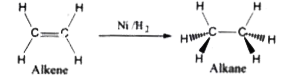
|
|
| 4. |
Explain the buffer action is a basic buffer containing equimolar ammonium hydroxide and ammonium chloride. (ii) Calculate the pH of a buffer solution consisting of 0.4 M CH_3COOH and 0.4 M CH_3COONa. What is the change is the pH after adding 0.01 mol of HCl to 500 ml of the above buffer solution. Assume that the addition of HCl causes negligible change in the volume. |
|
Answer» Solution :Dissociation to buffer components `NH_4OH(aq) leftrightarrow NH_4^+ (aq)+OH^- (aq)` `NH_4Clto NH_4^+ +Cl^-` Addition of `OH^-` The added `H^+` ions are NEUTRALIZED by `NH_4OH` and there is no appreciable DECREASE in pH. `NH_4OH(aq)+H^+ to NH_4^+ (aq)+H_2O(l)` Addition of `NH_4^+ (aq)+OH^- (aq) to NH_4OH(aq)` The added `OH^-` ions react with `NH_4^+` to produce UNIONIZED `NH_4OH`. SInce `NH_4OH` is a weak BASE, there is no appreciable increase in PH. (ii) Ph of buffer `CH_3COOH (aq) leftrightarrow CH_3COO^-(aq)+H^+ (aq)` 0.4-a a a `CH_3COONa(aq) to CH_3COO^- (aq)+Na^+ (aq)` 0.4 0.4 0.4 `[H^+]=(K_s[CH_3COOH])/([CH_3COO^-])` `[CH_3COOH]=0.4-aapprox0.4` `[CH_3COO^-]=0.4+a approx0.4` `therefore[H^+]=(K_s(0.4))/((0.4))` `[H^+]=1.8 times10^-5` `thereforepH=-log(1.8 times10^-5)=4.74` ADDITON of 0.01 molHCl to 500 ml to buffer Added `[H^+]=(0.01mol)/(500mL)=(0.01mol)/(1//2L)` =0.02 M `CH_3COOH(aq) to CH_3COO^- + Na^+` 0.4-a a a `CH_3COON to CH_3COO^(-) +Na^+(aq)` 0.4 0.4 0.4 `CH_3COO^(-)+HCl to CH_3COOH+Cl^-` (0.02) 0.02 0.02 0.02 `therefore[CH_3COOH]=0.4-a+0.02=0.42-a approx 0.42` `[CH_3COO^-]=0.4+a-0.02=0.38+a approx 0.38` `[H^+]=((1.8 times10^-5)(0.42))/((0.38))` `[H^+]=1.99 times10^-5` `pH=-log(1.99 times10^-5)` `=5-log1.99` `=5-0.30` =4.70 |
|
| 5. |
Explain the brown ring test for nitrate ions. |
|
Answer» Solution :The brown ring test for nitrates depends on the ABILITY of `FE^(2+)` to reduce nitrates to nitric oxide (NO) that reacts with `Fe^(2+)` to form a brown ring complex. To a sample CONTAINING `NO_(3)^(-)`ions, a dilute ferrous sulphate solution is added and then concentrated sulphuric acid is added carefully ALONG the SIDES of test tube. A brown ring at the interface between the solution and sulphuric acid layers indicates the presence of nitrate ions in the solution. `NO_(3)^(-) + 3Fe^(2+) + 4H^(+) to NO + Fe^(3+) + 2H_(2)O` `[Fe(H_(2)O)_(6)]^(2+) + NO to underset("Brown complex")([Fe(H_(2)O)_(5).(NO)]^(2+) + H_(2)O)` |
|
| 6. |
Explain the terms polymer and monomer. |
| Answer» Solution :POLYMERS, Monomers : Simple and REACTIVE molecule from which the polymers are prepared either by addition or CONDENSATION are called monomers. FRO EXAMPLE , ethene, vinyl chloride , acrylonitrle, phenol and formaldehyde , etc. | |
| 7. |
Explain the catalytic action of enzymers. |
|
Answer» SOLUTION :For understanding the interaction between a DRUG and an enzyme, it is important to know how do enzymes catalyse the reaction. In their catalytic activity, enzymes perform TWO major functions : (i) The first function of an enzyme is to hold the substrate for a chemical reaction. Active sites of enzymes hold the substrate molecule in a suitable position, so that it can be attacked by the reagent effectively. Substrates bind to the active SITE of the enzyme through a variety of interactions such as ionic bonding, hydrogen bonding, van der Waals interaction or dipole-dipole interaction.  (ii) The second function of an enzyme is to provide FUNCTIONAL groups that will attack the substrate and carry out chemical reaction. |
|
| 8. |
Explain the terms: Physisorption and Chemisorption. How does adsorption of a gas on a solid surface vary with pressure? |
|
Answer» |
|
| 9. |
Explain the bonding in CoCl_(3).5NH_(3). |
|
Answer» Solution :The compound `CoCl_(3).5NH_(3)` can be written as `[Co(NH_(3))_(5)Cl]Cl_(2)`. The complex has five `NH_(3)` ligands and one `Cl^(-)` ligand LINKED by coordinate BONDS. Two `Cl^(-)` in the outer sphere are bonded by IONIC bonds. |
|
| 10. |
Explain the terms Inductive and Electromeric effects. Which electron displacement effect explains the given correct orders of acidity of te carboxylic acids? (1) CI_(3)C COOHgtCI_(2)CHCOOHgtCICH_(2)COOH (2) CH_(3)CH_(2)COOHgt(CH_(3))_(3)CHCOOHgt(CH_(3))_(3)C COOH |
|
Answer» Solution :For explanation of the TERMS, N/A (1) The GIVEN sequence of acidity is explained by - effect of CI - atoms. As the number of chlorine atoms DECREASES, the OVERALL - I effect decreases and the acid strenght decreases accordingly.  The given sequence of acidity is explained by + I effect of alkyl groups. As the extent of + I effect of alkyl groups increases, the acid strenght decreases accordingly. 
|
|
| 11. |
Explain the bleaching action of halogens. |
|
Answer» Solution :(i) Fluorine and iodine do not show bleaching action. (II) Most CHLORINE is a good REDUCING agent while moist bromine BLEACHES SLOWLY. |
|
| 12. |
Explain the terms in the above equation. |
|
Answer» <P> `(x)/m rarr` extent adsorption p`rarr` PRESSURE k`rarr` CONSTANT |
|
| 13. |
Explain the bleaching action of Chlorine . |
|
Answer» `H_(2)O+Cl_(2)rarr HCl+underset("Hypo chlorous acid")(HOCl)` `HOCl rarr HCl +(O)` Colouring MATTER + Nascent oxygen `rarr` Colourless OXIDATION product. The bleaching of chlorine is PERMANENT . It oxidises ferrous salts to ferric, sulphites tosulphates and hydrogen SULPHIDE to sulphur. `2FeCl_(2)+Cl_(2) rarr 2FeCl_(3)` `Cl_(2)+H_(2)O rarr HCl+HOCl` `2FeSO_(4)+H_(2)SO_(4)+HOCl rarr Fe_(2)(SO_(4))_(3)+HCl+H_(2)O` Overall reaction `2FeSO_(4)+H_(2)SO_(4)+Cl_(2) rarr Fe_(2)(SO_(4))_(3)+2HCl` `Cl_(2)+H_(2)O rarr HCl+HOCl` `Na_(2)SO_(3)+HOCl rarr Na_(2)SO_(4)+HCl` Overall reaction `Na_(2)SO_(3)+H_(2)O+Cl_(2) rarr Na_(2)SO_(4)+2HCl` `Cl_(2)+H_(2)S rarr 2HCl +S` |
|
| 14. |
Explain the terms i) Order of a reaction ii) Molecularity of a reaction. |
|
Answer» SOLUTION :i) ORDER of a REACTION: N//A II) MOLECULARITY of a reaction : N//A |
|
| 15. |
Explain the aromatic electrophilic substitution reactions of anisole with equations. Aromatic electrophilic substitution reactions: |
Answer» SOLUTION :(i) HALOGENATION: 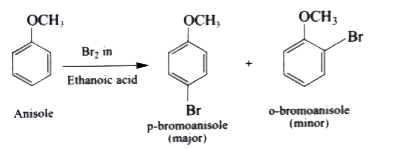 (ii) NITRATION: 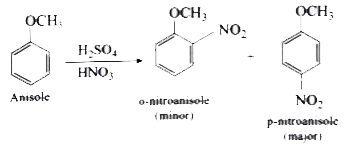 (III) Friedel Craft.s alkylation: 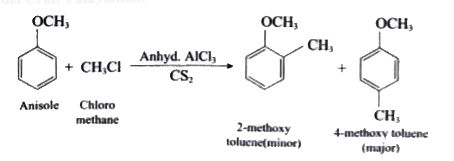 (iv) Fricdel Craft.s acylatiou: 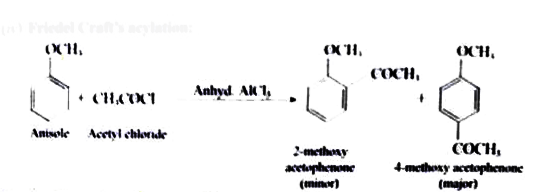
|
|
| 16. |
Explain the terms : (i) Rate determining step of a reaction, (ii) Molecularity of a reaction. |
|
Answer» Solution :(i) Rate determining step of a reaction (RDS) : The SLOWEST step of the complex reaction is called rate determining step. E.g., Thermal decomposition of nitrous oxide Step I : `N_(2)O OVERSET("Slowest step")rarr N_(2) + O` Step II : `N_(2)O + O overset("Fast step")rarr N_(2) + O_(2)` Rate `= K[N_(2)O]` `2N_(2)O rarr 2N_(2) + O_(2)` (ii) Molecularity of reaction : It is the number of reacting species undergoing simultaneous collision in the reaction. it is a theoretical concept. it can not be ZERO. It does not change with change in TEMPERATURE and pressure. |
|
| 17. |
Explain the Arrhenius concept of acid and base with example. |
|
Answer» Solution :(i) According to Arrhenius CONCEPT an acid is a substance that dissociates to given hydrogen IONS in water. For example `HCl_(g) leftrightarrow^(H_2O) H^+ (AQ)+ CL^(-) (aq)` (ii) Similarity a base is the substance that dissociates to given HYDROXYL ions in water For example. `Ca(OH)_2 leftrightarrow^(H_2O) Ca^(2+) (aq) +2OH^(-) (aq)` |
|
| 18. |
Explain the terms (i) Diamagnetism (ii) Ferromagnetism (iii) Ferrimagnetism. |
|
Answer» Solution :(i) Diamagnetism. This property is caused by an induced magnetic field of orbital electron. Such material are repelled by the magnetic fields. As a result, all electrons get PAIRED up in the substance e.g. `Zn, NaCl, N_(2), H_(7)`, etc. (ii) Ferromagnetism is the property associated with those substances which are strongly attracted by the magnetic field and show permanent magnetism even if the magnetic field is REMOVED. It arises due to alignment of the magnetic moments due to the unpaired electrons. For example, iron, cobalt, `CrO_(2)` etc. (iii) Ferrimagnetism is the property caused by the particles or inter-penetrating lattice with unequal number of electrons and with antiparallel spins. As a result, there is a net DIPOLE moment. For example, `Fe_(3)O_(4)` and ferrites of FORMULA, `M^(2+) Fe_(2)O_(4)`. (M = Mg, Cu, Zn etc.) |
|
| 19. |
Explain the terms : (i) CMC, (ii) Kraft temperature (T_(k)). |
| Answer» Solution :CMC: CONCENTRATION above which micelle FORMATION TOOK place.Kraft Temperature : It is the temperature above the micelle formation took place. | |
| 20. |
Explain the amphoteric behavior of amino acid. |
|
Answer» Solution :`NH_2-CH_2-COOH` Amino acids contains both-COOH groups and `-NH_2` GROUP. In AQUEOUS solution it exists as Zwritter ION `H_3N^+ -CH_2 -COO^-` `THEREFORE` Amphoteric. |
|
| 21. |
Explain the terms dialysis and Tyndall effect. |
| Answer» | |
| 22. |
Explain the application of adsorption in qualitative analysis with an example. |
|
Answer» SOLUTION :• In the identification of `Al^(3+)` ion in `Al(OH)_(3)`is obtained as blue lake. Due to adsorption of blue litmus solution added to the aluminium ion solution. • A red COLOURATION is seen due to the acidic NATURE of the solution. Ammonium hydroxide is added to it until the blue COLOUR develops. During this addition, `Al(OH)_(3)`precipitate is formed with blue colour due to the adsorption of litmus compound. |
|
| 23. |
Explain the term tranquillizer . Examples :Equanil, valium, veronal, meprobamate, serotonin, etc. are mild tranquillizers. underset("Equanil")({:(""CH_(3)),("|"),(H_(2)N-C-O-CH_(2)-C-CH_(2)-O-C-NH_(2)),("|||||"),(""O ""CH_(3)""O):}) |
|
Answer» Solution :The CHEMICAL substance used to relieve or REDUCE the stress and anxiety leading to calmness is called tranquillizer. Examples : Equanil, VALIUM, varonal, meprobamate, serotonin, etc. are mild `UNDERSET("Equanil")(H_(2)N-underset(O)underset("||")(C )-O-CH_(2)-overset(CH_(3))overset("|")underset(CH_(3))underset("|")("C ")-CH_(2)-O-underset(O)underset("||")(C )-NH_(2))` |
|
| 24. |
Explain the alpha- halogenation take place in acetic acid. (or) Explain Hell-Volhard-zelinsky reaction (HVZ reaction)? |
|
Answer» Solution :`underset(" Acetic ACID")(CH_3 - COOH) underset(H_2O)overset(Cl_2//RED P_4)(to) underset (alpha -" Chloro ethanoic acid")( undersetoverset(|)(Cl)(C ) H_2 - COOH)` Carboxylic ACIDS having an `alpha` - hydrogen are halogenated at the `alpha` - position on TREATMENT with chlorine or bromine in the presence of small amount of red PHOSPHORUS to form `alpha` - halo carboxylic acids. This reaction is known as Hell – Volhard – Zelinsky reaction (HVZ reaction) |
|
| 25. |
Explain the terms : (a) Antiseptics(b) Analgesics |
|
Answer» Solution :(a) An tiseptics : The drugs which are APPLIED to the living tissues to kill the basteria and to stop their group inside the human vody are called antiseptics Example : Dettol , PHENOL , Boricacid , Iodo forms ETC. (B ) Analegesic : Analgesics are the drugs which without loss of consciousness or disturbance of nervoussystem are called analgesics . Example : Naproxen , NOVALGIN , Aspirin and Analgins etc. |
|
| 26. |
Explain the anomalous behaviour of oxygen. |
|
Answer» Solution :Oxygen is the first element of group 16. Reasons for anomalous behaviour of oxygen: (i) It has small size. (ii) It has high electronegativity (3.5). (iii) It does not have vacant d-orbitals like other ELEMENTS in group 16. Oxygen shows following anomalous behaviour : (i) PHYSICAL state : Oxygen is a gas while other elenments in the group are solids at ordinary temperature. (ii) Atomicity : Oxygen exists as a diatomic molecule `O_(2)`, while other elements are polyatomic molecules like `S_(8), Se_(8)`, and bu puckered ring structure. (iii) Magnetic behaviour: (Oct. '14) Molecular oxygen `O_(2)` is paramagnetic while other elements are diamagmetic. Molecular `O_(2)` hastwo unpairedelectrons in theantibondding molecularorbital. (iv)Oxidation states : (Oct. '14) Oxygen shows oxidation state-2 in oxides, - 1 in peroxides while +2 in oxygen difluoride, `OF_(2)`. Since it does not have vacant d-orbital it doesn't show higher oxidation states while other elements of group 16 show +2, +4 and +6 oxidation states. (V)Hydrogen BONDING : Since oxygen has high electronegativity (3.5), it FORMS hydrogen bonding in its compounds like H,0, alcohols, etc. Other elements in the group do not show this property. (vi) Hydrides : (Oct. '14) The hydride of oxygen, `H_(2),O_(2)`. is a liquid while the hydrides of all other elements in group 16 are gases. |
|
| 27. |
Explain the advantages of using nano catalyst. |
| Answer» Solution :(i) Nano materials such a metallic nano PARTICLES, metal oxides, ETC., are used as catalyst in many chemical transformation. Nanocatalysts carry the ADVANTAGES of both homogeneous and heterogeneous catalyses. LIKE homogeneous CATALYSTS, the nanocatalysts give 100% selective transformations and excellent yield and show extremely high activity. (iii) Like the heterogeneous catalysts, nanocatalysts can be recovered and recycled. | |
| 28. |
Explain the term thermosetting plastics and give two examples. |
| Answer» Solution :Thermosetting plastics are the plastics which on heating in a mould, become infusible and FORM an insoluble hard mass DUE to extensive cross-linking between different CHAINS FORMING three-dimensional network of bonds and cannot be softened again. Hence, they cannot be used again and again. Two common examples of thermosetting plastics are BAKELITE and terylene. | |
| 29. |
Explain the adsorption theory of Heteroge neous catalysis. |
|
Answer» Solution :This theory explains the mechanism of heterogeneous catalysis. The old theory, known as adsorption theory of catalysis was that the reactants in gaseous STATE or in solutions are adsorbed on the surface of the solid catalyst. The increase in concentration of the reactants on the surface increases the rate of reaction. Adsorption being an EXOTHERMIC process the heat of adsorption is utilised in enhancing the rate of the reaction. The modern adsorption theory is the combination of intermediate compound formation theory and the old adsorption theory. The catalytic activity is LOCALISED on the surface of the catalyst. The mechanism involves five steps: (i) Diffusion of reactants to the surface of the catalyst. (ii) Adsorption of reactant molecules on the surface of the catalyst. (iii) Occurrence of chemical reaction on the catalyst.s surface through formation of an intermediate. (iv) Desorption of reaction products from the catalyst surface, and thereby, making the surface available again for more reaction to occur. (v) Diffusion of reaction products away from the catalyst.s surface. The surface of the catalyst unlike the inner part of the bulk has free valencies which provide the seat for chemical forces of attraction. When a gas comes in contact with such a surface, its molecules are held up there due to loose chemical combination. If different molecules are adsorbed side by side, they may react with each other resulting in the formation of new molecules. Thus, formed molecules may evaporate leaving the surface for the fresh reactant molecules.  This theory explains why the catalyst remain unchanged in mass and chemical composition at the end of the reaction and is effective EVEN in small quantities. However, it does not EXPLAIN the action of catalytic promoters and catalytic poisons. |
|
| 30. |
Explain the term, 'target molecules or drug targets' as used in medicinal chemistry. Name any two macromolecules that are chosen as drug targets. |
|
Answer» Solution :Receptors ACT as target molecules or drug targets. Receptors are PROTEINS that are crucial to body.s communication process. RECEPTOR proteins are embeded in the cell membrane in such a way that their small part possessing active site projects out of the SURFACE of the membrane. DRUGS act within the cell by modifying normal biochemical reactions. e.g., Proteins, Nucleic acids. |
|
| 31. |
Explain the addition reactions of alkyl isocyanide with (i) halogen (ii) sulphur (iii) ozone. |
Answer» Solution :(i) `R-N-=C+X_(2)to`  (ii) `R-N-=C+Sto underset("ALKYL isothiocyanate")(R-overset(..)(N)=C=S)` (III) `R-N-=C+O_(3)overset(2HgO)(to) underset("Alkyl ISOCYANATE")(R-overset(..)(N)=C=O)+Hg_(2)O` |
|
| 32. |
Give an example for heterogeneous catalysis. |
|
Answer» Solution :REACTANT molecules adsorb on the surface of the CATALYST, there by increasing the concentration of the VARIOUS reactant molecules on the surface of the catalyst. * Adsorption being exothermic process, the heat of adsorption is utilised in enhancing the rate of the REACTION. * Occurane of chemical reaction on the catalyst's surface through the formation of an intermediate between catalyst and REACTANTS. * Desorption of reaction products from the catalyst surface and thereby making the surface available again for more reaction to occur. |
|
| 33. |
Explain the addition of ammonia and its derivatives with aldehydes and ketones. |
Answer» Solution :Nucleophiles such as ammonia and its DERIVATIVES `H_(2)N-Z` add to carbonyl group of ALDEHYDES and KETONES in presence of acid to from intermediate which undergoes dehydration to form 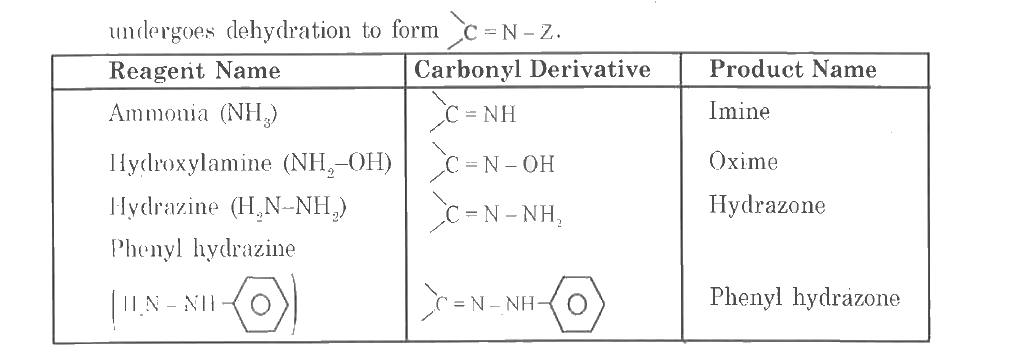
|
|
| 34. |
Explain the term, target molecules or drug targets as used in medicinal chemistry. |
| Answer» SOLUTION :DRUGS usually interact with biomolecules such as carbohydrates, lipids, proteins and nucleic acids. These are called target molecules or DRUG targets. | |
| 35. |
Explain the action of tin and hydrochloric acid with ethyl nitrite. |
|
Answer» Solution :Ethyl nitrite on REDUCTION with Sn/HCl gives ETHANOL `CH_(3)-CH_(2)-O-N=O UNDERSET (6[H])overset(Sn//HCl)(to) underset("Ethanol")(CH_(3)-CH_(2)OH)+NH_(3)uarr+H_(2)O` |
|
| 36. |
Explain the term physisorption and chemisorption. How do they differ ? |
| Answer» | |
| 37. |
Explain the action of the following reagents with acetic acid. (i) PCl_5 (ii) SOCl_2 |
|
Answer» SOLUTION :(i) `UNDERSET("ACETIC acid")(CH_3COOH) + PCl_5 to underset("acetyl chloride")(CH_3COCl) + POCl_3 + HCl ` (ii) `underset("acetic acid")(CH_3COOH) + SOCl_5 to underset("acetyl chloride")(CH_3COCl) + SO_2 uarr + HCl uarr ` |
|
| 38. |
Explain the action of the following reagents with acetyl chloride?(i) Pd//BaSO_4(ii) LiAlH_4 |
Answer» SOLUTION :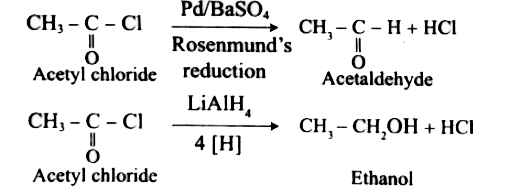
|
|
| 39. |
Explain the term ozonolysis with an example. |
Answer» SOLUTION :The reaction between an alkene and ozone results in the formation of ozonide which upon reduction GIVES the formation of carbonyl COMPOUND. Such a reaction is called ozonolysis. Analysing the final carbonyl products the position of double bond in an alkene can be established. For EXAMPLE : Ethylene on ozonolysis, FOLLOWED by the reduction gives formaldehyde. 
|
|
| 40. |
Explain the action of sodium amalgum and ethanol with Methyl Isoeyanide. |
| Answer» Solution :`UNDERSET("Methyl isocyanide")(CH_(3)-NC)underset(4[H])overset(Na(Hg)//C_(2)H_(5)OH)(to)underset("N-methyl METHANAMINE")(CH_(3)-underset(H)underset(|)(N)-CH_(3))` | |
| 41. |
Explain theterm mutarotation givingan example . |
| Answer» Solution :The spontaneouschangein SPECIFIC rotation whenan opticallyactive substanceis dissolved INWATER in calledmutarotation . Forexmaple, when`alpha` - glucoseis dissolvedin waterits specific rotation changes becausesome ofitgetsconverted into `beta` - glcose. The TWO forms possess differentspecific ION. | |
| 42. |
Explain the action of sodalime with sodium acetate. Name the type of reaction involved in it |
|
Answer» Solution :When SODIUM acetate is treated with sodalime, methane is formed. `underset("sodium acetate")(CH_3COONa) + NaOH OVERSET(CAO)(to) underset("methane")(CH_4 + Na_2CO_3)` Methane Removal of `CO_2`from carboxyl group TAKE PLACE in it and this is called decarboxylation |
|
| 43. |
PARTS PER MILLION |
|
Answer» Solution :(1) Parts PER million is the mass or volume of a solute in gram or `cm^(3)` per `10^(6)` gram or `10^(6)cm^(3)` of the solution. Parts per million (ppm) `=("mass (or Volume ) or a solute "xx10^(6))/("TOTAL mass (or total volume) of the solution")` (2) CONCENTRATION in ppm can also be expressed as mass of mass, volume to volume and mass to volume. |
|
| 44. |
Explain the action of SnCl_(2) and HCl with benzene diazonium chloride. |
| Answer» Solution :`underset("Benzene DIAZONIUM chloride")(C_(6)H_(5)N_(2)^(+)Cl^(-))underset(4[H])overset(SCl_(2)//HCL)(to) underset("Phenyl hydrazine")(C_(6)H_(5)overset(..)(N)H-overset(..)(N)H_(2))+HCl` | |
| 45. |
Explain the action of PCl_(5) on acetic acid. |
|
Answer» Solution :Action of `PCl_(5)` :Acetic acid reacts with PHOSPHORUS pentachloride to give ACETYL chloride. `UNDERSET("acetic acid")(CH_(3)-OVERSET(O)overset("||")C-OH)+PCl_(5) to underset("acetyl chloride")(CH_(3)-overset(O)overset("||")C-Cl)+POCl_(3)+HCl` |
|
| 46. |
Explain the term invert sugar. |
|
Answer» |
|
| 47. |
Explain the action of nitrous acid with trimehyl amine. |
|
Answer» Solution :Aliphatic tertiary amine reacts with NITROUS ACID to form triakyl ammonium nitrite salt, which in solutble WATER `underset("trimethylamine")((CH_(3))_(3)N)+HNO_(3)tounderset("Trimethyl ammonium nitrite")([CH_(3))_(3)overset(+)(N)H]NO_(2)^(-)` |
|
| 48. |
Explain the action of P_2O_5, with acetamide with equation. |
| Answer» Solution :`UNDERSET("acetamide")(CH_3-undersetoverset(||)(O)(C ) - NH_2) underset("dehydration")OVERSET(P_2O_5)(to) underset("ACETO nitrileor methyl cyanide")(CH_3 - C -= N) + H_2O` | |
| 49. |
Explain the term dialysis with a suitable example. |
| Answer» SOLUTION :It is the process by which colloidal solution CONTAINING ionic impurities is purified USING SEMIPERMEABLE membrane which allows the passage of ions but not colloidal particles. For example, if egg albumin sol is mixed with sodium CHLORIDE solution, `Na^(+)` and `Cl^(-)` ions will pass through semipermeable membrane whereas pure colloidal solution will be obtained. | |
| 50. |
Explain the action of ozone with 2-methyl but - 2 - ene followed by hydrolysis with zinc? |
Answer» SOLUTION :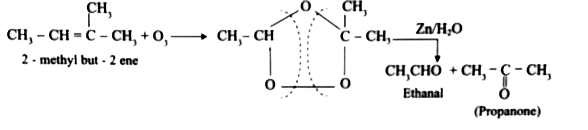
|
|