

Saved Bookmarks
This section includes 7 InterviewSolutions, each offering curated multiple-choice questions to sharpen your Current Affairs knowledge and support exam preparation. Choose a topic below to get started.
| 1. |
Explain van't Hoff factor. |
|
Answer» Solution :Van.t HOFF introduced a factor i, known as the van.t Hoff factor, to account for the extent of dissociation or association. This factor i is defined as : `i=("Normal molar mass")/("Abnormal molar mass")` `=("Observed colligative property")/("Calculated colligative property")` `i=("Total number of moles of particles after association / dissociation")/("Number of molar of particles before asociation / dissociation")` Here abnormal molar mass is the experimentally determined molar mass and calculated colligative properties are obtained by assuming that the non - volatile solute is neither associated nor dissociated. In case of association, value of i is less than UNITY while for dissociation it is greater than unity, while when no association / dissociation, then i = 1 For example, the value of i for aqueous KCl solution is close to 2, while the value for ethanoic acid in benzene is nearly 0.5. Inclusion of van.t Hoff factor modifies the EQUATIONS for colligative properties as follows : `(P_(1)^(0)-P_(1))/(P_(1)^(0))=i(n_(2))/(n_(1))` Relative lowering of vapour pressure of solvent, Elevation of Boiling point, `Delta T_(b)=i K_(b)m` Depression of FREEZING point, `Delta T_(f)=i K_(f)m` Osmotic pressure of solution, `pi = iCRT = i((N)/(V))RT` 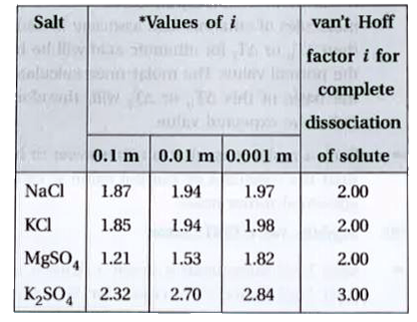
|
|
| 2. |
Explain vapour phase refining. |
|
Answer» Solution :In this method, the metal is converted into its volatile compound which is collected and decomposed to give pure metal. Thus, two requirements are: (i) The metal should form a volatile compound with an available reagent. (ii) The volatile compound should be easily decomposable, so that the recovery is easy. Following examples will illustrate this technique : (a) Mond.s Process for Refining NICKEL : In this process, nickel is heated in a stream of carbon monoxide forming a volatile complex NAMED as nickel tetracarbonyl. This complex is decomposed at higher temperature to obtain pure metal. `underset(("Impure"))(N i) + 4CO overset(330 - 350 K)(rarr) N i(CO)_(4)` `N i (CO)_(4) overset(450 - 470K)(rarr) underset("(Pure)")(N i) + 4CO` (b) Van Arkel Method for Refining Zirconium or Titanium : This method is very useful for removing all the oxygen and NITROGEN present in the form of impurity in certain metals like Zr and Ti. The CRUDE metal is heated in an evacuated vessel with iodine. The metal iodide being more covalent, volatilises: `underset("(impure)")(Zr) + 2I_2 to ZrI_4` The metal iodide is decomposed on a TUNGSTEN filament, electrically heated to about 1800 K. The pure metal deposits on the filament. `underset("(pure)")(ZrI_4 to Zr + 2I_2). ` |
|
| 3. |
Explain the factors favouring S_(N)2 reaction. |
|
Answer» Solution :The `S_(N)2` reaction requires the approach of the nuclephile to the carbon bearing the leaving group, and the presence of bulky substituents on or near the carbon atom retards the attack of nuclephile. THUS, the methyl halides react more RAPIDLY in `S_(N)2` reactions because there are only three small hydrogen atoms. Tertiary halides are the least reactive because bulky groups hinder the approach of nucleophiles. Thus, order of reactivity is 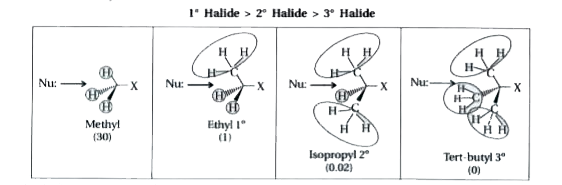 The `S_(N)2` reaction is also favoured by strong nucleophiles and POLAR aprotic solvents such as acetone, dimethylsulpoxide (DMSO) etc. Also the presence of strong electron withdrawing group FAVOURS `S_(N)2`. |
|
| 4. |
What is vulcanisation of rubber? |
| Answer» Solution :HEATING a mixture of RAW rubber with sulphur and on ADDITIVE at 373K - 415K TOMAKE it hard is called vulcanization. | |
| 5. |
Explain the factors affecting the stability of the coordination compounds. |
|
Answer» Solution :The stability of a coordination compound depends upon the FOLLOWING factors : (1) Charge density of the central metal ION : (i) The charge density is a ratio of the magnitude of the charge and the radius of the metal ion. (ii) Higher the charge density greater is the stability of the complex. (iii) For example the ionic radii of divalent ions `Cu^(2+) and Cd^(2+)` are 69 pm and 97 pm respectively hence charge density of `Cu^(2+)` ion is higher than that of `Cd^(2+)`. Therefore the complex `[Cu(NH_(3))_(4)]^(2+)` is more ions is, `Cd^(2+) LT Mn^(2+)ltFe^(2+)ltCo^(2+)ltNi^(2+)lt Cu^(2+)` (2) Nature of ligands : The ligands are Lewis bases since they donate pairs of electrons to the central metal ion in the complex forming coordinate bonds. Hence greater the basic strength of the ligands more is the tendency to donate electrons hence greater is the stability of the complex. For example, `CN^(-)` is more basic than `NH_(3)`. Hence cyano complexes of a metal ion are more stable than its ammine complexes. |
|
| 6. |
Explain vacancy and interstitial defects. |
Answer» SOLUTION :(i) VACANCY Defect : When some of the lattice sites are vacant, the crystal is said to have vacancy defect. This results in DECREASE in density of substance.  The density of the crystal can also be decreased by HEATING. (ii) Interstitial Defect : When some of the atoms or molecules OCCUPY an interstitial site, the crystal is said to have interstitial defects. The density of crystal increases by this defect. 
|
|
| 7. |
Explain the factors affecting S_(N)1 reaction. |
Answer» Solution :In a `S_(N)1` reaction, the carbocation is an intermediate product. Thus, greater is the stability of carbocation, faster is the reaction rate. In case of alkyl halides, `3^(@)` alkyl halides undergo `S_(N)1` reaction very fast because it will form high stable `3^(@)` carbocations. 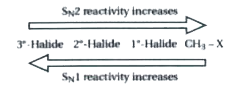 For the same reasons, ALLYLIC and benzylic halides show high reactivity towards the `S_(N)1` as they are stabilised by resonance. 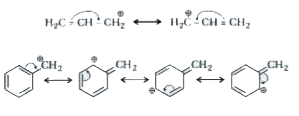 The presence of polar PROTIC solvents such as `H_(2)O, CH_(3)OH, CH_(3)COOH` etc. FAVOURS the ionisation of C - X bond and thus favours the `S_(N)1` reaction. `S_(N)1` reaction is favoured by a weak nucleophile. The presence of any +Mgroup favours the `S_(N)1` reaction because it will stabilise the carbocation. |
|
| 8. |
Explain % V/V in brief. |
|
Answer» Solution :The VOLUME of solute (mL) dissolved in 100 mL solution, is expressed as volume percentange (% V/V). Volume % of a component `= ("Volume of the component" xx 100)/("TOTAL volume of solution")` For example, 10% ethanol solution in water means that 10 mL of ethanol is dissolved in water such that the total volume of the solution is 100 mL. Solutions containing liquids are commonly expressed in this unit. For example, a 35% (V/V) solution of ethylene glycol, an antifreeze, is used in CARS for cooling the engine. At this concentration the antifreeze lowers the FREEZING point of water to 255.4 K `(-17.6^(@)C)`. |
|
| 9. |
Explain the factors affecting adsorption. |
|
Answer» SOLUTION : Factors affecting ADSORPTION : The adsorption is well understood by considering the various factors affecting it. Qualitatively, the extent of surface adsorption depends on (i) Nature of adsorbent (II) Nature of adsorbate (iii) Pressure (iv) Concentration at a given temperature. (i) Surface area of adsorbent : As the adsorption is a surface phenomenon it depends on the surface area of adsorbent. i.e., higher the surface area, higher is the amount adsorbed. (ii) Nature of adsorbate : The nature of adsorbate can influence the adsorption. Gases LIKE `SO_2, NH_3, HCl "and" CO_2`are easily liquefiable as have greater vanderwaal's force of attraction. On the other hand, permanent gases like `H_2, N_2 "and" O_2`cannot be liquefied easily. These permanent gases are having low critical temperature and adsorbed slowly, while gases with high critical temperature are adsorbed readily. (iii) Effect of temperature : chemical adsorption is fast with increase pressure, it cannot alter the amount. In Physisorption, when pressure increases the amount of adsorption increases. (iv) Effect of pressure : When pressure increases, adsorption becomes steadily increase in case of chemisorption and increases in case of physisorption. |
|
| 10. |
Explain types of solution on the basis of physical states of solute and solvent with suitable examples. |
Answer» SOLUTION :Homogeneous MIXTURE of two or more SUBSTANCE is CALLED solution.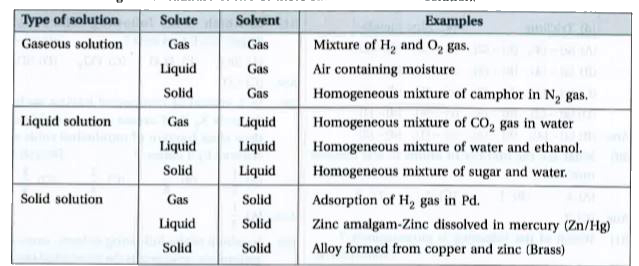
|
|
| 11. |
Explain types of soaps. |
|
Answer» Solution :Basically all soaps are made by boiling fats or oils with suitable soluble hydroxide. Variations are made by using different raw materials. (i) Toilet soaps : These are prepared by using BETTER grades of fats and oils and care is taken to remove excess alkali. Colour and perfumes are ADDED to make these more attractive. (II) Soaps that float in water : These are made by beating tiny air bubbles before their hardening. (iii) Transparent soaps : These are made by dissolving the soap in ethanol and then evaporating the excess SOLVENT. (iv) Medicated soaps : In this soaps, SUBSTANCES of medicinal value are added. In some soaps, deodorants are added. (v) Shaving soaps : Shaving soaps contain glycerol to prevent rapid drying. A gum called, rosin is added while making them. It forms sodium rosinate which lathers well. (vi) Laundry soaps : It contain fillers like sodium rosinate, sodium silicate, borax and sodium carbonate. (vii) Soap chips : Soap chips are made by running a thin sheet of melted soap onto a cool cylinder and scraping off the soaps in small broken pieces. (viii) Soap granules : Soap granules are dried miniature soap bubbles. Soap powders and scouring soaps contain some soap, a scouring agent (abrasive) such as powdered pumice or finely divided sand, and builders like sodium carbonate and trisodium phosphate. Builders make the soaps act more rapidly. |
|
| 12. |
Explain the fact that in aryl alkyl ethers (i) the alkoxy group activates the benzene ring towards electrophilic substitution and (ii) it directs the incoming substituents to ortho and para positions in benzene ring. |
Answer» Solution : From the above structures , it is confirmed that the presence of -OR (alkoxy) group increase the ELECTRON density on the benzene ring at ortho and para POSITIONS which is OBSERVED in strucutres (II), (III) and (IV) , THUS, alkoxy group is ortho-and para-director. As a result the electrophiles (electron deficient species) easily gets attacted to ortho-and para-positions because of high electron density. |
|
| 13. |
Explain types of molecular solids. |
|
Answer» Solution : (i) Polar molecular solids : In these type of solids, the constituent particles are polar COVALENT molecules. Molecules are held together by relatively stronger dipole-dipole forces. These solids have melting points higher than non polar molecular solids however they exists as gas or LIQUID at room temperature and PRESSURE. EX. : Solid `SO_2`, solid HCl, solid `NH_3` etc. (ii) Non-polar molecular solids : In these type of solids, the constituent particles are non-polar covalent molecules or either atoms such as argon, helium etc. In these solids, the atoms or molecules are held by weak dispersion forces or London forces. These solids are soft and non-conductors of electricity and have low melting points. They exists as liquid or in gaseous state at room temperature. Ex. : Naphthalene, `H_2, Cl_2, I_2` etc. (iii) Hydrogen bonded molecular solids : In these type of solids, the molecules are held together by hydrogen bonds (H-bonds) i.e. a polar covalent BOND exist between hydrogen and atoms such as fluorine, oxygen or nitrogen. These solids are non-conductors of electricity and are generally are volatile liquids or soft solids under room temperature and pressure. Ex. : Ice. |
|
| 14. |
Explain the fact that in aryl alkyl ethers (i) the alkoxy group activates the benzene ringtowards electrophilic substitution and (ii) it directs the incoming substituents to ortho and para position in benzene ring. |
Answer» Solution :The alkoxy group INCREASES the ELECTRON density on the benzene ring and THEREFORE, activates the aromatic ring towards electrophilic substitution REACTION as given ahead :  As is clear, structures III, IV and V show high electron density at ortho and para positions and therefore, direct the incoming substituents to o - and p - POSITION in the benzene ring. |
|
| 15. |
Explain the fact that in ary alkyl ethers (i) the alkoxy group activates the benzene ring towards electrophilic substitution and (ii) it direct the incoming substituents to ortho - and para - positions in benzene ring. |
Answer» Solution :Pairs of ELECTRONS on oxygen are donated to the bezene ring and this is stabilised by resonance STRUCTURES I to V. ORTHO- and para - positions are negative and the INCOMING substituents are attached at these positions. 
|
|
| 16. |
Explain Tyndall effect. |
Answer» Solution :When a strong beam of LIGHT is passed through a true solution placed in a BEAKER, in a dark room, the path of the light does not become visible. However, if the light is passed through a sol, placed in the same room, the path of the light becomes visible when VIEWED from a direction at RIGHT angle to that of the incident beam. 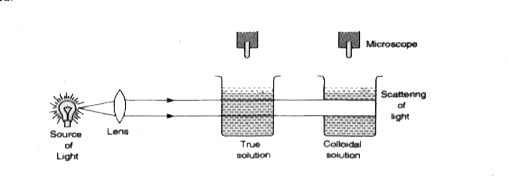 This PHENOMENON was studied for the first time by Tyndall and therefore, it is called Tyndall effect. The Tyndall effect is due to the scattering of light by colloidal particles i.e., these particles first absorb the incident and then a part of it gets scattered by them. Since the intensity of the scattered light is at right angles to the plane of the incident light, the path becomes visible only when seen in that direction. On the other hand, the particles in true solution are too small in size to cause any scattering and therefore, the Tyndall effect is not observed in true solution. |
|
| 17. |
Explain the extraction of zinc from zinc oxide or from zinc blende (ZnS). |
|
Answer» Solution :The reduction of ZnO is done using coke. The oxide is made into brickettes with coke and clay for the effective heating. This is heated to 1673K. ZINC oxide is REDUCED to zinc. `ZnO+CrarrZn+CO` The vapours of zinc SOLIDIFIED by passing through air COOLED condensers. The zinc obtained contains impurities like Cd, Pb and Fe which is called spelter. Zinc is purified by fractional distillation and then by electrolytic REFINING. |
|
| 18. |
Explain trends in M^(2+)//M standard electrode potentials |
|
Answer» Solution :The stability of `M^(2+)` ions in aqueous medium depends on three factors: (i) Enthalpy of atomisation (ii) Summation of first and SECOND ionization enthalpies (iii) Hydration enthalpy An elements in `Mn^(2+)` state in aqueous medium is more stabler if the electrode potential `(M^(2+)//M)` value of more negative. Across the period, the tendency to FORM `M^(2+)` ION decreases. Except copper, all elements of first transition series show negative values of electrode potentials. The exceptional behaviour of the copper due to low enthalpy of atomisation and very high summation of first and second ionization enthalpies which is not compensated by its hydration enthalpy `(Cu^(2+)`. Because of positive electrode potential, copper doesnot liberate hydrogen gas from dilute acids and reacts only with oxidizing acids such as nitric acid and hot concentrated SULPHURIC acid. The electrode potentials of Mn, Ni and Zn are more negative than expected. However, the electrode potential values of Mn and Zn are lowered because of low second ionization enthalpies while Ni has exceptionally more negative electrode potential due to its high hydration enthalpy.  Across the period `M^(2+)//M` value decreases because of INCREASE in first and second ionization enthalpies |
|
| 19. |
In the reaction of gold with aquaregia, oxidation state of Nitrogen changes from |
|
Answer» Solution :Gold ores are leached with sodium cyanide solution in presence of air. Due to oxidation gold DISSOLVES in sodium cyanide FORMING COMPLEX. `8NaCN + 4Au + 2H_(2)O + O_(2) rarr 4Na[Au(CN)_(2)] + 4NaOH` The metal is recovered by displacement METHOD by adding zinc. `2Na[Au(CN)_(2)] + Zn rarr Na_(2)[Zn(CN)_(2)] + 2Au`. |
|
| 20. |
Explain Transition state selectivity |
| Answer» Solution :Transition state selectivity : If the transition state of a REACTION is LARGE compared to the PORE size of the ZEOLITE, then no PRODUCT will be formed. | |
| 21. |
What is the role of lime stone in the extraction of iron from the concentrated hematite ore ? |
|
Answer» Solution :Concentration ore is mixed with lime stone and coke, and fed into blast furnace. Coke acts as fuel, CO formed from it acts as reducing agent and lime stone acts as flux. Reactions in the blast furnance. (i) Zone of COMBINATION : Hot air is blown from the bottom of the furnance coke burns to give `CO_(2)` temperature rises to 2200 K. `C + O_(2) rarr CO_(2)` The `CO_(2)` reacts wwith OVERLYING coke to from CO. `CO_(2) + C rarr 2CO`. (ii) Zone of reduction : In the upper PART of the furnance where the temperaturerange is 500 K to 800 K CO reduces iron oxides to iron. `Fe_(2)O_(3) + 3CO rarr 2Fe + 3CO_(2)` (iii) Zone of slag formation : In the middle part of the furnance where the temperature range is 800 K to 1000 K limestone decomposes to CaO, which removes silicate impurity to FORM slag. `CaCO_(3) rarr CaO + CO_(2)` `CaO + SiO_(2) rarr CaSiO_(3)`. 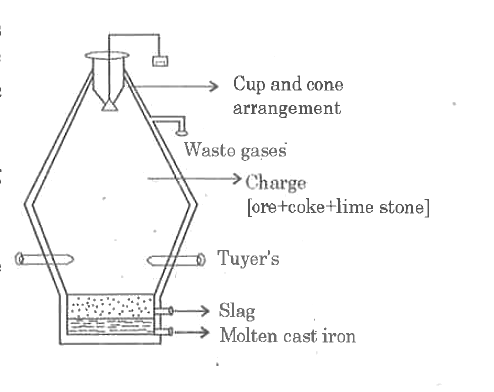
|
|
| 22. |
Explain : Transition metals have high melting and boiling points. |
| Answer» SOLUTION :The melting and BOILING points of transition metals are high. The high melting and boiling points suggest that the atoms of these ELEMENTS are held together by strong forces. This is DUE to the strong interactions of electrons in the partially filled d-sub-shells. In general, larger the number of unpaired d-electrons, stronger is the bonding between the atoms. Due to stronger binding forces, enthalpies of ATOMISATION are also large. | |
| 23. |
Explain the extraction of iron from haematite. |
|
Answer» <P> Solution :Haematite ore `Fe_(2)O_(3)`, contains silica `(SiO_(2))`, alumina `(Al_(2)O_(3))` and phosphates as impurity or gangue. Coke is used for the reduction of ore.To remove acidic gangue `(SiO_(2))` a basic flux CaO is used which is obtained from time stone `CaCO_(3)`. (1) Roasting: Theconcentratedore is heatedstronglyin a limited currentof air,duringwhichmoistureis removedand the impurities areoxidised. `S + O_(2) overset(Delta) to SO_(2) uarr, 2As +3O_(2) to As_(0)O_(3) uarr` `P_(4) + 5O_(2) to2P_(2)O_(5) uarr`. FeO presentin the ore isoxidised to `Fe_(2)O_(3)`. `4FeO + O_(2) to 2Fe_(2)O_(3)` (2) Reduction (or smelting) : The roasted or calcined ore is then reduced by heating in a blast furnace. 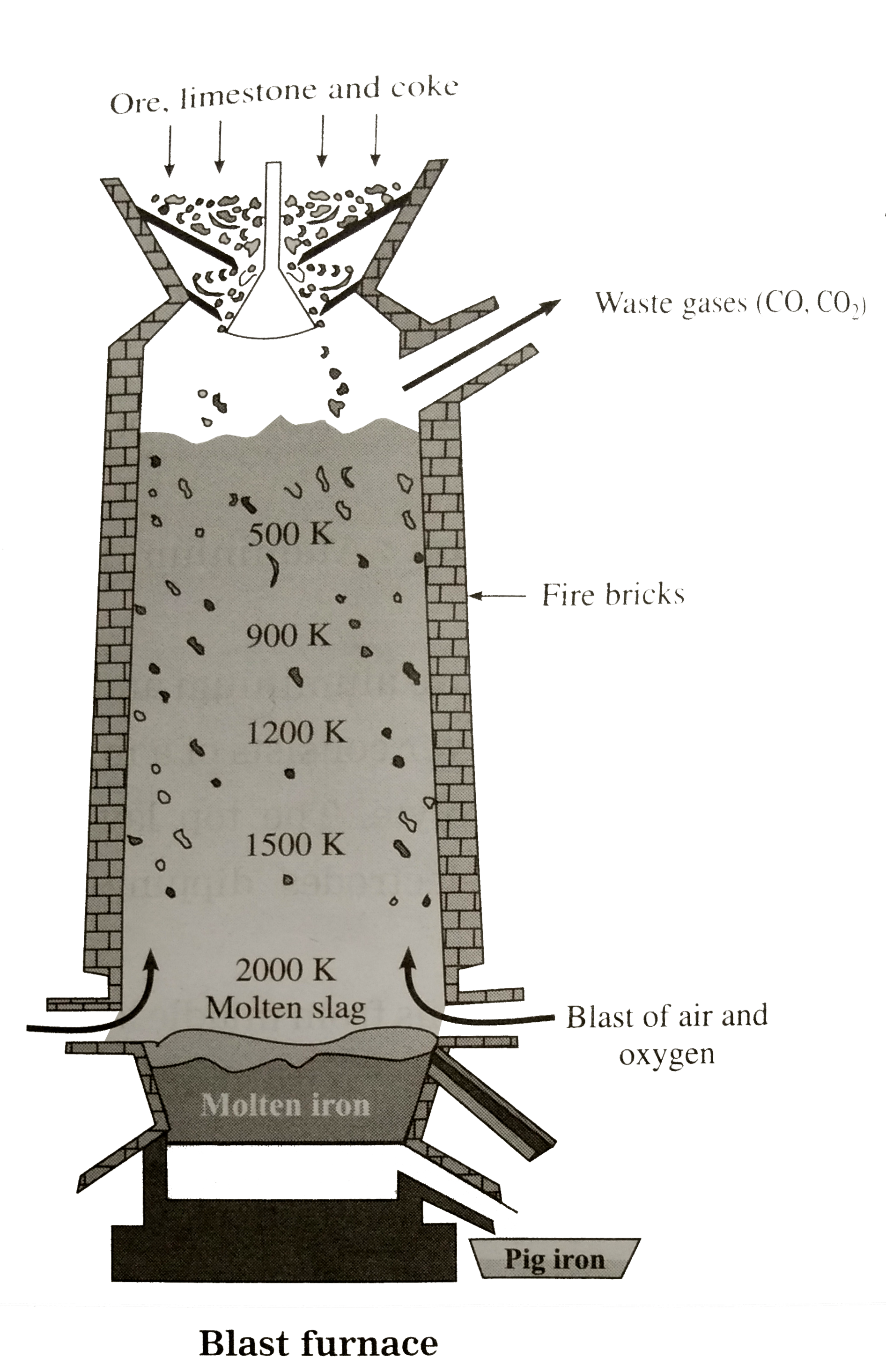 Blast furnace has three parts (i) the hearth, (ii) the bosh and (iii) the stack. The roasted ore in mixedwith cokeandlimestone in theapproximate ratio of 12 : 5: 3. A blast of hot air at about 1000 K is blown from downwards to upwards by layers arrangement. There are three zones of temperature in which three main chemical reactions take place. (i) Zone of combustion : The hot air blown from the bottom of the furnace oxidises coke to CO which is an exothermic reaction, due to which the temperature of the furnace RISES. `C+""^((1)/(2))O_(2) to CO DeltaH = - 220KJ` The hot GASES with CO rise up in the furnace and heat the chare coming down. CO acts as a fuel as well as a reducing agent. (ii) Zone of reduction : At about 900K, CO reduces `Fe_(2)O_(3)` to spongy (orporopus) iron. `Fe_(2)O_(3) + 3CO to2Fe + 3CO_(2)` Carbon alsoreduces partially `Fe_(2)O_(3)` to Fe. `Fe_(2)O_(3) +3C to2Fe + 3CO` Zone of slag formation : At 1200 K limestone, `CaCO_(3)`in the charge, decomposes and forms a basic flux CaO which further reacts at1500K withgangue`(SiO_(2),Al_(2)O_(3))`and forms a slag of `CaSiO_(3)` and `Ca_(3)AlO_(3)` whichis removedfrom thebottom. (iv) Zone of fusion : Theimpuritiesin ore like`MnO_(2)`and `Ca_(3)(PO_(4))`arereducedto Mnand Pwhile`SiO_(2)` is reduced to Si. Thespongy ironmovingdownin thefurancemeltsin thefusionzone and dissolvedtheimpurities like C, Si, Mn, phosphorus and sulphure. The molten iron collects at the bottom of furnace. The lighter slag floats on the molten iron and prevents its oxidation. The molten iron is removed and cooled in moulds. It is called pig iron or cast iron. It contains about 4% carbon. |
|
| 24. |
Explain Tollen's reagent test . |
|
Answer» SOLUTION :Tollen's reagent is a silver ammonia complex. `[Ag(NH_(3))_(2)](+) OH^(-)` (2) When an aldehyde, like acetaldehyde is heated with Tollen's reagent, it is oxidised to acetic acid and silver ions ` Ag^(+)` in Tollen's reagent complex are reduced to silver (Ag) giving greyish black precipitate or deposition of silver on innter suface of the test tube which shines like a mirror. Hence this test is also called silver mirror test.  (3) This test is not given by ketones. (4)Hence Tollen's reagentis used to distinguish between ALDEHYDES and ketones. |
|
| 25. |
Explain the extraction of boric acid from (i) Borax (ii) Colemanite |
|
Answer» Solution :(i) Borax: Borax is treated with hydrochloric acid or sulphric acid or NITRIC acid to give BORIC acid. `underset(("Borax"))(Na_(2)B_(4)O_(7)).10H_(2)O+2HNO_(3)tounderset(("Boric acid"))(4H_(3)BO_(3))+2NaNO_(3)+5H_(2)O` (ii) COLEMANITE: Colemanite is boiling with water to give boric acid. `underset(("Colemanite"))(Ca_(2)B_(6)O_(11))+11H_(2)Ooverset(O)(to)2Ca(OH)_(2)+underset(("Boric acid"))(6H_(3)BO_(3))` |
|
| 26. |
Explain thrope nitrile condensation. |
|
Answer» Solution :Self condensation of two molecules of alkyl nitrile in the presence of sodium to form iminoitrile is called Thrope nitrile condendsation. `UNDERSET("PROPANENITRILE")(CH_(3)-CH_(2)-C)-= N+CH_(3)-CH_(2)-CN OVERSET(Na//"ether")(to)CH_(3)-CH_(2)-overset(NH)overset(||)(C)-underset(3-"imino-2-methyl pentanenitrile")underset(CH_(3))underset(|)(CH)-CN` |
|
| 27. |
Explain the extraction of aluminium from purified alumina by Hall-Heroult process. |
|
Answer» Solution :Aluminium is extracted by electrometallurgy. Pure bauxite is a bad conductor of electricity so it dissolved in cryolite (`Na_(3) AlF_6`) which acts as an electrolyte. Little C`aF_(2) ` (fluorspar) is added to lower the melting point of the mixture and to increase conductivity. A mixture of purified bauxite, molten cryolite and `CaF_(2)`, is taken in a steel vessel coated with carbon lining which acts as cathode. A number of graphite rods acts as anode. On passing electricity aluminium is obtained at the cathode and oxygen is liberated at the anode. The oxygen liberated reacts with carbon of the anode to FORM carbon monoxide and carbon DIOXIDE. So for each kg of aluminium produced about 0.5 kg of anode is burnt off hence extraction of aluminium is costlier, The electrode reactions are At anode : (oxidation - loss of electrons )`C(s) + O^(-2) to CO(G) + 2e.` (melt) `C(s) +2 O^(-2)`(melt)` to CO_(2) (g) + 4e^(-)` At cathode : (Reduction - gain of electrons `Al^(3+) + 3^(e -)to AI(l)` The molten aluminium obtained is removed through the OUTLET. 
|
|
| 28. |
Explain three dimensional close packing from two dimensional square close-packing. |
Answer» Solution :THREE dimensional structures is OBTAINED by stacking two dimensional layers ONE above the other.  In this type of arrangement, the second SQUARE closed packed layer is placed exactly above the first square close packed layer such that the spheres of first and second layers are in same alignment horizontally and vertically and in the similar way more layers can be placed one above other. If the arrangement of spheres in the first layer is called ..A.. type, then all the layers have the same arrangement. Thus this lattice has AAAAA.... type arrangement and the lattice thus generated is simple cubic unit CELL or primitive cubic unit cell. The coordination number of each sphere is six. |
|
| 29. |
Explain three dimensional close packing from two dimensional hexagonal close packing. |
Answer» Solution :In hexagonal close packing layer in two dimensions, there are two sets of triangular voids. The three dimensional ARRANGEMENT is obtained by stacking the two dimensional hexagonal layers one above the other.  Over the first layer (say "A") of two dimensional hexagonal arrangement, if the second layer (say "B") is placed, the one set of triangular void of layer "A" is covered by the spheres of layer "B".  Over the second layer "B", there are again two sets of triangular voids. If the third layer is placed over the triangular voids of second layer such that the spheres of third layer an first layer in exact alignment, the hexagonal close packing in three dimensional is obtained.  The third layer and first layer are EXACTLY same and hence it is called "A" TYPE. Thus the arrangement obtained is ABABAB.... Pattern. Ex. : Zn and Mg shows this type of arrangement.  . . If the third layer of the spheres are placed over the triangular voids of the second layer that are formed just above the unoccupied voids of the first layer, the face cubic centred unit cell is formed. The third layer is different from layers A and B. Hence, if the third layer is called "C", the arrangement obtained is ABCABCABC... ie., fourth layer of sphere and first layer of spheres are exactly same.  Ex. : Metals such as CU, Ag, etc. crystallizes in FCC structure. In both type of close packing structures, the packing efficiency is 74% and co-ordination number is 12.` |
|
| 30. |
Explain the ethylamine is stronger than ammonia? |
Answer» Solution :(i) Aliphatic primary amines are more BASIC than ammonia. Ethylamine contains `C_2H_5` GROUP (alkyl group) which has + I effect. i.e., it is electron releasing in nature.  (ii) The ETHYL group tends to increase the electron density on the NITROGEN atom. Where no such group with + I effect is present in `NH_3`. So, ethylamine is more basic than ammonia. |
|
| 31. |
Explain Thermosetting plastics. |
| Answer» Solution :These are the polymers which cannot be used again and again . These are the HIGHLY cross-linked THREE DIMENSIONAL network polymers . On HEATING they do not BECOME soft but decompose. | |
| 32. |
Explain the estimation of nitrogen of an organic compound by b) Kjeldahl's method |
Answer» Solution :Eslimation of `N_(2)` byKjeldahl's method : In this method the organic compound is heated with conc, `H_(2)SO_(4)` in presence of a small amount of `CuSO_(4)`. Then `N_(2)` is quantitively CONVERTED into ammonium sulphate. The contents of the flask are transferred into another flask and heated with excess of `NaOH` solution to LIBERATED is passed and ABSORBED in a knwon vol. of known conc. `H_(2)SO_(4)` (excess). Now the excess of acid remained after the neutrallsation by `NH_(3)` is lirated against a slandard solution of akali. From this, the amount of `H_(2)SO_(4)` used to neutralise `NH_(3)` is calculated. From this the mass of ammonia formed is calculated and from the `%` of `N_(2)` gas is calculated. 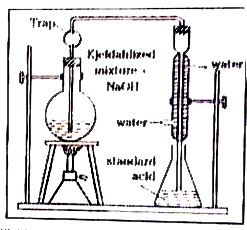 Organic compound `+H_(2)SO_(4)RARR(CH_(4))_(2)SO_(4)` `(NH_(4))_(2)SO_(4)+2NaOH rarr Na_(2)SO_(4)+2H_(2)O+2NH_(3)` `2NH_(3)+_(2)SO_(4)rarr (NH_(4))_(2)SO_(4)`. Calculations : Mass of organic compound = a g Vol. of `H_(2)SO_(4)` Initially taken = V ml. Molarity of `H_(2)SO_(4)=M` Vol. of `NaOH` consumed after complete neutrallsation `=V_(1)ml`. Molarity of `NaOH =M` `2NaOH +H_(2)SO_(4) rarr Na_(2)SO_(4)+2H_(2)O` Then from the formula, `(NaOH)=(MV_(1))/(n_(1))=(MV_(2))/(n_(2))(H_(2)SO_(4))` We get, `(MV_(1))/(2)=(MV_(2)/(1) or V_(2)=(V_(1))/(2)" ml. "` `therefore"Vol. of "H_(2)SO_(4)" neutralilsed by "NH_(3)` `=(V-(V_(1))/(2))ml` `=(2(V-(V_(1))/(2))ml` of M molar `NH_(3)` solution. `"1000 ml. of 1 M"NH_(3)` solution. 1000 ml. of `1 M NH_(3)` solution contains 17 g of `NH_(3)` of 14 g of `N_(2)`. `therefore 2(V-(V_(1))/(2))` ml of M molar `NH_(3)` solution .............? `=(14xxM xx2(V-(V_(1))/(2)))/(1000)g" of "N_(2)` `therefore % " of Nitrogen"` `=(14xxMxx2(V-(V_(1))/(2)))/(1000)xx(100)/(a)` |
|
| 33. |
Explain theory of reduction of oxide of metal with carbon as a reducing agent. |
|
Answer» Solution :During the reduction process the oxide of a metal decomposes and the reducing agent takes away the oxygen. The role of reducing agent is to PROVIDE `Delta_(r)G^(Theta)` negative and large enough to make the sum of `Delta_(r)G^(Theta)` of the two reactions, i.e, oxidation of the reducing agent and reduction of the metal oxide negative. If reduction is carried out by carbon the oxidation of the reducing agent (i.e., C) will be there `C_((s)) + 1/2O_(2(g)) to CO_((g)) , Delta_(r)G_(C,CO)^(Theta) "" ....(ii)` Also the complete oxidation of carbon to carbon dioxide MAY take place. `1/2C_((s)) + 1/2 O_(2(g)) to 1/2CO_(2(g)) , 1/2 Delta_rG_(C,CO_2)^(Theta)"".....(iii)` On coupling the reactions (i) and (ii) we get `M_(x)O_((s)) + C_((s)) to ""_(x)M_((s " or " l)) + CO_((g)) "" ....(iv)` On coupling reactions (i) and (iii), we have `M_(x)O_((s)) + 1/2 C_((s)) to xM_((s " or " l)) + 1/2 CO_(2(g)) "" ...(v)` Similarly if carbon monoxide is reducing agent, it would oxidised as follows: `CO_((g)) + 1/2O_(2(g)) + CO_(2(g)) - Delta_(r)G_(CO, CO_2)^(Theta) ""..... (vi)` On coupling reaction (i) and (vi), we have `M_(x)O_((s)) + CO_((g)) to xM_((s " or " l)) + CO_(2(g)) "" ...(vii)` The reactions (iv) and (vii) actually describe the reduction of metal oxide` M_xO` that is need to be accomplished. The values of `Delta_r G^(@)` for these reactions in general, can be obtained from the corres-ponding `Delta_rG^@` values of oxides. The temperature chosen for the reaction must be such that `Delta_rG^@`for two combined redox processes must be negative. This is indicated by the point of intersection of the two curves`Delta_rG^@`v/s T in Ellingham diagram, ie, curve for the FORMATION of `M_xO` and that of the formation of oxide of the reducing substance. After that point, the`Delta_rG^@`becomes large negative for the combined process that makes reduction of `M_xO` possible. The difference in the two`Delta_rG^@`values after that point determines WHETHER reduction of the oxide of the element of the upper line is feasible by the element of which oxide formation is represented by the LOWER line. If the difference is large the reduction is easier. |
|
| 34. |
Explain the estimation of nitrogen of an organic compound by a) Dumas method |
|
Answer» Solution :ESTIMATION of nitrogen by Duma's method : In this method a known weight of organic COMPOUND is heated strongly with coarse cupric oxide. Then carbon and hydrogen get oxidised to `CO_(2)` and `H_(2)O` vapour respectively. Nitrogen is converted to `N_(2)` gas some nitrogen cnverted into its oxides, gets reduced by copper gauze to nitrogen. The liberated gases are passed over a solution of KOH. Then `O_(2)` gets absorbed. Nitroegen is collected over KOH solution and its volume is found out. 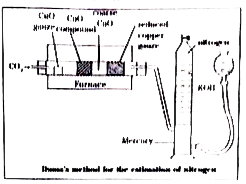 Calculation : Calculation : Suppose 'a' g of organic compound gives V ml of `N_(2)` gas at room temp. TK. Vol. of `N_(2)` gas at STP is calculated as follows. `{:("Expt. conditions","STP condition"),(P_(1)=(P-p)" mm where",P_(2)=760 mm),("p = aqueous tension ",),(T_(1)=TK,T_(2)=273K),(V_(1)=V,V_(2)=?):}` `(P_(1)V_(1))/(T_(1))=(P_(2)V_(2))/(T_(2))` `rArr V_(2)=(P_(1)V_(1)T_(2))/(P_(2)T_(1))=((P-p)xxVxx273)/(760 xxT)=" x ml"` `"22,400 ml. of "N_(2)" at STP WEIGHS 28 g"` `therefore" x ml. of "N_(2)" at STP weighs .............."?` `=(x xx28)/(22,400)g` 'a' g of organic compound contains `(28 xx x)/(22400) g " of "N_(2)` `therefore"100 g of organic compound contains"`? `=(100)/(a)xx(28xx x)/(22400)" g of "N_(2)` |
|
| 35. |
Explain theory of chemical reaction. |
|
Answer» Solution :The thory was developed by Max Trautz and william Lewis in 1916-1918 ,provides of greater insight into the energetic mechanistic aspects of reaction. It is based on Kinetic theory of GASES . (a)Collision Theory :(i)ACCORDING to this theory,the reactant molecules are assumed to be hard SPHERES and reaction is postulated to occur when molecules collide with each other. Collision frequency (Z):The number of collision per second per unit volume of the reaction mixture is known as collision frequency(Z). (b)Collision frequency (`Z_(AB)`) and reaction probability:For a bimolecular elementary reaction A+B `to` products Rate if reaction can be expressed as Rate=`z_(AB)e^(-(E_(a))/RT)`........(i) Where ,`Z_(AB)`=The collision frequency of reactants A and B . `e^(-E_(a))/(RT)`=The fraction of molecules with energies equal to or greater them `E_(a)` This equation comparing with Arrhenius equation .We can sat that A is related to collision frequency. Above equation predicts the value of rate constants fairly accurately for the reaction that involve atomic species or simple molecules. But for complex molecules significant deviations are obseved.The reaon could be that all collision do not LEAD to the formation of products. (C) Products after effective collision :To form products from reactants: (i)The collision will be occurs between molecules. (ii)The collision in which molecules collide with sufficient kinetic energy (threshold energy )and proper orientation . (iii)So ,as to facilitate breaking of bonds between reacting species and formation of new bonds to form products are called as effective collisions. (d)Probability or steric factor(P):To for effective collisions,the steric factor P is introduced .It takes into ACCOUNT the fact that in a collision ,molecules must be properly oriented. i.e Rate =P `Z_(AB)e^(-(E_(a))/(RT))` The collision follows above equation will form products. |
|
| 36. |
Explain the following : Esterification |
|
Answer» |
|
| 37. |
Explain the electron deficient nature of diborane towards Lewis bases through reaction |
|
Answer» SOLUTION :`B_(2)H_(6)+2NH_(3)to[H_(2)B(NH_(3))_(2)][BH_(4)]` `B_(2)H_(6)+2N(CH_(3))_(3)to2H_(3)BleftarrowN(CH_(3))_(3)` 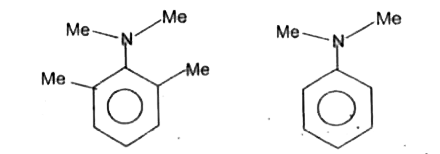
|
|
| 38. |
Explain the Wolff-Kischner reduction of acetone and write the equation for the same. |
|
Answer» Solution :The reduction of ALDEHYDES and ketones into corresponding hydrocarbons by heating with a MIXTURE of hydrazine and strong base like KOH in ethylene glycol is called wolff kishner reduction. `UNDERSET("Acetone")(CH_(3)-Cunderset(CH_(3))underset("|")"C "=O+H_(2))underset("hydrazine")(N-NH_(2))rarrunderset("Acetone hydrazone")(CH_(3)-underset(CH_(3))underset("|")"C "=N-NH_(2))overset("KOH/ethylene")underset("glycol heat")RARR underset("Propane")(CH_(3)-CH_(2)-CH_(3)+N_(2)UARR` When acetone is reacted with hydrazine gives Acetone hydrazone which is treated KOH ethylene glycol and heating gives propane. |
|
| 39. |
Explain the various reduction reactions of nirobenzene: |
|
Answer» SOLUTION : (i) Acid medium reduction: `underset("Nitrobenzene")(C_(6)H_(5)NO_(2))underset(6[H])overset(Sn//HCl)(to)underset("Aniline")(C_(6)H_(5)NH_(2)+2H_(2)O` (ii) Neutral medium reduction: `underset("Nitrobenzene")(C_(6)H_(5)NO_(2))underset(4[H])overset(Zn//NH_(4)Cl)(to) underset("Phenyl hydroxylamine")(C_(6)H_(5)NHOH+H_(2)O)` (iii) `underset("Nitrobenzene")(C_(6)H_(5)NO_(2))underset(2[H])overset(Fe//H_(2)O(g))(to)underset("Nitrosobenzene")(C_(6)H_(5)-N=O` (iv) Basic medium reduction `underset("Nitrobenzene")(C_(6)H_(5)NO_(2))underset(6[H])overset(SnCl_(2)//KOH)(to)[C_(6)H_(5)NH_(2)+C_(6)H_(5)N=O]overset("Self CONDENSATION")(to)underset("Azobenzen")(C_(6)H_(5)-N=N-C_(6)H_(5))` (v) `underset("Nitrobenzene")(C_(6)H_(5)NO_(2))overset(Zn//NaOH)(to) [C_(6)H_(5)-N=N-C_(6)H_(5)]overset(2[H])(to) underset("Hydrazo benzene")(C_(6)H_(5)NH-NH-C_(6)H_(5))` 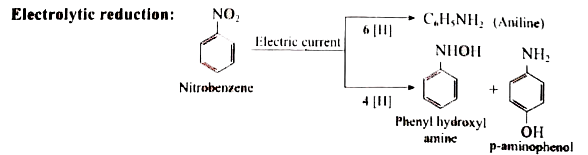 (vii) Catalytic reduction `underset("NItrobenzene")(C_(6)H_(5)NO_(2))+6[H]overset(Ni(or)Pt//H_(2))(to)underset("Aniline")(C_(6)H_(5)NH_(2))+2H_(2)O` |
|
| 40. |
Explainthe electrometallurgyof aluminium. |
|
Answer» Solution :(i) In the method Hall- HeroIdprocess,electrolysis is carriedout in an irontanklinedwith carbonwhichactsas a cathode. (ii) The carbonblocksimmersed in the electrolyteactsas a anode. (iii) A 20%solution of alumina, obtained fromthe buxiteore is mixedwith molten Cryolite and is taken in theelectrolysischamber. (iv) About10%calcium chlorideis also addedto the solution . Calciumchloridehelps to lower the meltingpoint of the mixture. (v) The fusedmixture is maintained at a temperature of above1270 K. (vi) The chemicalreactionsinvolvedd in this process are Ionisation of alumina. ` Al_(2)O_(3) to2AI^(3+) + 3O^(2-)` Reaction at cathode ` 2AI^(3+) (" melt") + 6e^(-) to 2AI^(l)` Reaction at anode ` 6O^(2-) (" melt") to 3O_(2) + 12^(e-)` (vii) Sincecarbon acts as anode the followingreaction takesplace. `C_(s) + O^(2-) (" melt") to CO + 2e^(-) ` ` C_(s) + 2O^(2-) (" melt") to CO_(2) + 4e^(-)` (VIII) Due to the abovetwo reactions, anodes are slowly consumedduringthe electrolysis, The purealuminium is formed at thecathodand SETTLES at the BOTTOM. (IX) The net electrolysisreaction can be writtenas follows. ` 4AI^(3+) (" melt") + 6O^(2-) (" melt") + 3C_(s) to 4AI_(l) + 3CO_(2(g))` |
|
| 41. |
Explain the various chemical methods by which colloids can be prepared. |
|
Answer» SOLUTION :Condensation Methods : Various chemical methods for the formation of colloidal particles. (i) Oxidation : Sols of some non-metals are prepared by this method. (a) When hydroiodic acid is treated with iodic acid, `I_2` sol is obtained. `HIO_3 + 5HI to 3H_2O + I_2` (Sol) (ii) Reduction : Many organic reagents like phenyl hydrazine, formaldehyde, etc are used for the formation of sols. For example: Gold sol is prepared by reduction of auricchloride using formaldehyde. `2AuCl_3 + 3HCHO + 3H_2O to 2Au("sol") + 6HCl + 3HCOOH` (iii) Hydrolysis : Sols of hydroxides of metals like chromium and aluminium can be produced by this method. For Example, ` FeCl_2 + 3H_2O to Fe(OH)_3 + 3HCl` (iv) DOUBLE decomposition : For the preparation of water insoluble sols this method can be used. When hydrogen sulphide gas is passed through a solution of arsenic oxide, a yellow coloured arsenic sulphide is obtained as a colloidal solution. `As_2 O_3 + 3H_2S to As_2S_3 + 3H_2O ` Decomposition : When few drops of an acid is added to a dilute solution of sodium thio sulphate, the insoluble free sulphur produced by decomposition of sodium thiosulphate accumulates into small, clusters which impart various colours blue, yellow and even red to the system depending on their growth WITHIN the size of colloidal dimensions. `S_2O_3^(2-) + 2H^(+) to S + H_2O + SO_2` By exchange of solvent : (i) Colloidal solution of few substances like phosphorous or sulphur is obtained by preparing the solutions in ALCOHOL and pouring them into water. (ii) As they are insoluble in water, they FORM colloidal solution. Pin alcohol + water`to`Psol. |
|
| 42. |
Explain the electrometallurgy of aluminium. |
|
Answer» Solution :(i) In the method Hall - Herold process, electrolysis is carried out in an iron tank lined with carbon which acts as a cathode. (ii) The carbon blocks immersed in the electrolyte acts as a anode. (iii) A 20% solution of alumina, obtained from the bauxite ore is mixed with molten Cryolite and is taken in the electrolysis chamber. (iv) About 10% calcium chloride is ALSO ADDED to the solution. Calcium chloride helps to lower the melting point of the mixture. (v) The fused mixture is maintained at a temperature of above 1270 K. (vi) The chemical reactions involved in this process are Ionisation of alumina `Al_(2)O_(3) rarr 2Al^(3+) + 3O^(2-)` Reaction at cathode `2Al^(3+) ("melt") + 3e^(-)rarr Al_((l))` Reaction at anode `2O^(2-)("melt") rarr O_(2) + 3e^(-)` (vii) SInce carbo n acts as anode the following reaction takes place. `C_((s)) + O^(2-)("melt") rarr CO + 2e^(-)` `C_((s)) + 2O^(2-)("melt") rarr CO_(2) + 4e^(-)` (viii) DUE to the above two reactions, anodes are slowly consumed during the electrolysis. The pure ALUMINIUM is formed at the cathode and settles at the bottom. (ix) The net electrolysis reaction can be written as follows. `4AL^(3+)("melt") + 6O^(2-)("melt") + 3C_((s)) rarr 4Al_((l)) + 3CO_(2(g))` |
|
| 43. |
Explain the variations in the following properties of group-18 elements : (i) Atomic radii (ii) Ionisation enthalpy (iii) Electron gain enthalpy |
|
Answer» Solution :(i) Atomic radii: The atomic radii of noble gases in their respective periods are exceptionally high because incase of noble gases, the atomic radii corresponds to Van-der-Waal.s radii which is ALWAYS larger than covalent radii. Down the group, the atomic radii increases with the increase in atomic number. (ii) Ionisation enthalpy : Ionisation enthalpies of noble gases are exceptionally high DUE to presence of fully filled valence SHELLS. However down the group the ionisation enthalpy decreases. (iii) ELECTRON gain enthalpy : The values of electron gain enthalpies are LARGE positive as they have fully filled valance shells. Hence, they have no tendency to accept electrons and form anions |
|
| 44. |
Explain the electrical property of colloids with a neat diagram. |
Answer» Solution :Helmholtz DOUBLE layer : (i) The SURFACE of colloidal particle adsorbs one type of ion due to PREFERENTIAL adsorption. (ii) This layer attracts the oppositely charged ions in the MEDIUM and hence at the boundary separating the TWO electrical double layers are setup. (iii) This is called as Helmholtz electrical double layer. (iv) As the particles nearby are having similar charges, they cannot come close and condense. (v) Hence this helps to explain the stability of a colloid. 
|
|
| 45. |
Explainthe electro metallurgy of aluminium |
|
Answer» SOLUTION :(i) In the methodHall- Heroldprocess,electrolysis is carriedout in an irontanklinedwith carbonwhichactsas a anode. (ii) The carbon blocksimmersed in theelectrolyteactsas a anode. (iii) A20 %solution of alumina,obtained fromthe bauxiteore is mixed withmolten Cryoliteand is takenin the electrolysis chamber. (iv) About10% calciumchlorideis alsoaddedto the solution . Caclium chloride HELPS to lowerthe melting point of the mixture. (v) THe fused mixtureis MAINTAINED at a temperature of abouve 1270 K (iv) The chemiacal reactionsinvolved in this processare Ionisation of alumina ` Al_(2) O_(3) to 2Al^(3+) + 3O^(2-)` Reaction of cathode ` 2Al^(3+)( " melt") + 6e^(-) to 2Al_(l)` Reaction at anode `6O^(2-) (" melt") to 3O_(2) + 12e^(-)` (vii)Sincecarbonactsas anodethe followingreaction takes place. ` C_(s) + O^(2-) "( melt") to CO + 2e^(-)` ` C_(s) + 2O^(2-) (" melt") to CO_(2) + 4e^(-)` (viii)Due to the abovetworeactions , anodesare slowlyconsumedduringthe electolysis , Thepurealuminiumis formedat thecathodeand settles at thebottom. (ix)The netelectrolysiscan be writtenas follows . `4Al^(3+) (" melt") + 6O^(2-) "( melt") + 3C_(s) to 4Al_(i) + 3CO_(2(g))` |
|
| 46. |
Explain the variations in atomic radii of transition elements in group |
|
Answer» Solution :Drown the group, with the increase in atomic number, the atomic radii increases because of addition of new shells. Hence the atomic radii of elements of second transition series are greater than corresponding elements of first transition series. The atomic radii of elements of second and third transition series are ALMOST same because of intervention of the 4 f-orbitals which must be filled before the 5d series of elements begin. The filling of 4f before 5d orbital results in regular decreases in atomic radii called LANTHANOID CONTRACTION. The lanthanoid contraction COUNTER balances the increase in atomic size with the increasing atomic number. Ex : Zx and Hf have very similar chemical adn properties and have nearly same atomic radii because of lanthanoid contraction. The lanthanoid contraction is because of the imperfect sheilding of one electron by another in the same set of orbitals. HOWEVER, the sheilding of one 4f electron by another is less than one d-electron by other, and as the nuclear charge increases along the series, there is fairly regular decreases in the size of entire `4f^(11)` orbitals. 
|
|
| 47. |
Explain the effect on reaction by Boltzman and Maxwell graph. |
|
Answer» Solution :All the MOLECULES in the REACTING species do not have the same kinetic energy since it is difficult to predict the behaviour of any ONE molecule with precision. Maxwell and Boltzmann used statistics to predict the behaviout of large number of molecules. Fraction of molecules=`(N_(E))/(N_(T))` Where,`N_(E)=E` kinetic energy containing molecule. `N_(T)` =Total number of molecules the plot of fraction of molecule `((N_(E))/(N_(T)))` kinetic energy is as  This plot contain RELATION of mole fraction and kinetic energy The peak of the curve corresponds to the most probable kinetic energy i.e. kinetic energy of MAXIMUM fraction of molecules . There are decreasing number of molecules with energies higher or lower then this value. |
|
| 48. |
Explain the variations in atomic radii of transition elements along the period |
|
Answer» Solution :The atomic radii of transition elements in a period decreases with the increase in atomic number and the decrease becomes small after middle of the series. However, the atomic radii are higher than p-block elements but SMALLER than s-block elements. In the beginning of the series, the atomic radii of the elements decreases with the increase in atomic number because of increase in nuclear charge. The attraction between the nucleus and outermost electrons (4s) increases which RESULTS in decrease of atomic radii from Sc to Cr. In the middle of the series, the sheilding effect of d-electrons and the nuclear attraction are counter balanced with the increases in atomic number and so that atomic radii is almost STEADY in middle of each series. Ex. From Cr to Cu in case of first transition series, the atomic radii is nearly same. At the end of the series, the electron-electron repulsions in d-orbitals gets dominant over the nuclear attraction with the increase in nuclear charge. These repulsions will EXPAND the electron cloud which results in increase of atomic radii. Ex: The atomic radius of zinc is greater than copper |
|
| 49. |
Explain the effect of temperature on reaction rate based on Arrhenius theory. |
|
Answer» Solution :(i) Generally, the RATE of reaction increases with increasing temperature. However, there are very few exceptions. (ii)As a rough rule , for many reaction near room temperature reaction rate tends tu when the temperature is increased by `10^@ C` (iii)A large number of reaction are known which do not take place at room temperature occur readily at higher temperatures . Example : Reaction between `H_2 and O _2`to from `H_2O` takes place only when an electric spark is passed. (IV) Arrhenius suggested that the rates of most reaction vary with temperature in such a WAY that the rate constant is directly proportional to `e^(-(E_a)/(RT))`and the proposed a relation between the rate constant and temperature . `k=Ae^(-(E_a)/(RT))` where k = frequency factor`""...(1)` R = gas constant T = Absolute temperature (in kelvin) The factory A does not vary significantly with temperature and HENCE it may be taken as a constant . TAKING logarithm on both side equation (1) ln `k = ln A + ln e^(-E_a//RT)` ln `k = lnA - E_a/(RT)[:. ln e = 1]` ln k `= ln A - E_a/R (1/T)` (vi) The plot of lnk vs `(1/T)` is a straight with negative slope `E_a/(RT)` . If the rate constant for a reaction at two different temperatures is known , we can calculate the activation energy ln `k_2 - ln k_1 -[E_a/(RT_2)]+[E_a/(RT_1]]`This equation can be used to calculated `E_a` from rate constants `k_1 &k_2` at temperature `T_1 and T_2` . |
|
| 50. |
Explain the effect of increase of temperature on rate of reaction and rate constant. |
|
Answer» Solution :Most of the chemical reactions are ACCELERATED by increase in temperature. E.g. :In decompositon of `N_(2)O_(5)` the time taken for half of the original amount of material is as under:  E.g.2:in a mmixture of `KMnO_(4)` and `H_(2)C_(2)O_(4)` potassium premagnate gets decolourused faster at a high temperature than that at a LOWER temperature . It has been foud that for a chemical reation witgh rise in temperature by `10^(@)` C the rateconstant isnearly doubled. As the temperature increase by `10^(@)` the graph of fraction of molecules `(N_(E))/(N_(T))` kinetic energyshift towards right side and fraction of molecules becomes double. The temperature dependence of the rate of a chemical reaction can be accurately explained byArrhenius equation . `k=Ae^(-E_(a))/(RT)` ...(i) k=ratem constant =Rate Where A=arrhenius factor or the FREQUECY factor.It is also CALLED pre-exponential reaction 0R=gas contant =`8.214 JK^(-1) "mol"^(1)` `E_(a)` =activation energy 1 `mol^(-1)` Taking netural logarithm of both side of eq,(i) In k=`-(E_(a))/(RT)+`in A and log k=`-(E_(a))/(2.303RT)`+log A `:. In k prop 1/T` Increase in temperature then increase in the rate of the reaction and an exponential increase in the rate constant. So, temperature is less then rate is less and temperature increase then rate increase. |
|