

Saved Bookmarks
This section includes 7 InterviewSolutions, each offering curated multiple-choice questions to sharpen your Current Affairs knowledge and support exam preparation. Choose a topic below to get started.
| 1. |
Empirical formula and molecular formula of monomer of natural rubber are respectively |
|
Answer» `C_(5)H_(8),C_(5)H_(8)` |
|
| 2. |
Emperical formula of compound is SF_(4). At 27^(@)C 0.1gm of gaseous compound occupies a volume of 22.2 ml and exert a pressure 1 atm. What is molecular formula of gas. [Take R=0.08atm lit k^(--1) "mol"^(-1)] |
|
Answer» `SF_(4)` `(1.02)xx22xx10^(-3)` `(0.1)/((108)x)xx0.0821xx293` `x=(0.1xx0.0821xx293)/((108)(1.02)(22.1)xx10^(-3))=1` M.F. `=SF_(4)` |
|
| 3. |
E_(MnO_4^(-)// Mn^(+2), H^(+)) can be 0.48 V greaterthan from E^@ value if the [MnO_4^(-)] is equal to [Mn^(+2)] at a P^(H) of ___________ |
|
Answer» Solution :`MnO_4 + 8 H^(oplus) + 5e^(-) to Mn^(+2) + 4H_2O , E= E^(0) - (0.0591)/(5) log""([Mn^(+2)])/([MnO_4^(-)][H^(oplus)]^(8))` ` (E-E^(0)) = (-0.0591)/(2) log [H^(oplus)]^(-8) , 0.48 = -(0.0591)/(5) xx (-8) log[H^(oplus)]` ` P^(H) - log[H^(oplus)] = [(0.048 xx 5)/(0.0591xx 8)] = 5.076` |
|
| 4. |
E_(Mn)^(@)+7|""_(Mn)+2 = 1.5 V E_(Mn)^(@)+4|""_(Mn)+2 = 1.2 V, then E_(Mn)^(@)+7|""_(Mn)+4 is |
|
Answer» A) `0.3 V` `DeltaG_(1)^(@) = -NFE^(@) = -5 xx F xx 1.5 rArr -7.5` F...(i) `Mn^(4+) + 2e^(-) to Mn^(2+), E^(@) = 1.2` V `DeltaG_(2)^(@) = -nFE^(@) = -2xxFxx1.2 = -2.4` F...(ii) On subtracting eqn (ii) from (i), we get, `Mn^(7+) + 3E^(-) to Mn^(4+), E^(@) =` ? `DeltaG_(3)^(@) = DeltaG_(1)^(@) - DeltaG_(2)^(@)` `-3FE^(@) = -7.5 F-(-2.4 F) rArr -3FE^(@) = -5.1 F` `:. E^(@)` = 1.7 V |
|
| 5. |
Emission of beta -particle by an atom of an element results in the formation of its |
|
Answer» Isotope `._(1)H^(3) and ._(2)He^(3)` are isobars (same mass no.) |
|
| 6. |
Emission of beta-particle by an atom of an element results in the formations of: |
|
Answer» isobar |
|
| 7. |
Emission of beta -particle is equivatent to: |
|
Answer» INCREASE of ONE PROTON only |
|
| 8. |
Emission is caused by the transformation of one neutron into a proton. This results in the formation of a new element having |
|
Answer» Same nuclear charge |
|
| 9. |
Emission of a beta- particle by an atom of the element results in the formation of: |
|
Answer» ISOTOPE |
|
| 10. |
E.m.f. of the cell Zn|Zn^(2+)(1)||Cu^(2+)(1M)|Cu is 1.1 volt. If the standard reduction potential of Zn^(2+)|Znis -0.78 volt, what is the oxidation potential of Cu|Cu^(2+) ? |
|
Answer» `+1.86V` |
|
| 11. |
emf value of spontaneous redox reaction will be. . . . |
|
Answer» Zero |
|
| 12. |
Emil Fischer was awarded Nobel Prize for his work on : |
|
Answer» SUGARS and PURINE synthesis |
|
| 13. |
Emf of the cell Pt. H_(2)("1 atm")|H^(+) (aq)||AgCl|Ag is 0.27 V and 0.26 V at 25^(@)C and 35^(@)C. Heat of reaction occuring inside the cell at 25^@C is |
|
Answer» `-54.8kJ` |
|
| 14. |
E.M.F of the cell reaction , 2Ag^(+) + Cu to 2Ag + Cu^(2+)is 0.46 V .If E_(Cu^(2+) // Cu)^(0) is | 0.34 V , E_(Ag^(+)//Ag)^(0) is |
|
Answer» 0.80 V |
|
| 15. |
Emf of given Daniell cell at 298 K is E_(1). Zn|ZnSO_(4)(0.01M)||CuSO_(4(1.0M))|Cu. The emf changed to E_(2) when concentration of ZnSO_(4) solution is 1.0 M and CuSO_(4) solution is 0.01 M, then what is the relation between E_(1) and E_(2) ? |
|
Answer» `E_(1) GT E_(2)` `E=E^(@)-(0.059)/(2)"log"([Zn^(2+)])/([Cu^(2+)])` `E_(1)=E^(@)-(0.059)/(2)"log"(0.01)/(1.0) THEREFORE E_(1)=E^(@)+0.059` `E_(2)=E^(@)-(0.059)/(2)"log"(1.0)/(0.01)therefore E_(2)=E^(@)-0.059` `therefore E_(1) gt E_(2)`. |
|
| 16. |
Emf of hydrogen electrode in tern of pH is (at 1 atm pressure): |
|
Answer» `E_(H_(2)) = (RT)/(F) XX pH` |
|
| 17. |
EMF of hydrogen electrode in terms of pH is (at 1 atm pressure) |
|
Answer» `E_(H_(2)=(RT)/(F)xxpH` Accordingto nernst equation `E=E^(@)+(2.303 RT)/(NF) log (1)/(H^(+)]^(2)` `=-(2.303 RT)/(2xxF)-log (H^(+))^(2)=(2.303RT)/(F)pH` |
|
| 18. |
EMF of Daniell cell was found using different concentrations of Zn^(2+) ion and Cu^(2) ion. A graph was then plotted between E_(cell) and log([Zn^(2+)])/([Cu^(2)]). The plot was found to be linear with intercept on. E_(cell) axis equal to 1.10 V. Calculate E_(cell) for Zn|Zn^(2+)(0.1M)||Cu^(2+)(0.01M)|Cu |
|
Answer» Solution :For DANIELL cell, `Zn+Cu^(2+)TOZN^(2+)+Cu` `E_(cell)=E_(cell)^(@)-(0.0591)/(2)"log"([Zn^(2+)])/([Cu^(2+)])` it is the equation of straight line (y=c+mx). INTERCEPT`=E_(cell)^(@)=1.10V` (GIVEN) `thereforeE_(cell)^(@)=1.10-(0.0591)/(2)"log"(0.1)/(0.01)=1.10-0.0295=1.0705`V |
|
| 19. |
E.M.F. of following cell is 0.265 V at 25^@C and 0.2595 V at 35^@C. Calculate heat of the reaction taking place at 25 ^@C Pt(H_2) | HCl (g) | | AgCl | Ag (s) |
|
Answer» |
|
| 20. |
emf of cell Ni, Ni^(2+)(1.0M) || Au^(3+)(1.0M), Au is …………If E^@ for Ni^(2+)|Ni is 0.25V, E^@ for Au^(3+)| Au is 1.50 V. |
|
Answer» `+1.25V` |
|
| 21. |
EMF of a cell whose half cells are given below is Mg^(2+)+2e^(-)toMg(s),E=-2.37V Cu^(2+)+2e^(-)toCu(s),E=+0.33V |
|
Answer» `E_(cell)^(o)=2.71V` |
|
| 22. |
EMF of a cell in terms of reduction potential of its left and right electrodes is:- |
|
Answer» `E=E_("left")-E_("right")` |
|
| 23. |
EMF of a cell in terms of reduction potential of its left and right electrodes is |
|
Answer» `E = E_("LEFT") - E_("RIGHT")` |
|
| 24. |
Emery consists of |
|
Answer» IMPURE corundum |
|
| 25. |
Elucidate the structure of glucose. |
|
Answer» Solution :(i) Its moleculer formula is found to be `C _ 6 H_ (12) O _ 6 `. (ii) On heating with HI it forms N-hexane suggesting that all the six carbon atoms are linked in a straight chain. ` overset(CHO) overset(|) underset(CH_2OH) underset(|) ((CHOH)_4) overset(HIDelta)tounderset("n- hexane")(CH _3 - CH _2 - CH _2- CH _2- CH_ 2- CH _3 ) ` (iii) Glucose reacts with hydroxylamine to form an oxime. This show it contain carbonyl group. `overset(CHO)overset(|) underset(CH_2OH) underset(|)((CHOH)_4) overset(NH_2OH) to overset(CH= N -OH)overset(|) underset("Oxime")underset(CH_2OH) underset(|)((CHOH)_4)` (v)Inpressureofbrominewater,glucoseundergoesoxidationforminggluconicacid.Thisshowscarbonyl groupisanaldehyde group. `overset(CHO) overset(|) underset( CH_2 OH) underset(|) ((CHOH)_4) overset(Br_2 "water")to overset(COOH) overset(|)underset(CH_2OH) underset(|) ((CHOH) _4)` (v) ACETYLATION of glucose with acetic anhydride gives glucose penta acetate which confirms the presence of five OH groups. (vi) On oxidation with strong oxidising AGENT. like Cone. `HNO_3` it gives saccharic acid. This indicate the presence ofprimaryalcoholic group. Based on the above facts Fischer gave open and ring STRUCTURE for glucose. 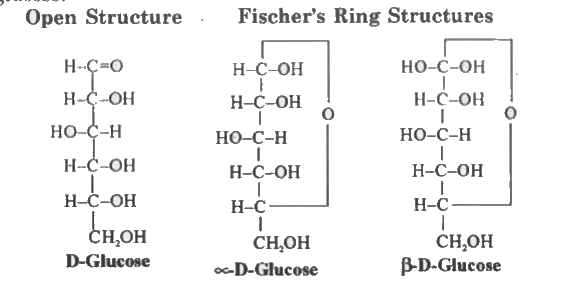
|
|
| 26. |
Elucidate the structure of fructose. |
|
Answer» Solution :Fructose is the sweetest of all known sugars. It is readily SOLUBLE in water. Fresh solution of fructose has a specific rotation -`133^(@)` which changes to - `92^(@)` at equilibrium due to mutarotation. Similar to glucose, the structure of fructose is deduced from the following facts. (i) Elemental analysis and molecular weight determination of fructose show that it has the molecular formula `C_(6)H_(12)O_(6)`. (ii) Fructose on reduction with HI and red phosphorus gives a mixture of n - hexane (major product) and 2 - iodohexane (minor product). This reaction INDICATES that the six carbon atoms in fructose are in a straight chain. `"Fructose"overset(HI//P)underset("Reduction")rarrCH_(3)(--CH_2--)_(4)CH_(3)+CH_(3)-underset(I)underset(|)"CH"(--CH_(2)--)_(3)CH_(3)` (iii) Fructose reacts with NH20H and HCN. It shows the presence of carbonyl groups in the molecule of fructose. (iv) Fructose reacts with acetic anhydride in the presence of PYRIDINE to form penta acetate. This reaction indicates the presence of fivehydroxyl groups in a fructose molecule. (v) Fructose is not oxidized by brom~ne water. This rules out the possibility of presence of an aldehyde (-CHO) group. (vi) Partial reduction of fructose with sodium amalgam and water produces mixtures of sorbitol and mannitol which are epimers at second carbon. New asymmetric carbon isformed at C-2. This confirms the presence of keto group.  (vii) On oxidation with nitric acid, it gives GLYCOLIC acid and tartaric acids which contain smaller number of carbon atoms than in fructose.  This shows that a keto group is presence of 10 alcoholic groups at C-1 and C-6. 
|
|
| 27. |
Ellution is the process for : |
|
Answer» Crystsllisation of COMPOUND |
|
| 28. |
Ellingham diagram represents a graph of |
|
Answer» `DeltaGvsP` Metal + `O_(2) RIGHTARROW` oxide (s) |
|
| 29. |
Ellingham diagram represents : |
|
Answer» change of `/_\G` with temperature |
|
| 30. |
Ellingham Diagram is useful |
|
Answer» To know thetempreature where phase TRANSFORMATION ocuurs |
|
| 31. |
Ellingham diagram is given below for the formation of some oxides. Then select the correct combination |
|
Answer» Below |
|
| 32. |
Ellingham diagram is given below for the formation of some oxides. The select the correct combination |
|
Answer» Below `T_(2).Al_(2)O_(3)+3Mg® MgO+2Al,DG=-ve` |
|
| 33. |
Ellingham diagram can be drawn in case of - |
|
Answer» `sulphide |
|
| 34. |
Ellingham diagram does not represents |
|
Answer» Change of `DELTAG` with TEMPERATURE |
|
| 35. |
Elimination reaction (especially beta-elimination) are as common as the nucleophilic substitution reaction in case of alkyl halides. Specify the reagents used in both cases. |
|
Answer» Solution :Both elimination reactions (particularly `beta`-elimination reactions) and nucleophilic substitution reactions occur simultaneously. However, by a proper choice of reagents and REACTION conditions, we can make one reaction to predominate over the other. Usually strong and bulkier bases and high temperature FAVOUR elimination reactions whereas weaker and smaller bases and lower temperature favour substitution reactions. For example, ethyl bromide on heating with alcoholic KOH (which contains the stronger base `C_(2)H_(5)O^(-)` ion) at about 473-523K undergoes elimination to give ethene while with aqueous KOH at about 373K it gives ethanol. `UNDERSET("Ethanol")(CH_(3)CH_(2)OH) underset("373K (Substitution)")overset(KOH(aq))to underset("Ethyl bromide")(CH_(3)CH_(2)Br) underset("473-523K (Elimination)")overset(KOH(alc))to underset("Ethene")(CH_(2)=CH_(2))` |
|
| 36. |
Elimination of bromine and hydrogen from 2-bromobutane results in the formation of |
|
Answer» PREDOMINANTLY TRANS 2-butyne |
|
| 37. |
Elimination of bromine from 2-bromobutane results in the formation of |
|
Answer» equimolar mixture of 1 and 2-butene |
|
| 38. |
Elevation in p.b of a molar glucose solution (d=1.2g mL^(-1)) is : |
|
Answer» `0.98K_(B)` |
|
| 39. |
Elevation of boiling point is directly proportional to |
|
Answer» MOLALITY of the solution |
|
| 40. |
Elevation in b.p of an aqueous urea solution is 0.52^(0). (K_(b)=0.52^(0)"mol"^(-1)kg). Hence, mole -fraction of urea in this solution is : |
|
Answer» 0.982 |
|
| 41. |
Elevation in b.p of a 0.5 molar glucose solution (d=1.2gmL^(-1)) is : |
|
Answer» `0.45K_(B)` |
|
| 42. |
Elevation in boililng point was 0.52^(@)C when 6 gm of a compound X was dissolved in 100 gm of water. Molecular weight of X is (K_(b) for water is 0.52 per 1000 gm of water) |
|
Answer» 120 `m=(100xx5.2xx6)/(0.52xx100)=60`. |
|
| 43. |
Elevation in boiling point was 0.52^@C when 6 g. of a compound X was dissolved in 100 g of water. Molecular weight of X is- |
|
Answer» 120 |
|
| 44. |
Eletrolysis of aqueous solution of sodium salt of acids giving hydrocarbon is ________ reaction. |
|
Answer» Knoevenagal |
|
| 45. |
Elements of group 11 and 12 are: |
|
Answer» NORMAL elements |
|
| 46. |
Elements X, Y and Z have atomic numbers 19,37 and 55 respectivley. Which of the following statements is/are true about them ? |
|
Answer» Their ionization POTENTIAL would INCREASE with INCREASING atomic number |
|
| 47. |
Elements X and Y form two different compounds. In the first, 0.324 g of X is combined with 0.471 g of Y. In the second, 0.117 g of X is combined with 0.509 g of Y. Show that these data illustrate the Law of Multiple Proportions. |
| Answer» SOLUTION :CALCULATE the MASSES of Y which combine with 1 g of X in each case which are 1.454g and 435 g, i.e., in the RATIO `1:3` | |
| 48. |
Elements with their electronic configuration are given below: Answer the following questions: |
|
Answer» `I LT III lt IV lt V` |
|
| 49. |
Elements with their electronic configuration are given below: Answer the following questions: |
|
Answer» I and IV |
|
| 50. |
Elements with their electronic configuration are given below: Answer the following questions: |
|
Answer» I |
|