Saved Bookmarks
This section includes 7 InterviewSolutions, each offering curated multiple-choice questions to sharpen your Current Affairs knowledge and support exam preparation. Choose a topic below to get started.
| 1. |
Energy required to dissociate 4 gms of gaseous hydrogen into free gaseous atoms is 208 kcals at 25^@C. The bond energy of H-H bond will be |
|
Answer» 104 kcals |
|
| 2. |
Energy profile diagram. |
| Answer» SOLUTION :The graph of the POTENTIAL energy of SPECIES in the REACTION VERSES reaction coordinate during the course of the reaction is called an energy profile diagram. | |
| 3. |
Energy of sublimation of solid heliumis much lower than that of ice because |
|
Answer» A large part of sublimation energy of ice is used to overcome hydrogen bonding |
|
| 4. |
Energy of the electron in hydrogen atom is 1.5 timesas much ass the minimum energy required for its escape (13.6eV) from the atom. Wavelength of the emitted electron is |
|
Answer» `3.96Å` `E_(1)=13.6eV` `E_(2)=13.6xx1.5=20.4eV` `DeltaeE=K.E. =20.4-13.6=6.8xx1.6xx10^(-19)J` `lamda=h/(sqrt(2mKE))` `=(6.61xx10^(-34))/(sqrt(2xx9.1xx10^(-31)xx6.8xx1.6xx10^(-19)))` `=4.71xx10^(-10)m=4.71Å` |
|
| 5. |
Energy of an electron is given byE=-2.178xx10^(-18)J((Z^(2))/(n^(2))). Wavelength of light requiredto excite an electron in an hydrogen atom from level n=1 to n=2 will be: |
|
Answer» `1.214xx10^(-7)m` `E_(2)=-2.178xx10^(-18)xx(1^(2))/(2^(2))=-5.445xx10^(-19)J` ENERGY required to excite electron from level n=1 to n=2 `DeltaE=-5.445xx10^(-19)-(-2.178xx10^(-18))` `=16.335xx10^(-19)J` `(hc)/(lamda)=16.335xx10^(-19)` or `lamda=(6.63xx10^(-34)xx3.0xx10^(8))/(16.335xx10^(-19))` `=1.217xx10^(-7)m` |
|
| 6. |
Energy of an electron is given by E= -2.178 xx 10^(-18)J ((z^(2))/(n^(2))). The wavelength of light required to excite an electron in a hydrogen atom from level n=1 to n=2 will be (h= 6.62 xx 10^(-34)Js, C= 3.0 xx 10^(8) ms^(-1)) |
|
Answer» `1.214 XX 10^(-7)m` |
|
| 7. |
Energy of an electron in a one-electron system can becalculated as E_(n) = (-2.18 xx 10^(-18) Z^(2))/(n^(2)) Which of the following correctly states the relationship between the n=2 level of He^(+) atom (Z=2) and n=2 level of Li^(2+) ion (Z=3)? |
|
Answer» `E_(He^(+)) = (9)/(4)E_(LI^(2+))` `E_(Li^(2+)) = (K(3)^(2))/((2)^(2)) = (9)/(4)K` `rArr E_(He^(+)) = (4)/(9) E_(Li^(2+))` |
|
| 8. |
Energy of activation for a reversible reaction is 6 kcal (E_(a) forward) and heat of reaction (DeltaH) is -3 kcal. What is the energy of activation for the backward reaction? |
|
Answer» |
|
| 9. |
Energy of activation of a reactant is reduced by: |
|
Answer» INCREASED temperature |
|
| 10. |
Energy of activation of a reactant is reduced by ____________ |
|
Answer» REDUCED PRESSURE |
|
| 11. |
Energyof activation and orientation of molecule together determine the criteria for effectivecollision . Explain. |
|
Answer» SOLUTION :In the molecular COLLISION theory of reaction rates RATE constant, `k=PZe^(-Ea//RT)`. Here P is the orientation factor and Z is the collision factor. The product of P and Z is the pre-exponential factor, A in the Arrhenius theory. Rate constant, `k="A E"^(-Ea//RT)`. |
|
| 12. |
Energy is tored in our body in the form of |
|
Answer» ATP |
|
| 13. |
Energy is associated with the orientation and distribution of molecules in space. Disordered crystals have higher entropy than ordered crystals and diffused gases have higher entropy than compressed gases. Entropy is also associated with molecular motion. As the temperature of a substance increases, random molecular motion increases hence entropy increases. Figure gives variation of entropy with temperature. At absolute zero (-273^(@)C) every substance is in solid state whose particles are rigidly fixed in a crystalline structure. If there is no residual orientational disorder, like that in CO, entropy of the substance is zero. Third law of thermodynamics states. At the absolute zero of temperature the entropy of every substance become zero and does become zero in case of perfectly crystalline structure. understand(T to 0)(LtS)=0 In case of CO and NO molecules in solid state, there is randomness even at 0 K due to their dipole moments hence entropy in such cases is not zero even at 0 K. As the temperature is raised, the molecules begin to vibrate. The number of ways in which the vibrational energy can be distributed increases with increases in temperature and the entropy of solid increases steadily as the temperature increaes. At the melting point (mp) of the solid, there is a discontinous jump in entropy because there are many more ways of arranging the molecules in the liquid than in the solid. An even greater jump in entropy is observed at the boiling point (bp) because molecules in the gas are to free to occupy a more larger volume and randomness increases. Out of the following statements : I, II and III. I . A system may be a complex as a human body as simple as a mixture consiting of a drop of water. II. A large system is said to be microscopic when it consists of a large number of molecules, atoms or ions. III. Pressure, volume, temperature and surface area are some macroscopic properties. Select correct statements |
|
Answer» `I`, `II`, `III` |
|
| 14. |
Energy is associated with the orientation and distribution of molecules in space. Disordered crystals have higher entropy than ordered crystals and diffused gases have higher entropy than compressed gases. Entropy is also associated with molecular motion. As the temperature of a substance increases, random molecular motion increases hence entropy increases. Figure gives variation of entropy with temperature. At absolute zero (-273^(@)C) every substance is in solid state whose particles are rigidly fixed in a crystalline structure. If there is no residual orientational disorder, like that in CO, entropy of the substance is zero. Third law of thermodynamics states. At the absolute zero of temperature the entropy of every substance become zero and does become zero in case of perfectly crystalline structure. understand(T to 0)(LtS)=0 In case of CO and NO molecules in solid state, there is randomness even at 0 K due to their dipole moments hence entropy in such cases is not zero even at 0 K. As the temperature is raised, the molecules begin to vibrate. The number of ways in which the vibrational energy can be distributed increases with increases in temperature and the entropy of solid increases steadily as the temperature increaes. At the melting point (mp) of the solid, there is a discontinous jump in entropy because there are many more ways of arranging the molecules in the liquid than in the solid. An even greater jump in entropy is observed at the boiling point (bp) because molecules in the gas are to free to occupy a more larger volume and randomness increases. Predict the sign of Delta S in the system for each of the following process (I) CO_(2)(s)toCO_(2)(g) (II) CaSO_(4)(s)toCaO(s)+SO_(3)(g) (III) N_(2)(g)+3H_(2)(g)to2NH_(3)(g) (IV) I_(2)(s) to I_(2)(aq) |
|
Answer» `{:(I,II,III,IV),(+ve,+ve,-ve,+ve):}` |
|
| 15. |
Energy is associated with the orientation and distribution of molecules in space. Disordered crystals have higher entropy than ordered crystals and diffused gases have higher entropy than compressed gases. Entropy is also associated with molecular motion. As the temperature of a substance increases, random molecular motion increases hence entropy increases. Figure gives variation of entropy with temperature. At absolute zero (-273^(@)C) every substance is in solid state whose particles are rigidly fixed in a crystalline structure. If there is no residual orientational disorder, like that in CO, entropy of the substance is zero. Third law of thermodynamics states. At the absolute zero of temperature the entropy of every substance become zero and does become zero in case of perfectly crystalline structure. understand(T to 0)(LtS)=0 In case of CO and NO molecules in solid state, there is randomness even at 0 K due to their dipole moments hence entropy in such cases is not zero even at 0 K. As the temperature is raised, the molecules begin to vibrate. The number of ways in which the vibrational energy can be distributed increases with increases in temperature and the entropy of solid increases steadily as the temperature increaes. At the melting point (mp) of the solid, there is a discontinous jump in entropy because there are many more ways of arranging the molecules in the liquid than in the solid. An even greater jump in entropy is observed at the boiling point (bp) because molecules in the gas are to free to occupy a more larger volume and randomness increases. Which has the highest entropy per mol of the substance ? |
|
Answer» `H_(2)` at `25^(@)C` at `1` atm |
|
| 16. |
Energy is associated with the orientation and distribution of molecules in space. Disordered crystals have higher entropy than ordered crystals and diffused gases have higher entropy than compressed gases. Entropy is also associated with molecular motion. As the temperature of a substance increases, random molecular motion increases hence entropy increases. Figure gives variation of entropy with temperature. At absolute zero (-273^(@)C) every substance is in solid state whose particles are rigidly fixed in a crystalline structure. If there is no residual orientational disorder, like that in CO, entropy of the substance is zero. Third law of thermodynamics states. At the absolute zero of temperature the entropy of every substance become zero and does become zero in case of perfectly crystalline structure. understand(T to 0)(LtS)=0 In case of CO and NO molecules in solid state, there is randomness even at 0 K due to their dipole moments hence entropy in such cases is not zero even at 0 K. As the temperature is raised, the molecules begin to vibrate. The number of ways in which the vibrational energy can be distributed increases with increases in temperature and the entropy of solid increases steadily as the temperature increaes. At the melting point (mp) of the solid, there is a discontinous jump in entropy because there are many more ways of arranging the molecules in the liquid than in the solid. An even greater jump in entropy is observed at the boiling point (bp) because molecules in the gas are to free to occupy a more larger volume and randomness increases. For the following reaction CaCO_(3)(s) to CaO(s)+CO_(2)(g) If at 0 K, DeltaS of this reaction is X cal mol^(-1) then entropy of CO_(2)(g) at 0 K is |
|
Answer» `-X CAL` |
|
| 17. |
Energy is associated with the orientation and distribution of molecules in space. Disordered crystals have higher entropy than ordered crystals and diffused gases have higher entropy than compressed gases. Entropy is also associated with molecular motion. As the temperature of a substance increases, random molecular motion increases hence entropy increases. Figure gives variation of entropy with temperature. At absolute zero (-273^(@)C) every substance is in solid state whose particles are rigidly fixed in a crystalline structure. If there is no residual orientational disorder, like that in CO, entropy of the substance is zero. Third law of thermodynamics states. At the absolute zero of temperature the entropy of every substance become zero and does become zero in case of perfectly crystalline structure. understand(T to 0)(LtS)=0 In case of CO and NO molecules in solid state, there is randomness even at 0 K due to their dipole moments hence entropy in such cases is not zero even at 0 K. As the temperature is raised, the molecules begin to vibrate. The number of ways in which the vibrational energy can be distributed increases with increases in temperature and the entropy of solid increases steadily as the temperature increaes. At the melting point (mp) of the solid, there is a discontinous jump in entropy because there are many more ways of arranging the molecules in the liquid than in the solid. An even greater jump in entropy is observed at the boiling point (bp) because molecules in the gas are to free to occupy a more larger volume and randomness increases. Which has maximum entropy of vaporisation ? |
| Answer» Answer :A | |
| 18. |
Energy is associated with the orientation and distribution of molecules in space. Disordered crystals have higher entropy than ordered crystals and diffused gases have higher entropy than compressed gases. Entropy is also associated with molecular motion. As the temperature of a substance increases, random molecular motion increases hence entropy increases. Figure gives variation of entropy with temperature. At absolute zero (-273^(@)C) every substance is in solid state whose particles are rigidly fixed in a crystalline structure. If there is no residual orientational disorder, like that in CO, entropy of the substance is zero. Third law of thermodynamics states. At the absolute zero of temperature the entropy of every substance become zero and does become zero in case of perfectly crystalline structure. understand(T to 0)(LtS)=0 In case of CO and NO molecules in solid state, there is randomness even at 0 K due to their dipole moments hence entropy in such cases is not zero even at 0 K. As the temperature is raised, the molecules begin to vibrate. The number of ways in which the vibrational energy can be distributed increases with increases in temperature and the entropy of solid increases steadily as the temperature increaes. At the melting point (mp) of the solid, there is a discontinous jump in entropy because there are many more ways of arranging the molecules in the liquid than in the solid. An even greater jump in entropy is observed at the boiling point (bp) because molecules in the gas are to free to occupy a more larger volume and randomness increases. Which of the following process is spontaneous? |
|
Answer» SOLID state |
|
| 19. |
Energy equivalent to one erg, one joule and one calorie is in the order |
|
Answer» 1ERG `GT` 1 joule `gt` 1 calorie |
|
| 20. |
Energy equivalent to one erg, one joule and one calorie are in order: |
|
Answer» 1 erggt1 Jgt1 CAL |
|
| 21. |
Energy change during neutralisation of NH_4OH and HCl is : |
|
Answer» `-1.5 KJ` |
|
| 22. |
Energy associated with the first orbit of He^(+)is: |
|
Answer» `8.72xx10^(-18)`JOULES For `He^(+),Z=2, n=1` `:.E_(1)=-2.18xx10^(-18)xx4` `=-8.72xx10^(-18)` |
|
| 23. |
Endothermic compounds are generally: |
|
Answer» Less stable |
|
| 25. |
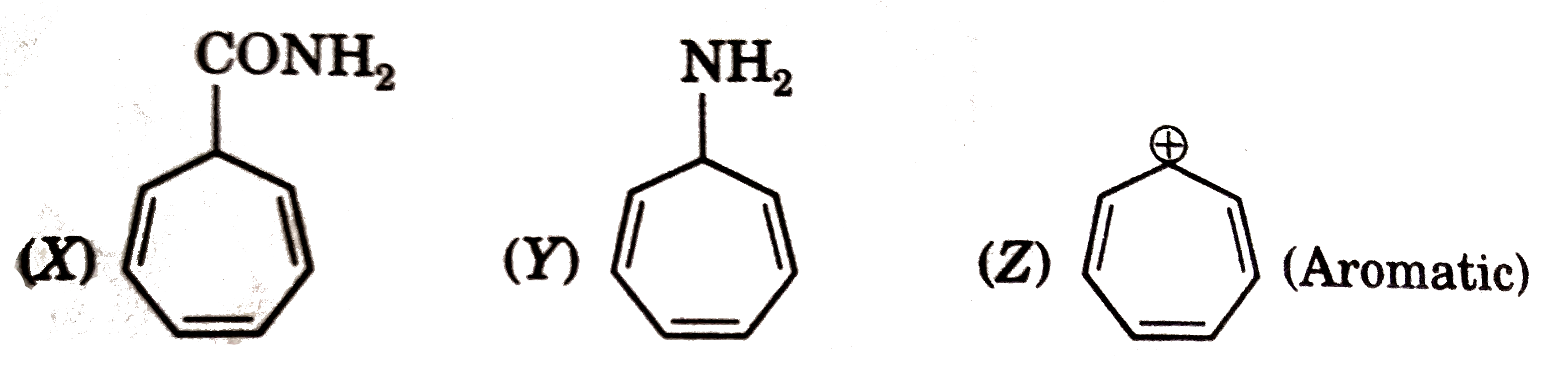
End product (Z) is obtained as : |
|
Answer»
|
|
| 26. |
End point//equivalence point of how many of the following titrations cannot be detected with the indicators given against them? {:(,"Titration","Indicator"),(i,KOH+HCN,"Methyl orange"),(ii,NaOH+HF,"Hin"(K_("In")=3xx10^(-4))),(iii,HNO_(3)+Sr(OH)_(2),"Phenol red"),(iv,HCIO_(4)+"Aniline","Methyl red"),(v,HCl+"Dimethyl amine","Hin"(K_("In")=5xx10^(-5))),(v,Ba(OH)_(2)+HNO_(2),"Phenolphthalein"),(vii,NaH_(2)PO_(2)+H_(2)SO_(4),InOH(K_("In")=3xx10^(-5))),(viii,"Pyridine"+"Benzoic acid","Phenol red"),(ix,KH_(3)BO_(3)+HI,"Methyl red"):} |
| Answer» Solution :(i),(II) &(VIII) are not matched with suitable indicators as the end point of these TITRATIONS doesn't lie within the `pH` range of the indicator. | |
| 27. |
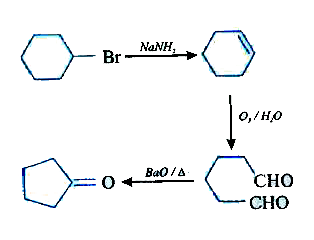
End product of following sequence of reaction is |
|
Answer»
|
|
| 28. |
End of detergents have |
|
Answer» Ester group |
|
| 29. |
Enantiomers have |
|
Answer» identical MELTING POINT/boiling point but DIFFERENT refractive indices |
|
| 30. |
Enantiomers can be better separated by: |
|
Answer» SALT FORMATION METHOD |
|
| 32. |
en is an example of a: |
|
Answer» Monodentate |
|
| 33. |
Emulsions are normally prepared by shaking the two components together vigorously although some kind of emulsifying agent usually has to added to stabilize the product. This emulsifying agent may be a soap or other surfactant (surface active) species or a lyophilic sol. Emulsions are broadly classified into two types : (i) Oil in water emulsions (O/W): Oil acts as dispersed phase and water acts as dispersion medium (ii) Water in oil emulsions (W/O) : Water acts as dispersed phase and oil acts as dispersion medium. Dye test, dilution test may be employed for identification of emulsions. Select correct statement : |
|
Answer» WATER in oil EMULSIONS are LESS VISCOUS than the aqueous emulsions |
|
| 34. |
Emulsions are normally prepared by shaking the two components together vigorously although some kind of emulsifying agent usually has to added to stabilize the product. This emulsifying agent may be a soap or other surfactant (surface active) species or a lyophilic sol. Emulsions are broadly classified into two types : (i) Oil in water emulsions (O/W): Oil acts as dispersed phase and water acts as dispersion medium (ii) Water in oil emulsions (W/O) : Water acts as dispersed phase and oil acts as dispersion medium. Dye test, dilution test may be employed for identification of emulsions. Read the two statements : A) Milk is an example of oil in water (O/W) type emulsion B) Cold cream is an example of water in oil (W/O) type emulsion |
|
Answer» Only statement (A) is correct |
|
| 35. |
Emulsifying agent used for O/W type emulsion is |
|
Answer» proteins |
|
| 37. |
Emulsifying agent is used for_______. |
|
Answer» PRECIPITATION of an EMULSION |
|
| 38. |
Emulsification of 10 mL of oil in water produces 2.4 xx10^(18) droplets. If the surface tension at the oil water interface is 0.03 J m^(-2)and area of each droplet is 12.5 xx10^(-6)m^(2), calculate the energy spent in the formation of oil droplets. |
|
Answer» Solution :TOTAL droplets `=2.4 xx10^(18)` Total area = Total no. of droplets `xx` Area of each drop `=(2.4xx10^(18))xx(12.5xx10^(-16))=12.5xx2.4xx10^(2)m^(2)` Total energy CONSUMED in the fomation of droplets `=(0.03Jm^(-2))xx(12.5xx2.4xx10^(2)m^(2))=90J` |
|
| 39. |
Emulsification of fat is brought about by: |
|
Answer» BILE pigment |
|
| 40. |
Empirical formulaof a hydrocarbon containing 80% carbon and 20% hydrogenis |
|
Answer» Solution :`{:("Element"," NO. of moles"," SIMPLE ratio"),(C80%,80//12=6.66,1),(H20%,20//1=20,3):}` Hence, EmpiricalFormula `= CH_(3)`. |
|
| 41. |
Empirical formula of a compound is CH_(2)O. If its vapour density is 90, then the molecular formula of the compound is |
|
Answer» `C_(5)H_(10)O_(5)` For other details see solution of QUESTION 42 |
|
| 42. |
Empirical formula of a compound is CH_(2)O and its vapourdensity is 30. Molecular formula of the compound is |
|
Answer» `C_(3)H_(6)O_(3)` Empirical formula mass `= 12 + 12 + 16 = 30` Mol.Mass`= 2 xx V.D. = 2 xx 30 = 60` `n = ("Mol.mass")/(" Empirical mass") = 60/30= 2` Molecular formula `= (" Empirical formula")_(n)` `= (CH_(2)O)_(2) = C_(2)H_(4)O_(2)`. |
|
| 43. |
Empricial formula of a compound is CH_(2)O and its molecular mass is 90, the molecular formula of the compound is |
|
Answer» `C_3H_6O_3` MOLECULAR mass = 90 N = molecular mass/emprical formula mass ` = 90/30 = 3` molecular formula ` = (CH_2O)_3 = C_3H_6O_3` . |
|
| 44. |
Empirical formula is the simplest formula of the compound which gives the atomic ratio of various elements present in one moleculeof the compound. However, the molecular formula of the compound gives the number of atoms of various elements present in one molecule of the compound. Molecular formula=(Empirical formula)xxn n=("Molecular mass")/("Empirical formula mass") A compound may have same empirical and molecular formulae Both these formulae are calculated by using percentage composition of constituent elements. A compound of Na, C and O contains 0.0887 mol Na, 0.132 mol O and 2.65xx10^(22) atoms of carbon . the empirical formula of the compound is: |
|
Answer» `NACO` |
|
| 45. |
Empirical formula is the simplest formula of the compound which gives the atomic ratio of various elements present in one moleculeof the compound. However, the molecular formula of the compound gives the number of atoms of various elements present in one molecule of the compound. Molecular formula=(Empirical formula)xxn n=("Molecular mass")/("Empirical formula mass") A compound may have same empirical and molecular formulae Both these formulae are calculated by using percentage composition of constituent elements. The pair of species having different percentage composition of carbon are: |
|
Answer» `CH_(3)COOH` and `C_(6)H_(12)O_(6)` |
|
| 46. |
Empirical formula is the simplest formula of the compound which gives the atomic ratio of various elements present in one moleculeof the compound. However, the molecular formula of the compound gives the number of atoms of various elements present in one molecule of the compound. Molecular formula=(Empirical formula)xxn n=("Molecular mass")/("Empirical formula mass") A compound may have same empirical and molecular formulae Both these formulae are calculated by using percentage composition of constituent elements. 10 g of hydrofluoric acid gas occupies 5.6 litres of volume at STP. if the empiriccal formula of the gas is HF, then its molecular formula in the gaseous state will be: |
| Answer» Answer :B | |
| 47. |
Empirical formula is the simplest formula of the compound which gives the atomic ratio of various elements present in one moleculeof the compound. However, the molecular formula of the compound gives the number of atoms of various elements present in one molecule of the compound. Molecular formula=(Empirical formula)xxn n=("Molecular mass")/("Empirical formula mass") A compound may have same empirical and molecular formulae Both these formulae are calculated by using percentage composition of constituent elements. Which of the following represents the formula of a substance which contains 50% oxygen? |
|
Answer» `N_(2)O` |
|
| 48. |
Empirical formula is the simplest formula of the compound which gives the atomic ratio of various elements present in one moleculeof the compound. However, the molecular formula of the compound gives the number of atoms of various elements present in one molecule of the compound. Molecular formula=(Empirical formula)xxn n=("Molecular mass")/("Empirical formula mass") A compound may have same empirical and molecular formulae Both these formulae are calculated by using percentage composition of constituent elements. An oxide of iodine (I=127) contains 25.4 g of iodine and 8 g of oxygen. its formula could be: |
|
Answer» `I_(2)O_(3)` |
|
| 49. |
Empirical formula is the simplest formula of the compound which gives the atomic ratio of various elements present in one moleculeof the compound. However, the molecular formula of the compound gives the number of atoms of various elements present in one molecule of the compound. Molecular formula=(Empirical formula)xxn n=("Molecular mass")/("Empirical formula mass") A compound may have same empirical and molecular formulae Both these formulae are calculated by using percentage composition of constituent elements. Which of the following compounds have same empirical formula? |
|
Answer» Formaldehyde |
|
| 50. |
Empirical formula is the simplest formula of the compound which gives the atomic ratio of various elements present in one moleculeof the compound. However, the molecular formula of the compound gives the number of atoms of various elements present in one molecule of the compound. Molecular formula=(Empirical formula)xxn n=("Molecular mass")/("Empirical formula mass") A compound may have same empirical and molecular formulae Both these formulae are calculated by using percentage composition of constituent elements. Two metallic oxides contain 27.6% and 30% oxygen respectively. if the formulae of first oxide is M_(3)O_(4), that of second will be: |
|
Answer» MO |
|