

Saved Bookmarks
This section includes 7 InterviewSolutions, each offering curated multiple-choice questions to sharpen your Current Affairs knowledge and support exam preparation. Choose a topic below to get started.
| 1. |
Detergents are prepared by the action of H_(2)SO_(4) followed by neutralization by starting with |
|
Answer» p-nitrophenol |
|
| 2. |
Detergents are better cleansing agent than soaps because : |
|
Answer» They WASH clothes better |
|
| 3. |
Detergents are advantageous over natural soaps. Explain. |
| Answer» Solution :Naturally occurring water contains dissolved materials, especially ionic substances. The presence of `Ca^(2+)` and `Mg^(2+)` IONS in water causes hardness to water. These ions of hard water produce a curdy white precipitate with SOAP. This precipitate adhers to CLOTH and the ability of soap to REMOVE grease and oil from FABRIC is decreased. However, if detergent is used, its anions are not precipitated by `Ca^(2+)` and `Mg^(2+)` ions of hard water. So, cleaning action of detergent is not influenced by hardwater. For this reason, detergents are advantageous than soaps. | |
| 4. |
Detergent is____. |
|
Answer» SODIUM STEARATE |
|
| 5. |
Detergent action of soaps and synthetic detergents is due to their: |
|
Answer» higher molecular weight |
|
| 6. |
Detection of Hydrogen Hydrogen is prevalent in the universe. Life in the universe is ultimately based on hydrogen. The electronic energy of a hydrogen atom is given by DeltaE(n_(1) rarr n)=-C(1//n_(1)^(2)-1//n_(1)^(2)), relative to zero energy at infinite separation between the electron and the proton (n is the principle quantum number, and C is a constant). For detection of the DeltaE=(3 rarr 2) transition (656.3 nm in the Balmer series), the electron in the ground state of the hydrogen atom needs to be excited first to the absorption line in the starlight corresponding to the DeltaE=(1 rarr 2) transition. |
|
Answer» DeltaE(1 rarr 2)=C (1//1-1//4)=0.75 C` `lambda(1 rarr 2)=(656.3)XX(0.1389//0.75)=121.5 nm` |
|
| 7. |
Detection of Hydrogen Hydrogen is prevalent in the universe. Life in the universe is ultimately based on hydrogen. Hydrogen in interstellar space cannot be excited electronically by starlight. However, the consmic background rediation, equivalent to 2.7 K can cause the hyperfine transition. Calculate the temperature of a blackbody whose peak intensity corresponds to the 1420 MHz transition. |
|
Answer» `T=2.9xx10^(-3) m K//0.21 m=0.014 K` |
|
| 8. |
Detection of Hydrogen Hydrogen is prevalent in the universe. Life in the universe is ultimately based on hydrogen. Wien generated hydrogen ions by discharge of hydrogen gas at a very low pressure and determine the e/m ("charge"//"mass") value, which turned out to be the highest among different gases tested. In 1919, Rutherford bombarded notrogen with alpha-particles and observed emission of a positively charged particle which turned out to be the hydrogen ion observed by Wien. Rutherford named this particle the ''proton''. Fill in the blank. ^(14)N+ ^(4)He rarr ............ + ^(1)H |
|
Answer» |
|
| 9. |
Detection of Hydrogen Hydrogen is prevalent in the universe. Life in the universe is ultimately based on hydrogen. The are about 1xx 10^(23) atars in the universe. Assume that they are like our sun (radius 700.000 km, density, 1.4 g//cm^(-3) 3//4 hydrogen and 1//4 helium by mass). Estimate the number of stellar protons in the universe to one significant figure. In the 1920s, Cecilia Payne discovered, by spectral analysis of starlight , that hydrogen is the most abundant element in most stars. |
|
Answer» Mass of protons of typical star `=(2xx10^(33)g)xx(3//4+1//8)=1.8xx10^(33) g` Number of protons of a typical star `=(1.8xx10^(33) g)xx(6XX10^(23) g^(-1))=1xx10^(57)` Number of stellar protons in the universe `=(1xx10^(57))xx(10^(23))=1xx10^(80)` SOL. |
|
| 10. |
Detection of Hydrogen Hydrogen is prevalent in the universe. Life in the universe is ultimately based on hydrogen. According to Wien's law, the wavelength (lambda) corresponding to the maximum light intensity emitted from a blackbody at temperature T is given by lambdaT=2.9xx10^(-3) mK. Calculate the surface temperature of a star whose blackbody radiation has a peak intensity corresponding to then n=1 rarr n=2 excitation of hydrogen. The ground state hydrogen is split into hyperfine levels due to the interaction between the magnetic moment of the proton and that of the electron. In 1951, Purcell discovered a spectral line at 1420 MHz due to the hyperfine transition of hydrogen in interstellar space. |
|
Answer» |
|
| 11. |
Despite having an aldehyde group : (a) Glucose does not give 2,4-DNP test. What does this indicate ? (b) Draw the Haworth structure of alpha-D-(+)-glucopyranose. (c) What is the significance of D and (+) here? |
|
Answer» Solution :(a) Thisis because- CHO is notfree in glucose. Itis bound. It isbound to - OH group in the CYCLIC structure . (b)  (C) D representsconfigurationof thecompound, i.e.,- OH group on firstchaial C atom fromthe bottomis downwards (+). signshowsthatit is dextrorotay i.e.,ROTATES the PLANE of polarised lightto the right . |
|
| 12. |
Desrible the variableoxidation stateof 3dserieselements . |
|
Answer» SOLUTION :(i)Thefirsttransitionmetalscandium exhibitsonly +3oxidatinstatebut allothertransitionelementsexhibitvariableoxidation statesby loosingelectrons from (n-1)orbitaland ns orbitalas the energydifferencebetweenthemis VERYSMALL. (ii)At the BEGINNINGOF theseries+3oxidationstateis stablebuttowardthe end+2oxidationstatebecomesstable. (iii) Thenumberof oxidationstatesincreaseswiththe NUMBEROF electronsavailableand itdecreasesas thenumberof pairedelectronsincreases. Hencethe firstand lastelementsshowlessnumberof oxidationstatesandthe middleelementswith morenumberof OXIDATIONSTATES. |
|
| 13. |
Desnsity ratio of O_2 and H_2 is 16:1 . The ratio of its V_(rms) is : |
|
Answer» 4:1 |
|
| 14. |
Design the cell having one of the half reaction CuS + 2e rarr Cu + S^(2-) and cell reaction CuS+2e rarr Cu+S^(2-) Also calculate E_(Cu//CuS)^(@) if K_(SP) of Cu = 8.5 xx 10^(-36). Calculate the standard free energy change, E_(cell)^(@) for the cell reaction. (Also given E_(Cu//Cu^(2+))^(@) = -0.34 V) |
|
Answer» |
|
| 15. |
Desigate the following double bonds as E, Z or none (N) configuration in the boxes provided below. |
|
Answer» 2-N , 3-E |
|
| 16. |
Deseribe about the oxidation reaction of ethylene glycol with dilute nitric acid. |
Answer» Solution :When dilute NITRIC acid (or) ALKALINE KMnO, is USED as the oxidizing AGENT, the following products are formed.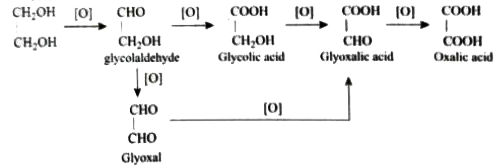
|
|
| 17. |
Describlewhatdo you understand by primary structureand secondary structure ofproteins. |
|
Answer» Solution :PRIMARY structure : Each POLYPEPTIDE in a protein has amino acids linkedto oneanother in a specific sequence . It is thesequenceofaminoacidsin a protein thatwe call asthe primarystructure. Secondary structure: Thesecondary strctureof protein REFERS to the shapein WHICHA longpolypeptide CHAIN can exist. |
|
| 18. |
Describletwo importantfunctionofnucleicacid . |
|
Answer» Solution :TWO importantof nucleicaccid are : (i) They direct PROTEIN synthesis.(II) They TRANSFER hereditory characteristics. |
|
| 19. |
(a) Describe the preparation of potassium dichromate. |
|
Answer» Solution :Potassiumdichromate ispreparedfromchromate ore.Theore isconcentrated by gravityseparation . It ismixedwithexcesssodiumcarbonateandlimeandroastedin areverbratoryfurnace . `4FeCr_(2) O_(4) + 8Na_(2) CO_(3)+ 7O_(2) overset(900 - 100^(@)C(to)` Theroasted massis treated withwaterto separatesolublesodiumchromatefrominsolubleironoxide. They yellossolution of sodium chromate istreatedwith conc. sulphuricacid whichconvertssodiumchromateintosodiumdichromate . `2Na_(2) CrO_(4) + H_(2) SO_(4) toNa_(2) Cr_(2) O_(3) + Na_(2) SO_(4) + H_(2) O` Theabovesolutionis concentrated to removelesssolublesodium sulphate . theresultingsolutionis filteredand furtherconcentrated . It iscooledto getthecrystalsof `Na_(2) SO_(4) 2H_(2)O`. Thesaturatedsolutionof sodiumdichromate in water in mixedwith KCIand thencon.centreatedto getcrystalof NaCI. It is filteredwhilehot andfilratecooledto OBTAIN`K_(2) Cr_(2) O_(7)` crystals. |
|
| 20. |
Explain the manufacture of nitric acid by Ostwald's process. |
|
Answer» Solution :This method is based upon catalytic oxidation of `NH_(3)` by atmospheric OXYGEN. `4NH_(3)(g)+5O_(2)(g)overset("Pt/Ph gauze catalyst")underset("500 K, 9 bar")rarr 4NO(g)+6H_(2)O(g)` Nitric oxide THUS formed COMBINES with oxygen giving `NO_(2)`. `2NO(g)+O_(2)(g)rarr 2NO_(2)(g)` Nitrogen dioxide os formed, dissolves in water to give `HNO_(3)`. `3NO_(2)(g)+H_(2)O(l)rarr 2HNO_(3)(aq)+NO(g)` NO thus formed is recycled and the aqueous `HNO_(3)` can be concentrated by DISTILLATION. |
|
| 21. |
Describle the following :(i) Glycosidiclinkage(ii) Peptidelinkage . |
Answer» Solution :(i) In DISACCHARIDES , TWO monosaccharides are joined togetherby an oxide linkageformed BYTHE loss of a WATERMOLECULE. SUCHA linkagebetweentwomonosaccharideunitsthrough oxygen atom is called glycosidiclinakge . 
|
|
| 22. |
Describe with an example of each, the role of coordination compounds in : (i) Biological System (ii) Analytical Chemistry (iii) Medicinal Chemistry |
|
Answer» SOLUTION :(i) Vit. B-12, it is a antipernicious ANEMIA factor. (ii) Determining and ESTIMATION of metal. (iii) EDTA is used in LEAD poisioning. |
|
| 23. |
Describe what do you understand by primary structure and secondary structure of proteins. |
|
Answer» Solution :Primary structure of proteins : The protein in which amino acids LINKED with each other in a SPECIFIC sequence is SAID to be the primary structure of that protein. SECONDARY structure of proteins : It refers to the shape in which a long polypeptide chain can exist i.e., `alpha`-helix and `beta-`pleated structure. |
|
| 24. |
Describe two important functions of nucleic acids. |
|
Answer» Solution :(i) DNA is responsible for tranfer of HEREDITY information from ONE generation to another. (ii) RNA is responsible for protein SYNTHESIS. |
|
| 25. |
Describe the variable oxidation state of 3d series elements. |
|
Answer» SOLUTION :(i) The first transition metal Scandium exhibits only +3 OXIDATION state, but all other transition ELEMENTS exhibit variable oxidation states by loosing ELECTRONS from (n-1) d orbital and ns orbital as the energy difference between them is very small. (ii) At the beginning of the 3d series, +3 oxidation state is stable but towards the end +2 oxidation state becomes stable. (iii) The number of oxidation states increases with the number of electrons available, and it decreases as the number of paired electrons increases. For example, in the 3d series, first element Sc has only one oxidation state +3, the middle element Mn has SIX different oxidation states from +2 to +7. The last element Cu shows +1 and +2 oxidation states only (iv) `Mn^(2+)(3d^(5))` is more stable than`Mn^(4+)(3d^(3))` is due to half filled stable configuration |
|
| 26. |
Describe tricliniccrystal lattice with tha help of a diagram. |
Answer» Solution : The three edges (sides ) are of unequal LENGTHS and all angles are different butnone is perpendicular to any of the others . 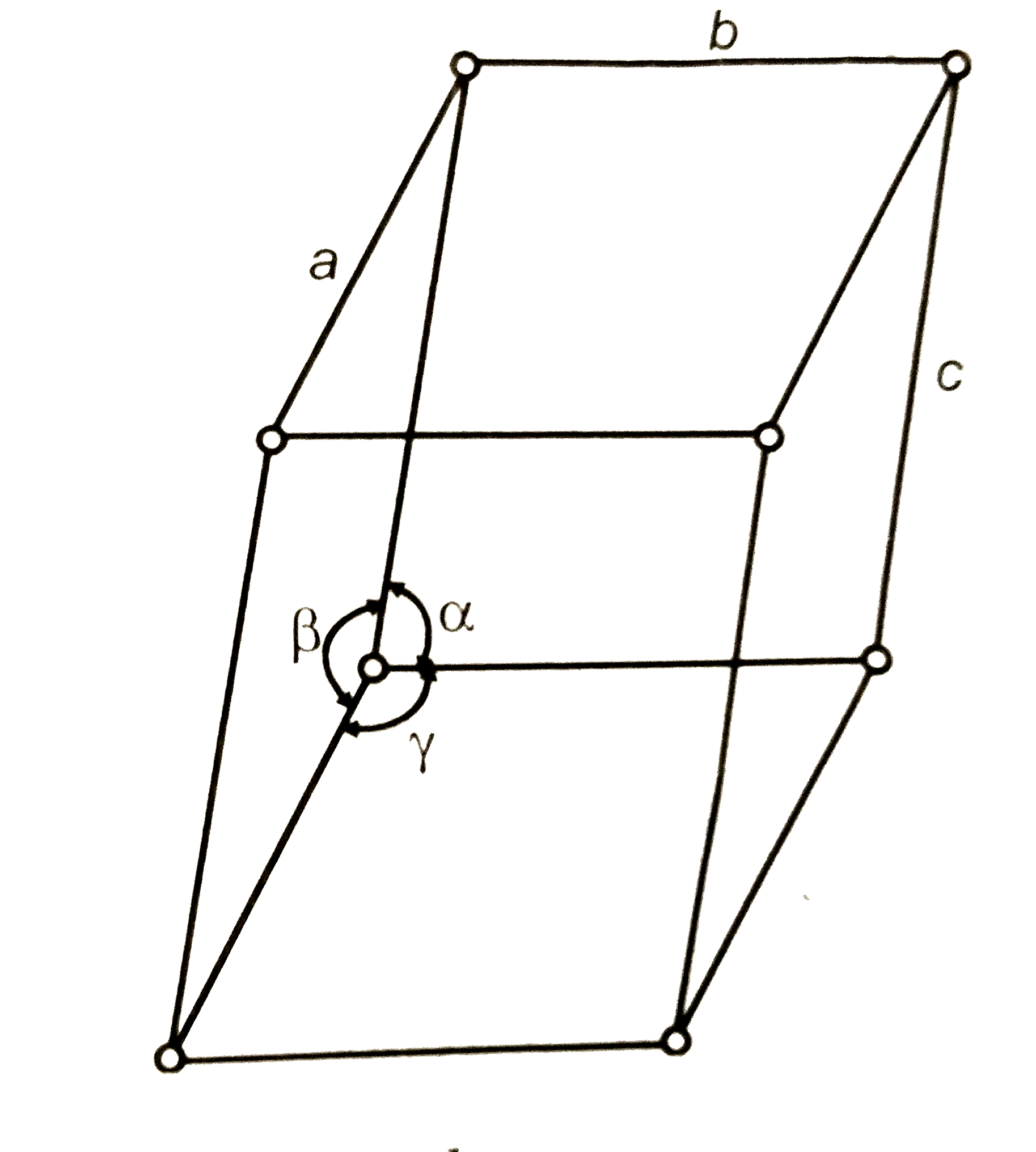 Edges :` a != b != C` Angles:` alpha != beta !=gamma != 90^(@)` EG : `CuSO_(4) * 5H_(2)O` `K_(2)Cr_(2)O_(7), H_(3)BO_(3)` |
|
| 27. |
Describe the underlying principle of each of the following processes : (i) Recovery of silver from the solution obtained by leaching silber ore with a solution of NaCN (ii) Electrolytic refining of crude metal. |
|
Answer» Solution :(i) N/A (ii) Electrolytic refining : In this, method, the impure metal is made to act as anode. A STRIP of the same metal in pure FORM is USED as Cathode. They are put in a suitable elecrtolyte both containing solulbe salt of the same metal. The more basic metal remains in the solutions and the less basic ones go to the anode mud. The rections are : Anode : `M to M^(n+) + "ne"^(-)` Cathode : `M^(n+) +" ne"^(-) to M` Copper and ZINC are refined by this method. |
|
| 28. |
Describe the underlying principle of each of the following metal refining methods : Vapour phase refining of metals. |
|
Answer» Solution :This method is used for preparing ultrapure metals. In this method, the impure metal is first converted into a volatile stable compound (GENERALLY iodide) leaving behind the impurities. It is then decomposed at a higher temperature to give pure metal. Metals like titanium, thorium, URANIUM and ZIRCONIUM are purified. `{:(Ti+2I_(2)overset(500K)(to)TiI_(4)overset(1700K)(to)Ti+2I_(2)),(" Impure metal Volatile compound Pure metal "):}`. |
|
| 29. |
Describe the underlying principle of each of the following metal refining methods : Electrolytic refining of metals. |
| Answer» Solution :This method is used for the REFINING of Ag, Au, Cu, Zn, Ni, Cr, etc. In this method, impure metal forms the anode while a thin plate of PURE metal acts as cathode. The ELECTROLYTIC solution consists of soluble salt of the metal. On passing electric CURRENT, the pure metal gets deposited on the cathode and insoluble impurities settle down at the anode in the form of anode mud. | |
| 30. |
Describe the types of colloids. Give one example of each. |
| Answer» | |
| 31. |
Describe the three steps involved in the leaching of bauxite to get pure alumina (equations not expected). |
|
Answer» Solution :Baeyer.s process is one of the methods used. (a) This method involves the digesting or powdered bauxite ore with concentrated NaOH at 473 - 523 K and 35 - 36 bar pressure. `Al_2O_3` is leached out as sodium aluminate (and `SiO_2` too as sodium silicate) leaving the impurities behind, `UNDERSET("bauxite")(Al_2O_3(S)+2NaOH(aq)+3H_2O(I))tounderset("Sodium aluminate")(2Na[Al(OH)_4](aq))` (B) Now `CO_2` gas is PASSED through the solution and a small amount of freshly prepared hydrated aluminium oxide is also added in order in induce the precipitation. `2Na[Al(OH)_4](aq)+CO_2(aq)tounderset("Hydrated aluminium oxide ppt")Al_2O_3.xH_2O(s)+2NaHCO_2(aq)` (c) The impurities of silica remain in the solution and the precipitate. formed is-filtered, washed, dried and ignited to produce pure alumina. `Al_2O_3,xH_2O(s)tooverset(1470K)toAl_2O_3(s)+xH_2O(g)` |
|
| 32. |
Describe the term D- and L-configuration used for amion acids with examples. |
|
Answer» Solution :Consider the following CONFIGURATIONS (I and II) of `alpha`-amino acids `H_(2)N-UNDERSET("L-Amino acid")underset(I)underset(R)underset(|)overset(COOH)overset(|alpha)(C)-H` `H-underset("D-Amino acid")underset(II)underset(R)underset(|)overset(COOH)overset(alpha|)(C)-NH_(2)` If the `NH_2` group on the `alpha` CARBON is ORIENTED towards left (as in structure I), it is REFERRED to as L- amino acid and if `NH_2` group is oriented towards right (as in structure II), it is referred to as D-amino acid. |
|
| 33. |
Describe the three steps involved in the leaching of bauxite toget pure alumina. |
|
Answer» Solution :Step.1: The ore of aluminium is bauxite. Bauxite is contaminated with several impurities such as Silica `(SiO_(2))`, iron oxide and TITANIUM oxide`(TiO_(2))`. Concentration is carried out by digesting the powder ore with corfcentrated NaOH solution at 473523K and pressure of 35-36 bars. `Al_(2)O_(3)` is leached out as sodium aluminate and `SiO_(2)` as sodium silicate leaving behind the impurities. `Al_(2)O_(3)2H_(2)O_((s))+2NaOH_((aq))rarr2Na[Al(OH)_(4)]_((aq))` Step.2: The sodium aluminate is neutralised by passing CARBON dioxide gas and hydrated `Al_(2)O_(3)` is ppt. The solution is treated with fresh hydrated alumina which induces precipitation `2Na[Al(OH)_(4)]_((aq))+CO_(2(g))rarr Al_(2)O_(3).xH_(2)O_((s))+2NaHCO_(3(aq))` Step.3: The sodium silicate remains in the solution and hydrated alumina is filtered, dried and heated to give PURE alumina. `Al_(2)O_(3).xH_(2)O_((s))overset(1470K)rarr Al_(2)O_(3(s))+x.H_(2)O_((s))` |
|
| 34. |
Describe the term D- and L- configuration used for the amino acids with examples. |
Answer» Solution :Naturally, the amino ACIDS have L-configuration. All the amino acids except glycine are OPTICALLY active. The `-NH_(2)` group is written on LEFT hand side. It is COMPARABLE to `(-)` isomer of glyceraldehyde. 
|
|
| 35. |
Describe the structuure of graphite. |
|
Answer» Solution :(i) Graphite is the most stable allotropic form of carbon at normal temperature and PRESSURE. (ii) It is soft and conducts electricity. It is composed of flat two dimensional sheets of carbon atoms. (iii) Each sheet is a hexagonal net of `sp^(2)` hybridised carbon atoms with a C-C bond lengthh of `1.41Å` which is CLOSE to the C-C bond distance in benzene `(1.40Å)`. (iv) Each carbon atom forms three `sigma` BONDS with three neighhbouring carbon atoms USING three of its valence electrons and the fourth electron present in the unhybridised p orbittal forms a `pi`-bond. (v) These `pi` electrons are delocalised over the entire sheet which is responsible for its ELECTRICAL conductivity. (vi) The successive carbon sheets are held togethher by weak vander Waals forces. The distance between successive sheet is `3.40Å`. (vii) It is used as a lubricant either on its own or as a graphited oil. |
|
| 36. |
Describe the structuure of diamond. |
|
Answer» Solution :(i) Diamond is very hard. (ii) The carbon atoms in diamond are `sp^(3)` hybridised and bonded to four neighbouring carbon atoms by `SIGMA` bonds with a C-C bond LENGTH of `1.54Å`. (iii) This results in a tetrahedral arrangement around each carbon atom the extends to the entire lattice. (iv) Since all four valance electrons of carbon are involved in bonding there is no free electrons for CONDUCTIVITY. (v) Being the hardest element, it used for sharpening hard tools, cutting GLASSES, making bores and rock drilling. |
|
| 37. |
Describe the structure of diborane. |
Answer» Solution :In doborane two `BH_(2)` units are linked by two BRIDGED hydroens. Therefore, it has EIGHT B-H bonds. However, diborane has only 12 valance electrons and are not sufficient to form NORMAL covalent bonds. The four terminal B-H bonds are normal covalent bonds (two centre- two electron bond or 2 c-2e bond). THe remianing four electrons have to used for the bridged bonds. i.e. two three centred B-H-B bonds utilise two electrons each. Hence, these bonds are three centre two electron bonds. THe bridging hydrogen atoms are in a plane as shown in the figure. In diborne, teh boron is `sp^(3)` hybrodised. Three of the four `sp^(3)` hybrodised orbitals contains single electron and the fourthorbital is EMPTY. Two of the half filled hybridised orbitals of each boron overlap wit the two hydrogens to form four terminal 2c-2e bonds, leaving one empty and one half filled hybridised orbitals on each boron. THe three centre two electron bonds, B-H-B bond formation involves overlapping the half filled hybridised orbital of one boron, the empty hybridised orbital of the other boron and the half filled 1S orbital of hydrogen. 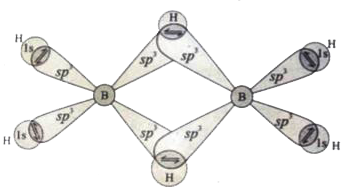
|
|
| 38. |
Describe the structure of fullerenes. |
|
Answer» Solution :(i) Fullerenes are NEWLY synthesised allotropes of carbon. (ii) Unlike graphite and diamond, these allotropes are discrete molecules such as `C_(32),C_(50),C_(60),C_(70),C_(76)` etc.. (iii) These molecules have cage LIKE structures. (iv) The `C_(60)` molecules have a soccer ball like structure and is called buckminster fullerene or buckyballs. (v) It has a fused ring structure consists of 20 six membered rings and 12 FIVE memebered rings. (vi) Each carbon atom is `SP^(2)` hybridised and forms three `sigma` bonds & a delocalised `pi` bond giving aromatic character to these molecules. (vii) The C-C bond distance is `1.44Å` and C = C distance `1.38Å`. |
|
| 39. |
Describe the structure of graphene. |
|
Answer» Solution :(i) GRAPHENE is an allotrophic from of CARBON. (ii) It has a single planar sheet of `sp^(2)` hybridised carbon atoms that are densely PACKED in a honeycomb crystal lattice. |
|
| 40. |
Describe the structure of carbon nanotubes. |
|
Answer» SOLUTION :(i) Carbon nanotubes, have graphite like tubes with fullerene ends. (II) Along the axis, these nanotubes are stronger than steel and CONDUCT electricity. (iii) These have many applications in nanoscale ELECTRONICS, CATALYSIS, polymers and medicine. |
|
| 41. |
Describe the structure of amines |
| Answer» Solution :In amines CENTRAL atom nitrogen is `sp^(2)` hybridised. Due to PRESENCE of a LONE pair of electron on N - atom amines are pyramidal in shape. | |
| 42. |
Describe the structureof diborane . |
|
Answer» Solution :(i) In diborane two `BH_(2)` units are linked by two bridged hydrogens. Therefore, it has eight B-H bonds. (ii) However, diborane has only 12 valance electrons and are not SUFFICIENT to form normal covalent bonds. (iii) The four terminal B-H bonds are normal covalent bonds (two centre - two electron bond or 2C - 2e bond). (IV) The remaining four electrons have to be used for the bridged bonds. i.e. two three centred B-H-B bonds utilise two electrons each. (v) Hence, these bonds are three centre - two electron bonds (3c - 2e). The bridging hydrogen atoms are in a plane as shown in the figure. In diborne, the boron is `sp_(3)` hybridised. Three of the four sp3 hybridised orbitals contains single electron and the fourth orbital is empty. (vii) Two of the half filled hybridised orbitals of each boron overlap with the two hydrogens to form four terminal 2c-2e bonds, leaving ONE empty and one half filled hybridised orbitals on each boron. (viii) The three centre - two electron bonds), B-H-B bond formation involves OVERLAPPING the half filled hybridised orbital of one boron, the empty hybridised orbital of the other boron and the half filled 1s orbital of hydrogen. 
|
|
| 43. |
Describe The shape and magnetic behaviour of following complexes : (i) [Co(NH_(3))_(6)]^(3+) (ii) [Ni(CN)_(4)]^(2-).(At.No.Co=27,Ni=28) |
| Answer» SOLUTION :`{:("S.No","Shape","MAGNETIC behaviour"),("(i)","Octahedral","Diamagnetic"),("(ii)","SQUARE PLANER","Diamagnetic"):}` | |
| 44. |
Describe the role of the following : NaCN in the extraction of silver from a silver ore. |
|
Answer» Solution :In this method, the silver ORE is concentrated by CHEMICAL reaction with sodium cyanide which dissolves silver. `{:(Ag_(2)S+4NaCN to 2Na[Ag(CN)_(2)]+Na_(2)S),(" SIVER sulphideSodium argentocyanide "):}` Sodium argentocyanide is treated with zinc metal to OBTAIN pure silver metal. `2Na[Ag(CN)_(2)] +Zn to 2Ag+ Na_(2)[Zn(CN)_(4)]`. |
|
| 45. |
Describe the salient features of the collision theory of reaction rates of bimolecular reactions. |
|
Answer» Solution :COLLISION theory of reaction rate bimolecular reactions salient features. `to` The reaction molecules are assumed to be hard SPHERES `to` The reaction is postulated to occur when molecules colloide with each other. `to` The number of collision per second per unit volume of the reactin maxture is KNOWN as collision frequency (Z). `to` For a bimolecular elementary reaction `A+B to` products Rate `=Z_(AB). e^(-E_(a)//RT),Z _(AB)=` collision frequency. `to` All COLLISIONS do not lead to product formation. `to` The collisions with sufficient kinetic energy (Threshold energy) are respnsible for product formation. These are CALLED as effective collisions. `to` To account for effective collisios a factor p called to probability factor or steric factor is introduced. Rate `=P Z_(AB), e^(-E_(a)//RT)` |
|
| 46. |
Describe the role of the following in the process metioned. (i)Silica in the extraction of copper. (ii)Cryolite in the extraction of aluminium. (iii)Iodine in the refining of Ziroconium. (iv)Sodium cyanide in froth floatation. |
|
Answer» Solution :(i)The role ofsilica in the extraction of copper is to remove the iron oxide obtained during the process of roasting as slag.If the sulphide ore of copper CONTAINS iron,the SILICA `(SiO_(2))` is added as flux before roasting.Then,FeO combines with silic to form iron silicate `FeSiO_(3)` (slag) . (ii)Cryolite reduces the melting point of `Al_(2)O_(3)` and increases its electrical conductivity. Aluminium is not an electrolyte.So it is made as an electrolyte by DISSOLVING it in the fused cryolite. The function of cryolite is to lower the fusion temprature. (iii)Zircomim CRUDE metal is heated with iodine in an evacuated vapour to separate from impurities and this decomposes at 1800 K to give a pure zirconium metal and iodine.Initially iodine is heated with zirconium to form a volatile compound. (iv)Sulphide ores which are concentrated by the forth floatation process. Depressants are used to prevent certain type to particles from FORMING the forth. NaCN act as a depressant to separate ZnS from pbS. |
|
| 47. |
Describe the role of the following in the process mentioned. Sodium cyanide in froth floatation. |
| Answer» SOLUTION :SODIUM ethyl xanthate in froth FLOATATION ACTS as a collector. | |
| 48. |
Describe the role of the following in the process mentioned. Iodine in the refining of Zirconium. |
| Answer» SOLUTION :To form a volatile COMPOUND which on further HEATING DECOMPOSES to give PURE Zn. | |
| 49. |
Describe the role of the following in the process mentioned. Silica in the extraction of copper. |
| Answer» Solution :Silica an ACIDIC FLUX is USED to REMOVE SLAG during the process of roasting. | |