

Saved Bookmarks
This section includes 7 InterviewSolutions, each offering curated multiple-choice questions to sharpen your Current Affairs knowledge and support exam preparation. Choose a topic below to get started.
| 1. |
Describe the role of the following : Cryolite in the extraction of aluminium from pure alumina. |
| Answer» Solution :CRYOLITE lowers the melting point and increases the conductivity of ALUMINA and THUS helps in the PROCESS of extraction of aluminium. | |
| 2. |
Describe the role of soap as emulsifier. |
| Answer» Solution :The SOAP reduces the interfacial TENSION between dirt (OIL) and water and form a stable oil in water type emulsion and thus removes dirt from the CLOTH. | |
| 3. |
Describe the role of Sodium cyanide in froth floatation. |
|
Answer» Solution :Sulphide ores are concentrated by the froth floatation process. DEPRESSANTS are used to prevent certain type of particles from forming the froth. NaCN act as a depressant to SEPARATE ZNS from PbS. |
|
| 4. |
Describe the role of SiO_(2) in the extraction of Cu from Copper matte. |
|
Answer» Solution :(i) COPPER is EXTRACTED FORM copper matte which contains iron as impurity. (ii) Silica is ADDED to remove this impurity as iron silicate in the form of FUSIBLE slag. |
|
| 5. |
Describe the role of SiO_(2) in the extraction of copper from copper matte. Write chemical equations for the involved reactions. |
|
Answer» Solution :Copper matte is charged into silica line CONVERTOR and hot air is blown. The following reactions take place : `{:(2FeS+3O_(2) to 2FeO+2SO_(2)),(FeO+SiO_(2) to FeSiO_(3)),(2Cu_(2)S +3O_(2)to 2Cu_(2)O+ 2SO_(2)),(2Cu_(2)O +Cu_(2)S to 6Cu+SO_(2)):}` We obtain BLISTER copper due to the EVOLATION of `SO_2`. |
|
| 6. |
Describe the role of Iodine in the refining of zirconium. Write chemical equations for the involved reactions. |
|
Answer» Solution :Pure ziroconium can be obtained from IMPURE Zr by van Arkel method. Crude Zr is heatedin an evacuated vessal with iodine. The metal iodide being covalent volatilises. `Zr +2I_(2) to ZrI_(4)` The metal iodide is heated on a TUNGSTEN filament, electrically heated to about 1800 K. Pure metal is DEPOSITED on the filament. `ZrI_(4) to Zr +2I_(2)`. |
|
| 7. |
Describe the role of NaCN in the extraction of gold from gold ore. Write chemical equations for the involved reactions. |
|
Answer» SOLUTION :Gold is leached with a solution of NaCN in the presence of AIR (for `O_2`) from which the metal is OBTAINED later by displacement. `4Au (s) +8CN^(-) (aq) +2H_(2)O +O_(2)(g) to 4[AU(CN)_(2)]^(-) (aq) +4OH^(-) (aq)` `2[Au(CN)_(2)]^(-) (aq) +Zn (s) to [Zn (CN)_(4)]^(2-) (aq) +2Au (s)`. |
|
| 8. |
Describe the role of (i) NaCN in the extraction of gold from gold ore. (ii) SiO_(2) in the extraction of copper from copper matter. (iii) Iodine in the refining of zirconium. Write chemical equations for the involved reactions. |
|
Answer» Solution :(i) ROLE of NaCN in the EXTRACTION of gold is to do leaching of gold ore in the pressence of air from which the gold is obtained LATER by replacement. `4Au(s)+8CN^(-)(aq)+2 H_(2)O+O_(2)(g) rightarrow 4[Au(CN)_(2)]^(-)+4 OH^(-)` (ii) `SiO_(2)` is added in copper matter to convert the remainingFeS, FeO to slag `FeO+Si O_(2) rightarrow underset(("slag")) (Fe Si O_(3))` (III) Iodine is heated with Zirconium to form a volatile-compound which on further HEATING decompose to give pure zirconium `Zr(impure)+2 I_(2)rightarrowZr I_(4)` `Zr I_(4) rightarrow Zr(pure)+2 I_(2)` |
|
| 9. |
Differentiate the processes annealing and hardening. |
|
Answer» SOLUTION :Annealing: It is a process to free STEEL from internal stress. The steel is heated to BRIGHT red heat and then gradually cooled. The restultant steel is soft and pliable. HARDENING: By this process steel can be made more hard and brittle. Steel is heated to bright red heat and then immersed in cold water. The restultant steel is hard and brittle GLASS. |
|
| 10. |
Describe the principle involved in each of the following processes of metallurgy : (i) Froth floatation method (ii) Electrolytic refining of metals (iii) Zone refining of metals |
|
Answer» Solution :(i) Forth floatation method : The method has been in use for removing gangue from sulphide ores. In this process, a SUSPENSION of thepowdered ore is made with water. To it , collectors and froth stabilisers are added. Collectors (e.g., pine oils, fatty acids, xanthates, etc.) enhance non-wettability of the mineral particles and froth stabilisers (e.g., Cresols,aniline) stabilise the froth. Themineral particles become wet by oils while the gangue particles bywater. A rotatingpaddle agitates themixture and draws air in it . As a RESULT, froth is formed which carries the mineral particles. The froth is light and is skimmed off. It is them dried for recovery of the ore particles. (ii) Electrolytic refining of metals: In this method, theimpure metal is made to act anode. A STRIP of thesame metal in pure form is used as Cathode. They are put in a suitable electrolyte both containing soluble salt of the same metal. The morebasic metal remains in the solution and the less basic ones go to the anode mud. Thereactions are Anode : ` M to M^(n+) +" ne"^(-)` Cathode : ` M^(n+) + "ne"^(-) to M` Copper and zinc are REFINED by this method. (iii) Zone refining of metals : This method is based on the principle that impurities are more soluble in themelt than in thesolid state of the metal. A circular mobile heater is fixed at one end of therod of the IMPURE metal. The molten zonemoves along withthe heater which is moved forward. As theheater moves forward,the pure metal crystalises out of meltand theimpurities pass on into the adjacent molten zone. This process is repeated several times and the heater is moved in the same direction.At one end, impurities concentrated. 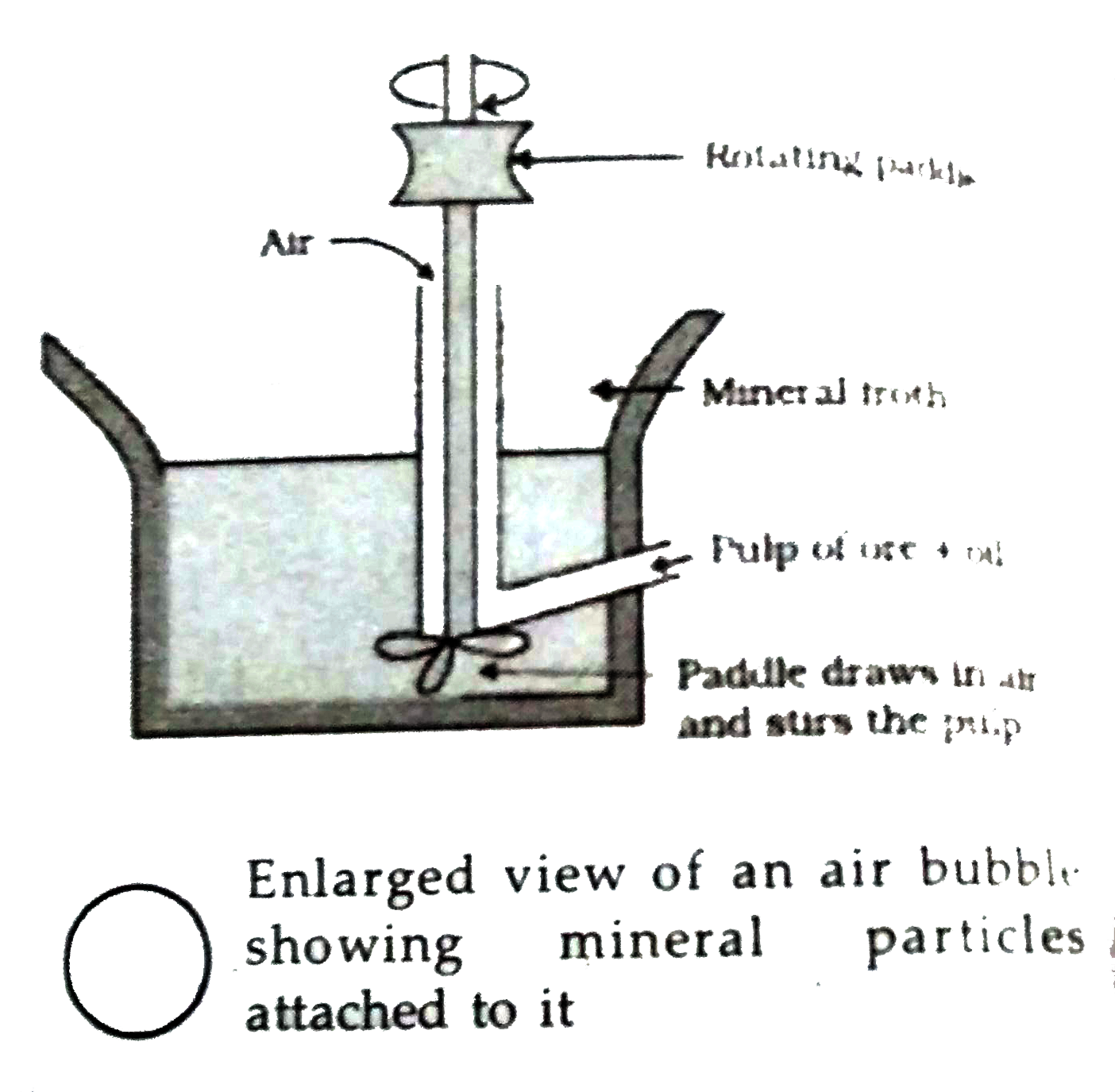 This method is very useful for producingsemiconductor and other metals of very high purity likegermanium, silicon, boron etc. 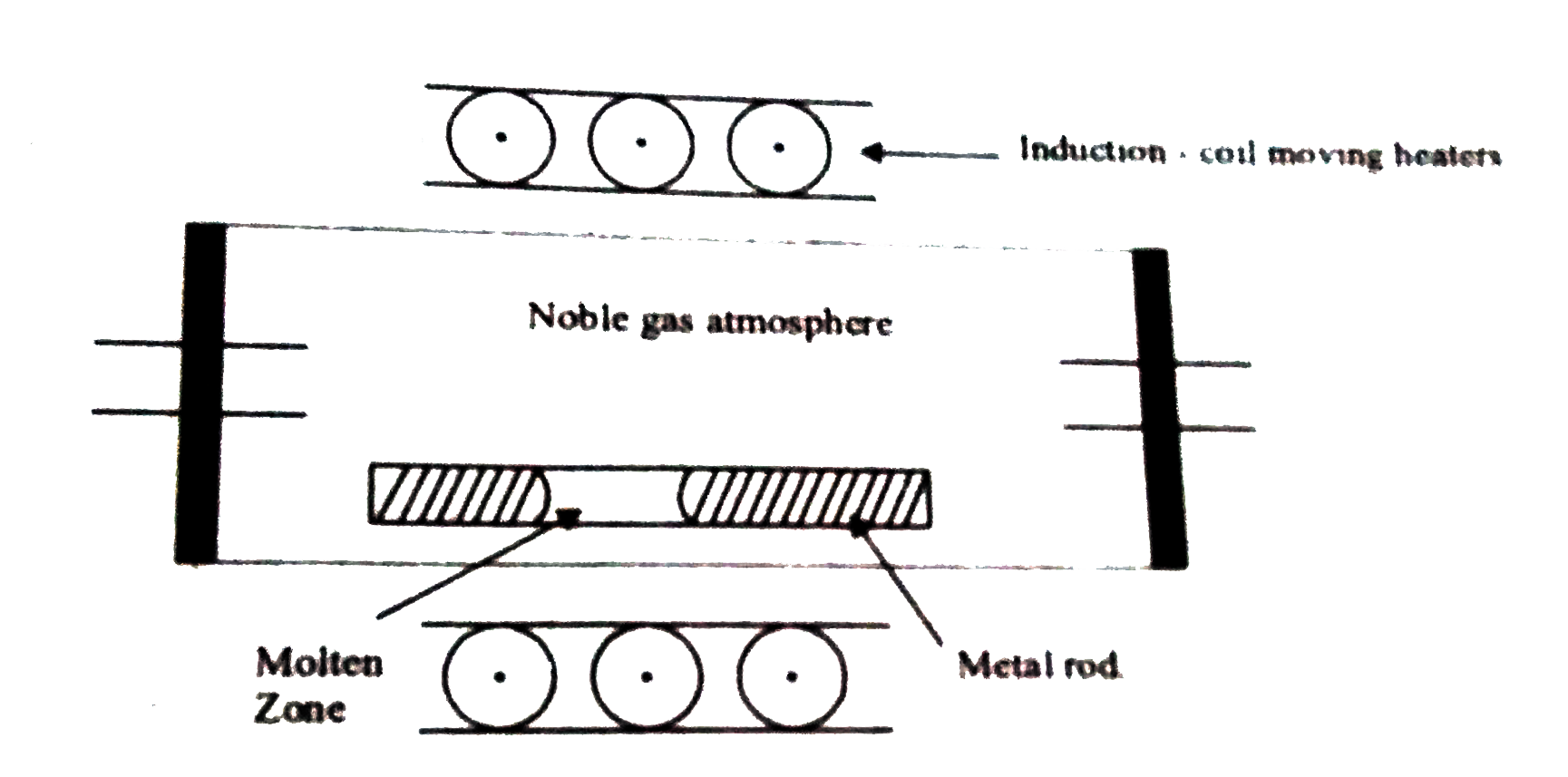
|
|
| 11. |
Describe the principle of froth floatation process. What is the role of a stabiliser and of a depressant ? Give one example each. |
|
Answer» Solution :Froth floatation PROCESS WORKS on the principle that the mineral particles are more wetted by oils and the gangue particles by water. Stabilisers are those substances which stabilise the froth. Cresol and aniline are examples of stabilisers. The DEPRESSANTS are USED to prevent certain TYPE of particles from forming the froth, e.g., sodium cyanide prevents ZnS from forming the froth. Only PbS comes to the foam and is thus separated from ZnS. 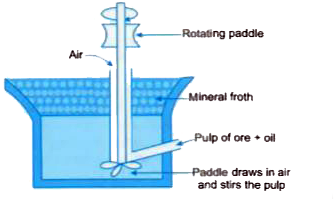
|
|
| 12. |
Describe the principle involved in each of the following processes : Mond's process for refining of nickel. |
|
Answer» Solution :This method is BASED on the FACT that certain metals are CONVERTED to their volatile compounds while the impurities are not affected during compound formation. The compound formed gives the puremetal on heating. Nickel is REFINED as under : `{:(Ni+4CO OVERSET(330-350K)(to)Ni (CO)_(4)overset(450-470K)(to)Ni+ 4CO),("VolatilePure "):}`. |
|
| 13. |
Describe the principle involved in each of the following processes : (i) Zone refining of a metal (ii) Vapour phase refining of metals |
|
Answer» Solution :(i) Zone refining : This METHOD is BASED on the principle that the IMPURITIES are more SOLUBLE in the melt than in the solid state of the METAL. (ii) N/A |
|
| 14. |
Describe the principle involved in each of the following processes : Column chromatography for purification or rare elements. |
| Answer» Solution :This method is based on the principle that DIFFERENT components of a mixutre are differently adsorbed on an adsorbent. The mixture is put in a liquid or gaseous MEDIUM which is moved through the adsorbent at different LEVELS on the column. LATER the adsorbed components are REMOVED (eluted) by using suitable solvents (eluents). | |
| 15. |
Describe the principle controlling each of the following processes : Vapour phase refining of titanium metal. |
|
Answer» Solution :In this method, the metal is converted into its volatile compound and collected elsewhere. It is then decomposed to give pure metal. The REQUIREMENTS are : (i) The metal should form a volatile compound with an EASILY available reagent. (ii) The volatile compound should be easily decomposable, so that the recovery of the metal is easy. Titanium is PURIFIED using this principle. Titanium is REACTED with iodine to form volatile titanium iodine which is then decomposed on TUNGSTEN filament at 1800K. `Ti +2I_(2) to TiI_(4)` `TiI_(4) overset(1800K) (to) Ti +2I_(2)`. |
|
| 16. |
Describe the principle controlling each of the following processes : Zone refining of metals. |
| Answer» Solution :This METHOD is based on the principle that the impurities are more soluble in the melt than in the solid state of the metal. A circular mobile heater is FIXED at one END of a rod of the impure metal. The molten zone moves along with the heater. As the heater moves forward, the pure metal CRYSTALLISES out of the melt and impurities pass on into the adjacent molten zone. The process is repeated several times. The impurities get concentrated at one end. This end is cut off. | |
| 17. |
Describe the principle controlling the extraction of cast iron from pig iron. |
| Answer» Solution :Cast iron has slightly less carbon content (3%) compared with pig iron (4%). In order to REDUCE carbon, pig iron is MELTED and a blast of HOT air is passed which oxidises carbon to carbon DIOXIDE. | |
| 18. |
Describe the principle controlling each of the following processes : Froth floatation method of concentration of a sulphide ore. |
| Answer» SOLUTION :The principle of this method is that the mineral particles BECOME wet by oils while the gangue particles by WATER. A rotating paddle agitates the mixture and DRAWS air in it. As a RESULT, a froth is formed which carries the mineral particles upwards. The froth is light and is skimmed off. It is then dried for the recovery of the ore particles. | |
| 19. |
Describe the principle controlling each of the following processes : Electrolytic refining of metals. |
|
Answer» Solution :The impure METAL is MADE the anode. A strip of the same metal in pure form is taken as cathode. They are immersed in an ELECTROLYTIC bath containing soluble salt of the same metal. Metals like copper and zinc are refined using this METHOD. The reactions INVOLVED may be written as: Anode : `M to M^(2+) +2e^(-)` Cathode : `M^(n+) +n e^(-) to M`. |
|
| 20. |
Describe the preparation of potassium permanganate. How does the acidified potassium permanganate react with : (i) SO_(2) (ii) oxalic acid (iii) FeSO_(4). Write the ionic equations for these reactions. |
|
Answer» Solution :Preparation of potassium permanganate. `KMnO_(4)` is prepared on a large scale from pyrolusite. It is FUSED with KOH in the presence of air forming a green mass of potassium manganate. `2MnO_(2) + 4KOH + O_(2) to underset("Pot. manganate")(2K_(2)Mnoverset(Delta)O_(4))+ 2H_(2)O` Potassium manganate is oxidised electrochemically to permanganate ion in the cathode compartment. At anode : `MnO_(4)^(2-) to MnO_(4)^(-)+ e^(-)` At cathode : `2H^(+)+ 2e^(-) to 2H` `2H to H_(2)` Properties. The important properties of `KMnO_(4)` are discussed below : 1. It is a dark violet crystalline solid having a metallic lustre 2. Its melting POINT is 523 K. 3. It is slightly soluble in water. 4. When heated strongly, it decomposes to give oxygen `2KMnO_(4) to K_(2)MnO_(4)+ MnO_(2)+ O_(2)` 5. Oxidising character. Potassium permanganate acts as a powerful oxidising agent in neutral, alkaline or acidic solution because it liberales nascent oxygen as Neutral solution, `2KmnO_(4) +H_(2)O to 2KOH+ 2MnO_(2)+ 3O` or `MnO_(4)^(-)+ 2H_(2)O+ 3e^(-) to MnO_(2)+ 4OH^(-)` Alkaline solution ` 2KmnO_(4)+2KOH to 2K_(2)MnO_(4)+ H_(2)O+O` or `MNO_(4)^(-)+ e^(-) to MNO_(4)^(2-)` Acidic solution `2KmnO_(4)+ 3H_(2)SO_(4) to K_(2)SO_(4) + 2MnSO_(4)+ 3H_(2)O+ 5O` or `MnO_(4)^(-)+ 8H^(+)+ 5e^(-) to Mn^(2+)+ 4H_(2)O` However, it is frequently used in acidic medium in the laboratory. The important oxidation reactions of acidified KMnO4 in the laboratory are :However, it is frequently used in acidic medium in the laboratory. The important oxidation reactions of acidified KMnO4 in the laboratory are : (i) It oxidises FERROUS salts to ferric salis. `2FeSO_(4) + H_2SO_4 +O toFe_(2) (SO_(4))_(3) + H_(2)O` or `5Fe^(2+)+ MnO_(4)^(-) + 8H^(+) to Mn^(2+) + 4H_(2)O+ 5Fe^(3+)` (ii) It oxidises oxalates or oxulic acid to carbon dioxide `underset(COOH)underset(|)COOH+O overset(50-60^(@)C)to 2CO_(2)+ H_(2)O` `underset(COO)underset(|)COO+ 2MNO_(4)^(-)+ 16H^(+)overset(50-60^(@)C)to 2MN^(2+)+ 8H_(2)O+ 10CO_(2)` (iii) It oxidises potassium iodide to iodine. `2KI+H_(2)O+O to 2KOH+I_(2)` or `10I^(-)+ 2MNO_(4)^(-)+ 16H^(+) to 2MN^(2+)+ 8H_(2)O+ 5I_(2)` (iv) oxidises sulphur dioxide to sulphuric acid. `SO_(2)+ O + H_(2)O to H_(2)SO_(4)` `5SO_(2)+ 2MnO_(4)^(-)+ 2H_(2)O to 2Mn^(2+) + 5SO_(4)^(2-)+4H^(+)` Uses of `KMnO_(4)`. It is used: (i) as an oxidising agent in the laboratory and in industry. (ii) as a disinfectant, germicide and DEODORANT. (iii) in qualitative and quantitative analysis. (iv) as alkaline solution in organic reactions under the name Baeyer.s reagent. (v) for purification of water. |
|
| 21. |
Describe the principe involved in each of the following process. (i) Mond process for refining of Nickel. (ii) Column chromatography for purification of rate elements. |
|
Answer» Solution :(i) MOND Process for refining of Nickel : The mond process for refining nickel is BASED on some features. In this process, IMPURE nikel is exposed to CARBON monoxide gas at `50^(@)C`. Whereby volatile nikel tetra carbonylforms. No impurity present in the crude nickel reacts with carbon monoxide e.g. `underset("Impure")(Ni+4CO)overset(330-350K)rarrunderset("Tetra carbonyl nickel")(Ni(CO_(4)))overset(450-470K)rarrunderset("Pure")(Ni+4CO)` (ii) Column Chromatography : Different components of mixture are absorbed to different extents, depending upon their polarity. |
|
| 22. |
Describe the preparation of potassium permanganate. How does the acidified permanganate solution react with (i) iron(II) ions (ii) SO_(2) and (iii) oxalic acid ? Write the ionic equations for the reactions. |
|
Answer» Solution :(B) Reactions of ACIDIFIED permanganate solution with (i) Iron(II) ions (ii) `SO_(2)` and (iii) Oxalic acid `2MnO_(4)^(-)+16H^(+)+10Fe^(2+)to 2Mn^(2+)+8H_(2)O+10Fe^(3+)` `2MnO_(4)^(-)+5SO_(2)+2H_(2)O to 5SO_(4)^(2-)+2Mn^(2+)+4H^(+)` `2MnO_(4)^(-)+16H^(+)+5C_(2)O_(4)^(2-)to 2Mn^(2+)+8H_(2)O+10CO_(2)` |
|
| 23. |
Describe the preparation of potassium permanganate. How doe the acidified permanganate solution react with (i) iron (II) ions (ii) SO_(2) and (iii) oxalic acid? Write the ionic equations for the reactions. |
|
Answer» Solution :PREPARATION of potassium permanganate: (i) Reaction with Fe(II) ions: Oxidation half reaction: `5Fe^(2+) rarr 5Fe^(3+) + 5e^(-)` Reduction half reaction: `MnO_(4)^(-) + 8H^(+) + 5e^(-) rarr Mn^(2+) + 4H_(2)O` Net reaction: `5Fe^(2+) + MnO_(4)^(-) + 8H^(+) rarr 5Fe^(2+) + MnO_(4)^(-) + 7H_(2)O` (ii) Sulphur dioxide `(SO_(2))`: Oxidation half reaction: `5SO_(2) + 10H_(2)O rarr 5SO_(4)^(2-) + 2OH^(+) + 10e^(-)` Reduction half reaction: `MnO_(4)^(-) + 8H^(+) + 5e^(-) rarr Mn^(2+) + 4H_(2)O xx 2` Net reaction: `5SO_(2) +2MnO_(4)^(-) + 2H_(2)O rarr 5SO_(4)^(2-) + 2Mn^(2+) + 4H^(+)` (III) Oxalic acid: Oxidation half reaction: `5C_(2)O_(4)^(2-) rarr 10CO_(2) + 10e^(-)` Reduction half reaction: `MnO_(4)^(-)+ 8H^(+) + 5e^(-) rarr Mn^(2+) + 4H_(2)O xx 2` Net reaction: `5C_(2)O_(4)^(2-) + 2MnO_(4)^(-) + 16H^(+) rarr 2Mn^(2+) + 10CO_(2) + 8H_(2)O` |
|
| 24. |
Describe the preparation of potassium permanganate from pyrolusite ore. Write balanced chemical equation for one reaction to show oxidizing nature of potassium permanganate. |
|
Answer» Solution :Formation of `KMnO_4`: It is prepared by fusing pyrolusite ore `(MnO_2)` with caustic potash (KOH) or POTASSIUM CARBONATE in the presence of air to give a green mass due to the formation of potassium manganate. `2MnO_2 = 4KOH + O_(2) overset("heat")(rarr) underset("(green mass)")underset("Magnanate")underset("Potassium")(2K_2MnO_4)+2H_2O` `2MnO_2 + 2K_2CO_3 + O_3 rarr underset("Maganate")underset("Potassium")(2K_2MnO_4) + 2CO_2` The solution is then TREATED with a CURRENT of chlorine or ozone to oxidise potassium manganate to potassium permanganate. The solution is concentrated and the dark purple crystals of potassium permanganate separate out. `2K_2MnO_4 + Cl_2 to 2KCI + 2KMnO_4` `2K_2MnO_4 + O_3 +H_2O rarr 2KMnO_4 + 2KOH +O_2` Oxidizing action of acidified `KMnO_4` on iron (II) ions . `2KMnO_4 + 3H_2SO_4 to K_2SO_4 + 2MnO_4 + 3H_2O + 5[O]` `([2FeSO_4 + H_2SO_4 + [O] to Fe_(2)(SO_4)_(3) + H_2O] xx 5)/(2KMnO_4 + 8H__2SO_4 + 10FeSO_4 rarr K_2SO_4 + 2MnO_4 + 5Fe_2(SO_4)_(3) + 8H_2O)` |
|
| 25. |
Describe the preparation of potassium permanganate from pyrolusite ore by electrochemical method. Discuss its important properties and uses. |
|
Answer» Solution :Preparation of potassium permanganate. `KMnO_(4)` is PREPARED on a large scale from PYROLUSITE. It is fused with KOH in the presence of air forming a green mass of potassium manganate. `2MnO_(2) + 4KOH + O_(2) to underset("Pot. manganate")(2K_(2)Mnoverset(Delta)O_(4))+ 2H_(2)O` Potassium manganate is oxidised electrochemically to permanganate ion in the cathode compartment. At anode : `MnO_(4)^(2-) to MnO_(4)^(-)+ e^(-)` At cathode : `2H^(+)+ 2e^(-) to 2H` `2H to H_(2)` Properties. The important properties of `KMnO_(4)` are discussed below : 1. It is a dark violet crystalline solid having a metallic lustre 2. Its melting point is 523 K. 3. It is slightly soluble in water. 4. When heated strongly, it decomposes to give oxygen `2KMnO_(4) to K_(2)MnO_(4)+ MnO_(2)+ O_(2)` 5. Oxidising character. Potassium permanganate acts as a powerful oxidising agent in neutral, alkaline or acidic solution because it liberales nascent oxygen as Neutral solution, `2KmnO_(4) +H_(2)O to 2KOH+ 2MnO_(2)+ 3O` or `MnO_(4)^(-)+ 2H_(2)O+ 3e^(-) to MnO_(2)+ 4OH^(-)` Alkaline solution ` 2KmnO_(4)+2KOH to 2K_(2)MnO_(4)+ H_(2)O+O` or `MNO_(4)^(-)+ e^(-) to MNO_(4)^(2-)` Acidic solution `2KmnO_(4)+ 3H_(2)SO_(4) to K_(2)SO_(4) + 2MnSO_(4)+ 3H_(2)O+ 5O` or `MnO_(4)^(-)+ 8H^(+)+ 5e^(-) to Mn^(2+)+ 4H_(2)O` However, it is frequently used in acidic medium in the laboratory. The important oxidation reactions of acidified KMnO4 in the laboratory are :However, it is frequently used in acidic medium in the laboratory. The important oxidation reactions of acidified KMnO4 in the laboratory are : (i) It oxidises ferrous salts to ferric salis. `2FeSO_(4) + H_2SO_4 +O toFe_(2) (SO_(4))_(3) + H_(2)O` or `5Fe^(2+)+ MnO_(4)^(-) + 8H^(+) to Mn^(2+) + 4H_(2)O+ 5Fe^(3+)` (ii) It oxidises oxalates or oxulic acid to carbon dioxide `underset(COOH)underset(|)COOH+O overset(50-60^(@)C)to 2CO_(2)+ H_(2)O` `underset(COO)underset(|)COO+ 2MNO_(4)^(-)+ 16H^(+)overset(50-60^(@)C)to 2MN^(2+)+ 8H_(2)O+ 10CO_(2)` (iii) It oxidises potassium iodide to iodine. `2KI+H_(2)O+O to 2KOH+I_(2)` or `10I^(-)+ 2MNO_(4)^(-)+ 16H^(+) to 2MN^(2+)+ 8H_(2)O+ 5I_(2)` (iv) oxidises sulphur dioxide to sulphuric acid. `SO_(2)+ O + H_(2)O to H_(2)SO_(4)` `5SO_(2)+ 2MnO_(4)^(-)+ 2H_(2)O to 2Mn^(2+) + 5SO_(4)^(2-)+4H^(+)` Uses of `KMnO_(4)`. It is used: (i) as an oxidising agent in the laboratory and in industry. (ii) as a disinfectant, germicide and deodorant. (iii) in qualitative and quantitative analysis. (iv) as alkaline solution in organic reactions under the NAME Baeyer.s reagent. (v) for purification of water. |
|
| 26. |
Describe the preparation of potassium dichromate from iron chromite ore. What is the effect of increasing pH on a solution of potassium dichromate? |
|
Answer» Solution :If pH of potassium dichromate in increased it is converted to yellow potassium chromate. `UNDERSET("(yellow)")(2CrO_(4(aq))^(2-)) + 2H_((aq))^(+) rarr underset(("ORANGE"))(Cr_(2)O_(7(aq))^(2-)) + H_(2)O_((l))` `underset(("orange"))(Cr_(2)O_(7(aq))^(2-)) + 2OH_((aq))^(-) rarr underset(("yellow"))(2CrO_(4)^(2-)) + H_(2)O` |
|
| 27. |
Describe the preparation of potassium dichromate from iron chromite ore. What is the effect of increasing pH on a solution of potassium dichromate ? |
|
Answer» Solution :On increasing PH of POTASSIUM dichromate solution (i.e., on adding alkali), it CHANGES to potassium chromate. `2K_(2)Cr_(2)O_(7)+2KOH to 2K_(2)CrO_(4)+H_(2)O` |
|
| 28. |
Describe the preparation of potassium dichromate. |
|
Answer» Solution :Preparation of potassium dichromate: (i) Potassium dichromate is prepared from chromite ore. The ore `FeO.Cr_(2)O_(3)` is concentrated by gravity separation process. (ii) The concentrated ore is mixed with excess sodium carbonate and lime and roasted in a reverbratory furnace. `4FeCr_(2)O_(4) + 8Na_(2)CO_(3) +7O_(2) overset(900 - 1000^(@)C)to8 Na_(2) CrO_(4) + 2Fe_(2)O_(3) +8CO_(2)uarr` (iii) The roasted mass is treated with water to separate soluble sodium CHROMATE from insoluble iron oxide. The YELLOW solution of sodium chromate is treated with concentrated sulphuric acid which converts sodium chromate into sodium dichromate. `underset(underset("(yellow)")("sodium chromate"))(2Na_(2)CrO_(4)) + H_(2)SO_(4) tounderset(underset("(orange red)")("sodium dichromate"))(Na_(2)Cr_(2)O_(7)) + Na_(2)SO_(4) +H_(2)O` (iv) The above solution is concentrated to remove less soluble sodium sulphate. The RESULTING solution is filtered and concentrated. It is cooled to get the CRYSTALS of `Na_(2)SO_(4)2H_(2)O`. (v) The saturated solution of sodium dichromate in water is mixed with KCl and then concentrated to get crystals of NaCl. It is filtered while hot and the filtrate is cooled to obtain `K_(2)Cr_(2)O_(7)` crystals. `underset(underset("(orange red)")("sodium dichromate"))(Na_(2)Cr_(2)O_(7))+ 2KCI to underset(underset("(orange red)")("potassium dichromate"))(K_(2)Cr_(2)O_(7))+ 2NaCl` |
|
| 29. |
Describe the preparation of Ozonised oxygen with an equation. Name the ozonised product obtained when the ozone reacts with lead-sulphide. |
|
Answer» Solution :When slow dry steam of oxygen is passed through a silent ELECTRICAL discharge CONVERSION of oxygen to ozone takesplace. The product is KNOWN as ozonised oxygen. `3O_(2)rarr2O_(3)DeltaH=+142 " kJ mol "^(-1)` |
|
| 30. |
Describe the oxidising action of potassium dichromate and write the ionic equations for its reaction with: (i) iodide (ii) iron (II) solution and (iii) H_(2)S |
|
Answer» Solution :In acidic medium,`K_(2)Cr_(2)O_(7)` is a powerful oxidizing agent. The oxidation state of chromium changes from (+6) to (+3) `Cr_(2)O_(7)^(2-) + 14H^(+) + 6e^(-) rarr 2Cr^(3+) + 7H_(2)O` (i) Iodide: Iodide `(I^(-))` is oxidized to `I_(2)`. Reduction half REACTION : `6I^(-) rarr I_(2) + 6e^(-)` Reduction half reaction: `Cr_(2)O_(7)^(2-) + 14H^(+) + 6e^(-) rarr 2Cr^(3+) + 7H_(2)O` Net reaction: `Cr_(2)O_(7)^(2-) + 6I_(-) + 14H^(+) rarr I_(2) + 2Cr^(3+) + 7H_(2)O` (ii) Iron (II) solution: `Fe^(2+)` salts get oxidized to `Fe^(3+)` salts. Oxidation half reaction: `6I^(-) rarr I_(2) + 6e^(-)` Reduction half reaction: `Cr_(2)O_(7)^(2-) + 14H^(+) + 6e^(-) rarr 2Cr^(3+) + 7H_(2)O` Oxidation half reaction : `6Fe^(2+) rarr 6Fe^(3+) + 6e^(-)` Net reaction: `Cr_(2)O_(7)^(2-) + 6Fe^(2+) + 14H^(+) rarr 2Cr^(3+) + 6Fe^(3+) + 7H_(2)O` (iii) `H_(2)S`: `H_(2)S` is oxidizd to sulphur Reduction half reaction: `Cr_(2)O_(7)^(2-) + 14H^(+) + 6e^(-) rarr 2Cr^(3+) + 7H_(2)O` Oxidation half reactin : `3H_(2)S rarr 6H^(+) + 3S + 6e^(-)` Not reaction: `3H_(2)S + 8H^(+) + Cr_(2)O_(7)^(2-) rarr 2Cr^(3+) + 3S + 7H_(2)O` |
|
| 31. |
Describe the oxidising action of potassium dichromate and write the ionic equations for its reaction with : (i) iodide (ii) iron (II) solution and (iii) H_(2)S |
|
Answer» Solution :(i) `Cr_(2)O_(7)^(2-)+14H^(+)+6I^(-)to 2Cr^(3+)+7H_(2)O+3I_(2)` (II) `Cr_(2)O_(7)^(2-)+6Fe^(2+)+14H^(+)to 2Cr^(3+)6Fe^(3+)+7H_(2)O` (III) `Cr_(2)O_(7)^(2-)+8H^(+)+3H_(2)S to 2Cr^(3+)+7H_(2)O+3S` |
|
| 32. |
Describe the oxidizing action ofwith the following. K_(2) Cr_(2) O_(7)Write ionic equations for its reaction (acidic medium) with : Iron (II) |
|
Answer» Solution :Itoxidizes`Fe^(+2) ` to `Fe^(+3)` `Cr_(2) O_(7)^(2-) + 6Fe^(+2)+ 14H^(+)to 2Cr^(+3)+7H_(2) O +6Fe^(+3)` |
|
| 33. |
Describe the phenomenon electrolysis with the help of two examples. |
|
Answer» |
|
| 34. |
Describe the preparation of Ozone. |
| Answer» SOLUTION :It is prepared by subjecting pure and dry OXYGEN to silent ELECTRIC discharge in an ozonizer at a temp. of `0^@` C. The reaction is ENDOTHERMIC. | |
| 35. |
Describe the oxidising action of potassium di chromate in H_2SO_4 solution with the following- (i) H_2S (ii) Na_2S_2O_3 (iii) NaCl |
|
Answer» Solution :In acidic medium `K_2Cr_2O_7` acts as a strong OXIDISING AGENT. (i) `K_2Cr_2O_7` reacts with `H_2S` and oxidises it to SULPHUR (S)  (ii)`K_2Cr_2O_7` oxidising `(S_2O_3^(2-))` to sulphate `(SO_4^(2-))` salt.  (iii) When NaCl react with `K_2Cr_2O_7` in acidic solution, VAPOURS of chromyl CHLORIDE are formed. 
|
|
| 36. |
Describe the one major type of semiconductors and contrast their conduction mechanism. |
Answer» SOLUTION :Semiconductor : The SOLIDS which have intermediate conductivities generally from `10^(-6)` to `10^(4)` (ohm `m^(-1)`) are called as SEMICONDUCTORS. e.g., silicon, GERMANIUM etc. 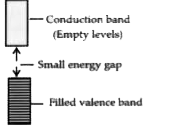 (i) n-type semiconductor : (a) It is produced by doping silicon with a group-15 element such as P, As, Sb (dopant). (b) The dopant atom (contains 5 valence electrons) uses four of Si electrons for covalent bonding but the fifth is extra and become delocalised. (c) This delocalised `e^(-)` increases the conductivity. |
|
| 37. |
Describe the objectives of Iraq invasion by the US. |
|
Answer» SOLUTION :USA went to war in Iraq, for lookin :- from WMD, terrorism to democracy in the MIDDLE EAST. President Busth and his administration said that the U.S. was going to war with Iraq because of the imminent THREAT of Saddam's Weapons of mass destruction and ties to terrorism also. And a threat to USA friends in the region. To protects the region USA went to war. |
|
| 38. |
Describe the mechanism of the formation of diethyl ether from ethanol in the presence of concentrated sulphuric acid. |
Answer» SOLUTION : 
|
|
| 39. |
Describe the mechanism of alcohol reacting both as nucleophiles and electrophiles in reactions. |
Answer» Solution :Alcohols as NUCLEOPHILES :  Alcohols as ELECTROPHILES : Protonated alcohols ACT as electrophiles `R-CH_(2)-OH+H^(+)rarr R-CH_(2)-OVERSET(+)OH_(2)` `Br^(-)+UNDERSET(R)underset(|)CH_(2)-overset(+)OH_(2)rarr Br - underset(R)underset(|)CH_(2)+overset(+)H_(2)O` |
|
| 40. |
Describe the mechanism for the formation of diethyl ether from ethanol in the presence of concentrated H_(2)SO_(4) |
| Answer» SOLUTION :For answer, CONSULT SECTION 22 (METHOS of preparationn of ETHERS ) | |
| 41. |
Describe the mechanism by which the hydroxyl group attached to an aromatic ring is more acidic than the hydroxyl group attached to an alkyl group. How does the presence of nitro group in phenol affects its acidic character? |
|
Answer» Solution :(i) The reaction of phenol with aqueous sodium hydroxide solution indicates that phenol is a stronger acid than ALCOHOLS in water. (II) Because phenoxide ion FORMED is stabilised by resonance whereas ALKOXIDE ion formed is destabilised by positive inductive effect of alkyl group. (iii) Presence of electron withdrawing group such as nitro group enhances the acidic strength of phenol. It is DUE to the effective delocalisation of the negative charge in phenoxide ion. |
|
| 42. |
Write the equations involved in the manufacture of sulphuric acid in contact process. |
|
Answer» Solution :Conversion of SULPHUR to sulphur DIOXIDE. `S+O_(2)RARR SO_(2)` CATALYTIC conversion of `SO_(2)` to `SO_(3)`. Thermodynamic conditions. `2SO_(2)+O_(2)overset(V_(2)O_(5))underset(673K)rarr 2SO_(3)+"45.2 Kcal"` Sulphur trioxide to sulphuric ACID with equation. `SO_(3)+H_(2)Orarr H_(2)SO_(4)` |
|
| 43. |
Describe the manufacture of potassium dichromate from chromite ore. |
|
Answer» Solution :(i) Preparation of `K_2Cr_2O` from chromite ORE (a) Potassium dichromate is obtained by the fusion of chromite ore `(FeCr_2O_4)` with sodium (or potassium) carbonate in the presence of excess of air. `4FeCr_2O_4+8Na_2CO_3+7O_2tounderset(("YELLOW solution"))(8Na_2CrO_4+2Fe_2O_3+8CO_2)` (b) The solutio is filtered and TREATED with sulphuric acid `2Na_2CrO_4+H_2SO_4toNa_2Cr_2O_7+Na_2SO_4+H_2O` (C) Now sodium dichromate is treated with potassium chloride. As a RESULT potassium dichromate is produced. `Na_2Cr_2O_7+2KCl tounderset("Potassium dichromate crystals")(K_2Cr_2O_7+2NaCl)` |
|
| 44. |
Describe the manufacture of H_2SO_4 by contact process |
|
Answer» Solution :Manufacture of SULPHURIC acid by contact process involves three steps: (i) Burning of sulphur in air to generate `SO_2`. (ii) Conversion of `SO_2` to `SO_3` by oxidation with air in the presence of `V_2O_5` as catalyst. (iii) Absorption of `SO_3` in `H_2SO_4` to obtain oleum `H_2S_2O_7`. A flow diagram for the manufacture of `H_2SO_4` is given below : 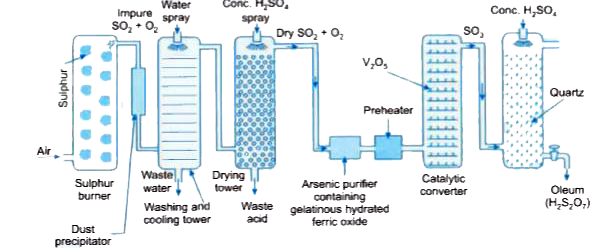 `SO_2` produced by burning of sulphur is freed from dust and other impurities. The plant is OPERATED at a PRESSURE of 2 bar and a temperature of 720 K. These are the optimum conditions for the conversion of `SO_2` to `SO_3`, according to Le Chatelier principle. `SO_3` produced in the catalytic converter is absorbed in concentrated `H_2SO_4` to produce oleum. Oleum is diluted with water to obtain `H_2SO_4` of DESIRED concentration. Sulphuric acid obtained as above is 96-98% pure. |
|
| 45. |
Describe the laboratory method of preperation of ammonia . |
|
Answer» Solution :In laboratory , ammonia is prepared by heating a mixture of a calcium hydroxide and ammmonium chloride and MOIST ammonia is dried by passingover quicklime (CaO) ` {:(Ca(OH)_(2)(s),+,2NH_(4)Cl_(s),to),("Calcium",,"AMMONIUM",),("hydroxide",,"chloride",):}` ` {:(CaCl_(2(s)),+,2H_(2)O_(1),+,2NH_(3)._(s)),("Calcium",,"Water",,"Ammonia"),("chloride",,,,):}` The tube in which ammonia is generatedb is fixed in a slanting position to prevent the water FORMED from running back and crack the whole tube. Concentrated sulphuric acid abd anhydrous calcium chloride are not used to dry ammonia because they react with it. Ammonia is collected by upward delievery as it lighter than air. |
|
| 46. |
Describe the laboratory method of preparation of glucose. |
|
Answer» Solution :Preparation of GLUCOSE from sucrose (cane sugar) : Labora-tory method. Glucose is prepared in the laboratory by hydrolysis of sucrose by boiling it with dilute HYDROCHLORIC acid or dilute sulphuric acid for about two hours. On hydrolysis, sucrose gives one molecule of glucose and one molecule of fructose. `underset("Sucrose")(C_(12)H_(22)O_(11))+underset("Hydrolysis")(H_(2)O underset((dil.HCl))overset(H^(+)))to underset("Glucose")(C_(6)H_(12)O_(6))+underset("Fructose")(C_(6)H_(12)O_(6))` Sucrose Hydrolysis Glucose Fructose Alcohol is added during cooling to separate glucose and fructose since, glucose is ALMOST insoluble in alcohol, hence it crystallizes out first. Fructose REMAINS in the solution as it is more soluble that glucose. Crystals of glucose are separated out by FILTRATION and purified by recrystallization. |
|
| 47. |
Describe the graphical representation of first order reaction. |
|
Answer» Solution :REACTION whose rate depends on the reactant concentration raised to the first power is called a first order reaction. Let us CONSIDER the following `Cl_(2)` first order reaction, `A rarr` product Rate law can be expressed as Rate `= k[A]^(1)` Where, k is the first order rate CONSTANT. `(-d[A])/(dt)=k[A]^(1)` `rArr (-d[A])/([A])="k dt"`....(1) Integrate the above equation between the limits of time t = 0 and time equal to t, while the concentration varies from the initial concentration `[A_(0)]`to [A] at the later time. `int_([A_(0)])^([A])(-d[A])/([A])=k int_(0)^(t)dt` `(-In[A])_([A_(0)])^([A])=k(t)_(0)^(t)` `-In[A]-(In[A_(0)])=k(t-0)` `-In[A] - In[A_(0)]=kt` `In(([A_(0)])/([A]))=kt ""`....(2) This equation is innatural logarithm. To convert it into usual logarithm with base 10, we have to multiply the term by 2.303.  A plot og ln[A] Vs t for a first order reaction, `A rarr` product with initial concentration of `[A] = 1.00 M` and `k = 2.5xx10^(-2)"min"^(-1)` `2.303 log(([A_(0)])/([A]))=kt` `k=(2.303)/(t)log(([A_(0)])/([A]))""`.....(3) Equation (2) can be written in the form `y=mx + c` as below `In [A_(0)]- In [A] = kt` `In[A] = In[A_(0)]-kt` `rArr y = c + mx` If we follow the reaction by measuring the concentration of the reactants at regular time interval 't', a plot of In [A] againt 't' yields a straight line with a negative SLOPE. From this, the rate constant is calculated. |
|
| 48. |
Describe The general characteristics of transition elements with special reference to the following: Catalyst |
|
Answer» |
|
| 49. |
Describe the following with examples : (i) Preservatives (ii) Biodegradable detergents |
|
Answer» Solution :(i) Preservatives : Those chemicals which are used to prevent FOOD from SPOILAGE are called preservatives. For example, SODIUM benzoate. (ii) Biodegradable detergents : Detergents which are decomposed by microorganisms present in the environment are called biodegradable detergents. These detergents have linear alkyl chains. Sodium lauryl SULPHATE and sodium dodecylbenzenesulphonate are EXAMPLES of biodegradable detergents. |
|
| 50. |
Describe the following with suitable examples: (i) Preservatives (ii) Artificial sweetening agents. |
|
Answer» SOLUTION :(i) Preservatives: Preservatives are the substances which are USED to prevent spoilage of food due to microbial growth. Examples - Sodium benzoate, Common salt. (ii) Artificial SWEETENING AGENTS: These are the chemical substances which are used to create sweet taste in food items in place of SUGAR. |
|