

Saved Bookmarks
This section includes 7 InterviewSolutions, each offering curated multiple-choice questions to sharpen your Current Affairs knowledge and support exam preparation. Choose a topic below to get started.
| 1. |
Determine the percentage of water of crystallisation, iron , sulphur and oxygen in pure ferrous sulphate (FeSO_(4).7H_(2)O). |
|
Answer» Solution :The formula mass of of FERROUS SULPHATE =At. Mass of Fe+At. Mass of S+4X At. Mass of oxygen +7X Mol. Mass of `H_(2)O` `=56.0+32.0+4xx16.0+7xx18.0=278.0` So, % of water of crystallisation `=(126)/(278)xx100=45.32` % of iron `=(56)/(278)xx100=20.14` % of SULPHUR=`(32)/(278)xx100=11.51` % of oxygen`=(64)/(278)xx100=23.02` |
|
| 2. |
Determine the oxidation states of central metal ions in the following complex compounds : (i) (a) K_(4)[Fe(CN)_(6)] (b) [Co(NH_(3))_(6)]Cl_(3) (ii) (a) K_(3)[Fe(CN)_(6)] (b) [PtCl_(4)]^(2-) (c ) [CoBr_(2)(CN)_(2)]^(+) (iii) (a) [Pt(NH_(3))_(3)Cl_(3)] ion (b) Na_(4)[Ni(CN)_(4)] (c ) [Zn(H_(2)O)_(3)OH]^(+) |
| Answer» Solution :(i) (a) + 2 (B) + 3 (ii) (a) + 3 (b) + 2 (c ) + 5 (III) (a) + 2 (b) 0 (c ) + 2 | |
| 3. |
Determine the percentage composition (by mass) ofmixture of anhydrous sodium carbonate and sodium bicarbonate from the following datam: wt. of the mixture taken = 2g Loss in weight on heating = 0.124 gm. Fill your answer as sum of digits (excluding decimal places) till you get the single digit answer. |
|
Answer» |
|
| 4. |
Determine the per cent concentration of a solution obtained by mixing 300g of a 25% and 400g of a 40% solution. |
|
Answer» |
|
| 5. |
Determine the packing efficiency of the unit cell in hexagonal close-packed (hcp) structure of particles. |
Answer» Solution :The unit cell in an hcp structure of particles is a hexagonal unit cell as shown in the given figure. The number of particles in the hexagonal unit cell = 6. If radius of each the  particles MAKING up the unit cell is = r, then total volume for 6 particles = `6xx4/3pir^(3)`. The area of the BASE of a hexagonal unit cell = `=6xxsqrt3/4xx4r^(2)=6sqrt3r^(2)`. The height of this unit cell = `4rsqrt(2/3)` Therefore, the volume of unit cell = area of the base `xx` height = `6sqrt3r^(2)xx4rsqrt(2/3)=24sqrt2r^(3)` `therefore" "` Packing efficiency of the hexagonal unit cell `=("Volume of 6 particles")/("Volume of unit cell")xx100=(6xx4/3pir^(3))/(24R^(3)sqrt2)xx100` = 74.01% |
|
| 6. |
Determine the osmotic pressure of a solution prepared by dissolving 2.5xx10^(-2)"g of "K_(2)SO_(4) in 2 L of water at 25^(@)C, assuming that it is completely dissociated. ("R = 0.0821 L atm K"^(-1)"mol"^(-1)," Molar mass of "K_(2)SO_(4)="174 g mol"^(-1)) |
|
Answer» `pi="i CRT,"pi=(3)(7.18xx10^(-5)" mol L"^(-1))("0.0821 L atm K"^(-1)"mol"^(-1))(298K)=5.27xx10^(-3)"atm"` |
|
| 7. |
Determine the osmotic pressure of a solution prepared by dissolving 25 mg of K_2SO_4in 2 litre of water at 25^@C , assuming that it is completely dissociated. |
|
Answer» SOLUTION :` K_2SO_4` dissolved = 25 mg = 0.025 g Molar mass of `K_2SO_4 = 2 xx 39 + 32 + 4xx16 = 78 + 32 + 64 = 174 g "mol"^(-1)` As `K_2SO_4` dissociates completely as `K_2SO_4 to2K^(+) + SO_4^(2-)` i.e., ions produced = 3 ` therefore i=3` Applying the following equation `pi = iCRT = i n/V RT=i xx w/W xx 1/V RT` Substituting the values, we get `pi = 3 xx (0.025 g)/(174 g "mol"^(-1)) xx (1)/(2L)xx 0.0821 L atm K^(-1) "mol"^(-1) xx 298 K` `= 5.27 xx 10^(-3) atm` |
|
| 8. |
Determine the osmotic pressure of a solution prepared by dissolving 25 mg of K_(2)SO_(4) in 2 litre of water at 25^(@)C, assuming that it is completely dissociated. |
|
Answer» Solution :`K_(2)SO_(4)to2K^(+)+SO_(4)^(-2)` Total number of ions produced = 3 Thereforem i = 3 Given, w = 25 mg = 0.025 g V = 2 L `T=250^(@)C=(25+273)K` = 298 K Also, we know that : `R=0.0821" L atm K"^(-1)mol^(-1)` `M=(2xx39)+(1xx32)+(4xx16)` `= 174 mol^(-1)` Appling the following relation, `pi=i(n)/(V)RT` `= i(w)/(M)(1)/(v)RT` `=(0.025)/(174)XX(1)/(2)xx0.0821xx298` `=5.27xx10^(-3)` atm. |
|
| 9. |
Determine the osmotic pressure of a solution prepared by dissolving "25 mg of "K_(2)SO_(4) in 2 litre of water at 25^(@)C, assuming that it is completely dissociated. |
|
Answer» Solution :`K_(2)SO_(4)" dissolved = 25 mg = 0.025 g"` `"Molar MASS of "K_(2)SO_(4)=2xx39+32+4xx16="174 g mol"^(-1)` As `K_(2)SO_(4)` dissociates completely as `K_(2)SO_(4)rarr 2K^(+)+SO_(4)^(2-)`, i.e., ions produced = 3, `therefore i=3` `thereforepi=iCRT=i(n)/(V)RT=ixx(w)/(M)xx(1)/(V)RT=3xx("0.025 g")/("174 g mol"^(-1))xx(1)/(2K)xx"0.0821 L atm K"^(-1)"mol"^(-1)xx"298 K"` `=5.27xx10^(-3)" atm."` |
|
| 10. |
Determine the osmotic pressure of a solution prepared by dissolving 25 mg of K_2 SO_4 in 2 litre of water 25^(@)C assuming that it is completely dissociated . |
|
Answer» Solution :If `K_(2) SO_(4)` is completely dissociated , `K_(2) SO_(4) to 2 K^(+) + SO_(4)^(2-)` ` t = 3` Mol mass of `K_(2) SO_(4) = 2 xx 39 + 32 + 4 xx 16 = 174 g mol^(-1)` `pi = iCRT` `= i(W_(B) xx RT)/(M_(B) xx V)` `= (3 xx 25 xx 10^(-3) xx 0.082 xx 298)/(174 xx 2.0)` `= 5.27 xx 10^(-3)` atm |
|
| 11. |
Determine the osmotic pressure of a solution prepa.red by diHolving 2.5xx 10^(-2) g of a solution 2I. Of water at 25^(@) C, assuming that it is completely dissociated. (R = 0.0821 " L atm K"^(-1) mol^(-1) , " molar mass of" K_(2)SO_(4) = 174 g " mol"^(-1)) |
|
Answer» Solution :When `K_(2) SO_(4)` is dissolved in water, IONS are produced. Total number of ions produced = 3 i= 3 `pi = I"CRT " = (I xx N xx R xx T)/(V)` `pi = 3 xx (25 xx 10^(-2)g)/(174 g "MOL"^(-1)) xx (1 xx 0.0821 " L ATM " xx 298)/(2I) = 0.00176 " " K^(-1) mol^(-1) xx 298` K `pi5.27 xx 10^(-3) ` atm |
|
| 12. |
Determine the order of stability of the following resonating structure. |
|
Answer» `igtiigtiii` |
|
| 13. |
Determine the order of reaction : Step 1. 2NO+H_2 to N_2+H_2O_2 Slow Step 2. H_2O_2 + H_2 to 2H_2O Fast |
|
Answer» Solution :Rate =`k[NO]^2[H_2]` ORDER =2+1 =3 |
|
| 14. |
Determine the number of optical isomers in the following compounds: (a) CH_(3)CH(OH)COOH (b) HOOC(CHOH)_(2)COOH (c) HOOC(CHOH)_(3)COOH (d) CH_(3)(CHOH)_(2)COOH (e) CH_(3)CH(Br)CH(Br)COOH. |
| Answer» Solution :(a)2,(b)3,(C)4,(d)4,(E)4. | |
| 15. |
Determine the order of reaction and also determine the units of rateconstant |
|
Answer» SOLUTION :First order REACTION `K=MOL^(1-n)L^(n-1)S^(-1)` n=1 `K=(mol)^(1-1)L^(1-1) S^(-1)` `=S^(-1)` |
|
| 16. |
Determine the number of moles of AgI which may be dissolved in 1.0 litre of 1.0 M CN solution. K_(sp)for Agl and K_f for [Ag(CN)_2]^- are 1.2 xx 10^(-17) M^2and 7.1 xx 10^19 M^2respectively. |
|
Answer» SOLUTION : |
|
| 17. |
Determine the number of formula units of NaCl in the unit cell. NaCl is a face centred cubic crystal. See the diagram of the NaCl unit cell in the text. |
| Answer» SOLUTION :Either of `Na^+` or `CI^(-)` IONS may be chosen as the lattice points. Choosing `CL^(-)` ions (as shown in the text), the CUBE contains a `Cl^(-)`ion at the centre of each face as well as at the corners of the unit cell. There are `12 Na^+` ions at the centres of 12 edges and 1 `Na^(+)`ion at the centre of the unit cell. | |
| 18. |
Determine the molecular formula of an oxide of iron in which the mass percent of iron oxygen are 69.9 and 30.1 respectively. Given that the molar mass of the oxide is 159.8 g mol^(-1) (Atomic mass : Fe = 55.85, O = 16.00 amu) |
|
Answer» Solution :Expirical formula mass of `Fe_(2)O_(3)=2xx55.85+3xx16.00=159.7gmol^(-1)` `n=("Molar mass")/("EMPIRICAL formula mass")=(159.8)/(159.7)=1` HENCE, molecular formula is same as empirical formula, VIZ., `Fe_(2)O_(3)`. |
|
| 19. |
Determine the number of formula units of NaCl in one unit cell. NaCl is face centred cubic. |
|
Answer» Solution :In the fcc arrangement, there are Eight corners `8 XX 1/8 =Cl^(-)` ion At the six faces `6 xx 1/2 = 3 Cl^(-)` ions Along the 12 edges `12 xx 1/4 = 3Na^(+)` ion At the cube centre `(1 xx 1 = 1Na^(+)" ion")/(" Total 4 " Cl^(-)" ions")` Hence, the unit cell contains FOUR NaCl UNITS. |
|
| 20. |
Determine the molarity of an antifreeze solution containing 250 g water mixed with 222 g ethylene glycol (C_2H_6O_2). The density of this solution is 1.07 g/mL. |
|
Answer» SOLUTION :Mass of water = 250 g Mass of ethylene GLYCOL = 222 g Total mass = 472 g Density of the solution = 1.07 g/mL Volume of the solution = 472/1.07 = 441 mL = 0.441 L No. of moles of ethylene glycol = `222/62 = 3.58` Molarity = No. of moles / Volume of the solution in litres ` = (3.58)/(0.441) = 8.12 M` |
|
| 21. |
Determine the molarity of an antifreeze solution containing 250 g water mixed with 222 g ethylene glycol (C_(2)H_(6)O_(2)). The density of the solution is 1.07 g/mL. |
|
Answer» `"MOLARITY "=(222g)/("62 G mol"^(-1))xx(1)/("441.1 mL")xx"1000 mL"="8.12 M."` |
|
| 22. |
Determine the molaarity of an antifreeze soliution sontaining 250 g water mixed with 222 g of ethylene glylene glycol (HOCH_(2)CH_(2)OH). The dnesity of solution is 1.07 g/mL. |
|
Answer» Mass of water = 250 g Mass of solution = (222+250)=472 g Density of solution = 1.07 g `mL^(-1)` `"Volume of solution (M) "=("Mass os ethylene glycol/molar mass")/("Volume os solution in litres")` `=((222g))/((62" g MOL"^(-1))XX(0.4412L))` =8.12 mol `L^(-1)`=8.12 M |
|
| 23. |
Determine the hybridization at the carbon atom indicated in each species. |
|
Answer» |
|
| 24. |
Determine the equilibrium constant of the following reaction at 298 K : 2Fe^(3+)+Sn^(2+) rarr 2Fe^(2+) +Sn^(4+) ("Given: "E_(Sn^(4+)//Sn^(2+))^(@)=0.15" volt, "E_(Fe^(3+)//Fe^(2+))^(@)=0.771" volt" ) |
|
Answer» Apply `E_(cell)^(@)=0.0591/2 LOG K` |
|
| 25. |
Determine the equilibrium constant for the reaction : HF(aq)+NH_3(aq)toNH_4^(+)(aq)+F^(-)(aq) K_a=6.9xx10^(-4) NH_3(aq)+H_2O(l)toNH_4^(+)(aq)+OH^(-)(aq) K_b=1.8xx10^(-5) 2H_2O(l)toH_3O^(+)(aq)+OH^(-)(aq) K_w=1.0xx10^(-14) |
|
Answer» `1.2xx10^(-8)` |
|
| 26. |
Determine the feasibility of the reaction 2Al_((s))+3Sn_((aq))^(4+)rarr 2Al^(3+)+3Sn_((aq))^(2+) |
|
Answer» SOLUTION :The given reaction consists of the FOLLOWING half REACTIONS `{:("Anode",:,2Al_((g))rarr2Al^(3+)+6e^(-),),("Cathode",:,3SN^(4+)+6e^(-)rarr 3Sn^(2+),E^(@)=-1.66V),(,,E_("cell")^(@)=0.15-(-1.66),E^(@)=+0.15V):}` `=1.81V` Since `E_("cell")^(@)` is positive, the reaction is FEASIBLE. |
|
| 27. |
Determine the difference between exhangeable pair for high spin and low spin d^(6) ions in an octahedral complex. |
|
Answer» Low spin :`t_(2g)^(2,2,2)eg^(0,0)` 2 EXTRA pairs generated in low spin. |
|
| 28. |
Determine the density of CsCI which crystallizes in a bcc type structure with an edge length 412.1 pm. |
|
Answer» SOLUTION :`"Molar mass of cscl"="168.5 g/MOL"` Number atoms present in PER unit cel for bcc (cscl) `N=1` `"Edge length (a) = 412.1 pm"` `"Density "(rho)=?` `rho=(nM)/(a^(2)N_(A))` `=(1xx168.5" g mol"^(-1))/((412.1xx10^(-10)cm)^(3)xx(6.023xx10^(23)"mol"^(-1))` `=(168.5gcm^(-3))/(6.998xx10^(-23)xx6.023xx10^(23))` `=(168.5)/(42.148)gcm^(-3)` `rho=3.997gcm^(-3)` |
|
| 29. |
Determinethe densityof cesiumchloride whichcrystallisesin a bcctypestructurewith theedgelength412. 1 pm .Theatomicmasses ofCs and C1 are 133and 35.5respectively. |
| Answer» SOLUTION :Densityof CsC1 CRYSTAL = 4.0 `g CM^(-3)` | |
| 30. |
Determine the correct order of stability :- |
|
Answer» `AL^(+1) gt Al^(+3)` |
|
| 31. |
Determine the bond order & formal charge on each oxygen atom in HCO_(2)^(-) respectively ? |
|
Answer» `1.5,-0.5` |
|
| 32. |
Determine the amount of CaCl_2 (i = 2.47) dissolved in 2.5 litre of water such that its osmoticpressure is 0.75 atm at 27^@C . |
|
Answer» Solution :For a solute undergoing dissociation, the following EQUATION may be used `pi = ICRT = i n/V RT ` (i is van.t Hoff.s factor) `pi = (pi xx V)/(i xx R xx T)` Substituting the values, we GET `n = (0.75 atm xx 2.5L)/(2.47 xx 0.0821 L atm K^(-1) "mol"^(-1) xx 300 K) = 0.0308` mole Molar mass of `CaCl_2 = 40 + 2 xx 35.5 = 111 g "mol"^(-1)` ` therefore ` Amount dissolved = 0.0308 x 111 g = 3.42 g. |
|
| 33. |
Determine the amount of CaCl_(2)(i=2.47) dissolved in 2.5 litre of water such that its osmotic pressure is 0.75 atm at27^(@)C. |
|
Answer» Solution :`pi=iCRT=i(n)/(V)RT"or"n=(pixxV)/(ixxRxxT)=("0.75 ATM"xx"2.5 L")/(2.47xx"0.0821 L atm K"^(-1)"mol"^(-1)xx"300 K")="0.0308 mole"` `"Molar mass of "CaCl_(2)=40+2xx35.5="111 g mol"^(-1) therefore"Amount DISSOLVED "=0.0308xx"111 g = 3.42 g."` |
|
| 34. |
Determine the amount of CaCl_(2)dissolved in 2.5L at 27^(@)C such that its osmotic pressure is 0.75 atm at 27^(@)C. (i for CaCl_(2) = 2.47) |
|
Answer» Solution :For `CaCl_(2) , "" i= 2.47` `pi = ICRT` `=i(n_(B))/(V) XX RT` `0.75 = (2.47 xx n_(B) xx 0.082 xx 300)/(2.5)` `n_(B) = (0.75 xx 2.5)/(2.47 xx 0.082 xx 300)` `n_(B) = 0.0308` MOL Amount = `0.0308` mol `xx` 111 g `mol^(-1)` `= 3.148` g |
|
| 35. |
Determine the amount of CaCl_(2)(i=2.47) dissolved in 2.5 litre of waster such that its osmotic pressure is 0.75 atm 27^(@)C at. |
|
Answer» SOLUTION :`pi = (n)/(V)RT` `pi=i(W)/(MV)RT` `k=(pi MV)/(iRT)` `pi-0.75` atm V = 2.5 L `i=2.47` `T=(27+273)K` = 300 K Here, `R=0.0821 " atm K"^(-1)MOL^(-1)` `M=1xx40+2xx35.5` `= 111 G mol^(-1)` Therefore, `w=(0.75xx111xx2.5)/(2.47xx0.0821xx300)` = 3.42 gram. |
|
| 36. |
Determine the average life of U^(238) having t^(1//2) = 140 days. |
|
Answer» SOLUTION :`t^(1//2)=(0.693)/(LAMBDA)` `TAU=(t^(1//2))/(0.693)` =202.02 DAYS |
|
| 37. |
Determine the absolute configuratins of the labeled carbons (a and b): |
|
Answer» a = R,b=R 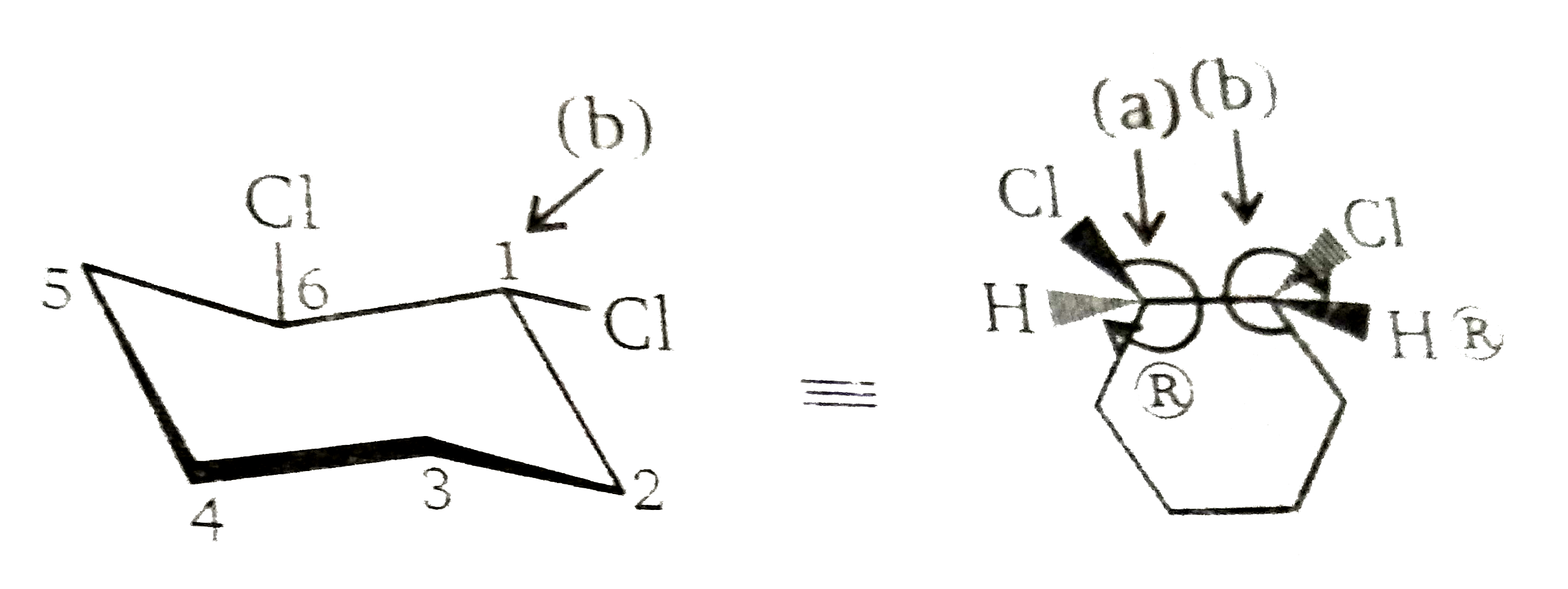
|
|
| 38. |
Determine DeltaH for the following reaction at 500 K and constant pressure : CO(g)+H_(2)O (g) rarr CO_(2) (g) +H_(2)(g) Use the following data : {:("Substance",C_(P)" (J/mol K)",Delta_(f)H (298 K) "(kJ/mol)"),(CO,29.12,-110.5),(H_(2)O,33.58,-241.8),(CO_(2),37.11,-393.5),(H_(2),29.89,0.0):} |
|
Answer» |
|
| 39. |
Determine pH of the solution that results from addition of 20 ml of 0.01 M Ca(OH)_(2) to 30 ml of 0.01 M HCl. |
|
Answer» `11.30` Moles of `Ca(OH)_(2)` in 20 ml solution `=(0.01)/(1000)xx20=2xx10^(-4)` mole Moles of HCl in 30 ml solution `=(0.01)/(1000)xx30` `=3.0xx10^(-4)`mole. 2 moles of HCl react with 1 mole of `Ca.(OH)_(2)`. Hence `3xx10^(-4)`moles of HCl react with 1.5 moles of `Ca(OH)_(2)` Moles of `Ca(OH)_(2)` left `=2xx10^(-4)-1.5xx10^(-4)=0.5xx10^(-4)` `=5xx10^(-5)` moles Moles of `OH^(-)=2xx5xx10^(-5)=10^(-4)`moles. `[OH^(-)]=(10^(-4))/(50)xx1000=2xx10^(-3)M` `pOH=-LOG[OH^(-)]=-log(2xx10^(-3))` `=2.699` `pH=14-pOH=11.301`. |
|
| 40. |
Determine final pressure after the valve is left opened for along time in the apparatus represented in figure. Assume that the temperature is fixed tat 300K. Under the given conditions assume no reaction of CO & O_(2). |
|
Answer» |
|
| 41. |
DetermineDelta S_(" total ") and showwhetherthe followingreactionisspontaneousis 25^ (@) C Fe_(2) O_(3(s))+ 3CO_((g)) to 2Fe_((s))+ 3CO_(2(g)) Delta H^(@) =- 24.8 kJ , Delta S^(-1)= 15 JK^(-1) |
| Answer» SOLUTION :`DELTA S_("TOTAL ") = 98.2 JK^(-1)` | |
| 42. |
Determine A_(i) and A_( c) for the reversible isothermal evaporation of 90.0 g of water at 100^(@) C. Assume that water vapours behaves as an ideal gas and heat of evaporation of water is 540 cal g^(-1) (R =2 "cal" "mol"^(-1)K^(-1)) |
| Answer» SOLUTION :44870 CAL | |
| 43. |
Determination of specific conductance and molar conductivity of electrolyte solution. |
|
Answer» SOLUTION :(1) Specific conductance, `kappa=(1)/(R)XX(l)/(R)` (2) Molar conductivity, `Lambda_(m)=kappaxx(1000)/(M)` |
|
| 45. |
Detergents can be made biodegradable and pollution free by : |
|
Answer» Using CYCLIC HYDROCARBON chain |
|
| 46. |
Detergents are usually made from products obtained by cracking of petroleum like : |
|
Answer» Chloroalkanes |
|
| 47. |
Detergents are sodium of potassium salts of sulphonic acids. Phosphates are added to commercial detergents because they form complex with metal ion that contributes water hardness and keep them dissolved. They also control acidity and micelle formation. Phosphates arediscouraged because there is overgrowth of vegetation and decay of dead plants reduceamount of dissolved oxygen. 1 mole of [AgI]Ag^(+) sol is coagulated by |
|
Answer» DETERGENTS having LINEAR ALKYL chain |
|
| 48. |
Detergents are sodium of potassium salts of sulphonic acids. Phosphates are added to commercial detergents because they form complex with metal ion that contributes water hardness and keep them dissolved. They also control acidity and micelle formation. Phosphates arediscouraged because there is overgrowth of vegetation and decay of dead plants reduceamount of dissolved oxygen. Which of the following are cationic detergents ? |
|
Answer» `[CH_3(CH_2)_(15)N(CH_3)_3]CL` |
|
| 49. |
Detergents are prepared by the action of H_2SO_4 on which of the following? |
|
Answer» Cholesterol |
|
| 50. |
Detergents are prepared by the action of H_2SO_4 followed by neutralization by starting with |
|
Answer» CHOLESTEROL |
|