

Saved Bookmarks
This section includes 7 InterviewSolutions, each offering curated multiple-choice questions to sharpen your Current Affairs knowledge and support exam preparation. Choose a topic below to get started.
| 1. |
Di-n-butylphthalate is a ....................... |
|
Answer» |
|
| 2. |
Dextrorotatory substance or d-Isomer. |
| Answer» SOLUTION :An optically active substance (or isomer) which rotates the PLANE of a plane polarized light to the right hand side (RHS) is CALLED dextrorotatory substance (or isomer) and DENOTED by d or `(+)` sign. | |
| 3. |
Dextrorotary alpha- pinenehasaspecific rotation [alpha]_(D)^(20) =+52.3^(@).A sampleofalpha- pinenecontainingboth theenantiomerswasfoundto havea specificrotationa value [alpha]_(D)^(20) = + 30.8^(@). Thepercentagesofthe (+ )and (-)enantiomerspresentin thesamplearerespectively. |
|
Answer» `70% ` and 30% |
|
| 4. |
Dextro-isomers rotate the plane of polarised light towards right. (R) Dextro-isomers are represented by putting (D) before their name. |
|
Answer» |
|
| 5. |
Dextron is |
|
Answer» POLYESTER |
|
| 6. |
Dextro -tartaricacidand meso- tartaric acidare : |
|
Answer» enatiomers |
|
| 7. |
Devise a series of reactions to convert benzene into meta-chlorobrombenzene. Select reagents and conditions from the following table, listing them in the order of use {:(,"Compound",,"Compound",,"Compound",),(1,"Sulphuric acid (conc.) heat",5,Mg "in ether",9,Cu_(2)Br_(2) + HBr,),(2,Cl_(2) + FeCl_(3) " and heat",6,PBr_(3),10,(CH_(3)CO)_(2)O + " Pyridine",),(3,NaNO_(2) +H_(3)O^((+)) 0^(@)C,7,H_(3)PO_(2),,,),(4,H_(2) " Pt catalyst",8,HNO_(3) ("conc.") + H_(2)SO_(4) ("conc.") " and heat",,,):} |
|
Answer» 1 then 2 then 6 
|
|
| 8. |
Devise sequences for preparing the following compounds from benzene |
|
Answer»
 (b) The target can be achieved if wee can form phenol from benzene. Formation of phenol from benzene is not straightforward. The route shown below involves the nitration, reduction to aniline and diazotisation. "Hydrolysis" of the diazonium ion gives phenol.  The subsequent steps involve temporary introduction of a `-SO_(3)` group as a protecting group of the para-position. This allows selective bromination of the ortho-position.(Note : Which products would you get without the `-SO_(3)` group?)  (c) Alkylation are carried out using Friedel-Crafts method. As carbocations are involved the potential of rearrangements has to be taken into account. In this case, the primary propyl cation obtained from chloropropane could easily rearrange into the more stable SECONDARY carbonication.  This can be avoided using a Friedel-Crafts acylation. The CARBONYL group is easily reduced , using the Clemmensen reduction as shown below:  (d) Iodine and fluorine are halogens which cannot be introduced using conventional Friedel-Crafts halogenation chemistry(why?). Since aniline is very electron rich,it undergoes electrophilic substitution even with relatively poor electrophiles such as iodine. 
|
|
| 9. |
Dextrins (C_6H_10O_5) are used in : |
| Answer» Answer :D | |
| 10. |
Dexto rotatory sucrose is named equal as either |
|
Answer» `ALPHA`-D-glucopyranosyl `BETA`-D-fructofuranoside |
|
| 11. |
Deviations for ideal behaviour will be less if the gas is subjected to : |
|
Answer» low temperature and high presure |
|
| 12. |
Deviation from Markovnikov's rule occurs in presence of |
|
Answer» Zinc 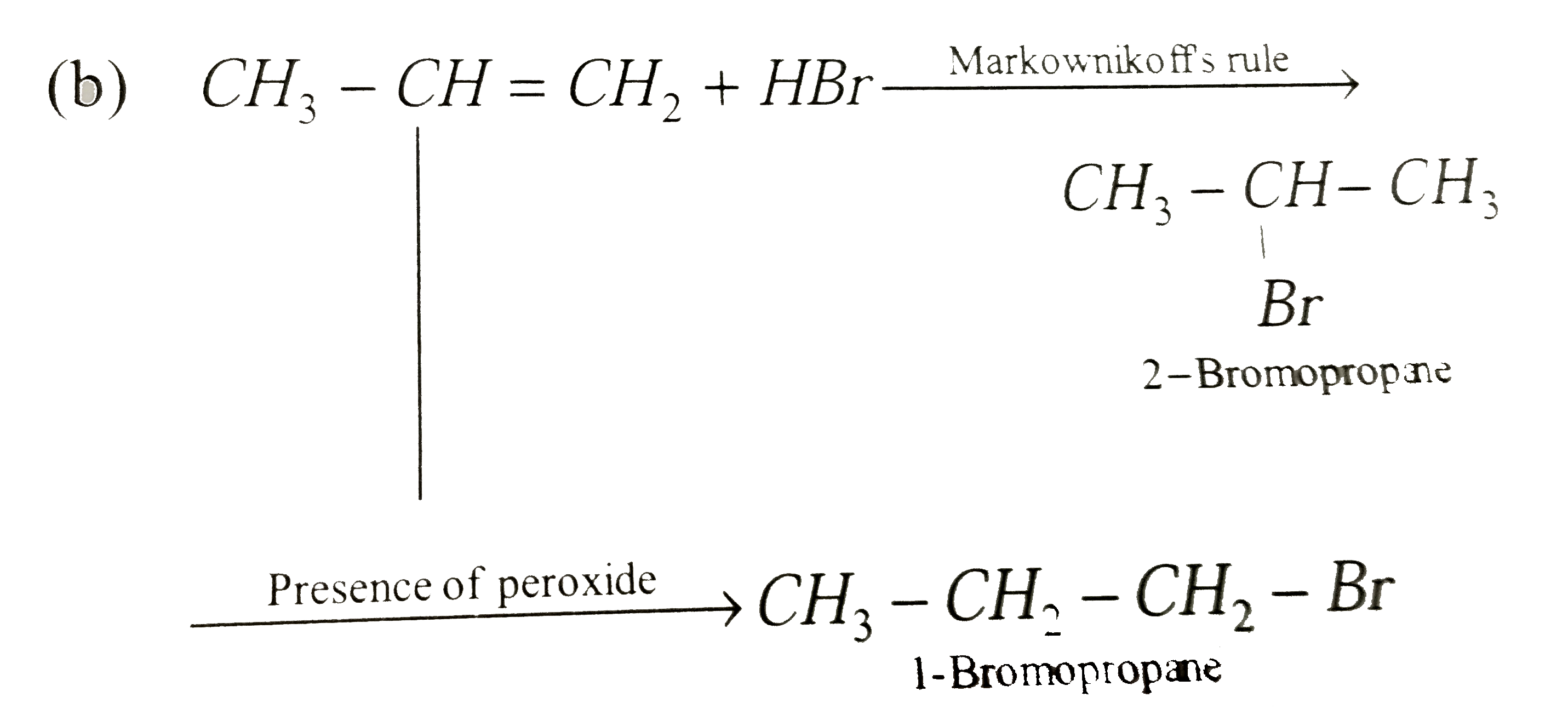
|
|
| 13. |
Deuterons when bombarded on a nuclide produce ._(18)Ar^(38) and neutrons. The target is |
|
Answer» `._(17)CL^(35)` |
|
| 14. |
Deuteroammonia (ND_(3)) can be prepared |
|
Answer» by fractionation of ORDINARY AMMONIA |
|
| 15. |
Deuterium resembles hydrogen in chemical properties but reacts : |
|
Answer» SLOWER than HYDROGEN |
|
| 16. |
Deuterium resembels hydrogen in chemical properties but reacts |
|
Answer» More VIGOROUSLY than HYDROGEN |
|
| 17. |
Deuterium is the isotope of hydrogen of mass number 2, with a proton and a neutron in its nucleus. The chemistry of deuterium is nearly identical to the chemistry of hydrogen, except that C-D bond is slightly (5.0 "KJ" //"mole") stonger than the C-H bond. Reaction rates tend to be slower if a C-D bond as opposed to a C-H bond is broken in a rate limiting step. This effect on the rate is called a kinetic isotope effect. |
|
Answer» `(K_(H))/(K_(D))=1` |
|
| 18. |
Deuterium is the isotope of hydrogen of mass number 2, with a proton and a neutron in its nucleus. The chemistry of deuterium is nearly identical to the chemistry of hydrogen, except that C-D bond is slightly (5.0 "KJ" //"mole") stonger than the C-H bond. Reaction rates tend to be slower if a C-D bond as opposed to a C-H bond is broken in a rate limiting step. This effect on the rate is called a kinetic isotope effect. CH_(3)-overset(O) overset(||)(C)-CH_(3)overset(D_(2)O,D^(+))toX |
|
Answer» `CD_(3)-OVERSET(O) overset(||)(C)-CD_(3)` 
|
|
| 19. |
Deuterium an isotope of hydrogen is: |
|
Answer» Radioactive |
|
| 20. |
Dettol is used as : |
|
Answer» Disinfectant |
|
| 21. |
Dettol used as an antiseptic is a mixture of ..... |
|
Answer» cholroxylenol and terpineol |
|
| 22. |
Dettol is used as |
|
Answer» only antisecptic |
|
| 23. |
Dettol is the mixture of |
|
Answer» PHENOL and Iodine |
|
| 24. |
Dettol is a mixture of chloroxylenol and : |
|
Answer» PHENOL |
|
| 25. |
Dettol is a mixture of |
|
Answer» CHLOROXYLENOL and terpineol |
|
| 26. |
Dettol is a mixture of_____ |
|
Answer» terpineol and BITHIONAL |
|
| 27. |
Dettol is a mixture of : |
|
Answer» terpineol and bithional |
|
| 28. |
Dettol consists of |
|
Answer» Xylenol+Terpeneol |
|
| 29. |
Dettol consist of |
|
Answer» CRESOL and ethanol |
|
| 30. |
Dettol, commonly used antiseptic is a mixture of |
|
Answer»
|
|
| 31. |
Determinewhetherthe reactionN_(2) O_(4(g)) to2NO_(2(g)) isspontaneous at 25^(@)C from thefollowingdata : Delta_(f)H_((N_(2)O_(4)))^(@) =9.16 kJ mol^(-1) Delta_(f)H_((NO_(2)))^(@) = 33.2 kJ mol^(-1) S_((N_(2)O_(4)))^(@) = 304.2 JK^(-1)mol^(-1)S_(NO_(2))^(@)= 240JK^(-1) mol^(-1) At whattemperaturewill the reactionbecomespontaneous ? |
|
Answer» Solution :`(i)Delta G^(@)= +4.85kJ .` REACTIONIS non- spontaneous (ii) `T= 325 . 6 K` |
|
| 32. |
Determinewhetherthe followingreactionis spontaneous understandardconditions. 2H_(2)O_((1))+ O_(2(g))to 2H_(2) O_(2(1))Delta H^(@)= +196 kJ , Delta S^(@)=- 126 JK^(-1) Doesis havea cross- overtermperature? |
| Answer» SOLUTION :THEREACTION is NON- SPONTANEOUS . There is nocross- over thetemperaturefor thereaction | |
| 33. |
Determinewhetherthe followingreactionwill bespontaneousor non- spontaneousunderstandard conditions. Zn_((s)) +Cu^(2+) to Zn^(2+) + Cu_((s)) ""DeltaH^(@) =- 219 kJ, DeltaS^(@) =- 21 JK^(-1) |
|
Answer» `Delta S^(@) =-21 JK^(-1)= 0.021kJK^(-1)` `Delta G^(@)= ?` forstandardconditions: Pressure= 1 atm TEMPERATURE= T = 298 K `Delta G^(@) = Delta H^(@)= T Delta S^(@)` `=- 219 - 298 xx (-0.021)` `=- 219 + 6.258` `=- 212 .742 kJ` Since `Delta G lt 0` THEREACTIONIS spontaneous. |
|
| 34. |
Determine true statement for Zn-Cu electrochemical cell. [E_(Zn^(+2)|Zn)^(@)=-0.76V,E_(Cu|Cu^(+2))^(@)=-0.34V] |
|
Answer» Zinc act at cathode and COPPER act as ANODE. `E_(Cu|Cu^(2+))^(@)=-0.34V` `E_(Cu^(2+)|Cu)^(@)=+0.34V` So, `E_(Cu^(2+)|Cu)^(@) gt E_(Zn^(2+)|Zn)^(@)`. So, they form electrochemical cell in which zinc act as anode and copper act as cathode. |
|
| 35. |
Determine Vapour pressure of water at 50^(@)C. If enthalpy of vaporisation of water is 40.6 Kj//"mol" |
|
Answer» 10 ATM |
|
| 36. |
Determine the volume (in ml) of NaOH (aq) needed to prepare 32.8 gm Na_(3)PO_(4) by reaction 3NaOH (aq) + H_(3)PO_(4) (aq) rarr Na_(3)PO_(4) (aq) + 3H_(2)O (l) Sodium hydroxide solution is 20% by mass and have density 1.5 gm//ml. [Divide your answer by 16] |
|
Answer» `n_(Na_(3)PO_(4)) = (32.8)/(164) = 0.2` MOLE ` n_(NaOH)` REQUIRED `= 0.2 xx 3 = 0.6` mole Mass of `NaOH = 0.6 xx 40 = 24 gm` `20 gm NaOH` in 100 gm solution `20 gm NaOH` in `(100)/(1.5)` ML solution For 24 gm `NaOH` volume of solution `= (100)/(1.5) xx (24)/(20) = 80 ml` `= (80)/(16) = 5 ml` |
|
| 37. |
Determine the vlaues of equilibrium constant (K) and DeltaG^(@) for the following reaction: Ni(s)+2Ag^(+)(aq)toNi^(2+)(aq)+2Ag(s),E^(@)=1.05V (1F=96500" C "mol^(-1)). |
|
Answer» |
|
| 38. |
Determine the values of equilibrium constant (K_(c)) and DeltaG^(@) for the reaction Ni(s)+2Ag^(+)(aq)rarrNi^(2+)(aq)+2Ag(s), E^(@)=1.05 V.("Given " 1F=96500"C mol"^(-1)) |
|
Answer» Solution :`DeltaG^(THETA)=-nFE_("cell")^(theta)` `n=2, E_("cell")^(theta)=1.05V` `F="96500 C mol"^(-1)` `DeltaG^(theta)=-2xx1.05xx96500` `=-202.650kJ` `DeltaG^(theta)=-RT ln K_(c)` `lnK_(c)=-(DeltaG^(theta))/(RT)=(-202.650xx10^(3))/(8.314xx298)` `K_(c)=3.32xx10^(35)` |
|
| 39. |
Determine the value of E^0 cell for the following reaction Cu^(+2)+Sn^(+2)toCu+Sn^(+4) Equilibrium constant is 10^6 Cu^(++)+Sn^(++)toCu+Sn^(+4) |
|
Answer» 0.1773 |
|
| 40. |
Determine the value of Delta E and Delta Hfor the reversible isothermal evaporation of 90.0 g of water at 100^@C . Assume that water vapour behaves as an ideal gas and heat of evaporation of water is 540 cal g^(-1) |
| Answer» SOLUTION :44.87 KCAL, 48.6 kcal | |
| 41. |
Determine the units of rate constant for first and zero order reaction. |
|
Answer» Solution :`K=(MOL)^(1-n) L^(n-1) S^(-1)` For ZERO ORDER , n=0 So, `K=(mol)^(1-0) L^(0-1) S^(-1)=S^(-1) "mol L"^(-1)` For FIRST order , n=1 `K=(mol)^(1-n) L^(n-1) S^(-1)` So, `K=(mol)^(1-1) L^(1-1)S^(-1)` `=S^(-1)` |
|
| 42. |
Determine the type of cubic lattice to which the iron crystal belongs if its unit cell has an edge length of 286 pm and the density of iron crystals is 7.86g cm^(-3). |
|
Answer» For iron M = 56 g `mol^(-1)`, `d = (ZM)/(N_A xx a^3)` or `Z= (d xx N_A xx a^3)/(M)= (7.86 xx 6.023 xx 10^(23) xx (286 xx 10^(-10))^3)/(56) = 1.98 ~~ 2` Since Z= 2, iron has bcc structure. |
|
| 43. |
Determine the standard enthlpy of the reaction C_(3)H_(8)(g) + H_(2)(g) to C_(2)H_(6)(g) + CH_(4)(g). Using the given enthalpies under standard conditions. Compound H_(2)(g)CH_(4)(g)C_(2)H_(6)(g)C("Graphite") Delta_(c)H^(0)(kJ//mol) –285.8 – 890.0 – 1560. 0 –395.5 The standard enthalpy of formation of C_(3)H_(8)(g) is –103.8 kJ//mol |
|
Answer» `-55.7 kJ` `Delta_(f)H_(H_(2)O(l)) = Delta_(C)H_(H_2(g))` `Delta_(C)H_(C_3H_3(g)) = [3 xx Delta H_(CO_2(g)) + 4 xx Delta_(f)H_(H_(2)O(l))]` `-[Delta_(f)H_(C_(3)H_(3)(g)) + 5 xx Delta_(f)H_(O_2(g))]` `=[3(-393.5)+4(-285.8)]` `-(-103.8) = -2219.9 kJ` `Delta_(f)H_("required") = -[Delta_(C)H_(C_2H_6(g)) + Delta_(C)H_(CH_4(g))]` `+[Delta_(C)H_(C_3H_8(g)) + Delta_(C)H_(H_2(g))]` `= -[(-1560.0) + (-890.0)]` `+[(-2219.9) + (-285.8)] = 55.7 kJ`. |
|
| 44. |
Determine thetotalwork done by gas ( inJoule )if system follows an expansion process as shown in figure [Given : 1 barliter =100J] |
|
Answer» Solution :`P_(B)V_(B)^(2)` =`P_(C)V_(C)^(2)` `or 50xx(0.4)^(2)=P_(C)xx(0.8)^(2)` `or P_(C)=(50xx0.4xx0.4)/(0.8xx0.8)=12.5` `W=W_(AB)+W_(BC)` `= 50(0.4-0.2)+(P_(C)V_(C)-P_(B)V_(B))/(2+1)` `=- 50 xx0.2+(12.5xx0.8 -50xx0.4)/(1)` `= - 10 +(-10)=- 20 "bar LITER " =- 2000 J` `W_(by)= 2000 J ` |
|
| 45. |
Determine the product of metalloids and the radio-active elements present in group-13 & group -14 |
|
Answer» |
|
| 46. |
Determine the potential of the following cell: Pt|H_(2)(g,0.1bar)|H^(+)(aq,10^(-3)M)|| MnO_(4)^(-)(aq,0.1M),Mn^(2+)(aq,0.01M),H^(+)(aq.0.01M)|Pt Given :E_(MnO_(4)^(-)|Mn^(2+))^(0)=1.51V |
|
Answer» `1.54V` (i)Cathode `MnO_(4)^(-)+8H^(+)+5e^(-)rarrMn^(2+)+4H_(2)O` (ii) `(i)XX(5)` `(ii)xx(2)` `E=E^(o)-(0.06)/(10)log,([Mn^(2+)]^(2)[H^(+)]_(a)^(10))/([MnO_(4)^(-)][H^(+)]_(ca)^(16)P_(H2)^(5))` `=1.51-(0.06)/(10)log,((10^(-2))^(2)xx(10^(-3))^(10))/((10^(-1))^(2)xx(10^(-2))^(16)(10^(-1))^(5))` `=1.51-(0.06)/(10)log10^(5)` `=1.51-0.03=1.48V` |
|
| 47. |
Determine the potential of a Daniell cell, initially containing 1.00 L each of 1.0 M copper (II) ion, after passage of 10^(5) coulomb charge. The E^(@) of the daniell cell is 1.10 volt. |
|
Answer» |
|
| 48. |
Determine the potential for the cell : Pt|Fe^(2), Fe^(3+)||Cr_(2)O_(7)^(2-), Cr^(3+), H^(+)|Pt in which [Fe^(2+)] and [Fe^(3+)] are 0.5 M and 0.75 M respectively and [Cr_(2)O_(7)^(2-)], [Cr^(3+)] and [H^(+)] are 2M, 4 M and 1M respectively. Given : {:(Fe^(3+)+e^(-) rarr Fe^(2+),,E^(@)=0.770"volt"),(14H^(+)+6e^(-)+Cr_(2)O_(7)^(2-) rarr 2Cr^(3+)+7H_(2)O,,E^(@)=1.35" volt"):} |
|
Answer» |
|
| 49. |
Determine the pOH of a solution after 0.1 mole of NaOH is added to 1 litre of solution containing 0.15 M CH_(3)COOH and 0.2 M CH_(3)COONa. Assume no change in volume. [Given: log 3 = 0.48, log 2 = 0.30, pK_(a) "of acetic acid" = 4.74] |
|
Answer» 8.48 `{:(0.15,0.1,0.2),(0.05,0,0.3):}` `pH = 4.74 + log (0.3)/(0.05)`. |
|
| 50. |
Determine the pH of the solution that results from the addition of 20.00 mL of 0.01 M Ca(OH)_(2) to 30.00 mL of 0.01 MHCl |
|
Answer» 11.3 Millimoles of `OH^(-) = 20 xx 0.01 xx 2 = 0.4` Remaining millimoles of `OH^(-) = 0.4 - 0.3 = 0.1` `[OH^(-)] = (0.1)/(50)` or `2 xx 10^(-3)` So, `pOH = 2.6999 rArr PH = 14 - 2.6999 = 11.30`. |
|


