Saved Bookmarks
This section includes 7 InterviewSolutions, each offering curated multiple-choice questions to sharpen your Current Affairs knowledge and support exam preparation. Choose a topic below to get started.
| 1. |
Diborane hydrolyses to give : |
|
Answer» `B_(2)O_(3)` |
|
| 3. |
Diborane combines with ammonia at 120^(@)C to give |
|
Answer» `B_(2)H_(6).NH_(3)` |
|
| 4. |
Diazotizationof aniline gives |
|
Answer» NITROBENZENE |
|
| 5. |
Diazotisation reaction is used to prepare |
|
Answer» alcohol |
|
| 6. |
Diazotisation of aniline followed by hydrolysis gives |
|
Answer» nitrophenol |
|
| 7. |
Diazotisation can be carried out by the action ofNaNO_2 and dilute HClat ice cold temperature on : |
|
Answer» Aromatic secondary amine |
|
| 8. |
Diazonium salts are stable only at : |
|
Answer» Very HIGH temperature |
|
| 9. |
Diazonium salt formation and coupling reaction: When a reaction mixture of phenyl amine and nitrous acid is kept below 10^(@)C, a diazonium salt is formed. This reaction is called diazotization reaction. The diazonium ion, -N_(2)^(+), is rather unstable and decomposes readily to nitrogen. However, delocalization of the diazonium from pi-bond electron over a benzene ring phenyl diazonium sufficiently for it to form at low temperature. The phenyl diazonium ion behaves as an electrophile, and will attack another arene molecule such as phenol. Electrophilic subsitiution takes at the 4 position, producing 4-hydroxy phenyl azobenzene. The reaction is known as coupling reaction. The compound formed is an energetically stable, yellow azo dye (the azo group is -N=N-) The stability is due to extensive delocalisation of electrons via the nitrogen- nitrogen double bonds. The product which is a red azodye obtained on reacting benzene diazonium chloride with one of the following compounds : |
|
Answer»
|
|
| 10. |
Diazonium salt formation and coupling reaction: When a reaction mixture of phenyl amine and nitrous acid is kept below 10^(@)C, a diazonium salt is formed. This reaction is called diazotization reaction. The diazonium ion, -N_(2)^(+), is rather unstable and decomposes readily to nitrogen. However, delocalization of the diazonium from pi-bond electron over a benzene ring phenyl diazonium sufficiently for it to form at low temperature. The phenyl diazonium ion behaves as an electrophile, and will attack another arene molecule such as phenol. Electrophilic subsitiution takes at the 4 position, producing 4-hydroxy phenyl azobenzene. The reaction is known as coupling reaction. The compound formed is an energetically stable, yellow azo dye (the azo group is -N=N-) The stability is due to extensive delocalisation of electrons via the nitrogen- nitrogen double bonds. The azo dye obtained on reacting 4-aminophenol with nitrous acid (in dilute hydrochloric acid) below 10^(@)C and coupling the resulting diazonium salt with phenol is : |
|
Answer»
|
|
| 11. |
Diazonium salt decomposes as C_(6)H_(5)N_(2)^(+)Cl^(-) to C_(6)H_(5)Cl+N_(2) At 0^(@)C, the evolution of N_(2) becomes two faster when the initial concentration of the salt is doubled. Therefore, it is |
|
Answer» a FIRST order REACTION |
|
| 12. |
Diazonium salt formation and coupling reaction: When a reaction mixture of phenyl amine and nitrous acid is kept below 10^(@)C, a diazonium salt is formed. This reaction is called diazotization reaction. The diazonium ion, -N_(2)^(+), is rather unstable and decomposes readily to nitrogen. However, delocalization of the diazonium from pi-bond electron over a benzene ring phenyl diazonium sufficiently for it to form at low temperature. The phenyl diazonium ion behaves as an electrophile, and will attack another arene molecule such as phenol. Electrophilic subsitiution takes at the 4 position, producing 4-hydroxy phenyl azobenzene. The reaction is known as coupling reaction. The compound formed is an energetically stable, yellow azo dye (the azo group is -N=N-) The stability is due to extensive delocalisation of electrons via the nitrogen- nitrogen double bonds. Benzene diazonium chloride on reaction with phenol in weakly basic medium gives : |
|
Answer» DIPHENYL ETHER |
|
| 13. |
Diazomethene (CH_2N_2) on decomposition forms singlet methylene (":"CH_2) which gets attached to different non-equivalent C-H bonds of alkanes formed when pentane (CH_3CH_2CH_2CH_2CH_3) reacts with singlet methylene. Assuming methylene to be highly reactive and less selective, calculate the probable amounts the formed alkanes. |
|
Answer» SOLUTION :Three alkanes are formed when pentane reacts with singlet methylene because there are three non-equivalent `C-H` bonds in pentane molecule. So, the alkanes formed are: `underset("hexane")(CH_(3)CH_(2)CH_(2)CH_(2)CH_(2)CH_(3))` `underset("2-methylpentane")(CH_(3)overset(overset(CH_(3))(|))(C)HCH_(2)CH_(2)CH_(3)) " " underset("hexane")(CH_(3)CH_(2) overset(overset(CH_(3))(|))(C)HCH_(2)CH_(3))`  As methylene is HIGHLY reactive and less selective, its insertion occurs in a random fashion. So, the amounts of the formed compounds are CALCULATED on the basis of probablility factor and number of equivalent `C-H` bonds. For example, PERCENTAGE of hexane. `(CH_(3)CH_(2)CH_(2)CH_(2)CH_(2)CH_(3)) = ((6)/(12)) xx 100= 50` Percentage of 2-methylpentane `CH_(3) - overset(overset(CH_(3))(|))(C)H - CH_(2)CH_(2)CH_(3) = ((4)/(12)) xx 100 = 33.3` Percentage of 3-methylpentane `= ((2)/(12)) xx 100 = 16.7` |
|
| 14. |
Diazo-coupling is useful to prepare some |
|
Answer» PESTICIDES 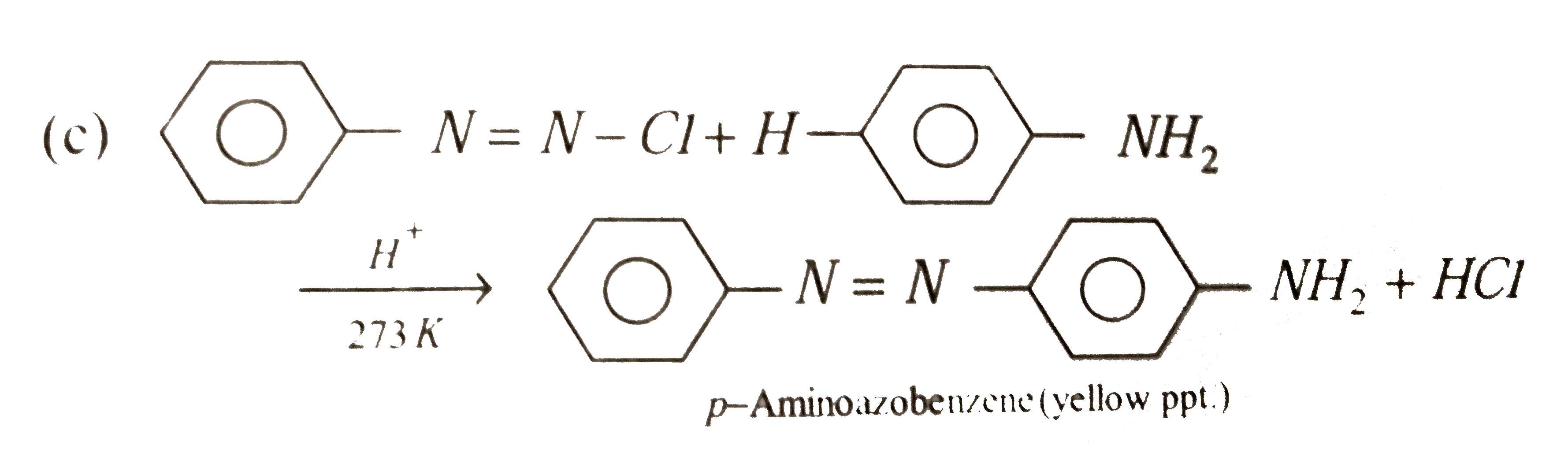
|
|
| 15. |
Diazo coupling is useful to prepare |
|
Answer» Pesticides |
|
| 16. |
Diazomethane reacts with carboxylic acids to produce : |
|
Answer» Ester |
|
| 17. |
Diazo- coupling is useful to prepare : |
|
Answer» PESTICIDES |
|
| 18. |
Diaspore is: |
|
Answer» `Al_2O_3.H_2O` |
|
| 19. |
Diane diol worked for several days to prepare compounds shown. She labelled and slept. When she got up all lables had slipped. Her friend Glycol said that They could be easily distuingished by two experiments. Which of the m were optically active. How many products were obtained when each is treated with periodic acid. after experimentation Diane found the following results 1. Compounds A, E, F were optically active and B, C and D were optically inactive. 2. one product was obtained from the reaction of A, B and D with periodic acid. 3. Two products were obtained from the reaction of F with periodic acid. 4. C and E didnt react with periodic acid. The structure of the compounds were Answer the following based on the above observations, On the basis of the observation which compounds cannot be distinguished ? |
|
Answer» COMPOUNDS C and F |
|
| 20. |
Diaspore is _________. |
|
Answer» `Al_(2)O_(3)` |
|
| 21. |
Diane diol worked for several days to prepare compounds shown. She labelled and slept. When she got up all lables had slipped. Her friend Glycol said that They could be easily distuingished by two experiments. Which of the m were optically active. How many products were obtained when each is treated with periodic acid. after experimentation Diane found the following results 1. Compounds A, E, F were optically active and B, C and D were optically inactive. 2. one product was obtained from the reaction of A, B and D with periodic acid. 3. Two products were obtained from the reaction of F with periodic acid. 4. C and E didnt react with periodic acid. The structure of the compounds were Answer the following based on the above observations, Which structure could be suggested for A |
|
Answer» II |
|
| 22. |
Diane diol worked for several days to prepare compounds shown. She labelled and slept. When she got up all lables had slipped. Her friend Glycol said that They could be easily distuingished by two experiments. Which of the m were optically active. How many products were obtained when each is treated with periodic acid. after experimentation Diane found the following results 1. Compounds A, E, F were optically active and B, C and D were optically inactive. 2. one product was obtained from the reaction of A, B and D with periodic acid. 3. Two products were obtained from the reaction of F with periodic acid. 4. C and E didnt react with periodic acid. The structure of the compounds were Answer the following based on the above observations, Which structure could be compound F |
|
Answer» II |
|
| 23. |
Diamond structure can be considered as ZnS (Zinc blend) structure in which each Zn^(2+) in alternate tetrahedral void and S^(2-) in cubic close pack arrangement is replaced by one carbon atom.If C C covalent bond length in diamond is 1 .SÅ,what is the edge length of diamond unit cell (2 =8). |
|
Answer» 3.46Å |
|
| 24. |
Diamond structure can be considered as ZnS (Zinc blend) structure in which each Zn^(2+) in alternate tetrahedral void and S2– in cubic close pack arrangement is replaced by one carbon atom. If C – C covalent bond length in diamond is 1.5 Å, what is the edge length of diamond unit cell (z = 8). |
|
Answer» |
|
| 25. |
Diamonds are formed from graphite under high pressure in coal mines. Calculate the equilibrium pressure (in atm) at which graphite is converted to diamonds at 25^(@)C (assumed constant) given densities of rho_("graphite")=2g//c c & rho_("diamond")=3g//c c (DeltaG_(f)^(@)) for diamonds is "3 k J m"^(-1) from graphite |
|
Answer» |
|
| 26. |
Diamond is harder than graphite because |
|
Answer» Graphite is planar |
|
| 27. |
Diamond is a non-conductor of electricity but a good conductor of heat-why? |
| Answer» SOLUTION :Due to absence of free electrons, it is a non-conductor of electricity. It has the highest known THERMAL CONDUCTIVITY because thermal motion is distributed in its 3D -structure very effectively. | |
| 28. |
Diamond has fcc crystal structure in which each carbon atom is attached with four other carbon atoms, then the number of carbon atoms per unit cell in diamond are. |
| Answer» ANSWER :C | |
| 29. |
Diamond has each of the following properties except : |
|
Answer» HIGH MELTING point |
|
| 30. |
Diamond belongs to the crystalsystem : |
|
Answer» cubic |
|
| 31. |
Diamond - bad conductor of electricity. |
| Answer» Solution :In DIAMOND, all four valance electrons of carbon are involved in BONDING there is no FREE electrons for CONDUCTIVITY. | |
| 33. |
Diamond and graphite are shown to be allotropic forms of carbon by the fact that |
|
Answer» diamond is hard but GRAPHITE is soft |
|
| 34. |
Diamond and graphite are: |
|
Answer» Isomers |
|
| 35. |
Dialysis is a method of purification of sols. But prolonged dialysis of the sol makes it unstable. Why? |
| Answer» Solution :Traces of electrolytes in the SOL, impart CHARGE to the dispersed phase particles making it stable. PROLONGED dialysis REMOVES all the electrolytes, thus making the sol unstable. | |
| 36. |
Diamagnetic oxide of chlorine is: |
|
Answer» `ClO_3` |
|
| 37. |
Dialysis can separate |
|
Answer» GLUCOSE and FRUCTOSE |
|
| 38. |
Dialkyl ethers react with very few reagents other acids. The only reactive sites that molecules of a dialkyl ether has to another reactive substance are the C H bonds of the alkyl groups and the O group of the ether linkage. Heating dialkyl ethers with very strong acids. (HI, HBr, and H_(2)SO_(4)) causes them to undergo reactions in which the carbon-oxygen bond breaks. When mixed ethers are used, the alcohol and alkyl iodide that form depend on the nature of the alkyl groups. Mechanism is by S_(N)^(2) reaction or S_(N)^(1). B gives positive lucas test in a few seconds. Which is 'B'. |
|
Answer»
|
|
| 39. |
Dialkyl ethers react with very few reagents other acids. The only reactive sites that molecules of a dialkyl ether has to another reactive substance are the C H bonds of the alkyl groups and the O group of the ether linkage. Heating dialkyl ethers with very strong acids. (HI, HBr, and H_(2)SO_(4)) causes them to undergo reactions in which the carbon-oxygen bond breaks. When mixed ethers are used, the alcohol and alkyl iodide that form depend on the nature of the alkyl groups. Mechanism is by S_(N)^(2) reaction or S_(N)^(1). |
|
Answer»
|
|
| 40. |
Dialkyl ethers react with very few reagents other acids. The only reactive sites that molecules of a dialkyl ether has to another reactive substance are the C H bonds of the alkyl groups and the O group of the ether linkage. Heating dialkyl ethers with very strong acids. (HI, HBr, and H_(2)SO_(4)) causes them to undergo reactions in which the carbon-oxygen bond breaks. When mixed ethers are used, the alcohol and alkyl iodide that form depend on the nature of the alkyl groups. Mechanism is by S_(N)^(2) reaction or S_(N)^(1). What is the coorect order of reactivity towards conc. HI assuming S_(N)^(2) type cleavage? |
|
Answer» `I GT IV gt III gt I` |
|
| 41. |
Dialkyl sulphides are known as : |
|
Answer» Sulphonal |
|
| 42. |
……………….diagrams normally consist of plots of triangle_(f)G^(0) vs T for the formation of oxides of common metals. |
| Answer» SOLUTION :ELLINGHAM | |
| 43. |
Dialkyl cadmium reacts with a compound to from a ketone. The compound is: |
|
Answer» Acit |
|
| 44. |
Diacetone alcohol is obtained when |
|
Answer» 2 MOLECULES of ACETONE condense in presence of barium hydroxide |
|
| 45. |
Diacetone alcohol is obtained by the reaction of : |
|
Answer» Acetone and ethanol |
|
| 46. |
Diabetes is detected using ......by testing urine of patients |
|
Answer» Fehling's solution |
|
| 47. |
Di-tert-glycols rearrange in the presence of acid to give alpha-trtiary ketones. The trivial name of the simplest glycol of this type is pinacol, and this type of reaction therefore is named pinacol rearrangement (in this specific case, the reaction is called a pinacol-pinacolone rearrangement). The rearrangement involves 4 steps. one of the hydroxyl group is protonated in the first step. A molecule of water is eliminated in the second step and a tertiary carbocation is formed. the carbocation rearranges in the third step into a more stable carboxonium ion via a [1, 2] rearrangement. In the last step, the carboxonium ion is deprotonated and the product ketone is obtained. Product (A) is : |
|
Answer» `CH_(3)-overset(O)overset(||)(C)-underset(CH_(3))underset(|)overset(CH_(3))overset(|)(C)-CH_(3)` 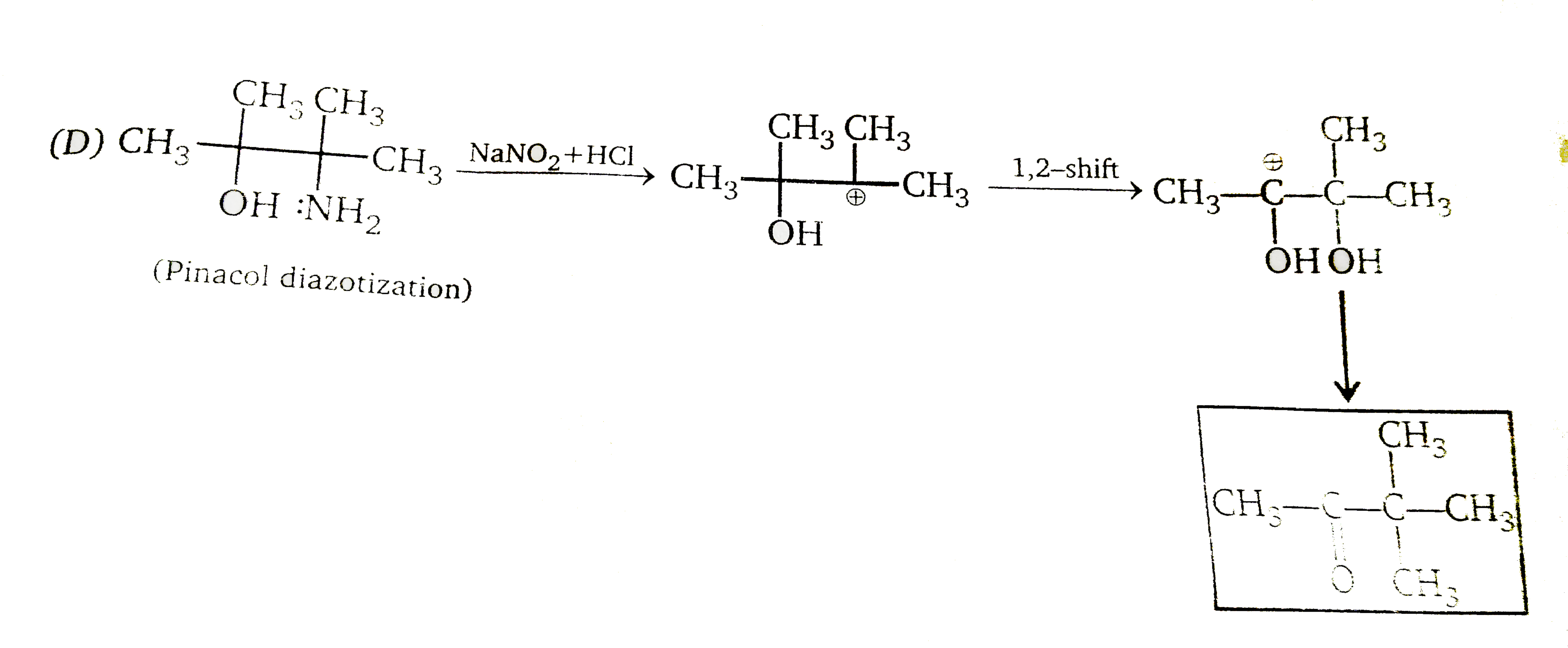
|
|
| 48. |
Diabetes is detected by testing urine of the patient with |
|
Answer» TOLLEN's REAGENT |
|
| 49. |
Di-tert-glycols rearrange in the presence of acid to give alpha-trtiary ketones. The trivial name of the simplest glycol of this type is pinacol, and this type of reaction therefore is named pinacol rearrangement (in this specific case, the reaction is called a pinacol-pinacolone rearrangement). The rearrangement involves 4 steps. one of the hydroxyl group is protonated in the first step. A molecule of water is eliminated in the second step and a tertiary carbocation is formed. the carbocation rearranges in the third step into a more stable carboxonium ion via a [1, 2] rearrangement. In the last step, the carboxonium ion is deprotonated and the product ketone is obtained. How many products obtained in above reaction ? |
|
Answer» 1 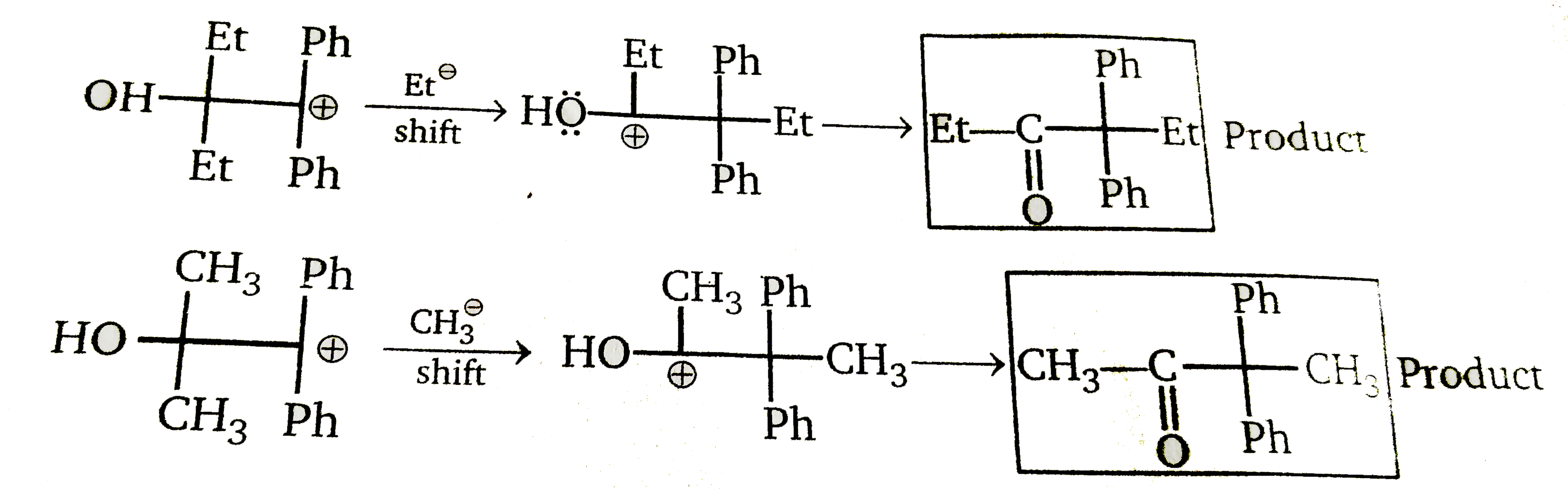
|
|
| 50. |
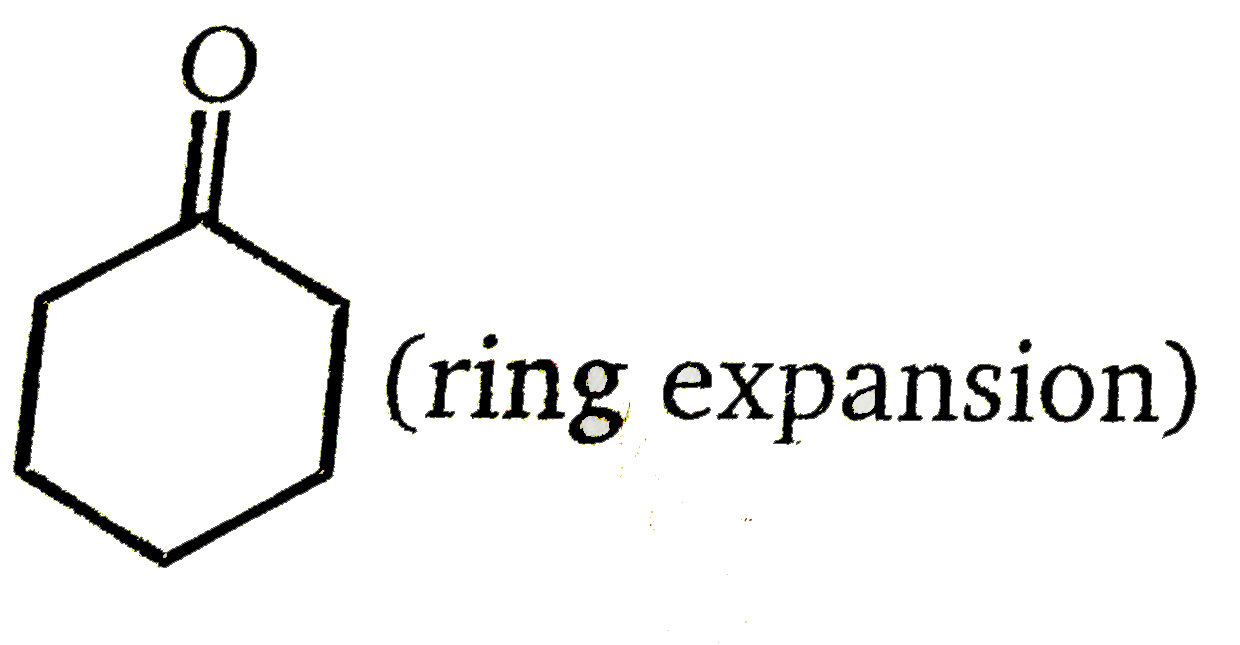
Di-tert-glycols rearrange in the presence of acid to give alpha-trtiary ketones. The trivial name of the simplest glycol of this type is pinacol, and this type of reaction therefore is named pinacol rearrangement (in this specific case, the reaction is called a pinacol-pinacolone rearrangement). The rearrangement involves 4 steps. one of the hydroxyl group is protonated in the first step. A molecule of water is eliminated in the second step and a tertiary carbocation is formed. the carbocation rearranges in the third step into a more stable carboxonium ion via a [1, 2] rearrangement. In the last step, the carboxonium ion is deprotonated and the product ketone is obtained. Product 'P' is : |
|
Answer»
|
|
_E01_893_O01.png)
_E01_893_O02.png)
_E01_893_O03.png)
_E01_893_O04.png)
_E01_891_O01.png)
_E01_891_O02.png)
_E01_891_O03.png)
_E01_891_O04.png)