

Saved Bookmarks
This section includes 7 InterviewSolutions, each offering curated multiple-choice questions to sharpen your Current Affairs knowledge and support exam preparation. Choose a topic below to get started.
| 1. |
A cubic unit cell is characterised by a=b=c and alpha=beta=gamma=90^@ . Calculate the number of atoms in one unit cell in the above three cases. |
| Answer» Solution :BCC, NUMBER of atoms = `8xxfrac{1}{8}+1=2` | |
| 2. |
Cubic unit cells are divided into primitive, bcc and fcc. Calculate the number of atoms in a unit cell of each of the following: ** bcc ** fcc |
|
Answer» SOLUTION :BCC-`2(8xx1/8+1=2)` FCC-`4(8xx1/8+6xx1/2=4) |
|
| 3. |
Cubic close-packed (ccp) latticealso called bcc is it true or false? |
| Answer» SOLUTION :face centred cubic (FEE) lattice | |
| 4. |
Cubic close-packed (ccp) lattice is also called_____ |
| Answer» SOLUTION :face centred CUBIC (fcc) LATTICE | |
| 5. |
Cu_(2)S+2C_(2)O to 6Cu+SO_(2) In which process of metallurgy of copper, above equation is involved ? |
|
Answer» Roasting `2Cu_(2)S+3O_(2)to 2Cu_(2)O+2SO_(2)` `Cu_(2)S+2Cu_(2)O to 6Cu+SO_(2)` |
|
| 6. |
Cu^(64)(" half life" =12.8 "hours" ) decay by beta^(c-)- emission (38%), beta^(o+)- emission(19%), and electron capture (43%). Write the decay products and calculate partial half lives for each of the decay processes. |
|
Answer» SOLUTION :The nuclear reactions are `:` `._(29)Cu^(64) rarr ._(30)Zn^(64)+._(-1)E^(0)(._(-1)beta^(0))` `._(29)Cu^(64) rarr ._(28)Ni^(64)+._(+1)e^(0)(._(+1)beta^(0))` `._(29)Cu^(64)+._(-1)e^(0) rarr ._(28)Ni^(64)` Given, `lambda_(avg)=(0.693)/(12.8)hr^(-1)` `:. lambda_(1)+lambda_(2)+lambda_(3)=lambda_(avg)=(0.693)/(12.8)=5.41xx10^(-2)hr^(-1)......(i)` Also for parallel PATH decay `lambda_(1)=` Fractional yield of`._(30)Zn^(64)xxlambda_(avg)` `lambda_(2)=` Fractional yield of `._(28)Ni^(64)xxlambda_(avg)` `lambda_(3)=` Fractional yield of `_(28)Ni^(64^(**))xxlambda_(avg)` `(lambda_(1))/(lambda_(2))=(38)/(19)....(ii)` and `(lambda_(1))/(lambda_(3))=(38)/(43) ....(iii)` From Eqs. `(i), (ii),` and `(iii), lambda_(1)=2.056xx10^(-2)hr^(-1)` `lambda_(2)=1.028xx10^(-2)hr^(-1),lambda_(3)=2.327xx10^(-2)hr^(-1)` `t_(1//2)` for `beta^(c-)-` emission `=(0.693)/(2.056xx10^(-2))=33.70hr` `t_(1//2)` for `beta^(o+)-` emission`=(0.693)/(1.028xx10^(-2)0=67.41hr` `t_(1//2)` for electron capture `=(0.693)/(2.327xx10^(-2))=29.78hr` 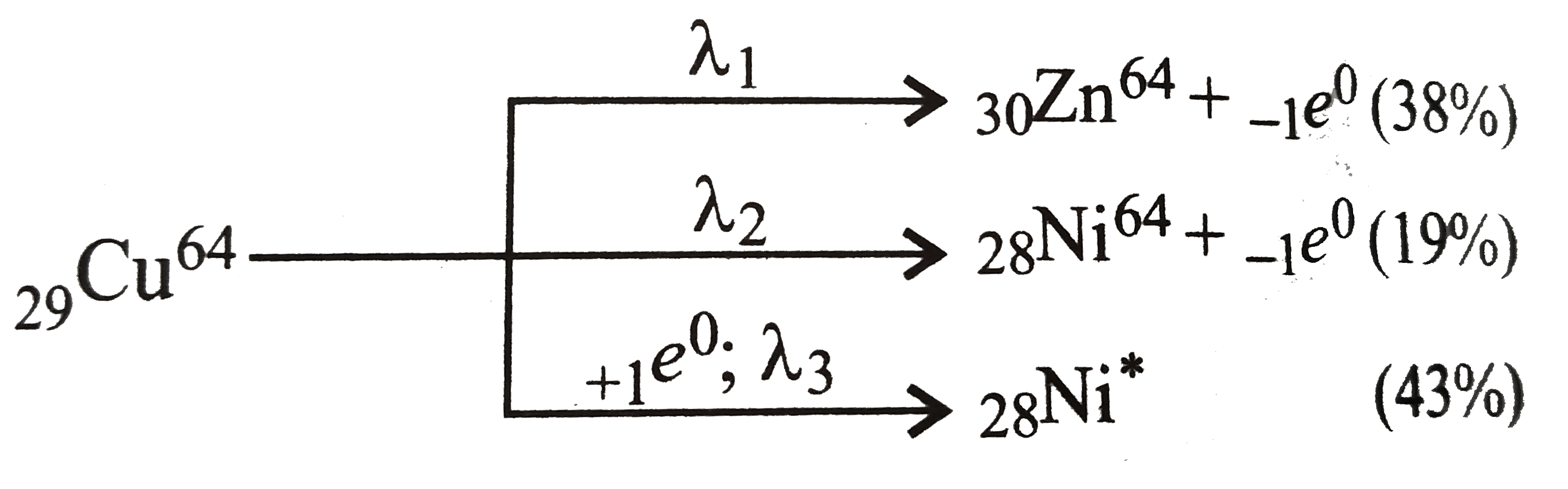
|
|
| 7. |
Cu_2O is : |
|
Answer» Black oxide of copper |
|
| 9. |
Cu^(2+) ions would be reducd to cuprous ion if their solution are mixedwith an aqueous : |
|
Answer» KL SOLUTION |
|
| 10. |
Cu^(2+) ions will be reduced to Cu^(+) ions by the addition of an aqueous solution of |
|
Answer» KF |
|
| 11. |
Cu^(2+) ions are more stable than Cu^(+) ions because Cu^(2+) ions___________ as compared to Cu^(+) ions. |
|
Answer» have HIGHER charge |
|
| 12. |
Cu^(2+) ions are coloured but Zn^(2+) ions are colourless. Give reason. |
|
Answer» Solution :`CU^(2+)` ions CONTAIN one unpaired electron in its d-subshell and can undergo d-d TRANSITION. Therefore it is COLOURED. In `ZN^(2+)`, there is no unpaired electrons, hence it does not undergo d-d transition. Hence it is colourless |
|
| 13. |
Cu^(2+) gives white ppt. of (a)____ with (b) ____ and deep blue colour of _____(c ) ______with (d) ____. |
|
Answer» |
|
| 14. |
Cu^(2+)(aq) + Zn(s) rightarrow Cu(s) + Zn^(2+)(aq), E^(@) = 1.1V Zn^(2+)(aq) + 2e^(-) rightarrow Zn(s), E^(@) = -0.76V Cu^(2+)(aq) + 4NH_(3)(aq) rightarrow [Cu(NH_(3))_(4)]^(2+)(aq) + 2e^(-) is: |
|
Answer» 0.34 V |
|
| 15. |
Cu^(2+)+2e^(-)toCu,E^(@)=+0.34V,Ag^(+)+1e^(-)toAg,E^(@)=+0.80V (i) Construct a galvanic cell using the above data. (ii) For what concentration of Ag^(+) ions will the emf of the cell be zero at 25^(@)C, if the concentration of Cu^(2+) is 0.01 M? (log 3.919=0.593). |
|
Answer» (ii) `Cu+2Ag^(+)toCu^(2+)+2Ag,n=2` `E_(cell)=E_(cell)^(@)-(0.0591)/(2)"log"([Cu^(2+)])/([Ag^(+)]^(2))`. hence, `0.46V-(0.0591)/(2)"log"(0.1)/([Ag^(+)]^(2))`. CALCULATE `[Ag^(+)]` |
|
| 16. |
Cu^(2+)+2e^(-) rarr Cu. For this, graph between E_(red) versus ln[Cu^(2+)] is a straight line of intercept 0.34V, then the electrode oxidation potential of the half cell Cu|Cu^(2+)(0.1M) will be |
|
Answer» `-0.34+(0.0591)/(2)V` It `log[Cu^(2+)]=0`, then `Cu^(2+)=1` `E_(Cu//Cu^(2+))=E_(Cu//Cu^(2+))^(@)` `:. OA=E_(Cu//Cu^(2+))^(@)=-E_(Cu//Cu^(2+))^(@)=-0.34" V"` Hence `E_(Cu//Cu^(2+))=-0.34-(0.0591)/(2)log 0.1=-0.34+(0.0591)/(2)` |
|
| 17. |
Cu^(2+) + 2e rarr Cu(s). For the graph between log[Cu^(2+)] versus E_("red") a straight line of intercept 0.34 V is obtained. Then electrode potential of the half-cell Cu// Cu^(2+)(0.1 M) will be : |
|
Answer» `[0.34+(0.0591)/2]V` |
|
| 18. |
Cu^(2+) +2e rarr Cu, log [Cu^(2+)] vs E_(red).graph is of the type as shown in figure where OA =0.34 V then electrode otential of the half cell of Cu^(2+)(0.1M) will be : |
|
Answer» `-0.34+0.091/2 V` |
|
| 19. |
Cu^(+), Zn^(2+), Sc^(3+), Ti^(4+) are colourless. Prove this statement. |
|
Answer» Solution :`(i) Cu^(+)`, `ZN^(2+)` have `d^(10)` CONFIGURATION and `SC^(3+)`, `Ti^(4+)` have `d^(1)` configuration . `(ii)d-d` transition is not possible in the above COMPLEXES. So they are colourless. |
|
| 20. |
Cu^(+), Zn^(2+) are diamagnetic. Prove it. |
|
Answer» Solution :`Cu^(+), Zn^(2+)` electronic configuration `[AR] 3d^(10)` The number of unpaired electron is 0. `MU= sqrt( 0(0+2)) = 0 mu_(B)`. So `Cu^(+), Zn^(2+)` are DIAMAGNETIC. |
|
| 21. |
[Cu ( NH _ 3 )_4 ]^ (2+)show thefollowinghybridization |
|
Answer» ` dsp ^ 2` ` Cu^ ( 2 +)= [Ar] 3 d^( 9) ` 
|
|
| 22. |
Cu^(+) ion is not stable in aqueous solution because of disproportionation reaction. E^(@) value for disproportionation of Cu^(+) is (Given E_(Cu^(2+)//Cu^(+))^(@)=0.15,E_(Cr^(2+)//Cu)^(@)=0.34V) |
|
Answer» `-0.49V` `Cu^(++)+e^(-)toCu^(+),E_(Cu^(++)//Cu^(+))^(o)=0.15V` . . .(i) `Cu^(++)+2e^(-)toCu,E_(Cu^(++)//Cu)^(o)=0.34V` . .(ii) Multiplying eq. (i) by 2 we get `2CU^(++)+2e^(-)to2Cu^(+)`. . . (iii) `DeltaG_(1)=-nFE=-2xxFxx0.15` `Cu^(++)+2e^(-)toCu`. . . (iv) Subtract the eq. (iv) from (iii) `Cu^(++)+Cuto2Cu^(+)` `DeltaG_(3)=-nFE=-1xxFxxE^(o)` Also `DeltaG_(3)=DeltaG_(1)-DeltaG_(2)` `-1FE^(o)=(-2Fxx0.15)-(-2Fxx0.34)` `E^(o)=-0.38` this is the value of the reaction `Cu^(++)+Cuto2Cu^(+)` but the given reaction is just REVERSE of it `thereforeE_(cell)` for given reaction =+0.38V. |
|
| 23. |
Cu^(+) ion is not stable in aqueous solution because because of dispropotionation reaction. E^(@) value of disproportionation of Cu^(+) is [E_(Cu^(2+)//Cu^(+))^(@)=+ 0.15 V, E_(Cu^(2+)//Cu)^(@)=0.34 V] |
|
Answer» SECOND ionisation entyhalpy of copper is less than the first ionisation enthalpy |
|
| 24. |
Cu^+ ion is not stable in aqueous solution because of diproportionation reaction . E^(@)value for the disproportionation of Cu^(+) is : (E_(cu^(2+)// cu^+)^(@) = + 0.15 V , E_(cu^(+) // cu)^(@)= + 0.34 V ) |
|
Answer» `Cu_((aq))^(+2)` is more STABLE than `Cu_((aq))^(+)` |
|
| 25. |
Cu (II) sulphate solution is treated separately with KCl and KI In which case, Cu^(2+) be reduced to Cu^+: |
|
Answer» With KCI |
|
| 27. |
Cu can reduce Ag^(+)to metallic Ag but Ag cancan't reduce CU^(2+)to metallicCu. Explain |
|
Answer» |
|
| 28. |
Cu^(+) (aq) is unstablein solutionand undergoessimultaneous oxidationand reduction according to the reaction 2cu^(+)(Aq)rarrCu^(2+)(aq)+cu(s) choose correct E^(2)for above reactionif E_(Cu^(2+)//Cu)^(@) =0.34 V and E_+(Cu^(2+)//Cu^(+))^(2) =0.15 V |
|
Answer» `-0.38 V` `(i) Cu (s) rarr Cu^(2+) (aq)+2E^(-)` `triangle G_(1)^(2)=-2xx(-0.34)xxxF` `(ii) Cu^(2+) +(aq)+e^(-) rarr Cu^(+) (aq).triangle G_(2)^(@)=- 1xx(0.15)"F on addition"` `Cu(s) rarr Cu^(+) (aq) +e^(-) triangleG_(3)^(@) =- 1xxE^(@)xxF` `triangle G_(3)^(2)=triangleG_(1)^(2)+triangle_(2)^(@)=(-2xx0.34 xxF)+(-1xx0.15 xxF)` `=+0.68 F-0.15 F` or `E^(@)=- 0.53 V` |
|
| 30. |
Cu^(+2) and and 'en gives a chelate complex. It is ... Membered |
Answer» 
|
|
| 32. |
CsCl has bec arrangement and its unit cell edge length is 400 pm. Calculate the inter-ionic distance in CsCl. |
|
Answer» |
|
| 33. |
CsCl has bcc arrangement, its unit cell edge length is 400pm, its inter atomic distance is |
|
Answer» 400 pm `(sqrt(3)/2)a=(r_(Cs^(+))+r_(Cl^(-)))" " (sqrt(3)/(2))=400=` inter ionic distance |
|
| 34. |
CsCl has bcc arrangement. Its unit cell edge length is 400 pm. Its interionic distance is …….. . |
|
Answer» 400 PM `r = (SQRT3)/(4) a` `thereforer = (sqrt3)/(4) xx 400` `implies r = sqrt(3) xx 100 "pm"`. |
|
| 35. |
CsCl has bcc arrangement, its unit cell edge length is 400 pm, its inter atomic distance is ……………… . |
|
Answer» 400 pm `((sqrt3)/(2))a=(r_(Cs^(+))+r_(Cl^(-)))((sqrt3)/(2))400=" inter ionic distance"` |
|
| 36. |
CsCl crystallises in body centred cubic lattice. If 'a' is its edge length, then which of the following expressions is correct? |
|
Answer» `r_(CS) + r_(CL^(-)) = 3a` |
|
| 37. |
CsCl crystallises in body-centred cubic lattice. If 'a' is its edge length then which of the following expressions is correct ? |
|
Answer» `r_(CS^+) + r_(CL^-) = sqrt(3)a` |
|
| 38. |
CsCl crystalises in body centred cubic lattice. If 'a' is its edge length then which of the following expression is correct ? |
|
Answer» `r_(Cs^(+))+r_(Cl^(-)) = 3a` Face diagonal = `sqrt( 2) a ` Body diagonal `= sqrt( 3) a ` Since `Cl^(-)` ions are PRESENT at the corners of the CUBE and `Cs^(+)`ion is at the body centre. `2 ( R _(Cs^(+)) + r_(Cl^(-))) = sqrt( 3). a ` `:. r_(Cs^(+)) + r_(Cl^(-))= ( sqrt( 3) a)/( 2)` |
|
| 39. |
CSCI possess bcc arrangement, its edge length in unit cell is 400 pm, then inter ionic distance in them are = .......... pm |
| Answer» Answer :B | |
| 40. |
CsBr has BCC structure with edge length 4.3 pm. The shortest interionic distance in between Cs^(+) and Br^(-) is: |
|
Answer» 3.72 PM |
|
| 41. |
CsBr has bcc structure with edge length 4.3. The shortest interionic distance in between Cs^+ and Br^- is : |
|
Answer» 3.72 |
|
| 42. |
CsBr crystallise in a body centred cubic lattice. The unit cell length is 436.6 pm. Given that the atomic mass of Cs = 133 and that of Br = 80 amu and Avogadro number being 6.02xx1023 mol^(-1), the density of CsBr is |
|
Answer» `8.25 g//cm^(3)` |
|
| 43. |
CsBr crystal has bcc structure . It has an edge length of 4.3 overset(@)A. The shortest interionic distance between Cs^(+) and Br^(-) ions is |
|
Answer» `1.86 OVERSET(@)A` `=(1)/(2)` of body diagonal `=(1)/(2)xxsqrt(3)a =SQRT(3)/(2)xx4.3=3.72overset(@)A`. |
|
| 44. |
C(s)+O_(2)(g)rarrCO_(2), DeltaH=-94 kcalCO(g)+(1)/(2)O_(2)(g)rarrCO_(2), DeltaH=+135.2 kcal Then heat of formation of CO(g) is |
|
Answer» `-26.4` KCAL |
|
| 45. |
Cs^+ ion imparts violet colour to the flame. This is due to the fact that the emitted radiations have: |
|
Answer» HIGH ENERGY |
|
| 46. |
Crystals which are good conductor of heat and electricity are - |
|
Answer» IONIC CRYSTALS |
|
| 47. |
Crystals which are good conductor of electricity and heat are known as - |
|
Answer» IONIC CRYSTALS |
|
| 48. |
Crystals where dipoles may align themselves in an ordered mannerso that there is a net dipole moment, exhibit |
|
Answer» pyro-electricity |
|
| 49. |
Crystals of which pair are isomorphous |
|
Answer» `ZnSO_(4),SnSO_(4)` |
|