

Saved Bookmarks
This section includes 7 InterviewSolutions, each offering curated multiple-choice questions to sharpen your Current Affairs knowledge and support exam preparation. Choose a topic below to get started.
| 1. |
CuSO_(4) reacts with Kl in acidic medium to liberate l_(2) 2CuSO_(4) + 34Kl to Cu_(2)l_(2) + 2K_(2)SO_(4)+l_(2), Mercuric periodate Hg_(5)(lO_(6))_(2) reacts with a mixture of Kl and HCl according to the following equation : Hg_(5)(lO_(6))_(2) + 4Kl + 24HCl to 5K_(2)Hgl_(4) + 8l_(2) + 24KCl + 12H_(2)O The liberated iodine is titrated against Na_(2)S_(2)O_(3)solution, 1 ml of which is equivalent to 0.0499 gm of CuSO_(4). 5H_(2)O. What volume in ml of Na_(2)S_(2)O_(3) solution will be required to react with l_(2) liberated from 0.7245 gm ofHg_(5)(lO_(6))_(2) ? Molecular weight of Hg_(5)(lO_(6))_(2) ? Molecular weight of CuSO_(4).5H_(2)O - 249 . 5 |
|
Answer» |
|
| 2. |
CuSO_4 solution reacts with excess of KCN solutionto from: |
|
Answer» `Cu(CN)_2` |
|
| 3. |
{:(CuSO_(4)+NH_(4)OH to "Deep blue soluble"),("excesscomplex salt"):} The correct statement regarding the complex is/are : |
|
Answer» It has square planar geometry. |
|
| 4. |
CuSO_4 on mixing with NH_3 (1:4 ratio) does not give test for Cu^(2+) ions but gives test for SO_(4)^(2-) ions. Why? |
| Answer» SOLUTION :It is because when `NH_3` COORDINATES to `Cu^(2+)` IONS and it forms the COMPLEX `[Cu(NH_3)_4]SO_4` copper ions are PRESENT in coordination sphere, therefore they are non-ionisable whereas `SO_(4)^(2-)` ions are counter ions which are ionisable. | |
| 5. |
CuSO_(4) solution +lime is called: |
|
Answer» LUCA's reagent |
|
| 6. |
CuSO_(4) +NH_(4)OH gives deep blue complex of |
|
Answer» `[Cu(NH_(3))_(4)]SO_(4)` |
|
| 7. |
CuSO_(4) is not stored in aluminium bottles because |
|
Answer» Cu gets oxidised |
|
| 8. |
CuSO_(4) is colourless while CuSO_(4).5H_(2)O is coloured. Why? |
| Answer» Solution : `CuSO_(4)`does not has any LIGAND, so SPLITTING of d-orbital take place while`CuSO_(4).5H_(2)O`has WATER ligand. | |
| 9. |
CuSO_(4) is colourless while CuSO_(4) 5H_(2)O is coloured. Why? [Ti(H_(2)O)_(6)]^(3+)is coloured while [Sc(H_(2)O)_(6)]^(3+) is colourless, why? |
|
Answer» SOLUTION :`CuSO_(4)` does not have any ligand, so splitting of d-orbitals take place while `CuSO_(4), 5H_(2)O` has water as ligand. `TI^(3)` has one UNPAIRED electron while `SC^(3+)` does not have any unpaired `e^(-)`, hence no `d-d` transition in `SC^(3+)`. |
|
| 10. |
CuSO_(4) decolourises onaddition KCN , the produce is |
|
Answer» `[CU(CN)_(4)]^(2-)` |
|
| 11. |
CuSO_(4) decolourises on addition of KCN, the product is |
|
Answer» `[Cu(CN)_(4)]^(2-)` |
|
| 12. |
CuSO_4 crystallise in rock salt structure.Its cell parametercan be determined by various experimental methods like electrical conductivity measurement, colligative properties measurement, pHmeasurement etc. A cubic crystal of CuSO_4 of edge length 17.1 mm, is dissolved in water to make 500 ml solution of pH 5.root3(1.5)=1.14) Given : Cu(H_2O)_6^(2+)+H_2O hArr [Cu(H_2O)_5(OH)]^(+)+H_3O^(+) , K=10^(-5) In the given solution is made 1 M with respect to [Cu^(2+)] becomes 10^(-15) M therefore K_f for the formation of Cu(NH_3)_4^(2+) is |
|
Answer» `10^10` `10^(-5)=x^2/(C-x)=((10^(-5))^2)/(C-10^(-5))` `C=2xx10^(-5)` mol/lt `:.` MOLES of `CuSO_4` DISSOLVED =`2xx10^(-5)xx0.5 =10^(-5)` Number of units cells `=(10^(-5)xxN_A)/4=6/4xx10^(18)=1.5xx10^(18)` number of unit cells along one edge of the cube =`root3(1.5xx10^(18))=1.14xx10^8` If edge LENGTH of F C C unit cell is a Now`{:(Cu^(2+)+,4NH_3hArr,Cu(NH_3)_4^(2+)),(2xx10^(-5), , ),(10^(-15),1,2xx10^(-5)):}` `K_f=([Cu(NH_3)_4^(2+)])/([Cu^(2+)][NH_3]^(4))=(2xx10^(-5))/(10^(-15)xx1)=2xx10^10` |
|
| 13. |
CuSO_4 crystallise in rock salt structure.Its cell parametercan be determined by various experimental methods like electrical conductivity measurement, colligative properties measurement, pHmeasurement etc. A cubic crystal of CuSO_4 of edge length 17.1 mm, is dissolved in water to make 500 ml solution of pH 5.root3(1.5)=1.14) Given : Cu(H_2O)_6^(2+)+H_2O hArr [Cu(H_2O)_5(OH)]^(+)+H_3O^(+) , K=10^(-5) Edge length of FCC unit cell of copper sulphate is |
|
Answer» 120 Å |
|
| 14. |
CuSO_4. 5H_2O(s)hArrCuSO_4(s)+5H_2O(g)K_P=10^(-10)("atm").10^(-2)moles of CuSO_4. 5H_2O(s) is taken in a 2.5 L container at 27^@C then at equilibrium [Take: R=1/12litre atm "mol"^(-1)K^(-1)] |
|
Answer» Moles of `CuSO_4. 5H_2O` LEFT in the container is `9xx10^(-3)` |
|
| 17. |
CuSo_(4). 5 H_(2)O is a |
|
Answer» solution of a solid in a LIQUID. |
|
| 18. |
Current is passed through two cells connected in series,the first cell contains X(NO_3)_(3(aq)) and the second cell contains Y(NO_(3))_(2(aq)). The relative atomic masses of X and Y are in the ratio 1 : 2. What is the ratio of the liberated mass of X to that of Y? |
|
Answer» `3:2` As EQ.wt. = Atomic mass/Valency Eq. wt. of `X=a/3`, Eq. wt. of `Y=(2a)/2` =a According to Faraday.s second LAW : `"Liberated Mass of X"/"Liberated Mass of Y"="Eq. wt. of X"/"Eq. wt. of Y"=(a//3)/a=1/3`=1:3 |
|
| 19. |
Current market prices of Al, Zn and Fe scraps per kg are Rs. 20, Rs. 16 and Rs. 3 respectively. If H_(2) is to be prepared by the reaction of one of these metals with H_(2)SO_(4), which would be the cheapest metal to use ? Which would be most expensive ? |
|
Answer» Solution :The various chemical reactions INVOLVED are given below : (i) `underset(2xx27=54 G)(2Al)+3H_(2)SO_(4)rarr Al_(2)(SO_(4))_(3)+underset(3xx2=6 g)(3H_(2))` (ii) `underset(65 g)(Zn)+H_(2)SO rarr ZnSO_(4) + underset(2g)(H_(2))` (iii)`underset(56 g)(Fe)+H_(2)SO_(4)rarr FeSO_(4)+underset(2 g)(H_(2))` Step 1. To calculate the cost of preparation of 100 g of `H_(2)` from Al 6 g of `H_(2)` prepared from Al = 54 g `THEREFORE` 100 g of `H_(2)` will be obtained from `Al=(54)/(6)xx100=900 g` Cost of 1000 g of Al = Rs. 20 `therefore` Cost of 900 g of `Al=(20)/(1000)xx900=Rs. 18` Step 2. To calculate the cost of preparation of 100 g of `H_(2)` from Zn. 2 g of `H_(2)` is peoduced from Zn = 65 g `therefore` 100 g of `H_(2)` will be obtained from `Zn=(65)/(2)xx100=3250 g` Cost of 1000 g of Zn Rs. 16 `therefore` Cost of 3250 g of `Zn=(16)/(1000)xx3250=Rs.52`. Step 3. To calculate the cost of preparation of 100 g of `H_(2)` from Fe. 2 g of `H_(2)` is produced from Fe = 56 g `therefore` 100 of `H_(2)` will be obtained from `Fe=(56)/(2)xx100=2800 g` Cost of 1000 g of Fe = Rs. 3 `therefore` Cost of 2800 g of `Fe=(3)/(1000)xx2800=Rs. 8.40`. Thus, Fe is the cheapest and Zn is the most expensive metal to use for the preparation of `H_(2)`. |
|
| 20. |
Curves with the shape shown are often observed for reactions involving catalysts. The level portion of the curve is best attributed to the fact that: |
|
Answer» PRODUCT is no LONGER being formed |
|
| 21. |
Current efficiency is defined as the extent of a desired electrochemical reaction, divided by the theoretical extent of the reaction times 100%. What is the current efficiency of an electrodeposition of Cy metal in which 9.8g Cu is deposited by passage of 3A current for 10000 seconds. |
|
Answer» 0.009 `1000 xx 3 xx 1/(96500)=0.311" mol e"^(-1)` If 0.311 mol electrons PROVIDED by the current 0.308 mol was used to DEPOSIT copper. The current efficiency is `(0.308)/(0.311) xx 100 =99.1%` |
|
| 22. |
Curdling of milk is |
|
Answer» naturation of protein |
|
| 23. |
Curd'contain the following vitamin |
| Answer» Answer :A | |
| 24. |
Cuprous salts are generally colourless while cuprous oxide is: |
|
Answer» Green |
|
| 25. |
Cuprous chloride is obtained from cupric chloride : |
|
Answer» By HEATING CAPRIC chloride with CHOLRINE |
|
| 27. |
Cuprous chloride can not be prepared : |
|
Answer» by PASSING `SO_2` through the solution containing `CuSO_4` and NaCl (A)`2CuSO_4 + 2NaCl+2H_2O+SO_2 to Cu_2Cl_2 + Na_2 SO_4 +2H_2SO_4` (B)`Cu+HCl+[O]toCuCl_2+H_2O,CuCl_2+CutoCu_2Cl_2` (C )`CuSO_4 + 2HCl to CuCl_2 +H_2SO_4 , CuCl_2 + Cu to Cu_2Cl_2` |
|
| 28. |
Cupric compounds are more stable than their cuprous counterparts in solid state. This is because |
|
Answer» <P>the endothermic character of the 2nd I P of Cu is not so high |
|
| 29. |
Cupra-ammonium silk is |
|
Answer» natural FIBRE |
|
| 30. |
Cupellation process is used in he metallurgy of : |
|
Answer» Copper |
|
| 31. |
Cupellation is a process used for the refining of |
|
Answer» Silver |
|
| 32. |
"Cumene"underset((ii)H_(2)O,H^(+))overset((i)O_(2))to (X) and (Y) What is X and Y? |
|
Answer» TOLUENE, Propene |
|
| 33. |
Cumene on air oxidation give |
|
Answer» CARBONIC acid |
|
| 34. |
Cumene process is the most important commercial method for the manufacture of phenol. Cumene is |
|
Answer» 1-methyl ethyl benzene 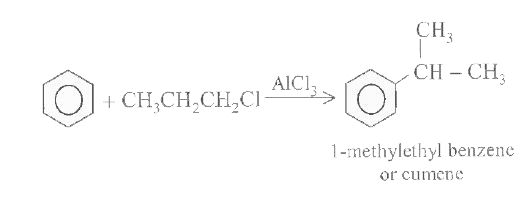
|
|
| 35. |
Cumene is isopropyl benzene. |
|
Answer» |
|
| 36. |
Cumene is converted in phenol by |
|
Answer» REDUCTION and DECOMPOSITION by acid |
|
| 38. |
CuFeS_(2) mineral was analysed for Cu and Fe percentage : 10 g of it was boiledwith dil . H_(2)SO_(4)and diluted to 1 L. 10 ml ofthis solution required 2 mL of 0.01 M MnO_(4)^(-) in acidic medium . In another titration, 25 ml of the same solutionrequired . 5 ml of 0.01MMnO_(4)^(-) solution iodometrically . Calculate the percentage of Cu and Fe in the mineral. |
|
Answer» |
|
| 39. |
CuCO_(3) was strongly heated to obtain a residue A and gas B. The residue obtained was treated with a salt of sodium 'X' and oxide Y, which produced a blue colored glassy compound C on heating in oxidising flame. The same combination of x and Y gave a green colored glassy compound D when Cr_(2)(SO_(4))_(3) was heated with them in oxidizing flame. Match the following accordingly : |
|
Answer» `CuO+underset("Borax bead")ubrace(overset((X))(NaBO_(2))+B_(2)O_(3))to underset((C )"Blue bead")ubrace(CU(BO_(2))_(2))+NaBO_(2)` `Cr_(2)(SO_(4))_(3) underset("Bead test")overset("Borax")to ` GREEN COLORED metaborate |
|
| 40. |
Cu(CN)_(4)^(2-) is colourless as it absorbs light in |
|
Answer» VISIBLE region |
|
| 41. |
CuCN reacts with FeCl_3 to give |
|
Answer» `CuCl_2` |
|
| 42. |
[CuCl_(4)]^(2-) exists while [CyI_(4)]^(2-) does not exist why ? |
|
Answer» Solution :`(i)` In `[CuCl_(4)]^(2-)` complex, the size of chloride ion is less hence exist. But in `[CuI_(4)]^(2-)` the bigger iodide ion makes the compound unstable. `(ii)` When copper cation comes in contact with iodide anion, iodide get oxidised to iodine molecule hence the formation of the above complex ion does not take place. Hence `[CuCl_(4)]^(2-)` EXISTS while `[CuI_(4)]^(2-)` does not exist. |
|
| 43. |
CuCl_(2) is used as catalyst in |
|
Answer» the conversion of `(CH_(3))_(2)SiCl_(2)` to linear silicones |
|
| 44. |
CuCl is sparingly soluble in water but it dissolves in KCl solution due to the formation of |
|
Answer» `K_(2)[CuCl_(4)]` |
|
| 45. |
CuCl is sparingly soluble in H_2O but it dissolves in KCI solution due to the formation of: |
|
Answer» `K_2[CuCl_4]` |
|
| 46. |
CuCl is insoluble in water but it dissolves in KCl solution. This is due to the formation of the complex. |
|
Answer» `K_(2)[CuCl_(3)]` |
|
| 47. |
CaCl is colourless, while CuSO_(4).5H_(2)O is coloured. Explain? |
|
Answer» Solution :Electronic configuration of `Cu^+` ion is [Ar] `4s^0 3d^9` In `CUCL, Cu^(+)` ion has no unpaired d- electron . THUS d-d transition is no POSSIBLE in CuCl and HENCE it is colourless. In `CuSO_4. 5H_2O` the `Cu^(2+)` ion has one unpaired d-electron in 3d -subshell . Thus, d-d transition is possible and hence it EXHIBITS colour. |
|
| 48. |
CuCl dissolves in ammonia forming a complex. The co-ordination number of copper in the complex is: |
|
Answer» 1 |
|
| 49. |
Cubic unit cells are divided into primitive, bcc and fcc. Calculate the number of atoms in unit cell of each of the following : *fcc |
| Answer» SOLUTION :FCC, number of atoms = `(8xxfrac{1}{8})+ (6xxfrac{1}{2})=4` | |