

Saved Bookmarks
This section includes 7 InterviewSolutions, each offering curated multiple-choice questions to sharpen your Current Affairs knowledge and support exam preparation. Choose a topic below to get started.
| 1. |
Crystals of AgBr can be removed from black-and-white photographic film by reacting the AgBr with sodium thiosulphateAgBr(s) + 2S_2O_3^(2-) (aq) iff [Ag(S_2O_3)_2]^(3-) (aq) + Br (aq) (a) What is the equilibrium constant for this dissolving process?(b) In order to dissolve 2.5 g of AgBr in a 1-litre solution, how many moles of Na_2S_2O_3must be added? K_(sp) (AgBr) = 5 xx 10^(-13), K_f [Ag (S_2O_3)_2]^(3-)= 2.9 xx 10^13 |
| Answer» SOLUTION :(a) 14.5 (B) 0.03 MOLE | |
| 2. |
Crystals can be described into "…........" basic crystal habits . |
|
Answer» 7 |
|
| 3. |
Crystals can be classified into …… basic crystal habits? |
|
Answer» 7 |
|
| 4. |
Crystalloids differ from colloids mainly in respect |
|
Answer» ELECTRICAL BEHAVIOUR |
|
| 5. |
Crystallographic parameters in KMnO_(4) are |
|
Answer» `ALPHA=BETA=gamma ne 90^(@)` |
|
| 6. |
Crystalline varieties of allotropes of carbon is : |
|
Answer» Graphite |
|
| 7. |
Crystallisation from concentrated solution of glucose at 303 K gives alpha-glucose. |
|
Answer» |
|
| 8. |
Crystalline solids have the different value of the following property in different directions : |
|
Answer» ELECTRICAL RESISTANCE. |
|
| 9. |
Crystalline solids have a sharp melting point. At a characteristic temperature they melt abruptly and become liquid. On the other hand, amorphous solids soften, melt and start flowing over a range of temperature and can be moulded and blown into various shapes. Amorphous solids have the same structural features as liquids and are conveniently regarded as extremely viscous liquids. They may become crystalline at some temperature. Some glass objects from ancient civilisations are found to become milky in appearance because of some crystallisation. Like liquids, amorphous solids have a tendency to flow, though very slowly. Therefore, sometimes these are called pseudo solids or super cooled liquids. 3. What is the similarity between amorphous solids and liquids ? |
| Answer» Solution :AMORPHOUS solids have the same structural FEATURES as liquids and are therefore REGARDED as EXTREMELY viscous liquids. | |
| 10. |
Crystalline solids have a sharp melting point. At a characteristic temperature they melt abruptly and become liquid. On the other hand, amorphous solids soften, melt and start flowing over a range of temperature and can be moulded and blown into various shapes. Amorphous solids have the same structural features as liquids and are conveniently regarded as extremely viscous liquids. They may become crystalline at some temperature. Some glass objects from ancient civilisations are found to become milky in appearance because of some crystallisation. Like liquids, amorphous solids have a tendency to flow, though very slowly. Therefore, sometimes these are called pseudo solids or super cooled liquids. 4. Why do very old glass panes become milky in appearance ? |
| Answer» Solution :This is because over a PERIOD of time, AMORPHOUS solids (GLASS) become crystalline. The milkiness that is SEEN is because of crystalline nature. | |
| 11. |
Crystalline solids have a sharp melting point. At a characteristic temperature they melt abruptly and become liquid. On the other hand, amorphous solids soften, melt and start flowing over a range of temperature and can be moulded and blown into various shapes. Amorphous solids have the same structural features as liquids and are conveniently regarded as extremely viscous liquids. They may become crystalline at some temperature. Some glass objects from ancient civilisations are found to become milky in appearance because of some crystallisation. Like liquids, amorphous solids have a tendency to flow, though very slowly. Therefore, sometimes these are called pseudo solids or super cooled liquids. 5. What are the other names given to amorphous solids ? |
| Answer» Solution :AMORPHOUS SOLIDS are also known as pseudo solids or SUPER COOLED liquids. | |
| 12. |
Crystalline solids have a sharp melting point. At a characteristic temperature they melt abruptly and become liquid. On the other hand, amorphous solids soften, melt and start flowing over a range of temperature and can be moulded and blown into various shapes. Amorphous solids have the same structural features as liquids and are conveniently regarded as extremely viscous liquids. They may become crystalline at some temperature. Some glass objects from ancient civilisations are found to become milky in appearance because of some crystallisation. Like liquids, amorphous solids have a tendency to flow, though very slowly. Therefore, sometimes these are called pseudo solids or super cooled liquids. 2. What happens when an amorphous solids is heated ? |
| Answer» SOLUTION :Amorphous solids, on heating, SOFTEN, melt and start FLOWING over a range of temperature. | |
| 13. |
Crystalline solids have a sharp melting point. At a characteristic temperature they melt abruptly and become liquid. On the other hand, amorphous solids soften, melt and start flowing over a range of temperature and can be moulded and blown into various shapes. Amorphous solids have the same structural features as liquids and are conveniently regarded as extremely viscous liquids. They may become crystalline at some temperature. Some glass objects from ancient civilisations are found to become milky in appearance because of some crystallisation. Like liquids, amorphous solids have a tendency to flow, though very slowly. Therefore, sometimes these are called pseudo solids or super cooled liquids. 1. Give a characteristic of crystalline solids. |
| Answer» Solution :CRYSTALLINE SOLIDS have a sharp melting point IE., they melt at a characteristic TEMPERATURE. | |
| 14. |
Crystalline solids have |
|
Answer» If both ASSERTION and reason are TRUE and reason is the correct explanation of assertion |
|
| 15. |
Crystalline solids are 'anisotropic'. What is anisotropy? |
| Answer» Solution :A crystalline solid is SAID to be ANISOTROPIC if CERTAIN physical properties such as refrective index, conductivity ETC. are different in different directions. | |
| 16. |
Crystalline solid AB has face-centred cubic unit cell. Corners and the face centres of unit cell are occupied by atoms A. The edge centres and body centre of the unit cell are occupied by atoms B. If all the face-centred atoms along one of the axes are removed, then resulting chemical formula of the solid will become- |
|
Answer» AB |
|
| 17. |
'Crystalline solids are anisotropic in nature.' What does this statement mean ? |
| Answer» SOLUTION :The PROPERTIES of a CRYSTALLINE solid are not the same in anyone direction. Anisotropic MEANS .not same.. | |
| 18. |
Crystalline solids are …………….. and they show different values of physical properties when measured along different directions. |
| Answer» SOLUTION :ANISOTROPIC | |
| 19. |
Crystalline solids |
|
Answer» have irregular shape. |
|
| 20. |
Crystalline polymers are |
|
Answer» HARDER Hence choice (a),(b) are correct. Choices (c) and (d) are INCORRECT. |
|
| 21. |
Crystalline metal can be transformed into metallic glass by |
|
Answer» Alloying |
|
| 22. |
Crystalline metal can be transformed into metallic glass by : |
|
Answer» Alloying |
|
| 23. |
Crystal structure of the oxide AB_(2)O_(4) is bassed on the cubic close packed (ccp) array of O^(2-) ions, with A^(2+) ions occupying some tetrahedral voids and B^(3+) ions occupying some octahedral voids. If a crystal of this oxide contains 1 mol AB_(2)O_(4) formula unit, then calculate (1) total number of voids in the crystal (2) total number of tetrahedral voids occupied by A^(2+) ions (3) total number of octahedral voids occupied by B^(3+) ions. |
|
Answer» Solution :TOTAL NUMBER of `O^(2-)` ions in 1 mol of oxide `(AB_(2)O_(4))` crystal = `4xx6.022xx10^(23)`. The ccp structure is formed by `O^(2-)` ions. So, total number of TETRAHEDRAL voids = 2 `xx` no. of packed `O^(2-)` ions = `2xx4xx6.022xx10^(23)=8xx6.022xx10^(23)` and total number of octahedral voids = number of packed `O^(2-)` ions = `4xx6.023xx10^(23)`. (1) Total number of voids in 1 mol oxide crystal = `(8+4)xx6.022xx10^(23)=7.2264xx10^(24)`. (2) To maintain STOICHIOMETRY and electrical neutrality, one-eighth of the total tetrahedral voids will be occupied by `A^(2-)` ions. Hence, total number of tetrahedral voids occupied by `A^(2-)` ions = `1/8xx8xx6.022xx10^(23)` `=6.022xx10^(23)`. (3) For the same reasons, half of the total octahedral voids will be occupied by `B^(3+)` ions. Hence, total number of octahedral holes occupied by `B^(3+)` ions. `=1/2xx4xx6.022xx10^(23)=1.2044xx10^(24)` |
|
| 24. |
Crystal field theory with its assumptions of completely electrostatic metal-ligand interactions, does not appear to retionalize the spectrochemical series particularly well. To explain the order of ligands in the series we must admit some covalent contribution to the metal ligand bond, both sigma and pi. Sigma bonds are formed by ligands using their p orbitals (e.g. Cl^(-)) or by hybrid orbitals (e.g. sp^(3)) by (H_(2)O) since all ligands are capable of such sigma interaction, this is not very useful in rationalizing spectrochemical series. The pi bonding ability of ligands partially justifies their position in spectrochemical series. pi-acid ligands. which can accept electron density from filled metal orbital into their empty orbital via pi interation appear towards stronger/higher and of the series e.g. CN^(-).PR_(3) etc. While sigma-donor ligands are typically weak field ligands e.g. Cl^(-),O^(2-) etc. Q. Which of the following is false for CO ligand? |
|
Answer» it is a PI-acid LIGAND. |
|
| 25. |
Crystal field theory with its assumptions of completely electrostatic metal-ligand interactions, does not appear to retionalize the spectrochemical series particularly well. To explain the order of ligands in the series we must admit some covalent contribution to the metal ligand bond, both sigma and pi. Sigma bonds are formed by ligands using their p orbitals (e.g. Cl^(-)) or by hybrid orbitals (e.g. sp^(3)) by (H_(2)O) since all ligands are capable of such sigma interaction, this is not very useful in rationalizing spectrochemical series. The pi bonding ability of ligands partially justifies their position in spectrochemical series. pi-acid ligands. which can accept electron density from filled metal orbital into their empty orbital via pi interation appear towards stronger/higher and of the series e.g. CN^(-).PR_(3) etc. While sigma-donor ligands are typically weak field ligands e.g. Cl^(-),O^(2-) etc. Q. Which of the following d orbitals of the central atom is useful for sigma bond formation with ligands in octahedral field? |
|
Answer» `d_(xy),d_(x^(2)-y^(2))` |
|
| 26. |
Crystal field theory was proposed by H.beths (1929) and Van Vleck (1932) and as originally applied to ionic crystals to explain their optical properties and is, therefore, called crystal field theory, however, this theory was appliedto the study of coordination compounds in 1950 and this theory accounts for more satisfactory expalnation for the properties of complexes especially colour and magnetism. Which of the following complex is paramagnetic in nature ? |
|
Answer» `K_(4)[Fe(CN)_(6)]` |
|
| 27. |
Crystal field theory was proposed by H.beths (1929) and Van Vleck (1932) and as originally applied to ionic crystals to explain their optical properties and is, therefore, called crystal field theory, however, this theory was appliedto the study of coordination compounds in 1950 and this theory accounts for more satisfactory expalnation for the properties of complexes especially colour and magnetism. What is the geometry of [Co(NH_(3))_(6)]^(2+)? |
|
Answer» OCTAHEDRAL 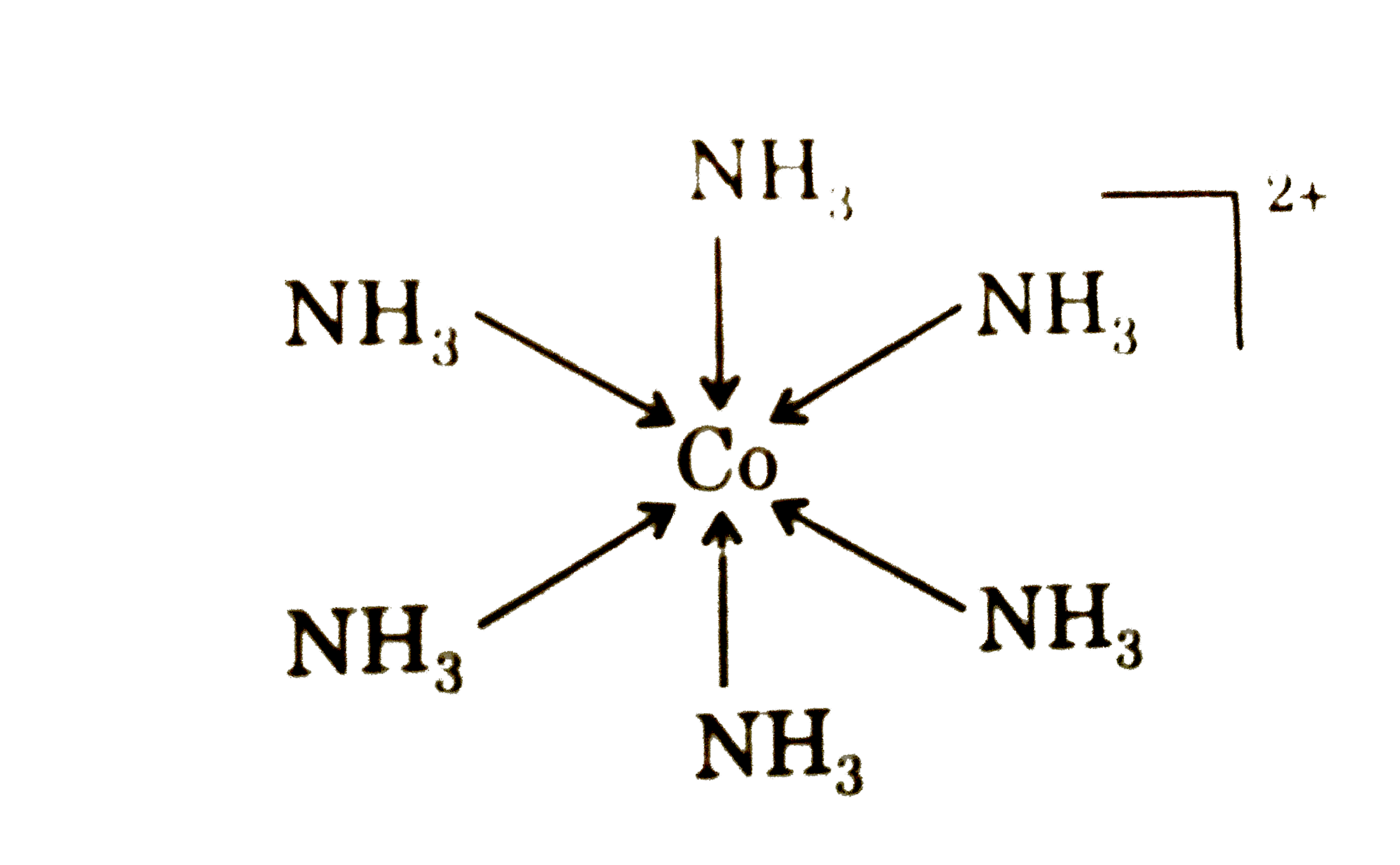
|
|
| 28. |
Crystal field theory views the bonding in complexes as arising from electrostatic interaction and considers the effect of the ligand charges on the energies of the metal ion d-orbitals In this theory, a ligand lone pair is modelled as a point negative charge that repels electrons in the d-orbitals of the central metal ion.The theory concentrated on the resulting splitting of the d-orbitals in two groups with different energies and used that splitting to rationalize and correlate the optical spectra,thermodynamic stability, and magnetic properties of complexes.This energy splitting between the two sets of d-orbitals is called the crystal field splitting Delta. In general, the crystal field splitting energy Delta corresponds to wavelenght of light in visible region of the spectrum, and colours of the complexes can therefore be attributed to electronic transition between the lower and higher energy sets of d-orbitals. In general, the colour that we see is complementry to the colour absorbed. Different metal ions have different value of Delta, which explains why their complexes with the same ligand have different colour. Similarly the crystal field splitting also depends on the nature of ligands and as the ligand for the same metal varies from H_2O to NH_3 to ethylenediamine, Delta for complexes increase.Accordingly, the electronic transition shifts to higher energy (shorter wavelength) as the ligand varies from H_2O from NH_3 to en, thus accounting for the variation in colour. Crystal field theory accounts for the magnetic properties of complexes in terms of the relative values of Delta and the spin pairing energy P. Small Delta values favour high spin complexes, and large Delta values favour low spin complexes. The [Ti(NCS)_6]^(3-) ion exhibits a single absorption band at 544 nm.What will be the crystal field splitting energy (in kJ mol^(-1)) of the complex ? (h=6.626xx10^(-34) J.s, C=3.0xx10^5 m//s, N_A=6.02xx10^23 ions/mole. |
|
Answer» 240 `=(3.65xx10^(-19)"J/ion")xx(6.02xx10^(23)"ions/mole")=(21.973xx10^(4))/1000"KJ mol"^(-1) =219.73 "kJ mol"^(-1)` |
|
| 29. |
Crystal field theory was proposed by H.beths (1929) and Van Vleck (1932) and as originally applied to ionic crystals to explain their optical properties and is, therefore, called crystal field theory, however, this theory was appliedto the study of coordination compounds in 1950 and this theory accounts for more satisfactory expalnation for the properties of complexes especially colour and magnetism. What is the hybridisation of [Ni(H_(2)O)_(6)]^(2+)? |
|
Answer» `sp^(3)d^(2)` 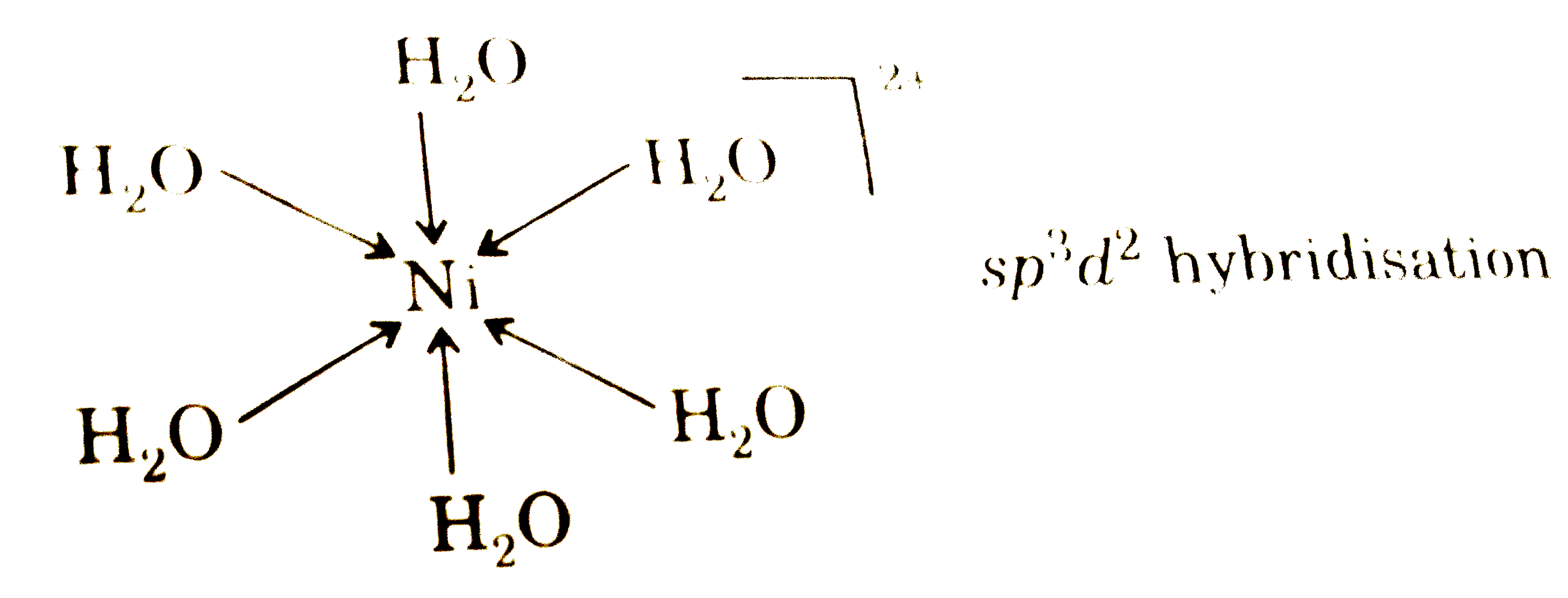
|
|
| 30. |
Crystal field theory views the bonding in complexes as arising from electrostatic interaction and considers the effect of the ligand charges on the energies of the metal ion d-orbitals In this theory, a ligand lone pair is modelled as a point negative charge that repels electrons in the d-orbitals of the central metal ion.The theory concentrated on the resulting splitting of the d-orbitals in two groups with different energies and used that splitting to rationalize and correlate the optical spectra,thermodynamic stability, and magnetic properties of complexes.This energy splitting between the two sets of d-orbitals is called the crystal field splitting Delta. In general, the crystal field splitting energy Delta corresponds to wavelenght of light in visible region of the spectrum, and colours of the complexes can therefore be attributed to electronic transition between the lower and higher energy sets of d-orbitals. In general, the colour that we see is complementry to the colour absorbed. Different metal ions have different value of Delta, which explains why their complexes with the same ligand have different colour. Similarly the crystal field splitting also depends on the nature of ligands and as the ligand for the same metal varies from H_2O to NH_3 to ethylenediamine, Delta for complexes increase.Accordingly, the electronic transition shifts to higher energy (shorter wavelength) as the ligand varies from H_2O from NH_3 to en, thus accounting for the variation in colour. Crystal field theory accounts for the magnetic properties of complexes in terms of the relative values of Delta and the spin pairing energy P. Small Delta values favour high spin complexes, and large Delta values favour low spin complexes. Which of the following complexes are diamagnetic ? {:([Pt(NH_3)_4]^(2+),[Co(SCN)_4]^(2-),[Cu(en)_2]^(2+),[HgI_4]^(2-)),("square planar","tetrahedral","square planar","tetrahedral"),((i),(ii),(iii),"iv"):} |
|
Answer» (i) and (ii) (ii)`._27Co^(2+)` has `3d^7` configuration , `SCN^-` is weak FIELD ligand. So thecomplex is paramagnetic with three unpaired electrons. (iii)`._29Cu^(2+)` has `3d^9` configuration , complex is paramagnetic with ONE unpaired electron. (iv)`._80Hg^(2+)` has `5d^10` configuration , all electrons are paired so diamagnentic |
|
| 31. |
Crystal field theory views the bonding in complexes as arising from electrostatic interaction and considers the effect of the ligand charges on the energies of the metal ion d-orbitals In this theory, a ligand lone pair is modelled as a point negative charge that repels electrons in the d-orbitals of the central metal ion.The theory concentrated on the resulting splitting of the d-orbitals in two groups with different energies and used that splitting to rationalize and correlate the optical spectra,thermodynamic stability, and magnetic properties of complexes.This energy splitting between the two sets of d-orbitals is called the crystal field splitting Delta. In general, the crystal field splitting energy Delta corresponds to wavelenght of light in visible region of the spectrum, and colours of the complexes can therefore be attributed to electronic transition between the lower and higher energy sets of d-orbitals. In general, the colour that we see is complementry to the colour absorbed. Different metal ions have different value of Delta, which explains why their complexes with the same ligand have different colour. Similarly the crystal field splitting also depends on the nature of ligands and as the ligand for the same metal varies from H_2O to NH_3 to ethylenediamine, Delta for complexes increase.Accordingly, the electronic transition shifts to higher energy (shorter wavelength) as the ligand varies from H_2O from NH_3 to en, thus accounting for the variation in colour. Crystal field theory accounts for the magnetic properties of complexes in terms of the relative values of Delta and the spin pairing energy P. Small Delta values favour high spin complexes, and large Delta values favour low spin complexes. Which of the following statements is incorrect ? |
|
Answer» The `Ni^(2+)` (aq) cation is coloured because `Ni^(2+)` ion can absorb light, which promotes electrons from the filled d-orbitals to the higher ENERGY HALF filled d-orbitals |
|
| 32. |
Crystal field theory provides correct electronic distribution of central metal under surrounding ligannd field, hence it clearly explains magnetic moment, colour of a complex. Q. Which of the following hydrated complex ion has high intensity colour in aqueous solution. |
|
Answer» `[Mn(H_(2)O)_(6)]^(3+)` |
|
| 33. |
Crystal field theory does not explain which of the following property of coordination compounds ? |
|
Answer» The COVALENT CHARACTER of the BAND between METAL and the ligand |
|
| 34. |
Crystal field theory considers purely ionic bond between metal and ligand. The five d-orbitals in an isolated gaseous metal are degenerate. The degeneracy of the d-orbitals is lost in prsence of ligand which is known as splitting of d-orbitals. Complex in which t(2g)^(3) electronic configuration is not observed. |
|
Answer» `[Fe(H_(2)O)_(6)]^(3+)` |
|
| 35. |
Crystal field theory provides correct electronic distribution of central metal under surrounding ligannd field, hence it clearly explains magnetic moment, colour of a complex. Q. Which of the following complex is high spin? |
|
Answer» `K_(4)[Fe(CN)_(6)]^(-)` `[PtCl_4]^(2-)`:LOS spin complex: `P lt Delta_(0)` `[CoF_(6)]^(3-)`: High spin complex: `P GT Delta_(0)` `[Ni(NH_(3))_(6)]^(2+)`: High spin or low spini not defined. |
|
| 36. |
Crystal field theory provides correct electronic distribution of central metal under surrounding ligannd field, hence it clearly explains magnetic moment, colour of a complex. Q. In which of the following complex transition of electron occurs from one shell to other shell of central metal. |
|
Answer» `[Fe(H_(2)O)_(5)(NO)]^(2+)` 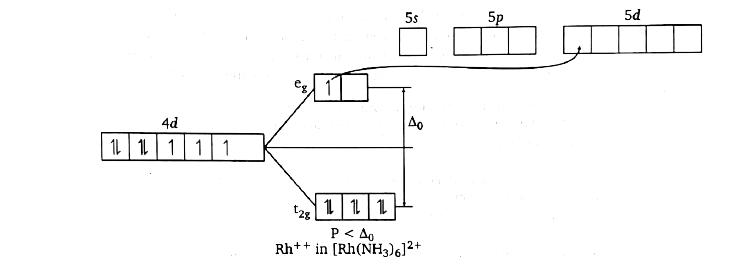
|
|
| 37. |
Crystal field theory considers purely ionic bond between metal and ligand. The five d-orbitals in an isolated gaseous metal are degenerate. The degeneracy of the d-orbitals is lost in prsence of ligand which is known as splitting of d-orbitals. Calculate crystal field stabilization energy in [Co(C_(2)O_(4))_(3)]^(3-) in terms of Delta_(0) |
|
Answer» `-2.4 Delta_(0)` CFSE`=-0.4xx6Delta_(0)=-2.4Delta_(0)` |
|
| 38. |
crystal field stabilization energy for high spin d^(5) octahedral complex is…….. . |
|
Answer» `-0*6Delta_(0)` |
|
| 39. |
What is crystal field splitting energy (CFSE)? |
|
Answer» <P>`-1.2 Delta_(0)` 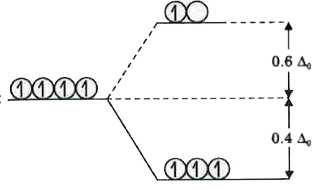 `CFSE=3(-0.4)Delta_(0)+(0.6)Delta_(0)=-1.2Delta_(0)+0.6Delta_(0)=-0.6Delta_(0)` |
|
| 40. |
Crystal field stabilization energy for high spind^(5) octahedral complex is |
|
Answer» `-0.6Delta_(0)` |
|
| 41. |
Crystal field stablisation energy for high spin d^(4)octahedral complex is :- |
|
Answer» <P>`-1.8 Delta_(0)` |
|
| 42. |
Crystal field stabilization energy for high spin d^4 octahedral complex is |
|
Answer» <P>`-1.8 Delta_0` |
|
| 43. |
Crystal field stabilization energy for high spin d^(4) octahedral complex is |
|
Answer» <P>`-0.6 Delta_(0)` `t_(2g)^(3) e_(g)^(1)` CFSE = (-0.4x+0.6y)`Delta_(0)` x=no. of ELECTRONS in `t_(2g)` y=no. of electrons in `e_(g)` `therefore` CFSE `=[-0.4(3)+0.6(1)]Delta_(0)` `=(-1.2+0.6)Delta_(0)=-0.6 Delta_(0)` |
|
| 44. |
Crystal field stabalisation energy for complex [Co(CN)_(6)]^(-3) will be :- |
|
Answer» `+2.4 Delta_(0)+3P` |
|
| 45. |
Crystal defects give rise to certain special properties in the solids. Why does LiCl not exhibit frenkel defect? |
| Answer» Solution :The size of the lithium cation is bigger than the INTERSTITIAL VOID in LICL. | |
| 46. |
Crystal defects give rise to certain special properties in the solids. What is meant by frenkel defects? |
| Answer» Solution :The MIGRATION of some cation from the normal lattice SITE to interstitial POSITIONS is called frenkel DEFECT. | |
| 47. |
Cryoscopy is concerned with |
|
Answer» osmotic PRESSURE of a solution |
|
| 48. |
Cryoscopic constant of a liquid |
|
Answer» is the decrease in freezing point when `1`g of SOLUTE is dissolved per KG of the SOLVENT |
|
| 49. |
What is Cryoscopic constant ? |
|
Answer» MOLAR mass of solute in the solution |
|
| 50. |
Cryolite is chemically |
|
Answer» `Na_(3) AlF_(6) ` andis used in the ELECTROYSIS of alumina for increasing electrical CONDUCTIVITY |
|