Saved Bookmarks
This section includes 7 InterviewSolutions, each offering curated multiple-choice questions to sharpen your Current Affairs knowledge and support exam preparation. Choose a topic below to get started.
| 1. |
Cresol and benzyl alcohol are isomers. |
|
Answer» |
|
| 2. |
[Cr(CN)_(6)][Co(NH_(3))_(6)] contains |
|
Answer» CATIONIC complex |
|
| 3. |
Cr^(3+), Mn^(4+), V^(2+) are paramagnetic. Calculate their magnetic moment values. |
|
Answer» SOLUTION :`CR^(3+), Mn^(4+), V^(2+)`Configuration is `d^(3)`. DUE to 3 unpaired electrons, they are paramagnetic. `mu= sqrt(3(3+2))= sqrt(15)= 3.87 mu_(B)` |
|
| 4. |
Cr_(2)O_(7)^(2-)+I^(-)toI_(2)+Cr^(3+) E_(cell)^(@)=0.79V,E_(Cr_(2)O_(7)^(2-))^(@)=1.33V,E_(I_(2))^(o) is |
|
Answer» `-0.10V` `E_(cell)^(o)=E_("cathode")^(o)-E_("anode")^(o),E_(cell)^(o)=E_(Cr_(2)O_(7)^(-2))-E_(I_(2))^(o)`. `0.79=1.33-E_(I_(2))^(o),E_(I_(2))^(o)=1.33-0.79,E_(I_(2))^(o)=0.54V`. |
|
| 5. |
Cr_(2)O_(7)^(2-)+I^(-)toI_(2)+Cr^(3+) E_(cell)^(@)=0.79V,E_(Cr_(2)O_(7)^(2-))^(@)=1.33V,E_(I_(2))^(@)=? |
|
Answer» `0.54V` `thereforeE_(cell)^(@)=E_(Cr_(2)O_(7)^(2-))^(@)-E_(I_(2))^(@)` i.e., `0.79=1.33-E_(I_(2))^(@)` or `E_(I_(2))^(@)=0.54V` |
|
| 6. |
Cr_(2)O_(7)^(2-) + I^(-) rarr I_(2)+Cr^(3+) E_(cell)^(@)=0.79V,E_(Cr_(2)O_(7)^(2-))^(@)=1.33V. Then E_(I_(2))^(@)=? |
|
Answer» 0.54V |
|
| 7. |
Cr_(2)O_(7)^(2-) + C_(2)H_(4)O overset(H^(+))rarr Cr^(3+) + C_(2)H_(4)O_(2). How many H^(+) ions are in the balance equation ? |
|
Answer» |
|
| 8. |
Cr_(2)O_(7)^(2-)+14H^(+)+6e^(-)toCr^(++ +)+7H_(2)O,E^(@)=1.33V,3xx[2I^(-)toI_(2)+2e^(-)],E^(@)=-0.54V Find out the value of the equilibrium constant and Gibbs free energy change in the reaction given above. |
|
Answer» |
|
| 9. |
Cr_(2)O_(3) is......... and CrO is in nature |
| Answer» SOLUTION :AMPHOTERIC, BASIC | |
| 10. |
Cr_(2)O_(3) dissolves in aqueous NaOH in the presence of an oxidant to form : |
|
Answer» `Cr(OH)_(3)` |
|
| 11. |
Cr_(2)O_(3) can be reduced by an……process |
| Answer» SOLUTION :ALUMINOTHERMIC PROCESS | |
| 12. |
Cr_2O_(7)^(2-)+X overset(H^+) toCr^(3+) +H_2O +oxidised productof X ,Xin theabovereaction cannotbe |
|
Answer» `C_2 O_(4)^(2-)` |
|
| 13. |
Cr_2O_23 on raction with HCl and the product on reaction with NaOH(aq) give respectively |
|
Answer» `CrO_2Cl,CrO_4^(-2)` |
|
| 14. |
Why is Cr^(2+) reducing and Mn^(3+) oxidising when both have d^(4) configuration? |
| Answer» SOLUTION :`Cr^(3+) // Cr^(2+)` has a negative reduction potential or positive oxidation potential. Therefore, `Cr^(3+)` is most stable. Hence, `Cr^(2+)` can easily CHANGE to `Cr^(3+)` by the LOSS of an electron. Thus, `Cr^(2+)` acts as a strong REDUCING agent. On the other hand, `Mn^(3+)//Mn^(2+)` has large positive reduction potential. Hence, `Mn^(3+)` can be easily reduced and thus acts as a strong oxidising agent.` | |
| 15. |
Cr^(2+) is a strong reducing agent whereas Mn^(3+) with the same d^4 configuration is an oxidising agent. |
| Answer» Solution :`CR^(3+) // Cr^(2+)` has a negative REDUCTION potential or positive oxidation potential. Therefore, `Cr^(3+)` is most stable. Hence, `Cr^(2+)` can EASILY change to `Cr^(3+)` by the loss of an electron. THUS, `Cr^(2+)` acts as a strong reducing agent. On the other hand, `Mn^(3+)//Mn^(2+)` has large positive reduction potential. Hence, `Mn^(3+)` can be easily reduced and thus acts as a strong oxidising agent.` | |
| 16. |
Cr and Cu are more stable. Give reason. |
|
Answer» Solution :(i) The electronic configuration of Cr and Cu are `[Ar] 3d^(5) 4s^(1)` and `[Ar]3d^(10) 4s^(1)` respectively, The extra stability of half FILLED and fully filled d orbitals, as already EXPLAINED in XI STD, is due to symmetrical DISTRIBUTION of electrons and EXCHANGE energy. (ii) The extra stability of half filled and fully filled d orbitals is due to symmetrical distribution of electrons and exchange energy. (iii) When the d orbitals are considered together, they will constitute a sphere. So the half filled and fully filled configuration leads to complete symmetrical distribution of electron density (iv) On the other hand, an unsymmetrical distribution of electron density will result in building up of a potential difference. To decrease this and to achieve a tension free state with lower energy, a symmetrical distribution is preferred. |
|
| 17. |
Covert the following into basis units : "(i) 28.7 pm(ii) 15.15 "mus"(iii) 25365 mg" |
|
Answer» Solution :(i) `"28.7 pm = 28.7 pm"XX(10^(-12)m)/("1 pm")=2.87xx10^(-11)m` (ii) `15.15 mu s=15.15musxx(10^(-6)m)/(1mus)=1.515xx10^(-5)s` (iii) `" 25365 mg = 25365 mg "xx (1g)/(1000mg)xx(1kg)/(1000g)=2.5365xx10^(-2)KG` |
|
| 18. |
Covert C_(6)H_(6)to C_(6)H_(5)D |
Answer» SOLUTION :)
|
|
| 20. |
Covalent molecules are usually held in a crystal structure by |
|
Answer» dipole-dipole interactions |
|
| 21. |
Pure covalent molecules are ususlly held in a crystal structure by |
|
Answer» Dipole-dipole attraction |
|
| 22. |
Covalent compounds have low melting point because |
|
Answer» COVALENT molecules are held by weak Van der Waal's force of attraction |
|
| 23. |
Covalent compounds generally have : |
|
Answer» low MELTING POINTS and are SOLUBLE in polar solvents |
|
| 24. |
Covalency of phosphorushas a maximum value |
|
Answer» 6 |
|
| 25. |
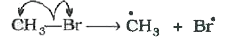
Covalent bond can undergo fission in two different ways. The correct representation involving a heterolytic fission of CH_(3)-Br is |
|
Answer»
|
|
| 26. |
Covalency of B in BF_4 is : |
|
Answer» 5 |
|
| 28. |
Coupling reaction takes place when benzene diazonium chloride is treated with : |
|
Answer» BENZALDEHYDE |
|
| 30. |
Coupling of diazotised _____with____gives methyl orange. |
| Answer» SOLUTION :Sulphanilic ACID, N,N-dimethylaniline. | |
| 31. |
Coupling of diazonium salts of following takes place in order |
|
Answer» `IV LT II lt III lt I`. `C_(6)H_(5)-BAR(O) gt C_(6)H_(5)NH_(2) gt C_(6)H_(5)OH gt C_(6)H_(5)overset(+)(N)H_(3)` |
|
| 33. |
Coupling of benzene diazonium chloride and aniline is carried out at pH |
|
Answer» 7 |
|
| 34. |
Coupling of benzene diazonium chloride and phenol to form p- hydroxy azobenzene (orange dye) is an example of |
|
Answer» ELIMINATION reaction |
|
| 35. |
Count number of test (s) given by this compound. (a) Liebermann's test(b) Brady's test (c ) Litmus test(d) Bromine water test (e ) Iodoform test(f) NaHCO_(3) test (g) Esterification test(h) Na metal test |
|
Answer» |
|
| 36. |
Coupling is an example |
|
Answer» ELECTROPHILIC SUBSTITUTION reaction |
|
| 37. |
Coulomb is the quantity of charge defined as : |
|
Answer» One ampere of current passing for 1 sec The charge which deposits 0.0118 gm mole The charge which deposits electrochemical EQUIVALANCE of Metal |
|
| 38. |
Coulomb is equal to |
|
Answer» AMPERE`XX`SECOND |
|
| 39. |
Cottrell's smoke precipitator is fitted at the mouth of the chimneys used in factories. |
| Answer» Solution :The CHARGED colloidal particles of carbon, after coming into CONTACT with oppositely charged ELECTRODE in Cottrell PRECIPITATOR lose their charge and settle down at the bottom. | |
| 40. |
Cotrell precipitator works on the principle of : |
|
Answer» DISTRIBUTION law |
|
| 43. |
Cotton fibers consist of cellulose polymers with neighboring polymers chains held together by hydrogen bonds between -OH groups in the glucose units. Due to these hydrogen bonds : |
|
Answer» cotton is insoluble in water |
|
| 44. |
Cost of electricity for the production of x L H_2 at STP at cathode is Rs. x, then cost of electricity for the production of x L O_2 gas at STP at anode will be (assume 1 mol of electrons as one unit electricity) : |
|
Answer» `2x ` `{:("RS :xxL"),("At ANODE " 2OH^(-1) (1)/(2) O_2 + H_2O + 2e^(-)):}` `(x)/(2) L " of " O_2 to Rsx , xL" of " O_2 to ? ((x)/(x) xx x)/(2) = 2x (Rs )` |
|
| 45. |
Cost iron is prepared from haematite . In most of the Cases ore needs no concentration,The ore is roasted to remove the volatile impurities ,During roasting the ,mass becomes porous Iron in the form of ferrous oxide os mixed with coke and heated in a blast furnace ,pig iron ios formed and is casted in the desired shape. One of the important advantages of rosting the iron ore is |
|
Answer» WASTAGE of ORE in the form of `FeSiO_(3)` is avoided |
|
| 46. |
Cost iron is prepared from haematite . In most of the Cases ore needs no concentration,The ore is roasted to remove the volatile impurities ,During roasting the ,mass becomes porous Iron in the form of ferrous oxide os mixed with coke and heated in a blast furnace ,pig iron ios formed and is casted in the desired shape. the approximate wight percent of coke preesent in the charge of blast furnace is |
|
Answer» 10 |
|
| 47. |
CoSO_(4)Cl.5NH_(3) exists in two isomeric forms 'A' and 'B'. Isomer 'A' reacts with AgNO_(3) to give white precipitate, but does not react with BaCl_(2). Isomer 'B' gives white precipitate with BaCl_(2) but does not react with AgNO_(3). Answer the following questions. Identify 'A' and 'B' and write their structural formulas. (ii) Name the type of isomerism involved. (iii) Give the IUPAC name of 'A' and 'B'. |
|
Answer» Solution :(i) As ISOMER A reacts with `AgNO_(3)` to give a white PRECIPITATE, Cl must be present in the ionization SPHERE. As it does not react with `BaCl_(2)`, `SO_(4)^(2-)` must be present in coordination sphere. `therefore` Formula of `A=[Co(NH_(3))_(5)SO_(4)]Cl` (coordination no. of Co=6) As reactions are reverse for isomer B, formula `B=[Co(NH_(3))_(5)Cl]SO_(4)` (ii) Ionisation isomerism (iii) A = Pentaamminesulphatocobalt (III) chloride , B = Pentaamminechloridocobalt (III) SULPHATE. |
|
| 48. |
Cost iron is prepared from haematite . In most of the Cases ore needs no concentration,The ore is roasted to remove the volatile impurities ,During roasting the ,mass becomes porous Iron in the form of ferrous oxide os mixed with coke and heated in a blast furnace ,pig iron ios formed and is casted in the desired shape. the composition of pig iron is shown as |
|
Answer» FeC |
|
| 49. |
Cosider the two alkenes2-methhyl-1-pentene and2-methyl-2-pentene and decide which would be most stable. |
Answer» Solution :First write the structure of the alkenes, then decide how many SUBSTITUENTS the double bond of each has. 2-Methyl-2-pentene has THREE substituents on its double bond, whereas 2-methyl-1-pentene has two, and THEREFORE 2-methyl-2-pentene is the more STABLE. 
|
|