Saved Bookmarks
This section includes 7 InterviewSolutions, each offering curated multiple-choice questions to sharpen your Current Affairs knowledge and support exam preparation. Choose a topic below to get started.
| 2. |
Cosider the given reaction for preparation of alkyne. (Fritsch reaction). Anti group will migrate because of less steric hindrance. Rate of reaction when the halide ion : |
|
Answer» `I^(Θ)GTCL^(Θ)gtBr^(Θ)gtF^(Θ)` |
|
| 3. |
Cosider the following reaction and statements: [Co(NH_(3))_(4)Br]^(+)+Br^(-) to [Co(NH_(3))_(3)Br]+NH_(3) (I) Two isomers are produced if the reactant complex ion is a cis-isomer. (II) Two isomers are produced if the reactant complex ion is a tran-isomer. (III)Only one isomers isproduced if the reactant complex ion is a tran-isomer. (IV) Only one isomers isproduced if the reactant complex ion is a cis-isomer. The correct statements are : |
|
Answer» (III) and (IV) |
|
| 4. |
Cosider the given reaction for preparation of alkyne. (Fritsch reaction). Anti group will migrate because of less steric hindrance. Product (A) is : |
|
Answer»
|
|
| 5. |
Cosider the given reaction for preparation of alkyne. (Fritsch reaction). Anti group will migrate because of less steric hindrance. , Major product (A) is : |
|
Answer»
|
|
| 6. |
Co(s) +Cu^(2+)(aq) rarrCo^(2+)(aq) +Cu(s).This reaction is : |
|
Answer» OXIDATION reaction |
|
| 7. |
Corrrect order of bond angle in the given compounds is/are: |
|
Answer» `gammaltgamma'` `alpha=beta` as both `C-F` bonds are equivalent SIMILARLY `alpha.=beta.` as both `C-Cl` bonds are equivalent `alpha=betagtgamma` `alphagtalpha.`betagtbeta.` |
|
| 10. |
Corrosive sublimate (HgCl_(2)) can be used to distinguish between |
|
Answer» formic acid and acetic acid `2HCOOH+2HgCl_(2) to Hg_(2)Cl_(2)+CO_(2)+H_(2)O` `CH_(3)COOH+HgCl_(2) to "No reaction"` |
|
| 12. |
Corrosion process is basically which type of process ? |
|
Answer» Converstion of reaction in PRESENCE of `H_(2)O` |
|
| 13. |
Corrosion of iron is essentially an electrochemical phenomenon where the cell reactions are ………………. . |
|
Answer» FE is oxidised to `Fe^(2+)` and DISSOLVED OXYGEN in water is reduced to `OH^-` |
|
| 14. |
Corrosion of metals is essentially an__________ phenomenon. |
| Answer» SOLUTION :ELECTROCHEMICAL | |
| 15. |
Corrosionof iron is essentially an electrochemical phenomeonon where the cell reaction are |
|
Answer» Fe is oxidised to `Fe^(3+)` and `H_(2)O` is REDUCED to `O_(2)^(2-)` `O_(2) +2H_(2)O+4e^(-) rarr 4OH^(-)` The overallreaction is `2Fe+O_(2) +2h_(2) rarr2Fe(OH)_(2)` `Fe(OH)_(2)` may be dehydrated to iron oxide FeO or furtheroxidisedto `Fe(OH)_(3)` and then dehydrated to ironrust`Fe_(2)O_(3)` |
|
| 16. |
Corrosion of iron is essentially an electrochemical phenomenon where the cell reactions are __________. |
|
Answer» Fe is oxidised to `Fe^(2+)`and dissolved OXYGEN in WATER is reduced to `H_(2)O` |
|
| 17. |
Corrosion of aluminum takes place at a much slower rate than iron. Give reason. |
|
Answer» SOLUTION :Other METALS such as aluminium, COPPER and silver also undergo corrosion, but at a slower rate than iron. Let us consider the reduction of aluminium, `""Al_((s)) rarr Al_((aq))^(3+)+3e^(-)` `Al^(3+)`, which reacts with oxygen in air to form a PROTECTIVE COATING of `Al_(2)O_(3)`. This coating act as a protective film for the inner surface. So, further corrosion is prevented. |
|
| 18. |
Corrosion of iron is essentially an electrochemical phenomenon where the cell reactions are |
|
Answer» Fe is oxidised to `Fe^(2+)` and dissolved oxygen in WATER is reduced to `overset(THETA)(OH)` `O_(2)+2H_(2)O+4eto4OH^(-)` (cathode reaction) The overall reaction is `2FE + O_(2) + 2H_(2)O to 2Fe(OH)_(2)` `Fe(OH)_(2)` may be dehydrated to iron OXIDE FeO, or further oxidised to `Fe(OH)_(3)` and then dehydrated NTO iron rust, `Fe_(2) O_(3)` |
|
| 19. |
Corrosion is an elctrochenmical process . It involves |
|
Answer» Loss of electrons by Iron, `FE rarr Fe^(+2) + 2e^(-)` . Ie, Iron ACTS as an anode |
|
| 20. |
Corrosion of |
|
Answer» an oxidation PROCESS A potential difference in the composition of the metal, which ARIES from LATTICE defects, imprities, or even partial oxidation. This potential difference makes it POSSIBLE fora corrosion process resembling the operation of a galvanic CELL to take place on the metal surface. The site of oxidation and the site of the reduction can be separeted in space. Electrons flow betwenn these sites through electrical connection of a glavanic cell. Water vapor that condness on the metal surface provides the solution through which the ions flow. |
|
| 21. |
Corrosion is basically a |
|
Answer» altered reaction in presence of `H_(2)O` |
|
| 22. |
Corrosion is basically a/an |
|
Answer» altered reaction in presence of `H_2O` |
|
| 23. |
Rusting of iron is an electrochemical phenomenon. Explain. |
|
Answer» Solution :When iron object exposed to moist air corrosion takes place. Iron being ELECTROPOSITIVE undergoes oxidation releasing electrons. These electrons go to another spot of the metal and reduces OXYGEN in presence of `H^(+)`. Reactions: `"Anode: "2Fe^(s) to 2Fe^(2+)+4e^(-)` `"Cathode: "O_(2)(g)+4H^(+)+4e^(-) to 2H_(2)O` `"OVERALL reactions: "2Fe(s)+O_(2)(g)+4H^(+) to 2Fe^(2+)+2H_(2)O` The ferrous ions are further oxidised by atmospheric oxygen to ferric ions which COME out as rust in the form of hydrated ferric oxide. `Fe_(2)O_(3). xH_(2)O` |
|
| 24. |
Corrosion. |
| Answer» Solution :It is defined as the DESTRUCTION of the METAL SURFACE due to electrochemical redox process with the components of atmosphere and environment, like oxidation by oxygen in the presence of moisture, forming undesired compounds like oxides, sulphides, ETC. on the metal surface. | |
| 25. |
Correctly match is: |
|
Answer» <P>`d_(x^(2)-y^(2))` atomic orbital-one nodal PLANE |
|
| 26. |
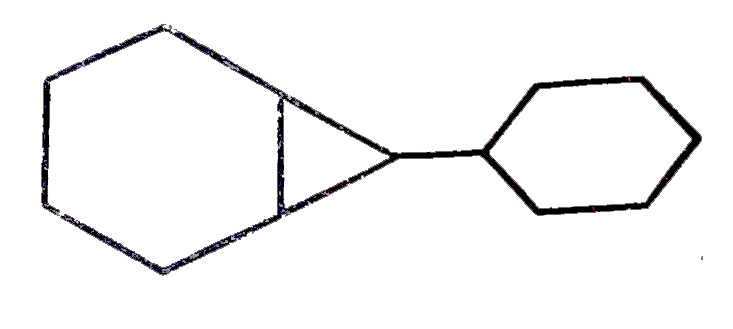
Correct water solubility order/is amongst the following pairs is/are. |
|
Answer» `CH_(3)-CH_(2)-CH_(2)-OH GT CH_(3)-UNDERSET(CH_(3))underset(|)overset(CH_(3))overset(|)C-CH_(3)` |
|
| 27. |
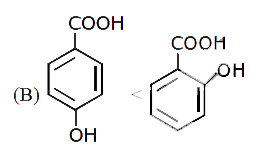
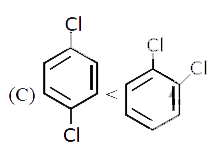
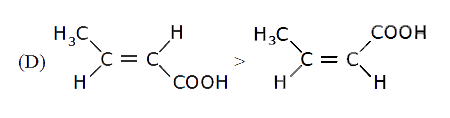
Correct water solubility order amongst the following pair is/are : |
|
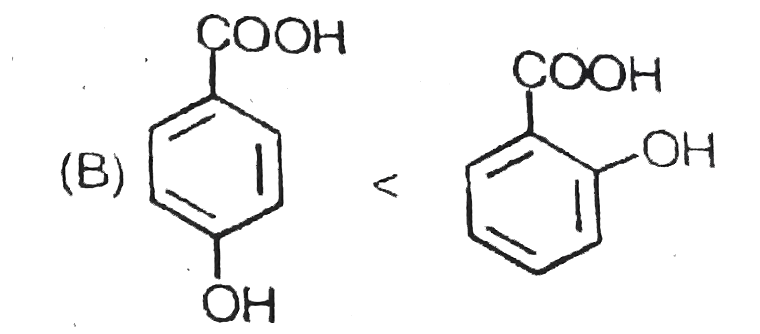
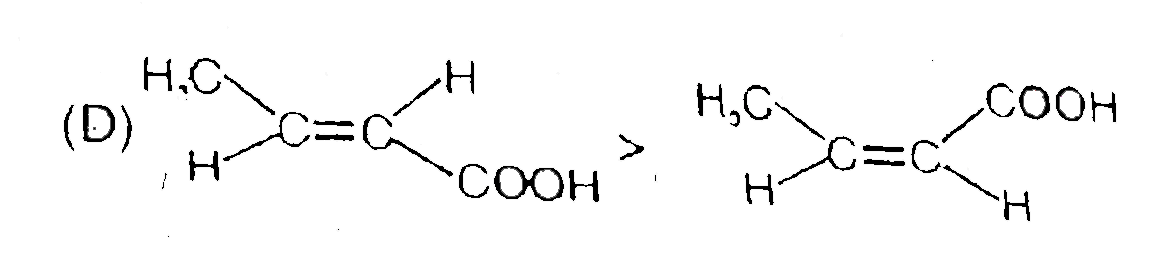
Answer» `CH_3-CH_2-CH_2-CH_2-OH gt CH_3-undersetunderset(CH_3)(|)oversetoverset(CH_3)(|)C-OH` (B) 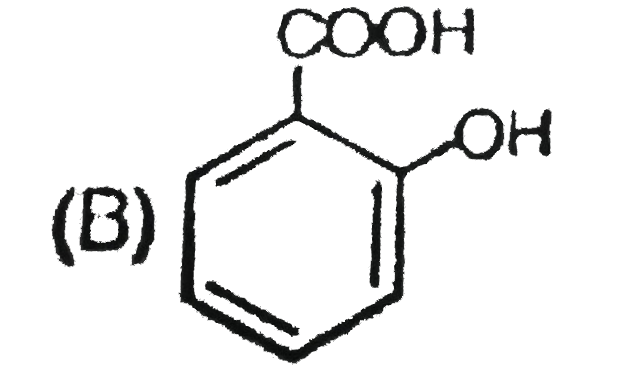 in it, due to the PRESENCE of INTRAMOLECULAR H-bonding the solubility is decrease, so B is wrong order. (C ) 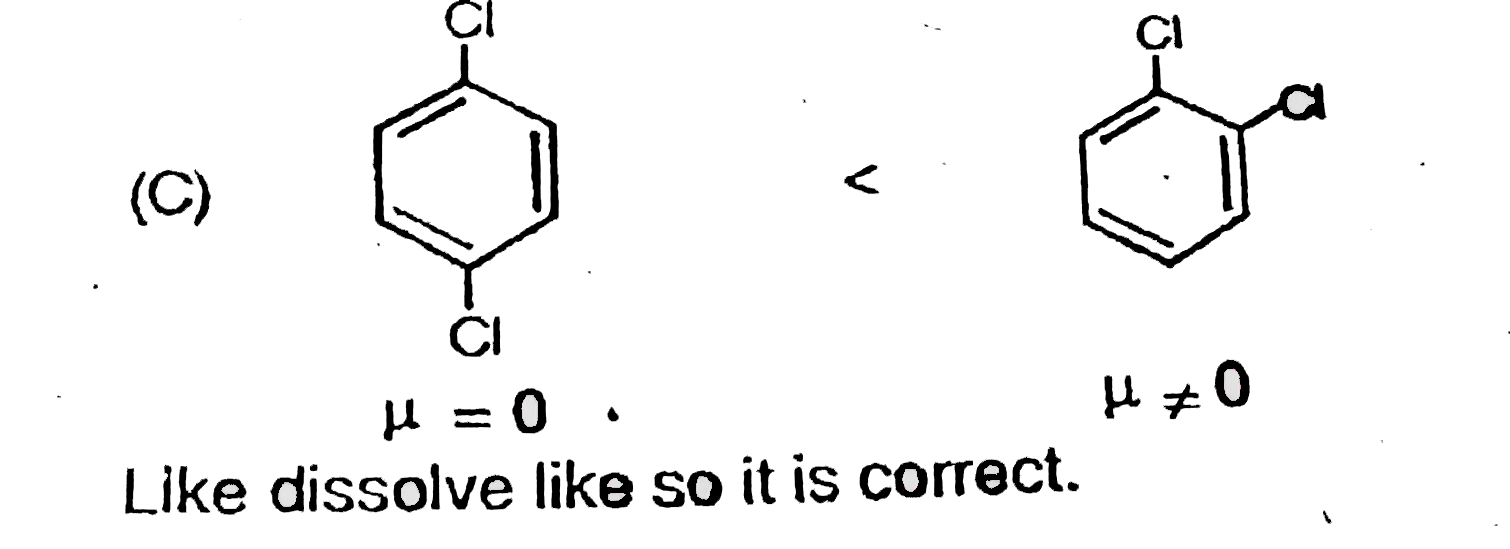 Like dissolves like so it is correct. (D)  dipole MOMENT of I is greater than II. Greater the dipole moment greater its solubility. |
|
| 28. |
Correct trends from ClO^(-) to ClO_4^- are A) Oxidation ability decreases B) Number of delocalised electrons increases C) Number of lone electron pairs on chlorine decreases D)O- Cl bond length decreases |
| Answer» Answer :D | |
| 29. |
Correct the statement and re write :- The first world was the communist countries and the third world was the capitalist countries. |
| Answer» SOLUTION :The FIRST world was Capitalist COUNTRIES and the THIRD world was DEVELOPING countries. | |
| 30. |
Correct the following statements by changing the underlined part of the statement (Do not change the whole statement) Vitamins act as target molecules for drug action in body. |
| Answer» SOLUTION :do not ACT | |
| 31. |
Correct the following statements by changing the underlined part of the statement (Do not change the whole statement) Synthetic detergents are easily biodegradable. |
| Answer» SOLUTION :not EASILY biodegradeable | |
| 32. |
Correct the following statements by changing the underlined part of the statement (Do not change the whole statement) Equanil is a disinfectant. |
| Answer» SOLUTION :TRANQUILLIZER | |
| 33. |
Correct the following statements by changing the underlined part of the statement (Do not change the whole statement) Chloramphenicol is a narrow spectrum antibiotic. |
| Answer» SOLUTION :a BROAD SPECTRUM ANTIBIOTIC | |
| 34. |
Correct the following statements by changing the underlined part of the statement (Do not change the whole statement) Phenacetin is a tranquillizer. |
| Answer» SOLUTION :an ANTIPYRETIC | |
| 35. |
Correct the following statements by changing the underlined part of the sentence. ul("Both polystyrene and terylene are addition polymers.") |
| Answer» SOLUTION :POLYSTYRENE is an addition polymer whereas terylene is a CONDENSATION polymer. | |
| 36. |
Correct the following statements by changing the underlined part of the sentence. Teflon is an example of ul("copolymers") |
| Answer» SOLUTION : TEFLON is an EXAMPLE of HOMOPOLYMERS. | |
| 37. |
Correct the following statements by changing the underlined part of the sentence. Repeating unit of teflon is H_2C=CF_2. |
| Answer» SOLUTION :REPEATING UNIT of TEFLON is `F_2C = CF_2` | |
| 38. |
Correct the following statements by changing the underlined part of the sentence. Proteins are formed by the ul("addition polymerization") of aminoacids. |
| Answer» Solution :PROTEINS are FORMED by the CONDENSATION POLYMERIZATION of amino acids. | |
| 39. |
Correct the following statements by changing the underlined part of the sentence. Polystyrene is an example of ul("thermosetting plastics"). |
| Answer» SOLUTION :POLYSTYRENE is an EXAMPLE of THERMOPLASTICS. | |
| 40. |
Correct the following statements by changing the underlined part of the sentence. Polyisoprene is an example of ul("step-growth polymer"). |
| Answer» SOLUTION :POLYISOPRENE is an EXAMPLE of chain-growth POLYMER. | |
| 41. |
Correct the following statements by changing the underlined part of the sentence. PAN is prepared from ul("butadiene"). |
| Answer» SOLUTION :PAN is PREPARED from ACRYLONITRILE `(CH_2=CHCN)` | |
| 42. |
Correct the following statements by changing the underlined part of the sentence. Neoprene is a ul("biopolymer"). |
| Answer» SOLUTION :NEOPRENE is a SYNTHETIC POLYMER. | |
| 43. |
Correct the following statements by changing the underlined part of the sentence. Neoprene is a polymer of ul("isoprene") |
| Answer» SOLUTION :NEOPRENE is a POLYMER of CHLOROPRENE. | |
| 44. |
Correct the following statements by changing the underlined part of the sentence. Natural rubber is ul("a condensation polymer.") |
| Answer» SOLUTION :NATURAL RUBBER is an ADDITION POLYMER. | |
| 45. |
Correct the following statements by changing the underlined part of the sentence (Do not change the whole sentence) Osmotic pressure of a colloidal solution is ul("much higher")than that of true solutions. |
| Answer» SOLUTION :MUCH LESS | |
| 46. |
Correct the following statements by changing the underlined part of the sentence (Do not change the whole sentence) A catalyst ul("does not participate") in reaction mechanism. |
| Answer» SOLUTION :PARTICIPATES | |
| 47. |
Correct the following statements by changing the underlined part of the sentence (Do not change the whole sentence) ul("Catalyst is a substance which alters ")the equilibrium constant. |
| Answer» SOLUTION :CATALYST is a SUBSTANCE which does not ALTER | |
| 48. |
Correct the following statements by changing the underlined part of the sentence (Do not change the whole sentence) Catalyst increases the rate of forward reaction ul("and decreases the rate of backward reaction") in a reversible process. |
| Answer» SOLUTION :as WELL as BACKWARD REACTION | |
| 49. |
Correct the following statements by changing the underlined part of the sentence (Do not change the whole sentence) Viscosity of a lyophilic sol is ul("same as that of dispersion medium.") |
| Answer» SOLUTION :MUCH HIGHER than that of DISPERSION MEDIUM | |