Saved Bookmarks
This section includes 7 InterviewSolutions, each offering curated multiple-choice questions to sharpen your Current Affairs knowledge and support exam preparation. Choose a topic below to get started.
| 3. |
[Co(NH_3)_6SO_4]Br and [Co(NH_3)_6Br]SO_4 are a pair of _____ isomers . |
|
Answer» Ionization |
|
| 4. |
[Co(NH_(3))_(6)][Cr(CN)_(6)] and [Cr(NH_(3))_(6)][Co(CN)_(6)] present an example of |
|
Answer» LINKAGE isomerism |
|
| 5. |
[Co(NH_3)_6]Cl_3 is called : |
|
Answer» Hexaammine COBALT (III) CHLORIDE |
|
| 6. |
[Co(NH_3)_6]^(3+)is diamagnetic where as [CoF_6]^(3-)is paramagnetic explain. |
|
Answer» SOLUTION :`[Co(NH_3) _6]^(3+) ` is DIAMAGNETIC because `NH_3` is a strong field ligand CAUSES PAIRING of electrons in d orbitals and there is no unpaired electrons (ii)`[CoF_6]^(3+) ` is paramagnetic because `F^(-)` is a weak field ligand does not cause pairing of electrons and there are unpaired electrons. |
|
| 7. |
[Co(NH_3)_5SO_4]Cl is an octahedral coordination compound Write the IUPAC name of the compound |
| Answer» SOLUTION :Pentaamminesulphatocobalt(III0chloride | |
| 8. |
[Co(NH_3)_5SO_4]Cland [Co(NH_3)_5Cl]SO_4 arecoordination compounds.Write the IUPAC names of the above compounds. |
| Answer» Solution :`[CO(NH_3)_5SO_4]CL`,pentaammine sulphato cobalt(III) chloride,`[Co(NH_3)_5Cl]SO_4`,Pentaamminechlorido cobalt(III) sulphate | |
| 9. |
[Co(NH_3)_5SO_4]Cl is an octahedral coordination compound write the formula of the ionisation isomer of the above compound |
| Answer» SOLUTION :`[CO(NH_3)_5Cl]SO_4` | |
| 10. |
[Co(NH_3)_5SO_4]Cland [Co(NH_3)_5Cl]SO_4 arecoordination compounds.Identify the ligands in each of the above compounds. |
| Answer» SOLUTION :In `[Co(NH_3)_5SO_4]CL`,the LIGANDS are `NH_3` and `SO-4` and in `[Co(NH_3)_5Cl)SO_4` The lignds rae NH_3 and CL: | |
| 11. |
Give evidence that [Co(NH_(3))_(5)Cl]SO_(4) and [Co(NH_(3))_(5)SO_(4)]Cl are ionization isomers. |
|
Answer» IONIZATION |
|
| 12. |
Give evidence that [Co[NH_3)_5Cl]SO_4 and [Co(NH_3)_5SO_4]Cl are ionisation isomers. |
| Answer» SOLUTION :IONISATION ISOMERISM | |
| 13. |
[Co(NH_(3))_(5)NO_(2)]Cl_(2)" and "[Co(NH_(3))_(5)ONO]Cl_(2) are related to each other as : |
|
Answer» GEOMETRICAL isomers |
|
| 14. |
[Co(NH_(3))_(5)NO_(2)]Cl_(2) and [Co(NH_(3))_(5)ONO]Cl_(2) are related to each other as :- |
|
Answer» GEOMETRICAL isomers |
|
| 15. |
[Co(NH_3)_5Br]SO_4 and [Co(NH_3)_5SO_4]Br are the examples of : |
|
Answer» LINKAGE isomerism |
|
| 16. |
[Co(NH_3)_5Br]SO_4 and [Co(NH_3)_5SO_4]Br are related as |
|
Answer» LINKAGE isomers |
|
| 17. |
[Co(NH_3)_5Br]SO_4 and [CO(NH_3)_5SO_4]Br are _____ isomers while [Co(NH_3)_5NO_2]Cl_2 and [Co(NH_3)_5ONO]Cl_2 are _____ isomers. |
| Answer» SOLUTION :IONISATION, LINKAGE or FUNCTIONAL. | |
| 18. |
[Co(NH_(3))_(4)(SCN)_(2)]^(+)" and "[Co(NH_(3))_(4)(NCS)_(2)]^(+) are : |
|
Answer» IONISATION isomers |
|
| 19. |
[Co(NH_(3))_(5)Br]SO_(4) and conc. [Co(NH_(3))_(5)SO_(4)]Br are example of which type of isomerism? |
|
Answer» LINKAGE |
|
| 20. |
[Co(NH_(3))_(4)(NO_(2))_(2)]Cl exhibits |
|
Answer» IONIZATION isomerism, geometrical isomerism and optical isomerism `{:([Co(NH_(3))_(4)(NO_(2))_(2)]Cl),([Co(NH_(3))_(4)(ONO)_(2)]Cl):}}rarr` linkage isomers. 
|
|
| 21. |
[Co(NH_(3))_(4)(NO_(2))_(2)]Cl exhibits. |
|
Answer» linkage isomerism, ionization isomerism and geometrical isomerism it may have ionisation isomerism due to presence of two ionisable GROUP `-NO_(2) & -CL`. It may have geometrical isomerism in the form of ci-s trans form as follows: `[CO(NH_(3))_(4)Cl(NO_(2))]NO_(2) and [Co(NH_(3))(NO_(2))_(2)]Cl`-ionisation isomers. `[Co(NH_(3))_(5)(NO_(2))_(2)]Cl and [Co(NH_(3))_(5)(ONO)_(2)Cl` -Linkage isomers.  Geometrical isomers. |
|
| 22. |
The complexes [Co(NH_(3))_(4)Cl_(2)]NO_(2) and : [Co(NH_(3))_(4)Cl.NO_(2)]Cl are isomers |
|
Answer» LINKAGE |
|
| 23. |
[Co(NH_3)_4CI_2] possesses: |
|
Answer» SQUARE PLANAR geometry |
|
| 24. |
[Co(NH_3)_4 (NO_2)_2]Cl exhibits |
|
Answer» IONIZATION ISOMERISM, GEOMETRICAL isomerism and OPTICAL isomerism |
|
| 25. |
{:("Configuration","Element"),("1) "5s^(1)4d^(5),"A) "Cu),("2) "6s^(1)5d^(10),"B) "Pd),("3) "4s^(1)3d^(1-),"C) "Mo),("4) "5S^(2)4d^(10),"D) "Cr),(,"E) "Au):} The correct match is |
|
Answer» `1-C, 2-A, 3-E, 4-B` |
|
| 26. |
Conformation in molecules is due to: |
|
Answer» ROTATION about a SINGLE bond |
|
| 27. |
Configuration of a chiral molecule can be changed by |
|
Answer» ROTATION AROUND a sigma bond |
|
| 28. |
Cone HNO_(3) is addedbeforeproceedingto test forgroup II This is to |
|
Answer» CONVENT `Fe^(+2)` ion `Fe^(+3)` ion |
|
| 29. |
Cone H_(2)SO_(4)on aditionto dry KNO_(3) givesdrown fames of : |
|
Answer» `SO_(2)` `4HNO_(3) rarr2H_(2)O + underset("BROWN")(4NO_(2))+O_(2)` |
|
| 30. |
Cone H_(2)SO_(4) will not give any gas with |
| Answer» Solution :`SO_(4)^(2-) ,PO_(4)^(2-) and BO_(3)^(3-)` do not react with cone `H_(2)SO_(4)` | |
| 31. |
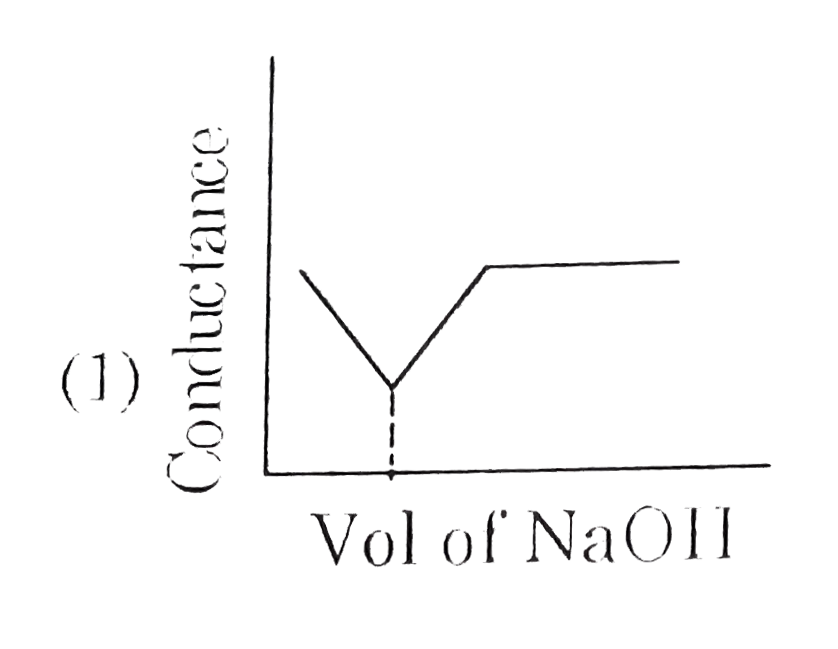
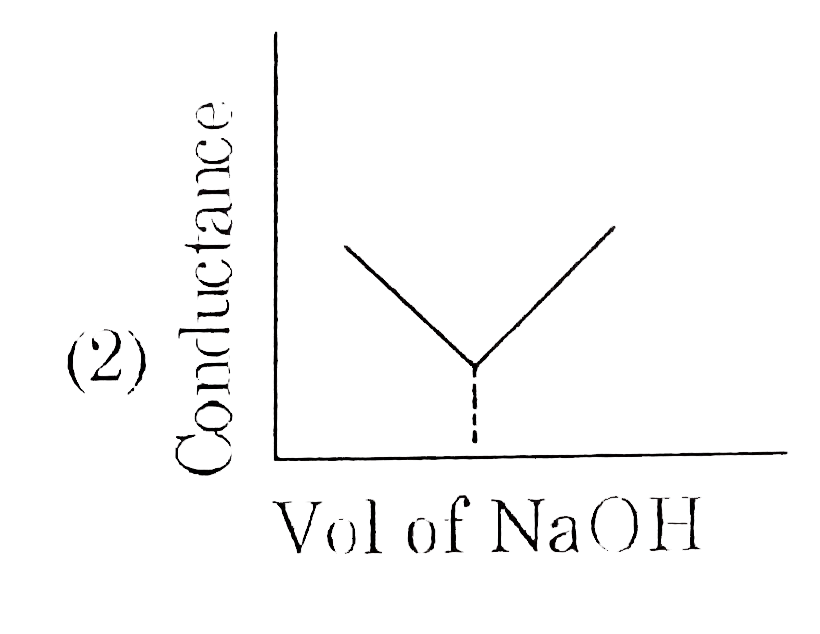
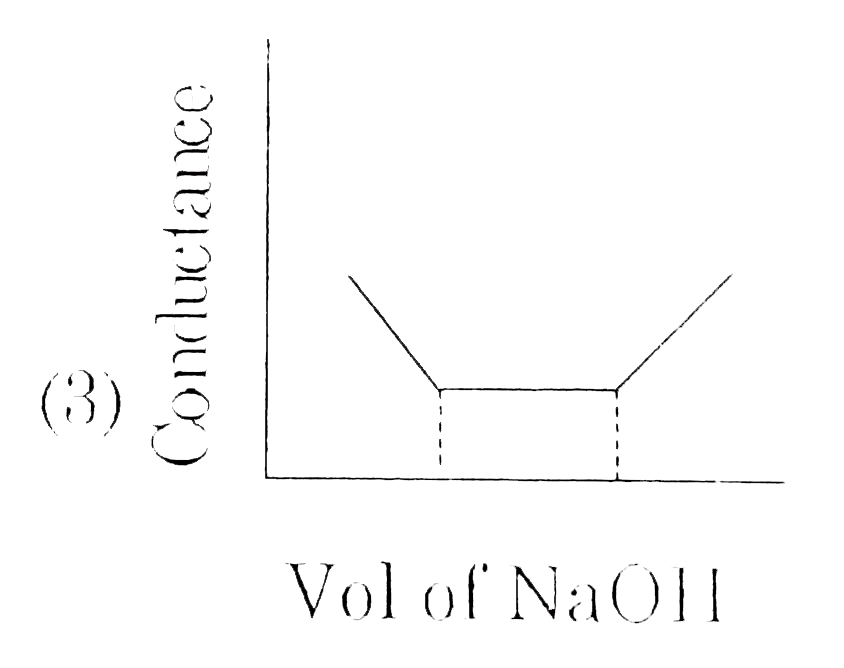
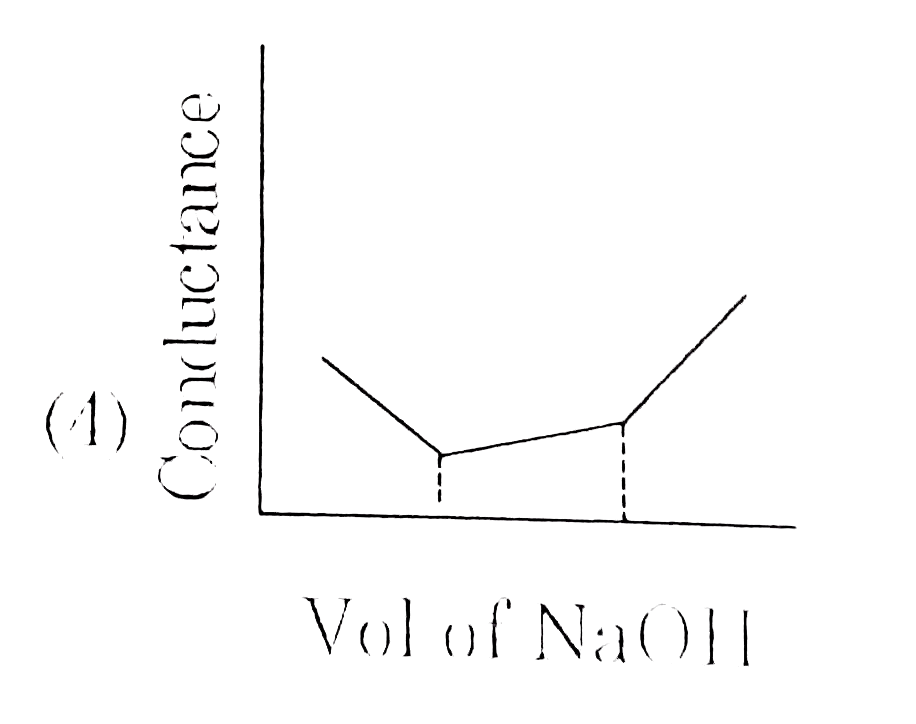
Conductometric titration curveof a equimolar mixture of HCI and HCN with NaOH(aq) is |
|
Answer»
|
|
| 32. |
Conductors have electrical conductivity in the range of |
|
Answer» `10^(2)` to `10^(7)OHM^(-1)m^(-1)` |
|
| 33. |
Conductors allow the passage of electric current through them. Metallic and electrolytic are the two types of conductors. Current carriers in metallic and electrolytic conductors are free electrons and free ions respectively. Specific conductance or conductivity of the electrolyte solution is given by thefollowing relation: K= cx (l)/(A) where, c=1/R is the conductance and 1/A is the cell constant, Molar conductance (^^_m) andequivalence conductance (^^_e) of an electrolyte solution are calculated using the following similar relations: ^^_m = K xx (1000)/(M) ^^_(e) = K xx (1000)/(N) where, M and N are the molarity and normality of the solution respectively. Molar conductance of strong electrolyte depends on concentration : ^^_m = ^^_m^(0) - b sqrt(C) ^^_m^(0) = molar conductance at infinite dilution C = concentration of the solution b = constant The degrees of dissociation of weak electrolytes are calculated asalpha= (^^_m)/(^^_m^(0)) = (^^_e)/(^^_e^(0)) Which of the following equality holds good for the strong electrolytes? |
|
Answer» `LAMBDA= Lambda^(0) " as " C to 1 ` |
|
| 34. |
Conductors allow the passage of electric current through them. Metallic and electrolytic are the two types of conductors. Current carriers in metallic and electrolytic conductors are free electrons and free ions respectively. Specific conductance or conductivity of the electrolyte solution is given by thefollowing relation: K= cx (l)/(A) where, c=1/R is the conductance and 1/A is the cell constant, Molar conductance (^^_m) andequivalence conductance (^^_e) of an electrolyte solution are calculated using the following similar relations: ^^_m = K xx (1000)/(M) ^^_(e) = K xx (1000)/(N) where, M and N are the molarity and normality of the solution respectively. Molar conductance of strong electrolyte depends on concentration : ^^_m = ^^_m^(0) - b sqrt(C) ^^_m^(0) = molar conductance at infinite dilution C = concentration of the solution b = constant The degrees of dissociation of weak electrolytes are calculated asalpha= (^^_m)/(^^_m^(0)) = (^^_e)/(^^_e^(0)) For which of the following electrolytic solution ^^_m and ^^_e are equal ? |
|
Answer» `BaCl_2` |
|
| 35. |
Conductors allow the passage of electric current through them. Metallic and electrolytic are the two types of conductors. Current carriers in metallic and electrolytic conductors are free electrons and free ions respectively. Specific conductance or conductivity of the electrolyte solution is given by thefollowing relation: K= cx (l)/(A) where, c=1/R is the conductance and 1/A is the cell constant, Molar conductance (^^_m) andequivalence conductance (^^_e) of an electrolyte solution are calculated using the following similar relations: ^^_m = K xx (1000)/(M) ^^_(e) = K xx (1000)/(N) where, M and N are the molarity and normality of the solution respectively. Molar conductance of strong electrolyte depends on concentration : ^^_m = ^^_m^(0) - b sqrt(C) ^^_m^(0) = molar conductance at infinite dilution C = concentration of the solution b = constant The degrees of dissociation of weak electrolytes are calculated asalpha= (^^_m)/(^^_m^(0)) = (^^_e)/(^^_e^(0)) Which of the following decreases on dilution of electrolytic solution? |
|
Answer» EQUIVALENT CONDUCTANCE |
|
| 36. |
Conductivity of saturated solution of BaSO_(4)" at 315 K is "3.648 xx 10^(-6)" ohm"^(-1)" cm"^(-1) and that of water is 1.25 xx10^(-6)" ohm"^(-1)" cm"^(-1). Ionic conductance of Ba^(2+) and SO_(4)^(2-)" are 110 and 136.6 ohm"^(-1)" cm"^(2)" mol"^(-1) respectively. Calculate the solubility of BaSO_(4) in g/L. |
|
Answer» Solution :`Lambda_(m)^(@)(BaSO_(4))=Lambda_(m)^(@)BA^(2+)+Lambda_(m)^(@)SO_(4)^(2-)=110+136.6="246.6 OHM"^(-1)"cm"^(-1)` `K_(BaSO4)=K_(BaSO4)" (solution)"-K_("water")=3.648xx10^(-6)-1.25xx10^(-6)` `=2.398xx10^(-6)"S cm"^(-1)` `Lambda_(m)^(c )=(Kxx1000)/("Solubility")=(2.398xx10^(-6)xx1000)/(246.6)=9.72xx10^(-6)"mol/L"` `"Solubility "=9.72xx10^(-6)xx233=2.26xx10^(-3)g//L` |
|
| 37. |
Conductivity of an electrolytic solution depends on. . . . |
|
Answer» nature of electrolyte. `k=(1)/(p)`. * SI unit of `k=S" "m^(-1)`. it depends on the nature of the electrolyte and concentration of the electrolyte. * Conductivity does not depend on power of AC source and distance between two ions. * The conductivity of the electrolytic solution depend on (i) nature of added electrolyte (ii) volume of produced ions and their solvation capacity (iii) nature of solvent and its viscosity and (iv) temperature. * So, conductivity depend on (A) nature of electrolyte and (B) concentration of electrolyte. |
|
| 38. |
Conductivity of a solution of [CoBr(NH_(3))_(5)]Cl_(2) corresponds to |
|
Answer» 2 : 1 electrolyte. |
|
| 39. |
Conductivity of a solution is directly proportional to |
|
Answer» Dilution |
|
| 40. |
Conductivity of a saturated solution of a sparingly soluble salt AB at 298 K is 1.85 xx 10^(-5) S m^(-1).Solubility product of the salt AB at 298 K is Given ^^_m^(0)(AB) = 140 xx 10^(-4)S m^(2) " mol"^(-1) |
|
Answer» `5.7 xx 10^(-12)` `S = (k)/(1000 lambda_m) = (1.85 xx 10^(-5))/(1000 xx 140 xx 10^(-4))` `S = 1.3 xx 10^(-6)` `K_(sp) = S^(2) =(1.3 xx 10^(-6))^(2) = 1.69 xx 10^(-12)` |
|
| 41. |
Conductivity of a saturated solution of a sparingly soluble salt AB(1:1 electrolyte) at 298 K is 1.85 times 10^(-5)Sm^(-1). Solubility product of the salt AB at 298 K(wedge_(m)^(@))_(AB)=14 times 10^(-3)S" "m^(2)mol^(-1). |
|
Answer» `5.7 TIMES 10^(-12)` |
|
| 42. |
Conductivity of a saturated of a sparingly soluble salt AB (1:1 electrolyte) at 298 K is 1.85 xx 10^(-5) S m^(-1). Solubility product of the salt AB at 298 (Lambda_m^@) = 14 xx 10^(-3) S m^(2) mol^(-1) |
|
Answer» `5.7xx 10^(-12)` |
|
| 43. |
Conductivity of 2.5xx10^(-4) M methanoic acid is 5.25xx10^(-5)S com^(-1). Calculate its molar conductivity and degreeof dissociation. "Given ":lamda^(0)(H^(+))=349.5 S cm^(2) mol^(-1) and lamda^(0)(HCOO^(-))=50.5 S cm^(2) mol^(-1). |
|
Answer» Solution :`"Given, "K=5.25xx10^(-5) S CM^(-1)` `C=2.5xx10^(-4)ML^(-1)` Then molar conductivity, `^^_(m)=(K)/(C)` `=(5.25xx10^(-5)S cm ^(-1))/(2.5xx10^(-4)ML^(-1))xx(1000 cm^(3))/(L)=210 cm^(2) M^(-1)` `OVERSET(@)^^_(m)(HCOOH)=lamda^(@)(H^(+))+lamda^(@)(HCOO^(-))` `=349.5 S cm^(2) mol^(-1)+50.5 S cm^(2) mol^(-1)=400 S cm^(2) mol^(-1)` `"Now, "alpha=(^^_(m))/(overset(@)^^_(m))=(210)/(400)=0.525` |
|
| 44. |
Conductivity of 2xx10^(-3)M methanoic acid is 8xx10^(-5)" S cm"^(-1). Calculate its molar conductivity and degree of dissociation if Lambda_(m)^(@) for methanoic acid is 404" S cm"^(2)" mol"^(-1). |
|
Answer» Solution :MOLAR conductivity `Lamda_(m)=(kxx1000)/(C)=(8xx10^(-5)" S CM"^(-1)xx1000)/(2XX10^(-3)" mol L"^(-1))` `=(8xx10^(-2))/(2xx10^(-3))40" S cm"^(2)" mol"^(-1)` Degree of dissociation `(Lamda_(m))/(Lamda_(m)^(@))=(40)/(404)=0.099` |
|
| 45. |
Conductivity of 1 mol electrolytic solution present between two electrode having unity cross sectional area and unit length is known as. . . . |
|
Answer» SPECIFIC CONDUCTIVITY |
|
| 46. |
Conductivity of 0.01 M NaCl solution is 0.00147" ohm"^(-1) cm^(-1) . What happens to this conductivity if extra 100 ml of H_(2)O is added to the above solution? |
|
Answer» INCREASES |
|
| 47. |
Conductivity of 0.00241M acetic acid is 7.896 xx 10^(-5)" S cm"^(-1). Calculate its molar conductivity and if Lambda_(m)^(@)m for acetic acid is "390.5 S cm"^(2)" mol"^(-1), what is its dissociation constant ? |
|
Answer» SOLUTION :`Lambda_(m)^(@)=(kxx1000)/(M)` `=(7.896xx10^(-5)"S CM"^(-1)xx1000cm^(3)L^(-1))/("0.0024 mol L"^(-1))` `=32.76" S cm"^(2)" mol"^(-1)` `alpha=(Lambda_(m))/(Lambda_(m)^(@))=(32.76)/(390.5)=8.39xx10^(-2)` `K_(a)=(CALPHA^(2))/(1-alpha)=(0.00241xx(8.39xx10^(-2))^(3))/(1-8.39xx10^(-2))` `=1.86xx10^(-5)` |
|
| 48. |
Conductivity of 0.00241 M acetic acid solution is 7.896xx10^(-5)" S "cm^(-1). Calculate its molar conductivity in this solution. If wedge_(m)^(@) for acetic acid be 390.5 S cm^(2)mol^(-1), what would be its dissociation constant? |
|
Answer» `ALPHA=(32.76)/(390.5)=0.084,K=(calpha^(2))/(1-alpha)=(0.00241xx(0.084)^(2))/(1-0.084)=1.85xx10^(-5)`. |
|
| 49. |
Conductivity of 0.00241 M acetic acid solution is 7.896 xx 10^(-5) S cm^(-1). Calculate its molar conductivity in this solution. If wedge_(M)^(@) for acetic acid be 390.5 S cm^(2) mol^(-1), what would be its dissociation constant? |
|
Answer» Solution :Conductivity of ACETIC acid, `K = 7.896 XX 10^(-5) "S cm"^(-1), wedge_(m)^(@)` for acetic acid = `390.5 " S cm"^(2)mol^(-1)` Molar conductivity,`wedge_(m)^(C) = (K xx 1000)/("Molarity")` `= (7.896 xx 10^(-5)xx 1000)/(0.00241)= (789600xx1000xx10^(-5))/(241)` `=32.76 " S cm"^(2) mol^(-1)` Degree of dissociation, `alpha = (wedge_(m)^(c))/(wedge_(m)^(@)) = (32.76)/(390.5) = 8.4xx10^(-2)` Dissociation constant of acetic acid, `Ka = (CALPHA^(2))/(1-alpha)=((0.00241)xx(8.4xx10^(-2))^(2))/(1-0.084) = 1.86 xx 10^(-5)` |
|
| 50. |
Conductivity of 0.00241 M acetic acid is 7.896xx10^(-5)"S "cm^(-1). Calculate its molar conductivity and if wedge^(@) for acetic acid is 390.5 S cm^(2)mol^(-1), what is its dissociation constant? |
|
Answer» SOLUTION :`wedge_(m)^(@)=(kappaxx1000)/("MOLARITY")=((7.896xx10^(-5)" S "cm^(-1))xx1000cm^(3)L^(-1))/(0.00241" mol "L^(-1))=32.76" S "cm^(2)mol^(-1)` `alpha=(wedge_(m)^(c))/(wedge_(m)^(@))=(32.76)/(390.5)=8.4xx10^(-2),K_(a)=(CALPHA^(2))/(1-alpha)=(0.00241xx(8.4xx10^(-2))^(2))/(1-0.084)=1.86xx10^(-5)` |
|