

Saved Bookmarks
This section includes 7 InterviewSolutions, each offering curated multiple-choice questions to sharpen your Current Affairs knowledge and support exam preparation. Choose a topic below to get started.
| 1. |
Consider a solution consisting of the following two buffer systems. {:(H_(2)CO_(3)hArrHCO_(3)^(-)+H^(+),pKa=6.4),(H_(2)PO_(4)^(-)hArrHPO_(4)^(2-)+H^(+),pKa=7.2):} At pH = 6.4, which one of the following is true for the concentration of acid and conjugate base present |
|
Answer» `[H_(2)CO_(3)]gt[HCO_(3)^(-)]&[H_(2)PO_(4)^(-)]gt[HPO_(4)^(2-)]` As in CASE of `pH=pKa` it will be only when `"[weak acid]"="[conjugate base]"` In case of `H_(2)PO_(4)^(-)|HPO_(4)^(2-)` `pH=pKa+log.([HPO_(4)^(2-)])/([H_(2)PO_(4)^(-)])` `6.4=7.2+log.([HPO_(4)^(2-)])/([H_(2)PO_(4)^(-)])` `log.([HPO_(4)^(2-)])/([H_(2)PO_(4)^(-)])=-ve""([HPO_(4)^(2-)])/([H_(2)PO_(4)^(-)])LT1""rArr[HPO_(4)^(2-)]LT[H_(2)PO_(4)^(-)]` |
|
| 2. |
Consider a setup of two urea solution of concentration C_(1) and C_(2)(C_(2)gtC_(1)), both at temperature T, separated by a semi permeable membrane. External pressure P_(1) and P_(2) respectively are applied on the two solutions. For what values of P_(1) and P_(2), osmosis does not occur through the semi permeable membrane? (R= universal gas constant) |
|
Answer» `P_(1)=C_(1)RT` and `P_(2)=C_(2)RT` |
|
| 3. |
Consider a reversible reaction, which Statement about this reaction is correct? (P) The reaction will never reach equilibrium (Q) IF ((k_(1))/(k_(2)))=2"then at"t=oo,[A]=(2a)/(3) if initially only A was present and at t=0,[A]=a. (R ) At any instant ,If [A] =(a)/(5)"then" [B] =(2a)/(5), if(k_(1)/(k_(2)=2. |
|
Answer» Only P |
|
| 4. |
Consider a room that is 20 xx 10 m with 15 m eciling. If pollutant present is 2 ppm, how many grams of pollutant are present in this room. (Density of air = 1 gm//"litre" |
|
Answer» `= 3000 m^(3) = 3000 xx 10^(3)` litre `= 3 xx 10^(6)` litre 2 grams of pollutant in `10^(6)` grams of air x grams of pollutant in `3 xx 10^(6)` GRAM of air`""` (because `d = 1 gm//"litre"` ) `x = (3XX 10^(6) xx 2)/(10^(6)) = 6` |
|
| 5. |
consider a reaction that occurs by the following mechanism A + BC to AC+B AC + Dto A + CD the potential energy profile for the reaction is shown: a) Write the equation for the overall reaction. b) What are the different species present at reactions stagest 1 to 5? c) What is the rate determinig step? |
Answer» Solution :a) The equation for OVERALL reaction is:  b) State 1: BE (reactant), D (reactant), A (CATALYST) stage 2: B………….C…………A (transition state), D (reactant) stage 3: AC ( intermediate), B(products) , D(products) stage 4: A..............C................D ( transition state), B (products) Stage 5: CD (products) , B(products) ,A (catalyst) c) The rate determining step is GIVEN by stage 3 since the potential energy is the minimum.It is: `A+BCto AC+B` |
|
| 6. |
Consider a reaction aG + bH to products. When concentration of both the reactants G and H is doubled, the rate increases by eight times. However, when concentration of G is doubled keeping the concentration of H fixed, the rate is doubled. The overall order of the reaction is |
|
Answer» 0 |
|
| 7. |
Consider a reaction aG + bH toProducts . When concentration of both the reactants G and H is doubled , the rate increase by eight times . However , when concentration of G is doubled keeping the concentration of H fixed , the rate is doubled . The overall order of the reaction is |
|
Answer» 0 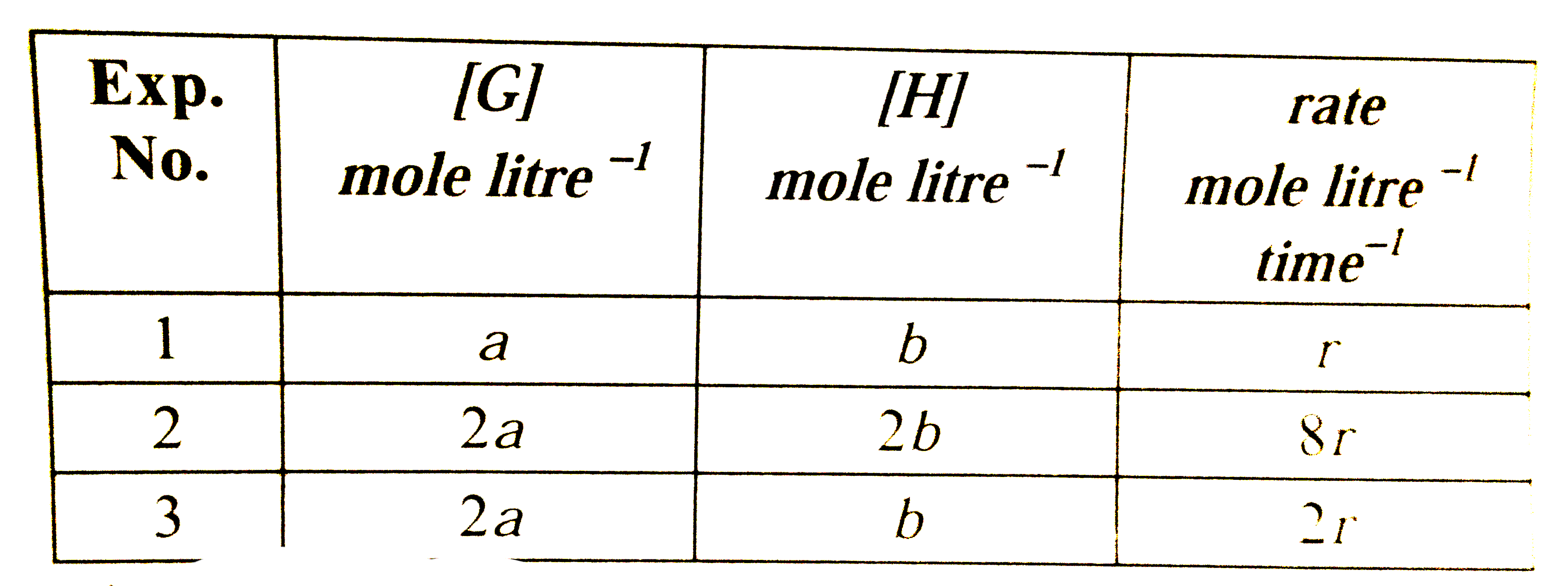 Applying I'= k `[G]^(x) [H]^(y)` x= 1 , y = 2 `THEREFORE ` overall order is 3 . |
|
| 8. |
Consider a reaction aG + bH to products.When concentration of both the reactants G and H is doubled, the rate increases by eight times. However, when concectration of G is double keeping the concentrationof H fixed, the rate is doubled . The overall order of the reaction is |
|
Answer» 0 Suppose order of REACTION = n When concentration of both C and H is DOUBLED then the increase by eight time rate `=" k (reactants)"^n` `(8) = k(2)^n` `n = 3` When concentration of G is doubled keeping the concentration of H fixed, the rate is double. rate `prop[G]^1` Than rate `prop[G]^1[H]^2` |
|
| 9. |
Consider a reaction aG+bH toproducts. When concentration of both the reactants G and H is doubled, the rate increase by eight times. However, when concentration of G is doubled keeping the concentration of H fixed, the rate is doubled. The overall order of the reaction is |
|
Answer» `0`  `because` For (1) and (3), the rate is doubled when CONC. Of G is dobled keeping that ofH constant i.e., rate`prop[G] therefore x=1` From (2) and (3), y=2 `therefore` Overall order is 3. |
|
| 10. |
Consider a reaction a G + bH rarr Products . When concentration of both the reactants G and H is doubled the rate increases by eight times . However when the concentration of G isdoubled keeping the concentration of H fixed the rate is doubled . The overall order of the reaction is : |
|
Answer» 0 `2^(x) 2^(y) =8 "or " 2^((x+y))= 2^(3)` `:. ` x+y=3 `:.` Order of reaction =3 |
|
| 11. |
Consider a reaction A+B rarr C , in which boht reactants are in the same phase, may be |
|
Answer» UNIMOLECULAR ELEMENTARY reaction |
|
| 12. |
Consider a prototypicalfullerene, C_(60) Let, a = Number of 5-membered rings:b = Number of 6-membered rings c = Number of pi bonds in C_(60) Find the value of (3a-2b+c) |
|
Answer» |
|
| 13. |
Consider a general reaction aA+bBto cC+dDThe rate expression for the reaction is Rate =k[A]^x[B]^y.Establish the significance of (a+b)and (x+y)term in terms of order and molecularity. |
| Answer» SOLUTION :(a+b) REPRESENT MOLECULARITY,(x+y)represent ORDER | |
| 14. |
Consider a large number of hydrogen atoms with electron randomly distributed in the n=1,2, 3 and 4 orbits. How many different wavelengths of light are emitted by these atoms as the electrons fall into lower energy orbits |
|
Answer» 1 |
|
| 15. |
Consider a general, single-step reaction of the type A + BhArrC. Show that the equilibrium constant is equal to the ratio of the rate constant for the forward and reverse reaction, K_(c)=(k_(f))/(k_(r)) |
| Answer» Solution :`k_(F)[A][B]=k_(R)[C],(k_(f))/(k_(r))=([C])/([A][B])=k_(c)` | |
| 16. |
Consider a general chemical change 2A+3B to products. The rate with respect to A is r_(1) and that with respect to B is r_(2). The rates r_(1) and r_(2) are related as |
|
Answer» `3r_(1)=2r_(2)` `-(1)/(2)(d[A])/(dt)=-(1)/(3)(d[B])/(dt), (1)/(2)r_(1)=(1)/(3)r_(2), 3r_(1)=2r_(2)` |
|
| 17. |
Consider a gaseous reaction, the rate of which is given by k[A][B], the volume of the reaction vessel containing these gases is suddenly reduced to 1//4^(th) of the initial volume. The rate of reaction relative to the original rate would be |
|
Answer» `16//1` |
|
| 18. |
A fuel cell is supplied 1 mole of H_(2) gas and 10 moles O_(2)gas. If the fuel cell is operated at 96.5 mA currecnt, how long will it deliver power? |
|
Answer» `1xx10^(6) s` |
|
| 19. |
Consider a first order gas phase decomposition reaction given below: A_((g))toB_((g))+C_((g)) The initial pressure of the system before decomposition of A was p_(i) .After lapse of time .t. total pressure of the system increased by x units and became .p_(t).The rate constant k for the reaction is given as....... |
|
Answer» `K=(2.303)/(t)` log `(p_(i))/(p_(i)-x)` INITIAL pressure :`p_(i)` 0.00.0 Pressure at t time: `(p_(i)-x)` xx Total pressure =`(p_(i)-x)+(x)+(x)=(p_(i)+x)` But total pressure =`p_(i)` is given `therefore p_(t)=(p_(i)+x)` and x=`(p_(t)-p_(i))` Pressure at t time: `p_(A)p_(i)-(p_(t)-p_(i))=(2p_(i)-p_(t))=p_(t)=[R]_(t)` `p_(B)=p_(t)-p_(i)` Initial `p_(A)=p_(i)=[R]_(0)` `p_(C )=p_(t)-p_(i)` k of first ORDER reaction =`(2.303)/(t)` log `([R]_(0))/([R]_(t))` `=(2.303)/(t)` log `((p_(i))/(2p_(x)-p_(t)))` Thus OPTION (B) is correct |
|
| 20. |
Consider a first order gas phase decomposition reaction given below : A(g)toB(g)+C(g) The initial pressure of the system before decomposition of A was P_(i). After lapse of time 't', total pressure of the system increased by x units and became 'P_(t)'. The rate constant k for the reaction is given as ..................... . |
|
Answer» `k=(2.303)/(t)LOG""(P_(i))/(P_(i)-x)` |
|
| 21. |
Consider a first order gas phase decomposition reaction given below : A(g) rarr B(g) + C(g) The initial pressure of the system before decomposition of A was P_(i). After lapse of time 't', total pressure of the system increased by x units and became 'p_(t)' The rate constant k for the reaction is given as : |
|
Answer» <P>`K=(2.303)/(t)"LOG"(p_(i))/(2p_(i)-x)` |
|
| 22. |
Consider a class room of dimensions 5 xx 10 xx 3 m^3at temperature 20^@C and pressure 1 atm. There are 50 peoples in the room, each losing energy at the average of 150 Joule/sec. Assuming that the walls ceiling, floor and furniture perfectly insulated and none of them absorbing heat, how much time will be needed for rising the temperature of air in the room to body temperature, i.e., 37^@C. For air C_p = 7/2 R . Loss of air to the outside as the temperature rise may be neglected. |
|
Answer» 502.3 SEC Volume of air in the room ` = 5 xx 10 xx 3 m^3` ` = 150m^3 = 150 xx 10^6cm^3` As ` PV = nRT` ` therefore = n = (PV)/(RT) ` where n = moles of air `= (1 xx 150 xx 10^6)/(10^3 xx 0.0821 xx 293) = 6.236 xx10^3 , Delta H = n.C_P . Detla T` ` = 6.236 xx 10^3 xx 7/2 xx 8.314 xx (310 - 293) = 3.085 xx 10^6 J` Therefore , HEAT needed to heat the room to `37^@C` `= 3.085 xx 10^6 J` Also heat released by 50 people ` = 150 xx 50 J//sec = 7500 J//sec` `because` 7500 J heat is produced in 1 sec ` therefore 3.085 xx 106 J` heat will be produced in `(1 xx 3.085 xx 10^6)/(7500)` ` = 411.3 sec ` |
|
| 23. |
Consider a chemical reaction 2X + Y rarr X_2Y. The reactant X will decrease at |
|
Answer» TWICE the RATE at which Y will DECREASE Therefore `-(1)/(2)(d[X])/(dt)=-(d[Y])/(dt)=(d[X_2Y])/(dt)` |
|
| 24. |
Consider a certain reaction Ato" Products with "k=2.0xx10^(-2)s^(-1) Calculate the concentration of A remainig after 100 s if the initial concentration of A is 1.0" mol L"^(-1). |
|
Answer» SOLUTION :The units of k SHOW that the reaction is of first order. HENCE, `k=(2.303)/(t)log""([A]_(0))/([A])` `:.2.0xx10^(-2)s^(-1)=(2.303)/(100s)log""(1.0" MOL L"^(-1))/([A])" or "log[A]=-0.8684` `:.[A]=" Antilog"(-0.8684)=" Antilog "(1.1316)=.1354" mol L"^(-1).` |
|
| 25. |
Consider a certain reaction A to products with k=2.0xx10^(-2)s^(-1).Calculate the concentration of A remining after 100 s if the initial concentration of A is 1.0 mol L^(-1) |
|
Answer» Solution :Reaction A `to` product K=`2.0xx10^(-2)s^(-1)` t=100 s Initial concentration =`[A]_(0)=1.0 mol L^(-1)` After 100S, `[R]_(t)`=(?) The unit of K is `SEC^(-1)` `therefore` The reaction will be first order `K=(2.303)/(t)`LOG `([R]_(0))/([R]_(t))` `therefore 2.0xx10^(-2)=(2.303)/(100s)` log `((1.0))/(log[R]_(t))` `therefore (2.0xx10^(-2)xx100)/(2.303)`=log 1=log `[R]_(t)` `therefore0.8684=-log[R]_(t)` `therefore log [R]_(t)=-0.8684` `therefore[R]_(t)`=Antilog (1-0.8684)=0.1354 mol `L^(-1)` |
|
| 26. |
Consider a certain reaction A to Products with k=2.0xx10^(-2)s^(-1). Calculate the concentration of A remaining after 100 s if the initial concentration of A is 1.0 mol L"^(-1). |
|
Answer» Solution :The units of K indicate that the REACTION is of FIRST order. Hence, `k=(2.303)/(t)"log"([A]_(0))/([A])` Substituting the values, we GET `2.0xx10^(-2)s^(-1)=(2.303)/(100s)"log"(1.0"mol L"^(-1))/([A])` or `log[A]= -0.8684` or ` [A]="Antilog" (-0.8684)="Antilog"(bar1.1316)=0.1354" mol L"^(-1)`. |
|
| 27. |
Consider a certain reaction A rarr Products with k=2.0xx10^(-2)s^(-1). Calculate the concentration of A remaining after 100s if the initial concentration of A is 1.0 mol L^(-1). |
| Answer» SOLUTION : [A] = 0.135 M | |
| 28. |
Consider a cell given below: Cu | Cu^(2+) || Cl^(-) | Cl_(2),Pt Write the reactions that occur at anode and cathode. |
|
Answer» SOLUTION :`{:("Anode", Cu to Cu^(2+) + 2E^(-)),("Cathode", Cl_(2) + 2e^(-) to 2Cl^(-)):}` Cu acts as anode as it is GETTING oxidised. `Cl_(2)` , acts as cathode as it is getting REDUCED. |
|
| 29. |
Consider a cell given below Cu|Cu^(2+)||Cl^(-)|Cl_(2),Pt, write the reactions that occur at anode and cathode. |
|
Answer» Solution :* OXIDATION of Cu and reduction of `Cl_(2)` Oxidation reaction on ANODE: `Cu_((S)) to Cu_((AQ))^(2+)+2e^(-)` Reduction reaction on cathode : `Cl_(2)+2e^(-) to 2Cl_((aq))^(-)` * Cu of anode dissolve and `Cl_(2)` on cathode liberated as `CL^(-)` due to reduction. |
|
| 30. |
Consider a binary mixture of volatile liquids . If at X_(A)=0.4 the Vapour pressure of solution is 580 torr than the mixture could be (P_(A)^(0)=300 torr, P_(B)^(0)=800 torr) |
|
Answer» `CHCl_(3) & CH_(3)COCH_(3)` |
|
| 31. |
Consider ""^(228)Th overset(-alpha)rarr ""^(224)Ra overset(-alpha)rarr ""^(220)Rn where t_((1)/(2)) (""^(228)Th)=1.913 yr, t_((1)/(2)) (""^(224)Ra)=3.64d. Determine the N (Th)/N (Ra) ratio once transient equilibrium in which t_((1)/(2)) (parent) gt t_((1)/(2)) (daughter) or lamda (parent) lt lamda (daughter) has been established |
|
Answer» Solution :We have, `(N_(1))/(N_(2))= (lamda_(2)-lamda_(1))/(lamda_(1))` Now, `lamda_(1)= (0.6932)/((t_((1)/(2)))_(1))= (0.6932)/(1.913 xx 365)=9.927 xx 10^(-4) d^(-1)` `lamda_(2)= (0.6932)/((t_((1)/(2)))_(2))= (0.6932)/(3.64)= 0.1900 d^(-1)` Thus, `(N(Th))/(N(RA))= (0.1900-9.927 xx 10^(-4))/(9.927 xx 10^(-4))= 190` |
|
| 32. |
Consider ""^(224)Ra overset(-alpha)rarr ""^(220)Rn overset(-alpha) ""^(216)Po where t_((1)/(2)) (Ra)= 3.64 yr, t_((1)/(2)) (Rn)= 55s. Determine the N (Ra)/N (Rn) ratio once secular equilibrium in which t_((1)/(2)) (parent) gt gt t_((1)/(2)) (daughter) or lamda (parent) lt lt lamda (daughter) has been established. |
|
Answer» Solution :We have, `(N_(1))/(N_(2))= (lamda_(2))/(lamda_(1))` Now, `lamda_(1)= (0.6932)/((t_((1)/(2)))_(1))= (0.6932)/(3.64 xx 60 xx 60)= 2.20 xx 10^(-6) s^(-1)` `lamda_(2)= (0.6932)/((t_((1)/(2)))_(2))= (0.6932)/(55)= 1.26 xx 10^(-2) s^(-1)` THUS, `(N(Ra))/(N(RN))=(1.26 xx 10^(-2))/(2.20 xx 10^(-6))=5727` |
|
| 33. |
Consider a 20 W light source that emits monochromatic light of wavelength 600 nm. The number of photons ejected per second in terms of Avogadro's constant (N_(A)) is approximately |
|
Answer» `N_(A)` |
|
| 34. |
Connsider thefollowingreaction , CH_(3) - underset(D) underset(|) CH-underset(CH_(3))underset(|) CH_(3)+overset(*)(Br) toX +HBr identify thestruturefo majorproductX: |
|
Answer» `CH_(3)-underset(D) underset(|)(CH)-underset(CH_(3))underset(|) (CH)-CH_(3)` |
|
| 35. |
Conjugation of electron withdrawing groups, e.e., -CHO, -overset(O)overset(||)C-R,-overset(O)overset(||)CRgt-overset(O)overset(||)C-OR,-C-=N,-NO_(2) activates nudeophilic attack in halobenzene. The order of reactivity of these groups is : |
|
Answer» `-NO_(2)gt-C-=gt-OVERSET(O)overset(||)C-Hgt-overset(O)overset(||)C-Rgt-overset(O)overset(||)C-OR` |
|
| 36. |
Conjugation of electron withdrawing groups, e.g., -CHO, -overset(O)overset("|")C-R","-overset(O)overset(||)C-OR","-C-=N","-NO_(2) activates nucleophilic addition. The order of reactivity of these groups is: |
|
Answer» `-NO_(2)gt-C-=Ngt-OVERSET(O)overset(||)C-ORgt-overset(O)overset(||)C-Rgt-overset(O)overset(||)C-H` |
|
| 37. |
Conjugated double bonds are present in : |
|
Answer» Propylene |
|
| 38. |
Conjugated double bond is present in |
|
Answer» 1, 2-butadiene |
|
| 39. |
Conjugated double bond is present in: |
|
Answer» Propylene Double BONDS SEPARATED by a single BOND is known as CONJUGATED double bond. |
|
| 41. |
Conjugate base of which of the following acid is weak ? |
|
Answer» `CH_(3)CH_(2)CH(BR)COOH` |
|
| 42. |
Conjugate base of SO_(4)^(-) is |
|
Answer» `SO_(4)^(2-)` |
|
| 45. |
Conjugate base of NH_(3) is |
|
Answer» `NH_(4)^(o+)` |
|
| 46. |
Conjugate base of HBr is |
|
Answer» `H_(2)Br^(+)` |
|
| 47. |
The conjugate base of H_(2)PO_(4)^(-) is : |
|
Answer» `HPO_(4)^(-)` |
|
| 48. |
Conjugate base of H_(2)PO_(4)^(-) is |
|
Answer» `HPO_(4)^(-)` |
|
| 49. |
Conjugate base for bronsted acids H_2O and HF are……… |
|
Answer» `OH^- and H_2FH^+` RESPECTIVELY `HF_(acid 1)+H_2O_(base 1) leftrightarrowH_3O_(acid2)^(+)+F_(base 2)^(-)` `therefore` CONJUGATE base are `OH^- and F^-` respectively |
|
| 50. |
Conjugate base of Bronsted acids H_2 O and HF are |
|
Answer» `OH^(-)andH_(2)FH^(+)`, respectively `UNDERSET("acid "1)(H_(2)O)+underset("base "1)(H_(2)O)hArrunderset("acid "2)(H_(3)O^(+))+underset("base "2)(OH^(-))` `underset("acid "1)(HF)+underset("base "1)(H_(2)O)hArrunderset("acid "2)(H_(3)O^(+))+underset("base "2)(F^(-))` `therefore` Conjugate bases are `OH^(-)andF^(-)` respectively |
|