

Saved Bookmarks
This section includes 7 InterviewSolutions, each offering curated multiple-choice questions to sharpen your Current Affairs knowledge and support exam preparation. Choose a topic below to get started.
| 1. |
Conductivity of 0.00241 M acetic acid is 7.896xx10^(-5)" S "cm^(-1). Calculate its molar conductivity and if Lamda_(m)^(@) for acetic acid is 390.5 S cm^(-2)mol^(-1), what is its dissociation constant ? |
|
Answer» Solution :* The CALCULATION of molar conductivity `Lamda_(m)^(c)`: Where, `M=0.00241" "CH_(3)COOH`, `Lamda_(m)^(c)=(kxx1000)/("molarity")""k=7.896xx10^(-5)" S "CM^(-1)` `=(7.896xx10^(-5)(" S "cm^(-1))xx1000(cm^(3)L^(-1)))/(0.00241(mol" "L^(-1)))` * The calculation of dissociation degree `(alpha)` of `CH_(3)COOH`: `therefore alpha=(Lamda_(m)^(c))/(Lamda_(m)^(@)),""alpha=(32.763)/(390.5)=0.0839|" Where,"alpha="dissociation degree,"Lamda_(m)^(c)=32.763" S "cm^(2)mol^(-1),""Lamda_(m)^(@)=390.5" S "cm^(2)mol^(-1)` * The calculation of dissociation constant `(K_(a))`: The EQUILIBRIUM in acetic acid `(CH_(3)COOH)` solution is as follow: `CH_(3)COOH_((aq))HARR CH_(3)COO_((aq))^(-)+H_((aq))^(+)` `therefore K_(a)=(CalphaxxCalpha)/(C-Calpha)=(Calpha^(2))/((1-alpha))`,`=(0.00241xx(0.0839)^(2))/(1-0.0839),""=(0.00241xx0.0839xx0.0839)/(0.9161)|" Where, dissociation degree "alpha=0.0839" Molarity "C=0.00241" mol "L^(-1)` `=1.8518xx10^(-5)` |
|
| 2. |
Conductivity kappa, equal to _____ |
|
Answer» `(1)/(R)(L)/(A)` `R ALPHA(l)/(A)` So, `R=rho(l)/(A)=(l)/(kappaA)` * Where, `rho` is resistance or specific resistance. `therefore rho=(RA)/(l)""therefore (1)/(R)=(1)/(rho)XX(A)/(l)` `(1)/(rho)=kappa""therefore (1)/(R)=kappa((A)/(l))` `therefore kappa=(1)/(R)=kappa((A)/(l))`. . . (A) `(l)/(A)=G^(**)""therefore kappa=(G^(**))/(R)` . . . (B) Where `G^(**)=(l)/(A)`=cell constant, `kappa`=conductivity of solution. |
|
| 3. |
Conductivity of 0.00241 M acetic acid is 7.896 xx 10^(-5) S cm^(-1) . Calculate its molar conductivity. If Lambda_(m)^(@) for acetic acid is 390.5 S cm^(2) mol^(-1).what is its dissociation constant ? |
|
Answer» SOLUTION :Using the following relation and substituting the values, we get `alpha = Lambda_(m)^( C)/Lambda_(m)^(@) = (32.76)/(390.5) = 8.4 xx 10^(-2)` DEGREE of dissociation may be obtained as under: `K_(a) -(CALPHA^(2))/(1- alpha) = (0.00241 xx (8.4 xx 10^(-2))^(2))/(1-0.084) = 1.86 xx 10^(-5)` |
|
| 4. |
Conductivity of 0.00241 M acetic acid is 7.896 xx 10^(-5) S cm^(-1). Calculate its molar conductivity. If Lambda_(m)^(@)for acetic acid is 390.5 S cm^2 mol^(-1) , what is its dissociation constant? |
|
Answer» Solution :`k = 7.896 xx 10^(-5) S cm^(-1)` Molar conductivity can be OBTAINED as under : `Lambda_(m) = (1000 k)/M = (1000 xx 7.896 xx 10^(-5))/0.00241 = (7.896 xx 10^(3))/241 =7896/241 = = 32.76 S cm^(2) mol^(-1)` `ALPHA = (Lambda_(m))/(Lambda_(m)^(@)) =32.76/390.5= 0.0832 = 8.38 %` Use the FOLLOWING relation to calculate DISSOCIATION constant, `K_(a)` `K_(a) = (Calpha^(2))/(1- alpha) =(0.00241 xx (0.084)^(2))/(1-0.084) = 1.86 xx 10^(-5)` |
|
| 5. |
Conductivity (kappa), conductance (G) and all constant (G^(@)) are related as___. |
| Answer» SOLUTION :`kappa=GxxG^(**)` | |
| 6. |
Conductivity is a conductance of ____of the solution and its units are_____ |
| Answer» SOLUTION :`1CM^(3)` or `1M^(3),Omega^(-1)CM^(-1)` or S `m^(-1)` | |
| 8. |
Conductivity depends on what ? |
|
Answer» Solution :* Conductivity depends on THREE MAIN FACTOR: (i) Nature of substance (II) Temperature and (iii) PRESSURE |
|
| 9. |
Conductivity decreases but molar conductivity increases with ________ in concentration. |
| Answer» SOLUTION :INCREASE | |
| 10. |
conductivity cell hastwoelectrodes 20mm apart and ofcrosssectionarea 1.8 cm^(2). Find thecellconstant. |
|
Answer» Crosssectionarea = a= 1.8 `cm^(2)` Cellconstant = b = ? `b= (1)/(a) =(2)/(1.8)= 1.111 cm^(-1)` |
|
| 11. |
Conductivity cell consists of two nickel electrodes coated with nickel black. |
|
Answer» |
|
| 12. |
Conductivity cell. |
Answer» SOLUTION :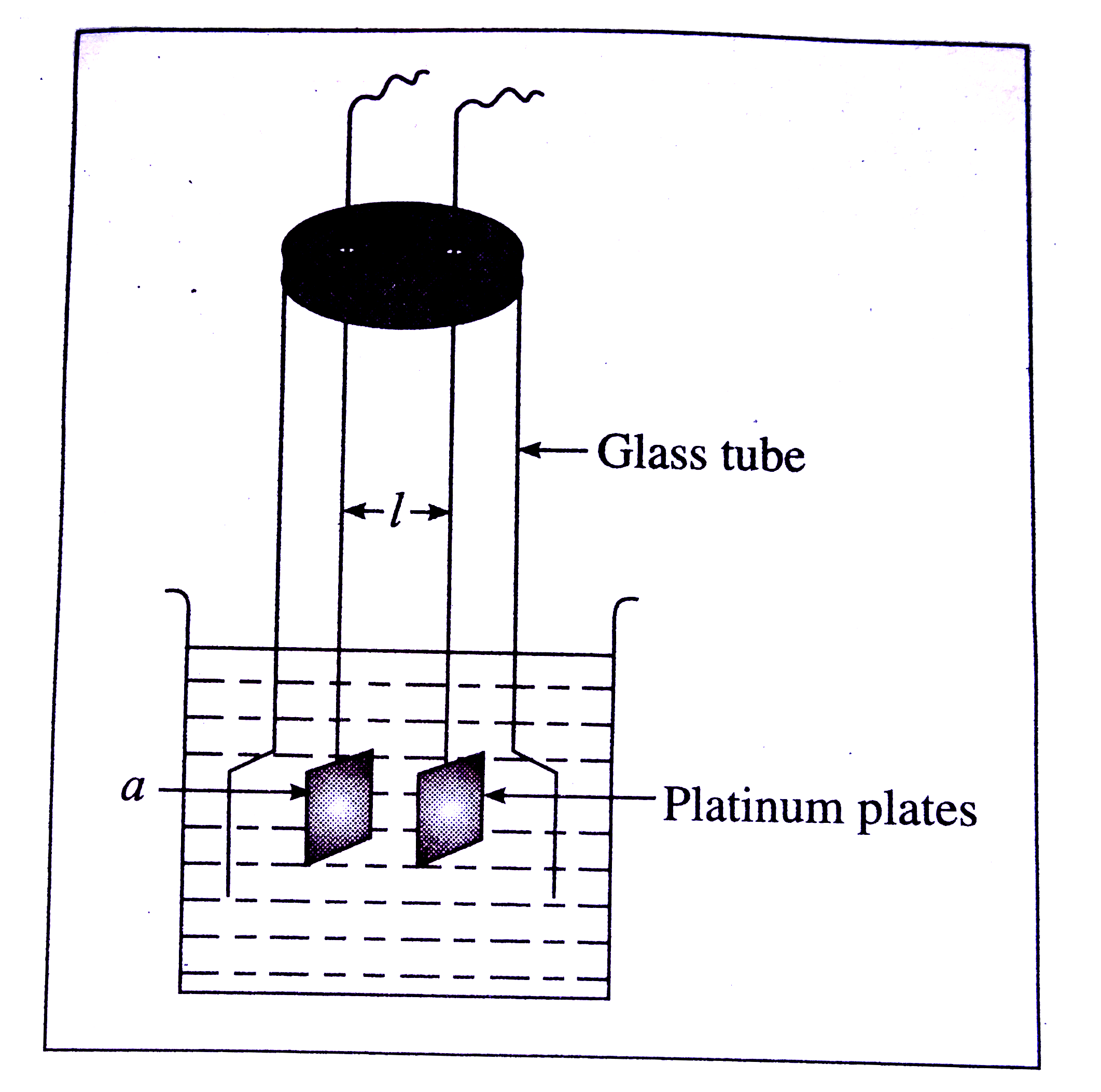
|
|
| 13. |
Conductanceof 0.1 MKCl (condiuctivity = X ohm^(-1)cm^(-1)) filled in a condictivity cell is Y ohm^(-1). If the conductance of 0.1 Mno OH filled in the csamecell is Z ohm^(-1), them olar conductance of NaOH will be |
|
Answer» `10^(3) (XZ)/(Y)` `therefore` Cell CONSTANT `=X/Y` Conductivity of `NAOH = X/Y.Z` `Delta M (NaOH) = X/Y . Z xx (1000)/(0.1) =(XZ)/(Y) 10^(4)` |
|
| 14. |
Conductance(G)conductivity(K)and molar conductivityLambda_mare terms used in electrolytic conduction.Write any two factors on which conductivity depends on . |
| Answer» SOLUTION :TEMPERATURE,CONCENTRATION of ELECTROLYTE | |
| 15. |
Conductance of electrolytic solution can be measured with the help of Wheatstone bridge. |
|
Answer» |
|
| 16. |
Conductance(G)conductivity(K)and molar conductivityLambda_mare terms used in electrolytic conduction.How do conductivity and molar conductivity vary with concentration of electrolytic solution? |
|
Answer» SOLUTION :Conductivity(K)of an electrolyte DECREASE in concentration of ELECTROLYTIC solution. Molar conductivity `(^^)`of an electrolyte INCREASES with decreases in concentration of electrolytic solution. |
|
| 17. |
Conductance of an electrolytic solution depends : |
|
Answer» NATURE of electrolyte |
|
| 18. |
Conductance of a solution of a strong electrolyte is measure of its |
|
Answer» POTENTIAL difference |
|
| 19. |
Conductance is directly proportional to area of the vessel and the concentration of solution in itand is inversly proportional to the length of the vessel, then the unit of the constant of proportionality is |
|
Answer» `S. m " MOL"^(-1)` |
|
| 20. |
Conducitivity of 2.5 xx 10^(-4) M methonic acid is 5.25 xx 10^(-5) S cm^(-1). Calculate the molar conductivity and degree of dissociation. Given: lambda^(@) (H^(+)) = 349.5 S cm^(2) mol^(-1) and lambda^(@) (HCOO^(-)) = 50.5 S cm^(2) mol^(-1) |
|
Answer» SOLUTION :`Lambda_(HCOOH)^(@)= Lambda_(H^(+))^(@) + Lambda_(HCOO^(-))^(@) =349.5 + 50.5 = 400 S cm^(2) mol^(-1)` `Lambda_(HCOOH) = K xx 1000 cm^(3) L^(-1) "MOLARITY"^(-1)` `=(5.25 xx 10^(-5) S cm^(-1) xx 1000 cm^(3) L^(-1))/(2.5 xx 10^(-4)"mol" L^(-1))= 210 S cm^(2) mol^(-1)` Degree of DISSOCIATION `(ALPHA) = Lambda_(m)/Lambda_(,)^(@) = 210/400 = 0.525` or `52.5%` |
|
| 21. |
Condsider the following combination of atomic orbitals : combinding orbitals (internuclear axis ) Combindig orbitals (internuclear axis). (i) s+p_(x)(x)(ii)d_(xy)+d_(xy)(x)(iii)d_(xy)+P_(x)(z)(iv)s+s(z)(v)d_(yz)+d_(yz)(x)(vi)p_(x)+p_(x)(z)(vii)d_(z^(2))+d_(z^(2))(z)(viii)d_(xy)+d_(xy)(z)(ix)p_(x)+p_(x)(y)(x)s+p_(z)(x) Then calculate value of a^(2)+b^(2)+2cd. (where a=sigma M.O.,b=pi M.O. , C=delta M.O., d=non-bonding M.O.) |
|
Answer» |
|
| 22. |
Condsider the following combination of atomic orbitals : combinding orbitals (internuclear axis ) Combindig orbitals (internuclear axis). (i) s+p_(x)(x)(ii)d_(xy)+d_(xy)(x)(iii)d_(xy)+P_(x)(z)(iv)s+s(z)(v)d_(yz)+d_(yz)(x)(vi)p_(x)+p_(x)(z)(vii)d_(z^(2))+d_(z^(2))(z)(viii)d_(xy)+d_(xy)(z)(ix)p_(x)+p_(x)(y)(x)s+p_(z)(x) Then calculate value of "a^(2)+b^(2)+2cs". (where a=sigma M.O.,b=pi M.O. , C=delta M.O., d=non-bonding M.O.) |
|
Answer» |
|
| 23. |
Conducitivity kappa, is equal to____ |
|
Answer» `(1)/(R)(l)/(A)` As `(1)/(A)=G^(@)` (cell constant), `kappa(1)/(R)G^(@)=(G^(**))/(R)` , i.e., (B)`. |
|
| 24. |
Conditions of standard state used in thermochemistry is |
|
Answer» `0^(@)C` and 1atm |
|
| 25. |
Condition for maximum yield of C_2H_5Cl is |
|
Answer» `C_2H_6"(excess)"+Cl_2overset"UV light"to ` |
|
| 26. |
Conditions for the formation of NH_(3) in Haber's process are |
|
Answer» HIGH temperature, low PRESSURE |
|
| 27. |
Condisder the followingreactionsat 1100^(@)C (i)2C+O_(2) rarr 2CO, triangle G^(@)=-460 kJ mol^(-1) (ii) 2Zn+O_(2) rarr 2 Zno, triangle G^(@)=-360 kj mol^(-1) Basedon the observation selectthe correct alternate |
|
Answer» zinccan beoxidised by co Hencethisis sponstaneous REACTION |
|
| 28. |
Condensation product of the benzaldehyde and acetophenone in alkaline medium at 293 K is |
|
Answer» `C_(6)H_(5)-CH_(2)-CO-CH_(2)-C_(6)H_(5)` |
|
| 29. |
Condensation polymers are formed from monomers |
|
Answer» which have bifunctional groups `nNH_(2)(CH_(2))_(6)NH_(2)+n(CH_(2))_(4)(COOH)_(2)to(--underset("Nylon-66")(NH(CH_(2))_(6))NHCO(CH_(2))_(4)CO--)_(n)+nH_(2)O` |
|
| 30. |
Condensation polymer. |
| Answer» Solution :The polymers formed by the repeated condensation REACTION betweem TWO bifunctional or trifunctional monomer UNITS whichresults in ELIMINATION of small molecules like water or alcohol are CALLED condensation polymers. Example : Nylon - 6,6. | |
| 31. |
Condensation of ethyl amine with acctaldehyde gives a compound A which upon reduction with hydrogen and nickel gives |
|
Answer» diethyl amine `CH_(3)CH_(2)N=CHCH_(3)OVERSET(H_(2)//Ni)(rarr)CH_(3)CH_(2)underset("Diethylamine")(-NH-CH_(2))CH_(3)` |
|
| 32. |
Condensation of secondarynitroalkanewith aldehyde procedsvia ____ ion |
| Answer» SOLUTION :CARBANION FORMATION | |
| 33. |
Condensation of acetone in conc. H_(2)SO_(4) and trimerisation of propyen by passing through hot copper tube give same compound X. The compound X is |
|
Answer» Phorone 
|
|
| 34. |
Condensation of caprolactam gives: |
|
Answer» Nylon-6,6 |
|
| 35. |
Condensation homopolymers among the following are : SBR , polyester , bakelite , nylon 6 , PVC , starch , nylon 6,6 glyptal , natural rubber. |
|
Answer» |
|
| 36. |
Concrete is a mixture of: |
|
Answer» Cement, lime and water |
|
| 37. |
Concider the following statements, (I) As the oxidation number of a metal increases, ionic character decreases. |
|
Answer» I,II,III and IV |
|
| 38. |
Conc.HNO_3can be stored in container of : |
|
Answer» Cu |
|
| 39. |
Conc.HCl reacts rapidly with : |
|
Answer» `CH_3CH_2OH` |
|
| 40. |
Concentration terms such as mass percentage, ppm, mole fraction and molality are independent of temperature, however molarity is a function of temperature. Explain. |
| Answer» SOLUTION : Molarity of a solution is defined as the number of moles of solute dissolved in one LITRE of solution. SINCE volume depends on temperature and UNDERGOES a change with change in temperature, the molarity will change with change in temperature. On the other hand, mass does not change with change in temperature. Mass percentage ppm, MOLE fraction and molality involve only mass and remain unchanged by changing temperature. | |
| 41. |
Concentration terms such as mass percentage, ppm mole fraction and molality are independent of temperature, however molarity is a function of temperature. Explain. |
| Answer» Solution :Molarity of a solution is a weight by VOLUME relationship to represent its strength and defined as .the number of moles of solute dissolved in one litre of solution.. Since volume depends on temperature and undergoes a change with change in temperature, the molarity will also change with change in temperature. On the other hand, the other concentration terms such as mass percentage, oom, mole fraction and molality are based upon mass by mass relationship of solute and SOLVENT present in a binary solution. Mass does not change with change in temeprature, as a result these concentration terms remain UNCHANGED with variation of temperature. According to the DEFINITION of all these terms, mass of the solvent used for making the solution is related to the mass of solute. | |
| 42. |
{:("Concentration process","Name of process"),("A) Hydrogen on finely","1) Physisorption"),("divided palladium","2) Chemisorption"),("B) Hydrogen on nickel","3) Occlusion"),("C) Hydrogen on charcoal","4) Desorption"):} The correct match is |
|
Answer» `{:(A,B,C),(1,2,3):}` |
|
| 44. |
…….concentration phenol solution acts as antiseptic. |
| Answer» SOLUTION :`0.2%` | |
| 45. |
Concentration of the reactant in first order is reduced to (1)/(e^(2)) after |
|
Answer» ONE NATURAL LIFE TIME |
|
| 46. |
Concentration of the ore is done : |
|
Answer» To MAKE the ore porus |
|
| 47. |
Concentration of the Ag^+ions in a saturated solution of Ag_2 C_2 O_4 is 2.24xx10^-4 mol L^-1 solubility product of Ag_2 C_2 O_4 is |
|
Answer» `2.42xx10^-8 mol^3 L^-3` |
|
| 48. |
Concentration of the Ag^(+) ions in a saturaed solution of Ag_(2)C_(2)O_(4) is 2.2 xx 10^(-4) mol L^(-1). Solubility product of Ag_(2)C_(2)O_(4) is : |
|
Answer» `2.66 xx 10^(-12)` `2.2 xx 10^(-4)M 1.1 xx 10^(-4) M` `K_(SP) = [Ag^(+)]^(2)[C_(2)O_(4)^(2-)]` `= [2.2 xx 10^(-4)]^(2).[1.1 xx 10^(-4)]` `K_(sp) = 5.3 xx 10^(-12)`. |
|
| 49. |
Concentration of the Ag^+ ion in a saturated solution of Ag_2C_2O_4 is 2.24 times 10^-4 mol L^-1 solubility product of Ag_2C_2O_4 is |
|
Answer» `2.42 TIMES 10^-8 MOL^3 L^-3` `Ag_2C_2O_4leftrightarrow2Ag^++C_2O_4^(2-)` `[C_2O_4^(2-)]=(2.24 times 10^-4)/2MOL L^-1` `=1.12 times 10^-4 mol L^-1` `K_(SP)=[Ag^+]^2[C_2O_4^(2-)]` `=(2.24 times 10^-4 mol L^-1)^2 (1.12 times 10^-4 mol L^-1)` `=5.619 times 10^-12 mol^3 L^-3` |
|
| 50. |
Concentration of SO_(4)^(2-) ions in a solution prepared by mixing 100 ml 0.1 M BaCl_(2) and 400 ml 0.2 M Na_(2)SO_(4). |
|
Answer» `(8)/(50)M` `{:(Na_(2)SO_(4),rarr,2Na^(+),+,SO_(4)^(2-),),(0.07 "mole",,-,,-,),(-,,0.14 "mole",,0.07 "mole",):}` `[SO_(4)^(2-)] = (n_(SO_(4)^(2-)))/(V_(1) + V_(2)) = (0.07)/(0.5) = (7)/(50) M` |
|