

Saved Bookmarks
This section includes 7 InterviewSolutions, each offering curated multiple-choice questions to sharpen your Current Affairs knowledge and support exam preparation. Choose a topic below to get started.
| 1. |
Carbohydrates containing more than 10 simple units of sugar are called : |
|
Answer» Monosaccharides |
|
| 2. |
Carbohydrates containing an aldehydic group are called ................and those containing a keto group any other chiral carbon of the carbohydrate molecule. |
| Answer» SOLUTION :ALDOSES, KETOSES | |
| 3. |
Carbohydrates are stored in the body as |
|
Answer» sugar |
|
| 4. |
Carbohydrates are used by body mainly |
|
Answer» for OBTAINING vitamins |
|
| 5. |
Carbohydrates are represented by the general formula |
|
Answer» `C_x H_(2X) O_(2x+2)` |
|
| 7. |
Carbohydrates are polyhydroxy aldehydes or ketones or substances which generally give these upon hydrolysis. These have been classified as mono, oligo or polysaccharides. These are all optically active since they contain number of chiral carbon atoms in their molecules. Further, the carbohydrates may be either reducing or non-reducing in nature. In disaccharides and polysaccharides, the monosaccharides are linked to each other by Glycosidic linkages. Which of the following given the same osazone ? |
|
Answer» GLUCOSE, Fructose |
|
| 8. |
Carbohydrates are essential for life in both plants and animals. Name the carbohydrates that are used as storage molecules in plants and animals, also name the carbohydrates which is present in wood or in the fibre of cotton clothes. |
| Answer» SOLUTION :CARBOHYDRATES are stored in animal body as GLYCOGEN. It is also KNOWN as animal starch. In plants, the carbohydrates are stored in starch. In wood or in the fibre of cotton clothes, cellulose is used. | |
| 9. |
Carbohydrates are classified on the basis of their behaviour on hydrolysis and also as reducing or non-reducing sugar. Sucrose is a ………… |
|
Answer» Monosaccharide The anomeric CARBON of glucose and fructose UNITS in sucrose are ENGAGED in GLYCOSIDIC linkage. So, it is a non-reducing sugar. |
|
| 10. |
Carbohydrates are classified on the basis of their behaviour on hydrolysis and also as reducing or non -reducing sugar. Sucrose is a ............. |
|
Answer» MONOSACCHARIDE |
|
| 11. |
Carbohydrates are classified into three major classes : monosaccharide, oligosaccharide and polysaccharides. What is inverted sugar ? |
| Answer» SOLUTION :An equimolecular mixture of D (+) glucose and D (-) FRUCTOSE obtained by the hydrolysis SUCROSE is called inverted sugar. | |
| 12. |
Carbohydrates are essential for life in both plants and animals. Name the carbohydrates that are used as storage molecules in plants and animals, also name the carbohydrate which is present in wood or in the fibre of cotton cloth. |
| Answer» Solution :Carbohydrates used as storage MOLECULE in plants in starch and in animals, it is glycogen. Cellulose is PRESENT in wood or in the FIBRE of cotton CLOTH. | |
| 13. |
Carbohydrates are classified into three major classes : monosaccharide, oligosaccharide and polysaccharides. Give two examples of polysaccharide. |
| Answer» SOLUTION :STARCH , CELLULOSE | |
| 14. |
Carbohydrates are classified into monosaccharides,oligosaccharides and polysaccharides. Give an example of an oligosaccharide? |
| Answer» SOLUTION :MONOSACCHARIDE- GLUCOSE, Oligosaccharide-Sucrose | |
| 15. |
Carbohydrates are classified into three major classes : monosaccharide, oligosaccharide and polysaccharides. What are polysaccharide ? |
| Answer» SOLUTION :Carbohydrates which give a LARGE number of monosaccharide UNITS on hydrolysis are called polysaccharide | |
| 16. |
Carbohydrates are classified into monosaccharide, oligosaccharides and polysaccharides. What is the basic of such classification ? |
| Answer» Solution :This CLASSIFICATION of carbohydrates is BASED on their HYDROLYSIS. If the CARBOHYDRATE cannot behydrolysed into simpler unit, they are CALLED monosaccharide. Carbohydrates that give 2-10 monosaccharide units on hydrolysis are called oligosaccharides. Carbohydrates that give many molecules of monosaccharide units on hydrolysis are called polysaccharides | |
| 17. |
Carbohydrates are stored in the body as : |
|
Answer» HYDRATES of carbon |
|
| 18. |
Carbohydrates are commonly found as starch in plant storage organ . Which of the following five properties of starch (i-v) make it useful as a storage material ? (i) easily translocated(ii) chemically non-reactive(iii)easily digested by animals(iv) osmotically inactive(v) synthesized during photosynthesis The useful properties-are: |
|
Answer» HYDRATES of carbon |
|
| 19. |
Carbohydrates are |
|
Answer» POLYHYDROXY ALDEHYDES |
|
| 20. |
Carbohydrates. |
|
Answer» Solution :Carbohydrates are essential for life in both plants and ANIMALS. (2) They are the important constituent of supporting TISSUES in plants e.g. cellulose found in wood, cotton etc. (3) They form a major part of our food and store chemical energy in plants. (4) They act as the major SOURCE of energy for animals and human BEINGS. (5) Animals store glucose in the form of glycogen which is main source of energy. (6) Carbohydrates satisfy the three basic needs, food, clothes and shelter. |
|
| 21. |
Carbohydrate is treated with alpha-naphthol and conc. H_(2)SO_(4) colour developed at the junction of the two liquids is |
|
Answer» Blue |
|
| 22. |
Carbohydrate contains |
|
Answer» -OH gp |
|
| 23. |
Carbogen is |
|
Answer» PURE FORM of carbon |
|
| 24. |
Carbocation which is most stable |
|
Answer» `CH_(3)CH_(2)^(+)` |
|
| 25. |
Carbocation as an intermediate is likely to be formed in the reaction : |
|
Answer» Propene`+Cl_(2) overset(hv) rarr`2- chloropropane This involves the formation of carbocation as an intermediate. |
|
| 26. |
Carbinol is the trivial name for : |
|
Answer» `(CH_3)_3COH` |
|
| 27. |
Carbinol is the trivial name for: |
|
Answer» `C_2H_5OH` |
|
| 28. |
Carbinol is |
|
Answer» `C_(2)H_(5)OH` |
|
| 29. |
Carbenes are the reactive intermediates in: |
|
Answer» Carbyamine reaction |
|
| 30. |
Carbide, which react with water to give propyne is |
|
Answer» `CaC_2` |
|
| 31. |
Carbanions initiate: |
|
Answer» ADDITION reactions |
|
| 32. |
Carbanion contains _______ electrons in valence shell |
|
Answer» six |
|
| 35. |
Carafully observe the given diagrams which indicates standard enthalpy of formation of different states of one mole Mg and 2 mole Cl atom and match the entries in column I and II provided. |
|
Answer» `DeltaH=2360-[1110+790]` `=460" kJ/mole"` (B) `Cl_(2)(g) rarr 2Cl (g) rarr 2Cl^(-) (aq)` For TWO `CL^(-) (aq) DeltaH=240-1490=-1250` For `Cl^(-) (aq)=-1250/2 =-625" kJ/mole"` (C) `Mg^(+2)(g) rarr Mg^(+2) (aq)` `DeltaH=-790-1110=-1900" kJ/mole"` (D) `MgCl_(2) rarr Mg^(+2) +2Cl^(-) (g)` `Delta=2510" kJ/mole"` |
|
| 37. |
Caprolactum is used for manufacturing |
|
Answer» Bakelite |
|
| 38. |
Caprolactum is a monomer of Nylon - 6 . It can be obtained from : |
| Answer» Answer :A | |
| 39. |
Caprolactum is a monomer of |
|
Answer» GLYPTAL |
|
| 40. |
Caprolactum can be obtained from: |
|
Answer» Benzaldehyde |
|
| 41. |
Caprolactam polymerises to give |
|
Answer» terylene |
|
| 42. |
Caprolactam polymcriscs to give |
|
Answer» terylene |
|
| 44. |
Caprolactam on reduction with LAH or H_(2)+Pt or Pd gives: |
|
Answer» a.`4`-Amino butan-`1-ol` 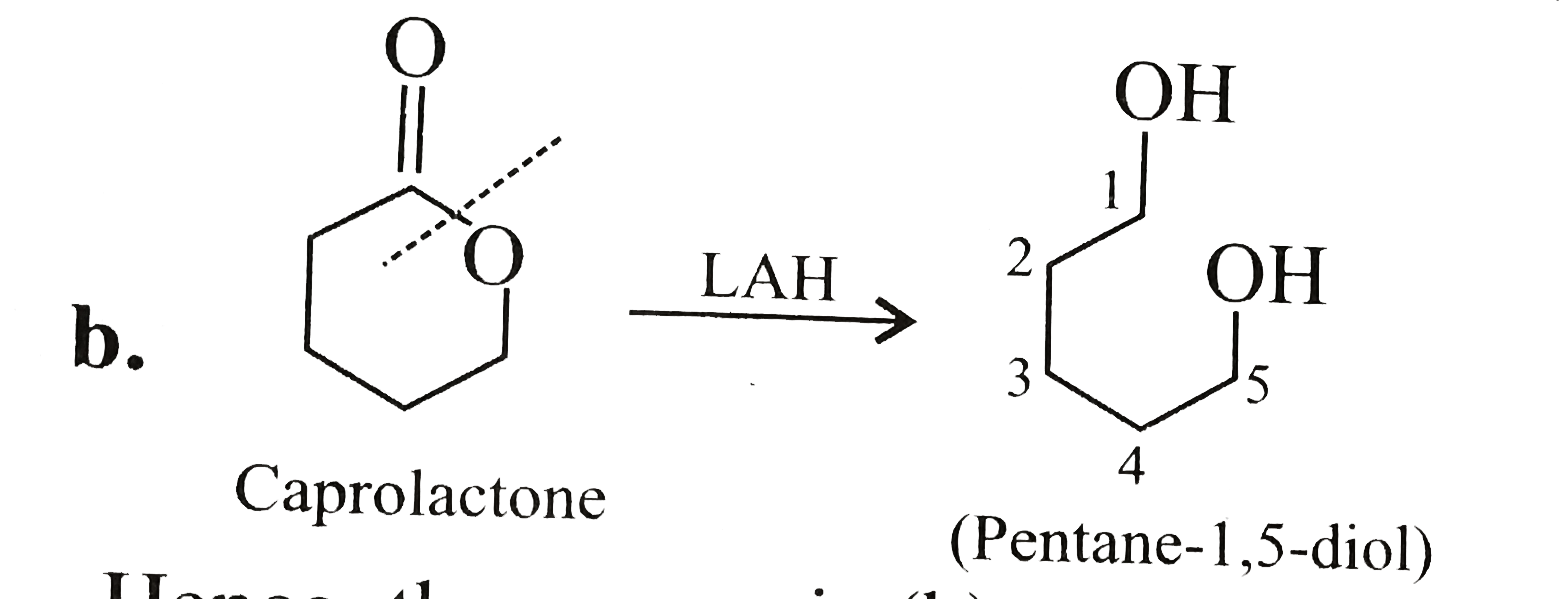 HENCE, the ANSWER is `(b)`. |
|
| 45. |
Caprolactam is used for the manufacture of : |
|
Answer» Terylene 
|
|
| 46. |
Capacity of fuel cell is. . . . . |
|
Answer» `(DELTAG)/(DELTAS)` |
|
| 47. |
Ca(OH)_(2)+H_(3)PO_(4) rarr CaHPO_(4)+2H_(2)O the equivalent weight of H_(3)PO_(4) in the above reaction is |
|
Answer» 21 `:'` MOLE wt of `H_(3)PO_(4)=3+31+64=98` `:. 98/2=49` |
|
| 48. |
CaOCL_2+H_2OrarrCa(OH)_2+XX+CH_3CHOrarrYY+Ca(OH)_2rarrCHCL_3What is 'Y'? |
|
Answer» `CH_(3)CH(OH)_(2)` |
|
| 49. |
CaOCI_(2) +H_(2)O to Ca(OH)_(2) +X X +CH_(3)CHO to Y Y +Ca(OH)_(2) to CHCH_(3) what is 'Y' ? |
|
Answer» `CH_(3)CH(OH)_(2)` |
|
| 50. |
CaO does not react with |
|
Answer» `SiO_2` |
|
